
Books
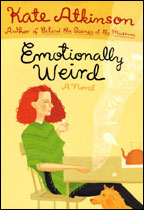
“Emotionally Weird” by Kate Atkinson
Stories proliferate in a giddy, madcap novel crammed with stoner students, crazy professors and long-kept family secrets.
It takes a careful writer to create carefree comedy, to balance the absurd and the believable, the earnest and the inane, so that the loopiness that farce demands never seems merely random. Kate Atkinson — whose debut, “Behind the Scenes at the Museum,” won Britain’s Whitbread Prize five years ago — writes with energetic intelligence, but her sense of balance often goes awry. Her third novel, “Emotionally Weird,” boasts a vivid atmosphere and some very funny business, but it’s successful neither as screwball comedy nor as a serious novel about its heroine’s quest for identity. There’s almost certainly a delightful story buried here somewhere, but it may demand more indulgence than even the most optimistic reader is likely to give it.
In the novel’s framing story, 21-year-old Effie is sharing a storm-swept house on a barren Scottish island with her mother, Nora. They endure their isolation by telling stories from their lives. Effie’s understandably curious to know where she came from — she knows no father and Nora claims to be a virgin. Nora’s tale clears up the mystery, but not until the end of the book, and in the interim Effie does nearly all the talking.
It’s 1972, and Effie has been idling her way through a university literature program in sleepy Dundee, Scotland. Her pothead boyfriend, Bob, is far more passionate about “Star Trek” than about her, and most of her classmates are as drifty and lackadaisical as she is. Effie, several fellow students and a few of the professors are working on predictably rotten creative writing projects, from which Atkinson quotes frequently in an annoying array of typefaces. The class lectures consist of comically impenetrable lit-theory jargon. Since she’s not doing much schoolwork, Effie careens around Dundee in the company of testy commune dwellers, stoners, muddle-headed malcontents, the hilariously dotty English department head, a pair of crones on the lam from the old folks home and a seedy, mysterious private investigator who keeps turning up out of nowhere and shanghaiing her into assisting him on evidently pointless stakeouts.
Atkinson is best at crowded scenes full of giddy, Orton-esque confusion, and her descriptions can be startlingly lovely, as when the wind grabs a pile of manuscript pages: “I jumped up and chased around the room after them and managed to retrieve all but one, which floated serenely out of the window like a birdless wing.” But so many characters surround Effie that even Nora interrupts her to complain, which brings up the novel’s biggest problem: The postmodern devices Atkinson uses seem tacked on in an attempt to rouse our curiosity when Effie’s story drags. Nora relates snippets of her past, and the information she gives is then incorporated into the story Effie’s telling. At one point Effie describes the extravagant death of a professor, then immediately magic-realisms him back to life; a bit later, another character commits suicide and Nora objects, so Effie revises her narrative to save the girl.
Charitably, one could say that the novel’s theme is the tricky nature of storytelling — the intertwining of truth and fiction, untrustworthy memories and deliberate lies, mystery and obscurantism, in literature and in life. But if Effie is making up her story as she goes along, then it’s hard to care about what happens to her; we’re reading only for the jokes, and the amusement is just too repetitious and too often strained for this to work.
“Emotionally Weird” fairly howls for an editorial scalpel. When Bob utters Trekisms like “Beam me up, Scottie,” and the hoary maxim “Just because you’re paranoid doesn’t mean they’re not out to get you” is repeated half a dozen times; it may be an accurate representation of student humor circa 1972, but Atkinson expects us to still be amused. The plot is so full of digressions and red herrings that by the time it resolves itself, you’re too weary to care what makes sense and what doesn’t. The novel displays a mischievous imagination and suggests a real talent for composing on a large canvas. But it feels, in the end, both packed and empty, overthought and underwrought.
Greg Villepique plays guitar in the band Aerial Love Feed. More Greg Villepique.
“People Who Eat Darkness”: The disappearing blonde
A true crime story set in Tokyo illuminates the complicated truths behind media cliches
Joji Obara and Lucie Blackman (Credit: Estate of Lucie Jane Blackman) Lucie Blackman, 21, went out for the afternoon in 2000, phoning her roommate and best friend Louise to arrange a meeting later that night. Lucie never showed up, and within a few days she’d become one of those vanished blondes whose fates fuel headlines and hours of speculative media coverage. She was British, a former flight attendant, and she and Louise were living in Tokyo. They were also bar hostesses, a profession with a very specific meaning in Japan, difficult to explain to foreigners and not entirely clear to the Japanese themselves. Lucie both did and didn’t match the classic Missing Blonde profile, and for a while the mystery of what happened to her threatened to lapse into permanent obscurity.
Continue Reading Close
Laura Miller is a senior writer for Salon. She is the author of "The Magician's Book: A Skeptic's Adventures in Narnia" and has a Web site, magiciansbook.com. More Laura Miller.
Corporate criminals gone wild
The maker of the documentary film "Inside Job" has a new book excoriating Wall Street -- and President Obama
A detail from the cover of "Predator Nation" “Inside Job,” Charles Ferguson’s Oscar-winning documentary film on how government, Wall Street and academia colluded to deliver us the worst financial crisis since the Great Depression, made a powerful case that something was very very rotten at the heart of the American political/economic nexus. His follow-up book, “Predator Nation: Corporate Criminals, Political Corruption, and the Hijacking of America,” can be considered the legal brief that dots every “i” and crosses every “t” in his argument. A tightly argued, profusely footnoted and deeply enraged castigation of everyone involved, “Predator Nation” isn’t just a factually unchallengeable account of how Wall Street blew up the global economy. It’s a denunciation, a call for justice and a warning: After getting away with the crime of the century, Wall Street still isn’t satisfied.
Continue Reading Close
Andrew Leonard is a staff writer at Salon. On Twitter, @koxinga21. More Andrew Leonard.
Can you identify?
Science shows that the only way around some readers' prejudices is to trick them
(Credit: Shutterstock/Salon) The news of recent research documenting how readers identify with the main characters in stories has mostly been taken as confirmation of the value of literary role models. Lisa Libby, an assistant professor at Ohio State University and co-author of a study published in the Journal of Personality and Social Psychology, explained that subjects who read a short story in which the protagonist overcomes obstacles in order to vote were more likely to vote themselves several days later.
The suggestibility of readers isn’t news. Johann Wolfgang von Goethe’s novel of a sensitive young man destroyed by unrequited love, “The Sorrows of Young Werther,” inspired a rash of suicides by would-be Werthers in the late 1700s. Jack Kerouac has launched a thousand road trips. Still, this is part of science’s job: Running empirical tests on common knowledge — if for no other reason than because common knowledge (and common sense) is often wrong.
Continue Reading Close
Laura Miller is a senior writer for Salon. She is the author of "The Magician's Book: A Skeptic's Adventures in Narnia" and has a Web site, magiciansbook.com. More Laura Miller.
“The Aleppo Codex”: The bizarre history of a precious book
A reporter traces the shadowy fate of the definitive version of the Hebrew Bible
Matti Friedman An ancient and priceless book, a murky history of evasions and coverups, an underground of sinister and possibly violent dealers, a former spy who drops tantalizing hints and a wily 84-year-old millionaire who says stuff like, “The problem with this story is that it could damage your health”: Are these the ingredients for a cheesy, improbable historical thriller? Yet “The Aleppo Codex,” Matti Friedman’s account of his attempts to learn the history of one of the world’s most precious books, sports all of these assets, and it’s nonfiction. If reporting this story damaged Friedman’s health, it probably happened when he realized what he’d stumbled into and his reporter’s heart started beating in doubletime.
Continue Reading Close
Laura Miller is a senior writer for Salon. She is the author of "The Magician's Book: A Skeptic's Adventures in Narnia" and has a Web site, magiciansbook.com. More Laura Miller.
Augusten Burroughs: Conquer trauma by letting it go
Salon exclusive: The best-selling memoirist says past horrors haunt us because we think about them too much. Stop
Augusten Burroughs Many people continue to feel influenced and even controlled by the things that happened to them a long time ago. Sometimes, people harbor dark, traumatic memories from childhood. Or fragments of memories — incomplete scenes, uncomfortable feelings, perhaps even a sense of certainty that something specific and terrible happened to them, but little more than this.
Others experienced something traumatic in adulthood that continues to affect them day to day many years later. Maybe an assault has left a person afraid to leave their home or enter a particular neighborhood.
Continue Reading CloseAugusten Burroughs' many books include "Runnning With Scissors," "Dry," "Sellevision," "Magical Thinking" and "Possible Side Effects." His latest book is "This Is How." More Augusten Burroughs.
Page 1 of 984 in Books