
Wendy M. Grossman

Britain’s first software billionaire

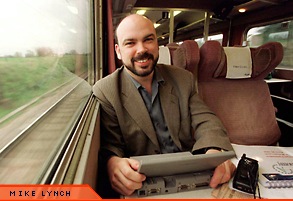
At Autonomy, Mike Lynch creates programs that act like people do, analyzing words and extracting ideas.

Mike Lynch is Britain’s first software billionaire. After years of hype about “Silicon Fen,” the high-tech concentration growing up in and around Cambridge, England, it finally happened: We got a multibillion-dollar company.

Lynch is founder and CEO of Autonomy, a maker of software that ties together all kinds of unstructured information — what’s now known as knowledge management. The term wasn’t in heavy use back in 1991, when Lynch borrowed 2,000 pounds (about $3,000) from an English pop promoter in a pub to start his first company, Cambridge Neurodynamics, from which Autonomy spun off in 1996. Lynch still sits on Neurodynamics’ board, but he believes there is more scope in Autonomy, whose software and techniques he expects to be everywhere in a couple of years.

In a corporate context, you might use Autonomy’s software to display links to material in the corporate archives that’s relevant to a memo you’re writing. On the Web, it might display links to news stories related to the ones you’re reading.

Both companies are built upon the statistical principles derived by Thomas Bayes, an 18th century Presbyterian minister and mathematician whose formulations underlie the pattern-recognition algorithms that help computers behave more like humans, enabling them to recognize context and understand connections. Bayes’ ideas on statistical models might never have been heard of had he not left his papers and 100 pounds to his friend and fellow clergyman Richard Price. Price published his late friend’s “An Essay Towards Solving a Problem in the Doctrine of Chance,” and promoted it by saying it proved the existence of God. In a computer context, however, Bayes’ theorem pulls many probabilities together, enabling the computer to pick an answer out of multiple, often conflicting, pieces of information.

I have to ask because every mathematician I knew when I was briefly a math major worshipped him — were you a fan of Martin Gardner’s mathematical games column in Scientific American?

To be honest, no. But I came from an engineering background to math, and so it was very much driven by “What do I need to solve the problem?” rather than by delight in pure mathematics. But then, I would say that the area that I work in is pure philosophy anyway, because my area of research — though I don’t get to do pure research anymore, only what I think of as applied research — is perception. Perception is very interesting because if you understand Bayes, if you start to think about it, you can see why Bayes is taught in philosophy classes these days.

I thought you were going to say he was taught in business schools.

Well, he ought to be, yes — but keep that a secret.

So: perception.

If you understand that the world exists only as you perceive it, that is actually only a cup in any sense because you perceive it as a cup. Otherwise, it’s a set of light rays coming off an object, or it’s a set of electrical impulses between synapses in the brain, or it’s a set of spinning electrons. We’ve been very obsessed with what people call materialism.

Physics was the great subject of the 20th century — how the world is, out there. But many of the more interesting questions aren’t about how the world is out there, or whether it is out there even, but how people perceive it, so you get the whole problem of pattern recognition or perception. Mental illness becomes fascinating from this viewpoint.

That’s where you come down to consensus reality.

Yes, but the whole point about perception is that it’s an artificial construction, because to the person who’s part of an alternative reality, it’s their reality; the fact that you’re telling them you see something different is irrelevant. The other thing is — take one of those computer screens. We could create random patterns on there, and of those a tiny, tiny subset would be perceived by us as representing something in the real world. So if you start looking at perception from a mathematical point of view, you have this massive dimensionality of possibilities, and the world we exist in is only a very small part of it.

Did you read much science fiction as a kid?

Relatively little, actually — more literature. One of the wonderful things about the English school system is I ended up doing ancient Greek and things like that. You could have this same conversation in terms of the Greek philosophers as in terms of computer science and mathematics. They were rather forward looking. But coming back to the point, perception is a lot more powerful subject than people think, because you can argue that in terms of our view of the universe — or my view of the universe — perception can be more powerful than physics can be.

Does this mean you should start experimenting with different kinds of drugs?

That’s a very interesting question — which I’m not going to answer as the CEO of a public company! But you read fascinating accounts from people who [experimented with drugs] from a scientific point of view in the 1960s. They’re especially interesting, as are dreams, if you know about the mathematics of pattern recognition. Another thing I find very interesting is near-death experiences, from a point of view of pattern recognition.

You’re frequently quoted as saying you want Autonomy to become “the Oracle of unstructured data.”

The problem we address is completely generic. People often just don’t understand the ramifications of that. I don’t think you’re going to be able to sell software in two years’ time that can’t make sense of information, because the amount of unstructured information in business is doubling every three months at the moment.

Of course, Larry Ellison has Bill Gates to compete with, at least in his own mind. But you’re in a class by yourself, aren’t you? There isn’t anybody else in Britain.

There’s a different motivation for me, though I get very annoyed about people that make untrue comments about their technology vs. ours. That’s the kind of thing that gets me, rather than some sort of scoreboard.

And you’re not moving to a tax haven.

I like it too much here. In the country here, they don’t have very many gadgets at all. They have clocks that go “tick.”

It’s a perspective thing. In the village where I live there’s a tower that was built about 900, probably to look for the Vikings coming by sea. In the church there are big slabs commemorating people, and the church stonemason was a bit of a character, so he wrote these epigraphs with implications, like “having risked the marriage bed a second time,” or “never one to be silent in his views,” and you read them and think, “Yes, people lived here.” And both their lives were different and their lives were the same.

I went to see Molihre for the first time a year ago, and I was stunned; the intrigue, backbiting and politics could have been straight out of today.

Like Bayes, Austen, Shakespeare … these greats who are all having an impact now. I always think it’s sad that people don’t get to find out what impact they had on the world. You sort of wish you could wake Bayes up for five minutes and say, “You won’t believe this, but …”

He’s actually buried not far from William Blake. They could have a pretty interesting discussion if they woke up for five minutes.

But it sort of underlines an insidious arrogance about our age, that we know more and are more intelligent than our predecessors. If you talk to my 25-year-olds down there, they’ve grown up with this endemic idea that we are somehow brighter than our forefathers were. I actually got knocked out of that by a very strange example, a model steam engine, of all things.

When people were apprentices they used to have to build a masterwork replica of a full-size steam locomotive. To make one of these things you have to find out how a steam engine works. And the problem is, there is high pressure in the boiler, and you’re heating water and turning it into steam, and very quickly you run out of water. So you have to get the water back in against the highest pressure in the system. There’s a thing called a steam injector, which is a system where you blow steam into a specially shaped cavity, and it creates a thermodynamic shock wave, which instantaneously creates a pressure rise, which will push some water into the boiler. And then you think, this was invented in the 1860s?

What’s your favorite gadget?

My new Philips MP3 player. I’m getting into the whole Napster thing at the moment. And I really love my little Toshiba Libretto.

Why is it that math and music so often go together? You play saxophone.

Contrary to the nerd image, good mathematicians are often good musicians, whereas literature students know nothing about science. Math at a pure research level is like playing jazz.

When I first saw Autonomy’s software in 1996, it was designed to run on individual PCs; it had these cartoon dogs I hated that ran endlessly while it searched for sites relevant to your query. It was unbelievably slow and, after hours of waiting, didn’t come up with sites I didn’t know about.

People either loved or hated the dogs. Those were the early days, when we were taking a client approach. Moving it to the server was when the business took off — the market caught up with us and people started setting up these big news sites. In 1996, it wasn’t clear that the client wouldn’t be where these things would be done. Then the market settled down, and now it’s moving the other way because people are beginning to question why they have to know what a directory or a file is. It should be the computer’s job to remember where I put something, not mine. Less than 5 percent of our business is search. Most of what we do is categorizing and linking. That’s much more interesting, because the more information you give it the more accurate it becomes.

A fair bit of your work is done for the police. In the context of the current debates about the British Regulation of Investigatory Powers bill, do you worry about the privacy consequences of the kind of profiling and traffic analysis your products enable?

It’s a debate that’s sadly a bit sound-bite based at the moment. One of the things we started with at Cambridge Neurodynamics is technology that searches fingerprints. That system has put a series of rapists and serial murderers away, and I don’t lose any sleep at all about that. Technology-based evidence actually makes it very hard to convict someone falsely. As long as a test is done correctly, it’s incredibly powerful.

I’m actually very sympathetic to the other point of view, but the issue is not the technology but the kind of society you want to live in. Having a basically honest government is the issue, not the technology.

Are British bobbies reading your e-mail?

While Americans gnash their teeth about the FBI's Carnivore spying technology, U.K. legislators pass a law that could let cops read your messages.

Americans are used to thinking of Britain as the source from which most of the principles of our democracy flow, a country for which these principles are so innate it doesn’t even need a written Constitution. The reality is increasingly different.

Compare and contrast. On July 14, the Wall Street Journal broke the news that the FBI was using an Internet wiretapping system known as Carnivore to intercept and access e-mail. By July 24, FBI assistant director Donald Kerr was explaining Carnivore to Congress. By Aug. 15, a federal appeals court had ruled, in response to a suit from the Electronic Privacy Information Center and others, that law enforcement officers must get a Fourth Amendment search warrant before they can have access to “packets from which call information has not been stripped.” The ruling, it seems, makes Carnivore illegal. In Britain, on the other hand, on July 28 the Regulation of Investigatory Powers Act (RIP) became law, requiring all Internet service providers to install and maintain interception equipment for the benefit of law enforcement. Yes, agents will have to get a warrant. But that warrant will be issued by the politician at the head of the Home Office (Britain’s equivalent to the Justice Department), not by a judge.

The government mantra is that the new legislation merely updates existing laws for new technology. British law enforcement folk, just like their American counterparts, argue that new technology such as strong encryption hinders their ability to investigate serious crimes, and that therefore they must have guaranteed access to all electronic communications. In the United States, this thinking has led the Clinton administration to push several policies: key escrow, the practice of storing a copy of every user’s decryption key; restrictions on the deployment of strong cryptography through the International Traffic in Arms Regulations; and the Digital Telephony Act, which requires a wiretap-friendly design for telephone networks.

In mid-May, the news broke that the security service MI5 is building a $37 million facility that will have the power to monitor all e-mail sent and received in Britain. Under this scheme, Internet service providers like Freeserve, Demon Internet, America Online and others who serve U.K. customers will be required to hard-wire their systems into the monitoring center. Given that messages are routed across the Internet without regard to geography, and that many Americans and Europeans communicate with people in the United Kingdom, this is more than a matter of British national interest: The e-mail they’ll be reading could be yours.

RIP’s provisions regarding encryption keys slide right into this surveillance scenario. If British law enforcement officers want access to your encrypted data — and in our electronic era that may be anything from your love letters to the details of your last medical exam — they can throw you in jail for up to five years if you can’t or won’t produce the necessary key and can’t produce a good reason why. Under some circumstances, not specified, they can slap a secrecy notice on you, under which you will not be allowed to tell anyone except your lawyer that your e-mail is being decoded. Your innocent, confiding correspondents won’t know. These particular provisions have been watered down a bit from the draft legislation, which reversed the burden of proof so that if you refused to produce your key you could be presumed guilty.

In a way, this is all sadly less surprising than it might be. British subjects’ right to remain silent without self-incrimination — what Americans call taking the Fifth — was done away with in 1994 by the Criminal Justice and Public Order Act, which also included restrictions on the right to peacefully assemble. In addition, the 1996 Criminal Procedures Act significantly altered the regime for the disclosure of evidence. For the first time in English law, defendants are now required to disclose the basis of their defense, while the prosecution is given greater discretion than it had before. The upshot, according to Justice, a lobbying organization, is to place a great deal of discretion in the hands of the police, who may make errors about what is relevant information. According to Justice, this system has been controversial enough that the entire criminal justice system is now under government review.

The theoretical savior in this mix is the European Convention on Human Rights, which comes into effect in October and includes principles such as freedom of speech and the right to privacy. Relying on a court most people in Britain still perceive as foreign, however, isn’t much comfort, especially since it can take five years to get a case to the European Court. Oddly, the British government used the ECHR as a justification for rushing RIP through: The Home Office claimed that some prosecutions would have to be dropped if RIP didn’t get through before October.

You’d think that claim would give it a clue that what it is doing is slowly but surely eating away at the fabric of one of the world’s oldest continuous democracies. In terms of the economic future Tony Blair’s government claims to care about so much — his current mantra is that he wants to make Britain the “best place to do e-commerce” — RIP is even more foolish. A British Chamber of Commerce report, published in mid-June, estimates RIP’s direct cost to ISPs at $964 million, and the overall cost to Britain as businesses relocate overseas at $52 billion over five years.

For Americans, RIP should serve as a warning. Don’t get too comfortable just because Carnivore failed in the courts. The United States and the United Kingdom have traveled in lock step on restricting cryptography and other Net freedoms, and the legislation they try to pass in one place inevitably pops up in the other, though not always in the same form. And they keep trying.

Continue Reading Close

Wireless warrior

Symbian CEO Colly Myers is partial to his electric knife sharpener -- but he's built an operating system that could radically change your phone.

When Nicholas “Colly” Myers talks about Symbian, the company he leads, it’s easy to get into a time warp muddle: The company sounds simultaneously fairly old and brand new. The reason is that although Symbian was only officially formed as a joint venture between Nokia, Ericsson, Motorola and Psion in 1998, its real origins date back to the forming of Psion’s software division in 1981. Psion is a maker of personal digital assistants (PDAs) and modems, and Myers has been with the company since the beginning.

Symbian’s product is a low-power, high-performance operating system called EPOC, originally designed for pocket computers. Eyeing the convergence between computing and mobile telephony, Symbian hopes EPOC will be the system of choice to power computer gadgets of all sizes and types, from smart phones to advanced wireless information devices. Elegant and lean, EPOC is so far primarily known through Psion’s series 5 and 5mx PDAs. Because of that, people often think of Symbian as a competitor to Palm and other handhelds, such as Microsoft’s just-released Pocket PC. But Symbian’s strategy is really fixed firmly on the mobile phone market. EPOC-based mobile phones are expected to start appearing within a few months.

Americans are often astonished that someone buying a mobile phone in London can be assured that the phone will work in the remotest corner of Italy while his American counterpart is still trying to get through the fine print on roaming agreements. Because mobile phones are so popular — by the end of 2000, there will be 30 million of them in the United Kingdom alone — and because the Wireless Application Protocol (WAP) means that new phones can browse the Web and take advantage of specially tailored data services, many believe the wireless Web will quickly overtake the PC-based Web, at least in Europe.

Unfortunately, Europe and the United States have different, incompatible standards for mobile telephony. The current European digital standard, GSM (for Global System for Mobile Communications), is limited to 9600bps and 160 characters per message — clearly inadequate for general Internet use. But GPRS (for General Packet Radio Services) is expected to change all that when it starts rolling out later this year. The difference is similar to that between traditional telephone networks and the Internet: circuit switching vs. packet switching. The result should be an explosion of mobile-phone-based Internet access.

There’s a rumor among the British technical press that EPOC stands for “Electronic Piece of Cheese.” Is that true?

That was an acronym that they backfitted. You know how if something’s cheesy … in this case, the hardware engineers had taken to using the word that if something was going smoothly, it was going like a piece of cheese. Don’t ask me why. So it became in the culture for a while that something that was akin to a piece of cheese was like a piece of cake — it was going very well, very smoothly. So electronic piece of cheese just meant a great piece of software. But EPOC stands for epoch, and nothing else.

Is it an advantage or disadvantage to be in Europe, far away from Silicon Valley?

Over the years, our greatest advantage is that we haven’t been in Silicon Valley — and also our greatest disadvantage. In terms of the resources and people we can get our hands on, it’s fantastically useful to be where we are. In Silicon Valley, it’s very difficult to recruit and run professional development at this stage. In the telecom world, Europe is ahead, and that’s very valuable to us because we’ve been able to focus on the wireless industry and get a head start over the U.S.

Why is wireless so far ahead in Europe?

Partly cultural. GSM was set up from the cultural model of getting the benefit to the user instead of the person who supplied it. America’s [model] is very much the O.K. Corral model of business — we’ll all go down to the O.K. Corral and start shooting each other, and whoever’s left standing is the winner. This isn’t very good in the communications world. You have to agree to cooperate on standards before you start shooting everybody. There’s also the cultural issue of the caller pays. The whole non-U.S. world is unified on that issue, and everything else follows from it. On the other hand, Americans don’t pay for local calls, which we do, so you have all these pagers in the U.S. …

When commerce begins to drive change, I don’t think the U.S. will stay behind. If you just look back to when we formed Symbian in June 1998, people really did not understand wireless. In just 20 months, that has changed so significantly. Many people in America get it now.

How did you get into the business?

I went to university in Zimbabwe and found computers in my chemistry course, so I spent four years writing software for my chemistry professor, and then went to South Africa to get some experience. There were only five computers in Zimbabwe when I left in 1977. South Africa had the latest stuff, and I got involved.

I ultimately wanted to write operating systems and there aren’t many places to do that — the U.S. or the UK. I met David Potter [founder and chairman of Psion], who recognized the opportunities for microprocessors in 1979, and I helped him out with exports to South Africa for a while. Then we started to write software and it became clear I was better off writing software here in England with the company. Then we did the Organizer 1, the first handheld, and it’s grown from there.

I don’t know where I picked up the ambition, somewhere in South Africa, to write a 32-bit virtual operating system, [but] I eventually did that when we wrote EPOC.

If you achieved your lifelong ambition with EPOC, what’s left?

To make Symbian successful as a company and as a standard. To do that, we have to enable this mass market. I think we’ve got the support for it. It’s about delivery now.

It’s odd: It seems like Symbian’s been around a long time and yet as you say it isn’t very old. It’s had a lot of media attention.

Yes, because this is a very large market. And if we talk about the commerce thing, you’ll have the device, that is, your phone and your data repository, and because we’re getting packet services coming to the wireless world this year and next year growing very strongly, you’ll be online all the time without having to make a call. You’ll be a first-class network citizen, even better than most PCs in the home. You’ll just be there. And although you’ll get disconnected as you wander around, from time to time, you won’t see that. We’ll handle that transparently for you …

As we go forward, what you’ll find when you do shopping, when you want to buy something, rather than money, the natural device you’ll use — and now we’re talking 2003, 2004 — will be your phone, your wireless information device.

So the phone will have some kind of wallet built into it?

Yes, absolutely. And I think smart cards aren’t going to make it for that reason. I think smart cards will eventually turn into these devices. They’ll have authentication on them, so it will know who you are. That will be part of this multifaceted thing it does with you. It will do it by directly merchanting from your bank to the bank of whoever it is you choose.

That makes me very uneasy.

Why — it’s far less dangerous than it is today, because the security will be supreme. And that’s what we’ve built into the platform. We have put all the underlying pieces of the puzzle in place: security, Java programming, enterprise connectivity with Oracle, IBM, Sun. That’s what Symbian’s been up to, putting all those pieces in place. We’re not fully there yet — as you know, it always takes a bit longer. But we’ve got all the parts ready to roll this out, as the market requires it.

I don’t for a second pretend to understand how this market’s going to play out. It’s very complicated and it’s very new. But I know the things that it will need, the technology that will have to be there. And that’s what we’ve been putting in place, the platform to make that happen. So whatever is required, we will have the closest thing to get there. And that’s what really differentiates us from the competition: We’ve been studying this market for a very long time and we understand it.

What happens to the phone companies’ own operating systems?

They will carry on — they’re a major part of the market. By 2003, we hope to have an annual sell-in of 10 to 15 percent of the market and, over time, deepen our presence.

And EPOC will power everything from simple devices to complex ones?

We allow our licensees to define the whole product line. All our products ship with standard programmers’ development kits; all our devices are programmable. That’s the biggest difference between advanced clients [such as PDAs with computing abilities] and thin clients [such as a standard mobile phone]. The result is that you get a much better user experience with a programmable device. That’s really the key issue: Users go for the better experience, something we call “enchantment.”

What is the killer thing that will make people buy your products?

First of all, it’s fundamentally a better phone. People change their phones every 18 months — every 18 months they’re coming to buy ever smaller, more available phones in terms of size, weight and battery life. The next thing is data enabled with WAP. Why wouldn’t you buy a better phone?

How do you handle competition from people like Palm and Microsoft?

It’s a mistake to see us as competing with others in the handheld market. We started working on our operating system in 1993, aiming at 2001. You have to aim into the future. The problem is if you don’t aim far enough — and that’s Palm’s problem — you end up behind.

But people love the Palm.

Two million people love it. We’re talking about hundreds of millions of people. Two million units is nothing in the bit of the market we’re addressing. [Editors' note: Palm Inc. reports that it now has more than 6 million users.] These are huge companies with huge channels. Nokia is shipping 3 million phones a week.

What’s your own favorite gadget?

A knife sharpener. I do a lot of cooking, and this sharpener has three sets of Vs and absolutely sharpens the knife to an unbelievable edge, and makes cutting a joy.

And then I love … the best gadget, I think, is all forms of computers … I am definitely in the computer business. I’ve been writing software for 24 years. I came from a mathematical background, so all these things like phones, DVD players, I think they’re all great. The things I don’t like today are things like PCs, where you don’t get a great experience.

Microsoft has done a great job in leading to market — I often call them the eighth wonder of the world — but Microsoft doesn’t understand consumers. It’s done what it’s done through the business market, and then flocked into the consumer world, and consumers don’t have a choice.

So when can I have what is, to me, the perfect device — that I can type on, and do telnet, and get e-mail, and maybe browse the Web a bit, and have it work in both the United States and the United Kingdom?

It’s a pity about the U.S./UK part. It will all be pretty much in shape in 2002. There’s a way to go yet.

I’ve wanted a mobile phone that would work in the United States, nationwide, since 1978.

Predicting technology is easy; knowing when: That’s the key to it.

Continue Reading Close