
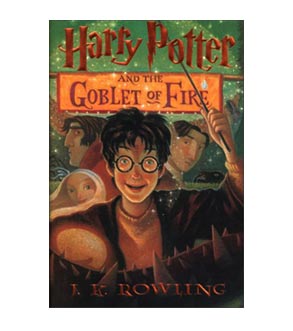

It’s time now to put aside all the talk of hype and rumors and huge first printings, time to stop fretting about whether innocent children are being sucked into a media frenzy (no — next question?). And most of all, it’s time to stop wondering “Why these books?”
Isn’t it obvious?
Children (and many of us who aren’t) have been so anxious for the fourth installment of J.K. Rowling’s Harry Potter series because they are caught up in a breathless adventure, because they have learned to ask the most vital and essential question any reader can: What happens next? “But,” the still-puzzled persist, “aren’t there other children’s books that are just as good?” Perhaps. But for kids, “Harry Potter” is of their time, something that will always be theirs instead of a legacy left to them by a previous generation. “Children shudder at the scent of newness as a dog does when it scents a hare,” the Russian writer Isaac Babel wrote, “expressing the madness which later, when we grow up, is called inspiration.”
If “Harry Potter and the Goblet of Fire” were to sell only five copies instead of — potentially — its first print run of 5 million plus, it wouldn’t change the fact that we are dealing here with one of the pinnacles of children’s literature. (And if you read books to be swept into a story, to make an emotional investment in its characters and to leave something of yourself behind in it, then the distinction made by calling it children’s literature may be a meaningless one.) The present explosion is the beginning of something that’s going to become a lasting part of culture. Harry is going to be one of those characters who, like Sherlock Holmes or Tarzan or Oliver Twist, stands for something even in the minds of people who have never read one of his adventures.
It would be easy to boil down the essence of Harry by calling him a good-hearted hero whose bravery overcomes his fear, who, through the lessons of experience, learns to balance his sense of what’s right and his sense of what’s necessary. But those qualities mean different things at different ages. We have followed Harry now from 11 (in the first book) to 14 (in the new one), and with each book the tests he faces have become more dangerous, the emotional and physical toll a little steeper, the stakes higher.
Some parents may be upset by the darker aspects of “Goblet of Fire” which, as in the previous book, “Harry Potter and the Prisoner of Azkaban,” burst forth with sometimes shocking power in the book’s final 100 pages. But Rowling understands that refusing to spare the emotions of the reader is not the same thing as exploiting those emotions. Our experience of pain and loss sharpens and deepens as we get older (almost in proportion to our ability to bear more), and so does the pain and loss that Harry feels. And the same is no doubt true of many of Rowling’s readers who are growing up with her hero. I don’t think it’s too much to say that J.K. Rowling is providing her readers with the gamut of what reading can be — the narrative fascination that gets us reading and the emotional resonance that keeps us reading.
The longest of the books, “Harry Potter and the Goblet of Fire” is also the most relaxed and, ultimately, the most intense in the series so far. Like the previous three books, it follows the course of a school year at Hogwarts, a school for young wizards, with studies taking a back seat to the adventures of Harry and his best friends Ron and Hermione. We’ve had time to get used to the routine, and (up until the last 150 pages) the book proceeds with a warm and pleasant familiarity, along with a heightening sense of what Rowling is waiting to unleash.
This time around, Harry’s challenge has to do with the revived tradition of the Triwizard Tournament, an international contest in which delegations from the French and German counterparts to Hogwarts come to visit and a student from each school is picked to compete in a demonstration of wizarding skills for the championship. Needless to say, Harry winds up in the competition and finds himself preoccupied both with its demands and with omens that suggest the Dark Lord Voldemort is drawing near to him. And that’s all I’m going to tell you.
Rowling has maintained that the reason she forbade the release of advance copies of “Goblet” was to prevent journalists and critics from revealing what happens before the people who have been waiting have had a chance to read the book. I’m glad she took such a hard line. There are journalists and editors who, for the sake of sales or to boost readership, couldn’t be trusted not to spill the beans. I don’t mean to hint at the plot when I say that, in mood and as a staging for the story to follow, “Harry Potter and the Goblet of Fire” is something like “The Empire Strikes Back.” (No, Harry does not turn out to be the son of You-Know-Who.) It’s dark, gleaming and unresolved, leaving our heroes awaiting the tests ahead.
The plural, “heroes,” is the appropriate word here. One of the wonderful things about Rowling’s books is the way Harry’s triumphs are always dependent on his friends. Rowling’s own story, her rise from scrabbling obscurity to prosperous fame, has often been said to parallel Harry’s. “Goblet of Fire” makes clear that her sympathies also lie with Ron and Hermione. Among fans of the series, that studious, bushy-haired girl inspires the same sort of protective love that Willow does among viewers of “Buffy the Vampire Slayer.” As always, Rowling pokes fun at Hermione’s bookishness. (What similarly bookish character isn’t kidded by its creator?) In “Goblet of Fire,” Hermione also becomes the focus of a sympathetic satire (that may make the book’s adult readers wince in recognition) of the self-righteous indignation adolescents indulge in when they discover the injustices of the world.
Harry and especially Ron have always regarded Hermione as a girl. Appropriate to a novel that finds the three of them at 14, that’s suddenly become less of a liability. And Rowling rewards Hermione with an entrance at a winter ball that justifiably shuts her two pals up. (Lest you think the author is abandoning the core of the character, Hermione is right back at her books the next morning.)
Ron, the essence of the regular-guy sidekick and progeny of a large, perpetually down-at-heels wizard family, is undergoing adolescent throes of a different sort. He’s at the age where he feels most keenly the privations of his family situation, where the shabbiness of his robes and used textbooks embarrasses him. Ron’s uncharacteristically bitter exclamation to Harry and Hermione, “I hate being poor,” cuts deeply. No doubt that’s because Rowling has been there herself. In an interview with Newsweek, when asked if she was happy that she could now buy whatever she wants, she simply said the best thing about having money is “the absence of worry.”
A new character, Rita Skeeter, a scandal-mongering reporter for the wizard newspaper the Daily Prophet, comes out of Rowling’s experience in another way. Most likely, the caricature is Rowling’s swipe at the tabloid reporters who dug up her Portuguese ex-husband and got him to make disparaging remarks about the author. On the other hand, if you live in England, a country with the most vicious tabloid press in the world, you don’t need any personal experience to come up with a character like Skeeter.
Rowling’s other regulars — Hagrid, Dumbledore, Snape and the others — have taken on the vitality of great popular characters. They seem more themselves than ever. And yet part of the deepening pleasure of the series is the way Rowling is making her young heroes aware of contingency, of the impurity of motives, of how good and evil are never as simple as they at first appear.
Ultimately, no great fantasy is ever an escape. When they are introduced into fantasy worlds, pain and loss can feel even keener. Think of moments like the one when Buffy sends Angel to hell just after he regains his soul; the scene in “Superman II” when Superman gives up his powers in order to love Lois as a man and then finds himself unable to protect her; the scene in “Tarzan of the Apes” when the ape mother substitutes for her dead baby chimp the human infant who will grow up to become Tarzan. By the time it reaches its climax, “Harry Potter and the Goblet of Fire” achieves that sort of excruciating and rapturous force.
By time time I finished it I was wrung out, exhausted and transported. Like all great fantasy sagas, the Harry Potter books have grown narratively, morally and psychologically more complex as the series progresses. There is a special pressure on a writer who midway through a series finds herself entrusted with the imagination of a huge number of readers. That Rowling has done nothing to break that faith seems a deed as brave and noble as any her hero has accomplished.
