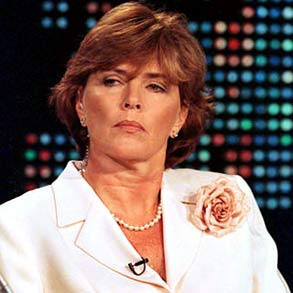

Federal bankruptcy court, stage for the quotidian tragedies of personal debt and commerce, is the last place anyone would expect to turn for a head-spinning legal yarn, and even less for the verdict on a national political scandal. But sometime in the next few weeks, a Richmond, Va., bankruptcy court will be the stage for both, when Judge Douglas O. Tice Jr. calls the case of Kathleen Schwicker.
Kathleen who? Until her recent remarriage, Kathleen Schwicker was Kathleen Willey. Almost two years ago, Willey went on “60 Minutes” to accuse President Clinton of unwanted sexual advances in the Oval Office, followed up by dark, never-confirmed tales of threats and intimidation by presidential operatives. Willey has remarried, changed her name and relocated to Ramrod Key, Fla. Now her bankruptcy appears to be one more effort at a new start, at leaving behind an overwrought period of life beginning with her husband Ed Willey’s 1993 suicide and culminating in her 1998 grand jury testimony for Independent Counsel Kenneth Starr.
But coming the same week that former Starr spokesman Charles Bakaly faces contempt-of-court charges, Willey’s bankruptcy case raises more questions about the probity of Starr’s investigation. The facts revealed in Willey’s bankruptcy filing and other documents obtained by Salon also raise questions about her past and character, and Starr’s decision to grant her sweeping immunity as a central strategy in his inquiry.
Willey claims she is virtually destitute. Her bankruptcy petition, filed in April, declares she has just $50 in her checking account, $2,000 worth of jewelry and $3,700 worth of household furniture. Her Subaru Outback, worth $13,000, has been claimed by her lawyers as collateral for unpaid bills.
In fact, Willey is far from destitute. She has been living in comfort in a suburban home, on a budget of thousands of dollars a month. Court records and other documents obtained by Salon suggest that in 1997 and 1998, at the very time she was going public with her accusations of genital groping by President Clinton several years before, Willey was at the center of a complicated series of asset transfers that appear to have been designed to insulate her money and property from the scrutiny of courts and creditors — and claiming under oath in Virginia that she could not remember basic personal matters from just weeks earlier.
It is a noteworthy tale of legal intrigue: In declaring bankruptcy, Willey claimed personal debts of over $700,000. But financial records suggest that at least two-thirds of that “debt” consists of Willey’s own assets, shifted on paper to her children while she has continued to reap the benefits. At the heart of this complicated financial maneuver, records suggest, is the manipulation of a $160,000 loan to create the appearance of a debt.
The road to Tuesday’s bankruptcy hearing goes back to 1991 — long before Kathleen Willey emerged as a White House volunteer with a tale to tell. It begins not with a presidential grope but with financial transactions by her now-deceased husband, Ed Willey Jr.
To understand Willey’s predicament, it helps to understand her husband. Ed Willey Jr. was a Richmond attorney and investor in local real estate deals. He was the son of the speaker of Virginia’s Assembly — and so in theory, born to the state’s political aristocracy. In fact he was the Willey clan’s black sheep. Sometime around 1970 — according to Kathleen Willey’s own account in her application for a volunteer position at the White House — Ed Jr. was charged with manslaughter in an auto accident, though the charges were later dropped. His taste for fast money further alienated Willey from his father.
When Ed Jr. married Kathy in 1971, their joint dedication to ostentation — the condo in Vail, the Rolex watches and jewelry — did nothing to dispel that reputation, though many in Richmond still find it convenient to blame outsider Kathy for driving her husband’s greed quotient into the stratosphere. Whatever the truth, by the early 1990s Ed Willey Jr. was beginning a long slide into debt, ultimately owing the IRS alone $325,000.
In August 1991, Ed Willey turned to a longtime friend for help: Richmond developer, architect and political activist Louis Salomonsky. Salomonsky was Gov. Douglas Wilder’s personal financial trustee and a successful player in local real estate projects that sometimes ended in scandal and indictments; though Salomonsky was named in at least one indictment, he was never charged himself.
Salomonsky agreed to lend the Willeys $160,000, according to court transcripts and Willey financial records obtained by Salon. The Willeys secured the loan with collateral: their suburban home worth over $200,000, part of a real estate partnership and their life insurance policy of over $1 million.
And in a final gesture, Salomonsky secured a promise of repayment not just from the Willeys themselves but from a company called “Planning and Zoning,” which Ed had set up as a protective front for his real estate investments — a company technically owned by his adult children.
This is a lot of collateral for a $160,000 loan — but given the Willeys’ life on the financial edge, any of their assets might evaporate at any time, so Salomonsky was evidently hedging his bets.
A few months later, despite the Willeys’ precarious financial condition, they managed to contribute $10,000 to presidential candidate Bill Clinton; they met Clinton during a campaign swing through Richmond, where he received a congratulatory kiss from Kathy which her husband reportedly bragged about for weeks.
Within a few months of the presidential election, though, the euphoria was evaporating. Ed Willey was behaving like panic-stricken Ray Liotta at the end of Goodfellas — the financial noose drawing as close and fast as Liotta’s FBI pursuers. By March 1993, Kathy Willey sought refuge two hours northward, in a volunteer job in the White House counsel’s office. In her White House application, obtained by Salon, she repeatedly describes legally troubled Ed Willey Jr. as her “former husband,” though she was still married at the time.
On October 15, Ed Willey went to Kathy with a confession: He had illicitly “borrowed” $200,000 from the escrow account of two clients, a brother and sister named Anthony Lanasa and Josie Abbott. Caught with both hands in the cookie jar, Ed had promised to repay the money in a matter of weeks if they would avoid reporting him to the state bar committee — but he needed Kathy’s signature on the contract. Reluctantly, she signed.
On Nov. 29, 1993 — the same day Willey later said she was groped by President Clinton when she went to seek his advice — Ed Willey shot himself.
Suddenly, all of the Willeys’ long-simmering financial crises boiled over. Kathy’s name was on that contract with her husband’s embezzlement victims. Legally, the aggrieved brother and sister were poised to take Kathy’s house, to attach that life insurance policy and, perhaps, to secure far more of her assets as damages in a lawsuit. Kathy, who had arranged to sell her home and already had her eye on another in one of Richmond’s up-market suburbs, was instead in danger of losing every dime.
Rescue came from Ed Willey’s old friend Lou Salomonsky. Salomonsky and another politically connected Richmond attorney, Daniel Gecker, moved with astonishing speed to protect the Willey family’s remaining assets from both the Lanasa-Abbott lawsuit and the IRS. Salomonsky declines to comment on the Willey bankruptcy, saying only that “I was a protector of the children, after their father’s death, and of her.”
First, Salomonsky transferred the $160,000 note on the loan Ed and Kathy had arranged in 1991 to the Willey’s two college-age children, or rather, to “Planning and Zoning,” the family company with their names on it. On paper, Kathy Willey now owed the money to her children rather than Salomonsky. The children — with Salomonsky as their business agent and Gecker as the attorney for every party involved — moved to “collect” on the debt by foreclosing on their own mother’s house, a transaction completed in 1996.
Salomonsky’s own real estate company bought the house at foreclosure and promptly sold it. The Willey children bought the new home Kathleen had been eyeing, and in 1997 began renting it to her for $450 per month — a laughably low rent in affluent Midlothian.
And then there was Ed Willey’s life insurance — more than $1 million worth, with Kathy designated the beneficiary for half of it. But Kathy refused her portion — ensuring that whole payoff would go to her children. The children began “loaning” their mother living expenses out of the insurance proceeds she had turned over to them.
The upshot: Kathy Willey received $200,000 cash from her children in the last five years according to her bankruptcy petition, not to mention tens of thousands of dollars worth of subsidized housing. Those loans alone make up one-third of the debts listed on her bankruptcy application. And in Virginia, at least, it’s all perfectly legal.
Lanasa and Abbott, outraged, sued Kathy Willey and Ed’s estate in 1994 for “wrongfully converting” the life insurance funds, but the Virginia Supreme Court could find nothing in the state’s laws to forbid it.
Another key part of the deal, however, remains very much subject to debate. To better understand Lanasa and Abbott’s anger, recall that the Willey children salvaged their mother’s assets through their acquisition of Louis Salomonsky’s $160,000 note, which in turn entitled them to foreclose on their mother’s house.
Yet according to Willey family insurance records obtained by Salon, by the time of the foreclosure, Kathy’s $160,000 note to Salomonsky no longer existed. In January 1994, weeks after Ed Willey’s suicide, Salomonsky had been paid off in full by Ed’s life insurance. Indeed, on December 29, 1994, Salomonsky wrote to the Equitable Life Insurance Company citing his 1991 agreement with Ed and Kathy, demanding that he receive “all net proceeds” of Ed’s policy; after he was paid his $160,000 plus more than $40,000 interest, the remainder could be turned over to the Willeys.
On January 25, 1994, Equitable cut a check to Salomonsky for $204,063. The foreclosure of Willey’s house, in other words, was based on a debt which had, in fact, been paid off months before.
Was the foreclosure legal? That depends on whom you ask. Kathy Willey’s attorney Ed Gecker replies with a polite “no comment” when asked about the transaction. Privately, say sources close to the case, he defends the arrangement by saying that since Salomonsky was repaid out of life insurance the Willey children would otherwise have gotten, they had the legal right to pursue the lost funds against their mother.
Joseph Koestner, a Richmond attorney who represented Lanasa and Abbot until they dropped their case out of sheer frustration, called it “a scam” in a 1997 court hearing in which — without access to insurance records showing the debt to Salomonsky had been paid — he was trying to establish a money trail. “If that $160,000 wasn’t owed, then that $160,000 … went someplace, and I want to know where it went,” he said.
Today, Koestner still believes his former clients were victims of “an elaborate shell game.” The Willey-Salomonsky transactions, he says, were designed only to conceal Willey’s assets from his clients without diminishing her benefit from them — as the housing subsidy and open-ended loans from her children indicate. “The children’s interests were not diminished at all when that note was paid back,” he says.
Just how active a player was Kathy Willey in these maneuvers? In court, she pled ignorance of the most routine financial matters. In fact, around the same time she was appearing on “60 Minutes” and before Ken Starr’s grand jury to detail purported incidents that had occurred four years earlier, in Virginia legal proceedings Willey was pleading ignorance of vastly more recent personal matters.
Asked by Koestner in that 1997 hearing whether she was at that time in debt, she responded, “I don’t know.” When did she sign papers transferring the $160,000 note? “I don’t remember.” Did she know why the note was transferred? “No.” How much had she borrowed from her children? The Virginia judicial officer reigning over the hearing finally grew so exasperated that he threatened her with contempt: “It waxes extremely strange to me, ma’am, that you cannot answer a question about whether you owe $160,000 or are owed $160,000.”
Whether or not the scheme was technically legal, in any event, it is profoundly revealing of the atmosphere of evasiveness and deceit surrounding Kathy Willey by 1997, when tales of her encounter in the Oval Office first led her to be subpoenaed by Paula Jones’ lawyers. Indeed, she was pleading poor memory about her massive debt during the very period that her story of being groped by Clinton was floating into public view through Newsweek’s Michael Isikoff and the Jones lawyers.
What does Willey’s active, years-long evasion of this massive debt — even if falling on the safe side of the legal line, as Gecker asserts — say about her motivations in going public with the Clinton story? According to an FBI interview with attorney Gecker during the independent counsel’s negotiations over Willey’s immunity, he and his client decided that the best solution to her financial problems might be a big book deal.
Gecker, says the FBI interview, “did recall thinking that if [O.J. Simpson girlfriend] Paula Barbieri could get millions for writing a book, it might be in my client’s best interest to consider a book deal, especially since she currently has a judgement against her for almost $300,000.”
If the inside narrative of Kathleen Willey’s bankruptcy raises fresh questions about her credibility, it also begs renewed scrutiny of the standards and methods by which Starr sought to make his case against Clinton. On April 24, 1998, the FBI interviewed Gecker at length in his Richmond office. He described several smaller-scale “deceptions” by his client, and then provided detailed records of the Lanasa-Abbott case and the Willey camp’s convoluted financial transactions.
Weeks later Starr granted Willey rare transactional immunity, despite the extraordinary trail of financial manipulation, most of it already in the independent counsel’s hands, according to FBI records prior to the immunity agreement. And Starr ignored this same record in prosecuting (but failing to convict) Willey’s former friend Julie Hiatt Steele for refusing to back up Willey’s sexual-harassment story.
When historians evaluate the Clinton scandals still playing out this week, the questions raised in Kathleen Willey’s bankruptcy should form a crucial part of the picture. The crisis leading to Clinton’ impeachment was powered not just by Starr’s “right-wing conspiracy,” but through the independent counsel’s collusion with such troubled individuals as Willey, whom Clinton repeatedly invited into his orbit. Like that even more central player, Monica Lewinsky, Willey was a questionable character of dubious qualifications, gaining access to the president only through the corrupting power of campaign contributions. (Lewinsky, recall, gained her White House internship thanks to the political connections and contributions of her mother’s boyfriend.) Did Starr’s team overlook Willey’s hopelessly clouded record, or was it deliberately obfuscated?
Koestner, former attorney for Lanasa and Abbot, says he was never even contacted by Starr or the FBI. “When those people did not even call me,” he says, “it demonstrated to me that Ken Starr was a joke.” Willey may get financial absolution in Richmond’s bankruptcy court this week, but historical absolution for Starr is rendered more unlikely by her case.
Desperate Mitt Romney is not only taking credit for the auto bailout he opposed, and pretending to be a “job creator” rather than a Bain Capital job destroyer. Now he’s regularly praising former President Bill Clinton as a centrist whose legacy has been betrayed by the “liberal” President Obama. Actual liberals laugh, but can Romney’s gambit work?
Of course not, but Mitt’s not giving up.
In Lansing, Mich., last week, Romney derided Obama as an “old school liberal” compared to Clinton, whom he called a “new Democrat.” Where Clinton “said the era of big government was over, President Obama brought it back with a vengeance,” Romney told a crowd of college students. A campaign official told CNN that Obama “really turned his back” on Clinton’s policies, including welfare reform and middle-class tax cuts.
Huh? Of course Obama cut taxes for the middle class in the 2009 Recovery Act, which Republicans consistently lie about, and Clinton controversially raised taxes on high earners (Romney would lower them) to cut the deficit in 1993. Meanwhile, Obama has left President Clinton’s welfare reform alone, despite rising rates of poverty and unemployment in the recession.
On Tuesday Romney took his attack up a notch, suggesting that “a personal beef” between the two men accounts for Obama allegedly rejecting Clinton’s centrism.
According to Romney, Clinton understood that “Democrats should no longer try to govern by proposing a new program for every problem. President Obama tucked away the Clinton doctrine in his large drawer of discarded ideas, along with transparency and bipartisanship. It’s enough to make you wonder if maybe it was a personal beef with the Clintons … but really it runs much deeper.”
There he is again, mean ol’ Mitt, trying to hype reports of personal tension between the last two Democratic presidents. It’s silly. Nobody denies there was trouble on the 2008 campaign trail during the Democratic primary, when the former president smarted at Obama camp charges that his overenthusiastic support for his wife’s candidacy, and diminishing of Obama’s, smacked of racism. And today, nobody suggests that the two guys are sneaking off to basketball games together or planning their next joint family trips. But whatever personal strain may persist, they put their problems behind them a long time ago.
Clinton stumped enthusiastically for Obama in 2008, and on behalf of the president and beleaguered Democrats in the 2010 midterms. Who can forget the current president calling on the past president to help him sell the idea of a compromise on the Bush tax cuts (to liberals, by the way) in December 2010 – and then walking away and leaving Clinton by himself at the lectern happily holding forth with the White House press corps (as Obama reportedly went off and did some Christmas shopping)? Currently Clinton is, of course, working hard to help Obama beat Romney. He recently attacked the presumptive Republican nominee for backing failed Bush policies “on steroids.”
As to the notion that Clinton was a centrist and Obama is a liberal: I think they’re both politicians with liberal hearts and centrist political instincts, working to make life better for the non-wealthy in an age when Republicans have become strident, extremist servants of the super-rich. President Clinton raised taxes on the rich. He signed the Family and Medical Leave Act, belatedly letting parents take time off after the birth of a child or when needed by a sick family member. He let Newt Gingrich’s GOP shut down the government rather than agree to Medicare cuts; on that point, he might be more traditionally liberal than Obama, who entertained the idea of Medicare cuts while trying to get a “grand bargain” on the deficit last summer. (Since then, though, Clinton himself has come out in support of Simpson-Bowles, which would trim Medicare.)
Clinton vastly expanded the Earned Income Tax Credit, which is one main reason why low-income people don’t pay any federal withholding taxes – a scandal (according to all the GOP presidential contenders) that Romney’s tax plan would remedy by imposing taxes on low-wage earners. The EITC is the absolute best proof that it’s Romney who’s moved away from the appealing mainstream ideas of his party’s past, not Obama. The low-wage tax credit Clinton and Obama expanded was originally a Republican notion (inspired by Milton Friedman) to make poorly paying jobs an alternative to welfare. Signed into law by President Gerald R. Ford, it was expanded by George H.W. Bush, and also supported by George W. Bush.
It’s true that Clinton tried to pioneer a “Third Way” attempt at Democratic centrism, balancing the budget and ending “welfare as we know it.” He thought if he met increasingly radical Republicans halfway, the country might make progress. He thought wrong. Instead Romney’s party attacked the man Romney now purports to admire; attacked him viciously, from Day One, culminating in a nihilistic effort at impeachment for sexual indiscretions that are common in Washington, D.C.
What Romney is really trying to do now, of course, is cause trouble with the segment of the electorate that admired Hillary Clinton but took a while to warm up to Barack Obama in 2008, particularly the white working class, as well as white female Democrats and independents. I don’t see it working. I’m on record saying repeatedly that dismissing Clinton’s support with working-class whites as merely racism was mistaken and divisive when Democrats did it four years ago. Working-class voters had valid reasons to doubt the charismatic newcomer whose economic platform was marginally less progressive than Clinton’s, and who talked riskily – and naively, as it turned out – of a post-partisan rapprochement with Republicans.
But that doesn’t make those voters easy targets for Romney. His record as Bain Capital job destroyer combined with his enduring prep-school entitlement should make him less simpatico than Obama to those voters. Romney lacks Bill Clinton’s “I feel your pain” empathy for working-class folks; he comes across as the guy who’s more likely to cause them pain.
Oh, and Romney, by the way, wasn’t always such a Clinton admirer. In his book “Turnaround,” he tells the story of visiting the White House in 1999, while Clinton was president (h/t Andrew Kaczynski):
When we got through the Secret Service checkpoint for clearance at the West Wing, the agent handed each of us a badge to wear around our necks. Mine had a big, red A. I turned to Cindy and, in front of the agents, said, “Why do I have to wear this?” Thinking I was confused, she tried to explain that all visitors to the White House had to wear a badge. “I know that,” I responded, “I’m asking why I have to wear the red A around my neck. I’m not the one that cheated on my wife. He should be wearing the scarlet A- not me.” I grumbled all the way up the drive and into the West Wing lobby. The look on Cindy’s face was priceless.
President Obama, surrounded by members of the Secret Service, upon his arrival in San Diego, Sept. 26, 2011. (Credit: AP/Pablo Martinez Monsivais)
It’s hard to work up much outrage about the Secret Service prostitution scandal, in which 11 members of the president’s elite protective service and various military personnel were found to have picked up escorts in Colombia, where they were doing advance work for the president’s visit. I guess it is probably not a good idea for the people in charge of protecting the president to leave themselves vulnerable to sexual blackmail, but on the other hand we do not live in a John Le Carré novel or “24″ episode, and I don’t think the threat of a honey-trap assassination conspiracy plot is very credible. If members of the Secret Service want to get drunk and hire escorts after work, that is their business. (As Melissa Gira Grant says, the only actual scandal here — and the reason this became an international incident — is that all these guys tried to bilk one of the women out of the money she was owed.)
But the predictable Washington mixture of prurient interest and moral posturing has turned this incident into grist for the scandals-and-investigations mill. And now we have the attempts at somehow making this a winning partisan issue for Republicans. Chuck Grassley, the senator from Iowa who triumphed over adversity and became the ranking Republican on the Senate Judiciary Committee despite being functionally illiterate, would like to know whether any White House staff also slept with escorts that evening. No one has made the claim, but Grassley’s asking just in case. (For a live peek at a future paranoid right-wing myth in its embryonic stage, read the comments on that Washington Times story: “I can just hear those paper shredders going a mile a minute in the white house, and the document forgers are being called in, you know the same ones that did the birth certificate.”) Grassley was on Fox last night to make sure viewers repeatedly heard baseless speculation as to the involvement of White House staff.
Rep. Pete King, Long Island Republican and stalwart publicity monger, has sent Secret Service Director Mark Sullivan a list of 50 questions about the scandal in order to make it appear that he is very seriously investigating this very serious incident.
For those outside Congress, for whom insinuating escort patronage by unnamed White House staff seems a bit of a reach, the game is to attempt to use the scandal to prove some point the fecklessness of Obama as a leader and his shameful failure to make everyone in Washington stop being so awful and wasteful all the time.
NRO’s Mark Steyn, after praising the fiscal discipline of the agent who attempted to bilk his escort (ugh), suggests that the moral of the story is that we pay too much for presidential security, and that all those agents and fancy bullet-proof Suburbans are wastes of taxpayer funds and evidence of broke post-Imperial America’s profligacy. Sarah Palin, who had every right to be personally aggrieved for once, after it was reported that the agent at the center of the scandal wrote gross sexist things about her on Facebook, was among the first to declare that the problem was with the “culture” Obama has created at the White House. (Karl Rove, smarter than most of these people, suggested that politicizing a Secret Service scandal was dumb and counterproductive. Secret Service Director Mark Sullivan, coincidentally, was elevated to his position under George W. Bush.)
The makeup of the Secret Service, obviously, has very little connection to the political party of the person occupying the White House. Like most American law enforcement agencies, it’s primarily white and overwhelmingly male, and, historically, the culture of the agency has had more than a whiff of machismo. These are not exactly the sort of public sector employees right-wingers get off on demonizing.
In fact, the right has had for years a sort of Clint Eastwood-inspired fantasy of the Secret Service agent as folk hero. Decent, hard-working men putting their lives on the line to protect a bunch of elitist ingrates. That ingratiating phony Bill Clinton and his frigid, hectoring monster of a wife weren’t deserving of such stolid, unflinching loyalty and service.
The fullest expression of this fantasy is in this classic chain email that made its way to every inbox in the nation during the second president Bush’s first term. According to this email, attributed to the unnamed author’s former neighbor, the president’s security detail was constantly disrespected by those awful Clintons and their terrible staff. Hillary Clinton was “arrogant and orally abusive.” “She forbade her daughter, Chelsea, from exchanging pleasantries with” agents. “Al Gore resented Bill Clinton and thought he was to centrist. He despised all republicans.” Agents prayed for Bush to win the election, and their reward was the joy they all felt in the presence of President Bush and his amazing, wonderful wife.
This nonsense has its roots in fake anti-Hillary attacks, attributed to imaginary Secret Service members, that Republican operatives spread to sympathetic media voices starting more or less the day Bill took office. Former Secret Service agents do plenty of gossiping and bitching, most frequently to Ronald Kessler, but their complaints don’t tend to track quite so directly to right-wing fantasy narratives.
But a popular trope is of the upstanding agents blanching at being asked to look the other way as libidinous Democratic presidents — Kennedy, Johnson, and Clinton — womanized. (Clinton was said to have threatened to fire agents who stymied his attempts to have trysts with Monica Lewinsky, though the agent who made the claim admitted to having invented it.) The pat moralism of the conservative Secret Service fantasy makes the agency’s lurid misadventure a bit funnier. It also explains why various people have to somehow convince themselves that the Obama administration somehow degraded the agency, through a lack of “management skills” or the widespread embrace of sexual deviance that is the logical end result of repealing the military’s ban on out gays and lesbians.
Alex Pareene writes about politics for Salon and is the author of "The Rude Guide to Mitt." Email him at apareene@salon.com and follow him on Twitter @pareene
More Alex Pareene.
Bill Clinton sat down for an long interview with Bill O’Reilly last night on Fox News, where the two discussed everything from economic and immigration policy, to the horse-race politics of the 2012 election. Clinton issued a favorable forecast for Barack Obama’s re-election — saying his prospects were better than 50/50 — and commented that the president’s current, tougher political posture would help him in the long run.
“[Obama's] out there running against himself now,” Clinton said. “Soon as he gets an opponent, it will be about the next four years — who do you think is going to take us in the right direction.”
Clinton also weighed in a few of the Republican candidates, saying of one-time nemesis Newt Gingrich that he respected the man’s ability to “think and do.” The former president was, however, momentarily lost for words when O’Reilly followed up by asking if he respected Gingrich “as a man.” Clinton tip-toed around the answer, then spent the next few moments criticizng the former speaker’s “scorched-earth” political approach.
When questioned about Mitt Romney, Clinton damned the former Massachusetts governor with praise for his Massachusetts health reform legislation. He stopped short, however, of issuing any endorsements for the Republican primary, saying only that he would vote for Barack Obama regardless in the general election. In fact, the closest he would get to voicing support for any of the candidates was when he mentioned that he liked Jon Huntsman — though he then quickly poked fun at the Utahan’s meager support in the polls.
I got to debate Jonathan Chait about his much-discussed New York magazine piece, “When Did Liberals Become So Unreasonable?” on “Hardball” Tuesday night. He’s aiming at President Obama’s liberal critics, but in fact his article proves that criticism is nothing new. Apparently, we’ve always been unreasonable, because Chait’s survey of Democratic presidents going back to FDR finds that the left has always found a reason to squawk. But he seems to think we’re particularly unreasonable when it comes to Obama. With Thanksgiving ahead, I found myself wondering whether liberals should be more grateful to the president.
First, let’s take in the list of Obama’s accomplishments as Chait describes them. They’re considerable:
His single largest policy accomplishment, the Affordable Care Act, combines two sweeping goals—providing coverage to the uninsured and taming runaway medical-cost inflation—that Democrats have tried and failed to achieve for decades. Likewise, the Recovery Act contained both short-term stimulative measures and increased public investment in infrastructure, green energy, and the like. The Dodd-Frank financial reform, while failing to end the financial industry as we know it, is certainly far from toothless, as measured by the almost fanatical determination of Wall Street and Republicans in Congress to roll it back.
Beneath these headline measures is a second tier of accomplishments carrying considerable historic weight. A bailout and deep restructuring of the auto industry that is rapidly being repaid, leaving behind a reinvigorated sector in the place of a devastated Midwest. Race to the Top, which leveraged a small amount of federal seed money into a sweeping national wave of education experiments, arguably the most significant reform of public schooling in the history of the United States. A reform of college loans, saving hundreds of billions of dollars by cutting out private middlemen and redirecting some of the savings toward expanded Pell Grants. Historically large new investments in green energy and the beginning of regulation of greenhouse gases. The Lilly Ledbetter Fair Pay Act for women. Elimination of several wasteful defense programs, equality for gays in the military, and consumer-friendly regulation of food safety, tobacco, and credit cards.
We could, and I do, quibble about details in each of Chait’s examples, but his overall point is important: Even if every measure he lists has its flaws, the list itself is impressive. That President Obama took office in the middle of the worst crisis since the Great Depression, and with a nominal Democratic majority in both houses, helps explain why some people still expected more, but we should still stop more often and acknowledge what’s been accomplished in the last three years.
Having conceded that, I think Chait’s piece suffers from big definitional problems. First, how do we define liberals? Polls show self-described liberal Democrats are happy with Obama – in Gallup’s weekly tracking polls upward of 75 percent approve of the job he’s doing (and the same was true for Clinton), and that’s been true since he took office. There’s no crisis of liberal support for the president.
Also, Chait’s roster of unreasonable “liberals” includes MSNBC’s Rachel Maddow and Starbucks CEO Howard Schultz. That’s silly: Schultz, cited along with New York Times centrist Thomas Friedman, rails against politicians who refuse to cut the deficit by trimming so-called entitlements and raising taxes. But that’s exactly what Obama tried to do with his proposed debt-ceiling “grand bargain”; Republicans wouldn’t cooperate. Those guys aren’t liberals; Friedman is a formerly liberal, formerly smart writer who got rich and stopped paying attention. (You’d think he could at least pay someone to pay attention for him, so he’d stop asking Obama to do what Obama has already done.)
What about actual liberals, people to the left of Schultz and Friedman – people like Rachel Maddow and, OK, sure, me. Yes, some of us have demanded more from Obama – on the economy, on Wall Street regulation, on gay rights, on civil liberties. But you know what? That’s our job. And when Chait goes down the list of the ways liberals have been disappointed with Democratic presidents going all the way back to FDR, I found myself thinking, Good job, liberals! Because we were usually right, and the country’s a better place for our pushing.
While liberals lionize JFK today, Chait notes, during his presidency (cut short 48 years ago Tuesday) they criticized him for not moving faster on civil rights. Yes, they did. Kennedy was trying to find a way to hold his party together and postpone the departure of the Dixiecrats, and he needed pushing. Should Dr. Martin Luther King Jr. have said, “OK, Mr. President, we’ll skip the March on Washington, we know you’re doing what you can.” Liberals were right to push Kennedy. (I am not trying to say that Obama is compromising on anything equivalent to the basic human rights of African Americans, just that on the social justice issues of their day, presidents need pushing.)
Similarly, while FDR gets more historic veneration from liberals (mainly because there’s almost no one here with us who actually lived through his presidency as an adult), his New Deal only came about because of left-wing agitation (and corporate desperation) in the first place. And liberals were right to criticize some of Roosevelt’s compromises: leaving most African-Americans out of the Social Security program (again to mollify Dixiecrats) and easing up on government spending in 1937 (to mollify conservatives and business leaders), which reversed some of the progress he’d made getting us beyond the Great Depression. Japanese internment was a shame that more liberals should have criticized.
In my adulthood, Jimmy Carter and Bill Clinton got elected with liberal support but wound up disappointing the left, particularly on the economy. Sadly, both men accepted the Republican premise that the economic problems and social disorder of the late ’60s and early ’70s required that Democrats trim back on government and make nice with business. Chait himself admits that while we all love the outspoken human rights defending, “Habitat for Humanity” supporting ex-president we know today, we didn’t love Carter during his term, and for good reason:
The truth is that Carter’s domestic agenda carried only small bits of liberalism, and those small bits (a consumer-protection agency, tax reform) met with total failure in the Democratic Congress. Carter’s policy accomplishments tilted right of center—he deregulated the airline and trucking industries and cut the capital-gains tax. Most infuriatingly to liberals, Carter refused to push for comprehensive health-care reform. A Carter adviser later recalled that the president “did not see health care as every citizen’s right, nor did he think the government has an obligation to provide it.”
When it comes to Clinton, I think many liberals are frustrated with Obama not because of some supposed great contrast with his supposedly liberal predecessor, but because of similarities between the two. Both of these liberal presidents spent considerable political capital trying to compromise with Republicans, and they failed. That’s been a particular problem for Obama because he didn’t have the strong economy that made Clinton’s inability to wrest concessions from the GOP less painful.
It was precisely because Clinton failed to neutralize the critique of Democrats as the “big government” party that I objected to Obama’s effort to do the same thing in a time of economic crisis. Before it all fell apart, the president defended the idea of his deficit-cutting grand bargain to progressives. “Get this problem off the table,” he argued, “and then with some firm footing, with a solid fiscal situation, we will then be in a position to make the kind of investments that I think are going to be necessary to win the future.” But Clinton already tried that, balancing the budget and endorsing a welfare reform plan largely crafted by Republicans. He believed that getting the issue of bloated government “off the table” would set the table for a progressive agenda. Of course, it didn’t work.
Before writing his New York magazine piece, Chait got a lot of attention for a scathing retort to Drew Westen’s left-wing critique of Obama that ran in the New York Times in August. Chait made a lot of good points; some of the things the left blames on Obama either didn’t happen, or couldn’t have happened otherwise given the Blue Dog Democrats in Congress. But he made one point I wanted to answer at the time, and didn’t. He accused Westen and other lefty Obama critics of romanticizing the power of the bully pulpit and the presidential speech:
Westen’s op-ed rests upon a model of American politics in which the president in the not only the most important figure, but his most powerful weapon is rhetoric. The argument appears calculated to infuriate anybody with a passing familiarity with the basics of political science. In Westen’s telling, every known impediment to legislative progress — special interest lobbying, the filibuster, macroeconomic conditions, not to mention certain settled beliefs of public opinion — are but tiny stick huts trembling in the face of the atomic bomb of the presidential speech. The impediment to an era of total an uncompromising liberal success is Obama’s failure to properly deploy this awesome weapon.
I think that’s a caricature of liberals’ criticism. I have an actual model of what I wish the president had done, and it doesn’t come from Bill Clinton or JFK or FDR, it comes from Barack Obama. Look at the way he tried to sell the deficit-cutting grand bargain, to settle the 2011 debt-ceiling stalemate, even though in the end, the GOP didn’t bite — and probably, predictably, never was going to. That let the president tell voters he was the one who really wanted to cut the deficit, but Republicans wouldn’t let him. He railed, he ranted, he ordered both parties’ leaders to work night and day on a deal. He told the American public to call their congressional leaders and demand compromise — and sure enough, they tied up the phone lines in Congress for a while. In the process, he accepted the Republican premise that deficit-reduction was more important than job creation, a hallmark of the Clintonian “third way” politics he’d supposedly rejected, but even critics had to admit it was a bold political move, and he worked hard and risked a lot for it.
Now, imagine the new president had told a comparably bold story about the recession in early 2009: that he was the one who knew how to use government to fix the economy — but Republicans and Blue Dog Democrats wouldn’t let him do all that was needed, so he was probably going to have to compromise to do what was possible. Obama failed to give voters a vision of the kind of government role that would be required to fix the economy — his advisors were telling him it would take at least $1.2 trillion in stimulus — even if he had to compromise and settle for less. And let’s be clear: He did have to settle for less. Since the Senate barely passed the $787 billion stimulus bill, even though 40 percent of it went to tax cuts, it’s hard to imagine the president getting more than that.
But what if the president laid out bigger, bolder plans for the Recovery Act? What if he’d gone on television every few days, as he did during the debt-ceiling crisis, and demanded the American people lobby Congress? Then, when the compromise stimulus worked as well as it did — and it did work, keeping the country out of a Depression and reversing the steep trend of job losses that began under Bush — but its effects trailed off, he’d have been in a much stronger position to push Congress to do more. But Obama never made that case. That was a missed opportunity that wound up hurting the president politically, and hurting the country.
One last thing about the debt-ceiling debacle: Obama’s approval numbers fell as he pushed for compromise with the GOP, and they have climbed since he’s begun pushing for a jobs bill he knows has no chance of getting Republican support. I think Obama’s liberal critics weren’t just right morally, they were right politically. But I’ll also give the president credit for what now looks like shrewd bargaining: He got the debt ceiling raised without cutting Social Security or Medicare, reckoning he could offer whatever he felt like knowing the GOP would never agree to raise taxes.
I think Chait’s right that liberals are less inclined than conservatives to close ranks around their president, right or wrong. Conservatives tend to defer to authority, by definition; our side, not so much. I think he’s right to remind liberals how much Obama has done. I’m grateful to Obama for a lot of those things, but mostly, I’m grateful to be a member of a party that fights openly about what’s right. When the president got heckled by some Occupy Wall Street protesters Tuesday in New Hampshire, he modeled that tolerance, listening to them; he didn’t have them pepper-sprayed. I guess I’m grateful for that too — but I wish I didn’t have to be.
Here’s our “Hardball” debate. Have a great Thanksgiving.
As Democrats survey the political wreckage of the last three years, the temptation to imagine more pleasant alternate realities is irresistible. What if Hillary Clinton had been elected president instead of Obama? Would events have played out any differently? Or, even more tantalizingly (albeit technically impossible), what if the Big Dog himself, Bill Clinton, had been in charge the last three years? Would he have done a better job fixing the economy? Been more effective knocking heads with the Tea Party? Established himself as a better bet to win a second term?
These are questions that obviously can’t be answered with any certainty. We’ll never know how a Clinton (or a McCain, for that matter) would have tackled the recession or jousted with John Boehner, just as we’ll never know what would have transpired if there had been no stimulus at all, or if Obama had taken a more confrontational stance against his Republican opposition from the get-go, rather than pursue a doomed strategy of bipartisan cooperation. We’re stuck with the world we’ve got.
But in the wake of the publication of Bill Clinton’s new book, “Back to Work: Why We Need Smart Government for a Strong Economy,” there is simply no choice but to plunge into these hypothetical waters, however impracticable they might be. Because even though, when you boil it down, the agenda set forth by Clinton is not substantivally different from what Obama has attempted to execute, the implicit theme of “Back to Work” is that there’s a better way to go about the business of government than what we’ve witnessed in the last three years. As TalkingPointsMemo’s Josh Marshall joked in a tweet, the real title of “Back to Work” should be “If I Were Still President I’d Be Ownin’ These Bitches.” Clinton periodically offers lukewarm support to Obama, but he’d much rather be recounting the successes of his 1990s glory days. Just put him back in the Oval Office, and we’d get this mess fixed, stat!
Dream on, Bill. One could reasonably argue that Clinton would have done a much better job facing down McConnell, Boehner and Cantor on the debt ceiling and government shutdown showdowns. But his program for smart governmental intervention in the economy would have constituted exactly the same kind of anathema to a Republican Party determined to prevent him from accomplishing anything as everything hitherto proposed by Obama. Clinton would also have discovered that when you come into office on the heels of a fiscal quarter in which the economy contracted by almost 10 percent, while facing a Senate opposition determined to filibuster your every move at a historically unprecedented rate from Day One, recovery would be slow and painful and politically costly. Furthermoe, any notion that Bill Clinton might have been tougher than Obama on the banks or Wall Street, while fighting for his beloved middle class, seems especially dubious. Let’s not forget, Obama’s economic team was largely staffed by veterans of the Clinton administration, and some of the key deregulatory measures that contributed to the financial crisis were passed during Clinton’s administration with the enthusiastic support of those very same men.
“Back to Work” includes a cogent analysis of where the U.S. has gone astray, is full of sensible ideas to encourage job creation and economic growth, and makes a robust defense of the notion that strong government is a good thing. But so what? The people who will buy and read this book not only already agree with just about everything that’s in it, but they also already know it all. There’s almost nothing here that hasn’t been proposed by the Obama administration, or that isn’t already a stock part of the mainstream Democratic agenda. Which makes it all completely meaningless in the context of current political gridlock. Clinton wants us to get back to a government based on doing things that work — but as has become abundantly evident in the past few years, congressional Republicans are content with a system that doesn’t work. And neither Obama nor Clinton has any leverage to change that reality, unless Democrats enjoy a surprising victory in the 2012 election.
Any imaginary history that plucks Bill Clinton out of 1992 and time-travels him into 2008 has to grapple with some mighty big historical transformations. For most of his two terms, Bill Clinton enjoyed a huge wind at his back — a stunning period of economic growth that was in large part fueled by two things he can take zero credit for: the end of the Cold War and the massive tech boom. And even without the black hole of the worst economic downturn since the Great Depression sucking at his presidency from the moment he moved into the White House, Clinton still managed to make a pretty big mess of things in his first two years. His efforts to push through the first priority on his political agenda — healthcare reform — failed miserably and contributed heavily to one of the worst midterm election defeats faced by a sitting Democratic president in a century. The Obama midterm debacle was even bigger, but in some ways less embarrassing. Until Clinton came along, Democrats had held a majority in the House of Representatives for 40 years.
Today, there is a rosy glow associated with the Clinton years. We tend to forget such things as the tawdry impeachment scandal, for a simple reason: The economy grew quickly and millions of jobs were created. If you couldn’t find a job in Northern California in the late ’90s, you weren’t breathing. The warm tint of the rearview mirror imbues Clinton with the authority to lecture us all now on how we should be doing a better job getting people back to work. But what about the responsibility that Clinton should shoulder for sowing the seeds of the financial crisis in the first place?
Clinton rightly dismisses the notion that his aggressive support of the Community Reinvestment Act was the root cause of the housing bust. We’ll give him points for that. But what are we to make of the one area in which he does acknowledge making a mistake?
I do think I can be fairly criticized for not making a bigger public issue out of the need to regulate financial derivatives. I couldn’t have done anything about it, because the Republican Congress was hostile to all regulations … But I should have spoken out more, especially after Congress included a measure barring financial derivatives from being regulated as securities or commodities in an appropriations bill that passed by a veto-proof majority.
Clinton then has the gall to approvingly mention Commodity Future Trading Commission director Brooksley Born’s strongly voiced opinion at the time that “financial derivatives should be subject to the same kinds of capital and transparency requirements as agricultural derivatives.” He somehow fails to mention the fact that Born’s push to regulate financial derivatives was cut off at the knees by Clinton’s own senior economic officials, including, notably, Larry Summers and Robert Rubin. The heads of the Treasury Department, Federal Reserve and SEC released a joint statement that left no doubt as to administration policy: “We have grave concerns about this action and its possible consequences. We seriously question the scope of the CFTC’s jurisdiction in this area.”
For Clinton to suggest that he would have made a bigger public issue “out of the need to regulate financial derivatives” implies that he agreed with Born — but there is very little evidence to be found for this revisionism in the historical record. The opposite is much more true. Clinton’s administration was extraordinarily accommodative of Wall Street’s desires; their priorities were his priorities. One can assume that the health of the financial sector would have been just as high a priority for a Clinton administration in 2008 as it was in 1999. The banks would certainly have been bailed out, fueling popular resentment and creating identical political problems for the incumbent party.
Before Bill Clinton decided to write a book arguing the merits for smart government, he should have fessed up to how his own dumb government played a role in creating the financial crisis that put so many Americans out of work and has made it so difficult to restart economic growth.
That having been said, however, anyone looking for a smart to-do list of what government can do to spur economic growth would not be ill-served by reading Chapter 6: “How We Can Get Back in the Future Business.” Clinton is a bit more supportive of the debt-reduction proposals that came out of Obama’s Erskine-Bowles commission than most serious liberals will feel comfortable with, but aside from that, most Democrats will find themselves nodding their heads at his proposal to spur green job creation through investment in renewable energy, his call for a big infrastructure buildup, and his plan to fix the housing sector. Clinton’s always been a wonk’s wonk — he clearly enjoys wallowing in the nitty-gritty details of policy. There’s meat in “Back to Work.”
But he gives away the game on Page 111:
If there are any militant antitax folks still reading this book, I can hear the counterattack forming in your minds: “Clinton wants European-style social democracy! He wants to tax us to death. He’s for too much government! He doesn’t believe in American exceptionalism! He doesn’t even love America anymore, or he wouldn’t be telling us all this bad stuff!
“That’s all nonsense,” he writes.
Well yeah, sure, except for the annoying little fact that it’s nonsense that represents the expressed views of most of the Republicans currently elected to Congress. And indeed, it’s mild nonsense that doesn’t even come close to the intemperate nastiness of the rhetoric routinely hurled at President Obama.
It’s cute for Clinton to pretend that any “militant antitax” folk would even purchase “Back to Work,” much less be reading it as far as Page 111 without their heads exploding. The sad truth — and this is something that Clinton is surely aware of — is that all the well-meaning and pragmatically effective job creation tools in the world are worth nothing when matched up against the scorched earth tactics and extreme calcified ideology of the current Republican Party. Clinton’s great 1990s nemesis, Newt Gingrich, is a moderate when compared to the GOP’s Tea Party backbone — something Gingrich learned to his shock when he had the temerity to criticize Paul Ryan’s budget as “right-wing social engineering.”
It is in the context of current political reality that all of Clinton’s suggestions must be evaluated, and this is where “Back to Work” is most lacking. It doesn’t matter how compellingly Clinton makes the case for smart government (and higher taxes) in an era when the opposition party has never been more antitax or more resolutely opposed to government action. It doesn’t matter how bad we look when compared to other rich countries, when we are considered by definition incomparable. It doesn’t matter how much sense Clinton makes — in Washington in 2011, sense is irrelevant.
If you’re in the market for an alternate reality, pick up “Back to Work,” mix yourself a strong drink, and pretend to your heart’s delight that if we just had the right wonk in office, pushing the right kind of policy proposals, unemployment would be falling while the economy boomed. But if you want to change reality, just make sure you go vote.