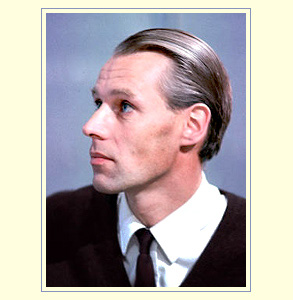

In April 1966, back on the job after their first vacation in five years, the Beatles embarked on the first session for their “Revolver” album. They began recording the hypnotic, apocalyptic “Tomorrow Never Knows,” a new John Lennon song that was unlike anything the band had ever attempted. Lennon’s lyrics were inspired by the “Tibetan Book of the Dead”: “Turn off your mind, relax and float downstream/It is not dying/It is not dying.” He wanted his voice to sound like the Dalai Lama singing from a high mountaintop with 4,000 monks chanting in the background. To achieve the dizzying, oracular effect, they ran Lennon’s vocals through a rotating Leslie speaker (normally attached to a Hammond organ); the saturated sounds of tape loops turned guitar notes into shrieking gulls.
The man who organized and thrived on all this madness was producer George Martin, whose relationship with the Beatles, always integral, was now entering uncharted territory. The aptly titled “Tomorrow Never Knows” closes the masterpiece “Revolver” with a tantalizing hint of the artistic statement Martin would help them realize next: “Sgt. Pepper’s Lonely Hearts Club Band.”
“It would be wrong to assume that the Beatles alone were responsible for this remarkable recording, or for the progressiveness which would be the hallmark of much of their future output,” Mark Lewisohn says of the song in “The Beatles’ Recording Sessions,” a day-by-day account of the group’s entire career that is definitive and required reading for serious fans. “George Martin was, as ever, a vital ingredient in the process, always innovative himself, a tireless seeker of new sounds and willing translator of the Beatles’ frequently vague requirements.”
With the exception of Phil Spector’s syrupy post-production on the “Let It Be” album, Martin produced every Beatles recording — from the first single (“Love Me Do”) to the last album (“Abbey Road”). Manager Brian Epstein, their most fervid salesman, may have given the scruffy Liverpudlians an initial gloss, but Martin gave them real artistic polish. He supervised the band’s transition from precocious boys to mature artists, harnessing all that wild genius into the most efficient and dazzling hit-making unit in modern pop.
In all he produced more than 700 recordings in a career spanning 50 years and genres as diverse as jazz, rock, classical, comedy and film soundtracks, with an unprecedented 30 No. 1 Beatles and post-Beatles hits to his credit in the U.K. Now known as Sir George, Martin may be the most influential and prolific record producer in history.
- – - – - – - – - – - -
George Martin was born on Jan. 3, 1926, in Holloway, North London. The son of a carpenter, he grew up poor, without formal musical training. He taught himself to play piano by ear, and at 16 started his own school dance band, George Martin and the Four Tune Tellers. From 1943 until 1948, he served with the British Fleet Air Arm as an observer in planes, rising to the rank of lieutenant. Paul McCartney later credited Martin’s legendary composure to his military service: “He pulled it all together — you’re ultimately responsible, you’re the captain. I think that’s where George got his excellent bedside manner,” McCartney is quoted as saying in Philip Norman’s “Shout!” “He’d dealt with navigators and pilots … he could deal with us when we got out of line.”
After his military service Martin studied composition and classical music orchestration at London’s Guildhall School of Music; his first job after graduating was at the BBC’s music library, where he further cultivated the clipped, upper-crust accent that belied his humble roots. He entered the music industry in 1950, as assistant to the head of EMI’s Parlophone Records, and was soon made responsible for the label’s classical recordings. He worked with artists like Stan Getz and Judy Garland, establishing himself as a jazz, classical and light music producer. But he also sought new markets, in an effort to shore up what was then known as EMI’s junk label. Martin produced a string of hit comedy records with Peter Ustinov, Peter Cook, Dudley Moore and, most notably, the Goons.
In 1955, after a management shake-up led to his boss’s retirement, Martin was appointed head of Parlophone at 29, becoming the youngest manager of an EMI label. In 1960 the Temperance Seven gave him his first No. 1 hit in Britain with “You’re Driving Me Crazy.” After watching the rise of another EMI label’s act, Cliff Richard and the Shadows, Martin was eager to acquire a pop group for Parlophone — just as Epstein was desperate to find a recording contract for the Beatles. Epstein had been turned down by major British labels Decca, Pye, Phillips and even EMI — twice. Martin scheduled an audition for June 6, 1962.
Despite feeling that the Beatles’ demo tape had been “pretty lousy” and “very badly balanced” and contained “not very good songs” by “a rather raw group,” Martin has recalled, “I wanted something, and I thought they were interesting enough to bring down for a test.” You know what happened next: He was won over by their Liverpudlian charm. “I liked them as people apart from anything else, and I was convinced that we had the makings of a hit group,” he told British music magazine Melody Maker in 1971. “But I didn’t know what to do with them in terms of material.”
Because Martin has a somewhat professorial demeanor, the obvious differences between him and the Beatles have always been played up, but in truth they had much more in common than it appeared. “I’ve been cast in the role of schoolmaster, the toff, the better-educated, and they’ve been the urchins that I’ve shaped. It’s a load of poppycock, really, because our backgrounds were very similar. Paul and John went to quite good schools. I went to an elementary school, and I got a scholarship for that, and I went to Jesuit college. We didn’t pay to go to school, my parents were very poor. Again, I wasn’t taught music and they weren’t, we taught ourselves,” Martin told Billboard magazine. “As for the posh bit, you can’t really go through the Royal Navy and get commissioned as an officer and fly in the Fleet Air Arm without getting a little bit posh; you can’t be like a rock ‘n’ roll idiot throwing soup around in the wardroom.”
Lennon was particularly impressed that Martin had recorded Spike Milligan and Peter Sellers from BBC Radio’s “The Goon Show.” “The Beatles instantly developed a rapport with George Martin,” Peter Brown, former director of the Beatles’ management company, writes in “The Love You Make.” Martin told them they needed to lose then-drummer Pete Best, and they did. Though only 14 years older than Ringo Starr, the oldest Beatle, Martin was light-years ahead of them in technical sophistication. “The various magic tricks that Martin could perform in the control room,” Brown writes, “made him seem like the Wizard of Oz behind his control panel.”
In the beginning, Martin was tough on the group. “As composers, they didn’t rate. They hadn’t shown me that they could write anything at all,” he told Melody Maker. “‘Love Me Do’ I thought was pretty poor, but it was the best we could do.” Martin saw the kernel of something, but even he had no clue just what kind of phenomenon he was about to help unleash. “The question of them being deep minds or great new images didn’t occur to me — or to anybody, or to them, I should think.”
When they laid down “Please Please Me” in February 1963, Martin told them they’d recorded their first No. 1. He quickly resolved to make a Beatles album, which he produced in a one-day session. “There can scarcely have been 585 more productive minutes in the history of recorded music,” Lewisohn writes. Known as a producer of live stage recordings, Martin tried to capture the manic excitement of a Beatles performance, even briefly considering taping at the Cavern Club. He got what he was looking for, particularly in Lennon’s larynx-gnashing finale, “Twist and Shout.”
In March, Martin was proved right; “Please Please Me” hit No. 1 on several lists. That year Martin would go on to spend an incredible 37 weeks at No. 1 as producer of the Beatles and other acts, including Gerry and the Pacemakers and Billy J. Kramer and the Dakotas. By June, Parlophone was dominating the British pop charts, just 12 months after the Beatles auditioned.
In September, Lennon and McCartney played Martin a song they’d recently written in a hotel room. Martin suggested they bring the catchy chorus — “She loves you, yeah, yeah, yeah” — up to the front of the song. “In ‘She Loves You’ George Martin had been able to incorporate in magic proportions all the ingredients of the three previous singles into one ineluctably attractive song,” Brown writes. “‘She Loves You’ didn’t climb the charts, it exploded with a fury into the No. 1 position, selling faster and harder than any single ever released.” It became the band’s first million seller.
For the next few years, Martin and the Beatles worked nonstop, churning out hit after hit. Unhappy with his EMI salary, he formed his own production company called AIR (Associated Independent Recording) in 1964 with producers Ron Richards, John Burgess and Peter Sullivan. Though under contract to make records for EMI, the Beatles continued to be produced by Martin. In the late ’60s, he oversaw the design and construction of AIR Studios in London, which became one of the most successful studios in the world.
Martin recently offered this appraisal of his job: “The producer is the person who shapes the sound. If you have a talent to work with — a singer together with a song — the producer’s job is to say, right, you need to put a frame around this, it needs a rhythm section to do this or that and so on,” he told the Irish Times in 1999. “He actually decides what the thing should sound like, and then shapes it in the studio. He may also be an arranger, in which case he may write the necessary parts … he shapes the whole lot. It’s like being the director of a firm.”
His input at the time consisted of crafting song structures, organizing beginnings and endings, harmonies and solos. He suggested a string quartet for McCartney’s “Yesterday,” then a radical idea for a rock group, and contributed the occasional harmonium, organ or piano part, including the Elizabethan-style solo on “In My Life,” which was cleverly sped up to achieve a quick, bright precision. He also wrote the orchestral scores for the Beatles movies “A Hard Day’s Night” and “Help!” (and, later, “Yellow Submarine” and, with McCartney, “The Family Way” and “Live and Let Die”). His role as Beatles producer, which had long since eclipsed all his other work, was about to gain a new complexity, thanks to new studio technologies (including four-tracking) and the Beatles’ desire to quit touring and devote themselves entirely to studio recording.
When Martin turned up at EMI’s Abbey Road Studios for the first time, he said during a recent lecture tour, recording devices were powered not by electric motors, which were too unstable to cut 78 rpm records, but by a slow-falling weight that descended from the studio’s roof to its basement. Records were heavy things that shattered if you dropped them. When the Beatles came along in 1962, things hadn’t improved much.
By 1965, “Rubber Soul” had gone far beyond the early live-performance albums. Rhythm, vocal and instrumental tracks were carefully layered over several weeks. The process, not to mention the music, altered the direction of rock. Martin was also bringing in more session players, changing the Beatles’ sound to reflect their leap in craftsmanship. Inspired by American film composer Bernard Herrman’s score for “Fahrenheit 451,” he composed a beautifully understated string accompaniment for “Eleanor Rigby.” (To hear just how understated, compare the song with Phil Spector’s gaudy orchestration of “The Long and Winding Road” on “Let It Be,” which horrified Martin and McCartney.)
But it was “Strawberry Fields Forever” that put Martin’s ingenuity to its most crucial test. Written by Lennon while he was in Spain making a Richard Lester film called “How I Won the War,” two versions of the song had emerged in the studio. One was a heavy amalgam of psychedelia inspired by the San Francisco music scene, the other softer and more traditionally Beatlesque, with trumpets and cellos. Lennon ended up liking the beginning of the first version and the ending of the second. Problem was, they were at different speeds and a semitone apart in key. Martin eventually solved this conundrum by speeding up one and slowing down the other, splicing the halves together into a seamless whole. With “Strawberry Fields,” “George showed us once and for all that the recording studio itself was a musical instrument,” producer Tony Visconti recently told Billboard. “This track was the dividing line of those who recorded more or less live and those who wanted to take recorded music to the extremes of creativity.” The “Sgt. Pepper” sessions had begun.
Inspired by a circus poster he’d found in an antique shop, Lennon wrote “Being for the Benefit of Mr. Kite,” telling Martin he wanted to smell the sawdust in the ring. The producer obliged him, procuring sounds of old Victorian steam organs. He put them all on one tape, had it cut into 15-inch sections, had the pieces thrown into the air and joined back together as one; some were backward and some were forward. The unusual sounds permeate the background. To get the song’s wildly atmospheric whooshing effects, Martin next played chromatic runs on a Hammond organ at half-speed, the same trick employed for “In My Life.” “I was quite pleased with that,” Martin told Melody Maker. “It was a sound picture thing, and I was doing really what I’d been doing with Peter Sellers.”
The real circus came in the form of one legendary session for “A Day in the Life.” With 24 bars to fill between Lennon’s verses (“I read the news today”) and McCartney’s middle eight (“Woke up, fell out of bed”), the duo suggested “a tremendous shriek, starting out quietly and finishing up with a tremendous noise.” Martin booked a 41-piece orchestra and scored chaos for it to play. He began each instrument at its lowest note and, at the end of the 24 bars, had it hit its highest note related to an E chord. Martin told the musicians to do whatever it took to get from point A to point B. A gaggle of celebrities was on hand, including Mick Jagger, Marianne Faithfull, Donovan Leitch and Mike Nesmith. McCartney brought in funny hats and fake noses, “and I distributed them among the orchestra. I wore a Cyrano de Bergerac nose myself,” Martin told Melody Maker. “Eric Gruneberg, who’s a great fiddle player, selected a gorilla’s paw for his bow hand, which was lovely. It was great fun.”
“Pepper” was released in 1967. Four years had intervened between the Beatles’ first, nine-and-three-quarters-hours album session for “Please Please Me” and “Sgt. Pepper,” which clocked in at 700 hours. From that collaborative peak, the Beatles began slowly going their separate ways; though Martin’s role didn’t change fundamentally, everyone was having less fun. During the White Album (“The Beatles”) sessions, Lennon and McCartney isolated themselves from each other; all four Beatles were rarely in the studio for recording together, a process much the reverse of their earliest days.
By the time the Beatles got around to “Get Back,” a literal attempt to go back to their rock ‘n’ roll roots (later retitled “Let It Be”), they were a mess, as evidenced by the 1970 film of the sessions, whose lone highlight is the famous rooftop set. The sessions were shelved, to be later reproduced by Spector, who for all his wall-of-sound artistry couldn’t do much to salvage the tracks. The band then decided to let Martin do some actual producing, and they were graced with a suitable finale in “Abbey Road.”
In the ’70s and ’80s, Martin produced albums by the Mahavishnu Orchestra, America (seven albums), Jeff Beck (two), Neil Sedaka, Jimmy Webb, Cheap Trick, Kenny Rogers and Paul McCartney (“Tug of War” and “Pipes of Peace”). One of the best of these, Jeff Beck’s “Blow by Blow,” was an artistic success and a bestseller that hit No. 4 in 1975. Martin opened an AIR Studios in Montserrat in 1979; it was destroyed when a hurricane ravaged the Caribbean island in 1989. In the mid-’90s, Martin returned to the vaults and to his familiar role, unearthing and preparing previously unreleased Beatles tracks for the three-volume Anthology series. The first volume entered the U.S. album chart in December 1995 at No. 1.
He was knighted in 1996, and received a Lifetime Achievement Award at the Grammys the same year. A year later, Martin produced his 30th No. 1 hit in the U.K., Elton John’s “Candle in the Wind 1997,” a charity single recorded after Princess Diana’s death that became the bestselling single of all time and, in Martin’s words, “probably my last single. It’s not a bad one to go out on.” The same year, in response to the second of two volcano eruptions since 1995 that had further devastated Montserrat, Martin put on a benefit concert for the island with McCartney, Eric Clapton, Elton John and Sting.
After five decades in the music industry, Martin bowed out of record production in 1999 with “In My Life,” a collection of Beatles songs recorded by comedians like Robin Williams and Jim Carrey and musicians such as Jeff Beck and Phil Collins. (Beck’s version of “A Day in the Life” was nominated for a Grammy award in the best pop instrumental performance category.)
Martin is still with his wife of more than 30 years, Judy Lockhart-Smith, his former Parlophone secretary. One of his four children, Giles, has also entered the business. In an interview on the promotional site for “In My Life,” Martin made him sound like a chip off the old block: “You’ve got to get on with people and you’ve got to lull them into a kind of sense of security and you’ve got to get rid of their fears, you’ve got to relate to people, and he certainly can do that.”
Martin may not be producing records, but he isn’t exactly retiring; he still oversees AIR Studios, and last year he became chairman of the advisory board of Garageband.com, a new Internet music initiative designed to seek out new talent outside the confines of the corporate record industry. The Beatles were inducted into the Rock and Roll Hall of Fame in 1988; Martin finally made it in 1999, alongside Sir Paul McCartney.
In not only chancing his career on the Beatles — then “an industry joke” as Martin has put it — but also giving a voice to their every musical whim, Martin has rightfully been referred to as the fifth Beatle. Martin blends giddy enthusiasm with cool intelligence and eloquence. His contributions to Beatles lore are intriguing and articulate; in documentaries such as “The Compleat Beatles” and throughout the marathon “Beatles Anthology,” he is mesmerizing when he leans over his mixer and calls forth individual tracks, be they orchestral swells or lone, spine-tingling vocals. He had the front-row seat.
I was on hand when Martin brought his lecture tour, “The Making of Sgt. Pepper,” to New York’s Town Hall in 1999. Each time he introduced a song, from “Penny Lane” through to “A Day in the Life,” there was a round of applause, and Martin would say, “Yes, that’s a great one,” or “Really marvelous, isn’t it?” — as if, all these years later, he was as truly amazed as all of us have always been. At one point, after he’d given an introduction to “Strawberry Fields,” a frenzied audience member shouted “Amen!” Martin replied, “Amen.” Walking out into Times Square on a cold winter night, I marveled at how it had been exactly 35 years and 10 blocks from this spot that Sir George’s boys blew down the doors and called in the invasion from Ed Sullivan’s stage. “They say if you can remember the ’60s, you weren’t there. Well, I was there,” Martin had assured his audience. Some of the audience had been there too, but even the younger ones knew exactly what he meant when he said, “It all happened so quickly, that flowering of genius so long ago.”
It’s no mystery that many of us never tire of the Beatles’ story. Part of their hold on us is that you can’t imagine history going any other way; the alternative is a bizarro universe too terrible to contemplate. We keep going back to their era as if mining for precious cultural ore. No number of albums, remixes, anthologies, bootlegs, books, television shows or movies will ever satisfy. Now there’s “The Beatles Anthology” book to feed our addiction, an oral history of the band in their own words. Weighing in at 5 pounds, the book strives to be two things: a lush coffee-table book and an exhaustive narrative. The reader bears the resulting burden, in my case with some serious neck and eyestrain. But audiences have suffered for the Beatles’ art before, and they’ll do it again. I know I had no complaints by the time I was done.
Some of the earliest material, which is the least well known, may be the most captivating. There are engaging passages about Ringo Starr’s hooligan youth: “The gangs didn’t have names, but there were leaders. We were the Dingle gang. There were several gangs in the area, and you’d walk en masse to try to cause trouble; ‘walking with the lads,’ it was called. But all you’d do was walk up and down roads, stand on corners, beat someone up, get beaten up, go to the pictures … It gets boring after a while.” (The other Beatles reveal they were scared of Ringo when he first joined the band.)
The Beatles wound up being like a gang themselves; they stuck together. From their early days, when they were on a constant quest for new chords and new music (“That was how we found things out — by going on a bus somewhere to see a man with a record,” Paul McCartney says), their closeness was part of their ineffable formula. Their influences were nearly identical — chiefly, Elvis Presley’s “Heartbreak Hotel.” “We all knew America, all of us … there was no such thing as an English record,” says John Lennon. “America had teenagers and everywhere else just had people.” McCartney, for his part, seems almost mystified that he and Lennon were able to make hometown haunts like Strawberry Fields and Penny Lane world famous.
Lennon’s presence hovers over the proceedings. He’s given the first and last word, which is appropriate, because Lennon started it, Lennon finished it and Lennon’s absence seals the Beatles in their moment. “I was a bit of a John fan,” McCartney says. “I think we all were.”
As the studio came to feel more confining to Lennon than liberating (as had touring before that), it was his abdication of leadership that allowed McCartney to make decisions, a process that began with “Sgt. Pepper’s Lonely Hearts Club Band” and became complete with “Magical Mystery Tour” and “Let It Be.” In the years before Yoko Ono became Lennon’s infatuation, drugs (especially LSD) yielded a distracting introspection, and the resulting bursts of creative energy kept Lennon involved. The book points out — though we knew this already — that Lennon was the one who broke up the band. He had begun to leave, in his mind, in 1966. His statements make clear that by the time he found Yoko, John was already poised to jump ship.
“I was too scared to break away from the Beatles, which I’d been looking to do since we stopped touring. I was vaguely looking for somewhere to go, but didn’t really have the nerve to really step out by myself, so I hung around,” he says. “When I met Yoko is when you meet your first woman and you leave the guys at the bar, and you don’t go play football anymore, and you don’t go play snooker and billiards. Once I found the woman, the boys became of no interest whatsoever, other than they were like old friends,” Lennon recalls in a 1980 Rolling Stone interview.
The story becomes increasingly familiar as it heads to the inevitable ending — Lennon and Christ, George Harrison and India, McCartney and LSD — with the odd anecdotal gem or enlightened retrospective take. All four Beatles make equal contributions.
For me the real pleasure in reading the anthology came from the little moments that stirred the imagination: John and Paul in bowler hats, trying to hitchhike across France for John’s 21st birthday in 1961; John and Paul circa 1967 in John’s Rolls Royce — which had blacked-out windows, a microphone and an external loudspeaker — roaring through the streets of suburban London at 2 a.m., in pursuit of George in his Ferrari, broadcasting to the streets, “It is foolish to resist! It is foolish to resist! Pull over!” And then there’s the Beatledome, a fort the Beatles talked about building on the Greek island they were going to buy in the summer of 1967.
We learn that Lennon’s aversion to crippled people, visible in his humor in candid shots, is a reaction to a truly disturbing phenomenon, if you were a Beatle trying to keep your head: constant backstage visitations by the disabled. “When a mother shrieks, ‘Just touch my son and maybe he’ll walk again,’ we want to run, cry, empty our pockets. We’re going to remain normal if it kills us.”
There is an archival quality to the book; documentation is scattered throughout the pages, including a statement of the group’s 1964 earnings, just over 1 million pounds. Various Beatles were out to set the record straight at times: “There’s something I’d like to get straight because it is kind of historical,” McCartney says at one point, emphasizing that he didn’t push Stu Sutcliffe out of the group back in Hamburg, Germany.
The harnessing of so much of the Beatles’ personal effluvia, photographs and anecdotes in one volume is invaluable, if tiring. So much ink has been spilled about the band that maybe the only rational way to approach the era anymore is to just sit back and marvel, and the anthology is conducive to wonderment. As for the social significance of it all, the four of them seem to be just as baffled, and delighted, as the rest of us, emphasizing that it all comes down to good music by “a good, tight band.” The Beatles already wrote the only book you truly need to understand their moment — the songbook that lives and breathes on their singles and albums. The rest is just history.
Continue Reading
Close
In the 1920s a Russian inventor named Leon Theremin unveiled the first
purely electronic instrument. You played the theremin by waving your
hands in the vicinity of two metal rods, controlling pitch and volume,
that were attached to a nondescript wooden cabinet. Between the strange arm
motions and the instrument’s invisible machinations, the theremin’s overall
effect in
performance was theatrical and mysterious.
But like the 200-ton telharmonium, the world’s first mechanical music
synthesizer (invented by Thaddeus Cahill around 1900), the theremin was
difficult to play. It soon disappeared behind the curtain, relegated to
cheap performances in B-grade alien-invasion movies. In 1955, four years after the theremin’s eerily weepy sound was employed in
“The Day the Earth Stood Still,” RCA introduced the first modern
synthesizer. The machine made sounds by
manipulating electrical waves to denote timbre, pitch and volume. Like
early computers, it filled a room and was tended by men in lab coats.
A few years later Robert Moog, a graduate student in physics at Cornell
University, published a magazine article explaining how to build a
theremin, offering do-it-yourself kits for $49.95. Orders poured in, and
Moog sold 1,000 that year. “We had $13,000 in the bank,” he
recalled recently, “a humongous cache of wealth for a graduate student
back then!” The windfall enabled a career that helped bring electronic
music out of the realm of novelty acts and university labs. A decade
after the first RCA machine, Moog introduced the first widely adopted
electronic instrument — the synthesizer that bears his name.
When Moog (rhymes with “vogue”) unveiled the Moog music synthesizer in
1965, his engineering skills combined with a bit of business luck to
radically change the way music was made. Synthesizers went from being
computers to instruments that could be found in any music store. The
flowering of rock music may have come via Leo Fender, Les Paul and the
Gibson
Guitar Co., but the innovative music of the early 21st century owes far
more to Moog and his imitators and successors.
- – - – - – - – - – - – - – - – - – - -
-
Growing up in the ’40s in Flushing, Queens, Moog suffered the usual
cruelties boys
inflict on the smarter, more introverted members of their tribe: “I was
the class brain,” he recalled in one of several e-mail interviews. “I
knew I was smarter than they were, so they felt compelled to beat me up
periodically to keep me in my place.” He spent a lot of time with his
father, who liked to dabble in electronics, and started his own
electronics projects. He built his first theremin with the help of a
hobby-magazine article at age 14. “I was hooked,” he recalled. Five
years later, Moog published his own do-it-yourself theremin article.
Moog’s mother, meanwhile, gave him piano lessons and made him practice
hours every day in the hope that he’d become a concert pianist,
“klopping” him if he “didn’t practice right.” He found refuge in New
York’s prestigious Bronx High School of Science, where he “actually
had some friends who were as nerdy as I was.” Later, at Queens College,
Moog finally developed what he called “a medical-minimum amount of
social grace,” and even started dating.
After getting some exposure to the liberal arts at Columbia
University’s Engineering School, Moog began graduate education in the
engineering physics department of Cornell University. He took eight
years to get his Ph.D., largely because of his part-time hobby: building
theremins and other electronic instruments. The degree came in 1965, a
year after Moog launched his synthesizer business.
Moog built his synthesizer in 1964 after a composer told him about the
need for user-friendly electronic instruments utilizing new
solid-state technology. The Moog was modular: You used patch cords to
select your waveform (the sound’s timbre) and frequency (pitch), and
plugged in the interface — a keyboard, instead of the binary
code on paper that had defined the first RCAs. Moog’s engineering
wizardry did the rest.
Significantly, Moog’s was the first synthesizer to use
attack-decay-sustain-release (ADSR) envelopes, set with four different
knobs, which control the qualities of a sound’s onset, intensity and
fade. Like many of his designs, Moog’s envelope generators became a
basic component of later synthesizers. The sound was monophonic — one
note at a time — but that was enough, since studio recording techniques
could create whole orchestras from single notes by the late 1960s.
RCA synthesizers, intended for an elite market of labs financed by
universities and record companies, had cost $100,000 and up. In 1967 the new
Moog sold for $11,000. It wasn’t the only synthesizer around; many
experts also commend Donald Buchla’s modular synthesizer, built around
the same time. But the Moog became prized for its utility and elegance,
making Moog the name that brought synthesized music to the masses.
“I remember seeing it as a teenager and thinking, ‘I gotta get my hands
on it,’” says Jeffrey Hass, director of the University of Indiana’s
Center for Electronic and Computer Music. “I wasn’t alone. It had a
tremendous impact on many people and brought electronic music to many
composers, both popular and academic.”
The synthesizer also boasted the voltage-controlled lowpass filter that
came to be known as the Moog filter, capable of making a variety of
full horn, string and vocal timbres. The filter was patented in 1968,
much to the envy of the competition, who “ate their hearts out,” Moog
says. They “all came up with voltage-controlled lowpass filters, but
most of them sounded like shit, if I do say so myself.”
The Moog’s biggest break came in 1969, when musician Walter (now Wendy)
Carlos had a huge, Grammy-winning hit with “Switched-on Bach,”
popularizing electronic music with Moog-made renditions of Johann
Sebastian Bach. Canadian pianist and Bach interpreter Glenn Gould
said that Carlos’ Fourth Brandenburg Concerto was “the finest
performance of any of the Brandenburgs — live, canned or intuited –
that I’ve ever heard.”
The Beatles introduced a new Moog in the majestic “Because,” on “Abbey
Road,” the last album they recorded. The instrument was somehow perfectly
suited to the layered, atmospheric vocals and John Lennon’s ethereal
lyrics. In 1971, Carlos brought the Moog to cinema, scoring Stanley
Kubrick’s “A Clockwork Orange” with electronic Beethoven whose gleeful
perversity helped lend the movie its malevolent sheen.
Still, these were products of studio recording. It took musicians with a
talent for excess — such as keyboardist Keith Emerson — to tote the
enormous Moog setup, a towering box of electronics, onto the stage
for live shows. Ever mindful of utility, Moog next introduced the portable,
performance-minded Minimoog. Rock-oriented musicians like Jan Hammer showed
that the synthesizer could be used as an expressive lead instrument.
Jazzers like Josef Zawinul used the instrument to “add new colors to the
traditional sound world of jazz,” says Doug Keislar, editor of the Computer
Music Journal.
“It was really the advent of the Minimoog that saw synthesizers take
off,” Keislar says. “The Minimoog showed that there was a significant
market for portable, cheaper synthesizers.” Or as Moog put it, in
typically dry fashion, “By 1974 or so, having a Minimoog would make it a
lot easier to get a job playing the local Ramada Inn.”
The Minimoog became the gold standard. “He hit it so right, everyone
realized that was the way to do it. So everyone did it more or less the
same,” says Joel Chadabe, author of “Electric Sound: The Past and
Promise of Electronic Music,” who has known Moog since 1965. “Underlying all
this
was a basic quality. The sound of his instruments was really good.”
A century after Thomas Edison reproduced the first recorded sound, the
synthesizer began to spread into musical genres from the avant-garde to
jazz. In 1977, the instrument took a central role in emerging forms of
electronic music, with Donna Summer’s hit dance single, “I Feel Love,”
created almost entirely on Moog synthesizers, and German band
Kraftwerk’s “Trans Europe Express,” an album of purely technological
music.
“The spirit of the times was very exciting,” says Chadabe, who also
serves as president of the Electronic Music Foundation. “You could start
a basement business and really have an impact. Later on the real
businessmen came in with their accountants and financial planning and a
lot of capital, and the business matured.”
Moog admits he didn’t have much of a head for the business end; his main
goal has always been creating useful technology. “My transition from
scientist to entrepreneur?” he asked in an e-mail. “Some would say that I
still haven’t made that transition,” he joked. “I suddenly found myself
in a growing business and I didn’t know how to run it,” Moog wrote of
his early days. “I didn’t know anything at all about business back then.
I didn’t know what a balance sheet was. I didn’t know what cash flow
was. So the business survived as long as it grew, but as soon as a
contraction occurred, I ran out of money.”
In quick fashion, Moog’s family business was bought out. The
Micromoog was the last synthesizer created by Moog to bear his name.
After musical instrument manufacturer Norlin took over his company,
including synthesizer design, Moog spent the rest of his days at the
company designing guitar effects, guitar amplifiers “and similar small
electronic stuff.” He left Moog Music in 1977, blaming corporate politics
for his
departure.
When the Polymoog went into production in 1976, Moog says,
“reliability-wise it was a disaster.” It had been created by Norlin’s
new head of synthesizer design, David Luce. And why did Luce design
synthesizers for Norlin while the man they were named for “was assigned
to the technological provinces”? Just like his school days in Queens,
Moog says, it came down to social skills: “Luce liked to go out and drink
and socialize with the Norlin brass, and I didn’t, or maybe couldn’t.”
The first digital synthesizer, the Synclavier, had come along in 1975.
Digital sound synthesis, invented in the 1950s, became an affordable and
popular technology in the 1980s. Soon digital sampling, computers and
MIDI (musical instrument digital interface) standardization swept
through electronic music, transforming the landscape. While the 1960s
and 1970s were the heyday of analog synthesis, a sound many musicians
still prefer, computer-synthesized sound now had the technological edge.
Moog largely eschewed the digital music revolution, though he had played a
part in it. In 1978 he moved to North Carolina to launch Big Briar
Productions and began making effects modules and control devices for
electronic instruments. One of the first projects was an attempt to create
a keyboard instrument that could be played as expressively as a violin. At
the International Computer Music Conference in 1982, he introduced the
multiple-touch-sensitive keyboard, developed with John Eaton of Indiana
University. In addition to responding to the downward motion of a key, the
keyboard also sensed the horizontal position of the finger playing it,
opening up new dynamic possibilities.
Later, at the behest of artists, he made a flat touch-plate
interface. “Artist feedback drove all my development work,” he
recalls, listing examples dating from the beginning of his career:
“The first synthesizers I made were in response to what [composer] Herb
Deutsch wanted. The now-famous Moog filter was suggested by several
musicians. The so-called ADSR envelope, which is now a basic element
in all contemporary synthesizers and programmable keyboard isntruments,
was originally specified in 1965 by Vladimir Ussachevsky, then head of
the Columbia Princeton Electronic Music Center. The point is that I
don’t design stuff for myself. I’m a toolmaker. I design things that
other people want to use.”
While Moog’s Big Briar inventions have not had the sensational impact of
the first Moog synths, they are creative, futuristic visions of
alternative methods for playing electronic instruments. “Unfortunately,
the trend is toward user interfaces that are simpler, not more complex.
Most people don’t care enough about the increased possibilities for
expression to sacrifice years of their lives mastering an instrument,”
says Keislar. “They want to press a button and hear music come out. As a
result, such systems are probably destined to remain experimental, even
if elegant.”
Big Briar also makes effects modules such as the “moogerfooger,” which
mimics analog synthesizer timbres, one of which (Big Briar
Moogerfooger Model MF101 Lowpass Filter) is based on the Moog filter.
In 1997 Moog came out with a theremin (the Ethervox) based on the
electronic instrument from the 1920s but featuring both a MIDI interface
and a sound module that can re-create a theremin performance from MIDI
data.
Reflecting on the waves of synthesizers and musical innovation that
followed in the Moog’s wake, the inventor says the instrument “has
introduced a vast array of new timbres and textures to the available
palette of musical sound” and fostered what he calls “sound design.”
Much of contemporary music, Moog points out, “has as much to do with
sculpting complex, slowly evolving sounds as it does with ‘playing’
fixed-timbre musical sounds.” Moog’s quotation marks underscore the
plasticity of the concept.
While some have credited Moog with helping to foment a
“democratization of music,” he will hear none of it. That societal shift
came about thanks to “cheesy Casio and Yamaha keyboards that sold for
$100 to $500″ and were “small and portable and battery-powered, so you
could take them to a party or to the beach,” he says. “I see these
devices as being on a branch of music technology that is completely
separate from the analog synthesizers of the 1970s.”
His newest project is an “interactive piano” that manages to be both
newfangled and old-fashioned. Designed with David Van Koevering, who
helped to market the first Moogs, it is housed in the fine finished wood
of a concert piano, but instead of strings under the lid, there is only
a speaker. A touch screen the size of a laptop’s takes the place of
sheet music. The piano has 128 sounds, including a digitally sampled
Steinway grand, and 256 tracks for recording. It will transcribe any
composition onto the screen as fast as you can play it. Connect to the
Web and download MIDI files to play along with in a kind of instrumental
karaoke. Hook up a CD burner and make copies of your symphony, or print
it on sheet music for that authentic touch. Its educational software is
far more forgiving than was Moog’s mother.
Institutions as varied as the University of Miami and the New York
Islanders use the $8,000 (and up) piano. But unlike Moog’s synthesizers,
the instrument is aimed more at musical tradition than musical
innovation. “Before the radio and the phonograph, people made their own
music, for themselves and for each other,” Moog says. “People regularly
got together to sing, play [music] and dance with each other.
Now, most of the music is recorded, and a lot of that is listened to by
solitary people, isolated from their surroundings by headphones.” Moog
hopes that in the near future, “people will get tired of being in their
own little boxes, and they’ll come to understand that they would be a
lot happier if there were more social music making in their lives.”
These days, Moog is accorded the respect and admiration of a great
American inventor. In the fall of 1994, when the excellent documentary
“Theremin: An Electronic Odyssey” had its debut at the New York Film
Festival, Moog was greeted by warm applause when he was recognized in
the audience by the film’s director, Steven Martin, during a
post-screening Q&A. If most musically inclined people have some
familiarity with the Moog, that’s because Moog became a de facto
leader when it came to introducing electronic music technology into the
public consciousness.
Moog also helped forever alter the creative process of music making.
It’s easy to forget that music was once an elite art, the province of
those who could liberate the scrawl of notes on a page through
specialized and sometimes highly technical mechanical expertise. Today,
Danny Elfman, who composed the scores for the “Batman”
movies, “The Simpsons” and countless other productions, has an advantage
Beethoven and Mozart probably never dreamed possible: creating full
orchestration with technology instead of sheet music.
For Moog, it all goes back to his initial, sustaining fascination with
the theremin: “Leon Theremin’s original designs are elegant, ingenious
and effective. As electronics goes, the theremin is very simple. But
there are so many subtleties hidden in the details of the design. It’s
like a great sonnet, or a painting, or a speech, that is perfectly done
on more than one level.” The statement equally applies to Moog’s own
marvel of engineering.
Continue Reading
Close
In a way, the 1923 photograph in Sunday’s
href="http://208.248.87.252/03122000/26056.htm">New York Post told much of the
story: heiress Gertrude Vanderbilt Whitney, great-granddaughter of
19th century robber baron Cornelius Vanderbilt, standing at the top of
a ladder, outstretched arm touching the shoulder of her sculpture of a tall,
dashing man in breeches. He squints at the distant horizon, while Gertrude’s
eyes are lowered; she appears desperate, as if she is losing her grasp on
her Art.
Seventy years after Gertrude founded the Whitney Museum of American Art in
Greenwich Village, some of her descendants are openly talking about removing
the family name — and, more importantly, a sizable portion of its money –
from the institution. The rift is over a work of art by Hans Haacke, called
“Sanitation,” which was commissioned by Whitney director Maxwell Anderson
for the museum’s upcoming 2000 Biennial Exhibition. The installation
apparently links Mayor Rudy Giuliani to Nazism, highlighting his
denunciations of the recent “Sensation” exhibition at the Brooklyn Museum of
Art.
“Sanitation” reportedly consists of quotations — including three from the
mayor about his opposition to “Sensation” — printed in the Fraktur Gothic
typeface favored by Hitler’s Third Reich. Beneath the quotations, according
to the New York Times, Haacke will place a row of eight to 12 garbage cans, each
fitted with a speaker playing the sounds of marching troops. The 2000
Biennial Exhibition opens March 23.
According to the Post, Haacke’s art has the Whitney “bluebloods seeing red”:
Feuding family members include Marylou Whitney, so angry she wants to
disinherit and strip the family name from the institution; Gertrude
Vanderbilt Whitney Conner, who called Haacke’s work “a horrible thing that
desecrates the memory of all Holocaust victims”; and Flora Miller Biddle,
who disagrees with her relatives, writing in a letter, “‘Sanitation’ … is a
wholly legitimate and powerful work.” Biddle’s daughter, Fiona Donovan, also
signed the letter.
“It is regrettable that so many have chosen to lash out at an artist who has
consistently been a voice of social conscience,” writes Biddle, who like
Conner is a granddaughter of Gertrude Whitney. “This country should allow
the free and unfettered expression of ideas through art.”
If you think the rarefied Whitney clan was horrified to see itself depicted
on two consecutive front pages of Rupert Murdoch’s loud-mouthed Post — “THE
QUITNEYS,” followed by “WHITNEY FAMILY FEUD” — well, not exactly. The saga
began largely in the New York tab’s pages, thanks to an “exclusive”
interview obtained by Gershe Kuntzman with a “tearful” Marylou,
daughter-in-law of Gertrude. “They’re trying to do what the Brooklyn Museum
[of Art] did, which is raise ticket sales with disgusting art,” Whitney told
the Post. “So why don’t they change their name to ‘The Sensation Museum’ and
get my family’s name out of it?” The 73-year-old heiress to the $100 million
family fortune is also threatening to take the museum out of her substantial
will.
This time New York’s mayor has decided to sit out the funding fracas,
telling a news conference, “The real concern of the city has to be when
public money is being used. If this is privately funded, and I believe that
it is, then the governmental objection to it passes away. The government has
no right to intervene.” But the pugnacious Giuliani couldn’t resist taking a
swipe at the art: “There is an issue here about demeaning the whole
historical and contemporary importance of the Holocaust,” he said.
Gertrude Whitney studied sculpture in New York and Paris, opened a
Village studio in 1907 and in her career created public sculptures in
Washington, New York, Saint-Nazaire, France, and Palos, Spain. A
great-granddaughter of Commodore Cornelius Vanderbilt, the American shipping
and railroad magnate who acquired a personal fortune of more than $100
million, Gertrude’s father (also Cornelius) was a financier and art patron.
At age 21 she married Harry Payne Whitney, heir to an oil and tobacco
empire. Fortunes merged and multiplied.
A year after New Yorks’ Metropolitan Museum of Art spurned her offer to
contribute her entire collection of American modernist artists, Gertrude
founded a museum of her own. The Whitney, as it is known, opened in
November 1931. The museum moved uptown 12 years after Gertrude’s death in
1942, first to West 54th Street and finally to West 75th Street and Madison
Avenue, where it still resides.
The Whitney dynasty also had strong connections to the arts, as well as
politics, publishing and entertainment. John Hay (“Jock”) Whitney was a
multimillionaire publisher, financier, philanthropist, horse breeder and
internationally ranked polo player. He invested in Broadway plays and used
his financial muscle to help David O. Selznick obtain the screen rights to
“Gone With the Wind” before its publication. He served as U.S. ambassador to
Great Britain from 1956 to 1961. He acquired the New York Herald Tribune in
1958 and tried to revive the newspaper until it ran out of steam in 1966.
Jock was also interested in art; he was a trustee of the New York Museum of Modern
Art from its inception in 1931 until his death in 1982.
Like many of his relatives, he also had one of the finest art collections in
the United States. The Whitney family has held some of the world’s most
valuable art, including works by Rembrandt, Michelangelo, Picasso, Monet and
Renoir.
It’s hard to imagine what the Old Guard Whitneys would have made of the work
of Haacke, who has taken on tough pols like Ronald Reagan and Margaret
Thatcher. Haacke is also known for creating a giant pack of cigarettes
called “Helmsboro,” with the words “Philip Morris funds Jesse Helms” printed
on each one.
Anticipating the stink over “Sanitation,” Whitney director Anderson
released a statement Friday defending Haacke’s work, citing a 30-year career
that “has consisted of unceasing assaults on authoritarianism in any form,
and of exposing the hidden vestiges of Nazism in Germany and Austria.” But
even Anderson admitted, “I personally recoil at the likening of these
contemporary public figures to Nazis and regret the pain that this is
causing many.” The Anti-Defamation League’s national director, Abraham
Foxman, has also taken issue with the museum for its plans to display the
work.
In response to her niece and grand-niece’s letter, Marylou Whitney said, “The museum
is free to associate itself with trash, but I have a right not to associate
myself with it.” The $1 million she had planned to give the Whitney this
year will now be re-directed to the institution’s cousin, the Whitney
Gallery of Western Art in Cody, Wyo. “My checkbook is out right now.”
Continue Reading
Close
The main character in the classic science-fiction story “The Time Machine” is known only as the Time Traveller. He travels aboard a machine of his own construction — made of ebony, bronze and chrome — far ahead in time, glimpsing the harrowing changes in store for humanity, and then returns home to the Victorian England of his creator, H.G. Wells, to relate his tale. At the end of the story, the Time Traveller enters the Time Machine again, equipped with his Kodak, and literally disappears into the future.
Since he began publishing in the 1940s, writer Arthur C. Clarke has been a modern-day Time Traveller whose mission has yielded far more practical results. With more than 80 books of science, fiction and nonfiction, Clarke has displayed an uncanny ability to see the future. In 1945, a year before the death of Wells and 12 years before Sputnik, Clarke predicted a global relay system of radio and television signals using geosynchronous satellites — a communications revolution that began taking shape 20 years later. The first draft of the article “Can Rocket Stations Give Worldwide Radio Coverage?” is now in the Smithsonian.
“As far as the future is concerned, any political or sociological prediction is impossible,” Clarke has said. “The only area where there is any possibility of success is the technological future.” This is the future he has seen. In “2001: A Space Odyssey,” his most widely recognized work (thanks to the Stanley Kubrick film), Clarke presages a space station (now under construction), videophones, laptops and e-mail. And he gives us one of the most impressive and enduring creations of his career: the HAL 9000 computer. Coming at a time when computers filled entire rooms, Clarke’s prediction of a sentient computer was way ahead of its time — and still is.
The machine that carries Clarke forward in time is his scientific imagination, fueled by clear, powerfully informed writing. Few writers in contemporary America can match Clarke’s breadth, versatility and penetrating intellect. Because of his background in physics and mathematics and his dedication to “hard,” fact-based science fiction, Clarke is the scientist’s favorite sci-fi writer. Astronauts revere him too — Neil Armstrong, in fact, had seen the Clarke and Kubrick depiction of a lunar base in “2001″ just a year before he became the first man on the moon.
Sir Arthur Charles Clarke (he was knighted by Queen Elizabeth in 1998) was born in Minehead, Somerset, England, in 1917 but has lived in Colombo, Sri Lanka (formerly Ceylon), since 1956, when he developed an interest in undersea exploration and took up scuba diving and photography. He’s been afflicted with post-polio syndrome since the 1980s, and although he can no longer walk without assistance, he still plays table tennis daily, leaning against the table, and is said to be a fierce competitor who gloats shamelessly in victory. He has many times documented his fervor for diving, which first led him to Sri Lanka, where he and his friend Mike Wilson started a scuba diving business a few decades ago. He and Wilson once discovered a 250-year-old wreck off the country’s Great Basses Reef. Sadly, Clarke hasn’t been able to dive in several years.
His seaside refuge in Colombo is a self-contained media center, work station and observatory that racks up a monthly telecommunications bill in excess of $1,000. The details of Clarke’s personal life are closely guarded. He was married once, for less than a year in the early 1950s, and now lives in the large, walled compound with a Sri Lankan-Australian family he has “adopted” as his own and a Chihuahua named Pepsi.
- – - – - – - – - – - -
As a boy, Clarke mapped the moon using a homemade telescope and became fascinated with science fiction after seeing his first sci-fi magazine, “Amazing Stories,” in 1928. Lacking the funds for higher education, he worked as a British Civil Service auditor from 1936 to 1941 and joined a new group that called itself the British Interplanetary Society.
After wartime service in the Royal Air Force, Clarke got his degree from King’s College in London. Already he had obtained the services of literary agent Scott Meredith and was finding that his scientific writing was providing him with what he called “occasional jam” — Clarke just “needed a more reliable source of bread and butter,” as he recalled in a 1999 nonfiction compilation “Greetings, Carbon-Based Bipeds!” He got a job, thanks to a dean at the college, as assistant editor of Physics Abstracts, published by the Institute of Electrical Engineering. The budding author couldn’t believe his luck: “All of the world’s leading scientific journals passed over my desk, and I had to mark the ones that appeared important.” The same year, 1948, Clarke wrote a short story called “The Sentinel,” a seed that would grow into his most famous work.
Clarke made himself expert in all matters pertaining to the dawning Space Age. In a review of the 1950 film “Destination Moon,” based on Robert Heinlein’s story, Clarke wrote, “The exhaust velocity, mass ratio, and other technical details of the spaceship have obviously been worked out with great care.” In an address to the British Interplanetary Society, “Space Travel in Fact and Fiction,” Clarke discussed his literary forebears, adding the great astronomer Johannes Kepler to the list. Kepler, who discovered the laws governing the motion of the planets, also composed a story about a Moon voyage in 1643. Kepler would prove to be an ideal role model for Clarke.
The Book-of-the-Month Club made Clarke’s “Exploration of Space” a selection in June 1952 and the book became a bestseller. Its closing words offered a hint of the passions that would animate much of Clarke’s career: “We stand now at the turning point between two eras. Behind us is a past to which we can never return … The coming of the rocket brought to an end a million years of isolation … the childhood of our race was over and history as we know it began.”
Just a year later, Clarke published what many consider (to his annoyance) to be his finest novel, “Childhood’s End,” a dark tale of an alien occupation of Earth. According to Thomas Disch, author of “The Dreams Our Stuff Is Made Of: How Science Fiction Conquered the World,” Clarke “never surpassed this tale of mankind self-destructing for its own transcendental good.”
If the two works seemed to exist in yin-yang opposition, it was because Clarke’s formidable intellect made for a complex optimism. As Clarke had said of Kepler, “He was both a scientist and a mystic.” The fabulist in him was stimulated by the new frontier, but his inner scientist was guarded. In 1962 — the same year John Glenn became the first American to orbit the Earth — Clarke cautioned, “We’ll never conquer space.” The universe is too vast, and stories like “The Sentinel” and “Childhood’s End” demonstrated his belief that, should there be intelligent life out there, it was likely far too advanced for human comprehension.
Clarke was prolific, publishing novels — “Earthlight” (1955), “A Fall of Moondust” (1961) — and collections of essays and lectures. Critics such as sci-fi editor David Pringle fault Clarke’s characterization as “minimal, the dialogue embarrassingly stilted.” But Pringle admits, “Clarke writes an unusually pure form of science fiction.” Clarke’s “City and the Stars,” he writes, “succeeds in evoking a childlike sense of wonderment.” The elegant novel, about the last city on Earth and a lone boy who yearns to escape, conforms “to popular science fiction stereotypes … and moreover does it beautifully.”
In April 1964, while in New York to work on a Time-Life book called “Man and Space,” the Time Traveller was summoned to Trader Vic’s in the Plaza Hotel to meet director Stanley Kubrick. Clarke joined Kubrick after the director, fresh from his success with “Dr. Strangelove,” informed him of his desire to make “the proverbial really good science fiction movie.” They used Clarke’s short story “The Sentinel” as a launch pad. As it evolved, the theme of “2001: A Space Odyssey,” “man’s place in the pecking order of cosmic intelligence” (as Clarke later put it), would suit both men perfectly.
The pair were in some ways a classically mismatched odd couple — English gentleman Arthur, who believes “no sane person is awake after 10 p.m., and no law-abiding one after midnight,” Stanley the Bronxite with “a night-person pallor,” as Clarke wrote in “Son of Dr. Strangelove” in 1972. But Stanley’s genius and meticulous attention to detail dovetailed with Arthur’s imagination and raw scientific knowledge. Diary entries from Clarke’s journal seem to encapsulate the relationship:
July 11. Joined Stanley to discuss plot development, but spent almost all the time arguing about Cantor’s Transfinite Groups … I decide that he is a mathematical genius.Sept. 28. Dreamed I was a robot, being rebuilt. Took two chapters to Stanley, who cooked me a fine steak, remarking, “Joe Levine [executive producer of Santa Claus Conquers the Martians] doesn’t do this for his writers.”
The dream foreshadows the HAL 9000. Kubrick breathed life into the sentient computer, but it was Clarke who provided HAL’s soul. He was holed up in the Hotel Chelsea — where diversions included visits from Allen Ginsberg, Arthur Miller, Andy Warhol and William S. Burroughs — to write the story upon which Kubrick would base his screenplay. “2001″ was published a few months after the film was released in the spring of 1968.
The film was a visual masterpiece, impeccably timed, but the novel is only slightly less opaque. Like other Clarke works, “2001″ imagines extraterrestrials as an enlightening force on humanity, steering the species toward the development of intellect. The aliens leave an alarm — the monolith — on the moon to notify them the moment humanity is smart enough to find it; astronaut David Bowman, on the outskirts of the solar system, eventually makes contact. Bowman is reborn in the image of the alien: as a form of radiation, bodiless, able to travel beyond the speed of light. “2001″ ends in a euphoric rush of hallucinatory imagery and Clarke’s familiar refrain: “History as men knew it would be drawing to a close.”
At Christmas, the Apollo 8 crew read from the book of Genesis as they orbited the moon, and later confided to Clarke that “they had been tempted to radio back the discovery of a large black monolith” on the dark side.
As for Clarke’s continuing track record: Later, after the Apollo 13 crew barely survived the explosion of an onboard oxygen tank, Clarke received a report on the mishap from a NASA administrator with the inscription, “Just as you always said it would be, Arthur.” And while “2001″ the film carries the spaceship Discovery only as far as Jupiter, in the novel Clarke uses Jupiter’s gravitational field to give the ship a boost in momentum, carrying it farther toward Saturn, a “slingshot” maneuver used for the first time 11 years later by Voyager II on its way to Neptune and beyond.
Clarke has often hit the moving target of the future with amazing precision, but part of his charm as a writer is that he doesn’t take himself too seriously to admit his misses: “I’m already a little embarrassed to see that ‘The Sands of Mars’ (1951) contains the sentence, ‘There are no mountains on Mars,’” he wrote in 1973. When a Sunday Times columnist offered a prize for the best alternative to the clunky new phrase “word processor” in 1986, “I submitted “word loom”, which seems to have taken off like the proverbial lead balloon,” Clarke writes.
The same year, and for the first time, Clarke entered into a novelistic collaboration, with NASA’s former director of planning for the Viking missions to Mars, Gentry Lee, with whom he penned “Cradle” and three sequels to his novel “Rendezvous With Rama” even as he continued to grind out sequels to “2001″: “2010: Odyssey Two,” “2061: Odyssey Three” and “3001: the Final Odyssey,” in which original astronaut Frank Poole (sent into the deep freeze of space by the homicidal HAL) is revived and given a crash course in human history by a device called the brain cap, which pumps information directly into the cerebral cortex.
As an essayist, Clarke discusses the implications of science, but humanity — its obsessions, aspirations and foibles — is the underlying subject to which he continually returns. He has little patience for organized religion: “The rash assertion that ‘God made man in His own image’ is ticking like a time bomb at the foundation of many faiths,” he writes in 1965, “and as the hierarchy of the universe is disclosed to us, we may have to recognize this chilling truth: if there are any gods whose chief concern is man, they cannot be very important gods.” If you think that’s harsh, you should hear what he has to say on the subjects of UFOs and astrology.
In “Credo,” an essay published in 1991, Clarke lays out a belief system by distinguishing between two views of God: Alpha, who “rewards good and evil in some vaguely described afterlife,” and Omega, “Creator of Everything … a much more interesting character and not so easily dismissed.” Clarke writes, “No intelligent person can contemplate the night sky without a sense of awe. The mind-boggling vista of exploding supernovae and hurtling galaxies does seem to require a certain amount of explaining.”
But Clarke is always careful to educate rather than merely lecture. On the immensity of space he writes, “To obtain a mental picture of the nearest star, as compared with the distance to the nearest planet, you must imagine a world in which the closest object to you is only five feet away — and then there is nothing else to see until you have travelled a thousand miles.” On biological evolution: “We seldom stop to think that we are still creatures of the sea, able to leave it only because, from birth to death, we wear the water-filled space suits of our skins.”
In 1975, the Indian government gave Clark his first satellite dish. Since then, appropriately enough, he has used the link on several occasions — including millennium eve — to address the world he helped to envision half a century ago.
The citizens of the future, Clarke has written, may be “like gods, because no gods imagined by our minds have ever possessed the powers they will command. But for all that, they may envy us, basking in the bright afterglow of Creation; for we knew the universe when it was young.” Clarke has
preserved his young state of mind; indeed, he often quotes his own
epitaph: “He never grew up; but he never stopped growing.”
Continue Reading
Close