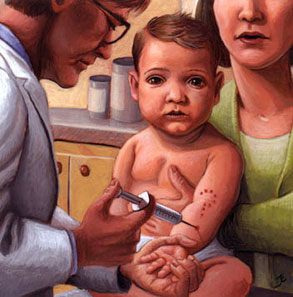

Autism

Secrets and lies

Is the astonishing rise in autism a medical mystery or a pharmaceutical shame?

As an Internet project manager in telecommunications, I am familiar with the symbiotic business relationship of industry and government. I understand the dynamics of profit, getting new products to market as quickly as possible, negotiating “value-added” partnerships, and above all the potential for ethics to be sublimated to the bottom line.

As a mother, I didn’t want to believe that the same business practices applied in medicine, because that would have meant accepting the possibility that my child was perceived first and foremost as a target market. A new mother is particularly vulnerable, and most of us harbor a trust bordering on reverence for the medical community, believing its members to be omniscient and above reproach.

When I held my baby in my arms for the first time and understood the magnitude of my responsibility, my faith in medicine translated into an implicit contract with my doctor: My job is to love him; your job is to keep him well.

And my baby was well, at least until 1998, when, at 2 years old, he was diagnosed with autism. When I read statistics from the Department of Education that said autism in school-age children had increased 556 percent in five years, skyrocketing past any other disability, I was shocked and horrified. But I trusted what my doctors told me: that the increase was due to better diagnostic skills, not to any real increase in autism.

It took two years for that trust to erode, chipped away by increasing evidence that business motives had mandated my child’s health. I learned that congressional investigations were underway into key members of the Food and Drug Administration and the Centers for Disease Control who vote on U.S. immunization policy despite a web of conflicts of interest: panel members who owned stock in vaccine makers, received research grants from those companies or even owned vaccine patents themselves.

I found out that vaccines given to my child had unsafe amounts of mercury, contained in the preservative thimerosal: a fact that led to the introduction this year of new “thimerosal-free” vaccines. I learned that last year a rotavirus vaccine was rushed to market too soon, without enough research, and had to be suspended by federal health officials because children were experiencing life-threatening bowel obstructions.

But it was during a conference this June that I crossed over to the other side, from conventional mom to vaccine-reform advocate, and began sounding more and more like Mulder in “The X-Files,” saying to anyone who would listen, “The truth is out there.”

At an autism conference in Irvine, Calif., I heard the first theory that made sense to me intuitively, not just about autism but about other children who were sick, children I could see around me every day, children of my friends, the “typical” children who shared my son’s classroom. Respected doctors and researchers presented evidence that the rise in autism over the past decade was related to immune system impairment, part of a spectrum of other childhood illnesses on the rise such as allergies, asthma, ADHD, learning disabilities and seizure disorders.

What was causing the immune system to turn against itself? The research was pointing to bombardment by multiple vaccines that overwhelmed the immature immune systems of infants and toddlers.

My son Connor was a perfect baby, the kind you see in commercials: engaging, happy, angelic. I had a normal delivery after a pitocin-and-epidural labor, and Connor scored a 9 on his Apgar, nursed vigorously, never had colic, smiled early and even laughed in his sleep at six weeks old. We figured we were doing everything right. When he got sick with his first ear infection at three months — the first of many to come — we did what most parents do: We relied completely on his doctor for treatment.

The American Academy of Pediatrics cautions against vaccinating children who are sick. I didn’t know this policy at the time, and apparently neither did anyone in the doctor’s office, because I was never told about it. What I did know was that he was supposed to get 33 vaccines before he started school, many of them simultaneously. My refrigerator magnet “freebie” of the vaccination schedule, included along with my complimentary diaper bag and free formula from the hospital, showed that he would be receiving as many as eight vaccines at the same time: combined measles, mumps, rubella (MMR), combined diptheria, tetanus, pertussis (DPT), polio and haemophilus influenzae type B. It seemed like a lot at one time, but I was simply grateful that the combination vaccines meant he would have fewer overall injections.

The ear infection and vaccination pattern continued unabated during Connor’s infancy and into his toddler months. His reactions to vaccines ranged from nothing to crankiness to occasional fevers. All of these reactions were considered normal, and all of them passed within a day. The ear infections became harder to treat over time, as if Connor’s system was building up an immunity to the frequent antibiotics.

One day in June of 1998 I noticed that his left ear was pushed out from his head. I had no idea what it meant but I took him to the doctor. Despite being on antibiotics, his latest ear infection had progressed into mastoiditis and he was rushed to the emergency room to get tubes in his ears that same day. The ear infections ceased. But an illness remained with him that was far worse than we had ever anticipated.

Much of his first year had been a period of triumphs. I marked his skills in my dog-eared copy of “What To Expect Your First Year,” noting with satisfaction that he was hitting all of his milestones early. I could see that he was a sharp kid, alert to the world around him, and I was proud of his precocious awareness. This ability to focus extended to people as well — he was compassionate and gentle in his temperament, possessing an unusual insight into the moods of the people around him. I honestly believed he showed early gifts of self-awareness and sensitivity to others.

Around his first birthday everything began to change. Connor regressed in his social behavior and speech and seemed to lose ground on all of his milestones. We had trouble getting his attention. We would call his name over and over again and finally had to look him in the face to get a response. At his birthday party, he was more interested in his balloons, ribbons and boxes than his new toys or the people celebrating around him. He would play with his toys repetitively and in unusual ways, like flipping over his bubble lawn mower to spin the wheels or rolling objects down a ramp for 30 minutes straight. Family members commented jovially that he might be a physics or engineering prodigy, already testing objects to see how they performed.

But when his language started to deteriorate, we lost any hope for his Nobel Prize and wanted desperately for him just to act normal. At 22 months he was mute; instead of pointing or naming things, he would lead one of us by the hand and place it on the thing he wanted. He preferred to watch the same video of “Thomas the Tank Engine” all day long rather than play with us. When people came over to our house he was shy, more than shy — he would run away and hide — and if we forced him out he would throw his body to the ground and scream.

I could see that the core of his real personality was still there, but I could only bring it out in him when he was totally at ease, which meant without distractions or interruptions in his routine. Even his diet changed for the worse. He would only eat about five foods — crackers, Cheerios, McDonald’s French fries, chips and cookies.

Time to take Connor back to the doctor, I thought. He’ll know. He’ll confirm my mom’s intuition that something is very wrong. But he didn’t.

“He used to talk and now he’s quit talking.”

“Well, he’s been sick from the ear infections. Have you considered having his hearing tested?”

“Yes, we thought of that. His hearing is normal. I’m also worried that he’s only eating a few foods, and he’s not getting any vegetables and fruits anymore.”

The doctor laughed. “My kids are extremely picky, too. As long as his weight is OK — looks like he’s in the 80th percentile — I wouldn’t worry about it. Toddlers are very finicky. As long as he’s getting a multivitamin he’s getting everything he needs.”

Meanwhile Connor is flapping his arms and spinning in circles. I watched for a while. “So he’s OK?”

My doctor’s forte was reassuring worried moms. “Of course. He’s fine. Let’s see him again in a month and make sure his weight is on target.”

As it turned out we didn’t see the doctor again for a few months. By that time Connor’s day care staff had evaluated his development and determined that he was autistic.

Months earlier, when we hadn’t suspected any problems, I had enrolled Connor part-time in a day care program that mixed typical kids and special needs kids. My mother was physically disabled, and I wanted Connor to grow up in an environment that didn’t exclude the handicapped. As it turned out the decision was a blessing — the staff therapists had seen plenty of autistic kids, unlike my doctor, who had never seen even one (and who admitted humbly, later, that he only got three days of education on autism in med school). But the day care staff was able to diagnose him earlier than many kids with the same condition, which was probably the key to Connor’s eventual progress.

I remember very clearly my first reaction to the label of autism: “But my kid’s not Rain Man.” And he wasn’t. When I started reading I found out the real statistics on autism, and they were scary. There was a new crop of kids who had what many called “acquired autism.” Unlike Dustin Hoffman’s character, the kids progressed normally until their second year and during that period lost any accumulated skills and socially retreated from people.

The late-onset kids made the current genetic theory suspect — if the cause was inborn, the kids would never have gained ground in the first place. Plus, the rate of these kids was staggering: In 10 years the incidence of autism had increased from one child in 10,000 to one child in 500. No one was sure why.

So I continued to go to doctors — immunologists to help me understand why Connor’s mosquito bites took six weeks to heal; neurologists to explain why his IQ was so low it couldn’t be measured; allergists to tell me why his cheeks and ears got red when he ate certain foods; gastroenterologists to relieve his constipation. Over and over again I was told that the outlook for autistic kids was grim, there was no treatment available for his symptoms, that perhaps I should consider putting him (and myself) on Prozac to help with his behavior.

Frustrated by the lack of sympathy and knowledge in the medical community, I networked with parents on the Internet and read as much as I could on my own. I decided to focus on cures instead of causes. Some parents had actually been able to “recover” their children with behavioral therapy, or ABA. This therapy used a one-on-one approach to teach autistic kids how to interact in the world, to talk, to socialize, to learn academic concepts, to regain the skills they had lost or never developed. We started within weeks of Connor’s diagnosis. In my heart and in my prayers I asked for one thing: Please, please let him say “mama” to me again.

And, amazingly, he did progress. One of Connor’s doctors, who had seen the results of the therapy with her own eyes, agreed to write a prescription for this treatment, and I sent it along with my claims to the medical insurer. The claim was denied because the therapy was considered “educational.” We continued to spend around $2,000 every month on behavioral treatment anyway. It was the only thing that was working.

Within a year Connor began talking again, regaining his old words first: mama (Yes!), daddy, cookie, no. Then he had a cognitive leap when language finally seemed to “click,” and he was off and running. He sought out adults and other children to talk to and play games with, caught up to age level in comprehension, bypassed his classmates in academics, and even developed a sense of humor (he renamed “Carnotaurs from Disney’s “Dinosaur” movie to “Connor-taurs”).

In March of this year he finally lost his autism label, after a year and a half (at 25 hours per week) of intensive ABA. His speech was still a year behind, but it was appropriate, and his therapists predicted that by the time he started first grade he would have the same basic skills as his peers. I breathed my first tentative sigh of relief — he had a chance of living a normal life.

It was only then that I began to focus attention back to the cause of Connor’s condition, and listened with interest to the congressional hearings on autism in April, spurred by Rep. Dan Burton (R-Ind.), chairman of the Committee on Government Reform. Burton had almost lost his granddaughter to anaphylactic shock after her DPT vaccination, and lost his grandson to autism within a week of the child’s receiving 11 vaccines administered in a single office visit.

I read the media coverage, too, most of it from medical professionals who pitied Burton’s situation, but tended to dismiss him with red herrings, “out-sensationalizing” Burton with claims that not vaccinating children would lead to outbreaks of life-threatening diseases. (A recent Newsweek story does this too, ending on the note: “Autism aside, the measles virus can kill.”)

But Burton wasn’t interested in eradicating the vaccine program, just in getting some answers about the rise in autism. He asked CDC representatives about their investigations of the Brick, N.J., township where the autism rate was dramatically higher even than the rising national average. He wondered aloud about California Department of Developmental Services statistics, now replicated in many states, that reported a 273 percent increase in autistic kids in the school districts.

Autism was an epidemic, Burton insisted to the CDC. What are you doing about it?

The vaccination issue had come up many times in online chats about autism, but I didn’t think it applied to me. Unlike many autistic kids, Connor was not whisked away to the emergency room after his MMR (mumps, measles and rubella) vaccination for seizures; he didn’t “turn” autistic within hours of his DPT. He had a few mild reactions, nothing more.

But I didn’t discount the parents’ claims: I knew these parents personally and respected their judgment. Many were doctors or research professionals themselves. The only thing that connected a lot of us was a common history of chronic infections, mainly ear infections, and consistent doses of antibiotics.

I decided to attend a conference on autism and learn more about the biological research.

Before I left I went through Connor’s photo album. I did this soon after he was diagnosed, but perhaps I was too close to him and too ignorant of autism to recognize dramatic changes. This time, I saw it: Connor at 11 months, smiling for the camera, looking into his daddy’s eyes, touching his mommy’s hair. Connor on his first birthday, after his morning visit to the doctor’s office and MMR vaccination, no longer looking at anyone, no longer smiling. And perhaps the most revealing picture: Connor walking on his toes, one of the most common behaviors in autism. Within a day he had changed.

The conference speakers presented the theory that autism was part of a spectrum of related immune disorders on the rise in children. The immune dysfunction in the body was triggered by reactions to multiple vaccines, either an ingredient in the vaccines themselves or the accumulated damage of multiple vaccines to the immune system. The body reacted by attacking its own cells, an “auto-immune” response, with reactions in the body ranging from mild allergies and behavioral changes to severe neurological damage such as autism and seizure disorders.

This evidence made a lot of sense to me because I was seeing these kids with my own eyes everyday — friends of mine whose kids were prone to severe allergies, asthma, attention and learning problems, all with no family history. When I was growing up, there was always one kid in the classroom who was allergic to eggs, who had circles under his eyes and pale skin. I never saw an autistic kid at all. Now I look around and see sick kids everywhere.

Dr. Andy Wakefield’s presentation was particularly compelling. A respected gastroenterologist at the Royal Free Hospital in London, he had been minding his own business studying inflammatory bowel disease and Crohn’s disease when he encountered something very curious that he hadn’t seen before. When he tested the growing number of autistic children who had come in with bowel problems, he noticed that their GI systems were damaged as if they’d been diseased for years.

Wakefield listened to parents about the late onset of symptoms, the similar stories of regression and the parents’ belief that vaccine damage may have caused the problem. When he ran more tests on the children he found measles virus in their GI tracts, where it wasn’t supposed to be. He published preliminary findings in a respected British medical journal, the Lancet, and immediately came under fire from colleagues in the U.S. and UK.

As I listened to the evidence Wakefield had gathered, I looked around at the other parents. There was no commonality among us — we were of all races and ethnic backgrounds and geographically spread out. A few of us had a genetic history of autism or allergies but most of us didn’t.

If you controlled for all of these factors, what common link was there? Controlling for genetics, allergy histories in families and environmental toxins from varied geography, there was only one candidate left that applied to all of us — a mandated vaccine program. Industrialized countries like the U.S., the UK and Canada were experiencing this tremendous rise in autism and other neurological disorders. And these were the same countries where modern medicine flourished.

Interestingly, Japan didn’t figure among the other countries’ high increase, and had withdrawn the MMR in 1993 because of concerns about adverse reactions. I started to become uneasy.

“I’m going to ask everyone a question,” said the conference host after Wakefield’s talk. “How many of you here believe your children have been damaged by vaccines?”

Seventy-five percent of the attendees stood up and raised their hands. One woman a few rows behind me was crying, and I knew intuitively that her faith in the medical establishment had finally crumbled. Her suffering was genuine; she sobbed quietly. When I looked back, she was embarrassed, covering her face with her hand.

But I was moved by her anguish, her private suffering, and I relived for a moment my own struggles since Connor’s diagnosis. The long nights of guilt I felt as a mother, constantly wondering what I had done wrong to give him autism; the long days of research to find a cure — the doctors told me to put him in an institution, but I wasn’t going to leave him; the countless doctor visits and tests Connor bravely endured without understanding why he was hurting or receiving little relief.

And finally — unsurprisingly — I was overwhelmed with rage. I felt it building within me and it was like nothing I’d experienced before. I knew very clearly at that moment that I had crossed over to the other side, that I was convinced my son was a cash cow for an industry that tested its products in production rather than the lab, motivated by $2 billion per year in profits, no different in its potential for corruption than any other industry.

There were no higher standards in medicine than in any other business — the rule of caveat emptor applied to vaccines as surely as it applied to any other consumer product. I could not trust the FDA and the CDC to protect me from pharmaceutical companies that wanted to get their products to market with as little testing as possible and to promote the repeated use of their products in order to maintain their monopoly under the guise of the public good.

I don’t have a medical degree, but I have learned how to be a thoughtful medical consumer. Connor’s up for his mandated boosters next year. I know now that he can have a simple blood test of his antibody titers, which measures his antibodies and confirms that he has the protection he needs against disease. I had the blood test done and he’s protected.

There’s no medical exemption from these boosters in my state for “sufficient protection based on antibody titers,” so I’ll have to use a religious exemption instead. I’ve accepted that there is no binding contract between me and the agencies and companies that purport to protect my child. But my bond with Connor remains, my responsibility as his mother expanding to include advocacy — even activism — along with love.

Lesli Mitchell is a writer and editor who specializes in education and technology. Her children's book about autism, "Party Train!," will be published in September by DRL Press.

Disabled — and handcuffed at school

Underfunded schools are facing an influx of students with disabilities -- and using increasingly brutal discipline

(Credit: Alexander Raths via Shutterstock)
This article originally appeared on AlterNet.

AlterNetThere’s a danger looming in schools today that’s putting our nation’s most vulnerable children at risk. Around the country, teachers and administrators are struggling to meet the needs of a growing population of disabled students, and they are entering school environments ill-prepared to educate these children responsibly, thanks to a lack of both adequate training and resources. This lack of preparation for handling students’ special needs is, in turn, sparking a disturbing and dangerous trend: the use of harmful “zero tolerance” policies that end in seclusion, restraint, expulsion and – too often – law enforcement intervention for the disabled children involved.

From coast to coast, the incidents are as heartbreaking as they are shocking:

  • In Brooklyn, NY, G.R., a 5-year-old autistic student, was traumatized when police were called to his school because he was having a temper tantrum. He was physically removed from the school by police and strapped to a stretcher, and when his family members tried to advocate for him, they were allegedly handcuffed. His grandmother’s ribs were broken in the altercation.
  • In Albuquerque, a 7-year-old with autism was handcuffed by police officers called to restrain him. His “offenses” included calling other children names, knocking over chairs, spitting, and shooting rubber bands at a police officer.
  • Tony Smith, a disabled student suing the Atlanta Police Department and his former school district, claims he was handcuffed to a filing cabinet for seven hours when the school investigated a crime that had taken place on campus. The officers involved, his suit argues, violated department policy and his civil rights.
  • In 2010, autistic student Evelyn Towry made national headlines when she was arrested after becoming agitated because her teacher wouldn’t let her wear her favorite cow hoodie. Her Individualized Education Plan (IEP), which detailed her needs and how they should be met specifically, included a clause allowing the school to contact law enforcement in the event of disruptive behavior, though her parents report they neither saw nor approved the document.

Cases like these, of students trapped by school policies rarely designed to deal with the nuances of their diagnoses, are growing – and the situation is further clouded by race, class and social factors. These factors can determine what kinds of evaluations, interventions and treatments are provided to students with disabilities or suspected disabilities, and they ultimately decide whether children are able to successfully complete their educations or fall by the wayside.

Race, Disability, and Discipline in Public Schools

The increased use of law enforcement to deal with behavioral issues in schools gained heightened attention this year when Salecia Johnson, age 6, had a temper tantrum in her principal’s office and was handcuffed and detained by local police as a result. She was so traumatized by the experience that she has trouble sleeping at night – and she’s not the only one.

Such situations are growing extremely common across the United States, with school districts calling on police to handle routine disciplinary infractions rather than dealing with them on their own. Many have adopted harsh zero-tolerance policies, where infractions are handled with a one-size-fits-all model, regardless of age, ability or the larger context in which the infractions took place. These policies can effectively set some students on the path of what the Florida ACLU calls a school to prison pipeline – and, notably, many of the victims of this system, such as Salecia, are minorities.

Racial disparities when it comes to school discipline are well-established in the United States; students of color are twice as likely as their white peers to be subject to out-of-school suspensions, according to the Department of Education’s 2012 Civil Rights Data Collection. Yet often, there’s more to these cases than meets the eye, because many of the minority students who find themselves harshly penalized also happen to be students with disabilities, many of them undiagnosed.

Annie Linden is a former teacher who taught in districts primarily composed of low-income students of color, and she still participates in the preparation of Individualized Education Programs. In an interview with AlterNet, she noted that many of her former students showed signs of cognitive disabilities that went undiagnosed, sometimes due to parental fears about deportation or concerns that their children might be removed from school. The data suggest that these parents were right to be afraid: Students of color are already at a higher risk of expulsion, and disability can compound that risk.

Studies in individual states lend support to the critical importance of discussing race and disability together in the context of school discipline; this is particularly important given the considerable funding disparities between white and nonwhite children when it comes to disabilities like autism. Students of color are generally less likely to be diagnosed with disorders of these kinds, making it still harder to provide them with the support they need in educational settings.

When Disability Meets District Policy

Even without counting the many children with undiagnosed disabilities in schools today, we know that the overall number of disabled students in our public school system is on the rise. Increasingly, school districts are tasked with educating students with a wide range of intellectual, cognitive and emotional disabilities, rather than physical disabilities, as in prior decades. In theory, our ability to identify these disorders earlier than we could in the past should ensure that students get the support and access they need to succeed in school, including individualized education when it is appropriate. But in practice, the rise in disabled students is crunching school districts terribly, as funding for these students has not at all kept pace with the rise in diagnoses. As a result, many schools are now hard pressed to serve their students’ educational needs and deal with disciplinary issues.

As funding for special education drops and available staff members dwindle – and as disabled students with behavioral problems are increasingly mainstreamed in response to changing thinking on disability education – discipline is becoming a large problem in a growing number of mainstream classrooms. In response, some districts have decided to bring out the heavy guns for handling disruptions associated with disabled students; from outbursts in class to tantrums in the hall, the new go-to solution in many districts is to call the police.

In addition to calling on law enforcement, Disability Rights Oregon notes that there has been an uptick in the use of restraint and seclusion in schools, as well. The organization points out that these practices appear to disproportionately target disabled students and can be fatal in some cases.

Last month, 16-year-old Corey Foster died after police were called to restrain him. Though Foster’s disability status is unclear, he was attending a school for at-risk youth that included a number of students with disabilities, and his fellow students say restraint is a common disciplinary tactic.

In Jackson, Mississippi, students at an alternative school are routinely handcuffed for discipline infractions, and many of them have emotional or intellectual disabilities. Such treatment of disabled students is not uncommon; the Judge Rotenberg Center, for example, has been under media scrutiny for years due to practices like shocking autistic students. And a study on the use of restraint in Texas schools has indicated a looming “crisis in special education” as growing numbers of disabled students are restrained by their teachers, sometimes unsafely because these teachers had never been trained to perform such techniques appropriately. These cases involved school staff, not law enforcement, but they are part of a larger pattern of criminalizing disabled students that has been criticized by disability rights organizations.

In response to these reports, the National Disability Rights Network has called for an end to restraint and seclusion in US schools, and along with that comes a radical need to rethink the use of law enforcement in the management of disabled students. Police officers are typically not provided with specific training in working with disabled children, let alone handling the de-escalation of a situation where a disabled child is frightened and potentially reactive. As public safety officers, their primary professional goal is not to provide disciplinary support in schools except in special circumstances – and routine discipline is not a special circumstance.

Clearly, the use of police officers to assist with school discipline is out of proportion to the need, and yet it persists. Some school districts, such as Evelyn Towry’s, mandate a law enforcement provision in IEPs, which allows the school to call police officers to assist with discipline problems, often under a vague mandate that could involve anything from an episode of extreme violence to stubbornness in the classroom. Others districts may strongly advocate for it, or push for frequent review of disabled students to determine if such a clause should be added. Rather than focusing on handling behavior before it gets out of control, districts are handing their students over to third parties when the going gets rough – and disabled students are the ones paying the price for those decisions, often finding themselves suspended for extended periods of time over behavior they cannot be expected to control.

Teachers Struggling in Understaffed Environments

So why the push to outsource discipline? Blame austerity measures again, which, on top of poor disability funding, have hit a number of districts hard. That’s a recipe for frustration, and sometimes danger, when it comes to providing a safe and educational environment for disabled students. Teacher Alicia Maude Wein from Guildeland High School in New York explained to AlterNet via email how her classroom support had radically decreased:

[Before], it was me, a co-teacher with a literacy/special ed degree, and three additional adults providing support — 5 adults every day to the 18 kids. This year, after 2 rounds of deep budget cuts (in a relatively affluent suburban district), it’s just me.

Overwhelmed by conditions like this, teachers struggle to keep order, and Wein says she understands why districts might be tempted to turn to outside options:

think similar circumstances (or worse) could be lending to the desperation that would sway some districts to call in outside supports like law enforcement (as grim, disrespectful and embarrassing as that notion is) when things get out of control in the classroom.

She noted that her district is generally supportive, promotes mainstreaming of disabled students, and works with students, staff and parents to create a productive environment, even under the stress of budget cuts. The same can’t be said of all districts, though, and in some cases the various pressures can create an explosive mixture: When staff without training for handling disabled students encounter autistic students mid-meltdown, for example, they may not know how to respond, and they could end up traumatizing students in an attempt to impose order.

This lack of teacher and staff training is a serious matter for both teachers and students; Wein herself pointed out that she’d taken just three credits in Special Education 15 years ago – and yet today she is faced with teaching and managing a classroom of disabled students. As the Michigan Education Association warns :

Because school personnel are not trained to work with children whose violent behavior stems from a disability and where the possibility of injury is discounted by the District, they daily face a situation they are ill-suited to handle without suffering injury, both physical and psychological.

Without the support they need to deal with disabled students and the training they need to effectively and humanely handle their behavior, there should be little surprise that so many teachers and administrators are allowing law enforcement to deal with these issues instead. But as Vicki Soloniuk, a pediatrician who works with disabled children and helps their parents to advocate on their behalf, pointed out in a conversation with AlterNet, the turn to these punitive measures can actually enflame a disabled student’s behavior rather than defuse it.

She explained that children with cognitive disabilities often have difficulty adjusting to new situations and strangers, so when an outside party like a police officer is called in, these children may experience extreme emotional distress. This can manifest in kicking, hitting and screaming – a fairly typical response among cognitively impaired children, but certainly unnerving if you have no training in dealing with such behavior.

“We tell our children to stay away from strangers,” Soloniuk said, “and then we don’t understand why they react poorly when the school calls in an outsider, someone a student has never met.” Like many school districts in the United States, the district Soloniuk works in responds to incidents like these by isolating the child involved, a mistake which can create even more behavioral problems. Soloniuk notes: ”The school hides a 7-year-old with autism alone in a classroom all day, and when they bring him out once a day, he starts flapping and stimming, because he sees all these kids around. So the school responds by saying, ‘He can’t handle it’ and locks him up again.”

She views such isolation as tantamount to torture and points out that it’s also ideally suited for creating further difficulties in the future because the student never has an opportunity to socialize. One way to address the issue, she says, is to get teachers and support staff fully trained; two working sessions a year, for instance, would allow everyone in a school to learn how to interact with disabled students so they can mainstream more successfully and be supported outside the special education classroom.

More Training, More Support Needed

After years of experience in the school system, Alicia Wein says she has come to feel comfortable with her disabled students, and she invests energy in interacting with them and their parents to learn more about their personalities and learning styles before entering the classroom. But not all teachers have this level of experience or the time required to give high-level individual focus to disabled students.

To begin to address these discrepancies, districts such as Wein’s are demanding that their teachers pursue more professional development, particularly when it comes to dealing with students with autism. Congress is also tackling the issue; lawmakers are currently pushing for better teacher training to help educators handle students with autism more effectively. Such training undoubtedly will be beneficial for both teachers and their students, but it certainly won’t solve the problem we’re facing entirely; even an experienced teacher with additional professional development can’t be expected to keep order all alone in a classroom of 12 students with severe disabilities.

Simply put, districts also need more trained staff on hand. Teachers handling mainstreamed classes require support to balance the needs of their disabled and nondisabled students and to make sure that every student is provided with the educational material and assistance he or she needs. Without staff support, students inevitably begin to fall through the cracks, and one consequence of that can be an increase in disruptive behavior. Overburdened instructors may fail to identify the warning signs of a tantrum or meltdown, for instance, making it difficult for them to intervene early on – before things have escalated beyond their capacity to deal with them. And even if they do spot a troubled student who needs more personalized attention, that level of engagement can often be impossible to provide in a classroom with 25 or more additional students vying for their attention. Trained staff can help mediate situations like these.

Another issue that came up again and again with educators who spoke to AlterNet was the impact of our increasing reliance on standardized testing to measure performance in the classroom. High-stakes testing creates a highly pressured environment for teachers, who are forced to focus on the tests rather than on their students’ learning needs – especially if the teachers don’t have tenure or secure positions in their districts. All students, regardless of disability status, suffer in this environment, where teachers are asked to view students not as individuals, but as aggregate test scores.

Bottom-up educational reform often focuses on teachers and blames them for the failures of the educational system. But this approach largely ignores the structural issues plaguing many districts as they fight for funding, cut student and staff services, and live in fear of the latest test results and what they mean for the school’s future. For students with disabilities, these issues are further complicated by the need to access a functional educational environment where they will be safe from harm and not at risk of run-ins with the police. In this educational landscape, it’s hard for disabled students to learn, let alone realize their full potential.

Poor training, funding cuts and increased pressure to teach to the test don’t add up to much for the most vulnerable students in our schools – or many of the other students, for that matter. “Sadly,” Vicki Soloniuk points out, “we don’t seem to care very much about our kids in this country.”

s.e. smith is a writer and editor whose work has appeared in Bitch, Feministe, Global Comment, the Sun Herald, the Guardian, and other publications. Follow smith on Twitter: @sesmithwrites.

Continue Reading Close

s.e. smith is a writer and editor whose work has appeared in Bitch, Feministe, Global Comment, the Sun Herald, the Guardian, and other publications. Follow smith on Twitter: @sesmithwrites.

Grandin on the autism surge

Temple Grandin tells Salon what the new numbers mean to her, and why increased autism awareness isn't always good

Temple Grandin (Credit: Rosalie Winard)

In the last few weeks, new autism figures have created widespread controversy among American parents. In early April,  the CDC released its latest, shocking report on the disorder, which showed a massive uptick in the number of diagnoses — according to the numbers, one in 88 children and one in 54 boys are now on the autism spectrum. That’s an astonishing 78 percent increase since 2002. In the weeks since, pundits and doctors have spent a lot of time debating what these changes actually mean: Are they due to increased detection, loosened definitions of autism or are we in the middle of a genuine upsurge in autism among American children? As Dr. Thomas Frieden, the director of the CDC, told reporters, this change may “entirely the result of better detection. We don’t know whether or not that is the case.”

For Temple Grandin, the country’s most high-profile autistic person, this news is a source of both relief and concern. Grandin was diagnosed with autism at the age of 2 and didn’t speak until age 4, but went on to become one of the country’s best known authorities in livestock facility design. (In 2010, she was the subject of a well-received HBO biopic, “Temple Grandin.”) Grandin is also the author of several books, including, most recently, “Different … Not Less,” a collection of inspiring personal essays by people on the autistic spectrum who are also gainfully employed. The collection, she tells Salon, was meant to inspire young people with autism to attain successful working lives.

Salon spoke to Grandin over the phone about the newest autism numbers, the problem with autism awareness — and what the government can do to help parents with kids on the spectrum.

The CDC recently released a shocking report that showed a huge uptick in autism numbers. What do you make of it?

I’m very familiar with those figures. One big question that’s come up is: Has autism increased on the mild side of things? I don’t think so — they’ve always been here. Some of this is increased detection. I’ve worked with tons of people that I know who are on the spectrum — but now I think severe autism has really increased. There may be environmental contaminants. I read an article the other day that a supposedly very harmless pesticide on cattle was making bulls infertile, so this brings up the issue of genetics.

There is some concern that by expanding the numbers of people with autism, the CDC is diluting the autism diagnosis.

The problem with these diagnoses is they’re not precise. They’re talking about changing the DSM and replacing it with Social Communication Disorder and they’re sitting around in rooms discussing it. It’s not a precise diagnosis like tuberculosis. You show certain behaviors, like social awkwardness, or fixated interest or repetitive behavior, and that’s labeled autism. But it’s a very big spectrum. On one hand you’ve got people working in technology jobs and on the other hand you’ve got someone who’s nonverbal with epilepsy, and that’s one of the big problems. Steve Jobs would probably be on the spectrum, and so would Einstein.

On the other hand, this newly expanded number may also make a lot of parents of kids with autism feel much less alone.

I think that’s really important. When I was young my mother was totally alone. It would have definitely made a lot of difference. She would have had other parents to talk to in a support group and none of that existed in the ’50s.

Nevertheless, while people have been talking a tremendous amount about autism and Asperger’s in recent years, you suggest that’s not been entirely productive for children with autism.

To a certain extent it’s a good thing. On the other hand, you get to the smart kids who could go have successful careers in Silicon Valley getting held back by labels. One kid goes to Silicon Valley, the other stays home to play video games, and they’re the same geek. I visit people in [autism] meetings, and a 9-year-old will come up and want to talk about his autism. I’d rather talk about his science project. You get fixated on your favorite thing as a kid, and now kids are getting fixated on autism instead of dogs or medieval knights. I’d rather get them to fixate on that something that could give them a career.

Is that the reason why you put together an essay collection like “Different … Not Less”?

The thing that motivated me to to put it together is seeing way too many people with high functioning autism and Asperger’s not getting jobs and making transitions to adult life. Having worked in a technical field my whole adult life, I think, “Where are the aspies?” I think about people I went to college with, the geeky kids, different kids. One of the things hurting people with Asperger’s today is they’re not being taught social skills from old people on the spectrum who managed to be employed their whole life.

So we got about 25 entries [for the book] and I picked half of them. Some of them are people well known in the autism field but I also wanted to have a wide variety of people. They had to be employed their whole life and have an actual diagnosis, but they all had childhood jobs, they all were bullied in school, and I wanted to show that to young people on the spectrum. I didn’t fill it up with happy people in Silicon Valley. There is a person who is a tour guide, a doctor, a psychiatric aide, retail clerk, advertising executive. There’s a real big variety of people, and they talk about how the diagnosis helped them to understand their problems.

There was one person who was a computer lady. Her dad died and she was devastated by that. She got diagnosed because she got depressed. Her boss asked her, “If you’d gotten the diagnosis when you were younger, would you have achieved what you achieved?” The problem with some of the young people on the spectrum is that parents are reluctant to push them out of their comfort zone, and they’re unemployable. I wanted to show in this book that we can succeed.

The same week the new CDC figures were released, another study found that mothers of autistic children are 56 percent more likely to be under the poverty line. Why do you think that is?

Autistic children are very difficult to take care of, especially severely autistic ones. When I was 4 I had almost no language; when I was 3 I had none at all. It’s much more work for the mother of an autistic child to have a job, because working with an autistic child is such a hassle until they go to school. Then it might be easier, but there are still likely to be more interruptions and things, and a mother might be restricted on what she can do in terms of travel.

What do you think needs to be done in order to change that?

My mother’s been working with a group called Families Together. For a family that has severely autistic kids, the divorce rate is through the roof. [Families Together] put on weekends where families meet up and they get the whole family working together so they don’t get so frazzled and fall apart. That’s a huge issue.

Should there be more government support for parents with kids on the autism spectrum?

Parents need to have respite so they can go out to a restaurant and have some time off. That’s a huge problem for parents. And then there’s the cost of therapy, a lot of schools have only two hours of speech therapy per week. If you talk with these kids when they’re very young, 20 to 30 hours a week with a good teacher, that improves the prognosis. But then you also need better services for adults. If you’ve got a non-verbal adult, what happens after he’s 21 or 22 and he ages out of school? That’s a huge problem, especially for severely autistic adults.

Continue Reading Close
Thomas Rogers

Thomas Rogers is Salon's Arts Editor.

The new autism reality

The recent stats may seem scary. But as a mom who worried in solitude, I know there's hope in not being alone

(Credit: ZouZou via Shutterstock/Salon)
This story was originally published on Ann Bauer's blog, The Forever Marriage.

The first person I ever heard call my child “autistic” was the story lady in the children’s section of the Duluth Public Library. January 1991.

My young husband and I had moved to the Iron Range for a number of romantic reasons. We thought it was beautiful and in some way more “authentic” than the place we’d been living. We also believed the clean lake air would cure the asthma suffered by our younger son. What we failed to take into account was the 14 percent unemployment and a taconite-weary city with little but service work.

So Jim was stringing together two backbreaking, low-paying jobs and I — the 24-year-old mother of two — was trying to fill the long, icy, dark winter days. The library was my best bet. But on this particular afternoon, my nearly 4-year-old was behaving oddly. He wouldn’t sit with the other children for story time. He kept flapping his hand in front of his eyes. Twice, he jumped up and went to the wall, where he flipped the light switches madly back and forth.

I was in the stacks looking for books and swaying my baby in his homemade sling when the story lady marched up, pulling Andrew by one hand. “This child is no longer welcome at story hour,” she said, pushing my son toward me as if he were a distasteful meal. Then she headed back to the waiting group of normal kids, but turned and said over her shoulder. “You better get him checked out. I think he might be autistic.”

In that moment, the sinister, sub-zero wind from outside entered my bones. The word “autistic” was monstrous. I wasn’t quite sure what it meant but it evoked for me something haplessly and forever broken. Part crazy, part retarded. Entirely lost and never to be found.

I had seen the Dustin Hoffman movie “Rain Man” — while I was pregnant with Andrew, in fact. Thank God, it came out the year he was born. But this was everything I knew about autism. Not a soul among my family or friends back home had ever met an autistic person. When I used the term they flinched, as if I’d said something sacrilegious.

Eventually we moved to Minneapolis, where a few people did know autism. Still, I watched as Andrew went through kindergarten, the only child in his class who could recite the letters of the alphabet both forward and backward. Also the only one who needed a rocking board to sit on during the morning meeting. At recess, he stood solitary on a knoll overlooking the other children as they played, like some scientist come to study a completely alien kind.

Through grade school and junior high, he was the only one. Because it turned out he wasn’t retarded; he was perfectly capable of learning math and science. The things he couldn’t do were random yet essential: hold a conversation, choose something to eat from a menu, focus on a teacher’s voice among the maze of classroom noise.

For years, I rejected the label. Yes, he stimmed and rocked and flapped. He had an absent sort of presence; you never knew when he was actually attending. But Andrew was verbal and he made connections to people. He played a mean game of chess. How was he different from Hasidic Jews who rock and mutter, or professors who get lost on the way back to their offices after lunch?

Finally, when Andrew was a teenager and things got awful, I capitulated. The label opened doors — maybe too many. My son got services he needed, as well as treatment that I believed then (and believe still) was unnecessary. Yet he still moved alone through the world, the only one of his high school class to wig out before graduation and spend three months paralyzed and mute. The only one to move from his parents’ home into a group home.

He was — and this part still gives me hope — generally liked by his classmates, but had no clue how to relate to them. Andrew had only one carefully arranged date. Facebook struck him as useless. He was left with shards of clear memories but no sense of community. Because he stood, as on that knoll in kindergarten, utterly alone.

- – - – - -

Andrew is 24 now. He’s an extraordinary painter, working at a gallery full of artists who are like him … and artists who are not. He lives in a home with three other young men, one of whom shares his talents and eccentricities. They play basketball on the weekends. Andrew is a fierce and highly rated player on the circuit for tournament chess.

I can finally use the term “autistic” without feeling that sweep of chill from the Duluth Library. But I do it only out of laziness and expediency. He’s really just Andrew. This is his life.

When I read stories about autism (and there have been plenty this week) it’s like reading about a city where I once lived. Providence, R.I., for instance. Their headlines catch my attention and I feel a tiny pull: Those are my people, too. But they really aren’t, of course — haven’t been for years. So I move on.

Nearly all the news and research about autism is, frankly, beside the point for my son and for me. It’s lasered in on babies, on “early detection,” on causes, rates, costs and sweeping societal changes. But if one thing is clear, it’s this: These kids and their families, no matter where they fall on the spectrum, are no longer alone. Chances are, mothers know other mothers in their very own neighborhoods who are implementing identical gluten-free diets and cutting the tags out of their kids’ clothes. The library story hours are prepared for these children; they welcome them and provide special rocking boards.

When the CDC announced recently that one in every 88 children has autism, some parent groups remonstrated. They’re worried that the continually broadening criteria will dilute services for people who are really in need. Or (and I’m speculating here), they’re resentful that the specific burden they’re carrying is being minimized by those whose situation is not nearly so dire. Parents raising mute teenagers who can never be toilet trained may not want to share a diagnosis — and social service dollars — with those whose computer wizard boys seem a little “Asperger-ish.” Which I can understand. And I feel for their frustration.

But my response to the news is a little more hopeful. If one in 88 among us is this way, it makes autism seem a little less terrifying and abyss-like and a little more like something that just happens in life.

Today, when people ask about my children, I tell them my oldest has autism and the vast majority nod without horror. They act like I said he has Crohn’s disease or some other lifelong but manageable condition. They ask if he’s going to college, if he’s married, what he does for a living. With the “creep” of this diagnosis has come a welcome acceptance. My son, like a lot of people, is struggling with something difficult. But he’s doing so valiantly, and it doesn’t define him.

It certainly doesn’t define me.

I must admit that the other big autism news from this past week — an article in the journal Pediatrics that said mothers of children with autism earn 56 percent less than mothers of “typical” children and 35% less than mothers of children with other disabilities — really, well, pissed me off.

My first novel featured a character with autism (or something like it), so I’ve met plenty of mothers. They come to my readings; they write me letters late at night. All in all, they’re an interesting lot.

I particularly like the older moms, the ones who were raising kids with autism back when I  was still a kid. In the ’60s and ’70s, practically no one knew the meaning of the word. And those who did likely as not adhered to the Bettelheim theory that the mother was to blame. Yet these ladies — the ones I’ve talked to, at least — forged on and lived heartily. Many of them have adult sons still living with them. (The rate remains four to five boys for every girl.) They are retired schoolteachers or secretaries. And autism was a burden, yes, but it did not completely dictate their lives.

I was divorced when Andrew was 12; my younger children were 9 and 5. My ex-husband did not pay child support — not out of any character defect on his part, but because his income wasn’t sufficient. So I made my way — working like crazy, screwing things up, moving too many times, not paying enough attention. I was far, far from the perfect mother and there are so many things I ache to go back and change. But I lay none of that at the feet of my son.

Nor do I ascribe my income, or lack thereof, to my kid.

I can attest from experience that divorce is rampant among moms of children with autism. And that’s a huge factor in women’s income. At the same time, one of the coolest women I know is the single mother of a teenager with cerebral palsy, autism and bipolar. She attends to her son solo more than half-time. She’s also one of the most successful securities brokers in town. Her clients start investing at a million and a half.

Granted, we’re only two women. Hardly a representative sample. But as I said, I’ve met literally hundreds of mothers in my travels. And here’s what I’ve observed.

There is a large group of women with kids on the spectrum so riveted and driven by the condition that it consumes their lives. They identify themselves as “autism advocates” on their Facebook pages. They attend government panels and testify. They refer to their children’s caregivers as their “staff.”

And they befuddle me.

Because my impulse is — has always been — to insist that my son exhibits just one of the myriad ways to be human. I don’t want the government categorizing him; nor do I want the bureaucracy deeply involved in his day to day. His teachers, caregivers, resources and therapists are not mine. They’re his. He’s leading his life bravely and with an amusing tilt that adds oodles to this world. It’s up to me to live mine.

Worried that I was being narrow in my thinking, I spoke to my friend Kate Barrett, a cultural anthropologist who taught at Stanford. She had a slightly different, but enlightening, take on the stats.

“I think this has less to do with autism than it does with a greater shift in how we parent,” Kate said. “Parenting today has become an acceptable out, what we call a ‘master identity.’ It’s become a way we don’t do other things in our lives: whether it’s fashion, whether it’s work, whether it’s romance, whether it’s fitness. Being a parent — especially being a mother — becomes an acceptable excuse for not doing other things.”

Put the two things together: the wind tunnel of autism, its skyrocketing rates and all its special treatments, diets and educational plans, plus the tendency to locate the role of “mother” at the center of everything. It is, as they say, the perfect storm.

- – - – - -

Perhaps it’s just me, being contrary. But when I put together the swirl of talk and data about autism, it feels as if we’re getting closer to a fundamental truth. People are odd and imperfect and random — particularly the interesting ones — and there is an urgent need for us to make room. Expand our definitions. Soften our lenses a little. Love unstintingly without becoming obsessed.

It’s taken me 20 years to learn these lessons and I have to learn them over and over again. My best teacher is my son, Andrew, who said to me when he was quite young, “I need to get you off from hanging on my back.”

He is stoic these days, telling me little. Which is appropriate for a young man his age. What he does in his spare time and with whom — it’s not really my business. I’m grateful that he still wants to meet me for coffee at least once a week.

In a wonderful bit of kismet, my office is about four blocks from his studio. And though I try not to abuse the privilege, I will sometimes walk over to see his new work. On Monday, he showed me the self-portrait he had painted, which not only looks like him — but somehow conjures up his spirit. He is serious but not unhappy. Magnetic, however silent. And yet alone. Himself.

Continue Reading Close

Ann Bauer's novel, "The Forever Marriage," will be published by Overlook Press in June. This article came from her blog, which you can read at www.theforevermarriage.com.

Bachmann: It’s ok to spread lies about vaccines because I never said I’m a doctor

After claiming that the life-saving HPV vaccine causes "mental retardation," the candidate declines to apologize

Republican presidential candidate, Rep. Michele Bachmann, R-Minn., speaks during a rally in Costa Mesa, Calif., Friday, Sept. 16, 2011. (AP Photo/Chris Carlson)(Credit: Chris Carlson)

The other day, Michele Bachmann said that the HPV vaccine made someone “mentally retarded,” which is not only untrue but also the sort of remark that leads to parents denying their children vaccines that could save their lives.

When confronted on this, after a few days of both liberals and conservatives decrying her, Bachmann did not really apologize or correct the record. Instead, she said it’s OK for her to say things like that because she never told anyone she’s a doctor. As long as you don’t lie about a doctor, you can claim anything you like about medical matters, on TV, and it’s OK! (I’m not a doctor but I heard that if you make your baby wear a onesie with a “funny” slogan on it your baby will die.)

From the San Francisco Chronicle:

“I didn’t make any statements that would indicate I’m a doctor, I’m a scientist, or making any conclusions about the drug one way or the other,” she said, adding she was merely relating the concerns of a woman who was “very distraught” and who supported her view that Perry’s actions were wrong.

Asked specifically if she would apologize for the HPV comments, Bachmann said, “I’m not going to answer that question.”

So, no, she will not apologize for that. She won’t apologize because she still needs the HPV issue to hammer Rick Perry, which she is still attempting to do.


No more “retardation” talk! Just “mandates” and crony capitalism.

Michele Bachmann, by the way, did used to campaign around Minnesota as “Dr. Michele Bachmann.” Bachmann called herself “Dr.” because she has a J.D. from Oral Roberts University. (While some lawyers argue the point, “Dr.” is generally reserved for medical doctors and people with Ph.D.s.) But she hasn’t called herself “Dr.” recently, so make sure not to take any medical advice from her.

Continue Reading Close
Alex Pareene

Alex Pareene writes about politics for Salon and is the author of "The Rude Guide to Mitt." Email him at apareene@salon.com and follow him on Twitter @pareene

Michele Bachmann moves to the left (on crazy conspiracy theories)

The suddenly flailing 2012 candidate adopts the popular liberal myth that injections are dangerous

In a Thursday, Sept. 8, 2011 photo, Republican presidential candidate Rep. Michele Bachmann, R-Minn., delivers the Republican response to the speech by President Barack Obama to a joint session of Congress at the Capitol in Washington. Starting this weekend, Bachmann plans to campaign almost exclusively in Iowa as she tries to reassert herself in a race that's become a two-candidate contest between Texas Gov. Rick Perry and former Massachusetts Gov. Mitt Romney. (AP Photo/Cliff Owen)(Credit: Cliff Owen)

Michele Bachmann said that the HPV vaccine makes babies “retarded.” This is easily the dumbest, most irresponsible and inflammatory comment she’s made in years. It began at Monday’s debate, when she attacked Rick Perry for his now infamous decision to require that girls receive the vaccine. “Little girls who have a negative reaction to this potentially dangerous drug don’t get a mulligan.”

She accused Perry of only supporting the policy for money:

What I’m saying is that it’s wrong for a drug company, because the governor’s former chief of staff was the chief lobbyist for this drug company. The drug company gave thousands of dollars in political donations to the governor, and this is just flat-out wrong. The question is, is it about life, or was it about millions of dollars and potentially billions for a drug company?

She got worse after the debate, on Fox and the “Today” show, when she said an unnamed mother told her that her daughter became “retarded” after receiving the vaccine.

Obviously there are no cases of kids becoming “retarded” after receiving the HPV vaccine. I am pretty sure Bachmann meant to reference the popular myth that vaccines (usually the common MMR vaccine) cause autism, but she got confused.

So she either repeated some hearsay some random person told her as factual at a nationally televised presidential debate and then twice more on television because she’s an imbecile, or she is cannily reaching out to the sizable number of paranoid parents with misguided concerns about vaccines. She has a very good ear for the sort of scary story people half-hear on the news or get the gist of third-hand from a friend — her first school board run was built on horrible tales of what the government was secretly doing to your children.

So, in that sense, this is completely unsurprising. Bachmann is an avowed enemy of science, running to represent a party that of late has decided that scientists are untrustworthy liberals. She has a long history of parroting conspiracy theories and believing and repeating anything she hears or reads that reflects her biases.

But this isn’t your typical right-wing conspiracy theory, about climate scientists plotting to destroy capitalism, or the U.N. using bike-share programs to institute a world government. This, this is a liberal conspiracy theory.

The “vaccines cause autism” lie is as liberal as conspiracy theories get. Crunchy coastal elites, panicky about the health of their babies in a world full of “toxins,” are the ones not getting their kids vaccinated these days, because of something they read on the Internet (or saw on “Oprah”). The story has traction in part because it’s anti-corporate. It insinuates collusion between the government and those damned pharmaceutical companies that are only out for profit. (The scientists, too, are in the pockets of big pharma!) This stuff doesn’t get much play on the right, because it doesn’t tap into the foundational myths of the conservative movement or play on their tribal fears. Right-wingers are more concerned about their babies being exposed to the mental toxins of liberal indoctrination than, say, mercury.

This is why Ace of Spades is mocking her. It’s why Rush Limbaugh said she “jumped the shark.” It’s why the Corner featured multiple posts strongly decrying Bachmann’s “dangerous flirtation with the anti-vaccine movement.” Conservatives oppose giving girls the HPV vaccine because they want premarital sex to have (potentially deadly) consequences, not because they think vaccines are inherently dangerous.

But vaccine panic is big. It’s specifically big with mothers. With Rick Perry sucking up Bachmann’s support, she needs to branch out a bit. This is her version of “moving to the center.” Michele Bachmann moderates her message by adding liberal conspiracy theories to her repertoire.

What is actually funny is that Perry only ever did the right thing in the first place for the wrong reasons. Everything Bachmann said about the Gardasil deal being an example of crony politics is totally true! A drug company hired Perry’s former chief of staff to lobby him to do something that would make them money. But sometimes the special interests looking to maximize their profit are maximizing their profit by doing something good. (Like, say, Internet companies fighting for net neutrality.) The lesson here is that Planned Parenthood should give Rick Perry a couple thousand dollars and watch him turn pro-choice.

So Bachmann, in going after Perry for coziness with industry lobbyists while also latching on to vaccine toxin panic, is now the Republican Party’s most liberal 2012 candidate. (She did already go after Obama on the African-American unemployment rate. Maybe she’s been a leftist this whole time!)

Continue Reading Close
Alex Pareene

Alex Pareene writes about politics for Salon and is the author of "The Rude Guide to Mitt." Email him at apareene@salon.com and follow him on Twitter @pareene

Page 1 of 10 in Autism