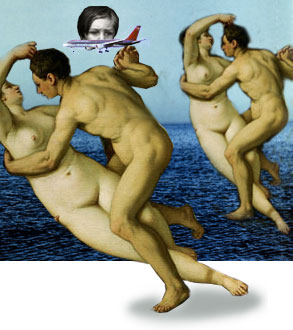

Sex
Sex and this boy flying
They don't get sex right. Can we please get sex right please?
There is the thrashing around of sex and there is the young boy on the plane to England.
First the boy: I don’t know the child — a friend told me the story. He told me of an American family relocating to London. Exhausted by the enthusiasm of his first plane ride, the young son falls asleep over the Atlantic. At Heathrow, his parents carry him from the plane to baggage claim to their taxi. He wakes finally, groggy and quiet.
He lives in England. He is like any child so he looks at animals and attends school and gets haircuts now and then. One day sipping milk at the breakfast table, he looks up at his parents: When, he wants to know, will they get off the plane?
There is that and there is the light shifting almost obscenely after sex. Because of dusk it’s gone blue. The universe’s great sad moments come in this blue and, as though stoned, I decide I’ve never seen the world quite as it is now. The fly butting the window pane from the inside, the cat with the dirty ears just beyond, the space that opens between two bodies recently inseparable, a space unveiled like a —
Let’s go pal, she says.
I’m up, mopping off. We have a movie to catch.
My clothes trail from the bed like adult breadcrumbs. Sex when it’s done begins again in replay; dressing, I recall the precipitous examination of the spider bite together on the couch, knees touching.
Having sex is preferable to remembering it, but then having it doesn’t come with a pause button. I am slow-witted — my puns are generally sharpest just after my fellow conversationalist has bowled his last frame, located his hat, put on his coat, made the goodbye rounds, dug for his subway fare and disappeared into the world. That’s when I’m real clever. Similarly, the intricacies of sex present themselves in their vividness only after I’ve achieved sufficient distance from the event. In the thick of great things, I catch only flashes.
The movie turns out to be fine, like most movies. I don’t care when it shows me boring car chases, and it doesn’t seem to care when I drift away. I drift when two actors up there start getting busy. It’s the kind of busy-getting scene where lamps fall from tables. Hello? Lamps? People guard those things like babies and besides, that’s not sex. Somewhere down the road, movies began compensating for their prudishness with the destruction of home furnishings. I want a movie I recognize.
The movie ends and we meet friends. We talk about jobs, the dog outside the bar with three legs, magazine articles we read half of. A couple of hours after one person is inside another, the two can drink and make fart jokes with friends. We are dumbfounded then unamazed by intercourse.
On the train home, my lady friend and I review the evening then salvage a newspaper from the next seat. She reads about a hurricane off Florida, I look at an ad for a book about love. The book looks tasteful and generous. It wants to share 1,000 lovemaking secrets.
Phew, says my friend. Turns out the hurricane will probably be downgraded to a storm.
Want to read a book about love? I ask.
She doesn’t. We regard love writing with leery interest. These people talk about sex, yes, but they get it too wrong. It’s dressed up in soft jazz, or supple lips, or Moments. Even the bold personal essays, the ones bent around their own alleged rawness, miss the nail. They describe the accouterments of sex, the material of sex’s orbit — vibrator collections, latex fetishes, the language of seduction — but not sex itself. Or else they let outrageousness displace candor: fucking, crazy fucking, quadruple mountain bike fucking, but nothing a person might call true.
I like this stuff but I want other stuff. What about boring underwear and the unbuckling of belts? Change spilling out of pockets? The throwing of the stinky socks far from the noses? What about the pieces of green condom wrapper, and who takes off what, and looking at each other for a moment, and a shoelace double-knotted and a pause to untie?
And the funny words for organs, while we’re here: dick, pussy, clit — organ itself is funny. And the bobbing funniness of sex, how the big joke lifts and sinks like a bag in the breeze. Sometimes it’s silly business, this rolling around like animals. Other times it’s humorless, busy and brief: Like temp work, maybe, except not boring.
And the crying of afterwards. Why are we crying? Are we laughing? Did something get in our eye? We say great, foolish things like “oh.” We nod off, then wake to say goodnight, then nod off again and in the morning make coffee.
As for the young child, the boy who confused England for the inside of a plane, one hears his story with sympathy and affection: this sweet child and the rug pulled out from under. One imagines the jolt, of course, the neurons hissing and steaming over their own new information. One pictures various scenarios in which he is somehow saved.
I want to find him. Find him and watch him in the world. In his gullibility is the thing that will make him happy. Or at least have good sex, when appropriate, if one may speak of a child’s sexual future. Sex weirdens up the world, pulls a sheet off it or throws one over so it’s hard to say what’s what. It drugs you and rewrites things. He’ll rub his eyes and blink and say, OK, oh.
Chris Colin is the author most recently of "Blindsight," published by the Atavist. More Chris Colin.
Taxing strip clubs for rape
Politicians are holding adult entertainment venues responsible for funding sexual assault services
(Credit: iStockphoto/wragg) It used to be that strip clubs were merely blamed for society’s ills. Now they’re actually being charged for it.
In recent years, measures have been introduced in Georgia, Pennsylvania, Texas, Illinois and, most recently, California to apply special taxes to strip clubs — specifically to fund sexual assault services. Now, even if you aren’t inclined to view erotic entertainment as the source of all evil, this might seem an appropriate aim — who wants to argue against additional support for rape survivors? It would seem even more so when you consider politicians’ and activists’ repeated claims of solid scientific evidence showing a link between strip clubs — specifically those that sell alcohol — and sexual violence.
Continue Reading Close
Tracy Clark-Flory is a staff writer at Salon. Follow @tracyclarkflory on Twitter. More Tracy Clark-Flory.
Massage therapists rubbed wrong by sex talk
A Jennifer Love Hewitt show and the Travolta allegations have masseuses tired of being confused for sex workers
(Credit: iStockphoto/sybanto) Joe, a licensed massage therapist, knows what it’s like having a famous client who expects something extra. He had an Academy Award-winning actor begin gyrating on his massage table before raising his hips in the air to show off his erection. “He was hoping that I would play with him in some shape or form,” he says.
Needless to say, Joe isn’t surprised by allegations by two masseurs that John Travolta got handsy during massages. (Travolta’s attorney has denied all the allegations, and called them “ridiculous.”) “It happens all the time,” he says, and not just with celebrity clients. He frequently encounters men who try to fondle him, usually while he’s working on their glutes or lower back and their hand happens to be level with his crotch. “They think they’re so original, but they’re all so much the same,” Joe says, his voice rising. “They all use the same tactics, the same body movements, the same gyrations and grinding my table, the [heavy] breathing.”
Continue Reading Close
Tracy Clark-Flory is a staff writer at Salon. Follow @tracyclarkflory on Twitter. More Tracy Clark-Flory.
A night at the vibrator museum
Early vibrators were hand-cranked, two-person jobs -- and prescribed by doctors. How far we've come since then
(Credit: Antique Vibrator Museum) I can now say that I’ve used a turn-of-the-century vibrator — on my hand, but still.
The silver, hand-cranked contraption is usually kept behind glass at Good Vibrations’ Antique Vibrator Museum in San Francisco — but staff sexologist Carol Queen made a rare exception. “This is very special,” she whispered, unlocking the case and carefully pulling out Dr. Johansen’s Auto Vibrator, a relic from 1904. The “auto” part is not so much: It was a two-person job, with her having to crank the device’s handle to get it thrumming. Pressing my finger tips to its inch-wide circular platform of pleasure, I was pleasantly surprised by its power.
Continue Reading Close
Tracy Clark-Flory is a staff writer at Salon. Follow @tracyclarkflory on Twitter. More Tracy Clark-Flory.
Maggie Gyllenhaal on sexual liberation
The beloved indie star tells Salon about her "vibrator movie" and why she loves playing transgressive women
Maggie Gyllenhaal (Credit: Reuters/Mark Blinch) When I met Maggie Gyllenhaal about six weeks ago, she was enormously and gloriously pregnant, stretching out on a sofa with her shoes off and feet up in a Manhattan office building. (Since that time, Gyllenhaal and husband Peter Sarsgaard have welcomed their second daughter, Gloria Ray, to the world.) We were there to talk about “Hysteria,” the charming, lightweight feminist farce from director Tanya Wexler that explores a key event in the history of female sexuality: the invention of the vibrator by Mortimer Granville, a Victorian doctor who was seeking to cure the mysterious “female malady” that lends the movie its title.
Continue Reading CloseMother-daughter sexperts
Susie Bright and her daughter, Aretha, make parental talks about sex look easy -- and fun
Most parents loathe talking to their kids about the birds and the bees, let alone pubic hair grooming, faked orgasms and “water sports” — but most parents are not legendary “sexpert” Susie Bright.
Better than talking about these things, she penned an advice column in 2009 with her daughter, Aretha, then 19, for the ladyblog Jezebel. Their answers to questions about everything from porn to Paxil were unflinching but playful, and at times controversial. Now the pair have collected those columns into a new e-book, “Mother/Daughter Sex Advice.” Together, they read as an irreverent version of “Our Bodies, Ourselves” for the Internet age. The mother-daughter team also reflect on what the experience of writing the column was like, and it turns out it wasn’t as weird as many would think: For the most part, it was just a continuation of conversations they had been having throughout Aretha’s life.
Continue Reading Close
Tracy Clark-Flory is a staff writer at Salon. Follow @tracyclarkflory on Twitter. More Tracy Clark-Flory.
Page 1 of 403 in Sex