
Toyota

Hopping into hybrids

Automakers hope smog and high gas prices will persuade consumers to embrace their new "green" lineup.

  • more
    • All Share Services

Topics:

Hopping into hybrids

On a hot Los Angeles afternoon when the sky is a dreary brown (yes, smog still blankets the City of Angels), any solution to the discomfort caused by the twin evils of pollution and excessive fuel consumption amounts to paradise.

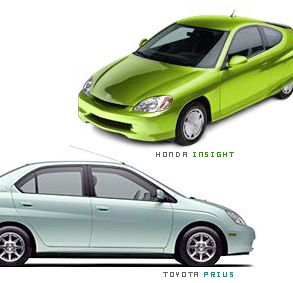
But at what price for paradise? Car manufacturers already have agreed to sell “zero-emission” (e.g., electric) vehicles in California by 2003. But the limited driving range of these cars, long battery recharge and huge cost of replacing battery packs ($22,000 per car) make the cars unfeasible. Hope now rides with fuel-celled cars, which are essentially pollution-free and extremely fuel-efficient. Major U.S. manufacturers already have begun developing cars using this technology, but their lineups won’t appear in dealer showrooms for at least a decade. At the moment, the latest advances aimed at easing drivers’ breathing woes and pump-side pains center on “hybrid” cars, such as Honda’s Insight and Toyota’s Prius.

Earlier this month, General Motors also entered the “green” race, saying it will begin producing hybrid versions of its full-size pickup trucks and buses. That followed Ford Motor’s announcement that it plans to improve the fuel economy of its sport utility vehicles by 25 percent during the next five years. Ford, however, seemed less sincere about saving the environment when it said its next generation of Ford Explorers — the industry’s top-selling SUV — would be larger and have a more powerful engine.

By no means will hybrids — which combine traditional internal-combustion engines with electric motors — turn L.A.’s skies blue. (Angelenos may never rid themselves of their not-so-lovely smog problem.) But Japan’s top two automakers are betting a market exists for these vehicles, engineered for minimal exhaust emissions and maximum fuel economy. Honda initially anticipated selling a modest 4,000 Insights per year, but revised its estimate to the bit less modest 6,500. Toyota, which recorded more than 850 Prius orders during the first four hours after the car went on sale, counts on selling 12,000 cars this year. (GM wouldn’t say how many hybrid pickups it plans to sell.)

It’s true. Insight and Prius buyers will see phenomenal gas mileage figures. (Seventy-one mpg in highway driving for the Insight and 45 for the Prius.) But it’ll cost them about $20,000 for either car, which is quite a lot for a two-seater (Insight) or a four-passenger economy sedan in the Ford Focus mold (Prius).

The thinking, however, is that pioneers have to make sacrifices.

But just who will these pioneers be?

Industry analysts and carmakers expect the initial group to be environmentalists, as well as those who want to be first in line for almost any trendsetting car. But then the hard part comes — persuading the masses to hop into a hybrid. The key, analysts say, is allowing consumers to make a seamless transition to the green version of their favorite cars. Honda plans to unveil a hybrid version of its popular Civic in 2002, the same year Ford introduces a hybrid Escape, its compact SUV. Toyota also has plans to expand its hybrid line.

A proliferation of hybrids on the roads could convince the public that a hybrid really does look and drive like an ordinary car. But because they paid a premium (Toyota estimates that hybrid buyers initially will pay $6,000 more than they would if they bought a traditional car), they’ll probably expect a lot more than they would from an ordinary set of wheels. However, tax incentives for hybrid buyers, now in place in Connecticut and being considered by lawmakers in Massachusetts, Virginia, Louisiana and New York, may ease some of the sticker shock.

Even with the somewhat elevated prices, Toyota is likely to lose a little money on each Prius it sells. Honda isn’t making a similar estimate of profitability on its Insight, and for good reason. Industry insiders believe Honda will lose a bundle on each Insight because it’s clearly the more exotic of the two hybrids, making use of expensive lightweight construction and mechanical components not used on any other Honda. Insights are built in the same labor-intensive assembly facility that turns out the Acura NSX sports car.

Ultimately, Toyota expects to make money on the Prius, making it willing to take a loss now to establish the vehicle in the marketplace. And Honda is using the Insight as a launching product to make even better — and greener — cars, which could make the cash register ring.

But Eric Noble of the Car Lab, an industry consulting firm in Santa Ana, Calif., sees a problem for hybrid manufacturers. “Under current North American conditions, people aren’t willing to pay more just for better fuel economy — gas is too cheap.” Manufacturers, according to Noble, are betting on future fuel price or supply shocks to make hybrids acceptable. Even so, the point where hybrids gain acceptance on their own will probably occur, Noble says, when a manufacturer “makes a conscious decision to sacrifice some of the hybrid’s fuel efficiency gains for an increase in performance. Fuel economy is not exciting in today’s market; performance is.”

Aside from the high cost, the government also hasn’t yet embraced hybrids — since it’s keener on promoting electric cars. The California Air Resources Board, for one, has demanded that 10 percent of all new cars sold in the state starting in 2003 be “zero-emission vehicles.” The agency will credit Toyota for the Prius (counting every three sold as being equivalent to one electric vehicle), but the Insight, with its slightly dirtier exhaust, gets no such consideration.

Analysts believe California will be forced to back away from its stringent demands, since there’s no evidence there’s a big demand for electric cars, aside from that by golf course owners and the government. In the end, customers will dictate what cars will be on the road. And at the moment, hybrids seem the most likely compromise between finicky drivers and environmental woes.

Continue Reading Close

Ray Thursby is a freelance writer who writes about the auto industry.

Toyota recalls 2.17 million vehicles for gas pedal problem

Gas pedals stuck in floor mats lead the Japanese automaker into a safety and public relations fiasco

  • more
    • All Share Services

Topics: ,

Toyota recalls 2.17 million vehicles for gas pedal problemA worker checks Yaris compact sedans, set for export to North America, at a plant of Toyota Motor Co.'s group company Central Motor Co. in Ohira in Miyagi Prefecture, northern Japan, Wednesday, Feb. 16, 2011. Toyota celebrated the opening of the auto plant in a forsaken rural area of Japan, which promises to grow into a new production point for the world's largest automaker. (AP Photo/Koji Sasahara)(Credit: AP)

Toyota Motor Corp. recalled 2.17 million vehicles in the United States on Thursday to address accelerator pedals that could become entrapped in floor mats or jammed in driver’s side carpeting, prompting federal regulators to close its investigation into the embattled automaker.

The Transportation Department said it had reviewed more than 400,000 pages of Toyota documents to determine whether the scope of the company’s recalls for pedal entrapment was sufficient.

“As a result of the agency’s review, (the National Highway Traffic Safety Administration) asked Toyota to recall these additional vehicles, and now that the company has done so, our investigation is closed,” said NHTSA administrator David Strickland.

Toyota has now recalled more than 14 million vehicles globally to fix gas pedals and other safety problems since 2009. U.S. regulators said earlier this month that electronic flaws were not to blame for reports of sudden, unintended acceleration. The company paid the U.S. government a record $48.8 million in fines for its handling of three recalls.

The world’s No. 1 auto company said more than half of the vehicles under recall were being added to a massive 2009 recall that fixed gas pedals getting trapped in the floor mat.

The Japanese automaker said it would add three models to the 2009 pedal entrapment recall: about 600,000 4Runner SUVs from the 2003-2009 model years; 761,000 RAV4 compact SUVs from the 2006-2010 model years; and 17,000 Lexus LX 570s from the 2008-2011 model years.

The recall also includes 372,000 RX 330, RX 350 and RX 400H vehicles from the 2004 through early 2007 model years and 397,000 2004-2006 Toyota Highlander SUVs and hybrid versions to replace floor carpet covering and retention clips on the driver’s side that could interfere with the accelerator pedal arm.

Toyota also recalled 20,000 2006 through early 2007 GS 300 and GS 350 all-wheel drive vehicles to change the shape of a plastic pad embedded in the driver’s side floor carpet that could cause pedal interference.

Toyota spokesman Brian Lyons said the company was unaware of any accidents or injuries related to the new recalls.

Continue Reading Close

Government investigation finds no electronic flaws in Toyotas

The Obama administration found that it wasn't electronic flaws led to a massive Toyota recall in 2009

  • more
    • All Share Services

Topics: ,

Government investigation finds no electronic flaws in ToyotasIn this Jan. 11, 2011 photo, the 2011 Toyota Corolla is shown at the North American International Auto Show in Detroit. Toyota sold 20,581 Corollas, up 20.2 percent, and 10,635 of its fuel-efficient Prius, up 25.4 percent in the month of Jan., 2011. (AP Photo/Paul Sancya)(Credit: AP)

The Obama administration’s investigation into Toyota safety problems found no electronic flaws to account for reports of sudden, unintentional acceleration and other safety problems. Government investigators said Tuesday the only known cause of the problems are mechanical defects that were fixed in previous recalls.

The Transportation Department, assisted by engineers with NASA, said its 10-month study of Toyota vehicles concluded there was no electronic cause of unintended high-speed acceleration in Toyotas. The study, which was launched at the request of Congress, responded to consumer complaints that flawed electronics could be the culprit behind Toyota’s spate of recalls.

“We enlisted the best and brightest engineers to study Toyota’s electronics systems and the verdict is in. There is no electronic-based cause for unintended acceleration in Toyotas,” Transportation Secretary Ray LaHood said in a statement.

Toyota has recalled more than 12 million vehicles globally since fall 2009 to address sticking accelerator pedals, gas pedals that became trapped in floor mats, and other safety issues. The recalls have posed a major challenge for the world’s No. 1 automaker, which has scrambled to protect its reputation for safety and reliability.

Toyota did not immediately comment on the report. Shares of the automaker climbed on the New York Stock Exchange following the news. Toyota shares were up more than 4 percent, to 89.00 in mid-afternoon trading.

Toyota paid the U.S. government a record $48.8 million in fines for its handling of three recalls. The company has said it has not found any flaws in its electronic throttle control systems and said the previously announced recalls have addressed the safety concerns.

LaHood said NASA engineers “rigorously examined” nine Toyotas driven by consumers who complained of unintended acceleration. NASA reviewed 280,000 lines of software code to look for flaws that could cause the acceleration. Investigators tested mechanical components in Toyotas that could lead to the problem and bombarded vehicles with electro-magnetic radiation to see whether it could make the electronics cause the cars to speed up.

A preliminary part of the study, released last August, failed to find any electronic flaws based on a review of event data recorders, or vehicle black boxes.

Despite its findings, LaHood said the National Highway Traffic Safety Administration was considering new regulations to improve safety. They include requiring brake override systems on all vehicles, standardizing keyless ignition systems and requiring event data recorders, or vehicle black boxes, on all new vehicles.

Transportation officials said they would also consider conducting more research on electronic control systems and review the placement and design of accelerator and brake pedals.

In Tokyo on Tuesday, Toyota reported a 39 percent slide in quarterly profit but raised its full-year forecasts for earnings and car sales. It is a mixed picture for the automaker, which is enjoying booming sales in high-growth markets in Asia, Africa and South America, while facing lingering worries about quality lapses in the U.S.

In addition to the recalls, Toyota began installing brake override systems on new vehicles. The systems automatically cut the throttle when the brake and gas pedals are applied at the same time. The company also created engineering teams to examine vehicles that are the subject of consumer complaints and appointed a chief quality officer for North America amid complaints its U.S. division did not play a large enough role in making safety decisions.

Consumer advocates and safety groups raised concerns that flawed electronics could be causing unwanted acceleration in the Toyotas. They have questioned the reliability of the event data recorders studied by the government, saying they could be faulty or fail to tell the whole story of the individual crashes.

Toyota’s safety issues received broad attention from the government after four people were killed in a high-speed crash involving a Lexus near San Diego in August 2009.

NHTSA has received about 3,000 reports of sudden acceleration incidents involving Toyota vehicles during the past decade, including allegations of 93 deaths. NHTSA, however, has confirmed just five of them.

Congress considered sweeping safety legislation last year that would have required brake override systems, raised penalties on auto companies that evade safety recalls and given the government the power to quickly recall vehicles. But the bills failed to win enough support, and it remains unclear if Congress will pursue similar legislation before the 2012 elections.

The National Academy of Sciences is conducting a separate study of unintended acceleration in cars and trucks across the auto industry. The panel is expected to release its findings this fall.

Continue Reading Close

Why Mitch McConnell is worse than Charles Rangel

Both men misused their power -- but the Senate leader gave corrupt BAE Systems $17 million in 2010 earmarks

  • more
    • All Share Services

Topics: , , , , , , , ,

Why Mitch McConnell is worse than Charles RangelU.S. Senate Minority leader Mitch McConnell (R-KY) listens during remarks about leadership elections on Capitol Hill in Washington, November 16, 2010. REUTERS/Jim Young (UNITED STATES - Tags: POLITICS)(Credit: Reuters)

On the same day that the House Ethics Committee convicted Rep. Charles Rangel of nearly a dozen violations of congressional rules, Sen. Mitch McConnell announced that under pressure from fellow Republicans, he will surrender his beloved earmarks. This is a notable coincidence because, like Rangel, McConnell has rewarded corporate donors to an academic center named after him — and used earmarks for that purpose. The top corporate recipient of earmarks from the Kentucky Republican in the 2010 budget not only happens to be a donor to the McConnell Center for Political Leadership at the University of Louisville, but one of the largest and most corrupt defense contractors in the world.

Topping the list of Rangel’s transgressions was the misuse of his congressional clout to raise money for a vanity academic “center” named after him at the City University of New York from private donors. Yet somehow McConnell got away with the same kind of dubious dealings at the University of Louisville — and was allowed to reward BAE Systems, donor of $500,000 to the McConnell Center, with $17 million worth of defense earmarks.

For years, the long list of corporate donors to the university’s McConnell Center for Political Leadership was kept secret, presumably out of deference to the senator and his well-heeled friends, including Toyota, AIG, RJ Reynolds and Philip Morris, among others. Perhaps the most questionable gift came from United Defense, a subsidiary of BAE Systems, the Pentagon contractor that finally settled a huge, transatlantic bribery case with the Justice Department last spring. United Defense gave $500,000 to the McConnell Center, and the senator has continued to perform for the company ever since, even while BAE was subject to a federal investigation that led to a record $450 million fine and three years of monitoring by a court-appointed “compliance officer.” Ironically, the chief accusations against BAE involved bribery of public officials (in Saudi Arabia, not Kentucky).

Everyone knew that BAE was suspected of serious corruption — and under investigation not only here but in Britain and Austria as well — when McConnell sponsored $25 million of earmarks for the company back in 2007. By the time he pushed through the FY 2010 earmarks last year, both the United Kingdom’s Serious Fraud Office and the Justice Department were preparing to file criminal charges. BAE’s sales tactics in the Mideast and Central Europe were not only crooked but interfered with American oversight of sensitive defense technology, according to Justice Department officials.

So while McConnell and his caucus are (temporarily and reluctantly) giving up their power to reward dubious donors like BAE with earmarks, it is hard not to wonder how the stringent “reformers” of the Tea Party can support his reelection as Republican leader. 

Continue Reading Close

Joe Conason blogs in Salon several times a week and writes a weekly column for the New York Observer. His latest book is "It Can Happen Here: Authoritarian Peril in the Age of Bush."

Toyota to roll out 2 new Prius cars

The automaker will begin selling a hybrid station wagon starting next summer as either a 2011 or 2012 model

  • more
    • All Share Services

Topics: ,

Toyota plans to roll out two new cars under the Prius name by next year, according to a dealer briefed on the plans, as the automaker seeks to turn its popular hybrid into a family of vehicles.

The Japanese automaker will begin selling a Prius station wagon starting next summer as either a 2011 or 2012 model, said Adam Lee, president of the Lee Auto Malls chain of dealerships in Maine. It will sell a plug-in version of the Prius that can get 30 miles on a charge starting later in the year, he said.

Toyota unveiled the new vehicles at its annual dealer meeting in Los Vegas this week. Lee was briefed on the new models by the manager of his Toyota dealership, who was in attendance.

Toyota spokesman Sam Butto declined to comment on any specific product plans,

“We will be coming out with some additional Prius products, but that’s really all I can say at this time,” Butto said.

Toyota has said in the past it hopes to expand the Prius name to a family of vehicles. The Prius is the best-selling hybrid in the U.S., but sales have been flat this year as the automaker continues to suffer from the fallout from huge recalls.

The automaker has recalled more than 10 million cars and trucks worldwide over the last year for a variety of problems, including a problem with the antilock braking system in its Prius hybrid and a Lexus hybrid. Toyota said this week it had fixed 86 percent of the hybrids recalled over the braking problem.

Also at the dealer meeting this week, Toyota President Akio Toyoda sought to reassure the company’s 1,200 U.S. dealers that the company is on track for sales growth in the U.S., Toyota said in a statement on Thursday. The company also told dealers of plans to make standard a free maintenance program that it first rolled out earlier this year.

Continue Reading Close

Panda squashes ninja; Prius saved

Not a coincidence: Japan releases Chinese fishing captain and Congress gets busy on rare earth elements

  • more
    • All Share Services

Topics: , , , ,

Panda squashes ninja; Prius savedA Toyota Motor Corp's staff wipes the logo of the company's Prius Plug-In Hybrid during a promotional event in Hitachiota, about 130 km (81 miles) north of Tokyo June 17, 2010. As Japanese car sales plummet, Toyota is trying to get consumers here excited about cars -- and driving -- by promoting cities and villages around the country that can only be reached by automobile. REUTERS/Yuriko Nakao (JAPAN - Tags: TRANSPORT EMPLOYMENT BUSINESS)(Credit: © Yuriko Nakao / Reuters)

Whether or not China officially halted exports of rare earth elements to Japan in retaliation for the imprisonment of a Chinese fishing captain is now irrelevant. Japan has buckled. There is no other way to interpret the following statement.

From the Wall Street Journal:

“We decided it was inappropriate to continue the investigation while keeping the suspect in custody any further, considering the future of the Japan-China relationship,” said Kenji Suzuki, a senior prosecutor at the Naha prosecutors’ office in Okinawa, a hastily called news conference Friday afternoon.

Japanese hybrid car manufacturers, who gobble up huge quantities of rare earth elements, might be breathing a sigh of relief, but the story doesn’t stop here. Japanese citizens are unhappy, the Economist is huffily warning that China’s “entirely disproportionate action” calls “into question its maturity as a responsible international actor, and the U.S. government is finally paying serious attention to America’s utter dependence on China for a critically important resource. On Thursday, the House Committee on Science and Technology approved H.R. 6160, the Rare Earths and Critical Materials Revitalization Act of 2010.

From the press release:

[R]are earths are necessary components of such advanced technologies as wind turbines, hybrid-vehicle batteries, weapons guidance systems, oil refining catalysts, computer disk drives, televisions and monitors, compact fluorescent light bulbs, and fiberoptic cable, to name a few. China currently controls an estimated 90-97 percent of the world’s supply of rare earths, and it is pouring effort and money into a rapid buildup of its own high-technology industries that rely on rare earths. China began imposing export quotas on rare earths in 2006; the quotas have gotten steadily stricter, and China cut its rare earths exports for the second half of this year by 72 percent.

H.R. 6160 is co-sponsored by two Democrats and two Republicans. It will be interesting to see whether the bill ends up getting caught in the same partisan cross-fire crippling just about everything else currently struggling to move through Congress.

Continue Reading Close
Andrew Leonard

Andrew Leonard is a staff writer at Salon. On Twitter, @koxinga21.

Page 1 of 6 in Toyota