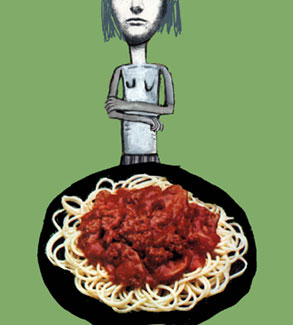

My heart began to pound, shaking my protruding collarbone and rattling my jutting wrists. Blood turned to lead in my trembling arms, anchoring them to my lap. Voluntary movement was not possible. I’m not ready for this, I thought. I faced the pile of spaghetti, alone.
A hill of stretched, pale worms wound around each other. Dark scabs of meat infested the blob of red goo that sank the mound’s middle. It looked like it could writhe at any moment. The smell conjured up a meal at “Mom’s Italian Restaurant” on Route 27 rather than the institutional cuisine I’d expected. That didn’t matter. To me, sustenance meant guilt and revulsion. I could sooner have swallowed a piece of homemade ravioli as chewed a giant beetle that crunched and then squirted.
Anorexia nervosa literally means nervous loss of appetite, but that’s not accurate. Like the bodies of other anorexics, mine yearned for food. Conventional wisdom holds that taming hunger instills a sense of control and mastery that a person lacks elsewhere in her life. The late 1970s, when I was sick, marked the beginning of what turned out to be a boom in eating disorder awareness in the general population. Girls of my generation, however, didn’t invent these illnesses. Ancient Egyptian hieroglyphics depict conditions that resemble what we now call anorexia nervosa so it’s probably been around for at least several thousand years. The first formal account lies in a medical paper from 1689, in which a patient was described as “a skeleton clad only with skin.” For a long time, anorexia nervosa was thought to be a form of tuberculosis or a manifestation of some other physical disease. It wasn’t until the 1930s that researchers began to think that this type of self-starvation might stem from psychological roots.
Today, symptoms of eating disorders — inappropriate dieting, maladaptive preoccupation with shape and weight, and overvaluing the role these characteristics play in a person’s life — are extremely common, although the full syndrome of anorexia nervosa strikes rarely. Experts estimate that about one-half to 1 percent of young women suffer from the disease. Many factors probably contribute, and researchers are investigating the roles of personality traits, family structure, social patterns, biology and cultural influences. Several recent studies, including one that involved 2,000 twins published earlier this year, have suggested that predisposition to anorexia is inherited. This result implies that certain forms of genes put people at risk for the disorder, thereby focusing attention on genetic as well as environmental factors. In many ways, I was a typical anorexic — female, adolescent, conscientious with a perfectionistic streak, and seemingly happy and successful, yet haunted by feelings of defectiveness and loneliness. In contrast to the textbook cases, however, I was acutely aware of what I was doing, and why.
I had gone to a lot of trouble to land myself in the hospital. At 15, I had embarked on a diet and had shed 50 pounds in six months. My body had started out slightly padded, clad in baggy painter’s pants to conceal my thighs. As I shrank, I wore tighter pants to flaunt my success, until those too began to hang on my diminishing frame. By summer, my pelvic bones looked as if they could cut my bathing suit. I snuck downward glances as I walked briskly to the edge of the pool, admiring how they rose sharply to define the valley that used to be my belly. Now a vast chasm of air separated my thighs when I stood with my feet together. The contours of my ribs resembled a row of black piano keys, and bald cords of sinew had replaced my neck. When I unzipped my jeans, they dropped to the floor.
To accomplish this dwindling feat, I memorized the USDA’s book of nutrition and dug out my mother’s scale for weighing food. I slid the shiny knobs back and forth to measure exactly 100 grams of cherries. After I’d lost 20 pounds, my mother wanted me to put it away and stop tallying calories.
“You’ve reached your goal,” she said, “You’re thin enough.”
The times I failed to shove it all the way into the corner on the top shelf, she knew I’d been sneaking it out.
“You’re trying to cause trouble,” she’d accuse, yanking open the cutlery drawer.
So I left the scale in the cabinet and honed my ability to weigh with my eyes. I dished noodles into a measuring cup in my mind and multiplied the calories in one grape by the number in the cluster on my plate. My chest clenched when I had to estimate the calories in a bowl of soup or a heap of casserole. It relaxed when I encountered a single-serving Rice Krispies box or a pre-packaged frozen bag of broccoli in cheese sauce. I could just read the nutritional information label.
If I added about one and a half times as much water as the package of instant oatmeal called for, I didn’t dilute the flavor too much, but felt as if I was eating a heartier breakfast. For variety, I might try half an English muffin (dry) with a slice of cantaloupe. That gave me a good 100-calorie start on the day. Lunch was more of the same, though sometimes I’d substitute the fruit. No blueberries, though — too many calories per feeling of fullness. For dinner I might eat a bowl of iceberg lettuce (dressed in a few drops of water), a drumstick of skinned chicken and maybe a small baked potato.
Under this regimen, I biked, swam, ran and played tennis every day that summer, except when I was vacationing with my parents in Switzerland. There I woke early to stuff the croissants meant for breakfast into my knapsack before my mother and father appeared in the dining room. I ate my lunch high in the Alps, amid snow-capped mountains and green lawns dotted with wildflowers, perched on the other side of the rock so Mom and Dad wouldn’t see how small I pared the cheese, and so they wouldn’t witness the surgical procedure with which I removed the soft part of my rolls. I screened my activities with hunched shoulders, my body taut with deception. I had never liked egg yolks so at least I could eat only the whites (which carry most of the protein, but few of the calories) in the open.
I scrutinized every decision about what I would eat and do. Did it contribute to my program of maximizing the ratio of expended to consumed calories? I refused to go on trips that would confine me to a vehicle for hours at a time. I could burn only so many calories jiggling my legs. I avoided situations where dinner was served after 7 p.m. Too close to bedtime — not enough hours to walk off my so-called meal. For a treat, I might go to a movie. But once inside the theater, I couldn’t concentrate on the screen. I was too busy thinking about what not to eat the next day. Nothing was really funny, anyway.
Even as I starved myself, I took pains to avoid permanent damage. I always drank enough so my electrolytes wouldn’t get out of whack and provoke a heart attack. And although I knew I could stick my finger down my throat, I succumbed to the urge only once. I could imagine bingeing and throwing up forever, without being noticed, and that was not what I was after.
I wanted to feel better, but not the kind of better that gaining weight would bring. I wanted to feel better from the rottenness that had been metastasizing in me before I’d quit eating, the sense that I was invisible except if I was misbehaving or inadequate. In one of the few instances that my father had taken time off from his laboratory experiments to participate in my life, I’d humiliated him. As he returned from Back to School Night, I looked up from my homework with a smile. He frowned and said grimly, “Your English teacher embarrassed me in front of the other parents. She said you whisper to your friends throughout class.” My mother was home more, and would stop practicing cello for important events — such as the moments I bounced in the door on a report card of A’s. She’d inspect and return it, saying, “In math, you can get everything right. You should be earning an A-plus.”
I had already tried spewing suicidal poetry. “Can’t you write something that does not reek of depression?” my ninth-grade creative writing teacher had admonished when I shared some of it with her.
Erasing myself was both an offer to my parents and a plea for help. I had invested a great deal of thought and energy into my appeal. It had to pan out.
My vague plan had partially worked. My friends urged me to try the chocolate chip cookies I baked for them. My parents weren’t canceling their trips to the Metropolitan Museum of Art or giving away their “Carmen” tickets to play rummy with me, but my increasingly prominent bones pierced the polymer mesh that enveloped my chemist father and the clumps of hair in the garbage prickled my mother’s thorny shell. He coaxed me to eat more while she ranted.
“You’re doing this on purpose,” she’d scream. “You want to keep getting skinnier and skinnier.”
She was right, sort of, but no one seemed to see past the surface. I didn’t want to glaze my skeleton with a reassuring layer of tissue, or pink up my cheeks until I felt solid.
At the beginning, I had mapped out my caloric intake and energy output, and often struggled to stick to my plan. Coffee fudge ice cream sang to me from waffle cone platforms, beckoning my tongue to plunge into its smooth sweetness. I’m not sure exactly when I ceded control to my illness, but eventually I was no longer directing my diet; it was directing me. “Don’t eat that,” I’d hear as I lifted the smaller half of an English muffin to my mouth. “Don’t nourish yourself,” a voice bellowed, stilling the edge of my spoon a mere millimeter into a cantaloupe’s flesh.
My diet had seeped its way through my mind. I saw billboards that said “Sandy Beach” and read “Sandwich;” “Next Gas,” “Ex-Lax.” I’d lie in bed, sleepless and shivering, while chocolate honey-dipped Dunkin’ Donuts tumbled frantically through my head and pizza slices topped with sizzling cheese careened around, hovering directly in front of my mind’s eye to taunt me.
The diet was insatiable. “Two more laps today,” it demanded. “Pedal faster.” Simultaneously, it slashed my meals. Cutting melon slices thinner and abandoning increasing portions of my allotted food filled me with a soothing calm.
I shriveled inside my diet, which swelled with every pound that I lost, every bite I didn’t take. Eventually I looked out from inside my withering body to see bars on all sides.
One evening my father appeared at the doorway to the living room to announce dinnertime. I looked up from the book I was reading and suddenly went limp inside. “I can’t eat,” I told him. “I need professional help.” Surely someone would know how to nurture the slim part of me that wanted to thrive.
Several days later, the first professional I visited prescribed Thorazine, Stelazine and three bowls of soup every day.
“You’re nervous,” that psychiatrist said.
“I’m not nervous; I’m anorexic,” I replied.
“If you know that you’ll die if you don’t eat, and you still won’t eat, you’re nervous,” he reasoned.
He had a point. But I knew I’d keep losing weight on three bowls of soup a day. Does he know anything about calories? I wondered. And I don’t know exactly what those drugs are, but if the dentist said I was too scrawny for laughing gas, why isn’t this guy worried about oversedating me?
By the time my parents and I got home from the appointment and trip to the all-night pharmacy, the little confidence I’d had in his approach had vanished.
“I’ll just fall asleep,” I explained. “That’s not what I need.”
My mother made a fist around the pill bottles and shook them at me. “You don’t really want to get better,” she said. “You’re just wasting everyone’s time.”
“I do. This won’t work,” I replied evenly, gulping tears. “How about a hospital?”
Several phone calls and a 90-minute trip to an eating disorders specialist secured me a spot at Children’s Hospital of Pennsylvania, site of one of the most progressive anorexia programs in the world. Dr. Collins had treated dozens of anorexics. She even noticed that I was wearing a sweatshirt on a sweltering day, and asked if I had trouble concentrating and how much hair I was losing. Plus she could explain why my calves hurt. “Your body’s breaking down protein for fuel.”
I was experiencing the relatively minor symptoms of anorexia. Self-starvation can lead to serious and sometimes irreversible physical problems, including irregular heart rhythms that can trigger heart attacks, kidney damage, infertility and weakening of the bones. Studies have shown that up to 10 percent of patients with anorexia admitted to university research hospitals die of complications. I didn’t really want to wind up in that category.
Once I knew I’d be going to the hospital, I could sleep more easily. I had done my part and now someone else would help me recover. I stopped eating almost entirely during the two weeks between acceptance into the hospital’s behavior modification program and the day I was admitted. That way I didn’t have to fight with myself about every morsel I put in my mouth. By the time I faced my first meal, I figured, someone would have asked me why I was doing this, and then listened as I began to explain. That person might say, “You will feel better eventually, and in the meantime, you’ve got to sustain your body.”
I had finally arrived. All afternoon, I had hung around my room, thinking that maybe Dr. Collins would drop by to remind me that this treatment had helped many other girls. I had sat on my bed, resolving to tell the truth about my thoughts and habits to the therapist who’d undoubtedly show up and assure me I’d heal with a lot of hard work.
No one came.
And now, here was this plate of spaghetti. If I didn’t get it into my stomach, I wouldn’t gain my half pound for that day, and I’d spend the following one with the yellow curtains pulled around my bed. That was part of the hospital deal — and I was ready to hold up my end. Yet no one had even talked to me, much less cured me.
Oh my God, I’m on my own, I realized.
I tried to quell the terror stemming from the guilt mounting inside me. Somehow, immediately, I had to transform myself into a person who deserved to eat.
My eyes locked on the spaghetti, and then filled with tears. They don’t have any magic answers. I got myself into this and I’m going to have to get myself out of it.
My gaze crept from the plate on the wheeled tray table to my thighs on the bed. They were already swelling, as my stringy legs dangled.
Inside my mind, I grasped the frayed, straining rope that connected me to a future self — someone who could again enjoy the thwack of the ball when playing table tennis, who belted out “Anything Goes” to her big brother’s piano accompaniment, who could thoroughly inhabit the novel she was reading. Someone who could even lick the batter off a wooden spoon, and whose sense of self-worth didn’t correlate with descending numbers on a scale.
I raised my eyes to confront the now-blurry spaghetti.
Then I lifted my hand and forced my thumb and fingers around the fork. Sinking the prongs into the towering strands, I slowly started twirling.
- – - – - – - – - – - -
Sites that can help
While no one can save a person with anorexia or other eating disorders, professionals can and do help. For information about eating disorders and treatment options:
Academy for Eating Disorders
Eating Disorders Awareness and Prevention Inc.
Anorexia Nervosa and Related Eating Disorders Inc.
National Association of Anorexia Nervosa and Associated Disorders
Dear Reader,
A quick public-service announcement: If you’re in the Bay Area, please note that a new session of my writing workshops starts this weekend. It’s been really great lately, and I’d be pleased if you can join us.–ct
Dear Cary,
Please, please help me. I have read (and like and respect) a number of advice columnists, but I think you dig deepest and your perspective is most likely to understand my own. I am so desperate for insight to break the cycle I am in, which is so negative and hurtful and just plain awful, for me and, less directly, for others around me.
Brief background on me: academic in the arts, advanced degrees, professor at a great school, musician and writer.
Married to a wonderful man, kids who are blessings. Husband is someone I truly like and whom I respect enormously. He has been unequivocally good to me. The one problem, and it has Always been there: the sex life. For me, it is bad, almost nonexistent. I have no desire for him, and at times it is a kind of revulsion. I do have desire, but not for him.
This is heartbreaking, and I have fought it for decades. It has wreaked all sorts of problems for me, from eating disorders to over-exercise injuries, to medications for depression, etc.
Complicating the issue is that I developed feelings for a work colleague/friend.
I have, of course, done the unthinkable. I fell in love with a work colleague, a married man (albeit one who had shared the unhappiness of his marriage with me), and someone who was probably my closest friend and confidant. It is necessary for me to keep this all a secret (though I have been seeing a therapist for over a year, to whom I can talk, but it has only been moderately helpful, as she is quite nice and supportive but not overly insightful; and also an acupuncturist who has been very helpful more broadly as well).
I cannot avoid this friend/colleague. I think I’m doing better, and then we have contact, and my feelings are all reopened, whether of love and desire or of absolute anger at how he has treated me. He has truly been a wonderful friend in all areas but this. I cannot begin to tell you how many hours this has sucked out of my life, and how much energy.
Last week I punched both of my forearms furiously, leaving horrible bruises, because I had nowhere to direct the pain (and I am working desperately to avoid bulimia, which was one of my main coping techniques in the past). If I were brave enough, I would have cut myself. It is horrible enough that I damaged my arms — me, as a musician. I must wear long sleeves this week to conceal the horrendous bruises from my children and my students — this, in a week in which summer has sprung on us prematurely.
I have reduced my calorie intake as much as I can while still managing life, and have no doubt mucked seriously with my metabolism.
It’s as if when I’m not eating, I feel the pain less, but I know I cannot sustain this indefinitely, and I’m terrified of having to rejoin life. I think if I started eating more, and feeling the pain, I could not go on, yet I know I must, for my kids.
I don’t know what to do. My background and life story suggest a kind of intelligence and hard work ethic, but it has not been helping me here. I think the analogy of an addiction is not a bad one, but it is like a food addiction in that I cannot leave this job, and cannot avoid him at it. And I hate negativity; it eats at me like an acid. I do not want to avoid him through anger and pain; I want, and need, to move on, but I keep being heartbroken — longing for him, enjoying our friendship so much, and then being consumed with anger, frustration and grief — all in no particular order. It does sometimes seem to be getting better, and then it will be worse again, like a virus that never quite goes away.
Meanwhile, my husband is still around — this wonderful man — for whom I have zero feelings physically or even negative ones. Indeed, perhaps I should not have married him, but I was so terribly inexperienced, and he was so good in other ways, that I thought — well, maybe I’ll get over it, or I’ll learn, or the feelings will develop, or it won’t really matter — life’s not a fairy tale, and you’re lucky to have found him. And indeed, I was, and have been, and yet… I have not learned, the feelings have not developed, and now — it does matter.
Please help me. I seek your insights, strategies, anything. I have been struggling for decades with the marital issue, and probably more than six years (I almost don’t want to count) with these other feelings of longing, which have consumed much more energy than even the marital stuff. I must find a way to break free — for my own sanity and even to offer the hope for myself of moving on — whether to find someone else, to make peace with what I have, or to make peace with myself on my own.
Desperate
Dear Desperate,
Yes, I agree, you need to break free.
But how?
Right now, you are trapped in a punishing cycle that you cannot reason your way out of or adjust your way out of.
I think you need to physically remove yourself. The best practical hope is to get into a residential treatment center. Residential treatment would give you an opportunity to step back for a few weeks. I really think that could help.
Insurance may very well pay for it.
It won’t be as hard as it sounds. While you are in pain, and enmeshed in these unsatisfying relationships, you continue to function at a high level. You continue to have a strong will. You can put that strong will to good use now. Your psyche needs that strength.
To find and arrange to enter a treatment center, you can marshal your practical skills to come to the aid of your wounded psyche. What is beautiful about human beings in crisis, beset with the worst of troubles, is that when we seek solutions, we discover our complementary skills; it’s as though in being forced to come to our own aid, we are forced to become whole.
I know what it is like to try to solve such wrenching problems on your own, in secret. It can hardly be done. But imagine finding hope in a community of people to whom your predicament is a known illness with known cures. What you are going through is no mystery. It has a cause and it has a cure.
Imagine the relief of having a real program of change. Imagine feeling it work. Imagine getting better!
Suggestion: Read this article from PsychCentral. It is an excellent overview: thorough but not technical. It says that cognitive behavioral therapy is considered the treatment of choice for people with bulimia. Using CBT, you can learn to recognize and combat the harmful thoughts that are causing your upset.
Here is a list of residential centers you might contact or visit.
And here is a list of online support for people with eating disorders.
What else do you need? You need deep compassion for your wounded self. To find compassion for your wounded self you need to tell someone all of this: the starving yourself, the eating, the hitting yourself, the thoughts of cutting. In order to tell all of this, you need to find somebody you can trust.
You can find that person. You can do this. You are going to get better. Just start taking the steps, one at a time.
Continue Reading
Close
A longer version of this piece originally appeared on Autumn Whitefield-Madrano's
Open Salon blog.
For National Eating Disorders Awareness Week—which starts today—the Renfrew Center, one of the best-known eating disorder treatment facilities in the United States,is sponsoring a new campaign. Called “Barefaced and Beautiful,” it’s encouraging women to post photos of themselves on various social media without any makeup. The point is to … well, they sort of lost me on that. I think the idea is to display pride in one’s natural, unadorned self, the idea being that … you don’t need to … adorn yourself … with an eating disorder?
I’m being intentionally dense here. Obviously the idea was to touch on the role of appearance dissatisfaction in eating disorders, using something plenty of people wear — makeup — as an entry point for talking about the larger issue. (Certainly it’s more on target than cryptically posting the color of your bra on Facebook for breast cancer awareness.) And for something like a week designed to raise awareness about eating disorders, you need a campaign that’s simple, accessible and attention-grabbing. But not only does the no-makeup rally willfully ignore the myriad reasons women wear makeup in favor of a one-dimensional shame-based explanation, it treats bodily dissatisfaction as the cause, not a symptom, of eating disorders. And if we keep the focus of eating disorder conversations on women’s bodies, we’re doing exactly what women with eating disorders do to themselves.
We should be wary of conflating body image and eating disorders, because they’re not nearly as connected as they’re made out to be. It’s not like she who has the worst body image develops the worst eating disorder, or that people whose body image is average are immune from eating disorders. (I have yet to meet a woman with an active eating disorder who has a good body image, but then again, I don’t know tons of women with a good body image to begin with.) I’m baffled that Renfrew chose the makeup hook for its NEDA campaign, unless the idea really was just to raise awareness of the existence of eating disorders. (“Anorexic” has been a coverline of enough celebrity magazines that I don’t think we need any more awareness of that elementary sort.) Yes, makeup is deeply tied to our ideas of self-presentation. It’s also a method of controlling the way you’re seen, and eating disorders are rooted in control. But none of that shows up in the Renfrew campaign; instead, it’s all about appearance dissatisfaction, as though that alone can set off a disease that ravages one’s life.
Eating disorders are complex beasts, with not-great recovery prospects and the highest mortality rate of any mental illness. We don’t entirely know what causes eating disorders, but last year when I interviewed Sunny Sea Gold, author of “Food, the Good Girl’s Drug“ and a recovered binge eater herself, she broke it down nicely:
Therapists pretty much agree that there are three main causes of eating disorders, and most of us who get them have a combination of the three. One is your genetics. Second is your physiology, like the biology of your actual brain — your personality…. The third thing is environment. Environment is broken into two parts: the environment of your home, what your mom and dad said to you, the behaviors they modeled. The other part of environment is culture. So about one-sixth of eating disorders can be blamed on cultural environment, like the pictures we’re shown… If we magically were able to suddenly change the images we see in order to be diverse in all ways, gradually that part of the pressure would relieve itself. But it wouldn’t relieve that need of a girl to control her food intake because she can’t control her life.
It’s that last part that continues to get short shrift in the popular media. I get why the press might latch onto the thin imperative as the root cause of eating disorders: Media outlets love nothing more than to generically critique themselves (what women’s magazine hasn’t covered the problem of unrealistic body ideals formed by… the media?). Less cynically, poor body image is something most of us have experienced at some point; using this as a hook for readers to empathize with eating disorder patients works beautifully. Plenty of people have dieted to lose weight for aesthetic reasons, and the disordered thought loop that makes a satisfying eating disorder story — I was obsessed with food! — is mimicked in the dieting mind-set. So the average reader may think she’s identifying with the subject, not realizing that what she’s identifying with are the symptoms of an eating disorder: the restriction of food, or the overconsumption of it, the vigilant attention paid. But the eating disorder doesn’t lie within its symptoms. It lies within its causes.
Listen, I’m not saying that there’s no connection between appearance and eating disorders. Of course there is. And body image is an essential topic to so many women’s lives — including women who have never exhibited a single eating disorder symptom in their life. Do I even need to point out the ways in which having poor body image is a drain of our reserves? Of enormous intellectual and psychic energy? Of time, of money, of already precious resources? Of emotion? Do I need to ask how many times women have asked “Do I look fat in this?” because we lack the words to ask for support and tenderness? As long as we have poor body image, we walk through this world ashamed. So, yes, we need body image work, and we’ve needed it for a long time. And a week devoted to eating disorder education is a good time to reinvigorate that conversation.
But eating disorders do not run parallel alongside a track of bodily dissatisfaction, and the more we conflate the two, the less we’re tackling the true complexity of eating disorders, and the less we’re looking at the threads that unite patients more deeply than hating their thighs. We’re not looking at perfectionism, or the twin sisters of compliance and rebellion, and how all of these play out in the lifetime of an eating disorder. We’re not looking at biology, or heredity, or giving proper diligence to plain old depression and anxiety. Hell, we’re not looking at stress. We’re not looking at choice, autonomy or modernity. We’re not looking at the role of trauma, or sex, or comorbidity with addiction. And it is impossible to treat eating disorders without treating all of these as seriously — no, more seriously than — body image.
It’s one thing for the media to treat body image with greater weight than, say, family dynamics in eating disorders. It’s quite another for a treatment clinic to do the same. The Renfrew Center certainly doesn’t take this approach in treating its patients. When I was treated at Renfrew for my own eating disorder a few years ago, I was repeatedly struck by how little body image came up as a topic, both from the counselors and my fellow patients. That’s not to say it wasn’t important; it was more that we’d all thought about our bodies so much by the time we landed in treatment that we were chomping at the bit to give voice to the things that we truly needed to be able to talk about. I could deconstruct body standards before treatment as fluently as I can now. But before entering Renfrew I had no words to tell you about the factors that took me 25 years deep into an eating disorder before I committed to getting help.
The link between appearance and eating disorders isn’t that one causes the other; it’s that they’re both partly rooted in expectations of properly gendered behavior. (It’s worth noting here that while plenty of straight men develop eating disorders, gay men are at higher risk.) To untangle the social angle of eating disorders, we need to look beyond the mere existence of the thin imperative and look at what it says about the role of women: that we are to be perfect, controlled, managed and compliant — themes that come up repeatedly with eating disorder patients, themes that get to the crux of the matter more directly, without taking the meandering detour through our bodies.
Makeup, too, can say a lot about those issues. It’s not the worst motif Renfrew could have chosen for its campaign. Nor is it the best. I’m no P.R. expert; I have no idea how the clinic could have better channeled its extraordinary work into a simple campaign for the public to engage with. I just know that by the time I was discharged from Renfrew, I’d finally begun to learn that my dissatisfaction with my body wasn’t causing my eating disorder; it was merely a symptom of my disease, like restricting my food intake or binge eating. I’d begun to take the focus off my body and put it into understanding the roots of my perfectionism, my people-pleasing, my family history, my silent shrieks of rebellion.
I’d begun to understand that loving my body wasn’t the point. The point wasn’t even to like it. The point was to learn how to eat.
Continue Reading
Close
Dearest Cary,
I am writing to you, not so much to seek advice but for the release of putting something down, putting it out there. I am in my 20s, clever, well-educated, feminist and successful. I also have an eating disorder.
I know what I need to do to overcome this disorder. I just need to get over it and eat healthily and according to the principles in which my intellectual mind believes. This shouldn’t be hard. For whatever reason, I don’t seem to be doing it.
My disorder is not that bad in the scale of things. I eat too little and am moderately underweight (BMI around 17.5-18). Over the past few years, I have been losing weight. I was never fat, but it has improved my health and appearance and was not a problem initially. The problem is that I am continually resetting the goalposts of what is an acceptable weight for me. For a while (about a year and a half) I was quite comfortable with my new, much slimmer frame. I watched what I ate and so on, but I didn’t feel constantly hungry or anything — I felt quite healthy and satisfied and had treats when I felt like it. But over the past few months, I’ve become obsessed with achieving a new, even lighter weight. And the disturbing thing is that there isn’t even a solid figure in my mind — I just want to lose, lose, lose and never stop losing, the idea of putting on or even maintaining weight appalls me. So I count calories, I exercise compulsively, I obsess and obsess and spend hours every day thinking about food and then I get really hungry and I binge and binge and eat mountains of food that is bad for me, food that doesn’t belong to me, food that will make me uncomfortable and sick. (I’ve tried throwing up, but I’m not any good at it.) And then after the binge my hunger is satiated and I go back to starving for a couple of days and then the cycle repeats itself, except that the binges have been getting more frequent lately, and it’s hurting me and making me sad.
The obvious answer to all this is to just GET THE HELL OVER IT. So what if I have an extremely slim body versus a fairly slim body? I’m naturally not a big eater. Until recently I was physically comfortable with my slightly heavier weight, which didn’t leave me feeling hungry or deprived, and which most onlookers probably couldn’t even distinguish from my current size. Why am I being so shallow on this one issue? I don’t care that much about clothes, I am virtually indifferent to the opinions of others regarding my appearance (outside of thinness), and yet I am wasting my time, my health and my potential on this obsession. There are so many ways I could use my time and my mental energy, and I choose to pour them down a drain of self-worship and destructiveness. I judge other people for being fat. I judge other people for being a shape which is not as thin as mine, and I know that is a shitty thing to do, and makes me a very small person — and not in the physical way. I tell other people off for being prejudiced against fat people, for exhibiting fat phobia and discriminating, and yet I am doing the same thing with my body, my life.
My mother, when I was growing up, was very fixated on weight issues (she always used to comment on the size of other women’s tummies!) and that influenced me toward becoming very conscious of my size. But I have rejected my mother’s influence in so many other ways, so I can’t just blame her for brainwashing me. Similarly, the media shoves the thin-equals-good message all the time, but then the media is full of stupid propagandistic bullshit every day and I don’t fall for all the rest of it, so why this??? WHY THIS???
The scary thing is, I sound like I’m sorry but I’m not. If I could just go on getting thinner without getting hungry and going bingeing, I would, regardless of the probable effects on my health. I am still pretty healthy — only at the tip of the underweight range, and physically very toned and capable of doing all the things I want to do — but it’s a shitty way to live.
The act of writing this down has been therapeutic. I’d be so interested to hear your thoughts on why I seem to be too stupid to fix a problem that has an obvious, easy solution.
Thanks,
Person Being Stupid in Stupid, Predictable Ways
Dear Person Being Stupid in Stupid, Predictable Ways,
You have to get help.
You can’t think your way out of this. It’s not going to make sense to you no matter how much you think about it. All the time you spend thinking about it, it’s just going to go right on killing you until your bones are brittle and your electrolytes are so messed up there’s no turning back.
So stop trying to figure it out and get help before it kills you.
It took a lot of courage to write this letter and it will take a lot of courage to go to someone and say, I think I have an eating disorder and I think it’s killing me and I’ll do whatever it takes to get better if you will only take me on.
But that is what you need to do. Find somebody with professional expertise and start the hard, lifesaving work of saying out loud exactly what you are doing and listening to somebody else and following a program of recovery.
From what I’ve heard, this is a hard one. So there’s no time to waste. You can flirt with it and play with it but it’s not flirting. It’s not playing. It’s killing you. It will keep on dragging you to the edge of starvation and collapse until you place yourself in the hands of someone who knows how to treat this.
Why would this happen? Because there’s something wrong with your brain. Sure, your brain is smart. My brain is smart too. But my brain also thinks it would be a good idea to go buy a six-pack and sit on the railroad tracks and drink the six-pack and then call in sick and lie down among the ballast stones.
Your brain can’t be trusted to tell you to eat right. That’s the problem you have. So put yourself in the hands of someone who knows how to treat eating disorders. Do what this person tells you to do. If you do that you will be OK.
You may not know where to go. Where to go depends on where you are. We don’t get into such specifics here. That’s to preserve your confidentiality. But you might call the National Eating Disorders Association hotline at 800-931-2237 and talk to them. Also, people writing in the comments may suggest places for help. Read those comments. Get in touch with those people. Accept help.
Don’t let this take you down.

What? You want more advice?
Continue Reading
Close
Welcome to Sausage McMuffins Anonymous. Thanks for sharing. Coffee is in the back.
Yesterday, I read about a new study suggesting that sausage, cheesecake and other tasty, fatty foods might actually be addictive — I mean, cocaine-like addictive, where addicts have trouble feeling pleasure without them. Rats, when fed junk food all day long, showed the same kind of chemical changes in their brain that are common with addictions. We’ve seen claims of this sort before — about sugar, about corn syrup — and, while I can’t quibble with the science, it’s simply not reasonable to think that we respond to hot dogs the same way we respond to cocaine. Most of us can enjoy these foods safely in some kind of moderation, just as most can enjoy a drink without being alcoholics. So I filed the story away under “Interesting but not earth-shattering.” But for some reason, the story kept creeping back up on me. I kept thinking about it, and seeing food in the dark light of addiction finally filled me with a confused sadness.
I am an aggressively joyful person. My work is about sharing my love of food, about the magic that can happen between people at table and the magic that can happen in your head when a bite of something amazing transports you. I write about it, I teach cooking, I stick candy in random people’s faces. For me, few things are more joyful, are more powerful than the pleasure of food. And because food is good, because my field is so rife with how food reminds of home, of warmth and love, it’s an occupational hazard to have it all feel a bit romantic after a while. You know: Soup comes with mittens and a hug from Mom. Cake comes with puppies and flowers. I try my hardest to stay out of LaLa Land, but it’s unnerving to be reminded that sometimes, food is not happy but fraught with difficulty and pain. Whether or not “food addiction” truly exists, the act of eating is troubled — and troubling — for many: those with eating disorders, or the very many who struggle with weight or health.
Reading about the addictive food study brought to mind a striking 2006 story by N.R. Kleinfield in the New York Times on diabetes in low-income communities. In it, the reporter asked a woman suffering from diabetes why she didn’t take better care of her condition.
She pointed out that many people in her world were stressed out and depressed. There are other serious health issues, like asthma and H.I.V., the signposts of many poor neighborhoods. Their cobbled-together lives drain residents of their resolve. And so they cede diabetes the upper hand and eat what tastes good to them to counteract the gravity of unhappiness.
“Listen, if I want to eat a piece of cake, I’m going to eat it,” she said. “No doctor can tell me what to eat. I’m going to eat it, because I’m hungry. We got too much to worry about. We got to worry about tomorrow. We got to worry about the rent. We got to worry about our jobs. I’m not going to worry about a piece of cake.”
The simple, private pleasure of sugar and fat in this case is no longer simple (and, given that the diabetes epidemic severely stresses our healthcare infrastructure, that pleasure is no longer private either). Over and over again in the story, the reporter came upon people too tired or too stressed to deal appropriately with their diabetes, and instead, as this woman does, make the conscious choice to compromise their health for this small moment of satisfaction.
“Chocolate cake may be a risk, but tastes good on a bleak day,” Kleinfield writes, breaking my heart with the knowledge that the dark context of suffering is what lets the soft light of a sweet treat shine so seductively. I think a healthy relationship with food recognizes its joys, but also recognizes its appropriate place. It should bring pleasure, maybe even escape from a bad day, but not escapism from a rough world.
I used to teach at a literature camp where I also volunteered to help run the kitchen, teaching students to cook. I did everything there with a sense of wildness, and, buoyed by students excited to learn everything about the world, I tried to make the kitchen a central part of the experience, bringing food into our discussions of Dickinson, teaching the lessons a writer can learn from frying a pan of eggs.
And then one year we learned that one of the students was bulimic. I was distraught. I dated a woman with terrible eating disorders once. We went to culinary school together, which I thought was awfully ironic until I realized that part of how the illness abused her was by causing her to surround herself with food at all times. And so I wondered, painfully, if the food-focused environment I was creating made things harder on our student. Here I was, leading the band, banging out rhythms on trays of pork loins, while she followed up, wild-eyed with polenta she was going to hurt herself with.
A friend came to my moral defense. “No, it’s good. You’re modeling what a positive, healthy relationship with food can look like,” she said. I was thankful for that, but it’s hard to shake the weirdness of knowing that what you find joyful is painful for someone you care about.
But, you know, when I think about it I realize that even for me it’s not always simple. I have struggled with my own weight for years. I was chubby as a child, and when I was a romantically lonely teenager, I nervously counted every fat gram as another step away from having a girlfriend. I had no idea how good I really had it, metabolism-wise, back then. Now, not 17 anymore or even 27, I find myself again learning to stand in new postures to hide my small but growing gut. I wince a little in the mirror. It’s OK. It’s not an obsession. But it’s a reminder that even the purest pleasure I know is always complicated.
Continue Reading
Close