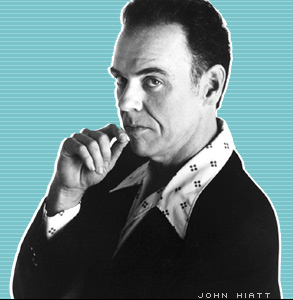

John Hiatt has a voice you can swim in — deep, warm, a little gritty. It moves slowly in spots, pools up, muddies into a thick groove, then hits a snag and runs clear.
You probably know Hiatt’s voice. Songs off his 1987 breakthrough record “Bring the Family,” 1988′s “Slow Turning,” 1990′s “Stolen Moments,” 1993′s “Perfectly Good Guitar,” 1995′s “Walk On” and 1997′s “Little Head” made their way up the charts, got their share of AAA radio play and helped build him a dedicated following.
You definitely know his songs. They’ve been covered by Bonnie Raitt (“Thing Called Love”), Ronnie Milsap (“Old Habits [Are Hard to Break]“), the Neville Brothers (“Washable Ink”), Bob Dylan (“Across the Borderline,” “The Usual”) and, just this summer, Eric Clapton and B.B. King (“Ridin’ With the King”).
He is, they say, a musician’s musician. But his lyrics are often so personal — drawing on his struggle with alcoholism, the breakdown of his first marriage (which ended in his wife’s suicide), the joy of bringing home his brand-new daughter, to name just a few — it’s hard to believe anyone can inhabit them quite like he can. Yet he says he’s “tickled” by all the big names who’ve sought out his music. Hearing his songs covered by his idols, he says, is “just too cool for words.”
After 26 years of recording, this week Hiatt is simultaneously releasing his first acoustic album, “Crossing Muddy Waters,” in both a pay-per-download format on EMusic.com and in “hardware” form by Vanguard Records. Relaxing on his Tennessee farm before heading out on tour, Hiatt took some time to share his thoughts on Napster, songwriting, success and the Red Hot Chili Peppers.
How did a guy like you, who doesn’t even have an e-mail address, decide to release an album on the Web?
It just happened. We spent a lot of time over the last year getting out of our deal with Capitol Records and being able to take the record we were making with us. And we were successful in doing that as of about Jan. 1 of this year.
Then this interest just suddenly sprung up from EMusic.com. They said, “How would you like to put something out with us?” Initially, they wanted to put out some demos that Dave Immergl|ck, the mandolin player, and I had, and it just turned into this record. And then Vanguard got involved after we’d already made this recording.
Does releasing the album on the Web give you more control? What’s the allure?
Well, it’s a new way to get your music out. And it’s a way of doing it without a middleman, i.e. a big corporate record company. I call the Internet “Willy Loman’s revenge,” from “Death of a Salesman.” Willy Loman actually gets to bring his wares right to the customer, direct. That’s exciting.
It’s also cool that it’s a new frontier — nothing’s settled. You have all this great technology exploding. It’s created all this great controversy with Napster, and I think that’s wonderful. I’m glad to be a little dinky part of it.
But you’re also releasing it the old-fashioned way.
Yeah, Vanguard Records is releasing it simultaneously, working in conjunction with EMusic, which is not something the other major corporate labels are willing to do, judging from their reaction to Napster.
What happened with Capitol? It sounds like things got unpleasant.
You know, it wasn’t unpleasant. It’s like a broken record, no pun intended, but it was the same old story: The guy who signed me left. So I had to reenthuse a new regime, and, to put it simply, they didn’t like the record we were making as much as we did, so we figured, you know what, they probably shouldn’t put it out. So that was that.
Are you going to release it?
Yes. We’re going to finish it in January. We own it. We got out of the label deal with the record, which was no small feat. We had to jump through a few flaming hoops and train poodles and God knows what else. But we got out with the record, and we’re going to put it out.
We’re shooting for May 2001. I’m going to start touring for “Crossing Muddy Waters” at the end of September, solo initially. I’ve got about a month’s worth of solo acoustic dates and then the two Daveys are going to join me in November and December. And then I’ll probably tour a little bit into the new year, January or February. Meanwhile, we’re going to finish the rock record with the Goners [Hiatt's backing band], and hopefully put that out in May or June 2001, and then tour next summer again with the Goners.
That’s a pretty busy year you’ve got planned.
It is. It’s great. That’s what so exciting about the business right now to me. There are so many more opportunities.
Like what?
Just the fact that it’s so wide open, that the corporate labels are being caught with their pants down. And obviously their reaction to Napster, which is I guess typical of modern corporate America doing business. When they find a competitor, their reaction is just to annihilate them.
So that was their knee-jerk reaction, but I think what it really said was, “Geez, we don’t know anything about this stuff.” I have lots of different feelings about Napster and that technology. It’s great in terms of kids sharing music, but I think it’s a problem when college kids download whole CDs and turn around and sell them for $20. But there are solutions to all this, I would think. And obviously the courts felt the same way because they’ve given Napster a chance at least to come up with a defense. It’s not going to go away; it’s going to change the music industry. It’s already doing it.
Is it going to be good for the artist?
Absolutely. How could it not be? How could another avenue of being able to get yourself heard not be a good thing? The traditional avenues have gotten so corporatized — it’s going to be one big major label when they’re all done eating each other. And then there’s one or two conglomerates that own all the radio stations, so you have to sound a certain way to make that work. When things get so constricted like that, other arteries have to open up. And that’s what’s happening, I think. The industry’s needing a triple bypass. [Laughs] And the Web’s giving it to ‘em.
Why an acoustic album?
I’d always wanted to make a more acoustic singer-songwriter kind of record. And this was the chance to do it. It’s pretty much acoustic, but there’s an electric slide on one song. And Dave [Immergl|ck] plays electric mandolin on another. No drums, though. We finally got rid of the drummer.
Is recording an acoustic album any different from recording when you’re all plugged in?
It’s just like any other record to me. It’s a joy and a thrill. But then, I never really have anything planned out, to be honest. And we made this record in four days, which is how much time we spent on “Bring the Family.”
I wanted to get kind of a back-porch feel to it, and I wanted to do it live. So we just sat around in a circle in this little studio up the road, about three or four miles from our farm. I’d play the song once and David Immergl|ck and Davey Faragher [the bass player] would remember the chord progressions. But my chord progressions aren’t too difficult to remember, and we’d played together for about six years, so we had a pretty good musical rapport. And we just rolled tape. A lot of it’s first take. There are a couple of second takes, but mostly we just went with it.
Have you worked that way before?
Yeah, that’s pretty much the way we work — especially with those guys. Davey Faragher has been playing with me since the “Perfectly Good Guitar” tour, which was, what, ’93, ’94? And Dave Immergl|ck has been playing with me since “Walk On.” We’ve arrived at the idea that we’re better when we don’t know what we’re doing. [Laughs]
What’s your writing ritual?
I’ve been writing for a long time. I picked up a guitar when I was 11 and within a couple of months I wrote my first song, so I’ve been around — I’m 48, so what’s that, 37 years?
Over the years I’ve employed all kinds of little tricks and disciplines, but they’ve all fallen by the wayside. I just write pretty much when the inspiration hits me. Usually, it’s just picking up a guitar and playing, and the next thing you know, you’ve got a chord pattern, and you’ve got a melody, and you’re singing nonsense because you like the melody so much. And the next thing you know, it sticks with you to the extent that you think, gee, maybe I oughta write some lyrics. So that’s when you get the paper out and try to come up with something that’s worth singing.
When you go back and listen to your music, can you identify in the music what you were going through when you wrote it?
Oh yeah. When I go back and listen, I definitely remember where I was at the time. When I listen to those first three A&M records ["Bring the Family," "Slow Turning" and "Stolen Moments"], I can go back to when we were newly married and when we had the baby and how the kids were all little — we each had a kid we brought to the marriage — when I wrote this song or that song. Or I look back and go, “Oh boy, I had my head directly up my own ass on that one.” You get a lot of that, too.
Is it weird for you to listen to the albums from the rough years? Some of the emotions seem so raw.
Oh, no. The songs are what got me through. It’s kind of like only the song survives. It’s not my real life in these songs. It’s inspired by bits of it, but it’s inspired by a lot of different bits. The songs were my release; the music makes me free. I’ve always felt like there’s nothing I couldn’t write my way out of.
Is it easier for you to write from a happy place or a place that’s a little dark?
That’s a tough one to answer, because once you start writing, all kinds of things come up. But, generally, I think the popular myth about suffering for your art is a bunch of crap. Who wants to suffer for anything? The fact is, life includes as part of the ticket price plenty of suffering. It’s gonna be there. I think the more whole I become as a person, the more whole I become as an artist.
The press often characterizes you as a very successful writer and a moderately successful performer and solo artist.
I think they’re gauging the success by what they know about. And so they figure, “Oh, 160-some odd covers, wow. This artist did your song? That artist?” And they go, “Oh, that’s successful.” So I guess they figure, “Oh, his songwriting must be the thing.”
But you know, the two work pretty well together for me, and have ever since “Bring the Family,” really. We can go out and play and draw a couple of thousand people in a lot of different places, so I feel very successful in that way — just the fact that people want to come out and hear me.
So you gauge your success by the performing rather than the songwriting?
I’ve never separated the two. I don’t sit down and write songs for other performers. That’s a misconception about me. Because I’ve been covered a fair amount of times, people think, well, he just sits there and writes songs for people. But I’ve never done that; I’ve never been able to. I’ve always written ‘em because I’m planning on singing ‘em. So the songwriting thing is that solitary exercise you do, which I love — you know, I have a real passion for it. It’s the process of it that I love, and then to be able to go out and play those songs in front of people is the payoff.
Is it also a kick to have someone else record your music?
Absolutely. I mean, put yourself in my place. If you’re in your car and you hear a song you wrote on the radio, first off, you’re hearing it on the radio, which is too cool for words. And then just the fact that someone thought enough of your song to record it is so totally flattering. How could you not feel good about that?
Is there a song of yours that another artist has recorded that made you see the song in a different way?
That happens a lot. And there again, it’s nothing you can really put into words. It’s just that you’ll get a nuance or a texture that you didn’t know was there, either in the melody or the music or the lyrics.
Like the Neville Brothers, when they did “Washable Ink,” you know, they put it in a whole different light for me. Or when Bonnie Raitt took “Thing Called Love” and made it so seductive. I guess she can just do that. That redhead!
What’s the sense you get from your fans? They’re so often described as a “cult following,” which is kind of a scary term when you think about it.
I think that’s what they call it when you don’t sell 20 million and hang around for a couple of years or five years or 10 years and then go away. You know what I mean? That’s the more typical kind of deal. I’ve never had huge sales like those artists.
I’m thinking of people like Neil Young or the Neville Brothers — although their sales are probably way different, those two acts, I call those people “lifers.” They’re in it, that’s what they do. They’ll do it till they drop. And I consider myself one of those, even though I don’t have as big a following as some of them.
The Red Hot Chili Peppers are an example of a contemporary act that’s having hits right now, but you know, they’ve got the goods. That Anthony Kiedis writes great lyrics. They always have great songs. They’re a great band and they’re lifers. They’re going to be doing this as long as they’re around.
Is there someone you’d like to record your music who hasn’t?
Yes. The Red Hot Chili Peppers. [Laughs] But they pretty much do their own stuff. Or Ray Charles. Or, gee whiz, you know who I’d love to have record one of my songs? Rosemary Clooney. She is something.
What has been your greatest musical high?
Having a song cut by the guy who wrote “Layla” is pretty great — and then having B.B. King singing and playing on it. That’s pretty up there. And when Bob Dylan recorded a song of mine for a movie he was in — what, 10 years ago? — that was a total kick.
There’s a little record that just came out — a bunch of my songs done by other artists — called “Rolling Into Memphis.” There’s some really great blues musicians on it. James Cotton plays harmonica on a song, and Odetta’s on it. I loved Odetta when I was coming up. And there she is singing a song of mine. I started crying when I heard it, because I remember what a comfort her voice was to me when I was a screwed-up little white kid in Indianapolis, totally into music and not having too much success in any other area of my life. That was real moving.
What’s left? What’s the big goal you’re still aiming for?
I’m not really goal oriented. That’s probably bad, but for me the goal is about the work. It’s all about the work — to be able to keep writing the songs and keep playing the music. The results of my writing and my singing are almost just a footnote to me. It’s the joy and the satisfaction I get out of doing it that keeps me doing it. I just want to keep that up.
And I think human development goes right along with artistic development. I think if you stop trying to get a little better as a person, then you stop getting a little better as an artist. I’d like to keep chipping away at the pitiful little sculpture. That’s it. That’s about the size of it.
Kelle Hampton, the author of the eye-opening new memoir “Bloom: Finding Beauty in the Unexpected,” left for the hospital to give birth to her second child with “everything just — perfect,” packing not only the birth music, the blankets she’d made herself, the baby’s coming-home outfit, a special nightgown and a crown for the baby’s big sister, but also hand-designed, beribboned favors to pass out to visitors. Yet the moment her newborn daughter, Nella, was placed in her arms, Hampton’s concept of perfection altered in an instant: Though ultrasounds had signaled nothing unusual, Nella was born with Down syndrome.
Hampton writes with bracing, brave honesty about her initial response to Nella’s condition — “I think I cried for seven hours straight. It was gut-wrenching pain” — and her struggle to find hope, joy and an expanse of possibilities in what first seemed to bring only sadness. As on her blog, Enjoying the Small Things, the journey Hampton records in “Bloom” becomes a call — and not only to parents — to rethink our concepts of perfection, discover our capacities for resilience, appreciate the family and friends on whom we depend and, yes, find beauty where we may not have noticed it.
We asked Hampton, via email, about “Bloom” and the experiences and impulses that inspired it. It may be typical of the author that she immediately turned the task of tackling our questions into an event worthy of celebration, writing, “I’ll put some good music on tonight, light a candle, grab a beer, and completely enjoy the process.”
The Barnes & Noble Review: One remarkable aspect of your writing is your knack for tapping into emotions, both your own and your readers’. Has motherhood — and particularly Nella’s birth — made you more connected to your emotions?
Kelle Hampton: I feel emotions very intensely. Expressing them is another story. I think we’re all conditioned to mask certain emotions because we think they won’t be accepted or they’re “too much.” Motherhood definitely compelled me to express emotions more freely. The depth of love, the fear of losing, the need to protect, the unearthly joy — it was too much for me to contain. That’s why I started writing more. And writing something I was thinking seemed more acceptable than saying it out loud. Then with Nella’s birth, there were these contrasting emotions that were so difficult to deal with — grief, fear, sadness, shame. But once I expressed them through writing and realized other women related to them, it gave me the freedom to express myself in a way I had never done before.
BNR: ”Bloom,” like your blog, uses photos and text to tell your story. Why did you choose to combine both elements?
KH: The book is a testament to my journey that first year, and writing and photography played equal parts in my healing and perspective shift. Because the book deals with Down syndrome, a condition that has many negative stereotypes, the photos are a powerful way to showcase the beauty of these children and the beauty Nella brought to our family.
BNR: Early in “Bloom” you mention a book you read shortly before Nella’s birth, Donald Miller’s “A Million Miles in a Thousand Years,” which spoke to you of “the power of challenges — how living a life of comfort does nothing to make us grow, and how hard times shape us.” But you also say you couldn’t fully grasp Miller’s message until you went through your own challenges. Can we learn life lessons from books or only from our own experiences?
KH: I’ve thought about this question a lot, especially from a parent’s perspective, because we make efforts to keep our children from pain and to give them happiness. No one wishes heartache for their child, and yet I know a lot of my happiness and contentment today comes from challenging experiences and sadness in my past. I think we can learn a lot from others’ experiences, and books give us an opportunity to do that. But life without any pain is unrealistic, and the great thing about reading books and learning from others is that when we do go through hard things, we’re more equipped to handle them and don’t feel quite so alone.
BNR: I initially assumed that, before Nella’s birth, you’d led a life without much difficulty. But then you discussed challenges you faced during childhood, in particular the breakup of your parents’ marriage when your father, a preacher, came out as gay. Did those childhood challenges help prepare you for those you’ve faced as a mother?
KH: My siblings and I talk about this a lot — the fact that we are so grateful for our past, even though it has a lot of pain, because it made us tough and definitely more compassionate. Once I started writing those chapters from my past, it really hit me how much those painful memories created a foundation for later challenges in my life. Does that mean someone who had a dreamy, heartache-free childhood is at a disadvantage for handling hard times as an adult? Not necessarily.
It’s important to me, as a mother, not to shield my children from life’s more disheartening realities but to bring awareness to them in a way that gives my children both a sense of gratitude for what they have and the motivation to bring positive change to their world. I want my girls to know that life isn’t going to be without pain, but I also want to equip them with love and confidence and a perspective that allows them to face these challenges when they come.
BNR: You learned fairly early in life to embrace difference. But still you struggled at first to embrace the ways Nella was different from the daughter you had envisioned. How has your sense of “perfection” changed since you had Nella?
KH: I’ve definitely shifted my views of perfection away from image and more to inner happiness, and that shift has taken away so much pressure and allowed me the freedom to really be myself. That, in itself, is happiness.
BNR: After Nella’s birth, your close circle of girlfriends — your “Net,” as you call them — stayed with you, giving you incredible support. What do you think is the secret to having such close female friends?
KH: I think women’s friendships get a bad rap in the media. They’re portrayed as catty, jealous and unsupportive. That saddens me because I know how amazing it is to be part of a group of women where you find love and support. I think women have high expectations for each other, and sometimes we are inclined to run or drop a friendship at the first sign of drama. I embrace my friendships with the understanding that because we are all women with fiery personalities, big dreams, and a hell of a lot of passion, some drama is inevitable.
You have to approach it with compassion and forgive mistakes, because we all make them. Of course, yes, you also need to make choices to surround yourself with people who bring out the best in you, who challenge you, who bring good energy. Those who don’t aren’t worth exhausting efforts.
Secondly, if you want close relationships with friends, you have to be vulnerable. I know how much it means to me when a friend admires me enough to call, crying, asking for help or trusting me with an intimate conversation. Likewise, I want to do the same and reach out to my friends, revealing my own vulnerabilities. My friends are great for shopping, laughing, or going out for drinks, but the best, most beautiful moments I’ve experienced with them are far more serious. And when you experience heartache with a friend at your side, it is bonding in a way that can’t be forgotten.
BNR: Do you think women can support each other in ways that men (even husbands) cannot in tough times, and particularly those involving parenting?
KH: As much I support equal rights for men and women, there are certain gifts women possess that men don’t naturally have and vice versa. Even though Nella is [Hampton's husband] Brett’s child and he, of course, was the only one who could sympathize with that personal parental loss of receiving her diagnosis, there was something so comforting that came from my friends — women who understood, in a way Brett couldn’t, the emotional aspect of the end of a pregnancy, a mother’s expectations, the ideal birth experience.
BNR: You write that you knew immediately, before anyone told you, that Nella had Down syndrome and worry that you didn’t show her enough love at that moment. We all sometimes feel a disconnect between the mother we want to be and the mother we fear we are in a particular moment. Should we even have a concept of what makes the “perfect” mother? Does that give us something to strive for, or give us only impossible standards we’ll never measure up to?
KH: I think we all have this imaginary version of the perfect mother we want to be. There is a quote I love about the fact that there is no way to be a perfect mother, but there are a million ways to be a good one. I try to focus on that, to know that when I try my best, acknowledge mistakes, follow my instincts, and remind myself of what’s most important, that is perfect parenting.
BNR: I wonder, too, about the dangers of our expectations for our kids. If we have a preconceived notion of who they should be, we may fail to appreciate them as they are. That’s a lesson you say you’ve learned. Is it something you feel is important for all mothers to learn?
KH: Yes! I’m learning it with Lainey [Hampton's elder daughter] just as much as with Nella. I’ve been challenging myself not to push Lainey to be a leader all the time. I have a preconceived notion that kids need to be leaders, not followers, and my husband recently reminded me that we do not need to tell our children to be leaders; we need to tell them to be themselves. It makes us all happier — to sit back, to lead by example, to accept what we are given, and to love our children no matter what path they choose to take in life.
BNR: Motherhood can be a touchy topic. Some of the emotions and responses you talk about in the book are bound to incite strong responses — mostly positive, but perhaps also negative. Were you afraid, writing about such personal topics, that you might be misunderstood and attacked?
KH: When I first published Nella’s birth story [on her blog], I discovered right away that being honest about touchy things is not always well received. It was good for me to read responses, even those “Oh my God, what kind of mother would say they want to run away!?” remarks. It initiated a personal process for me of challenging myself to write what’s true — in a respectful way, of course — and not to change my writing to cater to other people.
BNR: Did you ever find yourself pulling back? Or did you just write through those concerns?
KH: There were parts that I went to write and stopped to ponder the effects first. And, most always, I proceeded, hoping that people will understand this is my journey. Memoirs are personal, and not everyone is going to shake their head “yes” to every line, and that’s OK. The other side is that it has been incredibly fulfilling to read e-mails from women who have said, “Thank you for saying that. I felt it too, but didn’t want to say it, and you make me feel normal for admitting it.”
BNR: Do you worry about how your kids will respond to what you write when they’re old enough to read and understand it?
KH: What I wouldn’t do to have my own mother’s thoughts and photos and words and things that inspired her preserved from when we were little. I hope my children, through reading everything I’ve written — the good, the bad, the beautiful — will always read between the lines and be inspired by the constant truth of “Wow, she loved us. She celebrated life.”
BNR: One of the things you consider is how much you let your sense of how society perceives you shape how you feel about yourself. Was writing this book a way of shaping your own identity — and taking charge of your own narrative?
KH: I can’t begin to explain what writing this book has personally done for me. I owned every word I wrote, and as I typed it, I believed it even more. Empowerment — that’s what it is. I realize how much stronger I am, how much more effective I am in living purposefully, when I take control of how I feel about myself, my family and raising my kids, write it down, and put it out there for the world to see.
BNR: It sounds like writing is deeply therapeutic for you.
KH: There’s something mysterious and enlightening about the space I give myself when I write. It’s when I take all those loose philosophical/emotional thoughts I’ve had throughout the week and weave them together. I learn a lot about myself. I face my pain and struggles head-on, and I overcome them through the process of expressing myself. And, for me, when I write I’m going to do something? It’s even more powerful than saying it. When I write, “I’m going to rock this out,” it’s almost as if I hear the band in the background with each letter I type. I feel motivated, eager, excited. I’m inspired in a way I can’t explain. Writing is powerful — and it doesn’t cost near as much as therapy does.
BNR: Is it the same with photography?
KH: After taking pictures for a while, you begin to look at life a little differently, continually scanning landscapes, people, situations for that “framable” shot. In those first days, taking photos of Nella brought light to her beauty and made me recognize how perfect she was — the new, wrinkled skin on her fingers, those sparse rows of tiny eyelashes, her soft cowlick of silky hair. And it went beyond Nella as well. When I thought my world was this depressing reality, I’d pick up my camera and see the opposite — oh look, a sunset. Vivid blue skies. My child holding an ice cream cone with rainbow sprinkles. A dimpled smile. My husband rocking his new girl to sleep. I never stopped taking pictures of these things, and it sinks in after a while: Look for the good, and you will find it.
BNR: What are you most hoping readers will take away from “Bloom”?
KH: Life is full of challenges. But life is also as beautiful as you create it to be.
Continue Reading
Close
Last week, we hoped to spark conversation — and further suggestions — with a list of five amazing books to hand daughters this summer. We’re not leaving the boys behind. Here is our list of five great books for boys of all ages (books that will also, of course, appeal to girls, too). If your (or your kid’s) favorite book has been left off this list — John D. Fitzgerald’s “The Great Brain”? Norton Juster’s “The Phantom Tollbooth”? The Lemony Snicket books? Or, for the sports-minded child, Dan Gutman’s Baseball Card Adventure Series, or Kadir Nelson’s remarkable “We Are the Ship”? — blog about it on Open Salon: Just make sure to tag your post “Building a bookworm,” and we’ll cross-post the best ones onto Salon itself.
And now for our list:
“Frog and Toad Are Friends” by Arnold Lobel (Ages 4-8)
The thing about Lobel’s Frog and Toad — see also the equally wonderful “Days With Frog and Toad,” “Frog and Toad All Year” and “Frog and Toad Together” — is that, despite the whole amphibian thing, they’re so damn human. Toad is crabby, self-doubting and, let’s face it, somewhat prone to depression. Frog has a sunny, can-do disposition. And they may be an odd couple, of the Oscar and Felix variety, but they are also kind, supportive, considerate, loving friends. And though these stories are, of course, beloved by children of both sexes, the way these two very different fellows take care of each other — and delight in each other’s company — seems like a particularly valuable example for young boys.
“Diary of a Wimpy Kid” by Jeff Kinney (Ages 9-12)
Kinney’s “Wimpy Kid” series may not be writing at its finest, but it has struck a major chord with boys, capturing the attention of even the most reluctant readers. Described as “a novel in cartoons” — with lots of drawn illustrations, a lined-paper format and a font that looks like handwriting — it has an undeniable charm, evoking the misery that is middle school in spare, deft strokes. Its beleaguered narrator, Greg Heffley, isn’t the most sympathetic character, selling out his best friend Rowley when the occasion suits him, but he has a keen eye for demoralizing details. Like the cheese that lies rotting and repulsive on his school blacktop, spawning the terrors of “Cheese Touch.” “It’s basically like the Cooties,” Greg explains. “If you get the Cheese Touch, you’re stuck with it until you pass it on to someone else. The only way to protect yourself from the Cheese Touch is to cross your fingers.” If that doesn’t take you right back to middle school, well, you’re luckier than some of us.
“Danny the Champion of the World” by Roald Dahl (Ages 9-12)
If there is a more moving depiction of the relationship between a son and his father in all of literature than the one in this rollicking adventure tale, we’d sure like to know about it. “It is impossible to tell you how much I loved my father,” Dahl’s narrator, Danny, tells us. “When he was sitting close to me on my bunk I would reach out and slide my hand into his, and then he would fold his long fingers around my fist, holding it tight.” But Danny’s love for his dad — a filling station owner and widower who is raising his only child in a gypsy caravan — is apparent in every line, every moment of this story. Danny’s dad, he tells us, is an “eye-smiler,” whose eyes flash and twinkle when he is amused, but who never much moves his mouth. “I was glad my father was an eye-smiler,” Danny writes, “because it is impossible to make your eyes twinkle if you aren’t feeling twinkly yourself.” This gentle, funny, genuinely wonderful book will leave boys (and their parents) eye-smiling and deliciously amused.
“The Lightning Thief” by Rick Riordan (Ages 9-12)
Start your son on this first book in Riordan’s Percy Jackson and the Olympians series and watch him read away his summer. When we first meet Percy, he just seems like a troubled kid on the verge of getting kicked out of yet another school. In fact, he’s gone through six schools in six years: Bad things just seem to keep happening to him. It isn’t long before Percy (short for Perseus), and we, learn that those strange things he thinks he’s been hallucinating are actually real. Mythological monsters and gods — satyrs, minotaurs, centaurs — really are populating his life and he himself is a half-blood: His father, whom he never knew and had been told had been “lost at sea,” is, in fact, Poseidon. This popular series is a great read for any myth-minded kid who cut his teeth on “D’Aulaires’ Book of Greek Myths.” Come to think of it, it’s a great read for any kid. Come to think of it again, it’s just a great read.
“The Giver” by Lois Lowry (Young Adult)
This book about a futuristic world that initially seems utopian (no crime, no poverty, no illness, abundantly good manners), but, as it turns out, is less than ideal (no color, no music, no sunshine), is creepy yet altogether compelling. As it begins, 11-year-old Jonas is apprehensively anticipating his Ceremony of Twelve, when he will receive his adult Assignment from the Committee of Elders. Will he be a Nurturer or a judge, like the parents who are raising him? Will be a Caretaker of the Old, like his friend Fiona? But Jonas does not receive a conventional assignment: He is selected to become the community’s next Receiver of Memory, tasked absorbing the collective recollection of pain and pleasure, which the community has long since eschewed in pursuit of comfort, stability and Sameness. Jonas meets daily with the previous Receiver, now the Giver, and learns to appreciate a world with choice and compassion — and love.
Continue Reading
Close
Memorial Day is just around the corner, and school is nearly out. Even if you’ve planned a full summer of activities for your kids — camps, trips, days at the beach — there may come a moment when they look at you, bored and beseeching, wondering how to fill those long, hot days. What then?
Hand them a book. A really good book. To help you out, we’ve put together two lists of great books for kids, one tailored especially for girls, one curated with boys in mind, though of course all the books on these lists may be enjoyed by kids of either gender. This week we’ll start off with especially engaging reads for girls of all ages (the boys list will appear next Thursday):
“Lilly’s Purple Plastic Purse” by Kevin Henkes (Ages 4-8)
Plenty of people have other favorites by Henkes — “Chrysanthemum,” “Owen,” “Sheila Rae, the Brave,” “Chester’s Way.” But “Lilly’s Purple Plastic Purse” stands out for its emotional nuance. Lilly, a young mouse who wears fabulous red cowboy boots, adores her teacher, Mr. Slinger. One day, Lilly brings her new purse to school, and is seriously excited to show it to the class. Asked to wait, she can’t quite manage to restrain herself, repeatedly interrupting the class to show off her new treasure. When Mr. Slinger takes the purse away until the end of the school day, Lilly, infuriated, gets revenge by drawing a mean picture of him and slipping it into his bag. Then, on the way home, she finds that Mr. Slinger has written her a sweet note, “Today was a difficult day. Tomorrow will be better.” Lilly is filled with sickening regret. But she apologizes and is forgiven and, best of all, manages to forgive herself. Mr. Slinger’s words, and Lilly’s acceptance of herself — on good days and bad — are lessons that any fabulous little girl (or grown woman) who occasionally struggles to control her impulses can take to heart.
“Eloise” by Kay Thompson, Drawings by Hilary Knight (Ages 7 and up)
There’s a reason this book about a 6-year-old girl making all manner of mischief in New York’s Plaza Hotel, originally published in 1955, is beloved by girls and women everywhere. Actually, there are myriad reasons, Knight’s breathtakingly elegant, deliciously expressive illustrations significantly among them. But mostly, it’s Eloise herself — that never-bored, perpetually inventive little girl, who orders everything from room service with a definitive “and charge it please, Thank you very much,” torments her tutor, adores her nanny, misses her absent mom (though she’d never say so), braids her pet turtle Skipperdee’s ears first thing each morning (“Otherwise he gets cross and develops a rash”), and generally spends her days, well, pretty much as she pleases. She’s a far cry from the overscheduled, helicopter-parented children of today.
“Ramona the Pest” by Beverly Cleary (Ages 7-12)
There are those who would make a strong case that Barbara Park’s more recent Junie B. Jones series is the better girl-starring series for this age group. Then there are those who remember devouring Cleary’s books by the pile when they themselves were around 7. Those people will point to the books’ enduring popularity, and the fact that the adventures (er … misadventures) of the irrepressible Romana can still deeply absorb girls — and yes, boys, too — just transitioning to chapter books, and make them laugh and laugh. If Ramona is a pest, she’s a pest many children can truly relate to.
“Little Women,” by Louisa May Alcott (Ages 9-12)
Ah, the March sisters — coltish tomboy Jo; frail, sweet Beth; beautiful, practical Meg; pampered, artistic Amy — living in genteel poverty with their mother, Marmee, in their New England home and struggling to make the best of things while their father is away, fighting in the Civil War. As wonderfully warm and endearingly romantic as you may remember them to be, the stories that make up the novel are surprisingly insightful, fresh and modern. It’s a book worth returning to, if you haven’t picked it up since childhood, and a lovely book for girls in the midst of their own.
“Are You There God? It’s Me, Margaret” by Judy Blume (Ages 9-12)
For many girls and young women, this book pretty much wraps up their preteen years: the angst over their changing bodies (or bodies that aren’t changing fast enough), the confusion over fitting in socially and staking a claim to their own beliefs, the deep desire to know right now what life will bring them at its own pace. Blume’s protagonist, 11-year-old Margaret, whose family moves to the New Jersey suburbs from New York City when she’s on the brink of sixth grade — that universally difficult year — contends with all of this, chatting with God in her bed at night though she has been raised in a non-religious home. Grown-ups who read this book years or even decades ago (it was initially released in 1970) can probably conjure images of first bras and first periods. And while they may recall how personal and real the book felt, they may have forgotten how funny it is, too.
——————
Is your favorite book sorely lacking from this list? Let’s face it, any list of five great books for girls is, by definition, woefully inadequate. Where, you might ask, looking over this handful of literary selections, is Frances Hodgson Burnett’s “The Secret Garden”? Or Roald Dahl’s “Matilda”? Or L.M. Mongtomery’s “Anne of Green Gables”? Or Astrid Lindren’s “Pippi Longstocking”? Or Madeline L’Engle’s “A Wrinkle in Time”? Or Alice, or Madeline, or Coraline? Or, frankly, a host of other long-loved favorites?
If your most treasured read hasn’t been included here, don’t shake your fist in the air and curse the gods at the injustice of it all: Blog about your own summer reading suggestions for kids on Open Salon (make sure to explain what makes them so great). Don’t forget to tag your post “Building a bookworm.” We’ll be cross-posting your submissions on Salon in the coming weeks.
Continue Reading
Close