
Charles Taylor

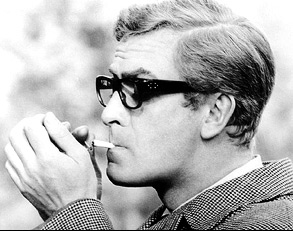
Michael Caine

Over four decades -- from "Alfie" to "The Cider House Rules" -- he has played warm, cold and everything in between, and never feared losing the audience's sympathy.

  • more
    • All Share Services

Michael Caine

“The thing about … Michael Caine is … that he only … speaks t’ree words … at a time.” That was British actor Jim Dale mimicking Caine’s distinctive stop-and-start cockney inflections. It’s a compliment, really, an acknowledgment that Caine had joined the select body of movie stars whose speech and mannerisms are so familiar they can be parodied. It must have tickled the former Maurice Joseph Mickelwhite, who took his name from a marquee advertising “The Caine Mutiny,” starring one of his all-time favorite actors, Humphrey Bogart, to have gained entrance to such a select club. (Just as it thrilled him, in John Huston’s “The Man Who Would Be King,” to be playing a role originally intended for Bogart.)

Michael Caine, who had an easy birth on March 14, 1933 (“the last easy thing I was to do for 30 years,” he has said), seems as familiar as any actor to have emerged in the past 40 years. We all think we know him. The ska group Madness named a song after him and punctuated it with the actor’s voice announcing simply, “I am Michael Caine.” In the midst of Eddie Izzard’s one-man show “Definite Article,” the English comic suddenly veers into dialogue from Caine’s 1969 caper flick, “The Italian Job,” and the English audience erupts in laughter of recognition with each new line. Roy Budd’s score for Caine’s 1970 tough-as-nails “Get Carter” (recently voted by British critics as the greatest British gangster film of all time) has been flying out of specialty CD shops on a pricey British import that features bits of Caine’s dialogue between the music tracks. (A remake starring Sylvester Stallone and featuring Caine in a supporting role is due out Friday.)

The iconic image of Michael Caine is probably best summed up by a 1965 David Bailey photograph recently reprinted in his book “Birth of the Cool.” In it, Caine wears the black horn-rimmed glasses he donned to play secret agent Harry Palmer in three films that began with “The Ipcress File.” An unlit Gauloise dangles from his mouth, and his black suit, tie and white button-down shirt are slim and immaculate. But there’s something unstable about the photograph, an unnerving aliveness that, 35 years later, still makes its meaning impossible to pin down, cut loose from its era as much as Bailey’s chic portraits of other icons of ’60s Brit cool — Jean Shrimpton, Mick Jagger, even the Kray Brothers — are contained by their times. The portrait is bordered by the edges of the black frame, but Caine’s eyes make you feel as if you’re the one who has been nailed to the wall. Steady, cool to the point of frigidity, they look as if they’re glowing from within their partially shadowed sockets; the long eyelashes that frame them might be tiny laser beams. Caine’s impassive expression and ray-gun orbs don’t offer the certainty of either kindness or cruelty but something far more unsettling: the sensation of being coolly appraised, of having each action or utterance totted up and held to your credit or debit.

Looking at that picture now, I can’t help feeling that it holds the key to the range and contradictions of Michael Caine — not just the key to how a great movie star became a great actor but the key to how such an essentially warm actor (and one moviegoers think of warmly) has been able to play cold. In “What’s It All About?” his enormously entertaining autobiography, Caine rather startlingly reveals that something other than his love for Bogart led him to take his name from a movie marquee. “Cain was the brother of Abel,” he writes, “who was cast out of Paradise, and I felt a great sympathy with him at the time.” Caine means that as someone scraping professional bottom after a promising start, he knew what it felt like to be suddenly on your uppers.

But could that understanding be part of what has made him so memorable when he has played bastards? The young Maurice Mickelwhite dreamed of being a movie star. Yet Caine has escaped the perennial curse of movie stars: vanity. He has never shied away from a role because he was afraid of losing the audience’s sympathy. That has been true from the beginning, when he gained his first huge success as unrepentant cad “Alfie,” through to the preoperative transsexual killer in “Dressed to Kill,” slimy underworld king Mortwell in “Mona Lisa,” the put-out-to-pasture middle-aged businessman who resorts to murder in “A Shock to the System” and the sadistic, Torquemada-like psychiatrist in the upcoming “Quills.”

There are certain actors (Christopher Walken, for instance, or Harvey Keitel) whom we expect to play villains. And after a while, they are robbed of the power to unsettle us. Go see Walken or Keitel now, even at their best, and you’re more likely to chuckle in pleasure at the way their villainy fulfills our expectations. Caine’s villains are so effective because, in his other roles as well as in his public persona, he seems the most levelheaded of actors.

The tone that pervades “What’s It All About?” is one of someone who has gotten used to luxury but doesn’t take it for granted. The former Archibald Leach may have said, “Everybody wants to be Cary Grant. Even I want to be Cary Grant.” But part of Caine still seems to be Mickelwhite. He is refreshingly free of guilt about being an actor who has worked for financial security. (“I have never seen ["Jaws: The Revenge"] but by all accounts it is terrible. However I have seen the house that it built, and it is terrific.”) There’s a famous story about his being treated as a cockney scruff by a Rolls Royce salesman, who saw Caine just a few hours later when the actor rode past the fellow’s showroom in a Rolls he’d purchased from another dealer, giving a two-fingered salute. In an interview a few years ago, he told one of those stories that make you laugh even as your eyes are tearing up. When money was no longer a concern for Caine, he told his mother that he could now take care of her and asked what she had always wanted. “Would it be all right,” Caine’s mum responded, “if I were to order an extra quart of milk, because sometimes I run out by the end of the week?”

Caine possesses a smoothness, a star quality that transcends class, a believability that has made him convincing as everything from an international movie star (“Sweet Liberty”) to a variety of lowlifes and losers (“Mona Lisa,” “Little Voice”) to a swank Riviera con man (“Dirty Rotten Scoundrels”) to Manhattan businessmen (“Hannah and Her Sisters,” “A Shock to the System”) to an Oxford professor (“Educating Rita”) to a small-town doctor (“The Cider House Rules”). But in the ’60s, when his career took off, Caine was the movies’ quintessential cockney.

You can talk all you want about the changes wrought on British culture by John Osborne and the Angry Young Man school of writing, or by the theatrical experiments of director Joan Littlewood (who told Caine, after his short stint in her company, “Piss off to Shaftesbury Avenue; you’ll only ever be a star”), or by the writing of Allan Silitoe and Shelagh Delaney. Those artists reached primarily intellectual, educated audiences. It was the Beatles who, reaching everybody, sent the British class system topsy-turvy. Suddenly, people were affecting Liverpudlian and cockney accents instead of upper-crusty ones. Suddenly, being born in the East End was more desirable than being listed in “Burke’s Peerage.” The aristocracy was a closed club; the joys of the new “ruling class” were open to anyone who responded to the excitement that carried the day.

Caine’s entry into acting had nothing to do with the British tradition of theatrical training. He started acting as a teenager in youth clubs, and after his National Service, moved on to stage managing and small roles at a little theater company, and from there into regional repertory, TV and small movie roles. By the time he became known in the ’60s he had already been acting for some years. (He had also gone through his first marriage and had a daughter, Dominique.)

Despite his role as official cockney, producers almost didn’t see it that way. Caine lost a part as a cockney in “Zulu,” only to be cast in his first big movie role as aristocratic snob Lieutenant Bromhead. Speaking in an upper-class accent that contained a wafer’s edge of parody, Caine modeled himself physically on Prince Philip, clasping his hands behind his back in the manner of “a powerful man and well guarded so he did not have to be ready to defend himself as the unguarded lower orders do. He never had to open doors or do other mundane things for himself.” The response from a senior Paramount executive in London who saw the rushes was a telegram that read: “ACTOR PLAYING BROMHEAD SO BAD HE DOESN’T EVEN KNOW WHAT TO DO WITH HANDS … SUGGEST YOU REPLACE HIM.” Luckily, director Cy Endfield knew when to ignore studio executives. The movie was a big hit, and Caine got great reviews but not the contract he had hoped for. Famous producer Joseph Levine, president of Embassy Pictures (which made “Zulu”), told Caine the studio was not picking up his option because “you look like a queer on-screen.” (This, incidentally, was 1964, the same year Rock Hudson was ending his seven-year run as the top box-office attraction.) But Caine’s performance attracted the attention of producer Harry Saltzman, who cast him as spy Harry Palmer in the film of Len Deighton’s bestseller, “The Ipcress File.”

The movie marks the beginning of Caine the icon. Right down to his ordinary-bloke name, Harry Palmer was conceived as the antithesis of James Bond, the spy as civil servant (though not one of the tortured and rumpled denizens of John le Carri’s gray world). The result is a movie that’s static and unsatisfying, a pop entertainment without the kick of pop (which was the distinctive joy of the Bond films). But Caine’s Palmer, competent, disrespectful to his superiors without being flagrantly insubordinate, was a coolly contained version of the working-class cheek that had won over British culture. Palmer’s targets can never quite tell whether he’s sincere or taking the piss.

It was his next role, as Cockney cad “Alfie” (a role that Caine had tried for and lost in the stage version), that would not only make him a star but give a hint of the fearlessness that would make him a rarity among movie stars. The part had already been turned down by other British actors, who knew that playing a bastard who uses women guiltlessly wouldn’t win them audiences’ sympathy. When Alfie Elkins loses interest in a bird, he knows she can still be handy to keep around for laundry and meals, and no matter how badly he treats women, to Alfie, it’s never his fault. Caine’s inspiration was to say the hell with sympathy. Narrating much of the story directly to the camera in a thick cockney accent, Alfie puts all of his charm at the purpose of his self-justification, trying to make all of us in the audience his marks. It’s not a great movie. The director, Lewis Gilbert, can’t resist the material’s “sensitive” touches, like Alfie’s guilt over his son being raised by another man. But he never shortchanges the hurt of the women, particularly Vivien Merchant, who’s quietly spectacular as the plain housewife for whom Alfie has to arrange an abortion. The triumph of the movie is contained in that sequence, in Gilbert’s dead-on handling of the seedy atmosphere, and in Caine’s awareness of Alfie’s blissful ignorance that this coldhearted stud is only a few years away from going to seed himself.

The key to Caine’s performance as Alfie, in a way the key to all his acting, is the lightness of his approach. In his autobiography Caine tells a story about Jack Lemmon making his movie debut for George Cukor, who, after every take, kept telling the actor, “Do less.” Finally, Lemmon said, “If I do any less, I’ll be doing nothing,” to which Cukor replied, “Now, you’re getting it.” Caine has learned that subtlety as only a handful of great film actors ever have.

There’s another kind of subtlety at work in the 1986 British thriller “The Whistle Blower,” one of the spate of movies made in disgusted reaction to the contempt for simple human decency that characterized every aspect of Margaret Thatcher’s rule. Caine plays a former army man whose son (Nigel Havers), a Russian translator for British intelligence, is murdered when he stumbles onto the government’s scapegoating of an innocent man. Caine’s performance in “The Whistle Blower” is one of his very best. Loath to believe that his England engages in the dirty dealings other countries do, Caine’s character must come to terms with the fact that his son’s death negates everything he has ever thought was true. His finest moment comes shortly after he has to identify his son’s body; a functionary brings in his son’s belongings in a green garbage bag, and after signing for them, Caine holds up the bag and asks, “I suppose this is cheaper than a cardboard box or something decent?” That’s one of the hardest things for any actor to do: to impart a sense of shame to another adult without a trace of self-righteousness. In that one line, Caine lays out something like an ethics of functioning as a human being, an awareness that every moment involves a choice of whether or not to behave humanely.

Through his whole body of work, Caine has raised his voice sparingly, almost always saving overt shows of anger for comic effect. Like the scene in “The Italian Job” where he’s sorting out the petty complaints of his crew of thieves before they pull their big job (“Yer not havin’ yer me-graine! Yer not bein’ sick! An’ yer both sittin’ in the back of the mini!!”), or the scene in “The Man Who Would Be King” (featuring, in a small part, his wife, Shakira, whom he married after falling in love with her face in a coffee commercial) where a Kaffir he’s trying to train in British military discipline can’t even count off in time with his fellow recruits (“Billy! Billy! He said it before the others! Not before the others! Not after the others! With the bloody others!!”).

The exception is his final scene as small-time theatrical agent Ray Say in “Little Voice.” In his early scenes with the astonishing Jane Horrocks as the painfully shy girl whose uncanny vocal imitations he hopes will make him the fortune he has sought for so long, Caine is sweetly seductive, solicitous of the girl. She’s his gold mine, but he cares for her as well. “Little Voice” is one of those unfortunate movies in which characters are finally no more than the sum of their worst impulses, but Caine explodes the cheap misanthropy. His hopes dashed, his pockets bare, he mounts the stage in the sort of crummy nightclub where, for years, he has wheedled and cajoled the slimy owners to book his pathetic acts. Letting out all the contempt he has held in for decades, Caine launches into a lacerating, self-pitying version of Roy Orbison’s “It’s Over.” He’s like a mad bomber using the song as dynamite strapped to his chest, determined to detonate it and drag everyone around down with him.

That lightness that does not exclude depth is precisely why Caine is so menacing in his villain roles. He’s the hero in “Get Carter,” Mike Hodges’ macho pulp thriller, which has achieved mythic status in Britain. But Caine plays British gangster Carter, returned to his hometown in the bleak industrial north to find the men who murdered his brother, as if he were a villain. He tosses off the most cutting remarks (and dispatches his enemies) with ice-cold aplomb. In a scene in which he runs into an old despised acquaintance and presses him for information, Caine doesn’t allow Carter’s contempt to come out until the end of the scene, and he does it so frigidly you feel years sliding off the other guy’s life. Lifting the man’s sunglasses off, he says, “Do you know, I’d almost forgotten what your eyes looked like. They’re still the same. Piss holes in the snow.”

Caine appears only intermittently in Neil Jordan’s “Mona Lisa,” but those appearances are vivid enough to turn the film’s pulp-romantic dream into a nightmare. As Mortwell, the underworld king whose fingers are in every sordid pie that presents itself to him, Caine more than lives up to the character’s name. Oozing Vitalis more than vitality, looking puffy and sated in his too-tight polo shirts and Members Only jackets, Caine is a walking portrait of death in life. His droopy eyelids belong to someone who willed his conscience and emotions dead a long time ago. For all the paunch that’s a sign of Mortwell’s success, he might as well be a death’s head, his quiet threatening air a looming reminder to all who encounter him of their final destination.

There’s a mischievousness to the villainy Caine undertakes in Philip Kaufman’s brilliant and unnerving Gothic drama “Quills,” which opens in November. As unscrupulous psychiatrist Dr. Royer-Collard, charged by the French king with breaking Charenton asylum’s most famous resident, the Marquis de Sade (superbly played by Geoffrey Rush), Caine wears the mask of civic virtue that hides festering rot. The movie spirals into horrors that even Royer-Collard can’t contain. And as it does, you see something like stone enter his countenance, a mounting determination to clamp down even tighter on the deviance that so offends his propriety. This is one of the performances where Caine uses his winning open smile as a mark of deviousness. Playing a louse of a man who pretends to the highest public demeanor, he is the Kenneth Starr of the Terror. His smile is a slap in the face, a promise across the centuries that the deeds of bastards carried out in the name of decency are far from done.

In the four decades he has been starring in movies, Caine has managed to go from generating amazement that he held his own next to Laurence Olivier in 1972′s “Sleuth” (a backhanded compliment — the material is worthy of neither of them) to recognition as a master actor. Because Caine has literally dozens of films to his credit, some of the best have slipped through the cracks. I urge you to check out “The Whistle Blower”; Jan Egleson’s crafty, malicious thriller “A Shock to the System”; and the tense, workmanlike political thriller “The Wilby Conspiracy,” in which Caine plays an English businessman who, during a vacation in South Africa, gets involved with saving the life of an escaped political prisoner, played by Sidney Poitier. This past spring, hours before he won his second Oscar for “The Cider House Rules” (he won his first for a skillful but not terribly flattering performance in “Hannah and Her Sisters”: There’s not much pleasure in watching Woody Allen foisting his neuroses on as grounded an actor as Caine), he was asked what two movies of his entire career he would keep. He answered “Cider House” and “Educating Rita.” Good choices.

Caine may never have gone deeper than he does in “Educating Rita,” which was directed by “Alfie’s” Lewis Gilbert from Willy Russell’s play. As Frank, a perpetually sozzled Oxford prof and stymied poet, Caine delivers perhaps the gentlest portrait of self-loathing ever in the movies. Frank is disgusted with himself for not producing any more poetry, disgusted with the poems he did produce, disgusted with the way he goes through the motions for students who regard him as an academic freak show, a souse who’s better for a laugh than a seminar. Frank may be faking, but he’s no fraud. The soul hasn’t burned out of the man, just gone into weary retreat. “Educating Rita” is about how he finds his way back with the help of a working-class hairdresser (Julie Walters) he tutors in an adult-ed program.

You can see Frank’s anguish in Caine’s watery eyes, his bloated gut and the curly hair and beard he seems to be doing his best to hide behind. He looks like a boozy, overgrown rabbit, and there’s something soft, almost caressing, about Caine’s performance. Without diminishing any of Frank’s waste or weariness, Caine portrays the dilemma of an unmoored man heading for oblivion as delicately as a solitary balloon mounting mournfully skyward. And he tries to deflect Frank’s caught-in-the-headlights terror at not knowing where to jump next by masquerading as a man calmly contemplating his next move. We register the calm, but we feel the panic underneath. It’s a portrait of lost (and reclaimed) human potential that bestows the greatest gift the movies can: a heightened, expansive sense of what it means to be human.

As Dr. Wilbur Larch in “The Cider House Rules,” Caine might be taking everything he has learned about acting and distilling it down to its essence. The whole performance is one of an actor defying the minefields of sentimentality to achieve purified and thorny emotion. Caine manages the tricky feat of making sternness equal love without going soft or becoming a lovable old codger. The exasperation he directs toward his protigi, Homer Wells (wonderful Tobey Maguire), manages to make Larch’s heartbreak at the prospect of losing Homer clear without ever becoming explicit. Caine’s utterly straightforward performance is an exquisite piece of transparent misdirection, a portrait of a man who makes his feelings obvious by what he doesn’t say.

Any actor, if he or she is good enough, begins, over the course of a career, to suggest links between the actor’s characters, not just by familiar inflections or gestures but in the way some characters seem to be living out alternate versions of other characters’ lives, confronting the same demons, winning or losing, or at least figuring out how to keep body and soul together. Wilbur Larch has won the battle that the disillusioned patriot Caine played in “The Whistle Blower” may wind up losing. He has accepted life as it is and not as it should ideally be. Larch’s central speech, his justification for performing abortions, is an argument for the possibility of decency and honor amid ugly choices. Ministering to a 12-year-old girl who has attempted to abort her fetus with a crochet hook, Larch says to Homer, “This is what doing nothing gets you … It means that someone else is going to do the job — some moron who doesn’t know how!” Caine delivers those lines with the sort of unimpeachable authority that only a few actors are ever lucky enough to achieve. Larch is a small-time, small-town country doctor, and his escapes into ether dreams notwithstanding, he has the immense stature, the cant-free moral authority of the movie characters who embody heroic decency.

Caine has said that he now looks at the quality of a part rather than its size. But he has reached the place where the roles that come his way are going to have to measure up to him. Caine slips effortlessly into Larch’s sensible, battered brown shoes and finds, after 36 years of movie stardom, that they are a perfect fit. Though Prime Minister Tony Blair recently made him Sir Michael Caine, his aristocracy seems to derive from another source: He’s the type of actor who is elevated to the status of movie aristocrat by the sheer love of his audience. He is that irresistible combination of an actor who feels both close to us and larger than us. Maurice Joseph Mickelwhite is no longer the man who would be a movie king. He’s the only kind of aristocrat whom people take to their hearts. One of ours.

“Justified’s” hero gets his own book

Elmore Leonard's latest novel revisits the story of the fictional U.S. marshal

  • more
    • All Share Services

This article appears courtesy of The Barnes & Noble Review.

There’s a streak of perversity in Elmore Leonard, contemporary American fiction’s master of dialogue, choosing the laconic cowboy type as a hero for his crime fiction. True, Leonard started out writing westerns, but the characters who populate his crime stories are talkers, some profane, some funny, some sarcastic, many all at once. But they are talkers.

Barnes & Noble ReviewRaylan Givens, the U.S. marshal who first appeared in Leonard’s short story “Fire in the Hole” and has since become the hero of the FX series “Justified” (which started its third season on Jan. 17; the first two are available on DVD), occupies the center of Leonard’s new “Raylan,” essentially a couple of long short stories woven loosely into a novel. Leonard’s Raylan is a bit more upfront about his appetites than he is in Timothy Olyphant’s wittily underplayed portrayal of the character in the series. He’s still no chatterbox, though.

Both “Raylan” and “Justified” are contemporary westerns, moving the conventions of horse opera to present-day Kentucky. Oxycontin (“hillbilly heroin,” as it’s called in one episode) has supplemented moonshine, but much else is still the same. Raylan is the upright, no-nonsense lawman, and the villains he faces (many of them) are the type of inbred bad news who caused problems for decent, law-abiding folks in pictures like “My Darling Clementine,” “Man of the West,” and “Ride the High Country.” Raylan, like every great western hero, is burdened by his own reputation, which in his case stems from the time he gave a Miami drug kingpin 24 hours to get out of town (and blew the bastard away when he didn’t). That gets Raylan reassigned to the hometown he wanted to escape, back in the same territory with his scheming con man daddy, his ex-wife, and his high school crush, who’s just taken permanent revenge on her abusive husband.

Leonard’s novels have inspired some fine adaptations, both in movies (“Out of Sight,” “Jackie Brown,” the relatively unseen “Killshot”) and on TV (the late, lamented “Karen Cisco”). “Justified” may be the best anyone has done at capturing the novelist’s mordant, flippant tone. The various brands of mayhem that have turned up on the show are greeted by victims and lawmen alike with a “Well, whadd’re you gonna do?” shrug. As Raylan, Olyphant is what you might have seen if the young Gary Cooper had been a put-on artist. The marshal is a hot pistol who’s had to learn to play it cool. His 10-gallon hat might be the cork that keeps his inner volcano from blowing. Much of the time Olyphant, who moves through each episode in lean, clean strides, seems to be privately amused by the corruption of the fools who mess with him.

As a novel, “Raylan” is a casual endeavor, Leonard having fun with a character who’s gained a measure of popularity. It’s also a pisser. Leonard has come up with some doozies for the plot: the dimwit sons of a backwoods pot grower joining in a scheme to swipe kidneys and then ransom them back for replacement in the victims’ bodies; a female coal company exec who, annoyed with a local’s complaints about the pollution caused by strip mining, picks up a rifle and shoots the old man. The violence here has the swift kick of a good, mean joke. It makes you wince and grin at the same time.

Raylan’s a straight arrow, but he’s not a stick-in-the-mud. He’s not too upright to consider a dalliance with the transplant nurse who’s masterminding the kidney-swiping scheme or that coal company exec, who hires him as her bodyguard. (His common sense wins out — by a hair — over his libido.) The compressed form of the stories is perfect for a writer who long ago learned to pare away every extraneous word.

There’s another reason Leonard’s creation and the TV show it spawned have clicked. A hero who sees the irony in being the tall, true man of the law — and is anyway — may be the only kind of traditional hero we can believe in now. In recent years, “cowboy” has come to be an epithet denoting ill-advised American military adventuring. But what’s denigrated as cowboy behavior is almost always more appropriate to the recklessness of the outlaw that the westerner faces. Raylan keeps his own counsel, considers the consequences before he acts, tells those who oppose him what the consequences are, uses violence when it’s called for but never revels in it and would just as soon avoid it. Among the other pleasures Leonard and his Kentucky lawman provide, they’ve restored the cowboy’s good name.

Continue Reading Close

How to catch a Taliban impostor

If Afghan officials don't want to be fooled by another huckster, they should take a close look at these movies

  • more
    • All Share Services

How to catch a Taliban impostorHamid Karzai (left) and the ladies of "Sex and the City 2"

Today the New York Times reports that a still-unidentified Afghan man was posing as a Taliban leader in secret peace talks with Afghanistan officials. It’s unclear whether this individual was a con man out to line his pockets, a Taliban agent out to sabotage the talks, or a plant from Pakistani intelligence. The writers, Dexter Filkins and Carlotta Gall, note that the incident “could have been lifted from a spy novel.” Regrettably, they may be right. The days when writers of espionage fiction conceived of impostor spies who called themselves Julian or Raoul seem to have passed in favor of writers who are less interested in the glamour of international intrigue than in impostors who don’t drink and call themselves Mullah Akhtar Muhammad Mansour.

Further reports on the story are sure to observe that the entire episode might have been plucked from the movies. This is incorrect. Plucked from films, yes. The story is half-ready for the art house. Strip the tale of glamour, remove any potential for excitement and you’ve not only got a greenlight, but guaranteed analysis in Cineaste, and a panel accompanying the New York opening consisting of Naomi Klein, a New York University expert on the Middle East, and any film critic dextrous enough to use “hegemony” in a sentence.

But the movies? Forget it. Hollywood is too besotted with sequels, reboots, animation to stick a toe into the real world. And the supposed change from this routine that the holiday season offers consists usually of adaptations of the kind of novels (usually Booker winners) that are purchased instead of read, or a Nancy Myers comedy in which a 50-ish divorcee (Meryl/Goldie/Diane) who has founded her own successful wrapping-paper company has to decide if her heart lies with her younger lesbian business partner (Debra Messing) or with a rakish older European diplomat (Bernard-Henri Levy).

Opportunities for film viewing in Kabul are understandably sparse. Salon’s sources in the city report that there are only two screens in operation at the city’s sixplex and they are currently offering “Speed Racer” and “Lambada: The Forbidden Dance.” Clearly, it’s time for America to intervene. Despite our massive expenditures in the country, our officials can surely afford a selection of DVDs designed to train Afghan officials on not falling for an impostor.

We suggest:

“Guess Who’s Coming to Dinner?” (1967) — We direct Afghan leaders to the suspicion shown by Spencer Tracy and Katharine Hepburn in the early part of the film toward the doctor their daughter brings home as her fiancé. The audience may consider their fears unreasonable because the doctor is, after all, Sidney Poitier and the young woman could as easily have brought home Eldridge Cleaver or Sonny Liston. But had the Afghans treated the impostor’s moderate proposals with even a smidge of the skepticism Spence and Kate show toward even such a paragon as Poitier, surely this embarrassing situation might have been avoided.

“Brokeback Mountain” (2005) — Was this individual really in close contact with the Taliban? If he had, he surely would have shown some inclination to the rugged, and all too often lonely, life that solitary figures like insurgents or closeted gay cowboys lead. Simply the mention of certain items — Ralph Lauren flannel shirts; beef jerky; a pet mule named Faiza — would have elicited a certain gleam in the eye of the real McCoy.

“Footloose” (1984) — Certainly only as dedicated a zealot as an actual Taliban leader could resist the combined lure of Kevin Bacon’s dancing and Kenny Loggins’ music. Slip the movie on during a break in negotations. Does this alleged mullah tap his feet, or nod his head sternly during John Lithgow’s fire-and-brimstone sermons? For the sake of the money you’ve just shelled out, pray it’s the latter.

“The Passion of the Christ” (2004) Four words: It’s the Jews’ fault. Sure to warm the heart of any true jihadist.

“Sex and the City 2″ (2010): Watch your man as he watches Carrie and the girls live it up in Abu Dhabi. Does he chuckle at their antics or make proclamations about profanations of the infidel harlots? (Note: The film can also be useful for other methods of recognition. See: “Brokeback Mountain.”)

Charles Taylor is a writer in New York.

Continue Reading Close

King’s lost dream

The final volume of Taylor Branch's magisterial biography shows how Martin Luther King Jr. reached out to his enemies. His example should shame the shrill partisans on both sides of our poisonous cultural divide.

  • more
    • All Share Services

King's lost dream

Consciously or unconsciously, great storytellers have a way of tipping us off to their concerns right upfront. On the first page of “At Canaan’s Edge,” the concluding third volume of his magisterial “America in the King Years,” Taylor Branch writes about J.T. Haynes, a high-school agriculture teacher in Alabama’s Lowndes County, the region that in the ’60s would see some of the worst Klan violence against the civil rights movement and would also give rise to the Black Panther Party. “Haynes,” Branch writes, “a teacher of practical agriculture, tried to harmonize his scientific college methods with the survival lore of students three or four generations removed from Africa — that hens would not lay eggs properly if their feet were cold, that corn grew only in the silence of night, when trained country ears could hear it crackling up from the magic soil of Black Belt Alabama.”

You could argue that Haynes, being black himself, had a built-in kinship to the black sons and daughters of Lowndes County. But seen from the midst of our current national division, one that’s less dramatic though perhaps just as poisonous as the divisions of the ’60s, it’s hard not to read Haynes’ faith that he could reach his students — not to overwhelm them or argue them down but, in Branch’s exquisitely chosen word, “to harmonize” — as a belief in the transformative power of discourse, a belief that America, both right and left, has largely abandoned.

And if that faith is abandoned, Branch would likely argue, then Martin Luther King Jr.’s vision is a dream that has no hope of being realized.

Every year, Dr. King’s birthday brings editorials extolling how far we’ve come from the days of legal segregation (true) or lamenting how far we’ve fallen short of his example (also true). Writers complain that a day devoted to nothing more than shopping is no way to honor his legacy. The far more insidious debasement of King’s legacy can be seen every day in what passes for political engagement in America right now. In 2003, in the left political journal Dissent, Queens College history professor Michael Wreszin inadvertently exemplified that debasement when, responding to co-editor Michael Walzer’s assertion that the left needs to enter a dialogue with the people most set against it, he asked if King should have been expected “to communicate with the average white citizen in racist Mississippi and Cicero, Illinois.” And, of course, the answer is yes. King knew that if he didn’t communicate with those people, there was no hope of eroding racism. That doesn’t mean that he took a gentle line with them, or hesitated to name ignorance and brutality when he encountered it. But King’s approach depended on reaching reasonable people, people who may not have been ready to welcome black people into their homes but who, ashamed by the more repellent racism around them, were finally able to see the legal and moral arguments for admitting blacks to lunch counters and public facilities and, the toughest stretch of all, to their schools and neighborhoods.

That’s a rapprochement Wreszin can’t imagine. He writes from the blinkered depths of a culture war where the most notorious phrase of a despised president, “You’re either with us or you’re against us,” fits the mind-set of both his fiercest adherents and his most vociferous opponents. Just as politics is not possible if you’re not willing to say what people don’t want to hear, it’s not possible if you’re willing to listen only to what you want to hear.

In “At Canaan’s Edge,” which deals with 1965-68 — the years spanning the Selma to Montgomery march to King’s assassination in Memphis — Branch sticks to the facts, following the story (not just of King but of “America in the King Years”) into Vietnam, tracking J. Edgar Hoover’s campaign against King, charting the divide between the civil rights movement and the emerging black power movement, and almost never interpreting. There is a vision that comes through, though, a vision that is an implicit rebuke to the divisiveness of what currently passes for politics.

For Branch, nonviolence represents the highest form of political engagement because it must be employed at the moments when it’s most tempting to abandon the idea that engagement is even possible. Branch wants to demonstrate the political viability of nonviolence as both moral stance and practical strategy — even though he calls nonviolence “an orphan among democratic ideas” that “has nearly vanished from public discourse even though the most basic element of free government — the vote — has no other meaning.” What’s been orphaned, in Branch’s view, is an expansive vision of what it means to be a citizen.

“America’s founders centered political responsibility in the citizens themselves, but, nearly two centuries later, no one expected a largely invisible and dependent racial minority to ignite protests of steadfast courage — boycotts, sit-ins, Freedom Rides, jail marches — dramatized by stunning forbearance and equilibrium into the jaws of hatred.” In other words, Branch is saying, people who were not even allowed the rights granted them by the Constitution acted, not simply for their own freedom, but as if the very fate of the republic depended on their actions. In order to do that, they had to have faith that the potential and the possibility of America far surpassed the worst of its governance and its people.

Branch does not need to underline the irony that some in the civil rights movement, like J.T. Haynes, were World War II vets, and returned from combat only to face a homegrown fascism. Haynes was in the congregation of Mt. Carmel Baptist Church in Lowndes County on the night of Feb. 28, 1965, when Klansmen surrounded the church with rifles. (The congregation was able to leave when the Klansmen inexplicably withdrew.) Incidents like this, and the earlier murder of a 26-year-old pulpwood worker named Jimmie Lee Jackson, shot twice in the stomach by police during a night march from Zion’s Chapel Methodist Church, galvanized the response to Rev. James Bevel’s proposal for a 54-mile march from Selma to the Alabama state capital in Montgomery. The march would take participants right through the heart of Lowndes County. The violence began before the marchers even made it out of Selma.

The first attempt at a march, on Sunday, March 7, 1965, resulted in the notorious scenes of Gov. George Wallace’s Alabama state troopers and reserves on horseback ramming through marchers as they attempted to cross the Edmund Pettus Bridge. ABC showed footage of the carnage that night, interrupting its broadcast of “Judgment at Nuremberg.” (At the point ABC cut into the film, a German couple was explaining they knew nothing about the treatment of Jews under Hitler.) A second attempt was made during which King turned back so as not to defy a court order barring the march. Hours later, the Rev. James Reeb, a Unitarian minister who had come from Boston to join the march, was clubbed outside a cafe and later died of his injuries. The third — and finally successful — march was begun on March 21. The marchers, their ranks victoriously swollen, reached Montgomery on March 24. That night, Viola Liuzzo, a white marcher from Detroit, was shot to death as she began the long drive home to Michigan. (It was later revealed that one of the passengers in the shooter’s car, Gary Thomas Rowe, was an FBI informant who almost certainly had knowledge of what was going to happen.)

The Selma to Montgomery march takes up almost the first 200 pages of “At Canaan’s Edge.” It needs to, because it was the last great march of the civil rights movement. It was also the moment when the coalition formed between church groups like King’s Southern Christian Leadership Conference and student groups like the Student Nonviolent Coordinating Committee, and others like the Congress of Racial Equality, began to fray. The deaths of Jackson, Reeb and Liuzzo, the 1964 murders of the Freedom Summer volunteers Andrew Goodman, James Chaney and Mickey Schwerner, and the constant threats and danger civil rights workers faced in the rural South were starting to grind down the commitment to nonviolent change. To people who had seen their co-workers beaten or had themselves suffered in jails, King’s unwavering insistence on nonviolence came to seem almost suicidal.

Branch understands the almost inhuman effort required of people not to react violently when they live in constant fear for their lives. Reading “At Canaan’s Edge,” you understand exactly why Stokely Carmichael, arrested 27 times during his work with SNCC, finally came to the point where he yelled at a crowd of demonstrators about to be tear-gassed by state troopers, “You tell them white folks in Mississippi that all the scared niggers are dead!” You see why Carmichael and movement figures like SNCC’s James Forman came to conclude that nonviolence would not help American blacks. More profoundly, you understand just how foolhardy a conclusion that was.

What is frequently branded radical politics in America is often just romantic fantasy, a childish impatience with anything that produces less than immediate results, mistakenly equating the compromises that politics entails with corruption. One of King’s favorite quotations, often used in his speeches, was the abolitionist Theodore Parker’s “the arc of the moral universe is long, but it bends towards justice.” That was not a means of mollifying people who had given and suffered so much — it was a way of honoring that suffering and sacrifice. It would be wrong to discount the sacrifices that the members of SNCC made. It’s not exaggerating to say that attempting to register black voters in the South at that time was an invitation to being murdered. But as SNCC became increasingly radicalized, it, along with the Black Power movement and the Black Panthers — who, with their uniform of leather and sunglasses and proudly displayed weapons, had made themselves the stars of the vigilante movie playing in their heads — came to be certain that working toward equality through the mechanisms of representative democracy was the same thing as making yourself a whipping boy for the Man.

One of the few places in the book where Branch betrays his own impatience is when he writes of SNCC, “They were no longer students or nonviolent. They no longer coordinated sacrifice beyond the wisdom and courage of the nation’s elders, nor operated by egalitarian grassroots committee. Instead, they competed for celebrity attention while reverting to youthful disputes as tawdry as snipes at their clothes.” Having given them the respect they are due, Branch is, I think, saying that finally they did not have the moral courage to live up to the meaning of their sacrifice, and that their rhetoric was less articulate than the unspoken faith shown by others who were confident that the courage they had shown and the violence they had endured would pay off in profound change. Those people understood, as a friend of mine put it, no real revolutionary ever hated his own country.

Lost in the fantasy that the system was so rotten it could not be changed, SNCC ceded the moral high ground to, among others, the president it despised, Lyndon Johnson. In Johnson’s March 1965 address to Congress on the moral necessity of passing the Voting Rights Act — along with Lincoln’s second inaugural address, it remains the greatest of all presidential oratory — Johnson showed both verbal and moral eloquence: “It is not just Negroes, but really it’s all of us, who must overcome the crippling legacy of bigotry and injustice. And we shall overcome.” Mayor Joseph Smitherman of Selma said that hearing a white Southern president say those words was like “a dagger in your heart.” James Forman’s response: “That cracker was just talkin’ shit.”

One of the things Branch brings back so vividly is how unfashionable Martin Luther King became in the last years of his life. I choose the adjective deliberately. There were plenty of people willing to groove on the same fantasies of rebellion. Branch records a debate in New York City where Hannah Arendt, who was shortly after to formulate her own response to the revolutionary perfume in the air in “On Violence,” argued that “violence always arises out of impotence.” From the floor Arendt was challenged by Tom Hayden, who claimed democratic means had been exhausted for ending the war in Vietnam and racism at home (especially when you give up on the democratic process), and Susan Sontag, who said that arguments about the nature of violence dodged the question of action, “whether we in this room, and the people we know, are going to be engaged in violence.”

By 1966, Andrew Kopkind, writing in the New York Review of Books, said haughtily of King, “Whites have ceased to believe him, or really to care; the blacks hardly listen.” Shortly after, in the same pages, Kopkind was extolling as the true movement the National Conference for New Politics, at which H. Rap Brown had said, “We should take lessons in violence from the honkies. Lee Harvey Oswald is white. This honky [Richard Speck] who killed the eight nurses is white.”

It’s easy to dismiss Kopkind’s effusions and Hayden’s posturing and Brown’s psychotic babble as the nuttiness that’s in the air at any given time, and that eventually fades out of vogue. But the moment-to-moment style of Branch’s prose suggests the harm that fuzzy thinking can do in its own time, draining energy and thought from the hard work of forging change, and offering escapist fantasy from the sometimes untenable choices of real politics.

Which is not to say that nonviolence doesn’t present its own set of moral problems. When Arendt finally published “On Violence” in 1969 she acknowledged that nonviolent resistance can only be employed against a democratic country. Against a totalitarian country that used violence to force compliance, nonviolence is doomed. “Those who oppose violence with mere power,” she wrote, “will soon find that they are confronted not by men but my men’s artifacts, whose inhumanity and destructive effectiveness increase in proportion to the distance separating the opponents.” And strict adherence to nonviolence can produce its own inhumanity. In his essay “Reflections on Gandhi,” George Orwell noted that Gandhi said the correct pacifist response to the Nazi persecution of Jews was that the Jews should commit mass suicide and thus rouse the world to action.

But Arendt’s arguments provide a hardheaded reply to the charge that King’s nonviolence was merely fuzzy Christian humanism unsuited to the reality of his time. “Power springs up whenever people get together and act in concert, but it derives its legitimacy from the initial getting together rather than from any action that may then follow,” she wrote. “Violence can always destroy power; out of the barrel of a gun grows the most effective command, resulting in the most instant and perfect obedience. What can never grow out of it is power.”

And that, in large part, is why King’s ideas truly deserve to be called radical when the fantasies of those who claimed he was out of touch remain such dangerous nonsense. When praising those who’ve been deemed moral leaders, people tend to overlook their pragmatism as if such common-sense concerns somehow invalidated their aura of saintliness. For King, nonviolence was clearly and primarily a moral principle. But it was also a practical one. He knew that many people who had not been convinced of the need for racial equality would be, understandably, turned off by violence. Which means that, for King, nonviolence was an act of faith that people were capable of change, and that the mechanisms of representative democracy were capable of enshrining those changing attitudes into the law of the land.

With this final volume, “America in the King Years” becomes unsurpassed in the last 50 years of American biography. Which is not to say that Branch has written a perfect book. His syntax is at times unnecessarily twisted, and he can be careless about identifying the figures in the story. The last section of this epic tale is fragmented in the telling, but that is perhaps unavoidable; the story itself is fragmented and thus, not as emotionally satisfying as the stories of the civil rights movement’s earlier triumphs. As King moved his campaign into the Northern ghettos (notably, Chicago), he found problems not given to such clear-cut moral victories. And as he began to speak out against the war in Vietnam, the moral thrust of the civil rights movement began to seem blunted — though with a disproportionate number of blacks fighting the war, and with funding for the war undermining the funding for LBJ’s Great Society programs, protesting Vietnam was a logical step. (Branch is merciless in detailing how the establishment press, particularly the New York Times, said King had no standing to speak on Vietnam. Those Op-Eds were the polite Eastern version of telling King to step to the back of the bus.)

But these are minor reservations about a book that gradually reveals a large-scale vision of democracy as an act of hope thrown down like a gauntlet. If one of the marks of greatness is that a person’s stature continues to grow after he is gone, then King is one of the titans of American history. Next to his example, what passes today for a politics of opposition seems puny, snobbish, a closed circle rather than one ready to expand to allow those willing to enter. It’s heartening to pick up the paper and read of the Georgetown students who protested Attorney General Gonzales’ speech justifying Bush’s domestic spying. A dozen of them simply stood and turned their back to Gonzales while others unfurled a banner that quoted Benjamin Franklin: “Those who would sacrifice liberty for security deserve neither.” As an act of protest it was simple, elegant and to the point, devoid of the grandstanding, the sheer thoughtlessness, that marks so much political speech.

What no one seems willing to say about the red state-blue state divide is that people on both sides like it because it allows them the dual pleasures of feeling superior and having someone to hate. I don’t doubt that the Bush White House would love to stifle dissent. But there is something skin-deep about arguing for dissent in an atmosphere where the dissenters have adopted the same simplistic moral scheme of those in power. We have become so scared of appearing to be on the incorrect side of an issue, so scared of seeming to give credence to the other side, that we are willing to eliminate inconvenient facts from our rhetoric, ignore ugly echoes. (It’s depressing to hear “sovereignty” cited as a reason against going into Iraq — a war I oppose. It’s the same argument used by segregationists of the ’50s and ’60s as a way of resisting integration. Arguing for the sovereignty of a tyranny is simply a means of legitimizing the oppression of its people.)

Against the current certainty on the right and the left that the other side is beneath contempt, not worth talking to — an attitude that leaves no possibility for real change and reduces democracy to majority tyranny, no matter who is in power — we have King’s belief in the ability of people and their country to overcome the worst in themselves. In his vision empathy is not appeasement but the beginning of change. In his introduction, Branch quotes the last words of Mickey Schwerner, spoken to the Klansmen who held a gun to his head: “Sir, I know just how you feel.” That’s the challenge this story throws down to us. How can any less be expected of those of us who don’t have a gun to our heads?

Continue Reading Close

“Timeless” beauty

With her latest album, Martina McBride breathes new life into contemporary country music by summoning ghosts from the past.

  • more
    • All Share Services

“Ghosts from a beautiful dream.” That’s how country-and-western star Marty Stuart refers to such living luminaries of country music as Loretta Lynn, George Jones, Willie Nelson, Merle Haggard and others in his liner notes for Martina McBride’s latest album, “Timeless.” Could any description be more loving? Or more withering?

To describe country music as a place where living greats have become ghosts is to describe it as having betrayed its past, probably the most damning thing you could say about a genre that claims to have such respect for tradition.

I stopped listening to contemporary country music a few years back. I was tired of the anonymity of the songwriting, of arrangements that sounded like some postmodern representation of country instead of music itself. And the music that sprang up in opposition, alt-country, was usually about as much fun as sitting bare-ass naked on a splintery bench. The alt-country artists sounded as if any expression of pleasure was a sellout. If mainstream country had become the equivalent of a shiny new SUV, alt-country was a dirty window with dead flies littering the sill. A choice between that shopping-mall dominatrix Shania Twain or Lucinda Williams’ wallflower moping was no choice at all.

What does it say that two of the biggest icons in country, Dolly Parton and George Jones, and country’s biggest contemporary female star, Martina McBride, have all turned their backs on contemporary country on their new records? Parton’s “Those Were the Days” is a selection of folk-rock covers from the ’60s and ’70s; George Jones’ “Hits I Missed … And One I Didn’t” consists of songs he turned down that became hits for other artists. The Parton and Jones albums aren’t played on country radio, but for Martina McBride to release “Timeless,” consisting entirely of classic country hits, is, whether she intends it to be or not, a gauntlet thrown at the facelessness of contemporary country. (That “Timeless” entered the country charts at No. 1 — and that Lee Ann Womack’s “There’s More Where That Came From,” which, from the cover art to the sound of the music, harked back to ’70s country, was one of last year’s biggest country albums — suggests that some country fans may be willing to throw down the gauntlet as well.)

Ever since her debut in 1992, Martina McBride has been a perpetual ray of hope in country music. She’s never equaled her first big hit, “Independence Day” — the witness of a true believer delivered as a scorched-earth sermon — which, after Nirvana’s “Smells Like Teen Spirit,” is the greatest single of the ’90s. Her choice of material, her arrangements and production, have been as slick as anything mainstream country has to offer. And some of the songs, most notably those on 1997′s “Evolution,” had a treacly self-actualization subtext (the faux feminism country music adopted as a reaction to what has been so dimwittedly read as the submissiveness of Tammy Wynette’s “Stand By Your Man”).

Why, then, do I still listen to everything McBride does as soon as she does it? Because she has never once sounded defined by the commercial slickness of her material or musicians, has never seemed to be phoning it in, has never not sounded like a real person. Martina McBride possesses one of the truest voices I know, and while I have often wished for her to travel rougher territory, I have never doubted her sincerity or integrity.

Now, when you say someone has a voice, you have to be clear what you mean. The same can be said of every Trivial-Pursuit-answer-in-waiting on “American Idol.” What separates McBride from them and from most of her country and pop contemporaries is that she’s a singer. McBride shuns vocal gymnastics; she never sings four syllables where one will do. Her voice never goes shrill; the bigger it gets, the freer it becomes. Rare among contemporary singers, McBride is emotionally unfettered and yet also has an innate sense of what to hold back, how to suggest.

McBride opens “Timeless” with Hank Williams’ “You Win Again” as if it were a statement of ethics. The utter simplicity of the song, her faith in it and her refusal to embellish become a way of returning not just herself but the entire genre of country back to priorities.

At a generous 18 tracks, “Timeless” is the most satisfying album McBride has made, largely because she’s got great material, and also because of the way the material is presented. Acting as her own producer, McBride and her manager-husband, John (who recorded and mixed “Timeless”), have used mostly analog equipment (no guitars or amps newer than 1965, for example) to give the album a fat, warm sound, the sound you’d hear when most of these songs first hit the radio.

There are covers here of songs by Ray Price, Tammy Wynette, Johnny Cash, Ernest Tubb and others. All are good. Two of the songs, Buddy Holly’s string-laden ballad “True Love Ways” and “I Can’t Stop Loving You,” the Don Gibson song that was a smash for Ray Charles, virtually copy the arrangements of the song’s best-known versions. (“I Can’t Stop Loving You” even has the white-sounding backup singers Ray used.) That’s worth noting because there’s nothing that sounds like mimicry in McBride’s vocals. For a white country singer to cover “I Can’t Stop Loving You,” a song that a black R&B master took from another white country singer, and still make her version true, suggests both chutzpah and confidence, the kind of confidence that doesn’t need to boast.

If I had to choose a song to sum up the special poignance country music is capable of, it might well be “Satin Sheets,” Jeanne Pruett’s 1973 song, which she herself promoted all the way to No. 1 after her record company told her it was “too country,” and which McBride tackles on “Timeless.” Pruett discovered it on an unsolicited tape sent to her by its composer, a Minneapolis factory worker named John Volinkaty. It’s a song about someone who’s found a life of unimagined luxury but who still pines for the true love who will give her what money can’t buy. That’s a classic setup for a country weeper, but the authenticity of the song can be summed up by one line — “tailor-mades upon my back.” That’s an example of specificity as instinctive genius. No one used to fine clothing would ever speak of it in that way, and the language reveals, as does the unalloyed carnal longing in McBride’s vocal, country’s simultaneous wish for material comfort and the distrust of it. The satin sheets and tailor-mades are distractions; emotion is the only real thing.

That’s as good a metaphor for what’s true in McBride’s music as anything could be. But the languid soaring she does on the song that closes “Timeless,” Kris Kristofferson’s “Help Me Make It Through the Night,” sums up the album in another way. When Sammi Smith recorded it in 1971, it had the same impact on country that the Shirelles’ singing “Will You Love Me Tomorrow” had on rock ‘n’ roll in 1962. That is, it was an open expression of a sexuality women were not meant to feel, let alone acknowledge. There’s something like a swoon in McBride’s voice in the way she accentuates the verb in “I don’t care what’s right or wrong,” as if she could will herself into the abandon she’s turning to for comfort. She’s holding coldness at bay here; beneath the longing in the singer’s voice is a hardness that says she knows just how temporary the comfort she seeks will be.

Emotionally, the song is all of a piece, and yet the first line of the chorus, “Yesterday is dead and gone,” is the only untruth on the album. McBride sings each song on “Timeless” not as a part of history, as something dead and gone, but as though each were a living thing, because, for her, these songs are alive. On the best album she’s made, Martina McBride has landed nearly all of contemporary country music in a pickle: How can we be satisfied with country music as it is now when this is its living past?

Continue Reading Close

Soul man

In a vast new biography, Peter Guralnick takes on the late, great, silky-smooth crooner Sam Cooke.

  • more
    • All Share Services

Soul man

How does an American artist aim for a broad audience without being accused of selling out? Trying to maintain your distinctiveness while entering the mainstream is particularly fraught for black performers, who can find their desire to generate a widespread following dismissed as a bid to join the white world.

The most overt, dramatic and controversial example of this struggle was Ray Charles’ switch from the R&B he recorded at Atlantic Records to the orchestrated pop, country music, show tunes and Beatles covers he recorded when he made the lucrative move to ABC Records in 1959. Though, if you have the ears to hear, what comes through is consistency. There is just as much soul in Charles’ string-laden “Moonlight in Vermont” as in the guttural exhortations of “I Got a Woman.” Which is not to say everything he did was equally great, but that Charles’ career exposed the narrow ways in which we decide what constitutes “authenticity.” It was inevitable that Charles, who truly deserves the overworked appellation “genius,” wouldn’t be content with one color on the musical palette and would try to encompass as much of American popular music as he could.

If the tension between pop and soul doesn’t seem so overt in the case of Sam Cooke, it may be because many people never assumed it was there. While a large portion of the black audience already knew Cooke from his tenure with the gospel group the Soul Stirrers, when his first hit single — that sweet summer breeze of a song “You Send Me” — brought him to national attention, he was seen by a much larger audience as just about the silkiest singer imaginable.

But if the tension seemed less present in the music, it was there in Cooke’s psyche, and the conflict between assimilation and individualism is the strongest overarching theme in Peter Guralnick’s new biography, “Dream Boogie: The Triumph of Sam Cooke.”

Guralnick had wanted to write a Cooke biography ever since meeting Cooke’s business partner, J.W. Alexander, in 1982. Other books intervened, none more time-consuming than his two-volume biography of Elvis Presley, “Last Train to Memphis” and “Careless Love.” Anyone who’s read the Elvis books knows that Guralnick is a scrupulous and thorough interviewer. The common thread running through all of Guralnick’s work is a commitment to decency. In every interview he does, he allows his subjects the space to present themselves, and trusts his readers to use their intelligence and instincts to make their own judgments.

Still, there’s one problem with “Dream Boogie.” While Guralnick the meticulous researcher and compassionate interviewer is present, the part of him that synthesizes and brings a critic’s eye to the story is absent here. This is particularly disappointing in the long section that comes about a third of the way into the book that covers the time between Cooke’s leaving the Soul Stirrers and his finding his feet in the pop world, alternating great singles like “Twistin’ the Night Away” with brassy albums of standards, and his establishing himself as both a star and a businessman. There’s no denying that business is key to the Sam Cooke story. But there are times when you wish Guralnick would cut through the details of the meetings and negotiations and simply tell us what it meant for Cooke to set up a publishing company, what it meant for him, along with Alexander, to found the SAR record label. (You can get a more concise view of this from the liner notes Guralnick has contributed to the new CD reissues of the Cooke albums “One Night Stand! Sam Cooke Live at the Harlem Square Club” and “Night Beat.”)

It’s worth persevering, though, because “Dream Boogie” offers ample evidence that the historian-as-storyteller is still kicking around. Guralnick brings the gospel touring circuit of the ’50s and the soul circuit of the ’50s and ’60s to life and gets at how, in the temptations available on each, the sacred held no more sway than the secular. This is where his determination to let the story tell itself really does work. Guarlnick not only calls up a vanished milieu; his vivid portrayal of that scene helps to explain Cooke’s drive to move beyond it.

For all the fondness in Guralnick’s stories of traveling, boozing, womanizing (at one point, three different women gave birth to a child of Cooke’s at virtually the same time), for all the thumbnail vividness in the sketches of the characters and musicians Cooke met both on and off the road (“In mid-November they signed Johnny ‘Guitar’ Watson, a star on the L.A. R&B scene whose talent was exceeded only by his panache and by his ambivalence about whether he wanted to be a singer or a pimp”), the second-rateness of the chitlin circuit comes through. The performers are forced to stay in lousy hotels because the better ones are segregated, as are the restaurants. As far as the sight of a group of black men driving a new car in the South, forget it. At times it seems obvious that Cooke’s older brother, Charles, who’d had run-ins with the law, was hired as driver as much to keep him out of trouble as for the muscle he could provide.

And there was worse. For Cooke and for every performer on this circuit, there were too many examples of the dangers both within and without. The R&B singer Jesse Belvin died in a car accident caused by slashed tires, and the damage was thought to have been inflicted by white fans angered by Belvin’s refusal to play a segregated show. In the months before Cooke died in December 1964, Frankie Lymon had already been arrested for possessing heroin; he’d die a junkie four years later. The great Little Willie John would be arrested for killing a man in an argument. Ray Charles had been busted for heroin in Boston.

The horrors and humiliations of the road might have been enough to impress themselves on anyone. Cooke’s upbringing ensured they did. Cooke was the son of a conservative preacher, so it might be supposed that Cooke — who gave up sacred music for secular, who loved his women, who enjoyed all the advantages that money and being a truly beautiful-looking man brought him — was a rebel. In truth, he took his father’s advice to heart. “Respect your elders, respect authority,” Guralnick recounts it. “But if you were in the right, don’t back down for anyone, not the police, not the white man, not anyone.” It’s possible that what protected Cooke in some confrontations was the astonishment he provoked in others by being a black man who did not back down. Guralnick tells a story about Cooke’s running out of gas on tour in Memphis. Waiting for Charles to come back from the service station, Cooke was approached by a white cop who told him to move the car, to push it if he had to. “His name was Sam Cooke, and he didn’t push cars,” is what he told the cop, before finally saying, “You push the fucking car. You may not know who I am, but your wife does. Go home and ask your wife about me.” The unmistakable sexual nature of that taunt makes you gasp, as does the fact that Cooke got away with it.

“Dream Boogie” leaves you wishing that Guralnick had more fully explored how Cooke’s career embodied both the desire to integrate and the belief in black self-determination (and also how, if Malcolm X and Martin Luther King had lived, how those views might have reconciled themselves). Cooke wanted to find the widespread popularity that Nat King Cole and Harry Belafonte had (Belafonte’s “Calypso” LP had spent three years on the charts), which inevitably would have meant moving more toward the middle of the road. But he also seemed adamant that that popularity would give him the freedom to move beyond pop, to meld together all his influences, and to have an audience that was primed to follow him as he did.

Guralnick records several incidents that reveal Cooke was aware of the changes taking place in pop music. He admired the Beatles. Hearing “Blowin’ in the Wind” on “The Freewheelin’ Bob Dylan” inspired him to write “A Change Is Gonna Come,” which has rightly been called the greatest soul song of all time. And Guralnick quotes Bobby Womack, whose “It’s All Over Now” was covered and turned into a hit by the Rolling Stones, telling Cooke that this guy — Mick Jagger — couldn’t sing. Womack simply wouldn’t believe it when Cooke told him the Stones represented the future. (In fact, the Stones would soon be represented by Allen Klein, the accountant-turned-agent who managed Cooke during the last year and a half of his life. Not the least important accomplishment of “Dream Boogie” is its portrait of Klein, more complex and nuanced than others that have painted him as one of the principal villains in the breakup of the Beatles.) Could a man with such catholicity of musical taste (matched, from everything Guralnick tells us, by his omnivourous taste in reading) be satisfied with making middle-of-the-road pop?

Certainly those two recently reissued RCA recordings suggest not. “One Night Stand! Sam Cooke Live at the Harlem Square Club” hints that Cooke still had some musical integration of his own to accomplish. Recorded at the Saturday night late show in a packed Miami club in 1963, it can stand with “Otis Redding Live in Europe” as one of the greatest live albums ever. This was the show Cooke did on the soul circuit, quite different from the one he’d record the next year before a largely white audience at the Copacabana in New York City (“Sam Cooke at the Copa”), and it took RCA more than 20 years to issue it. It’s a raw show; Cooke’s voice is raspy throughout and the sort of call-and-response interaction between performer and audience marks just how fully Ray Charles and others had succeeded in bringing the fervor of gospel into R&B. The accounts of Cooke’s live performances in “Dream Boogie” suggest that he relied largely on his voice to seduce a crowd instead of the theatrics that were a staple of Jackie Wilson’s act. Whatever his physical presence was that night in Miami, you can hear, just by the vocals, what whips the crowd up, why every song is punctuated by shouts of excitement. By the time Cooke and the band reach the closer, an extended “Having a Party,” you feel as if you could die from sheer happiness, and as if you’re ready to.

“Night Beat,” which might be the only satisfactory studio album Cooke completed in his lifetime, suggests that Cooke was well on his way to merging the direct emotion of soul with the sheen of pop. Obviously taking some inspiration from the “themed” albums Frank Sinatra had made at Capitol in the ’50s, “Night Beat” aims to get the feel of the blues and spirituals (the album opens with “Nobody Knows the Trouble I’ve Seen” and includes numbers by Willie Dixon and Charles Brown) into a relaxed late-night groove. The album succeeds in creating a sound that is both mellow and deeply emotional, which, of course, is not a contradiction in terms.

The best argument for why Guralnick the critic should be more present in “Dream Boogie” (the title is taken from a Langston Hughes poem) is that Cooke was at his most complex in his music. For much of this book, Sam Cooke comes off as somewhat indistinct. Everyone Guarlnick interviews tells us he was a charmer, highly motivated and ambitious, but they also refer to a veiled side. And while we see the flashes of temper, the ease with which he left groups and labels when he had a chance to further his own career, the callous attitude he had toward women (including his second wife, Barbara, who had fallen in love with him when she was a little girl), he remains something of an enigma — except in the music.

Cooke comes most alive toward the end, when he is both realizing his greatest popularity and suffering as he never has following the drowning death of the infant son who, because of (unfounded) doubts of his siring, he held distant in his affections. And it’s those washes of darkness and turmoil that serve Guralnick so well in the account of Cooke’s death suggesting that some sort of recklessness wasn’t out of the question. Cooke was shot to death by Bertha Lee Franklin, the proprietor of a $3 Los Angeles motel. He had gone to the motel with Erica Boyer, a hooker and, more to the point, a roll artist (someone who picked up men, took them to a hotel and, before any sex had taken place, absconded with their money). What happened there will always be a matter of dispute. Boyer claims she was kidnapped by Cooke and escaped with Cooke’s clothes when he went into the bathroom. Cooke, coming out and finding most of his clothes and money gone, started banging on the motel office, demanding Bertha Lee Franklin produce the girl. They got into a rough scuffle during which Franklin fired a shotgun into him.

Even if, as is likely, the homicide was justifiable, there are questions that have never been answered about whether, also as likely, Cooke was Boyer’s specifically chosen mark for the night. A private investigator hired by Allen Klein was on the verge of finding out, but Klein, fearing the results would damage Cooke’s reputation, dropped the investigation as he was requested to do by Cooke’s widow, Barbara. Inevitably, as with so many pop deaths (Tammi Terrell, Marvin Gaye, Kurt Cobain), all sorts of conspiracy theories have sprung up about the killing.

It was not uncommon to hear Cooke’s death talked of, bitterly, as the comeuppance that a racist society metes out to black men who got above themselves. Without diminishing Cooke, without denying Erica Boyer’s probable culpability in creating the situation that got Cooke shot, Guralnick understands the death as the sad, stupid waste of life and talent that resulted from Cooke putting himself in a very bad position.

For all the things that keep “Dream Boogie,” a solid, scrupulous, thoughtful biography, from being a truly great book, there’s no doubt that rock ‘n’ roll history, and, hell, American history, needs Peter Guralnick. His magisterial work on Elvis Presley, which can leave you feeling unmoored for days, convinced that you have just read, as Guralnick claims, “the saddest story” he knows, can stand alongside Taylor Branch’s ongoing “America in the King Years” and Robert Dallek’s two-volume life of LBJ as one of the greatest recent accomplishments in American biography. No subject Guralnick approaches in popular music is likely to have that immensity. But there are still pieces of the story of American music that call out for his perspicacity and decency and smarts.

We are in a period where, instead of turning our cultural past into the vast library it promised, technology has, by its pace, accelerated the culture of disposability. The CDs and DVDs available to us may form a library of the past, but the speed of our culture encourages us never to get past the new-releases wall. Rock journalism — God, even that name sounds like a relic — far from being the great enterprise it seemed 30 years ago, has given way to a sort of undifferentiated fandom. There is simply too much music for any critical sensibility to present a clear overview of our pop present. And so the solipsism Lester Bangs envisioned in his obituary for Elvis has, just as he predicted, come to hold all the cards. Too much pop music criticism no longer seems even interested in talking to an audience beyond the small one that will already know what the writer is talking about.

Which is why, even at the risk of seeming a mere archivist or even an old fogy, Guralnick needs to bring his talents to other figures who are in danger of becoming relics of a past that many people no longer believe they should care about. Buddy Holly and Otis Redding are just two of the titanic figures who need solid biographies written about them, as does an artist Guralnick has written about so lovingly in the past, Charlie Rich, still the least acknowledged great American singer of the 20th century. I can’t imagine how exhausting it must be to work on the scale that Guralnick does. I pray for his stamina. Our past needs the love and respect he continues to show it.

Continue Reading Close

Page 1 of 127 in Charles Taylor