
Sex
Written on the body
"Pay It Forward" is emotionally manipulative, but the stars save the film with the acting -- especially in their love scene.
It’s nearly a clichi, I suppose, but the people who live in Las Vegas (especially those who are hard up) are assumed to be unhappy spectators as the rest of the world arrives expecting to collect its big break. In the new film “Pay It Forward,” Arlene McKinnon is a single mom who needs two jobs to survive — as a cocktail waitress and a change maker, both in small casinos.
She’s Helen Hunt, and she’s doing all she can not to be an alcoholic. Her boy, Trevor (Haley Joel Osment), is in the seventh grade, where he has a social studies teacher who says, “What’s wrong with the world, and what are you going to do about it?” But he says it in a deadpan, ironic way, as if he doesn’t believe there’s a way of saving things. He’s withdrawn, alone and chilly; he’s Kevin Spacey and his character’s name is Eugene Simonet.
Trevor’s attempt to make things better is to try to get Mr. Simonet and his mom together. The film is very emotional — it’s going to be an enormous hit — and manipulative. Sometimes you resent the ease with which it can bring tears to your eyes. But nothing dispells that reluctance quicker than fine acting — for which we have Spacey and Hunt, not just recent Oscar winners but actors who can draw upon their own emotional awkwardness.
Arlene’s urge for the bottle comes from her broken family, and the mockery of so much wonder and magic on display in Las Vegas. It’s a hard city to live in if the American dream has failed you. And it’s a tricky place to teach social studies, with “transformation of the self” referring to the turn of a card rather than to a lifetime of work. So Arlene and Eugene are wounded people, afraid of feeling too much for each other.
Eugene’s other problem is having a hideously abusive father who once set him on fire. There are some scars on his face, and Eugene feels that everyone is alarmed by them. But the scarring to his body is far worse.
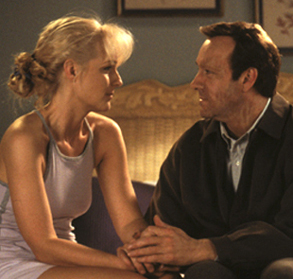
They advance gingerly on their love scene. Arlene is helplessly Vegas: She wears a turquoise bra; she lets men stuff tips there; she wears a blue wig. Hunt lets herself look like a wreck in the effort to show Arlene’s desperate attempt to stay “glamorous.” But in the love scene, she picks up shyness and gentleness. The actress has asked not to have her breasts shown, and the film allows this. Instead, the camera dwells on her face, which relaxes a little as Eugene looks at her.
Then Eugene’s shirt comes off, and he is like “The Illustrated Man” (if you recall that film). He has a forest of scars on his chest. She dips her head to kiss his ravaged body, and Spacey comes close to tears.
It is a beautiful scene, yet perilous too, for we have to feel the makeup job. If only, as the film allowed Hunt her modesty, it had let her amazed face convey to us the profuse damage done to Eugene. I think the scene would have played better without the misleadingly perverse allure of scarring. Above all, I think Spacey is so good an actor that he doesn’t need the makeup or the prop. He has a being that is already overshadowed by some dark experience. Nevertheless, it’s a moment you don’t want to miss in a film that everyone is likely to be seeing.
David Thomson is the author of "A Biographical Dictionary of Film" (new edition just published), "Rosebud: The Story of Orson Welles" and "In Nevada." More David Thomson.
Taxing strip clubs for rape
Politicians are holding adult entertainment venues responsible for funding sexual assault services
(Credit: iStockphoto/wragg) It used to be that strip clubs were merely blamed for society’s ills. Now they’re actually being charged for it.
In recent years, measures have been introduced in Georgia, Pennsylvania, Texas, Illinois and, most recently, California to apply special taxes to strip clubs — specifically to fund sexual assault services. Now, even if you aren’t inclined to view erotic entertainment as the source of all evil, this might seem an appropriate aim — who wants to argue against additional support for rape survivors? It would seem even more so when you consider politicians’ and activists’ repeated claims of solid scientific evidence showing a link between strip clubs — specifically those that sell alcohol — and sexual violence.
Continue Reading Close
Tracy Clark-Flory is a staff writer at Salon. Follow @tracyclarkflory on Twitter. More Tracy Clark-Flory.
Massage therapists rubbed wrong by sex talk
A Jennifer Love Hewitt show and the Travolta allegations have masseuses tired of being confused for sex workers
(Credit: iStockphoto/sybanto) Joe, a licensed massage therapist, knows what it’s like having a famous client who expects something extra. He had an Academy Award-winning actor begin gyrating on his massage table before raising his hips in the air to show off his erection. “He was hoping that I would play with him in some shape or form,” he says.
Needless to say, Joe isn’t surprised by allegations by two masseurs that John Travolta got handsy during massages. (Travolta’s attorney has denied all the allegations, and called them “ridiculous.”) “It happens all the time,” he says, and not just with celebrity clients. He frequently encounters men who try to fondle him, usually while he’s working on their glutes or lower back and their hand happens to be level with his crotch. “They think they’re so original, but they’re all so much the same,” Joe says, his voice rising. “They all use the same tactics, the same body movements, the same gyrations and grinding my table, the [heavy] breathing.”
Continue Reading Close
Tracy Clark-Flory is a staff writer at Salon. Follow @tracyclarkflory on Twitter. More Tracy Clark-Flory.
A night at the vibrator museum
Early vibrators were hand-cranked, two-person jobs -- and prescribed by doctors. How far we've come since then
(Credit: Antique Vibrator Museum) I can now say that I’ve used a turn-of-the-century vibrator — on my hand, but still.
The silver, hand-cranked contraption is usually kept behind glass at Good Vibrations’ Antique Vibrator Museum in San Francisco — but staff sexologist Carol Queen made a rare exception. “This is very special,” she whispered, unlocking the case and carefully pulling out Dr. Johansen’s Auto Vibrator, a relic from 1904. The “auto” part is not so much: It was a two-person job, with her having to crank the device’s handle to get it thrumming. Pressing my finger tips to its inch-wide circular platform of pleasure, I was pleasantly surprised by its power.
Continue Reading Close
Tracy Clark-Flory is a staff writer at Salon. Follow @tracyclarkflory on Twitter. More Tracy Clark-Flory.
Maggie Gyllenhaal on sexual liberation
The beloved indie star tells Salon about her "vibrator movie" and why she loves playing transgressive women
Maggie Gyllenhaal (Credit: Reuters/Mark Blinch) When I met Maggie Gyllenhaal about six weeks ago, she was enormously and gloriously pregnant, stretching out on a sofa with her shoes off and feet up in a Manhattan office building. (Since that time, Gyllenhaal and husband Peter Sarsgaard have welcomed their second daughter, Gloria Ray, to the world.) We were there to talk about “Hysteria,” the charming, lightweight feminist farce from director Tanya Wexler that explores a key event in the history of female sexuality: the invention of the vibrator by Mortimer Granville, a Victorian doctor who was seeking to cure the mysterious “female malady” that lends the movie its title.
Continue Reading CloseMother-daughter sexperts
Susie Bright and her daughter, Aretha, make parental talks about sex look easy -- and fun
Most parents loathe talking to their kids about the birds and the bees, let alone pubic hair grooming, faked orgasms and “water sports” — but most parents are not legendary “sexpert” Susie Bright.
Better than talking about these things, she penned an advice column in 2009 with her daughter, Aretha, then 19, for the ladyblog Jezebel. Their answers to questions about everything from porn to Paxil were unflinching but playful, and at times controversial. Now the pair have collected those columns into a new e-book, “Mother/Daughter Sex Advice.” Together, they read as an irreverent version of “Our Bodies, Ourselves” for the Internet age. The mother-daughter team also reflect on what the experience of writing the column was like, and it turns out it wasn’t as weird as many would think: For the most part, it was just a continuation of conversations they had been having throughout Aretha’s life.
Continue Reading Close
Tracy Clark-Flory is a staff writer at Salon. Follow @tracyclarkflory on Twitter. More Tracy Clark-Flory.
Page 1 of 403 in Sex