Amy Benfer

Knocked up like me

What's cooler than being a middle-class teenage mother? Having a TV show all about you.

In my house, we don’t watch TV. We do own a television, the same one that my mother bought for us five years ago, when I was still in college, because she had the good sense to figure out that children’s videos would be a good diversion for my daughter while I was studying. I was happy to have a TV and VCR so I could keep up with the art flicks that I missed in first run because of the lack of a baby sitter. (Harbor no delusions that single motherhood cannot coexist with pretension.) Still, I did not want us to watch TV, so I broke the antennae in such a way that even local channels come in laced with static, populated by four-dimensional characters that are usually either orange or blue.

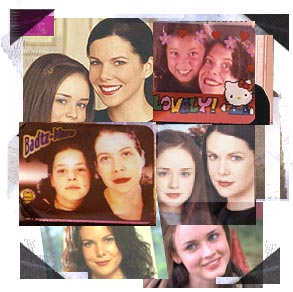
Despite my attempts to render our TV viewing a deliberately unpleasant experience, my daughter has been known to try it anyway. One night recently, she dragged me to the television, arguing that the show we were about to watch “is about us.”

Why would she think that anything on the WB depicted her own life?

Because the show in question, “Gilmore Girls,” was advertised as being about a mother and a daughter who were “just like sisters.”

Big fucking deal, I thought as I watched. A show about a young mother and her teenage daughter, called “Gilmore Girls,” as if they were the permanent junior auxiliary, the adjunct understudies to the just plain Gilmores. And I was not thrilled to see the “girls” swapping sweaters, dancing around the living room to XTC and, when they fought, retreating to their respective rooms with the same Macy Gray CD. What were the scriptwriters thinking? That parenting a teenager as a young mother is just like living with your favorite college roommate?

But I must admit that I did find parallels to our own lives that were downright eerie — so eerie, in fact, that I fear if I ever decide to write my memoirs, I will find that the television rights already belong to Amy Sherman-Palladino of Dorothy Parker Productions. To begin with, Lorelai Gilmore and her daughter, Lorelai Gilmore, called Rory, are, like my daughter and I, 16 years apart in age. Like me, Lorelai has never been, nor as far as we know, ever attempted to be, married. They live in a small town in Connecticut, 30 minutes out of Hartford, where Rory attends an exclusive private school called Chilton. We spent four years in a small town 30 minutes out of Hartford where I attended a private university. Lorelai goes reluctantly into debt to her parents to finance Rory’s education, and they in turn demand that she involve them in her life; I was financially dependent on my parents for my education, and they in turn demanded that they have a say in how I was raising my daughter.

Christ, Lorelai, played by the exquisite Lauren Graham, even looks like an actress I would choose to play me in the movie of my life — she’s even got my coloring: shoulder-length brown hair, blue eyes and perpetual red lipstick. Thank God, unlike me, she’s tall.

Of course, there are some differences. Lorelai never went to college; I did. Lorelai is from an upper-middle-class family in Connecticut; I am from a middle-class family in Idaho. Rory and Lorelai are 16 and 32, respectively; Sydney and I are 11 and 27. Lorelai works as the director of a quaint New England inn; I work as an editor at a San Francisco Internet magazine. But the basic premise of the story is the same, and it is one that is almost never told: How does one assert one’s independence as a parent when one is, in some ways, still in need of financial and emotional parenting oneself, in a culture that sees teenage mothers as nothing short of monstrous? And later, how does one deal with tensions of being a grown-up former teenage mother who has somehow, in most ways, become part of the middle class?

On the very same night that we watched the first episode of “Gilmore Girls,” Sydney and I had gone to one of those fake Mexican restaurants for tourists around the corner from our apartment, each making the other swear that we wouldn’t tell other people that we had a sudden craving for blended drinks and seafood fusion enchiladas.

“Excuse me,” said the waiter. “Miss, did you know that she just put a napkin on your head?”

I knew that she had put a napkin on my head because, when she wasn’t looking, I had balled up mine and thrown it at her.

“How old are you?” the waiter asked my daughter. “12? 14?”

“Eleven,” she said.

“And you are her sister?” he asked me.

“Mother,” we said, together.

“I thought you were her sister,” he said. “Sister? Or friend?”

“Mother,” we said again, together.

“Mother.” He giggled and brought her a free lemonade refill. “Mother,” he said again, stepping back to survey each of us, as if he could deduce our story if he simply stared long enough.

In the opening scene in the first episode of “Gilmore Girls,” Lorelai is sitting in a cafe. A Lothario in his 20s attempts to pick her up. She shuts him down, only to see him trying to pick up her daughter, Rory, several minutes later.

“Hey,” Lorelai says. “That’s my daughter.”

“Your daughter?” he asks.

“My daughter.”

“Hey, that’s cool,” he says, “I’m traveling with a friend …”

You can see why the executives at the WB saw “Gilmore Girls” as an idea with legs. Two really great pairs, in fact.

The network had been asked by its advertisers (in this case the Family Friendly Forum, a consortium that includes Procter & Gamble and Johnson & Johnson) to create a “family-friendly” show as an alternative to the network’s usual sexy teen fare. And if you are a WB producer looking to fit a family show into a lineup that includes Sarah Michelle Gellar and Katie Homes, what better way to do it than to define “family” as a unit composed of two young, beautiful, sexually available women? (Or “girls,” as they would have it.)

Next to the idea that one will be picked up by two gorgeous, identical-twin nymphomaniacs, I am told (I have been told, complete with leering glances), the idea of meeting a gorgeous mother-daughter duo ranks high on the list of male masturbation fantasies. (I really don’t know how any of the men who have said to me, “Hey, when you are 34 and she’s 18, you’ll be hot,” expected me to respond, but they have said it all the same.) And while certain single and divorced parents of all ages see PTA meetings as a dating opportunity, the presence of an especially young woman is viewed as a very special coup indeed for certain kinds of men — like for instance, the distinguished-looking 40-something divorced father who hits on Lorelai in Episode 2. Or the cool 30-something high school English teacher who does the same thing in Episode 3.

So far, Lorelai has demonstrated the good sense to refuse to hook up with anyone affiliated with her daughter’s school, but we do know she is certainly available. We learn she is a little bit slutty, too, when Rory asks her mother, upon learning that she has been accepted at Chilton, “What did you do, sleep with the headmaster?” We learn that Rory is not when Lorelai teases Rory about her plus-size eggshell fishermen’s sweater by saying, “What is that, a mumu? Could you not find any armor to deflect those with X-ray eyes?”

The whole thing is a little grating, not to mention insulting, and you sometimes wish that someone in the scriptwriting department had had the imagination not to portray the chick who got knocked up in high school as a slut, forever promising to teach her daughter dirty cheers, with her daughter forced to play reluctant parent. But given the dearth of popular portrayals of mothers as spunky, attractive and sexually active, it’s also somewhat refreshing. (And for the record, I stopped watching “Jesse,” the Christina Applegate vehicle about a slightly younger, working-class former teenage mother, around the time she starting insisting that she couldn’t date her hunky neighbor because Mothers Don’t Date.)

But putting up with Lorelai’s rather frisky dating life is more than worth it when it comes to her ideas on marriage. Cornered by her mother, who is berating her for having never married Rory’s father, who is now a successful Internet mogul in California (of course), Lorelai replies, “By not getting married, we kept our bright futures.”

I would like to see this motto emblazoned in 20-point font and underscored in red in every last textbook and advice manual for pregnant and parenting teenagers. Not that I am a proponent of absolute, one-size-fits-all advice, mind you, and I am sure there are some very good marriages out there that have their origin in a broken condom at 16 — just as there are interesting, intelligent mothers who happen to be very young. But Lorelai’s mother espouses the idea that the sanctity of the nuclear family, the irreducible need of a child for two parents, is so great that it is worth compounding the very real difficulties of an untimed pregnancy with the extraordinarily bad gamble that the cute boy with the motorcycle whom you like — or even love — in high school is in any way suited to be your life partner. That’s ill-informed at best and dangerous at worst. Teenagers have enough romantic delusions as it is. They certainly don’t need adults to pretend that a shotgun marriage makes economic sense.

“I had to figure out how to live,” Lorelai tells her mother. “I had to do it myself.”

In Lorelai’s case, she worked her way up from chambermaid to executive director of the Independence Inn. (In my case, I worked my way through two years of high school, four years of college and two years of freelancing at night while holding down some very bad day jobs, like working customer service in a bank and editing the phone book.) It’s a seductive formula for creating a character — an upper-class girl whose breeding makes her elegant and attractive to viewers, and whose prodigal pregnancy makes her interesting. In this, she conflates two of the most pervasive American myths: She has the taste and pedigree of someone who was born knowing what to do with the silver spoon in her mouth and the independence of someone who has pulled herself up by her bootstraps.

It’s not as if Lorelai’s parents had nothing to do with her eventual success — all of the skills that facilitated her rise from maid to manager are the skills that one acquires from undergoing 16 years of parental training in how to become an lady. And what kind of quaint inn would hide in housekeeping a gorgeous woman with an eye for the right crystal, one who knows a good mushroom risotto when she tastes it and has perfect pitch for how one talks to valets, businessmen with scratched cars and little old ladies looking for the best antiques in the city? (If she had been a mechanic or a plumber or a waitress at Denny’s, it’s unlikely that she would have been able to trade in her good breeding for upward mobility.)

The most visible “difference” between Lorelai and her parents seems to be that she is upper middle class and they are landed gentry. She has a sprawling white house stuffed with antiques and Laura Ashley prints, drives a new Jeep and eats out every night in a funky cafe around the corner. They have an even bigger white house with a gate and oak paneling, kitchen help whose names they can’t remember and a country club membership.

Nevertheless, the scriptwriters insist, week after week, on framing the conflicts between Lorelai and her parents, and Lorelai and Rory and the Chilton set, in terms of class. In every episode, Lorelai breaks some social code and is ritually humiliated for her haplessness.

On Rory’s first day at Chilton, for example, Lorelai oversleeps because her fuzzy clock doesn’t purr on time, forgets to pick up her cute blue suit with the flippy skirt from the dry cleaner and ends up meeting with the dean of Chilton while dressed like a rodeo queen, in a pink tie-dyed T-shirt, Daisy Dukes and cowgirl boots. Of course, she has a respectable gray flannel coat to cover herself with, but her mother is waiting for her in the dean’s office and insists that she remove her coat. In a later episode, she is late for a PTA meeting and is chastised for being one of the women who — horrors! — voted to amend the dress code to include scrunchies in Chilton plaid. (“They must be one of the scholarship families,” murmurs one Chilton grande dame to another, prompting Lorelai to a spunky display that threatens to escalate to fisticuffs.)

These slapstick moments provide grist for the plot mill, but they ultimately fall flat. A true outsider is one who does not know that one should wear the blue suit with the flippy skirt to the first day of school, or if she does know it, she doesn’t own it, or is proudly defiant that she isn’t one of those rich bitches who follow the WASP dress code. A woman who can afford both the suit and the dry cleaning, but forgets to pick it up, is an insider with a time-management problem and maybe a few issues with handling responsibility.

It’s not entirely unrealistic. We don’t get the benefit of seeing the years between 16 and 32, after Lorelai had rejected her parents’ money and before she came into her own. Presumably, a good many of these years provided the kind of material that makes for hardcore social documentary, not prime-time lifestyle drama. There are already more than enough of those stories in circulation, so many, in fact, that telling an airbrushed, sanitized version about teenage pregnancy is nearly revolutionary.

The truth is that there are teenage mothers — not a lot, but some — who do find themselves in a different, better place 10 years later. Including myself, I know three of them.

We are not all so telegenic. If they were filming my life, it would be set in two rooms, with no Laura Ashley in sight and, most days, laundry and books and old essays and journals strewn about in such a way that navigation, even in daylight, is something of a challenge. If they were filming my friend Tonya, you would see a three-bedroom apartment in the Park Slope neighborhood of Brooklyn, N.Y., where she works as a corporate recruiter by day and writes her fiction on weekends. My friend Deb, a physicist turned computer geek, lives with her new boyfriend in Connecticut and drives a new VW bug. I don’t expect we’ll be inviting in any camera crews, but that’s OK, because two of the three of us are writers, and fiction is better suited to capturing the nuance and ambiguity of daily life anyway.

After all, “Gilmore Girls” is not about nuance, it’s not about art, it’s television. I don’t fault “Gilmore Girls” for presenting the pop version of affluent former teenage motherhood any more than I would critique “Married … With Children” for its version of shoe salesmen, or berate the “The Cosby Show” for not accurately portraying affluent African-American life. After all, don’t all Americans have the inalienable right to find themselves caricatured beyond recognition on television?

And in the meantime, anyone want to buy the rights to a book about a 27-year-old former teenage mother from Idaho?

Men “experiment,” women “experience”

Jeanette Winterson talks about her new autobiographical novel and the gender assumptions we make about writers

This article appears courtesy of The Barnes & Noble Review.

In 1985, 25-year-old Jeanette Winterson published “Oranges Are Not the Only Fruit,” a semi-autobiographical novel about a girl named Jeanette, adopted and raised in northern industrial England by Pentecostals, whose plans to become a missionary are derailed when she falls in love with girls (prompting her parents to hold an exorcism) and goes off to Oxford and becomes a writer instead.

Barnes & Noble ReviewAlthough the rough outlines of Winterson’s biography follow more or less the same as those sketched above, she has always resisted the idea that “Oranges” should be taken as a literal account of her childhood. “I was trying to get away from the received idea that women always write about ‘experience’ — the compass of what they know — while men write wide and bold, the big canvas, the experiment with form,” she writes in her new book, “Why Be Happy When You Could Be Normal?,” released last year in England and published in the United States last week.

Over the past two decades, Winterson’s novels have been loaded with play, pose and experiment, roaming through and remixing ideas about history, genre, and gender. Her characters include a Venetian gambler with webbed feet in a romance with Napoleon’s cook (“The Passion”); a giant mother named Dogwoman (“Sexing the Cherry”; a lover with no identified name or gender (“Written on the Body”); and a scientist on a planet inhabited by dinosaurs (“The Stone Gods”).

Her new book, begun almost exactly 25 years after she began writing “Oranges,” revisits the same territory as her first — Winterson World, as she calls it. As in the first time around, the story is dominated by her adopted mother, a “flamboyant depressive: woman who kept a revolver in the drawer, and the bullets in a tin of Pledge. A woman who stayed up all night to avoid sleeping in the same bed as my father. A woman with…two sets of false teeth — matt for everyday, and a pearlised set for ‘best.’ ” This time, however, there is a parallel narrative in which adult Jeanette searches for her biological parents.

The book makes a forceful argument for the necessity of art and in all lives, not just for those — like Winterson — who will grow up to be working artists but also for those like her adoptive father, a factory worker who reads the Bible and Shakespeare, and her biological family, who live in public housing and discuss “The Tibetan Book of the Dead.”

I met Jeanette Winterson in late January at her hotel in Soho. She showed up in sneakers and workout clothes under a beautifully tailored wool coat — she had called to see if she might meet an hour later to fit in exercise — and we went to a local organic restaurant, where she ordered a lentil and sweet potato salad. An edited transcript of our exchange is followed by some “Outtakes”: pieces of the conversation that address a wider range of topics.

The Barnes & Noble Review: You are essentially revisiting the same material of your first book, published when you were 25, almost exactly 25 years later yet seen through a different lens, along with contrasting your adoptive family, the Wintersons, with your biological family, whom you meet late in life. Why did you have the impulse to do that?

Jeanette Winterson: I didn’t. I was dealing with the search for the biological mother and that necessarily prompted in me all sorts of questions and reconsiderations of life with Mrs. Winterson; life in Winterson World. The past is a negotiation; it’s not fixed. I was forced into another negotiation with the past. I thought, “Well, let me start writing through this again and see what comes out.” I was doing it for my own sake, and not for anyone else. The trouble is that after two weeks, I had written 15,000 words. When that happens, you realize there is this enormous pressure building up to do something. So I thought, “OK, I’m just going to carry on with this.”

BNR: So those two lines bring you up to basically sixteen, when you leave home to go to Oxford, then a quick jump to 25, letting us know you wrote “Oranges,” and another narrative starts when you search for your adoptive mother and begin this new book. Yet there is still a 25-year gap that both parallel narratives skip over.

JW: Yeah, I get myself to Oxford, and then I write “Oranges,” and then we arrive in 2008 and I’m going to kill myself and it’s all gone wrong. Each half was written at the same time; they were two parallel lines that eventually converged. I didn’t start at the beginning and end at the end. When do I ever do that? That’s the story I wanted to tell. The rest was irrelevant. I’m also interested in what you can do with form and shape. And I thought, “Why should I write this in a linear way? I never do. So why start now?” I thought, “If I want to miss out on twenty-five years, I can. ” Although it would have been an inefficient thing to do in a memoir, anyway.

BNR: Even the use of the word memoir is fairly loaded. You were very emphatic that “Oranges” was not a memoir but an autobiographical novel, with points of fact and points of fiction. Are you comfortable saying that this is the memoir?

JW: I don’t even call it that. I just say it’s a cover version.

BNR: I like that phrase. That’s pretty wonderful.

JW: I really think, well… Let’s not call this “sexism.” Let’s call it an “asymmetrical judgment” between men and women. If Henry Miller writes “Tropic of Cancer” and calls the hero “Henry Miller,” he’s still allowed to say these are novels, and none of the guys question it. Because a man is allowed to be bigger. A woman isn’t. She can only possibly talk about herself.

BNR: Meanwhile, Anaïs Nin is just writing “journals.”

JW: Journals, right, journals! If I want to use myself as a fictional character, why can’t I? Over the years, it’s been one of the most frustrating things. If you call yourself  “Jeanette” in the novel, then it’s all about you. And I’m thinking, No. This is a person I’ve invented. Why shouldn’t I? That’s what I mean by an asymmetrical judgment because Paul Auster, Henry Miller, Milan Kundera, any of those writers who quote themselves directly, Philip Roth, for God’s sake! We all say, “That’s so great! That’s so interesting!” But if you do that as a woman, it becomes confessional and autobiographical.

BNR: In the book you make the distinction between “experience,” which is what women writers are seen to have, versus “experiment,” which male writers do.

JW: It’s all just a way to make it small. If you are a woman, you’ve got to be a little one; you’ve got to be small. And if you’re not small, you’re a ball-breaker.

BNR: Was it at all problematic for you to decide to call this book a “memoir,” then? Doesn’t it seem to imply this is the real, factual truth?

JW: Well, I didn’t decide that. My publisher did. They have to stick some bloody label on it. It’s not my word and it never will be.

BNR: One of the most striking differences between the two books — “Oranges” and “Why Be Normal?” — is that the character “my mother” becomes “Mrs. Winterson.” Meanwhile, your adoptive father stays “my father.”

JW: I think I needed to operate at a distance, so it does shift from “my mother” to “Mrs. Winterson.” But she never called any of her friends by their first name. She didn’t let them call her by her first name. She very much was the lady of the house. She liked that formality and that dignity.

BNR: I assume that in your adult life, other people have called you “Ms. Winterson” from time to time.

JW: Yes [laughs].

BNR: So although referring to this same woman as “Mrs. Winterson” sounds more alienating than calling her “my mother,” it also seems like a way to subtly state the connection between the two of you. Sons often talk about the experience about growing into being Mr. So and So, like their fathers, though with patrilineal descent, that is rarer for women. It almost seemed to underline the closeness between the two of you as adult women.

JW: Yes, she’s an archetypal figure. The main model, the only one. She was a mother, and she’s also a character in her own drama. But it’s a sleight-of-hand. I think she comes off very well in this book. I think there’s compassion for her and warmth and the reader will end up feeling rather drawn to her. Even though she’s a monster.

BNR: She does come off as a monster in some ways. But she also comes off as being so important. There’s a way in which the two of you seem twinned in a way that in the end you never even seem to have with your bio-mom. She just looms so large over your life in a way that no one else seems to come close.

JW: She is. The person you grow up with is really important. This biology business, it doesn’t do it for me. And yes, she was the big-screen character in the small screen of our lives.

BNR: In the book, you connect her to the Dogwoman character, the gigantic, all-encompassing mother in your novel “Sexing the Cherry.” But in a way, she was the one who shrunk all of your lives down to the small-screen, too, right? She was very educated for her class. She seemed to be incredibly intelligent. There are so many ways in which the two of you seem like parallel characters. And yet, she seemed to limit herself: she married “down”; became a housewife; became a member of a very strict religion. It seems to go along with the stereotype you mention about the “Battleaxe” northern woman. These women are so huge, and yet their bigness is used to make them small.

JW: They have to know their place. And those women, those pre-feminist women, they did know their place. It might have made them depressed and miserable — it did — but they accepted it like a natural phenomenon, like gravity or something. It couldn’t change. It was as pointless to them to wish that things were different as it was to wish that you could walk three feet off the ground. Because you couldn’t. It was a law of nature that men were superior and that women had to know their place.

BNR: You talk about adoption as self-invention, and the idea that each adoption story introduces the possibility of a parallel life. There is a fabulous moment in the book when you find yourself sitting in the bar in your hometown, well dressed and inexplicably wearing a spray tan. One crucial question that you never did answer: Why in God’s name did you have a spray tan?

JW: I’m not telling you! As I said in the novel, “for reasons that remain unsaid!” I shall never confess!

BNR: So unfair! But you do have this striking moment when suddenly you have this image of what your life might have been like if you hadn’t grown up in Winterson World, left town, gone to Oxford, become a writer.

JW: It felt like a shadow passed across me, and I was like, “No!” It wasn’t like a game I was playing in my head, like “What if?” or “Let’s pretend.” It did feel like I was looking through this door, this other possibility, this whole world within the universe. Having met my bio-mom and my family, I know it would have gone wrong. It would have gone wrong because I would not have been educated. I’m sure of that. But I’m clever. And I wasn’t going to sit at home and do nothing, so I would have made something of myself. But there would have been more brutality than poetry in it. And that’s kind of scary.

BNR: So you think part of the poetry, then, comes from being born into an evangelical household? You talk a lot about the poetry of the Bible and the deep search for philosophical meaning that it brings into working-class lives, like the one you were born into.

JW: I think it gives you a language for poetry. My nature is intense, and I think loss pushes you towards a search for meaning and a search for language. Poetry is very good at dealing with all of that. I was looking for a way to deal with loss even though I didn’t call it loss. That’s why I talk about in the book about “lost loss.” When you can’t even get at it; you don’t even know it’s there. I think that yearning, that search for meaning came out of that. My intense and solitary nature pushed me towards a poetics because I was looking for complexity. I didn’t want the easy narrative. I really wanted to understand. And yes, my nature, fortunately met a situation that was going to nourish it, which sounds very odd, given what that situation was. I’m not going to go up and down and say it’s good to lock your kid in the coal hole, or out on the front step or to give them Bible readings morning, noon, and night. But it seems to have worked for me. It did give me something that I would not have gotten.

BNR: It seems you wouldn’t have had to struggle in such an epic, archetypal way. You wouldn’t have had to struggle against such strict religious rules, they wouldn’t have exorcised you for being gay, or likely even cared much, you wouldn’t have been labeled a sinner…

JW: And it seems the spiritual damage made a difference. In either family, I would have been poor; there was no material benefit either way. In my birth family, I think my focus would have been on, “I have to get out of here and make a better life.” There wouldn’t have been the spiritual overlay. At least being brought up in the church, it’s irrelevant, the money question. Nobody had any money and nobody cared about having any money, because our rewards were in heaven. And our riches were not of this earth. So that was not a suitable place to put your ambition. And so I didn’t. But I think that’s very interesting: the idea that it’s much more important to pursue meaning, to pursue the inner life. So what began as a connection with God became a connection with life itself, to which art, poetry are central, but money never being a consideration.

Going to Oxford, all of my friends went off and got really good jobs. I could have done that too. This was the eighties for God’s sake, and I had an Oxford degree. I could have gone anywhere. But I didn’t. Because money continued to be of no importance. I think that was very much the spiritual teaching I grew up with: This is not a worthy endeavor. Which was directly at odds with the zeitgeist of the eighties, which was all about money.

BNR: So what we are saying here is that in many ways, Mrs. Winterson did give you the roots of your story and a reason to create.

JW: She did. I’m really a big believer in just working with what’s there, with who you are and what you’ve got. And not putting happiness or success or achievement impossibly out of reach, which people do all the time. It’s good to have ambition. But you have to work with what you’ve got and be in that place. I’m a realist as well as an optimist.

BNR: As you point out, in both of your families, the search for meaning and art and discussion and answering the question “Why are we here?” was very important, even though both were very poor. Many politicians right now are telling us that books and poetry and education are “elitist” pursuits. But you point out there is still a deep need for self-reflection and inner life and art, no matter what your day job is.

JW: I think that’s right. I don’t want to see that go. Young people now — this was supposed to be the post-ideological generation. When the money was there, no one was going to care. And that might have worked. So the fact that the money has run out, now, and the whole thing has been laid bare in all its goriness and its corruption and unsustainability, I think that’s really good. This is going to radicalize another generation of young people. It’s not just going to be Islamic jihad or radical Christian fundamentalism, these are going to be kids who want to get political because they can change things that way, who will want to find a new system. I always have hope for the human race like that. They will respond to our times, and then alter them. I can’t believe that we won’t.

OUTTAKES

The following parts of our conversation wandered somewhat from our discussion of ”Why Be Happy When You Can Be Normal?”

BNR: What is your writing schedule? Do you have an intense daily schedule? Or do you write in short bursts?

JW: No. I’m in my study every day. I think that’s important. I just go to work. You have to get up and go to work. I show up. It doesn’t mean I do anything useful all the time. Very often I don’t. But I divide my day. I try to keep the dreaming day in the morning. I get up straightaway. I pretend that I have to cycle to work. I don’t, because my studio is in my garden. But I get on my bike and I do a circuit and come back. So I have cycled to work. If I don’t cycle to work, it’s so fixed in my head, I can’t go to work.

BNR: You talk so much about poetry, both in your work, and even on your website, where you often post poems of the day. I can also see a poetic influence in the way your sentences scan: there is an intention to the rhythm; it is very spare; there are even many sentences that read almost as epigrams. Do you ever write poetry?

JW: No. But I read it all the time.

BNR: Do you think that the fact that you don’t actually write poetry helps you to keep it in a space that is purely inspirational in a way that prose isn’t?

JW: I was always clear that I wanted to have that intensity and that spareness for my prose. I didn’t want to strip it out completely to an artful, i.e, artless, conversational style. I wasn’t trying to do a Hemingway or Henry Miller or any of that stuff. I wanted to have something which used language in a way which had a certain artificiality to it, in that we don’t speak that way. We’re not that precise; we’re not that complex. But I wanted to feel as natural as possible. And I thought I could do that, using the prose. That’s always been what has interested me. To try to keep the complexity of language — the imagery, the symbolism, just the way the words work together, instead of trying to pull them apart, thinking how few can I get in there? That’s not it for me. I need to know that they can make a different kind of landscape. That’s what poetry does. So I thought, “Why can’t you have that in your prose? Why shouldn’t I work towards that?”

BNR: And you’ve never had the urge to start arranging any of your prose into verse or stanzas?

JW: No. It is rhythmic; it works well being read out loud. In that sense, I’ve achieved what I wanted. What it doesn’t do is a casualty of speed reading. You can’t read Jeanette Winterson just for the content. There’s no point. No point. You can’t read down the middle. I’ve built it. They aren’t very long books anyway. They are as short as they can be. You can’t make them shorter by reading them faster. That can be a problem, because we do surf. For me, the pleasure is actually in the language and in what develops through the language. That, to me, is what literature is. If we don’t want it to be language, then let’s go and do something else. But if we’re only looking for the story, we can get that in many different media now. There’s nothing wrong with that. But language has its own particular, specific idiosyncratic pleasures and challenges. It is language. So much as I’m using language, I really don’t want to be told by anyone that it’s elitist if you use it in a particular way, or that it gets in the way of just telling a story. Why can’t we just go from A to B in a straight line? That’s not interesting to me. I’ve been a critic of the realist novel for a long time. I think very often in fact TV and film can do that better. Docu-drama is also very good. We do have other mediums to take that burden away.

BNR: We are in a golden era as far as television is concerned. When I was growing up, it would never have occurred to me to think about writing for television, but right now it seems that’s where some of the very best writing is taking place.

JW: I agree with you. I just think that we need to let a book be what it is and not criticize it for being what it isn’t. It’s there to tell a story, yes, but it’s there to do many other things as well. That’s what literature is. There has to be a place for the craziest imagination or fantasy or the strange circularity of fiction. It doesn’t have to go in a straight line. My fights with the realist novel have always been, “Are you sure you want this to be a novel? Or could it really be something else? And are we losing language along the way if we are only reading for the story?”

BNR: You actually did adapt your first novel as a TV drama for the BBC. Did that give you a clear idea of the difference between drama and literature even when telling the same story?

JW: I like working for TV. You can do the dialogue and be very precise, and I like all of that. But it’s no good at interior dialogue or monologue. Interiority just does not work onscreen. It’s very hard to have those conversations with yourself and others that prose can do simultaneously, at the same time it’s allowing you to locate within yourself and the landscape. But that’s because it is essentially an introverted art form. And we’re in a very extroverted world at the moment, perhaps the most extroverted the world has ever been. Everything happens on the outside and its all about display. That puts the novel and poetry in a very curious position. It’s fighting for the inner life, the inner world, at a time when everything is pushing towards what’s outside.

BNR: You say that you are an introvert, but one of the things that is very striking about you is that you are very extroverted on the Internet, much more so than many literary writers. You write journalism regularly, you have a blog and a website. Do you have a theory as to why it works so well for you?

JW: The Internet is curious in a way in that it is the ultimate introvert activity because you sit alone, at your screen. It’s making people into sociopaths. They feel like they’ve got a million friends and they are all alone in their bedroom. How screwed up is that? I never use the Internet when I am working, because it is way too distracting. But I like the website. The world is as it is. We can work to change it. But we have to be in it. There’s no point in lamenting that we’d like it to be otherwise. We have to be both politically and personally active to change the things we dislike, but also to work energetically with what is there. I have a Twitter account. That’s fine. I’m here. But nobody will know if I’m just stomping up and down the pavement, being angry at the way the world is.

BNR: You have been a big supporter of the Occupy movement. In recent years, you have fashioned yourself as a public intellectual of sorts, writing and commenting on the news and world events. What do you think the role of writers and artists should be in politics?

JW: To do two things simultaneously: Everybody, regardless, has a duty to be active in our civic life, and to protest the things we don’t want, and to actively support the things that we do want. Writers can be at the forefront of that, saying: “This isn’t correct. We can challenge this intellectually.”

But I think a writer has a second job, which is to support and protect the inner world that we talked about earlier, the inner life, the imaginative life; to support what it means to be a human being, not just the kind of work you do, or which political party you support but who you are, and how we develop who we are. How we develop ourselves, how we become more, so we can have a satisfying life. That has social ramifications, whether we are a good friend, a good parent, a good member of the community, but it’s also about ourselves. Are we interested in ourselves? Do we have the tools for self-reflection? Do you have some Archimedean point where you can stand outside yourself and look in, and where you can stand outside and look at the world? That doesn’t come naturally. We need to learn tools for self-reflection. That happens through education, through reading, and writers have a real duty, I think, to promote all of that, to say life has an inside as well as an outside, so let’s put some energy there.

Continue Reading Close

Escape from Hasidism

Deborah Feldman talks to Salon about her journey from hyper-repressed Jewish enclave to feminist single motherhood

Today Deborah Feldman is a model of modern, independent young womanhood: the 25-year-old single mother of a 6-year-old boy, Yitzy, a recent graduate of Sarah Lawrence College, and a new author, with one memoir, “Unorthodox: The Scandalous Rejection of My Hasidic Roots,” just published and a second memoir and a novel on the way.

But as a child and teenager, she lived the kind of life that would not have been out of place for a girl born a century before. Williamsburg, Brooklyn at the turn of the millennium was, for some, the epicenter of the post-punk revival, artists lofts, angular haircuts and hipster culture. But Williamsburg is also the long-time home of the Satmar community, a sect of Hasidic Jews that formed two large settlements in Brooklyn and upstate New York shortly after the end of World War II.

Feldman grew up in her grandparents’ brownstone — her father was mentally ill; her mother was estranged for reasons that don’t become clear until the end of her memoir — watched over by her grandmother, Bubby, a Holocaust survivor, and her frequently interfering aunt. In her home, there were no secular newspapers, no radios, no television. She saw her first forbidden movie at 17.

“If I had been living 200 years ago,” she says, “my story wouldn’t have been strange at all.” Books, too, were forbidden, but Feldman smuggled in 19th-century novels — “Pride and Prejudice,” “Jane Eyre,” “Little Women” — in which she saw a version of her own life. Like those heroines, Feldman grew up believing her life would be determined by her marriage plot. And at 17, her grandparents selected her husband, a young man she had never met, who was considered old at 23. They met for 30 minutes; eight months later they were married. It took them a year of humiliating tinkering — and very public interference — to figure out the mechanics of sex, but by 19, she had a son, the first of many children she was expected to bear over the course of her marriage.

But soon after her son was born, Feldman veered off the script. She secretly enrolled in the adult program at Sarah Lawrence College, telling her husband that she was taking a “business course” to help her get more copy-writing jobs within the Hasidic community. As her intellectual life burst open, and her marriage deteriorated, she eventually decided to leave her husband and her community. Inspired by a history class at her college told through first-person memoirs written by people who lived through each historical era, she began writing her own memoir the day after she left. She finished it six months later.

Feldman and I first met each other at the apartment of another writer friend, who introduced us knowing that we had both gone to college as single mothers with young children. We met again at a cafe on Manhattan’s Upper East Side, where we discussed Jezebels, Judaism and the limits of multi-culturalism.

As you point out in your book, there is something very 19th-century about your story. Do you ever remember feeling optimistic about your future — like well, maybe this marriage will be the beginning of my adult life and everything will be settled?

The year before I got engaged, when I was 17, was the best year of my adolescence and childhood. I was working, suddenly I had all this independence, and I had made this very good friend. I thought for the first time, “Oh, I can make this work. I have great friendships. I feel fulfilled in my career.” My career such as it was — I was getting paid $128 a week to teach.

I felt full of promise. I felt like a ripe fruit, about to come off the tree. And then I plopped off the tree and it was like, gross. I was left to rot. But I definitely remember that feeling. It was such a brief moment in time, six to eight months, but it was the happiest time I remember. But after the wedding, everything really did change.

In your book, you talk about how even the husband’s sexual sins — masturbation, visiting prostitutes — come back on the wife, because women are perceived as having caused him to sin, even in situations when she seems to be hurt by his behavior. So is the idea here that women’s sexual emancipation is the worst possible outcome?

Absolutely. That is what they are trying to prevent. Every rule the Hasids come up with these days is about women. Men have way more freedom than they used to. It’s the women they are trying to crack down on. I lived in that community for two decades, and during that time I saw the advent of the Internet. There was a direct response. My skirts were six to 12 inches longer than my aunt’s skirts. That’s in one generation. The same idea is behind the shaved head: They thought, “We’ll get women to cover their hair, but whose to guarantee they won’t take off their coverings and show their hair? Oh, let’s have them shave their heads.” When my grandfather told my grandmother to shave her head, she thought it was ridiculous. She was horrified. And then she did it. And I did it, too.

There were all sorts of mini-scandals in your community while you lived there: debates over whether or not babies could be carried on the Shabbos; shaving heads; the use of human hair wigs.

You have to understand: We don’t have TV or any real forms of entertainment at all. So politics among the rabbis are entertainment, legal arguments are entertainment. Everyone is looking for something to get involved with, to get heated about, to talk about — especially the young men, who are bored out of their minds and need to get rid of all of that testosterone. The same thing is happening in Israel right now. You see these photos of these riots. You see them throwing rocks and Molotov cocktails and destroying cars and you wonder, “Are these the religious, peaceful people I know?” But there’s all this pent-up energy that never gets allowed out, except for the purpose of religion. So then you understand where all this violence comes from.

As a teenager, you bought a secret copy of the Talmud, which women were forbidden to read, and hid it under your bed. When you read it, you found out some very salacious information about David and his concubines.

People never think of that as the most rebellious moment in my book, but it was. What it was is it wasn’t so much rebellion as heresy. In the Spanish Inquisition, people were burned for heresy. That’s how bad it is in Judaism as well. There’s a law that you can’t ever question David, or have bad thoughts about David, so what I was doing was very heretical. I remember just being so furious that he treated women like objects when he was supposed to be this holy person and therefore provided an excuse for every holy person or every self-appointed holy person to treat women as objects. I thought it was a terrible example for men. I thought, “How could God love someone like that?” If God loved someone like that, he hated me. And so I was, by extension, mad at God.

Obviously, the men in the community already knew this story about David. But the women did not.

No. They were never told. You know, there’s a prayer that women say every day — “Thank you, God for making me as I am” — But the men say, “Thank you, God for not making me a woman.” I don’t think Judaism started out as misogynist. I think people came to power who wanted to make it a misogynist tool for the oppression of women.

As in many repressive cultures, it seems that many times that while the men are the ones making the rules about women, the women in the community are the ones who enforce the rules upon one another.

Oh, all the time. You see this in other religious cultures as well. Women realize that they are so disempowered that they will do anything to get power, so they will buy into the patriarchy to get more power. So technically, they are a tool of the oppressors, but they are also being the oppressors. I saw so many women go down that path, because they were like, “What are our other options? I want some power, so if I become super-religious, the rabbis will trust me to wield my authority over other women.” It’s tough for all women. It’s like picking sides.

At one point in your book, your older cousin tries to assault you, before you even really know what sex it. Your aunt sympathized with you a bit. But under the sexual code, you would still be held responsible, more or less, for provoking his lust, right?

My aunt never addressed it. She never took the information or passed it on or did something with it. She never apologized to me. She just said, “Oh, boys, they are animals,” and left the table. There are women out there in the world who can tell you much worse stories about rape and attempted rape. Why I included it in the book wasn’t so much because it affected me so deeply but because the feelings I had about the story and the way my family responded affected me. It gave me this message, like, “Don’t ever talk about these things. They are always your fault. And you will never find support if something like this does happen.” That’s a frightening thing to feel.

 You went essentially straight from this 19th-century culture and were plunked down right in the middle of 21st-century feminism. You named your blog “Hasidic Feminist.” In a way, you are almost a time-traveler of sorts. What observations do you have on the state of contemporary feminism, having come from a place where it was largely unknown?

My first impression of feminist literature was, “Oh, my God. People are actually allowed to say this? Society thinks this is relevant and valid?” I felt so ebullient. I felt like I was just bubbling over with this sudden thrill of discovery. I wanted to tell everyone I knew. But of course, I couldn’t. In conversations with my Hasidic friends, I would bring up something I knew from a feminist text, without referencing it, because I couldn’t. And the people around me would just be like, “Oh, crazy women. You are such a weirdo.” They’d say the most derogatory remarks. The things men would say about women began to sting much more because I could see perfectly how each remark fit into each offending box. How was this exactly critical of women? How would feminists describe this sort  of sexism? I began to be very painfully aware of exactly how sexist my world was and what those feminist writers would say about the world I lived in. And everything just became untenable, suddenly. It no longer became, “Oh, I live in a different world.” No. It was a world I could no longer bear. Because those women that I respected and loved so much — those women would never put up with it.

Feminism had been developing over a century or so essentially in a parallel universe right outside your community, within your same city. So unlike an earlier generation of women that had to wait decades for their community to catch up, you could just jump the track and arrive in a totally different time. If you once felt like you were a 19th-century heroine, it was like you could jump ahead …

Skip right ahead into the ’60s. I definitely had a moment in college where I was like my own Simone de Beauvoir. Even my classmates in college thought that I was just very, very  passionate. When I asked my classmates what they thought of me later, they were just like, “You were very outspoken. You had a lot to say.” And I did  have a lot to say, and I felt it was urgent and that it was life and death, and I came to the classroom every day feeling like the world was going to change. And these kids were just like, “Oh, I’m getting my degree. Whatever. I’ve seen all of this.”

I just sat there, alternating between fury and joy and frustration and shock and disbelief, all these emotions just playing across my face.

After you left, how did you feel about the culture you grew up in?

In one of my philosophy classes, towards the end, we talked about this idea of justice and multi-culturalism. The professor was very liberal and was a very strong proponent of multi-culturalism, as everyone at Sarah Lawrence was, because you know, we’re liberal, we’re tolerant. But that kind of came in as contrast to feminism for me: This doesn’t go together. And I remember sitting in this class, thinking, “I am a very liberal person, but this makes me mad.” It makes me mad that we are willing to tiptoe around individual cultures and allow women and children to be sacrificed in the name of culture. I remember sitting there feeling like something of a test case and feeling very angry because I was the guinea pig of this system. I was the one suffering because of this system. I spent those classes feeling bitter and angry and disillusioned because all this great philosophy that I loved and that had changed the world that I could now go into, I felt all the sudden betrayed.

You had a very beautiful passage in your book when you talk about what is done with problem children in the community. I’m curious how you would characterize the reaction to you, as a problem child.

Anyone who has a mental or physical illness, it is ignored, because it puts a stain on the entire family. I wasn’t necessarily a problem child myself. I was smart, capable, kept to myself. I didn’t necessarily make waves. It was my parents that were the problem. But the fact that I published this book, that people are writing about it, that means that my family is now known in their community as this family who has this black sheep in it that is now embarrassing the community. And that means no one wants to marry into this family anymore. So that means they can’t marry off their kids anymore. I ruined their lives in a sense. I didn’t do it deliberately. It’s just an unpreventable consequence of this happening.

So as you know, I was a single parent in college, too. And you were one for your last two years. What was it like to suddenly be free of your husband, your religion and let loose in the secular world?

Everyone thinks, “Oh, she must have been out clubbing and doing drugs.” I wasn’t. I was busy staying home and being a mom. I remember being by myself at the end of the day and just being so exhausted and feeling just so much stress and all these emotions at once. I would feel guilty because I was convinced I was a terrible mother. I felt self-doubt that I would ever make it, that my life would ever get better. I felt less than everyone else around me. Everyone else in college, I thought, was off to a bright future, but I was somehow doomed. I felt alone. I had a lot of negative emotions my first year or two. I didn’t think that I was good enough, or that I had done the right thing.

That’s so funny to me because it seems like an moment of liberation.

But it’s not that simple. It’s not overnight. It’s taking a huge risk. I knew when I left that the first year or two would be extremely difficult, and they were. Things gradually got better.  Now they continue to improve. I look back on that time as necessary. But it’s something I never want to relive or remember.

And actually, you don’t spend much space on that time in your book.

The book finishes the day I leave. But I’m working on another memoir right now that deals with that period. It’s not the fairy-tale ending, it’s not like you leave and everything is great. It’s not great. It’s a lot of culture shock. It’s a real uphill battle.

There probably aren’t many single mothers in the Hasidic community. But in the secular community, there are plenty of them, along with their own stigmas and stereotypes. Was it odd to come out into the secular world and be confronted with all these new stereotypes that didn’t really apply to your situation?

People always thought I was my son’s nanny. And if I said I was not, they thought I was white trash. I had a very hard time making friends. A lot of that was because I started incorporating other people’s images of myself. I started believing what they thought about me. And then when I got into environments with other moms, I’d think, “They all think I’m white trash. I’m not going to talk to any of them.” I recently made friends with a mom at my son’s school, right now. Just this week. And she said, “When you first showed up at the school, you wouldn’t talk to anybody. And I thought, ‘Oh, she’s keeping to herself because she doesn’t want to get into her life story. And she just thinks once she gets to know someone, they’ll just have so many questions that she’s just going to avoid everything by not making friends.’ ” She was partly right. But also I was just convinced that other people looked down at me. But then I ended up meeting some other moms who were just absolutely lovely.

I remember that feeling. The “tell me your story” part drives me nuts. There’s never any shortcut. Sometimes you want to bond with people and sometimes you just want to buy groceries, without having to explain how your kid became your kid.

And then you get introduced by friends as “the woman who did this thing.” Sometimes you want to just withdraw. That’s one of the reasons I am an extremely reserved person. I have an extremely limited social circle. I don’t go out a lot. I don’t make friends easily. Now that the book is out, I’m worried about being recognized. It’s one of the reasons I don’t date.

Well, at least now you can say, If you want to know the story, read the book. 

Continue Reading Close

The beautiful banality of high school

A John Hughes-esque book details the failed romance of a "jocky" boy and an "arty" girl

This article appears courtesy of The Barnes & Noble Review.

This novel, the fourth that Daniel Handler, better known for the novels he wrote under the name Lemony Snicket, which rival those written by a woman named Rowling in copies sold, has written under his own name, is arguably his first explicitly targeted toward older teens. Though the first two Handler novels featured high school and college-age protagonists, their subject matter (homicide and incest) made them more the province of literary adults.

Barnes & Noble ReviewThe subject of “Why We Broke Up” — the unlikely romance between a “jocky” boy and a girl he insists, despite her protests, on calling “arty” — would sit comfortably next to any classic John Hughes movie. But the execution is a master class in the things books do best: It’s loaded with sly, beautifully produced illustrations by Maira Kalman and Handler’s exquisitely wrought sentences, brimming with charm and surprise, whether describing invented plots to classic films, clothes coming off a dry-cleaning rack, or the gorgeous banality, beauty and terror of high school life.

The novel begins at the end: 16-year-old Min — “call me La Desperada” — is making a pilgrimage in a borrowed truck to dump off a cardboard box containing the “prizes and the debris of this relationship, like the glitter in the gutter when the parade has passed.” The intended recipient is her ex-boyfriend, Ed, the co-captain of the basketball team, whom she met when he waltzed into her friend’s Bitter Sixteen party — featuring dandelion green pesto and an inedible 89 percent cacao cake in the shape of a black heart — looking exactly opposite its theme, “strong and showered” and “enormous as a shout.”

Ed is “like some movie everyone sees growing up”: “the jocky hero, handsome in the student newspaper and star of a million strands of gossip,” who always “has a girl on him in the hall, like they came free with a backpack.” She likes jazz, he likes mainstream rock “as bold and dull as a giant potato”; she wants to be a film director, he wants to be “winner of state finals.”

At first, she can’t believe a boy like him would be interested in a girl like her and struggles to put together “the print and the negative, the boyfriend and the celebrity shadow.” But he is utterly smitten; to him, she is “different,” like a “spicy food” from “Whatever-stan.” Though we know from the beginning — heck, from the title — to expect a bad end, Handler unfolds the odd-couple love story in a way that resists, rather than reinforces, clichés — of boys and girls; jocks and freaks — while evoking the universal adolescent experience of falling in, then right back out of, love.

Continue Reading Close

The teen mom dilemma

A memoir and a novel both provide fresh, personal takes on the problems of young pregnancy

This article appears courtesy of The Barnes & Noble Review.

Eleanor Crowe, the fictional protagonist of Han Nolan’s novel “Pregnant Pause,” the daughter of missionaries, likes smoking, drinking and “base-jumping” (leaping off tall places with a parachute). She has, according to her boyfriend, Lam, “a cute way about her that guys like and girls are jealous of,” not “dumb-pretty” but “smart-pretty, like sexy-lawyer pretty.”

Barnes & Noble ReviewGaby Rodriguez, the author of the memoir “The Pregnancy Project,” soon to be a Lifetime movie of the same name, lives in Toppenish, Wash., population 9,000, 75 percent Latino, with a casino and a discount movie theater where second-run movies cost $3; where 98 percent of the students at her high school qualify for free lunch and teens compete with their parents for jobs at Dairy Queen and Taco Bell, and in migrant labor.

When Eleanor announces she is pregnant at 16, it is taken for granted that “her future” can’t include a child until well after college and a suitable marriage. When Gaby, the youngest daughter of a woman who has seven children between the ages of 14 and 35, and 31 grandchildren by the time Gaby is in her early teens, does the same, it is greeted as the expected outcome for a girl like her.

Abortion isn’t an option considered by either girl: “[M]y parents would more likely kill me if I had an abortion than if I were just pregnant, because that’s very against their religion,” says Eleanor (emphasis mine). Gaby, who describes herself as “very pro-life” says she “really had no idea what Planned Parenthood did” until she walks into their office at 16; after reading their literature, she decides it is “designed to make girls feel okay about getting abortions.” But while Eleanor’s pregnancy is real, Gaby’s is not: As part of her senior project, she decided to fake a pregnancy, with the help of her boyfriend, Jorge, her mother, the school superintendent, and a belly sculpted from clay and padded with fabric.

Each girl faces both stereotypes and discrimination: some quite similar, others inflected by each girl’s very different class and cultural expectations. Although Eleanor’s parents work with African AIDS orphans as their life’s work, they see their daughter’s pregnancy as shameful. Eleanor and Lam marry, are given summer jobs at the camp his parents run to force obese children to lose weight, and are paid with lodging in a “one-room cabin heated with wood, with the kitchen up the hill in the main house, and the bathroom a hornet-infested latrine six cabins away” — not exactly comfortable for a pregnant woman who visits the latrine several times a night. As part of the deal, Eleanor has to “pretend I’m twenty (yeah, lying — what a great example), and we have to be married and pretend the marriage came before the baby, so it doesn’t look like I got knocked up by accident or anything.” Another counselor, Jen, mocks her for her perceived stupidity about birth control and alleged sluttiness — though she’s got where she is with one partner and a broken condom — and informs her, “If I had a baby, my dreams would just go down the toilet.”

Although Eleanor herself is seen as damaged goods, her baby — assumed to be that much-sought-after commodity, a white, healthy infant  — is much in demand. Lam’s parents, who lost a child in infancy, want to raise the child as their own; her parents would like her to give the baby to “perfectly prim, older sister, Sarah — just hand it over like a sack of potatoes.” After all, says Sarah, “We’re young and we live in a beautiful home.”

Nolan ends her novel with a surprising but very satisfying and believable twist that profoundly underscores the idea that demanding “perfection” in parents or children can be its own fatal flaw, and that sometimes passion, determination and a woman’s connection to her own child can mean more than a perfectly groomed nursery.

While many of Gaby Rodriguez’s friends and family decide her teenage pregnancy is unremarkable — “they’re used to teen moms,” says one classmate to her best friend — it is likewise assumed that she has “ruined her life.” Gaby points out, “Pregnant or not, I was still in school and getting great grades. I was in the top 5 percent of my class, with a 3.8 grade point average. With everything they knew about me, why would they be so quick to write me off as another statistic?… Didn’t they believe in me enough to know that, even if I were pregnant, I’d still find a way to go to college and achieve my dreams for me and my baby?”

Although young mothers are statistically less likely to finish high school and go to college, it may be comparable, she says, to the four-minute mile, which was once thought to be an impossible goal for a runner. But within three years after the first runner came in at four minutes, 16 others did the same. Why not see the academic plans of women like, say, President Obama’s mother — who earned a doctorate and raised two children, one of whom became president — as “the four-minute mile of teen pregnancy”?

Gaby removes her fake stomach at an assembly in front of all her classmates and a single local reporter. By the next morning, her story has spread across the wires, and she’s fielding competing offers from “Good Morning America” and the “Today” show, culminating in a contract for said Lifetime movie and this very memoir, helped along by credited ghostwriter Jenna Glatzer. At the assembly, she writes, there were “about seven girls” who were actually pregnant. “I hoped they would know I wasn’t trying to embarrass them or betray their trust,” she writes, “but that I was honestly trying to give them a voice.”

Gaby Rodriguez is sharp and compassionate; no one could credibly accuse her of naiveté or the desire to exploit teen parents, with whom she is intimately familiar through her family and community. But one can’t help but wonder why outsiders saw her — a teen who could have been pregnant but ultimately was not — as such an extraordinary mouthpiece for understanding teen mothers. Might it have more than a little to do with exactly the kind of prejudice she described in her book? No one was clamoring to interview her when she was one of eight presumed teen mothers at the school. Why did it take revealing she was not a teen mother for her to gain the authority to “give a voice” to those who were?

“The Pregnancy Project,” in this light, brings to mind “Black Like Me,” the 1961 book by John Griffin, a white man who impersonated a black man in order to describe the prejudice he encountered in the South. In part, the revelation comes from seeing how the exact same person can be treated so differently, depending on the circumstances. But at the time, Griffin surely benefited in part from white readers who conferred more authority on a white author. One can’t help but wonder if Rodriguez similarly gained moral authority to talk about a group of women who experience prejudice once it was established she was not a member of the group. In her book, she quotes a teen mother on a message board who writes: “When you get pregnant as a teenager, a lot of people give up on you and treat you like garbage, no matter how smart or nice or hard-working you were before. Nobody wants to ‘encourage teen pregnancy’ so they feel it’s their duty to make you suffer.” That writer remains anonymous.

Continue Reading Close

Surviving the dystopian future

In a new young adult novel, the protagonist's unique ability threatens to destabilize a new class-driven America

This article appears courtesy of The Barnes & Noble Review.

Charlaina, nicknamed Charlie, unlike many of her friends — Brooklynn, Cheyenne — is not named for one of the “many faraway, long-ago cities” that were destroyed or renamed after the revolution. She is a member of the Vendor class — one step above Serving; one step below Counsel — moderately educated, marked by the hard work visible on their hands and their “practical” clothing, in shades of “gray, blue, brown and gray,” made of “durable and hard to soil” fabrics like “wool, cotton and canvas.” In Kimberly Derting’s “The Pledge,” members of each class literally have their own language; to look at a member of a higher class while they are speaking their unique language is punishable by death.

Barnes & Noble Review
Charlie, however, is the only person she knows who, from birth, has been able to understand both the universal language common to all classes, and the three distinct, class-based languages. This gives her often unwelcome insights (her neighbor’s racist rants about immigrants; the exact nature of the snubs she and her friends get from the Counsel girls at the prep school with the slippery marble steps). And like her 6-year-old sister’s ability to heal wounds, it is a talent, according to her parents, which will be fatal to their entire family if discovered.

With her voluptuous best friend, Brooklynn, Charlie frequents secret clubs, like one at which the hand stamp is embedded with hallucinogens and the comely youth of all classes mix freely. It is there that she meets “predatory,” silver-eyed Xander, “dangerously boyish and beautiful Max” — and hears and comprehends a language she has never heard before. Futuristic punk, medieval dynasties, social commentary, swashbuckling revolutionaries and a dash of magical powers combine to make this a swift, sequel-friendly read.

Continue Reading Close

Page 1 of 34 in Amy Benfer