
The art of disappearing
Folk artist Kenny Hill left a decade's work on the banks of a Louisiana bayou, then vanished.
By Pegi Taylor
Kenny Hill arrived in Chauvin, La., stayed 12 years and then disappeared in January 2000. He didn’t organize a rummage sale or pack up a U-Haul; he abandoned his personal possessions in his sudden flight. Above the kitchen sink he painted a sign in red: “HELL IS HERE, WELCOME.”
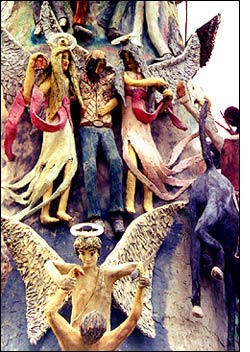
Few would have paid any attention to his vanishing act had Hill not left something behind. On the banks of Bayou Petit Caillou, dotted with shrimp boats, more than 100 brightly painted sculptures mark Hill’s stay in Chauvin (pronounced show-van, population 3,400). Many of the pieces are made from cement and wire mesh, though the most prominent, a 45-foot-tall lighthouse, is composed of 7,000 bricks. Figures in relief stud the outside: musicians, cowboys, soldiers, angels, God and Hill himself.
Before Chauvin, Hill worked as a bricklayer in a town 60 miles west. After leaving his three children and the woman he married at 20 (when she was 14), he rented some property on the bayou in Chauvin for $250 a year in 1988. He lived in a tent while he did bricklaying jobs and built himself a small cottage. Then in 1990, without explanation, he started making religious scenes beside the house. Like many other self-taught or “outsider” artists, he was a resourceful scavenger, lifting sand, cement and bricks from nearby work sites. A neighbor welded the underlying metal armature for some of the sculptures.
Hill spent a decade working on his art without giving a thought to profit, according to those who knew him. This idea of making for making’s sake is part of what Roger Cardinal meant when he coined the term “outsider art” in 1972, a translation of the French “art brut” first used by artist Jean Dubuffet in the 1940s. Cardinal describes this art as “not hooked up to galleries … it should be more or less inwards-turning and imaginative.” He goes on to explain how this definition is fairly easy to use when categorizing the work of a dead artist but can become problematic when dealing with the living, who “might at some point, after all, go to their own openings and begin to be interviewed.”
Howard Finster is perhaps the best-known outsider artist to actively enter the world of profit — to the point of becoming a cottage industry. In his Paradise Garden in Pennville, Ga., Finster makes what he calls “sermons in paint.” His fame spread via newspaper articles and TV appearances and then through pop culture after R.E.M. and the Talking Heads commissioned album covers from him. His Web site encourages visitors to call the 800 number and buy, buy, buy. At an auction in October, the price of pieces started at $300, but Finster didn’t want anyone to lose out. “If you cannot afford a Howard Finster piece,” the site suggests, “his daughter, Beverly Finster, is now re-creating his pieces for approximately 1/3 the price of a Howard Finster Original.”
Hill may fit into a subcategory of outsider art — “psychotic art.” Cardinal finds in this genre “a quality of urgency, and sometimes quite fearful urgency, which can give … viewers a particular emotional shock.”
The reclusive 45-year-old Hill certainly came across to locals as disturbed, and several tried to help him before he vanished. A story in a regional paper described Hill as “an eccentric who was completely obsessed with his biblically themed sculptures.”
Frederic Allamel, a French art sociologist, first noticed Hill’s project in 1992. He remembers a handful of sculptures, most with only the armature in place, and the partially built lighthouse. He returned to Hill’s site in 1999. On this visit, Hill came out of his house and started to talk about his work.
“He spoke as if he were in a trance,” recalls Allamel, who describes Hill’s monologue as irrational, spiritual and schizophrenic. “There was no chance for me to say a word.”
Dennis Siporski, who looks a bit like Dennis Hopper, has devoted a fair amount of time over the past year to preserving Hill’s work. Siporski chairs the art department at Nicholls State University, about 30 miles north of Chauvin. The artist entered his radar in the fall of 1999. Siporski was on his way to Louisiana’s Barrier Islands when he passed the carnival of figures.
He saw angels everywhere: Teams of two, armed with swords, protect gateways; one sits playing a harp; another holds an hourglass; three have their arms in the air and their heads thrown back in celebration; sterner angels point the way to eternity. Three flying angels accompany a procession of 11 figures winding their way along a brick-lined path. Hill placed himself in many of the tableaux. He rides a horse, or he carries Christ’s cross and stands with long hair and a beard, his heart bleeding, in a circular cement base inscribed with the message “It is emty [sic].”
Siporski was so entranced that he returned soon afterward to take photographs and interview Hill. When Siporski spoke with him last fall, Hill hadn’t touched any of the pieces all summer. “This part of my life is done,” Hill told Siporski. Siporski tried to get him to expound on the site’s meaning.
“Is this your vision?” Siporski asked.
“It’s about living and life and everything I’ve learned,” Hill replied.
Siporski gently urged him to be more specific. Instead, Hill got vague. “It was like talking to a guru — very Zen,” Siporski recalls. “It was my job to find out what it meant. If he had to explain, I obviously didn’t get it.” Hill talked on and on and on about wanting people to come and experience his dioramas, and he was not unintelligent.
“If he’d cleaned himself up and put on a suit,” Siporski says, “you’d think he was an old college professor, talking about how it takes the whole being to make art. He was way beyond art as a thing.”
A recluse doesn’t make a lot of acquaintances, and tracking down information on Hill is an uphill battle. No one in the office at Patterson High School remembers him, nor can anyone find a record of him graduating. In Chauvin, most people never laid eyes on him. He never wandered into Sportsman’s Paradise just across the bayou, though a waitress there heard he was “odd in the head and temperamental.”
As nobody knows Hill, nobody knows what triggered his abrupt departure. At the fire station next to the library, one of the firefighters speculates that financial problems drove Hill away. As Siporski pieces it together, Hill misunderstood his obligations to the IRS: He seemed to think the government was going to take any money he made, so he stopped working. Soon he could no longer pay the rent. Then his mother died. Siporski believes Hill’s sense of loss was intensified by increasing guilt about the limited contact he maintained with his children after he moved to Chauvin.
Over at Danny’s Fried Chicken, patrons suggest he went overseas to make money. Customers at the Pizza Express disagree. They say he took off for Arkansas to hide in the woods near his brother. Siporski, Allamel and Hill’s former neighbor, Julius Neil, concur. Some of the locals use the Cajun expression “comme une bétaille” — like a wild beast — when describing Hill’s existence in lands farther north.
According to Neil, who knew Hill the entire time he resided in Chauvin, “Kenny loosened up about six months before he left. He wouldn’t talk right and raised all kinds of hell.” Before then, Neil had found Hill to be a good neighbor. If Neil was cutting the grass and Hill came by, he’d stop to help. Neil has his own explanation for Hill’s departure. “The landlord came to collect the rent money, but Kenny felt he owned the land. He got sassy with the landlord and was evicted.”
The couple who owned the property where Hill lived put it up for sale immediately after he left, though they were skeptical that any buyer would want it with the huge sculpture garden. Siporski could have purchased the land himself and sold the pieces to collectors for thousands of dollars, he says. Over the past 20 years, folk and outsider art has become big business. But the idea of auctioning off Hill’s vision turned Siporski’s stomach. He met with the owners to discuss the aesthetic value of the site and begged for some time to explore how to preserve the sculptures. The couple agreed.
To drum up support, Siporski invited faculty from art departments at Nicholls and Louisiana State University to come take a look. Greg Elliott, head of the sculpture program at LSU, said, “I’ve spent most of my life looking for folk art and this is really a remarkable site.” Still, neither of the colleges could fund a full conservation effort.
Siporski remembered the Kohler Foundation in Wisconsin, which had restored another “art environment” along the Mississippi River, and, on a whim, Siporski called. Executive director Terri Yoho took an immediate interest and some foundation members flew to Louisiana to talk with the property owners.
At the same time, Siporski approached the president of Nicholls, Donald Ayo. “The president is an art lover and within 10 minutes agreed to have Nicholls take over maintenance of the site once Kohler finished restoration,” says Siporski. On May 2, the foundation purchased the property. The foundation has participated in the preservation of seven self-taught artists’ environments in Wisconsin, but this is its first project outside the state. No one involved will make any money from Hill’s art.
Next year, construction of a visitor and education center will start across the road from the site. Siporski dreams of a day when people will be able to stay at the center, take time to really look at what Hill made from every angle and create their own sculptures in response. These would become part of a new, ever-growing sculpture garden.
Those working to protect what Hill abandoned find themselves in an uncertain position. After spending hundreds of hours and thousands of dollars — they cleaned and sealed all the sculptures, and obtained an Army Corps of Engineers permit to build a bulkhead to protect the art from flooding — they don’t really know how Hill would react to their efforts. Hill took obvious pride in his salvation scenes but also hated publicity. Kohler Foundation project coordinator Michele Gutierrez, who inventoried and mapped the site, worries about a story a neighbor told her: Supposedly, Hill burned a houseboat he’d built when a picture of it appeared in a magazine. But Neil believes Hill will stay away: “He left and it’s out of his mind.”
Gutierrez never met Hill, but she carefully went through the personal effects he left behind. “This [art] was created by a person in great strife,” Gutierrez says, “but Kenny … deserves respect and empathy. The art says it all — the poignant and the solitary, the grand and the low, the humorous, the fearful, the hoped for. It is the story of life: Kenny’s, mine, everyone’s.”
Out of the frying pan, into group therapy
A new Supreme Court ruling could increase the number of former sex offenders released into the community. For these ex-cons, the end of detention marks the beginning of intense, and possibly endless, therapy.
By Pegi TaylorTopics: Supreme Court, Violence Against Women
Bert, a wide-hipped man in his 40s, perches on a stool to the left of a white marker board. He writes down numbers as men in the room call them out. When the math is done, participants in the tally — 16 sex offenders who range in age from their 20s to 60s — learn that, all together, they have had 214 victims.
Primarily pedophiles, rapists and perpetrators of incest, the men sit in a nondescript office space in a small Wisconsin town — across a river, between a feed mill and a car dealership. They meet every Saturday afternoon with Joe Henger, a psychotherapist who facilitates therapy for sex offenders at confidential sites around the state.
These are Henger’s highest-risk clients. Most have spent many years in prison, and their parole agents will check to see whether they attended this mandatory weekly session. They all face a possible lifetime of therapy, as well as constant, and sometimes humiliating, surveillance in their communities — but they are considered lucky. They have, as Henger says, “ducked the bullet” of indefinite civil commitment, a means by which courts in Wisconsin and 15 other states can detain prison inmates identified as violent sex offenders — even if they have served their sentences.
Indefinite commitment is the subject of intense national debate, focused mainly on the constitutional rights of offenders. Just this week, the U.S. Supreme Court issued a ruling in a Kansas case that adds to the state’s burden in justifying commitment. Previous to Tuesday’s ruling, states with commitment laws had two basic standards for holding an offender: proof of a mental disorder that predisposes the offender to engage in sexual violence, and evidence that the offender is likely to reoffend if released. In a 7-2 decision, the Supreme Court ruled that the state must also show that the offender poses a “serious difficulty in controlling behavior.”
Further constitutional challenges, arguing, for instance, that commitment constitutes double jeopardy, have been unsuccessful. The laws overcome the charge by shifting the status of sex offenders from inmates to “patients,” who are not considered “incarcerated” but rather “in treatment” at secure facilities. (In some states, offenders serve their commitments in the community with supervision.)
Proponents of civil commitment laws point out that, once inmates become patients, their status is significantly enhanced, while the community is protected from a threatening presence. “Patients” are required by law to have access to treatment (prisons have no legislative mandates to provide treatment), and patient housing, while it sometimes resembles a prison, is specialized in states where there is no option to serve commitments in the community: It might be a building specifically designed for sex offenders, a mental hospital or wing of a prison. The patients have the ability to petition the courts for release based on their progress in treatment — typically, once a year.
In each of the 16 states with civil commitment laws, no more than a handful of patients have been released after completing treatment. Some lawyers have initiated suits claiming that the dearth of releases shows that conditions for committed offenders are more punitive than therapeutic, and as such constitute double jeopardy. So far, these efforts have failed. The U.S. Supreme Court ruled last year that deficiencies in Washington state’s treatment program for a particular patient did not constitute double jeopardy, or grounds for release.
At the moment there are about 1,200 committed offenders nationwide. Case by case, county judges will decide whether individual offenders, supported by the recommendation of mental health professionals who treat them, are ready for release.
When Washington state enacted the country’s first commitment law for sexually violent persons in 1990, treatment for offenders was in total disarray. Mental health professionals were using primarily psychoanalytic, humanistic or behavioral models with widely varied results. In a 1998 issue of “Psychology, Public Policy, and Law,” two articles written by psychologists and academics reviewed studies of the methods and concluded that they had very limited impact. In one article, three researchers concluded that “even more discouraging” than the lack of the methods’ effectiveness was “the suggestion that [humanistic and psycho-dynamic treatments] may even increase the likelihood of new sexual offenses.”
In the past decade, as more states enacted commitment laws, there was a move to use cognitive-behavioral therapy — sometimes in coordination with medication — to treat the majority of violent sex offenders. It will take years to test the impact on recidivism of this particular approach, but early reports indicate a better outcome than previous therapies — so far.
The cognitive-behavioral group therapy employed by Henger conforms to the guidelines recommended by the Association for the Treatment of Sexual Abusers (ATSA). The ATSA, an Oregon-based international organization of approved professionals who work with offenders, has provided standards for professionals in the field of sex offender evaluation and treatment since 1984. According to ATSA executive director Connie Isaac, core elements of successful therapy for sexual abusers must include disclosure, victim empathy and relapse prevention. Henger incorporates these elements into his own approach, which he describes as “heavy in problem solving and role playing.”
On the September night when Henger’s high-risk offenders add up the number of their victims, one of the men brings out a yellow legal pad full of notes — preparation for “disclosure.” Nick, the son of a minister, tells the group a bit about himself and then describes — minute by minute — the details of his single crime. He says that his father beat and sexually humiliated him as a child, and he contemplated suicide; but, he tells the group, his father had drilled into him as a child that he would go to hell if he took his own life.
Instead, Nick nursed a fantasy about sexually degrading his stepmother and eventually showed up one night at the house of the mother of an acquaintance, a woman in her 60s who looked like his stepmother. When he rang the bell and she welcomed him in, he sexually assaulted her.
Henger later describes the disclosure process as “undercover” work. “I go in and understand these offenders’ worlds. Then I can figure out a logic they’ll buy into and reprogram them.” He says that Nick’s anger toward his father is so powerful that he has projected his rage onto his mother and stepmother instead. He categorizes Nick’s crime as “a classic rape about anger.”
As he does with each of his clients, Henger will use Nick’s account to help him identify all the triggers that led up to the assault, and then find ways to avoid or interrupt them. He will then have Nick describe his crime again, from the perspective of the victim, to begin the process of victim empathy.
As it happens, victim empathy is the subject of Henger’s meeting with the same men three weeks later. They bring in their homework assignments — letters they have written to their victims. Each letter had to address a series of 13 questions, starting with “Why did you do those things to me?” Their answers had to explain why they committed their crimes and why the victim is no longer in danger. The men never send the letters, but the project gives Henger a chance to assess each participant’s degree of victim empathy.
Henger asks one of the men to read the 13 questions to Matt. Matt, in his 40s, sexually assaulted 33 boys over a period of 22 years. His hands shake as he tries to give his answer to question No. 3, “Will you ever do those things to me again?” He stammers, “This is really hard for me.”
Henger has some other men respond and returns to Matt for No. 9, “How did you feel when you were hurting me?” At first Matt replies, “I felt anger, fear, depressed and low self-esteem.”
A couple of the men are clearly unconvinced and shoot back, “Come on … ”
“OK. I was pretty much excited,” Matt divulges. “I felt the boys owed me for all the grooming and all the gifts I gave them.” (Grooming refers to the process a sex offender uses to gain the trust of a vulnerable person, most often a child, and break down the victim’s fears and defenses so he or she will accept the perpetrator’s sexual advances.)
Another man nods and adds, “When I would give something before, I gave it with a sense of wanting something in return. Now when I do things for people, it’s not for what I can get down the road.”
Peter starts to cry and reveals, “My daughters were holding out their arms for love and attention and I treated them like shit. They would ask, ‘Why Daddy?’ and I’d say, ‘Shut up. I’m not your fucking father.’”
Some of the men are confused. Roberto, who molested his daughter, asks, “Were they your real daughters?” Peter says they were and Bert shakes his head: “Double hurt — to rape and disown.”
At another point in the letters work, Peter says he committed his crimes because “I was getting back at the bitches who hurt me in the past.” Henger immediately interrupts, “If you’re using the word ‘bitches,’ it shows you haven’t learned much.”
The group continues going through victim empathy letters the following week, in late October. Henger has Steven answer question No. 13: “When you think of me now, what are your thoughts?” Steven, who is young and Latino, has an unusual case. His victim was a young girl who picked up the letter-size pictures of his penis that he placed at a bus shelter for her to find. Steven masturbated in the bushes while watching her and eventually planned to have sexual contact with the girl. He fantasized and masturbated at home about other potential victims.
“I felt rejected and was looking for someone to love me,” reads Steven. He thought she liked the pictures because he left the images for other girls, but she was the only one to pick them up.
An older man in the group, Ken, tries to coach Steven: “Thinking she liked the pictures was a distortion,” he says. Henger agrees and adds, “I don’t think you thought she really liked it. That’s bullshit. You really liked it.”
Steven complains, “Loving kids got me into trouble.” Almost everyone in the group joins in a sarcastic, “Awwww.” Ken coaches some more: “You’re stuck someplace. If you’re hurting someone, that’s not love.”
Henger considers victim empathy the turning point in therapy. “Many of these men have no idea of the harm they create,” he explains. “They are consumed with themselves. I can see the change when they realize they hurt somebody.” He adds that the change cannot be solely demonstrated “on the surface” by shows of emotion. “A blubberer can be full of it,” he says. Instead, Henger is looking for the offender to take full responsibility for his crime, not blame the victim in any way for what transpired, and to “refer to people as people, vs. objects.”
Henger, who is 50, has been working with sex offenders for almost a decade. He had not planned on doing so when he trained as a therapist. Instead, after earning a masters degree in guidance counseling from the University of Wisconsin-Whitewater, he opened a private practice in which he worked, for the most part, with couples and families.
Henger had some clients who were victims of sexual abuse, but when he searched for institutions that offered training programs for treating the special issues of those clients, he couldn’t find any. When he started doing his own research on the topic, he came to the conclusion that there were many more victims of sexual abuse than there were offenders. There was, he says, “a need to eradicate the source.”
In 1991, Henger first set up a relapse prevention program for adolescent offenders. Then, in 1994, he discovered that Wisconsin was home to the Wisconsin Sex Offender Treatment Network, the nation’s first program to train mental health professionals in up-to-date treatment specifically for sex offenders. Basically, the program created a network in which Lloyd Sinclair, a psychotherapist with 27 years of experience in the field, ran workshops for mental health professionals, who, once trained, could run therapy groups for offenders on parole and probation around the state. Henger signed up and became one of the inaugural graduates.
Once he began working exclusively with sex offenders, Henger never looked back. In nine years he has treated 2,000 male and female sex offenders in prisons and community settings. The makeup of his clientele is broad: He has treated indigents, firemen and heads of corporations. Reflecting national statistics, the vast majority are white and knew their victims. Says Henger, “Most of these guys can’t talk to a stranger, let alone offend one.”
Henger has done most of his work outside prisons. Offenders are challenged by living in a community, he says, and challenging situations create an opportunity to intervene — opportunities to change deviant thinking and behavior. Prison programs usually offer a set number of treatment sessions, perhaps 30. Outside, Henger can work with his clients for years — with more control. “In prison, a man will say anything to get out,” says Henger. With a client on parole or probation, Henger’s therapeutic supervision is enforced by probation agents; regular polygraph tests augment his analyses of progress.
A central, obligatory tenet of the ATSA manual and Henger’s therapy is, “Members shall not make statements that a client is ‘cured’ or no longer at any risk to reoffend.” As in Alcoholics Anonymous, the assumption in the treatment of sex offenders is that they “may require ongoing management.”
Henger, a sturdy man with steady dark eyes, believes in the constant vigilance of therapy, telling his groups, “This is no different than a fireman or a military man in training. You need to keep a constant edge.”
In fact, one of the men in the Saturday group reports that he has just seen a man in his apartment unit who resembles the last of his 30 victims. Taylor is obviously shaken: This particular victim committed suicide while Taylor was in prison.
Before he was arrested, Taylor had been a trusted man in his community who became a supervisor of adolescent boys. At a home owned by another child molester, Taylor groomed a series of primarily adolescent boys and molested them. (Taylor was abused by a man when he was young. Henger says 30 percent of male sex offenders were sexually abused as children. “One of the gifts that keeps on giving,” he comments to the group.)
Taylor acknowledges in the meeting that his response to the victim look-alike gave him a “wake-up call” to alter his attitudes. In the group, Taylor has taken responsibility for his victim’s death. However, Henger imagines that seeing someone who looked like this victim “hit Taylor in the solar plexus. It brought him back to the reality of how he needs to guard himself against his attraction to adolescents.”
Henger is aware of the urgency in his work — one out of four women and one out of seven men are sexually abused before the age of 18 — and he describes his goal as “getting into the minds of the men and changing them to protect future victims.” But he also believes that the media perpetuates an unrealistic image of sex offenders as “monsters” who nearly always go back to committing crimes after incarceration. He cites as a glaring example a TV show in which a reporter claimed that 90 percent of sex offenders revert to criminal behavior.
Experts in the field are reluctant to give a general figure for the rate of recidivism among sex offenders, who recidivate after incarceration at different rates over different periods of time, depending on the type of crimes committed. In the issue of “Psychology, Public Policy, and Law” published in spring 1998, researchers found that the rate of recidivism ranged from the low teens to more than 50 percent. In a recent phone interview, Dr. Fred Berlin, a researcher, clinician and teacher at the Sexual Disorders Clinic at Johns Hopkins University, said that “overall” an estimated 35 percent of untreated offenders commit new crimes. After weekly cognitive-behavioral therapy over a series of months, the number drops to around 15 percent. Henger’s own data reflects a similar conclusion: Only 2 percent of his clients have been reconvicted, though he believes a higher percentage may have reoffended without being caught. Of the 2 percent who were sent back to jail, the majority were convicted for “hands-off” crimes like exhibitionism.
An important part of relapse prevention involves interrupting the arousal patterns of sex offenders. In his meetings, Henger is relentless on the subject.
“A month ago you were still masturbating to little children; are you still?” he asks Steven, the offender who left pictures of himself at the bus stop. Steven says he’s “had the urge,” but he hasn’t.
“You need to fantasize about adult women,” suggests a long-term member of the group. “Are you able to masturbate to adult women?” Henger asks.
“I’m attracted to kids more than adults,” Steven admits.
“This won’t go away by magic,” Henger says. “You need to be proactive. You can’t wait.”
“It’s too late then,” a few men voice in unison.
Steven explains that the fantasies he has with adults feature women rejecting him. “Do not masturbate to women who reject you,” Henger commands. He compares inappropriate masturbating to “gas on a fire.”
“For homework,” he tells Steven, “think out a consensual adult fantasy you could ejaculate to and tell us.” The men in the group offer advice, explaining that a fantasy has to be about an unattainable man or woman. “Like Sigourney Weaver,” suggests Matt.
Sam, a man who molested all three of his daughters, has been a participant in the Saturday group for years. He has had a total of 11 years of therapy, in prison and on parole — without a relapse. (Henger has worked with him since his 1995 release from prison.) This Saturday, he tells the group that on Monday, he visited his middle daughter with his ex-wife. It is the first time he’s seen her — at the daughter’s request — since he went to prison.
“My daughter hugged me,” Sam says, in tears. While they talked, his ex-wife held his right hand and his daughter held his left. “Up to 17 years old, she just felt manipulated and controlled,” says Sam. “I have a chance to give back what she missed.”
His daughter said the worst times for her have been the holidays and not having a father when she got married. Sam says, “I learned through therapy where my feelings weren’t.” Adds Bert, “The old Sam wouldn’t cry for anyone.”
As the group gets ready to leave, Bert says, “The hardest thing is going home.” The participants don’t really have time to think during the sessions, says Henger. They begin to internalize new perceptions and ideas afterward.
Henger goes home with his own burdens. When he first started treating sex offenders, he would tell his wife stories. “It was new, and there was a voyeuristic quality to it,” he says. Now, he talks to parole and probation agents about his job and never discusses it at home.
On holidays, when Henger’s extended family gathers for dinner, his relatives hold a round table. Each family member takes a turn, fielding questions from the others about their lives since they last met. When it’s Henger’s turn, he says, no one ever asks him about his job.
Not enough nuts?
At the seventh annual Cracker Jack Collectors Association Convention, all that's lost is restored.
By Pegi TaylorTopics: Wisconsin
Al Reichwaldt thanks his lucky stars that he was able to attend the seventh annual Cracker Jack Collectors Association Convention in Milwaukee June 21-23.
Just over a year earlier, Reichwaldt, then 61 and a 40-year factory worker, was driving north from Milwaukee to his mobile home, two hours away in the village of St. Nazianz. Suddenly the muggy day turned strangely chilly. He’d heard from the postmaster that a bad storm was coming, and when he got home, he went to watch the Weather Channel with a neighbor who lives 50 feet west of him. It was then that the sky went pitch black and baseball-size hail started to pelt the trailer. Reichwaldt was standing 7 feet away from a window when the pane crashed inward. The bathroom sink from his mobile home nearby had slammed through the glass. “Tank Gods I had on my glasses,” says Reichwaldt, who grew up on a Wisconsin farm speaking German until first grade. An ambulance rushed him and other park residents to a hospital, where he received 113 stitches.
The thunderstorm, which Reichwaldt calls a tornado, struck with winds of 110 miles per hour. It flattened his furniture, sent his refrigerator through a wall and blew away his electric stove, never to be found. Reichwaldt also owns about 10,000 Cracker Jack toys, which he kept primarily in metal cans in his mobile home. Miraculously, he lost only three tin dog bookmarks.
At the Cracker Jack convention, Reichwaldt — without a single scar on his baby face — handed out a special card to other convention-goers. It pictured him as Sailor Jack with his faithful dog Bingo clutching his leg as a funnel cloud looms behind them. The bottom of the card read: “Tornado Al: Cracker Jack Collector.”
Everyone in the Cracker Jack Collectors Association knows the words to the 1908 song “Take Me Out to the Ball Game,” but not for any love of baseball. It was the line “Buy me some peanuts and Cracker Jack” that made their beloved confection famous. All serious collectors have items numbering in the thousands. “The more you collect the more you want,” they’ll quip, a takeoff on the early C.J. slogan “The more you eat the more you want.” Often surprisingly vague about how many pieces they have, members can list exactly what they’re missing.
Collectibles range in cost from less than a dollar for plastic toys or current paper prizes to more than $1,200 for a Joe Jackson baseball card from 1915. This huge price spread attracts a membership of diverse means. Alex Jaramillo Jr., one of the organization’s unofficial historians, wonders, “Why were these paper prizes saved?” He compares them to pressed flowers, tucked away to preserve a memory.
Each year, a representative from Cracker Jack, a division of Frito-Lay since 1997, has given a presentation at the convention. Don Helms, fairly fresh out of graduate school with a couple of years’ experience with Doritos under his belt, showed a chart of C.J.’s flat sales. One member complained, “There aren’t enough peanuts in the package.” Helms confessed that when he took over as associate product manager of the brand four months ago, his predecessor warned him, “You’re going to hear this every day of your life,” despite Frito-Lay’s having increased the percentage of peanuts. And even though Frito-Lay reintroduced three-dimensional plastic prizes, which hadn’t appeared for years, people still kvetch that “the prizes are lame.”
The collectors also heard from Becky Smith, sales manager of W/S Packaging Group in Algoma, Wis. The company produces paper prizes, typically in lots of 10 million, for Cracker Jack. Smith understood her audience. She held up samples she’d brought along of uncut sheets to give out during a trivia game.
A number of members instinctively oohed, and a low murmur of want started to hum through the room. The walls seemed to close in and the room got warm with all the heavy breathing. Smith even warned the audience that it wasn’t worth driving to Algoma for some Dumpster diving because all the paper waste is burned or shredded. At “shredded,” someone cried out, “What a nasty word!”
The 170 CJCA members all have their own stories of how they got started collecting, but the trajectory often follows a familiar path. Ann Brogley, the founder and first president of the association, who now owns about 10,000 items, began collecting the inexpensive but visually exciting plastic toys that were primarily inserted in boxes the ’50s and ’60s. Then she started amassing series of paper prizes. Once you’re looking for specific toys, you’re hooked. Soon you pick up a few of the metal surprises from the early 1900s. Finally, you see one of the early, fragile paper prizes or premiums and bite the bullet, laying out more than $100 for a single item.
Some people you’d expect to have spectacular collections tend to be Johnny-come-latelies. Cecelia Downs’ grandmother worked on the toy line at the Chicago Cracker Jack plant for 30 years. As a child, Grandma Anna always gave Downs C.J. toys, but she didn’t save any. When her grandmother died, she left Downs about 100 prizes. At first Downs let kids in the neighborhood play with them and handed out others. Later, she went around the block to try to get them back. She first attended the CJCA convention two years ago to read to the group from her novel in progress about her grandmother’s close ties to the other women she worked with on the second shift. Downs came to this year’s convention to add a few items to her slowly growing collection. She’s up to 200 prizes now and focuses on the items she casually gave away in her youth.
If any one person is responsible for enticing people to collect C.J. memorabilia, it’s historian Jaramillo. Rick Magnus from New York blames Jaramillo for what has become “a passion, not a collection.” In 1989, Magnus bought Jaramillo’s book “Cracker Jack Prizes.” Jaramillo, hired as the official Cracker Jack spokesman during the ’80s and ’90s when Borden owned the brand, wrote the book as a social history. He describes how each decade of prizes from 1900 to 1980 represents “particular people in that particular time.” The luscious close-up photographs of the prizes made readers itchy to own them. Larry White, with a collection of about 80,000 items, says people would think, “I’m going to try and get every prize on Page 27.”
Convention regular Harriet Joyce was called the “Queen of Cracker Jack” in a 1979 South Bend Tribune article. She’s too humble to let anyone in the CJCA call her that, but with more than 100,000 items in top condition, she is the queen. And she’s visited more Cracker Jack shrines than anyone.
The C.J. universe is full of unpredictable twists and turns, which might be part of its appeal. Through an ad Joyce placed in a magazine in the ’70s, she met John Craig, who designed prizes for Cracker Jack. In 1980, he invited Joyce to join him on one of his visits to the Chicago plant, and she obtained permission to enter the second-floor vault. It was drab inside, with cement block walls and fluorescent lights, but Joyce spent the day on a collector’s high going through drawer after drawer of prizes. “I never knew what was going to be in the next drawer,” recalls Joyce. Later that year, she met the king of C.J. collectors, Wes Johnson from Kentucky. He, in turn, brought her along when he visited the studio of C. Carey Cloud.
Cloud, born on an Indiana farm in 1899, designed 102 different sets of prizes over 28 years. Hired in 1937, he played a key role when the company stopped importing prizes from Japan during World War II. He had to be inventive, since rationing limited his access to anything but paper for materials. He also designed the first plastic figurines when the company began using injection molds.
Only once did the company have a complaint about his prizes. In the late ’40s, some adults thought his plastic sea captain looked like Joseph Stalin. According to Jaramillo, “Rabid anti-Communists … believed Cracker Jack was being used to propagandize the youth of America.” The company withdrew the figure from circulation. Of course Joyce owns a sea captain, worth about $20.
Joyce is a charter member of the CJCA and helped Brogley find other collectors to join. Until the association got going in 1994, people tended to fiercely guard lists of people with whom they traded. This all changed at the first convention. An article in Ohio’s Columbus Dispatch explained, “The association has transformed once-hostile hobbyists into a group of friendly competitors scrounging through attics, toy boxes, floorboards, antique shops and flea markets.” Brogley remembers witnessing “people scream and hug each other” after they matched up collectors they’d known only by their handwriting or voice.
Each convention has had its defining story. Larry White, a Massachusetts antiques dealer, often plays a key role. Since the publication of his Schiffer price guide, “Cracker Jack Toys: The Complete, Unofficial Guide for Collectors,” in 1997, and then 1999′s “Cracker Jack: The Unauthorized Guide to Cracker Jack Advertising Collectibles,” he has been a familiar name to any C.J. collector. And yet his nickname in the CJCA is “Larry the Loser.”
At the first convention, White and a number of other members arrived late to the banquet. They decided to sit together at a table in the back. During the raffle, the table mates realized they were jinxed and had won nothing but a little bottle of bubbles, which wasn’t even a C.J. item. With nothing else to do, they started blowing bubbles and pounding on the table in frustration. They had such a good time they decided to sit together at the second convention banquet too. White was supposed to give a slide presentation, but couldn’t get the projector to work. He was instantly dubbed “Larry the Loser” and the table, now an annual fixture, the “Losers Club.” Last year in Dallas, White outdid himself. He came to the banquet wearing a red ten-gallon hat, a sports jacket he’d made out of Mylar C.J. bags and a tie with caramel-coated popcorn glued to it. The popcorn slid down the tie throughout the humid evening.
For 2001, everyone will remember the grand finale of the magic show. That morning, Mary Rowe returned to her room after breakfast to find that someone (perhaps a suspicious-looking person some had seen lingering in the hall with a vacuum cleaner) had taken $800 from a bag. That afternoon, at the end of a Cracker Jack-themed magic show, the young magician looked around the room for a volunteer. He selected Rowe, who came to the front of the room.
The magician asked her for a dollar; she shook her head in embarrassment. Someone in the front row handed him a dollar for her. He folded it up into a tiny cube and blew on it, and when he opened it up, it was a $100 bill. He handed it to Rowe, along with four more he pulled out of the air. Rowe cried, along with everyone else in the room. In six hours, the membership had accumulated $500 for her. Some people didn’t know about the fundraising effort, but rolled bills continued to pass from hand to hand. By the time Rowe left, she had $770.
But Magnus sits with shoulders slouched after the magic show. “This is a hard day. We’ll all be leaving soon and won’t see each other for another year. This is not the real world here. Here, if you get hurt, people ask, ‘What can we do to help you?’”
It’s a sticky business
Cracker Jack's associate product manager "missed the Pok
By Pegi Taylor
Cracker Jack associate product manager Don Helms, who spoke at the seventh annual Cracker Jack Collectors Association Convention in June, appeared a little pooped after only four months on the brand for Frito-Lay.
A few minutes into his presentation, everyone started to understand why. Although 96 percent of adults in America, when asked “Can you name a brand of caramel popcorn?” will reply “Cracker Jack,” only 6 percent of kids will. According to Helms, who has run lots of focus groups, kids see Sailor Jack on the box and think, “Who’s this old dude in a weird outfit?”
As if resuscitating C.J.’s icon trademark status isn’t enough of a challenge, Helms must compete with constant additions to the “sweet popcorn” segment of the snack market, like microwaveable caramel-flavored popcorn — and this segment itself is declining. Cracker Jack and Doritos are both part of the Frito-Lay family of products, but Doritos outsells C.J. 2-to-1.
Of course, a bag of Doritos doesn’t have a prize in it. Helms came to the brand during the Pokémon bust. “We missed the boat on Pokémon,” he admits. Helms wants to target the toys more toward 10-year-olds than 6-year-olds. He’s got livelier paper prizes in the works, not just more stickers and tattoos, and continues developing 3-D toys for larger packages and special promotions.
And Helms is starting to tinker with the product. At the time of the convention, shoppers in the test market area of Minneapolis could pick up three new C.J. flavors. In the past, C.J. has regularly tried adding different snacks to the line. “Butter Toffee” still appears in a fifth of all stores where C.J. is sold. The newer products are geared primarily toward kids: the eye-popping “Zany Watermelon,” marshmallow “Frosted Popcorn Crunch” and “Dazzlin’ Blue Raspberry.” The adults at the CJCA Convention weren’t overwhelmed when Helms passed around bags for members to sample. One woman turned down an offered handful of Raspberry saying, “I don’t eat blue food.”
With this sort of reaction, it’s no surprise Helms is looking elsewhere for new C.J. fans. C.J. will soon premiere in Mexico.
At the end of every day, two problems remain unsolved, as they always have. If German immigrant Louis Rueckheim could figure out a recipe to keep the candy-coated popcorn and peanuts from sticking together in 1896, and if America could land a man on the moon in 1969, why can’t Helms keep the peanuts from falling to the bottom of the package and make sure everyone always finds a prize inside?
Nowhere to hide
Male nude models have a special problem female models don't: What to do if they get a woody?
By Pegi TaylorTopics: Love and Sex, Sex
As a curious female and an art model, whenever the opportunity arises, I ask male models if they’ve ever had an erection while posing. Most have at least one story to tell — though usually not about themselves.
One of the most knowledgeable people I ever talked to about the subject was Robert Speller. Speller probably hires more models than anyone else in New York as modeling coordinator at the New School for Social Research and Parsons School of Design. He started modeling in the 1960s and has seen it all: a father and son who modeled together; a couple who would pose as Adam and Eve with a live snake. In the late 1970s he set up modeling engagements for Madonna.
I asked Speller what he thought about male models having erections and he replied, “Well, men are vulnerable to the air. All male genitals change shape. There are rustlings in all of us, you know.”
Once, Speller received a complaint that a model had ejaculated during a pose. Speller considered the model one of his best and called him to ask him what had happened. The fellow explained he’d been reclining with a spotlight shining right on his crotch. He continued, “Let’s just say I might have been glistening.”
Art schools are always looking for new models, and I hope my stories won’t discourage any man from deciding to join the profession. Just a few weeks ago, I asked some artists, at the end of an open drawing session, who have been coming weekly for years and years if any of them had ever witnessed a woody. None of them had.
We models exhibit and expose ourselves when we pose, and our sexuality is part of who we are, but we don’t intentionally aim to stimulate ourselves or the artists. Any male model who enters a studio wanting to wave his poker around should leave. As Jerry, one of my favorite Milwaukee models, put it, “I don’t find modeling erotic. I have to be in intimate contact with my wife for that. People don’t believe me, but I mostly forget I’m nude when I model.” He’s worked in the profession for more than 20 years, and his penis has never acted up on him.
Most male models have a strategy, like solving multiplication problems, for preventing any rustlings. “I immediately think about two football teams clashing,” says a New York model. “When I experience the pain of envisioning the hike and three or four 6-foot-3-inch, 275-pound guys crashing into each other, I can guarantee I will lose my erection.”
Hugh Kilmer has led workshops to train models and wrote a manual for beginners. He heard some models claim that masturbating shortly before posing could act as an erection deterrent. Kilmer doubts the effectiveness of this method and coaches male models against trying it because, “It contradicts the revelation of self which, at least symbolically, is the essence of modeling as an art.”
Rods do get rigid, and not all models find this revelation of the self overly comfortable. Pete became stiff in a Milwaukee studio and confessed, “I felt more naked than I’ve ever felt.” It occurred in a small class with only four students, and no one said anything.
No hard and fast rules exist about how to handle this embarrassing situation. From what I’ve gathered, in general people do their best to ignore a boner. In a series of comments about nude modeling at About.com, a graduate student remembered “the sound of 20 erasers rubbing against paper [recording] the change in anatomy,” as the only discernible reaction after a model had a hard-on during a pose.
Instead of obvious sexual responses, female models contend with the monthly hassle of tucking in the strings of tampons. I’ve never heard a female model sweat about having erect nipples, though they would be clearly visible to artists. A couple of women have mentioned to me fantasizing about sex to avoid falling asleep while holding a long pose and getting really moist. In one instance, fluid started to run down a woman’s leg.
Viewing all sorts of all-too-human conditions comes with the territory for artists who regularly draw the figure. An art student told me about a model who hopped up onto the platform with a distinctly distracting “chunk of toilet paper in her butt.” The student discreetly asked her instructor, “So, do I draw it or what?” Inexperienced students may publicly humiliate models whose images perplex them. “The model has such a hairy bottom it’s hard to draw,” a young woman blurted out to an instructor. The model managed to hold his tongue as well as his pose.
Sometimes, instructors hire multiple models. When male and female models work together, there’s nothing a priori sexual about it. I look forward to modeling with men, but I’m not thinking about them as men really. What makes it fun is arranging our bodies in relationship to one another. I miss Michael, a Milwaukee dancer, elementary school teacher and part-time model, who would choreograph all our positions. This would include touching, like me resting a hand on his shoulder.
I swear, even though he was a good-looking guy, I never got turned on. We were both too busy. When a pose ends, artists expect you to immediately assume the next one, and during the pose you are looking toward the artists so they can see your face, and models put clothes on at breaks. For all the times I’ve modeled with another man, I’ve never had a chance to check out the guy’s equipment for more than a minute. If I want to scrutinize a model’s apparatus, I bring pencils and paper to a session and draw instead of modeling.
Instructors, on occasion, get a dynamic going in the studio that they may not perceive of as sexual, but that could easily become erotic for the model. During an anatomy class an instructor’s hand inched closer and closer toward Speller’s penis. “Am I making you nervous?” the teacher whispered. Speller whispered back, “Right now, no, but lower, perhaps.” Speller refused when a student asked him to move his hands down the body of a female model. “Some artists forget models are human beings,” he sniffed with disdain.
A Milwaukee model I interviewed was posing with another male and two female models in the 1980s when the other man stiffened. He put a piece of paper over his erection, but “a half-hour later the newspaper was still wiggling.” The model supposedly left town out of embarrassment.
Kilmer gave me an example of how he dealt with possible arousal before one of his training sessions. The boyfriend of a woman planning to participate in a workshop called Kilmer to see if he could attend as well. When Kilmer welcomed him to come, the boyfriend confided he was anxious he might get an erection. Kilmer wrote him, “Erections are not only possible for someone in your situation: They are likely. They are also, however … thoroughly appropriate.” A model has no need to control himself because Kilmer values commitment over control. The model commits to “what it means for us to be human: human both as strength, and as weakness.”
An instructor who used to teach at the University of Wisconsin at Milwaukee would purposely set up sexually charged poses. Pete told me about modeling for a class of hers when, during a break, some students started joking about self-portraits of expressionist artist Egon Schiele masturbating. The students pestered Pete to masturbate for the next drawing. The instructor turned the teasing into a request, and Pete decided, “OK, I’ll do it for artistic purposes.” Before he started stroking himself, he worried he might not be able to get hard with so many eyes on him. After he did, and kept his hand around his woody, he worried about the social system. If the art school administration found out what he’d done, would it blacklist him?
The school never reprimanded him and he received compliments from the teacher, who said, “A great academic drawing can be boring. But a drawing with emotional energy, even if the proportions are off, can still be a really nice drawing.” Kilmer would agree. “Sex needs to be accepted and incorporated into art,” he wrote in an unpublished essay, “with a careful, humble mixture of humor, prudence and delight.”
In the most recent public stiff anecdote I heard, a group of female artists certainly found a model’s chubby acceptable. The story started with a question: “Mom, what if I get an erection?” This isn’t something most sons ask their mothers, but in this case, perfectly understandable. In August, Brian, 18, contemplated art modeling for the first time in a classroom with strangers. His mother, Kathy, a naturist who has modeled nude in artists’ studios for more than 20 years, had encouraged her son to try posing for a class run by a family friend.
According to Kathy the teacher assured Brian, “If it happens, it’s no big deal.” The teacher further assuaged Brian’s fears by explaining, “Occasionally a male model does become aroused during class, but the erection usually quickly subsides and no one is offended.” Brian agreed to try.
So what happened to young Brian, who modeled for the first time in September? Not five minutes went by before he got a boner. It was an adult-education class, and Kathy attended. “I could see that he was trying very hard not to, but the more he tried the harder it got,” she observed. The women all continued sketching; the sole male student was outraged. He stopped drawing and demanded Brian step down. The teacher decided to put the situation to a vote. All the women’s hands shot up to have Brian stay.
Bone dry
After I die, I want maggots to eat away my flesh so my skeleton can be used for research purposes.
By Pegi TaylorTopics: Science
I’m sitting in Susan Wallace’s Baylor University lab, where human skulls and bones decorate counters, and flesh-eating insects adorn glass cases. It’s mid-September 1999, and I have traveled to Waco, Texas, from Milwaukee so she can show me examples of how to properly rid skeletons of their flesh. To demonstrate, Wallace lifts a meaty red pig spine out of a glass box. Fat maggots, hard at work, cover the spine. Wallace, who isn’t wearing gloves, flicks the maggots off the spine using a dental probe. She then reaches over to hand me a lower human jaw with one gold molar. The 50-year-old forensic anthropologist doesn’t even pause as she does all this, enabling us to continue talking about our common passion — donating our skeletons for anatomical study — without so much as skipping a syllable.
You may be thinking all we’d need to do is contact the closest medical school. This isn’t the case. Although many people donate their bodies each year to science, it is not easy to salvage their skeletons for research purposes. As Roger Haushalter, anatomical curator of the Medical College of Wisconsin, explained to me, bodies donated to science have the “flesh cemented to the bone in the embalming process.” If a gross anatomy lab wanted a skeleton, it would have to neutralize the formaldehyde, use bugs or chemicals to clean the flesh away and carefully wire the bones back together again. Even then, the bones, degraded by formaldehyde, would be inferior specimens. This is why most cadavers end up being cremated.
In 1985, India banned the export of skeletons to foreign countries. Before this, it was the supplier of more than 80 percent of the world’s human skulls and skeletons. There is a shortage in the United States as a result. Doctors and those studying the fine anatomical details of skeletons worry about a generation of medical and dental students relying increasingly on plastic replicas instead of the real thing to learn about bones and how disease affects them. The Medical College of Wisconsin’s collection, for example, has dwindled over the last 15 years from 20 skeletons to six. Studying real skeletons help doctors understand everything from how certain cancers attack the bone to diagnosing rickets more accurately. It also helps physical therapists, forensic pathologists, physical anthropologists and even art students in their work. Companies who design surgical and prosthetic equipment are also aided by real skeletons.
“So much detail is lost with plastic replicas,” Wallace says as she explains the difference between the two. “Characteristics unique to each individual are not visible, thus limiting the information a student can learn from examining the bones.” No one has yet to develop a way to mold a realistic plastic reproduction. The tiny canals in the cranium, and the fine bones in the nasal passage are among the most difficult to copy.
Hugh A. Patterson feels the skeleton shortage firsthand. The University of California at San Francisco anatomy professor says that although he would like to buy more skeletons for his students, he can’t afford it. “The costs are prohibitive,” he says. Skeletons before 1985 cost under $500, but with this crisis, they are now retailing for more than $2,000. Instead, he keeps repairing the school’s badly worn specimens. Ever since India banned their export and exposed the world to how many skeletons are reportedly obtained — through practices like grave robbing, instead of donation — many researchers are wary to add to their university’s collections. “I question whether the source of replacement skeletons is legitimate and ethical because most skeletons are imported from other countries,” Patterson says.
There is no clearinghouse for skeletons in the United States. And Wallace and I are devoted to establishing one. No, we’re not morbid, and we don’t have that big of a fascination with death, but we believe if we were to set up a place, others could donate their skeleton for research purposes with greater ease. We hope this will also assuage the skeletal shortage and ensure that the skeletons that end up in our labs and classrooms aren’t ones obtained through grave robbing.
The facility would publicize the need for donors, accept donated bodies, process them, maintain a registry and distribute skeletons to educational institutions. Without the current practice of imported skeletons passing through a series of suppliers, each tacking on overhead charges, the price of skeletons would come down substantially.
Right now, this site is just a dream of mine, and not a dream I ever imagined having. Like many others, I never thought about skeletons much, except during Halloween, until I started art modeling part-time at colleges around Milwaukee in the ’90s. During figure-drawing classes devoted to anatomy, instructors often use live models as well as skeletons to illustrate their lectures. I found the uniform, Rubbermaid-white plastic facsimiles lifeless, but I developed a collegial fondness for real skeletons, with their diversity of color, texture and form. Then, at a retirement party for a local art model, he mentioned planning to bequeath his skeleton to an art school after he died so art students could continue drawing him. The idea sounded good to me too.
This became a quest when I stumbled upon the skeleton crisis while posing for a class in 1995. I overheard a teacher complain about the difficulty of obtaining real skeletons. I began to investigate whether I could give my own bones to the Milwaukee Institute of Art and Design. The school’s president accepted my gift, assuming I can arrange the details.
It’s been five years now, and after spending hundreds of hours trying to figure out how to do it, I learned how difficult it is to simply give the gift of your bones. I called around the country to anatomists, as well as physical and forensic anthropologists, to find out who might macerate my body and take an interest in starting up a national facility. These calls finally led me to Wallace. She has the expertise and dedication the task requires.
Wallace learned the hard way about the complexity of skeletonizing, or macerating, a body. Three summers ago, the police called her to help determine a murder victim’s cause of death. The boy’s body had lain undetected for seven weeks; it was so badly decomposed a mortician could do nothing to make it presentable for a funeral. The mother agreed to let Wallace have her son’s body to use for educational purposes. Since Wallace didn’t have a lab at the time, she transported the body to a local funeral home, where the mortician soaked it in ammonia for four days. He complained it stank too much, so Wallace took over. She simmered the bones in her backyard barbecue pit. “It smelled horrendous,” she recalled. After nine hours, the bones still weren’t clean, and the hands kept rising eerily to the surface. For days, she kept the bones stewing on a hot plate and finally commandeered a student to finish pulling off all the tendons. This was the boy’s jaw that I held during our first meeting last September; it was so identifiable with its gold molar.
Schools, for many decades, have purchased imported skeletons through distribution companies. Not many people who order skeletons ask where they come from and, as a result, schools have tacitly supported grave robbing all over the world.
Now, companies such as Oklahoma City’s Skulls Unlimited fill in as skeleton distributors. Skulls Unlimited touts itself as “The World’s Leading Supplier of Osteological Specimens.” Office manager Michelle Donaldson told me over the phone last year that all their skeletons come from “20- to 100-year-old abandoned burial sites in Asia.” She confirmed that many come from the Cambodian killing fields and even gave me a quick lesson on the topic. “You can tell because they often are missing their lower mandibles and teeth, and you can even see the markings of earth on some of the bones,” she explained.
Although most people don’t know about them, there are a few places in the United States that accept bequeathed bodies for maceration. For example, the Maxwell Museum of Anthropology at the University of New Mexico would be happy to send you a donation form so you can “be permanently preserved in the form of a skeleton,” as long as you are over 18 years of age. The museum uses those skeletons for teaching and research purposes.
Or, if you wanted to have the decomposition of your corpse studied, you could donate your body to the decay rate facility through the University of Tennessee-Knoxville Department of Anthropology. At the three-acre fenced-off lot, better known as the “body farm,” you might be partially buried or left in a car trunk to analyze exactly how people rot under varying crime scene circumstances.
However valuable the endeavors at these facilities, they aren’t equipped or interested in taking on the broader responsibility of a national site. After her grisly experience with the barbecue pit, for instance, Wallace realized the need to determine the most efficient maceration process.
Of course, any site would need to comply with federal health regulations and oversight from some federal department. Wallace and I believe it could take federal legislation to formally approve and designate the facility, and perhaps some funding for the initial development and construction costs. With a site up and running, the federal government could ban the import of skeletons from other countries, unless the importer could prove the skeletons resulted from a donation process similar to the United States.
Some people have asked me whether enough donors would come forward to warrant a national facility. It might take an initial nationwide educational campaign, but with more awareness, enough bequests would surely follow. After an article I wrote appeared in a small Madison, Wis., newspaper, 10 people contacted me because they were interested in donating their skeletons.
One of the women who called me has osteogenesis imperfecta (OI), a condition known as brittle bones. Many children with the disease do not survive past infancy. However, Gretchen (not her real name), now 48, has a mild case. Gretchen was misdiagnosed for years and has endured multiple surgeries, fractures and intense chronic pain. She walks on crutches and occasionally uses a wheelchair. “I’m disappointed but not surprised there are no skeletons to show this particular disease to medical students, since OI is so rare,” she says. “Eighty percent of the stress fractures don’t show up [through X-rays].” Gretchen wants doctors to see the results of “years of stress on weak bones and how bones remodel around metal implants … I think my skeleton could be very instructive to medical students.”
If Wallace’s proposed procedure becomes standard practice at a national site, I anticipate that after Gretchen or I die, a mortician would bag us with some ice and ship our decomposing bodies to Waco. A technician would place our bodies on a grate inside a large glass box with vermiculite on the bottom. The technician would add thousands of blowflies. They would lay their eggs on us, and within hours the eggs would hatch as maggots and devour our flesh. The maggots would turn into flies and get trapped as they tried to fly out the top of the box. It might take a couple of different types of blowfly maggots to clean us off. After several days, a technician would lift us out of the box and wash off our bones with distilled water. Our skeletons would then be ready for many years of use.
Page 1 of 2 in Pegi Taylor