
Sex
It’s in the eyes
That which Dr. Lecter cannot eat, he must love.
Whenever the people behind movies beg critics not to reveal an ending, we have reason to be suspicious. It’s often a way of conceding that the ending (and some endings, apparently, start early on in the movie) is as ridiculous as it is spectacular. So ride the roller coaster, but don’t bother believing you’re really on it, or that it’s going anywhere.
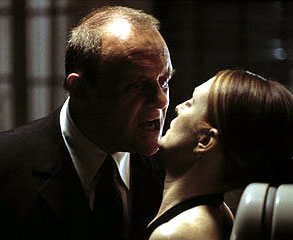
But in the case of “Hannibal” (or, as I call it, “Lecter’s Looking at You”) I’m ready to make some extra allowance. You see, I rather like the film, and I really like the way Anthony Hopkins’ Lecter looks at Clarice.
I know, it’s not the same. Clarice is 40 now, and looks it. You feel that Julianne Moore has had a lot of weak, insubstantial men. So she’s sexy, but withdrawn and disillusioned. Ten years ago, Jodie Foster was 29, and seemed younger. She seemed like an asexual virgin who didn’t know why prisoners could smell her sex. It was her confusion that brought out the fond father in Dr. Lecter.
This time around, with “Hannibal,” if you’ve read the book or heard about it, you’re expecting much more. Never mind exactly what you get — I’m not here to spoil suspense. Let me just say that what made Lecter so fascinating in “The Silence of the Lambs” was the impossible desire, that “I could eat you” pilot light in his eyes. It was the way he surveyed or contemplated Foster, cooked or raw, and knew she was so immaculate she was worthy of the love he had despaired of. After all, why is Lecter such a monster? It’s because he’s angry that life doesn’t meet his very high standards.
And in this film, it’s so clear how much they share — the same dismay at slovenliness, hypocrisy and compromise in others. They are outcast scholars and moralists in their professions. They understand each other.
Thus it is that we see more plainly than before that that which Dr. Lecter cannot eat, he must love. That’s what it comes to — adoration, the urge to be with, to help, to rescue, to respect, to aspire to. His warped saintliness can hardly be debated now. And he is, like all sensual self-deniers, modest, almost chaste. In one really glorious sequence of hide-and-seek, where the sounds of proximity, or intimacy, are as vital as what you see, he closes in on her in a pubic (I meant public) place and, as she stands there, still but turning, trying to place him, he drifts past her on a carousel and lets his hand brush against the fine red flesh of her hair.
Now we know why Moore was adroit casting, for her hair the hue of blood or rare lamb (did you have the lamb?) makes the most secret touch appetizing. Oh, later on, he will carry her, and there is time for one cool kiss, but the chance to feel her hair in passing is both lyrical and barbaric. It is a love scene that reaches from before tenderness to past rape. And yet there is a saving fragrance of humor to it, as if Lecter now were actually directing the film, healing the cuts with thyme and rosemary. You see, the very sharpest thing in this film is to make their love impossible, the imagined meal. Which is the same as infinite.
David Thomson is the author of "A Biographical Dictionary of Film" (new edition just published), "Rosebud: The Story of Orson Welles" and "In Nevada." More David Thomson.
Taxing strip clubs for rape
Politicians are holding adult entertainment venues responsible for funding sexual assault services
(Credit: iStockphoto/wragg) It used to be that strip clubs were merely blamed for society’s ills. Now they’re actually being charged for it.
In recent years, measures have been introduced in Georgia, Pennsylvania, Texas, Illinois and, most recently, California to apply special taxes to strip clubs — specifically to fund sexual assault services. Now, even if you aren’t inclined to view erotic entertainment as the source of all evil, this might seem an appropriate aim — who wants to argue against additional support for rape survivors? It would seem even more so when you consider politicians’ and activists’ repeated claims of solid scientific evidence showing a link between strip clubs — specifically those that sell alcohol — and sexual violence.
Continue Reading Close
Tracy Clark-Flory is a staff writer at Salon. Follow @tracyclarkflory on Twitter. More Tracy Clark-Flory.
Massage therapists rubbed wrong by sex talk
A Jennifer Love Hewitt show and the Travolta allegations have masseuses tired of being confused for sex workers
(Credit: iStockphoto/sybanto) Joe, a licensed massage therapist, knows what it’s like having a famous client who expects something extra. He had an Academy Award-winning actor begin gyrating on his massage table before raising his hips in the air to show off his erection. “He was hoping that I would play with him in some shape or form,” he says.
Needless to say, Joe isn’t surprised by allegations by two masseurs that John Travolta got handsy during massages. (Travolta’s attorney has denied all the allegations, and called them “ridiculous.”) “It happens all the time,” he says, and not just with celebrity clients. He frequently encounters men who try to fondle him, usually while he’s working on their glutes or lower back and their hand happens to be level with his crotch. “They think they’re so original, but they’re all so much the same,” Joe says, his voice rising. “They all use the same tactics, the same body movements, the same gyrations and grinding my table, the [heavy] breathing.”
Continue Reading Close
Tracy Clark-Flory is a staff writer at Salon. Follow @tracyclarkflory on Twitter. More Tracy Clark-Flory.
A night at the vibrator museum
Early vibrators were hand-cranked, two-person jobs -- and prescribed by doctors. How far we've come since then
(Credit: Antique Vibrator Museum) I can now say that I’ve used a turn-of-the-century vibrator — on my hand, but still.
The silver, hand-cranked contraption is usually kept behind glass at Good Vibrations’ Antique Vibrator Museum in San Francisco — but staff sexologist Carol Queen made a rare exception. “This is very special,” she whispered, unlocking the case and carefully pulling out Dr. Johansen’s Auto Vibrator, a relic from 1904. The “auto” part is not so much: It was a two-person job, with her having to crank the device’s handle to get it thrumming. Pressing my finger tips to its inch-wide circular platform of pleasure, I was pleasantly surprised by its power.
Continue Reading Close
Tracy Clark-Flory is a staff writer at Salon. Follow @tracyclarkflory on Twitter. More Tracy Clark-Flory.
Maggie Gyllenhaal on sexual liberation
The beloved indie star tells Salon about her "vibrator movie" and why she loves playing transgressive women
Maggie Gyllenhaal (Credit: Reuters/Mark Blinch) When I met Maggie Gyllenhaal about six weeks ago, she was enormously and gloriously pregnant, stretching out on a sofa with her shoes off and feet up in a Manhattan office building. (Since that time, Gyllenhaal and husband Peter Sarsgaard have welcomed their second daughter, Gloria Ray, to the world.) We were there to talk about “Hysteria,” the charming, lightweight feminist farce from director Tanya Wexler that explores a key event in the history of female sexuality: the invention of the vibrator by Mortimer Granville, a Victorian doctor who was seeking to cure the mysterious “female malady” that lends the movie its title.
Continue Reading CloseMother-daughter sexperts
Susie Bright and her daughter, Aretha, make parental talks about sex look easy -- and fun
Most parents loathe talking to their kids about the birds and the bees, let alone pubic hair grooming, faked orgasms and “water sports” — but most parents are not legendary “sexpert” Susie Bright.
Better than talking about these things, she penned an advice column in 2009 with her daughter, Aretha, then 19, for the ladyblog Jezebel. Their answers to questions about everything from porn to Paxil were unflinching but playful, and at times controversial. Now the pair have collected those columns into a new e-book, “Mother/Daughter Sex Advice.” Together, they read as an irreverent version of “Our Bodies, Ourselves” for the Internet age. The mother-daughter team also reflect on what the experience of writing the column was like, and it turns out it wasn’t as weird as many would think: For the most part, it was just a continuation of conversations they had been having throughout Aretha’s life.
Continue Reading Close
Tracy Clark-Flory is a staff writer at Salon. Follow @tracyclarkflory on Twitter. More Tracy Clark-Flory.
Page 1 of 403 in Sex