
Sex
No inner life
"The Center of the World" is titillating, but it's not sexy.
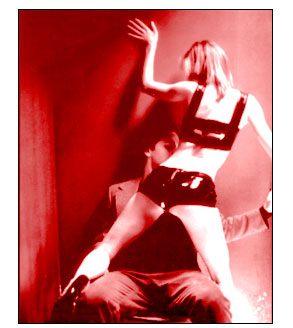
Wayne Wang’s “The Center of the World” (set to open in mid-April) begins very promisingly: Richard (Peter Sarsgaard), an absurdly successful computer engineer, hires Florence (Molly Parker), a stripper, to go with him to Las Vegas for three days.
For all his success and money, for all his seeming command of the world through the computer, Richard is an emotional infant. Florence is about the same age, but tougher and worldlier. She has a deal with herself: She strips to earn money to support the thing she loves — being the drummer in a rock band. In the spirit of such compartmentalization, she gives Richard rules for the Vegas trip: no kissing on the mouth, no penetration and, by implication, no falling in love. But it’s painfully obvious from the start that the callow Richard has nowhere else to go, except to fall into the thing he calls love.
So, on the one hand, it’s a film about sex. There are brief shots that are technically pornographic; there is also a great deal of sexual acting out — dancing, writhing, moaning (the code that most films fall back on). Yet we never see Richard’s penis or Florence’s pubic hair: The apparent “wildness” of the actors is rigorously controlled — by Wang’s shyness or the script’s immaturity (or the contracts the performers signed onto). So it’s a stretch to call the film uninhibited, abandoned or an amazing realization of sexual pleasure. The movie fails to be explicit, erotically factual or deeply arousing. But it’s titillating, exactly because it can’t give the characters inner life.
Richard falls in love, and then turns mean in disappointment when Florence insists on the rules. There is a strong hint, too, that she has been falling herself and uses the idea of the rules as a safety net. The couple part. But the film ends with a repeat of their meeting and the suggestion of the arid circle being renewed in further Vegas weekends.
What do I mean by the inner life that needs to be filled in? Well, I thought of a television play by Harold Pinter, written in the early 1960s at the start of his career. It’s called “The Lover,” and it has just two characters — a man and a woman. They are married, as the play starts, and very fond. But as the husband goes off to work, or whatever, he wonders whether his wife will be seeing her lover today. Oh yes, she sighs, hardly able to keep herself from the forthcoming rapture. Later in the day she does entertain the lover and it is the husband, of course, but she refuses to recognize him. There is no open sex in the play (there could not be in London in the early 1960s), so the fucking takes place in the only fit and decent place — in our mind.
Later in the day, the husband comes home, asks about the lover and listens to the glorious interlude recounted. And they flip roles: She becomes his mistress. It goes on and on, and what it amounts to is the portrait of a marriage in which the two people struggle to find fantastical ways to avoid habit or dullness. The play is very funny, but the mood is entirely enigmatic: It is not clear whether these two are in paradise or in hell.
Las Vegas could and should have been a clever version of that uncertainty. But “The Center of the World” has no humor, and no real ambiguity. It does not know a way of seeing the dance in which fantasy and reality never touch or penetrate, but may sustain each other. It thinks that sexual impersonation (actually doing it on-screen — or seeming to: These actors do nothing) is more erotic than the way people look at each other and talk. It is one more movie that suggests the way film is only viable as a medium for promoting sexual fantasy — seldom showing the thing itself.
David Thomson is the author of "A Biographical Dictionary of Film" (new edition just published), "Rosebud: The Story of Orson Welles" and "In Nevada." More David Thomson.
Massage therapists rubbed wrong by sex talk
A Jennifer Love Hewitt show and the Travolta allegations have masseuses tired of being confused for sex workers
(Credit: iStockphoto/sybanto) Joe, a licensed massage therapist, knows what it’s like having a famous client who expects something extra. He had an Academy Award-winning actor begin gyrating on his massage table before raising his hips in the air to show off his erection. “He was hoping that I would play with him in some shape or form,” he says.
Needless to say, Joe isn’t surprised by allegations by two masseurs that John Travolta got handsy during massages. (Travolta’s attorney has denied all the allegations, and called them “ridiculous.”) “It happens all the time,” he says, and not just with celebrity clients. He frequently encounters men who try to fondle him, usually while he’s working on their glutes or lower back and their hand happens to be level with his crotch. “They think they’re so original, but they’re all so much the same,” Joe says, his voice rising. “They all use the same tactics, the same body movements, the same gyrations and grinding my table, the [heavy] breathing.”
Continue Reading Close
Tracy Clark-Flory is a staff writer at Salon. Follow @tracyclarkflory on Twitter. More Tracy Clark-Flory.
A night at the vibrator museum
Early vibrators were hand-cranked, two-person jobs -- and prescribed by doctors. How far we've come since then
(Credit: Antique Vibrator Museum) I can now say that I’ve used a turn-of-the-century vibrator — on my hand, but still.
The silver, hand-cranked contraption is usually kept behind glass at Good Vibrations’ Antique Vibrator Museum in San Francisco — but staff sexologist Carol Queen made a rare exception. “This is very special,” she whispered, unlocking the case and carefully pulling out Dr. Johansen’s Auto Vibrator, a relic from 1904. The “auto” part is not so much: It was a two-person job, with her having to crank the device’s handle to get it thrumming. Pressing my finger tips to its inch-wide circular platform of pleasure, I was pleasantly surprised by its power.
Continue Reading Close
Tracy Clark-Flory is a staff writer at Salon. Follow @tracyclarkflory on Twitter. More Tracy Clark-Flory.
Maggie Gyllenhaal on sexual liberation
The beloved indie star tells Salon about her "vibrator movie" and why she loves playing transgressive women
Maggie Gyllenhaal (Credit: Reuters/Mark Blinch) When I met Maggie Gyllenhaal about six weeks ago, she was enormously and gloriously pregnant, stretching out on a sofa with her shoes off and feet up in a Manhattan office building. (Since that time, Gyllenhaal and husband Peter Sarsgaard have welcomed their second daughter, Gloria Ray, to the world.) We were there to talk about “Hysteria,” the charming, lightweight feminist farce from director Tanya Wexler that explores a key event in the history of female sexuality: the invention of the vibrator by Mortimer Granville, a Victorian doctor who was seeking to cure the mysterious “female malady” that lends the movie its title.
Continue Reading CloseMother-daughter sexperts
Susie Bright and her daughter, Aretha, make parental talks about sex look easy -- and fun
Most parents loathe talking to their kids about the birds and the bees, let alone pubic hair grooming, faked orgasms and “water sports” — but most parents are not legendary “sexpert” Susie Bright.
Better than talking about these things, she penned an advice column in 2009 with her daughter, Aretha, then 19, for the ladyblog Jezebel. Their answers to questions about everything from porn to Paxil were unflinching but playful, and at times controversial. Now the pair have collected those columns into a new e-book, “Mother/Daughter Sex Advice.” Together, they read as an irreverent version of “Our Bodies, Ourselves” for the Internet age. The mother-daughter team also reflect on what the experience of writing the column was like, and it turns out it wasn’t as weird as many would think: For the most part, it was just a continuation of conversations they had been having throughout Aretha’s life.
Continue Reading Close
Tracy Clark-Flory is a staff writer at Salon. Follow @tracyclarkflory on Twitter. More Tracy Clark-Flory.
On the rack: A cultural history of breasts
Did breasts evolve for lactation or to enhance sex appeal? A new book explores why they matter
(Credit: iStockphoto/NadyaPhoto) It’s hard to be boobs. Sure, breasts are cherished as givers of milk and the pinnacle of sex appeal, but the modern world hasn’t been good to mammaries.
As Florence Williams writes in “Breasts: A Natural and Unnatural History,” they’re the most tumor-prone organ in the human body. They “soak up pollution like a pair of soft sponges,” and transmit environmental toxins to babies through breast milk. “Breasts are bellwethers for the changing health of people,” she says. While we’ve “genetically modified our crops to be able to protect them from the ill effects of pesticides,” Williams writes, “we haven’t yet figured out how to modify our breasts.” Aside from using saline and silicone, of course.
Continue Reading Close
Tracy Clark-Flory is a staff writer at Salon. Follow @tracyclarkflory on Twitter. More Tracy Clark-Flory.
Page 1 of 403 in Sex