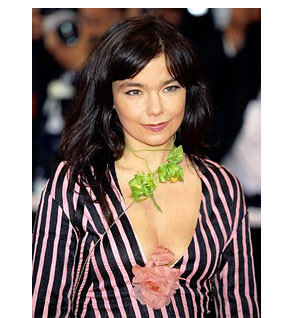

Talking about Björk, we find ourselves on the verge of medium-size changes. We’re rethinking our country, our moves, our hairstyle. What if we moved to Iceland, or even arranged it so we came from there? we’re asking. What if we remixed things? We could quit our jobs and wear swan clothes. She’s moved people to do stranger things, after all: One man tried to kill her, and another — her prime minister — tried to give her an island.
Björk, too, is verging. She has a lean to her, a tilt that makes us want to turn the music up or off, write her the kind of letter that would pause her just a moment. We want to catch up and relate. It’s the frustrating, great compulsion that all famous people both smart and busy seem to provoke.
Nobody has us dancing to weirder music — with new musicians, it’s usually dancing or weird, not both — than Björk. (It’s not the kind of dancing that gets you a date. You do it in your living room, curtains down.) The persistent novelty of her sound and personality has gotten the Icelandic singer/arranger stuck in our notions of new, and we can’t even hum more than a measure of her work. Björk belongs to that genre of musician that makes you feel genuinely odd. In 50 years, we will all talk about where we were when we heard that first song.
Before her recent and biggest fame — she verged on making the Oscars different, verged on making Lars von Trier’s film “Dancer in the Dark” tolerable — and before the steady, measured ascent that preceded that, Björk Gudmundsdottir was a girl among eight adults on a purple commune in Reykjavik.
She lived a long, quiet life there until she was 11, at which point she decided things were too slow and she’d become a great singer. So she did. With five years of music school under her belt, she entered a contest in 1977 and won a record contract. Her stepfather played guitar on the album, and it was soon a hit. Listen to her translation of “Fool on the Hill” — it’s the cutest Icelandic cover of a Beatles tune you’ll hear.
She was precocious and lovable, and the record company positioned her to be a child star, Iceland’s own Jackson 5 squeezed into a Gudmundsdottir 1. Instead, the 11-year-old, who comes from a working-class family, said no thank you. She slipped back out of the spotlight and stayed away for years.
As Björk describes it, her adolescent years were a saturation of Hendrix and Cream. She registered her boredom by leaving home and joining a punk band at 15. (Her parents probably saw it coming: At 7 or 8, she approached the adults in the commune and asked, “Why don’t you stand up and do something?”) She joined several bands over the next few years, worked at a fish factory and a Coca-Cola bottling plant and finally met the friends who would become her ticket out of Iceland. On a summer day in 1986, she gave birth to her son, Sindri. That evening she formed the Sugarcubes.
It was a hobby, she says of the internationally successful edgy guitar band. They offered a refrain heard from a lot of good young bands: We can’t believe we’re making it. Apparently by accident, the Sugarcubes informed the world that Iceland, in fact, existed, and that it could produce a hit pop record. It could even do so while one of the singers tended to her young son. There were MTV videos and extensive tours.
When Björk left the band in 1992 — no major drama, it’s just that six years was enough — she got more deliberate. She left Iceland for London, and arty rock for techno and dance music. Her first solo album since childhood, “Debut,” came out in 1993 and went gold in the United States. She was 28.
The next album came out in 1995. It was called “Post,” supposedly because the songs are letters from London to Iceland. They combine techno with guitar with weird instruments (all elegantly, too: Play wine glasses on one of her albums and you won’t look foolish). Björk saves tiring genres from themselves by mixing them into others, then sews it all up with her macho bellowing and breathy lilting.
“Most bands try to imitate others,” “Ren & Stimpy” creator John Kricfalusi told Paper magazine. Kricfalusi directed her animated video for “I Miss You.” “But Björk is as original as Elvis — and she’s got a cuter groin thrust.”
She was suddenly everywhere, and was still trying to find the time to be as creative as usual. (Some Björk experts say she recorded the vocals for “Possibly Maybe,” off the “Post” album, nude, standing in water, in a cave in the Bahamas. As the story goes, an extra-long microphone cord was used. Bats from the cave, if you believe the story, can be heard swarming around her.) She was too good and too busy to not become a full-fledged celebrity, and it soon caught up with her.
It takes a lot of great songs to live down an assault on a journalist. Nobody’s quite forgotten Björk’s 1996 attack on a TV reporter at an airport in Thailand. It was a turning point that came at a turning point: More and more, the media wanted a piece of her, and when they couldn’t get enough, they turned, at least on this one day, to her 10-year-old son.
Björk had requested in advance that the press leave her and Sindri alone in Thailand until her press conference. When she arrived at the airport, she was surrounded by cameras. As Björk tried to get away, Julie Kaufman, a reporter from a cable TV station, approached Sindri and said, “Welcome to Bangkok!”
Björk lunged at Kaufman, dragging her to the floor and knocking her head against the concrete several times before security pulled her off. Later a mortified Björk apologized and Kaufman chose not to sue. The reporter allegedly turned down an offer to do an ad for a hairspray company — whose product was strong enough to withstand Björk’s fury. The singer’s reputation as an unbalanced brute was cemented.
The year got worse before it got better. A 24-year-old Miami fan, in love and enraged that Björk was then dating a black man, filmed himself building an acid bomb inside a hollowed-out book. The man, Ricardo Lopez, mailed the package to her London home, shaved, put a Björk song on the stereo and took his head off with a pistol. Police intercepted the bomb before it got to Björk’s home. Shocked, Björk took Sindri to Spain — after sending flowers and a card to the dead man’s parents.
She recuperated. There’s an aura of integrity at her center — think of a Space Age Bruce Springsteen in tights — that seems to let her actually work things out in her songs, the way nonfamous musicians have done for ages. And she’s smart, too. When “Homogenic” came out in 1997, it was shocking to hear someone so weird be so articulate. “I thought I could organize freedom,” she sings in “Hunter.” “How Scandinavian of me.”
If Björk is on the verge of something — if she’s permanently liminal — her music is too. It’s not too complicated to enjoy on the first listen, but sit down with a guitar to copy it and nothing really happens. Her songs are too odd to reproduce.
In one, it’s Broadway. In another, the bass rattles the floor under the speakers. In another, the guitar slips gently through an arpeggio like down a glacier, and meanwhile a decent dance beat keeps you moving. The whole thing happens behind a gentle old fuzz, like this futuristic music was actually recorded a hundred years ago.
There are references in her songs, and not the parlor-trick variety. She plays earnestly with crescendos, for example: If Led Zeppelin’s were sex — buildup, buildup, buildup, guitar solo! — hers are sex interrupted, or the walk home afterward. In the decadent, run-down old mansion of rock music, Björk has her head stuck way out the window, and appears to be planning either escape or renovation.
She’s been way out the window forever. Hear that bracing pause 25 years ago, halfway through her “Fool on the Hill” rendition, between verses, just before she belts out, “Oh oh oh!” Musically, the cover is fairly faithful to the original, but in this one moment she waits just a little longer than the Beatles did; it’s the most thoughtful, richest silence an 11-year-old has ever committed.
Lopez was on to something: People like her urgently. It’s the kind of haste that follows anyone too frenetic to keep up with. Luckily the haste is usually generous. Once she almost got an island.
“Björk has done more for the popularity of Iceland than most other Icelanders,” Icelandic Prime Minister David Oddsson told parliament last year. “My view is that she may be given the use of this island as a royalty payment, as recognition from the state.”
She’s mythic. People trip over themselves trying to elaborate the legend. Read a review from the last decade and you’ll almost certainly find her referred to as the Ice Queen, or the Elfin Princess, or the Elfin Witch, or the Icelandic Pixie, or the Icy Chanteuse, or the Iceland Elf.
Another thing that comes up is the occasional child in her. Or maybe it’s the occasional adult in her. It’s a compliment when it’s said, a way of explaining that she’s pure and unspoiled. But patronization aside, it’s imprecise. Imprecision is dangerous in the world of music, where too many stars are man-children and yet give us the opposite of this so-called kidlike purity.
Considerable effort has gone into pegging Björk, getting her number, and this is revealing. She’s slippery and we’re looking for a grip. We know she’s thoughtful, funky, glamorous and intractable, but we don’t have the proportions. Often we can’t seem to whistle the songs we love. Sometimes we can’t even picture her — she doesn’t look the same in any two photos. She’s the soap sliding around in the tub, the movie we never remember once we get to the video store.
“I don’t like in-between stuff,” she has said more than once, and she’s right. She’s on the border or she’s nothing at all. All brilliance is off the grid, but with Björk, the grid’s so far gone that she’s building a new one. It’s loud and passionate and sleek, the kind of grid that deserves an island.
“In this hour of the ever-changing season, may our tears not douse the fire in our hearts.”
That’s a guy named Michael Pless singing “Something’s Got to Give.” Even without hearing the song, you can surely imagine the essential elements: Plaintive acoustic strumming, an earnest vocal, and an air of polite outrage to match the stilted syntax and hoary platitudes. Welcome to “Occupy This Album,” the collection of protest-minded songs released by Occupy Wall Street. Sprawling across four CDs and a slew of bonus digital tracks, this behemoth set includes 100 (why not 99?) new and previously released tracks from artists representing a range of generations, genres, backgrounds, settings, and styles. Folkies join hands with rappers; ominous post-rock marches alongside peppy radio pop. There’s spoken-word poetry, tribal percussion, earnest singer-songwriter fare. Even a bit of jazz.
Especially with Occupy reaching a crossroads in summer 2012 — a time when it needs to reassess its ideals, its accomplishments, its methods and its artifacts — “Occupy This Album” plays like a state-of-the-field survey of the protest song. From Jeff Mangum covering the Minutemen to the anonymous drum circles that soundtracked the demonstrations in real time, music has been a constant presence in the movement, although it’s not quite clear what role it has played. The new album portrays a movement with a broad scope and an admirably varied constituency, but the same criticisms that have been leveled against Occupy can also be applied to “Occupy This Album:” There is general unease but no clear direction forward. There is outrage but no plan. There is deep feeling but no clear message.
Ostensibly, there should be something on “Occupy This Album” for everyone to love, but that also means there is more than enough here for everyone to hate. It’s an unwieldy tracklist, almost daring you play it front to back. Of course, it’s pointless to review a 100-track release the same way you would approach a studio album, where functionality and some sense of logical progression are crucial. But there’s no consistent development of political or musical ideas weaving these songs together, nothing to link them or to justify this particular sequencing. As a result, “Occupy This Album” cannot make a statement as an album. In one sense, this release mirrors the leaderless ethos of the movement, which stridently preserves the democracy of the demonstrations. While that idea has certainly energized the Occupy protest, it makes for an amorphous blob of music and a messy, often frustrating listening experience.
But they mean well, right? It’s a charity album after all, with each disc sold separately and with all proceeds benefiting Occupy directly. You’d probably be better off contributing directly to the cause and just making your own mix of politically minded music. You might even have some of these songs in your iTunes already, although why you’d want to include Lucinda Williams’ drippy “Blessed” or Mogwai’s interchangeable “Earth Division” is beyond me.
The music that actually is new — that purports to find direct inspiration in either the righteousness of the demonstrators or the plight of the 99 percent — is generally unimaginative, hokey, disappointingly safe. Most of these artists address these economic issues either through narrative or through high-minded rhetoric. The latter produces the most lackluster results: Jackson Browne’s “Which Side Are You On?” which he has been touting for several months now, turns out to be political white noise, a gentle fist bump to the like-minded that barely puts across either side of the debate. At least it’s better than My Pet Dragon’s epiphany on “Love Anthem”: “Only love can save us now.” To their credit, they sing it like they might actually believe it.
The storytellers have more success, if only because they’re willing to entertain a bit more grit, a bit less blind hope. Featuring Joan Baez and Steve Earle, James McMurtry’s “We Can’t Make It Here” sounds downright curmudgeonly as it surveys the state of the working class in an economy that regularly sends its manufacturing jobs overseas. The song, however, goes a bit overboard when the trio decry litterbugs and graffiti artists.
One of the true standouts among these 100 tracks is Richard Barone’s ditty “Can I Sleep on Your Futon?” about a veteran-turned-singer who couch-surfs from one generous soul to the next. The verses are specific and soulful, as through he’s derived them explicitly from lived experience, and in that regard, the song could function as commentary on the music biz. But Barone stumbles over that massively awkward chorus, “Can I sleep on your futon?” It’s hard to imagine a crowd of protesters singing along.
If there is one overarching theme here, it is, vaguely, “history.” The past informs and even defines this music. Even the very idea of this type of compilations seems like a throwback to the CD’s heyday in the 1990s, when seemingly every charity, from NARAL to the Red Hot Organization, had its own release. It’s an impression reinforced by much of the music, especially hip-hop tracks by Born I Music and George Martinez & the Global Block Collective, whose lyrics and beats sound like they were scavenged from 1994. (For a better example of how hip-hop can address political themes, check out Killer Mike’s new track “Reagan.”)
Of course, there is a lot of folk music on “Occupy This Album.” That style has proved one of the most politicized musical forms of the 20th century, as lefties in the 1930s and 1940s adopted labor songs as battle cries. Clean-scrubbed, buttoned-up folkies like the Kingston Trio had some chart success in the 1950s, but they were quickly rendered obsolete by the Village bohemians reimagining the music as a vehicle for countercultural sentiments. That’s the model so many Occupyers are reverently appropriating, never suspecting that it might not be a natural fit for 21st-century dissent. The folk revivalists of the 1960s drew from the past as well, but took pains to update the music to the times: The mere fact that Dylan wrote new songs in this old style was revolutionary, alienating an older generation of folkie purists.
“Occupy This Album” obviously represents a counterculture, but too many of the artists are too caught up in role playing the past, which seems like an especially boomer enterprise. Michael Moore (yes, that Michael Moore) performs the most chipper version of “The Times They Are A-Changin’” imaginable, one that seems wholly unaware of the gritty realities of 2012, much less of 1964. (The less said about his skiffle version of the song, a hidden track on disc four, the better.) Perhaps the one artist who understands how to plumb history for present-day relevance is Loudon Wainwright III, whose wry “The Panic Is On” updates an 80-year-old tune originally penned by Hezekiah Jenkins (the cover originally appeared on Wainwright’s album “Ten Songs for the New Depression”). It’s an unusual artifact from the early 1930s, but there’s a sneaky observation about class disparity that sounds more disgusted and potent than anything else on the album.
Perhaps the worst thing that can be said about “Occupy This Album” is that the music is deeply conservative. There are so few moments that grab your attention or make you see the world differently. When Occupy already seems to be in danger of losing momentum, it’s hard to say whether the movement has failed to inspire these artists or the artists have failed to document the movement.
Continue Reading
Close
There is so much about Donna Summer that we didn’t know… and not just the cancer that took her life. Let’s start with her relationship to rock. Summer is quite understandably known as a disco singer, and quite rightly so. It was disco that made her, and she, as perhaps disco’s highest profile performer, who helped to shape the genre. But like a number of other disco artists — Nile Rodgers and Bernard Edwards of Chic, the vocal trio Labelle and Chaka Khan all come to mind — Donna Summer was also a rocker. Yes, she grew up singing gospel, but she began her professional career as a ’60s rocker. She would describe this as her Janis Joplin phase, and she did indeed sing in a group that performed at the Psychedelic Supermarket — Boston’s version of Bill Graham’s Fillmore. She then went on to play a hippie in the Munich production of the rock musical “Hair,” and sported an enormous Afro inspired in large part by her hero, the black radical activist, Angela Davis. Although the disco music that she made with producers Giorgio Moroder and Pete Bellotte, and engineer Harold Faltermeyer provoked a fierce backlash from some aficionados of rock, this was a foursome that, as critic Dave Mash pointed out, functioned as a rock band, one in which Summer played a pivotal role as singer and songwriter. And then there is her singing. Listen to her hit “Hot Stuff,” and tell me that Summer could not sing rock.
Summer, who was strikingly beautiful, made some very steamy — some would say X-rated — music, most memorably with her first hit, 1975’s “Love to Love You Baby.” With Summer’s groans, moans and gasps powering the track, it broke new ground in its sexual explicitness. Promoted by her record company in explicitly sexual terms, and giving performances that made Tina Turner’s look tame, Summer soon found herself tagged the “Linda Lovelace of pop music.” She had seen this coming. In fact, she had not wanted to be the singer on that track, and agreed only to record the demo, and only then in a blackened studio where she sang, imagining that she was Marilyn Monroe giving herself over to orgasmic ecstasy. After producer Moroder convinced her to let him use her vocal, her record label president, seeing its bedroom potential, demanded a long-playing version that left the media debating whether the singer came 22 or 23 times. Rock critic Robert Christgau poked fun at the record with a review that consisted of three questions, “Did you come yet? Huh? Did you come yet?” Other reviews were more disparaging. But “Love to Love You Baby,” like much of her music, put female desire front and center in a way that it wasn’t in most rock music. Indeed, Summer’s music is inseparable from second-wave feminism’s emphasis on women’s sexual empowerment.
There is so much to say about Summer, who could have been a full-fledged personality had she not been pigeon-holed and dismissed as a disco tart. I was once on a radio program with her and, believe me, she was nobody’s fool. She described the “star-making machinery” as well as anyone. After she had already became famous she told Rolling Stone that her career sometimes felt like “this monstrous, monstrous force, this whole production of people and props that you’re responsible for, by audiences and everything that rules you until you take it upon yourself to be a machine… And at some point a machine breaks down.” Fame, she observed, diminished her, making her feel like nothing so much as a “commodity.” After falling into a debilitating depression and attempting suicide, she took control of her life again through Christianity.
In a way, I think one hears Summer confront her own commodification on her marvelous record “Bad Girls.” Although the music in the final, released version suggests otherwise, Summer isn’t celebrating prostitution on “Bad Girls.” Rather, she is confronting what she shares with those streetwalkers. “Now, you and me are just the same,” she sings. And if Summer sounds unusually exuberant as she yells out to a john, “Hey, mista, have you got a dime?” perhaps it’s because Summer understood what it meant to be made into a commodity and reduced to a seductive whisper. Tellingly, in a television interview some years later, Summer noted that “Bad Girls” marked the moment when she stopped being an object and became a subject. Let’s hope that in her death she inspires more writing that fully acknowledges the intelligent subjecthood of this disco diva and kick-ass rock and roller.
Continue Reading
Close
NEW YORK (AP) — Disco queen Donna Summer, whose pulsing anthems such as “Last Dance,” ”Love to Love You Baby” and “Bad Girls” became the soundtrack for a glittery age of sex, drugs, dance and flashy clothes, has died. She was 63.
Her family released a statement Thursday saying Summer died and that they “are at peace celebrating her extraordinary life and her continue legacy.”
Summer gained prominence during the disco era of the 1970s, and released a number of albums that have reach gold or platinum status, including the multiplatinum “Bad Girls” and “On the Radio, Volume I & II.” Her No. 1 Billboard Hot 100 hits include “Hot Stuff” and “MacArthur Park.”
Her sound was a mix of genres, and helped her earn Grammy Awards in the dance, rock, R&B and inspirational categories.
She released her last album, “Crayons,” in 2008. She also performed on “American Idol” that year with its top female contestants.
If I were the Texas School Board in search of the one text that could justify teaching “intelligent design,” I would use the Creation Myth of the Beatles as my sole curriculum. It is a story oft retold with wonder, as it defines the word “supernatural.” Two musical prodigies of staggering gifts, with complementary personalities, just happen to meet in the same fairground, and just as casually decide to change the world. They soon meet a third musical force of nature, and, just before they march from their secret fortress, they add the final element to what is now an impregnable weapon of mass musical distraction.
In the words of noted musicologist Steve Jobs, “It was the chemistry of a small group of people, and that chemistry was greater than the sum of the parts. And so John kept Paul from being a teenybopper and Paul kept John from drifting out into the cosmos, and it was magic. And George, in the end, I think provided a tremendous amount of soul to the group. I don’t know what Ringo did.”
If Jobs had to ask what Ringo did, well, it proves every genius has a blind spot. But the ineffable mystery is this. There are many precedents for single geniuses that spontaneously combust into existence (see Dylan, Bob, or Hendrix, Jimi), but how do four extraordinary elements come together to produce a world-changing hydrogen bomb of musical genius? I’ll leave the Texas School Board to explain that to me. Or, watch the two films in this week’s double bill.
Today marks the DVD release of “George Harrison: Living in the Material World,” the four-hour Martin Scorsese dissection of the life and offhand times of George Harrison. The film’s compiler — not really director (more on that later) — Martin Scorsese, knows from musical genius and genius in general, being something of one himself. His last core sample on this subject, “No Direction Home,” spent four hours getting as close to the genesis of Bob Dylan’s genius as the artist would allow, which is to say, not very. It wisely did the next best thing, which was just showing Dylan being Dylan, while a chorus of friends and acquaintances tried to figure it all out. Nobody came close, of course, and Dylan’s own interview was conducted by his manager, Jeff Rosen, with all of the hardball questioning one would expect of Fox’s Chris Wallace interviewing John Boehner. Scorsese did the best he could – and that is very good indeed – overseeing a compilation of found objects in something that resembled a narrative structure. But in Dylan’s case, good is never good enough. Essential viewing if you are a Dylan fan, but ultimately, a museum artifact, where Dylan’s infinity of talent is definitely not on trial.
Scorsese’s follow-up, “George Harrison: Living in the Material World,” is not really much different, though, ironically, one of the very few things left out in this tragical history tour was the impact of Harrison’s long creative and personal association with Dylan. The Beatles Creation Myth is front and center here, and as a duly authorized by the Harrison estate project, the archive material takes the viewer on a ride through the highlights. But only in the back seat. Paul McCartney and Ringo Starr are both interviewed at length on both Harrison and the journey they took together, but they offer few new insights. Ringo Starr lets down his guard only once, when he remembers his last encounter with his dying comrade, but that guard is soon posted again, and the show goes on. Knowing the forensic details of a magic trick does not do that trick any favors, and there’s little magic to be found in the first half of this film.
The second half of the film that deals with George coping with that ever-so-awful burden of huge fame and unlimited wealth drags on longer than the interminable jams that rounded out Sides 5 and 6 of the vinyl of “All Things Must Pass,” and while Harrison emerges as the hero of his own life, we ultimately agree with him that there were compelling reasons why his private life should have stayed private.
Sometimes, as I am sure Scorsese knows, bootlegs reveal far more than official releases, and the weight of being an “Authorized Release” somehow diminishes the end result. Scorsese doesn’t put much of his own skin in the game, and acts less as a director here than a detached observer, and that detachment prevents us from connecting with a story that defined a cultural renaissance. One longs to see Scorsese on fire, beating the creative process into submission in the way that Nick Nolte’s abstract painter bashed out a canvas to Dylan’s 1974 apocalyptic version of “Like a Rolling Stone” in the underrated anthology “New York Stories.” It takes one to know one, and in “George Harrison: Living in the Material World,” as in his other musical hagiographies, Scorsese seems almost embarrassed to confront genius on his own terms, in that secret language he’s privileged to share with his subjects.
A much scruffier and ultimately more revealing insight into the Beatles Creation Myth comes from the 2009 “Nowhere Boy.” This movie is set entirely in those moments when a strange kind of human alchemy transpired, in the grimy laboratory of Liverpool. No attempt is made to explain how the magic happened, but the viewer gets the distinct sense “why.” It’s ironic that one of the most insightful glimpses into the real George Harrison in “Living in the Material World” comes from a long excerpt from “A Hard Day’s Night,” where George stumbles into an advertising focus group, and returns the cynical condescension he is given with a far more withering detachment. The fact that this scene is wholly fictional does not diminish its insight – and the same thing can be said for “Nowhere Boy.”
Based on a memoir by Lennon’s half-sister, Julia Baird, the film was endorsed and informed at extreme arm’s length by Yoko Ono and Paul McCartney, and is far better for their lack of involvement. Lennon is inhabited, not played, by Aaron Johnson, and at no time does Johnson’s performance descend into mere impression. Johnson just “is” – and within a few moments of his first on-screen appearance, you are transported back to 1955, and present at the creation. Primal rock ‘n’ roll fills the air, and a rough beast slouches on its way to be born, and Johnson’s Lennon puts a face on that creature. The film’s director, Sam Taylor-Wood, married the much younger Aaron Johnson after she completed the movie, and her primal attraction does seem justified.
All the bases are covered. The eternal fights with Aunt Mimi, played with prim precision by Kristin Scott Thomas. The strange, almost sexual attraction between Lennon and his uninhibited mother, Julia. And of course, the legendary 1957 first meeting with Thomas Brodie-Sangster’s Paul McCartney. Entire books have been written about this July day at a school fair, where the world turned on its axis. As a card-carrying Beatlemaniac, with a mail-order degree in advanced Moptopology, I noticed that “Nowhere Boy” got all of the details just exactly right, down to the checkered shirt that Lennon wore on that meeting day, and even a brief glimpse of the photographer who took the now iconic picture that is the only record of that day when the world turned inside out. George Harrison’s later back-of-a-bus passage into legend is also documented adroitly, though here, as was sadly the case in the life of the Beatles, Harrison plays a supporting role.
But in ways that no authorized documentary can hope to attain, “Nowhere Boy” gets the human dimensions of the Beatles myth just right. The shimmering brilliance, tragic vulnerability and occasional brutality of Lennon comes through, and the telepathic connection that bound the Beatles together somehow extends to the viewer. Even if huge dramatic licenses are taken, they are not abused. The John Lennon in “Nowhere Boy” is often referred to as a “dick” by his peers – but in this film, the wavering line between “dick” and “genius” is navigated with a drunken precision.
Stanley Kubrick once said that “sometimes the truth of a thing is not so much in the ‘think’ of it, as in the ‘feel’ of it.” “Nowhere Boy” has that feel, and that touch, and brings us as close as we are likely to get to “feeling” the reality behind the myth.
Continue Reading
Close