
Books
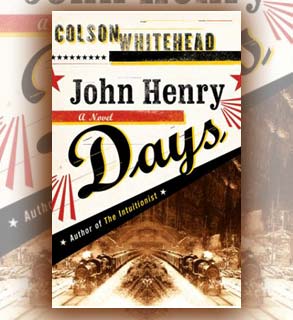
“John Henry Days”
In Colson Whitehead's dazzling follow-up to "The Intuitionist," a junketeering journalist pursues an American legend in an epic tale of man, machine and free drinks.
Colson Whitehead’s “John Henry Days,” the follow-up to his much — and quite rightly — acclaimed 1999 debut, “The Intuitionist,” is, by every standard, a big book. For one, there’s Whitehead’s hulking talent, the potential of which buzzed through “The Intuitionist” with the voltage of a city power line; for another, there’s the novel’s outsize subject matter, which is more or less America, the epic idea of which Whitehead chases with the dogged ambition of a Lawrence or DeLillo. And, on the simplest level, there’s the novel’s overstuffed, 389-page girth. Writers tend to shrink back with their sophomore efforts, having thrown kitchen sink and all into their long-gestated debuts, but with “John Henry Days” Whitehead took the opposite tack — there’s enough debris for seven or eight lesser novels whirling ’round Whitehead’s funnel cloud.
At the novel’s vortex, with hammer in hand, stands John Henry, the semi-mythical 19th-century black railway worker whose triumphant race against a steam-powered drill cost him his life but transformed him into American folklore’s lushest metaphor — that of mankind’s noble if futile struggle against the soullessness of machinery. Orbiting John Henry’s story — thinly but marvelously told — are a panoply of others, the most essential of which concerns J. Sutter, a black freelance journalist too jaded “to pretend that there is anything but publicity,” who’s been reduced to covering, for a cheesy travel Web site, the cheesier unveiling of a commemorative postage stamp in a small West Virginia town.
Like John Henry, who the postage stamp honors, J. is engaged in a race of his own: He’s trying to smash a dubious record for attending press junkets, having made it to at least one per day for the last three months, a jag he is “too unwilling or too scared to break.” Not unlike blasting railroad tracks through mountains, this line of work entails its own physical hazards — one of J.’s fellow junketeers, for instance, lost an eye to a finger, Stooge-style, while leaping for a free cocktail, and J. himself comes perilously close to a very real if also metaphorical end when he chokes on a “stern and vengeful” plug of gratis prime rib.
These contrapuntal narratives, with their chafing together of the Industrial and Information Ages, are almost always pitch-perfect. Whitehead, a former television critic for the Village Voice, brings a serrated wit to his depiction of the junketeering life; his wickedly precise portrayal of a Manhattan publishing party — with its clinking glasses and banal, disjointed chatter — shudders with a grandly satiric frisson. But Whitehead, pendulating between John Henry’s feats and J.’s, never once settles for an easy, false nostalgia; hero and hack walk side by side through their paralleled worlds, equals in their fight against their respective mountains. As another character puts it: “We make our own machines and devise our own contests in which to engage them.”
Less perfect — and what fainter criticism there is I do not know — are the stories festooning the novel’s periphery: stories of briefly glimpsed bluesmen, folklorists, songsters, stamp collectors, hoteliers, even Paul Robeson; stories of lives touched, however softly, by John Henry’s legacy. Darting in and out of the novel, these flyaway tales alternately rev and sputter the narrative engine. The oblique light they shed on Whitehead’s central metaphor isn’t always revelatory, but then the metaphor itself isn’t exactly revelatory, either. As a young J., upon first hearing about John Henry in grade school, longs to ask his teacher: “Mrs. Goodwin, if he beat the steam engine, why did he have to die? Did he win or lose?” In Whitehead’s extraordinary hands, a nation is contained in that question.
Jonathan Miles, a contributing editor at Men's Journal, writes regularly for Salon Books. More Jonathan Miles.
“People Who Eat Darkness”: The disappearing blonde
A true crime story set in Tokyo illuminates the complicated truths behind media cliches
Joji Obara and Lucie Blackman (Credit: Estate of Lucie Jane Blackman) Lucie Blackman, 21, went out for the afternoon in 2000, phoning her roommate and best friend Louise to arrange a meeting later that night. Lucie never showed up, and within a few days she’d become one of those vanished blondes whose fates fuel headlines and hours of speculative media coverage. She was British, a former flight attendant, and she and Louise were living in Tokyo. They were also bar hostesses, a profession with a very specific meaning in Japan, difficult to explain to foreigners and not entirely clear to the Japanese themselves. Lucie both did and didn’t match the classic Missing Blonde profile, and for a while the mystery of what happened to her threatened to lapse into permanent obscurity.
Continue Reading Close
Laura Miller is a senior writer for Salon. She is the author of "The Magician's Book: A Skeptic's Adventures in Narnia" and has a Web site, magiciansbook.com. More Laura Miller.
Corporate criminals gone wild
The maker of the documentary film "Inside Job" has a new book excoriating Wall Street -- and President Obama
A detail from the cover of "Predator Nation" “Inside Job,” Charles Ferguson’s Oscar-winning documentary film on how government, Wall Street and academia colluded to deliver us the worst financial crisis since the Great Depression, made a powerful case that something was very very rotten at the heart of the American political/economic nexus. His follow-up book, “Predator Nation: Corporate Criminals, Political Corruption, and the Hijacking of America,” can be considered the legal brief that dots every “i” and crosses every “t” in his argument. A tightly argued, profusely footnoted and deeply enraged castigation of everyone involved, “Predator Nation” isn’t just a factually unchallengeable account of how Wall Street blew up the global economy. It’s a denunciation, a call for justice and a warning: After getting away with the crime of the century, Wall Street still isn’t satisfied.
Continue Reading Close
Andrew Leonard is a staff writer at Salon. On Twitter, @koxinga21. More Andrew Leonard.
Can you identify?
Science shows that the only way around some readers' prejudices is to trick them
(Credit: Shutterstock/Salon) The news of recent research documenting how readers identify with the main characters in stories has mostly been taken as confirmation of the value of literary role models. Lisa Libby, an assistant professor at Ohio State University and co-author of a study published in the Journal of Personality and Social Psychology, explained that subjects who read a short story in which the protagonist overcomes obstacles in order to vote were more likely to vote themselves several days later.
The suggestibility of readers isn’t news. Johann Wolfgang von Goethe’s novel of a sensitive young man destroyed by unrequited love, “The Sorrows of Young Werther,” inspired a rash of suicides by would-be Werthers in the late 1700s. Jack Kerouac has launched a thousand road trips. Still, this is part of science’s job: Running empirical tests on common knowledge — if for no other reason than because common knowledge (and common sense) is often wrong.
Continue Reading Close
Laura Miller is a senior writer for Salon. She is the author of "The Magician's Book: A Skeptic's Adventures in Narnia" and has a Web site, magiciansbook.com. More Laura Miller.
“The Aleppo Codex”: The bizarre history of a precious book
A reporter traces the shadowy fate of the definitive version of the Hebrew Bible
Matti Friedman An ancient and priceless book, a murky history of evasions and coverups, an underground of sinister and possibly violent dealers, a former spy who drops tantalizing hints and a wily 84-year-old millionaire who says stuff like, “The problem with this story is that it could damage your health”: Are these the ingredients for a cheesy, improbable historical thriller? Yet “The Aleppo Codex,” Matti Friedman’s account of his attempts to learn the history of one of the world’s most precious books, sports all of these assets, and it’s nonfiction. If reporting this story damaged Friedman’s health, it probably happened when he realized what he’d stumbled into and his reporter’s heart started beating in doubletime.
Continue Reading Close
Laura Miller is a senior writer for Salon. She is the author of "The Magician's Book: A Skeptic's Adventures in Narnia" and has a Web site, magiciansbook.com. More Laura Miller.
Augusten Burroughs: Conquer trauma by letting it go
Salon exclusive: The best-selling memoirist says past horrors haunt us because we think about them too much. Stop
Augusten Burroughs Many people continue to feel influenced and even controlled by the things that happened to them a long time ago. Sometimes, people harbor dark, traumatic memories from childhood. Or fragments of memories — incomplete scenes, uncomfortable feelings, perhaps even a sense of certainty that something specific and terrible happened to them, but little more than this.
Others experienced something traumatic in adulthood that continues to affect them day to day many years later. Maybe an assault has left a person afraid to leave their home or enter a particular neighborhood.
Continue Reading CloseAugusten Burroughs' many books include "Runnning With Scissors," "Dry," "Sellevision," "Magical Thinking" and "Possible Side Effects." His latest book is "This Is How." More Augusten Burroughs.
Page 1 of 984 in Books