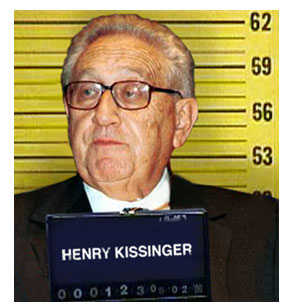

Christopher Hitchens

Wanted

If Henry Kissinger isn't guilty of war crimes, no one is. A Vietnam War whistleblower on Christopher Hitchens' case against the former secretary of state.

“It is the lack of (Albert Speer’s) psychological and spiritual ballast and the ease with which he handles the terrifying technical and organizational machinery of our age which make this slight type go extremely far nowadays. This is their age; the Hitlers and Himmlers we may get rid of, but the Speers, whatever happens to this particular special man, will long be with us.”
— London Observer, April 9, 1944

“The attack of bombardment, by whatever means, of towns, villages, dwellings, or buildings which are undefended is prohibited.”
– Article 25, The Hague Convention, 1907

Henry Kissinger was a lightning rod for Vietnam War opponents from 1969 to 1975, when he served as national security advisor and secretary of state to Presidents Nixon and Ford. A quarter century after Kissinger left public service, the United States is still picking at the scars of Vietnam and grappling with the global resentments sparked by his realpolitik policies. And yet, despite a whiff of ignominy that still clings to him, Kissinger has grown jowly and prosperous off his connections and consulting services, and is feted in the most exclusive salons of Manhattan and Washington. His guttural pronouncements can be heard whenever there’s a global crisis that needs explanation.

But some of us will never forget the Kissinger of the 1970s.

Several times a month, as I shave, I find myself looking deeply into my eyes — and remembering theirs. It took a lot to create that haunted and broken look in the eyes of the peasants who had fled the Plain of Jars in northern Laos. I interviewed hundreds of these refugees from the illegal Nixon-Kissinger air war while working as a journalist and interpreter for TV reporters like Ted Koppel and Bernard Kalb between September 1969 and February 1971. I dispatched tapes of these interviews and photos to congressional committees in Washington and later appeared before a hearing chaired by Sen. Ted Kennedy. But while my efforts helped generate a flurry of attention for the victims of the illegal Laos air war — the most brutal and sustained bombing campaign against a civilian population in history — no one from the Nixon administration was ever brought to justice as a result.

They had names, these people: Thao, Bounphet, Khamphong, Loung. They had treasured wives and husbands, children and grandparents, buffaloes and homes, rice fields and temples. And they had dreams — and as much right to these dreams as did any of the U.S. leaders who obliterated them.

It was a wrenching experience to hear these kind, decent human beings describe the extermination of revered grandmothers, burned alive by napalm before their eyes, to hear them weep as they remembered seeing a beloved 3-year-old daughter torn apart by anti-personnel bombs. Many of the children who survived carried the marks of the U.S. air war, burned flesh, missing limbs.

These people had voices, too, although they were rarely heard back in the United States. I collected their stories in a book called “Voices From the Plain of Jars.” In it, one 33-year-old woman recalled, “We lived in holes to protect our lives. There were bombs of many kinds. I saw my cousin die in the field of death. My heart was most disturbed and my voice called out loudly. (The airplanes came) until there were no houses at all. And the cows and buffalo were finished. Until everything was leveled and you could see only the red, red ground.”

The Nixon-Kissinger holocaust from above continued to afflict the peasant populations of Southeast Asia until the end of the war. Although these two remorseless executioners were finally forced by the growing antiwar fervor at home to withdraw U.S. ground troops, they vastly expanded their bombing operations across Vietnam, Laos and Cambodia. Their goal was not, as they claimed, to protect the American troop withdrawal. The North Vietnamese would have happily escorted U.S. troops out of the country. Rather, Nixon and Kissinger used the bombing to prop up local regimes and avoid being seen as responsible for “losing” Indochina.

It is important to separate the way the air war was conducted from the politics on the ground. Even if one believes U.S. support for local Indochinese regimes was warranted, this in no way justified the indiscriminate U.S. bombing that decimated hundreds of villages in violation of the most basic laws of humanity and international justice. Nor is it true, as Kissinger claims, that his bombing was supported by Congress. This supremely cunning man orchestrated an extraordinary coverup of the extent of civilian casualties. Had the full human consequences of the air war been brought before the American people, it’s likely that support for U.S. bombing would have quickly evaporated.

Nearly 4 million tons of bombs were dropped on the people of Southeast Asia while Kissinger orchestrated the war, over 1 million tons more than was dropped during the presidency of Lyndon Johnson and twice the tonnage dropped on all of Europe and the entire Pacific theater in World War II. More than 1 million Indochinese perished and 10 million were wounded and made homeless.

Kissinger executed this massive aerial assault without any serious regard for the civilians below, as I discovered in an investigation of the bombing of Cambodia in the spring of 1973. On a research mission for Washington’s Indochina Resource Center, I spent a day flying over a Khmer Rouge-controlled area that the U.S. Embassy estimated was inhabited by 2 million Cambodians without seeing a single sign of life. I had hitched a ride with an old acquaintance from Laos who was piloting a plane on contract for the CIA, dropping supplies to outposts of pro-U.S. Cambodian troops. He told me the people were hiding from the American bombing — particularly the B-52s, which indiscriminately obliterated areas the size of football fields from 30,000 feet — and that there was little if any evidence on the ground of legitimate military targets.

I used the pilot’s radio the next day to listen in on raids, and discovered that U.S. pilots bombing Cambodia neither knew, nor checked with anyone to discover, if there were civilians in the area. Later I was informed by the U.S. Air Force “bombing officer” at 7th Air Force Headquarters in Nakhorn Phanom, Thailand, who was officially charged with making sure that no civilian targets were bombed, that in reality he only certified that no CIA teams were in areas under bombardment. He said he had no idea if civilians were present.

This wanton bombing of civilian populations was a direct violation of international law. And it is this wholesale slaughter of noncombatants that Christopher Hitchens cites in making his strongest case for the prosecution of Henry Kissinger as a war criminal in his provocative new book, “The Trial of Henry Kissinger.” (Hitchens interviewed me for the book, distilling my reports into a two-page discussion of the bombing of Laos.)

Hitchens’ book originated as a two-part essay in Harper’s magazine in February and March 2001. The Harper’s essay stirred no investigative interest in official Washington or corporate media circles, as did the recent Bob Kerrey revelations. But Hitchens did succeed in provoking a lively reassessment of Kissinger’s record on the Internet and in campus forums. His book deserves much wider attention. If former Sen. Bob Kerrey’s actions as a young Navy commando in Vietnam momentarily pricked the national conscience, Kissinger’s Southeast Asia policies should haunt us to our graves if we do not come to terms with them.

If killing hundreds of thousands of innocent peasants by dropping million of tons of bombs on undefended civilian targets is not a war crime, then there are no war crimes. If Kissinger is not responsible for these crimes, then there are no war criminals.

Hitchens does not confine his case against Kissinger to the bombing of Indochina. He also focuses on the dark arts of Kissinger diplomacy, the aiding and abetting of murderous U.S. client states, such as the Pakistani regime whose violent repression of Bangladesh in 1974 resulted in the deaths of between 500,000 and 3 million people, the blood-soaked junta led by Augusto Pinochet in Chile and the Indonesian generals who killed 200,000 civilians in East Timor.

There is no question that Kissinger’s support for such savage regimes will stain his name for many years to come. But it would be more difficult to indict Kissinger as a war criminal for these actions — since other powers ordered the actual killing — than for his actions in Indochina. There he was a prime architect of the massive bombing of undefended civilian targets. And international conventions endorsed by the U.S., such as the 1907 Hague convention quoted above, unambiguously forbid such bombing.

Not surprisingly, Kissinger shares few of Hitchens’ concerns in his new book, “Does America Need a Foreign Policy?” which largely ignores Vietnam, Indonesia, Chile and many other Cold War battlegrounds to which he once devoted so much time. But Kissinger and Hitchens do share an interest in one subject: the Pinochet case, that is, the extent to which jurists in one nation have international jurisdiction over officials who have committed human rights violations in another. Writing of Spain’s indictment of the former Chilean dictator on torture and murder charges, and his subsequent detainment in England, Hitchens notes that “Kissinger [has grasped] what so many other people did not: that if the Pinochet precedent became established, then he himself was in some danger.”

Indeed Kissinger does seem worried when he addresses the subject in his book: “If the Pinochet case becomes a precedent, magistrates anywhere will be in a position to put forward an extradition request without warning to the accused and regardless of the policies that the accused’s country might already have in place for dealing with these charges.”

Fortunately for Kissinger, in his case, “the accused’s country” has no such policies for dealing with the mass murder of civilians in Indochina. Not only are there no official means for dealing with Hitchens’ charges against him, but he is lionized by the highest sectors of American society. As Hitchens notes, Kissinger is paid between $25,000 and $30,000 a speech and has grown wealthy by offering advice to Fortune 500 companies and catering to foreign clients like the Chinese dictatorship. His opinions are sought by Newsweek and the Washington Post; his new book is a Book of the Month Club selection. Kissinger’s status tells us less about himself than it does about our society as it begins the 21st century.

Only a nation in deep spiritual and psychological disarray could honor a man with as much blood on his hands as Henry Kissinger. An entire generation was plunged into a moral abyss during the Vietnam War from which it has yet to emerge. This moral confusion was on stark display during the recent public agony over Bob Kerrey’s wartime actions. Under what circumstances, if any, is it permissible to kill civilians? Should America ever engage in wars where military enemies and civilians cannot be separated? The fact that we are still struggling with these questions decades after we fled Vietnam shows how deeply unresolved they still are.

It is not necessary, however desirable, to say we were wrong in intervening in Indochina, or even to admit that we were responsible for the vast majority of the war’s casualties. But we refuse at our peril to at least take responsibility for the millions of casualties we certifiably did cause, and seek to make amends to the relatives of those we killed. The Germans did so after World War II, not so much for the Jews as for themselves. Our failure to do so harms our society no less than that of the Indochinese.

Kissinger’s new book highlights the central problem facing America today: the rise of a skilled but unfeeling class that has ascended to the heights of power as the new century begins. Kissinger’s stance is that of the technocrat, above party and ideology, unselfishly pursuing the national interest. “On the left, many act as if America has the appropriate democratic solution for every society regardless of cultural and historical differences,” he writes. “On the right, some believe … that the solution to the world’s ills is American hegemony. Either interpretation makes it difficult to elaborate a long-range approach to a world in transition.”

But what exactly is the nonideological “long-range approach” we need? Kissinger never really says. His book is essentially a foreign policy travelogue, as he proceeds region by region around the world describing a variety of short-term issues — supporting missile defense here, sanctions against Saddam Hussein there — and making countless observations of stupefying banality. Even more striking than the vacuity of what he does say, however, is what he does not. America’s top foreign policy imperative for the coming century is clearly to lead an international effort to save a biosphere now seriously threatened by global warming and other environmental ills. Kissinger gives the tersest of nods to this monumental global challenge, bundling it together with a hodgepodge of “New Age issues: proliferation, environmental, cultural and scholarly exchange, among many others.”

It is almost banal to note Kissinger’s banality. But his unique mixture of emptiness and celebrity, power and amorality, mystique and lack of principles, has made him one of the quintessential figures of the post-World War II era — fulfilling the prediction made by the London Observer 57 years ago.

In the past we had most to fear from charismatic tyrants. Today it is the technocrats, the “slight types” who efficiently run our government and dominate our age. It is the Dick Cheneys, who manage our withdrawal from the Kyoto treaty on global warming and cut spending on conservation; the Donald Rumsfelds, who lead the charge for missile defense and space war and disturb the world’s nuclear equilibrium.

With his unparalleled talent for bureaucratic intrigue and media manipulation, Henry Kissinger was among the first of these types to attain power in the post-war world.

He will not be the last.

Fred Branfman can be reached at Fredbranfman@aol.com. His Web site is www.trulyalive.org.

I knew Christopher Hitchens better than you

Every writer who had a drink with Hitch has now told his story. But even Rushdie and Amis didn't know him like this

Christopher Hitchens. (Credit: AP/Chad Rachman)

Christopher Hitchens and I were friends for 40 years, plus another five when we were enemies. He took ideas so seriously that if he disagreed with you on a matter that he deemed important, he’d literally throw you in a ditch. It was 1972, the height of our mutual virility. He and I went to a pub to celebrate his most recent intellectual victory over the establishment press. I intimated that sometimes women could be funny on purpose. Even back then, the thought enraged him. Hitchens threw a drink in my face, pressed a lit cigarette into my neck, and hit me over the head with a barstool. The next thing I knew, it was two days later and I was lying hogtied and naked beside the M5. Hitch had already severely damaged my reputation in a vicious essay in the Guardian. But that’s how he operated, and that’s why we loved him.

University, as you know, is the only time in one’s life when anything really worthwhile happens. I met Hitch there. The first time I saw him, he had a bird on each arm and a woman by his side. She beamed as he read aloud passages from “Homage to Catalonia.” He looked up.

“Who the hell are you?” he said.

“I’m your housemate,” I said.

“Are you in favor of the war in Vietnam?”

“Of course not.”

Hitch put down the book and took a swig of cheap Scotch.

“Good,” he said. “Because I refuse to fraternize with men who are afraid to be intellectual heroes.”

In the annals of history, only Orwell, Voltaire and maybe a half-dozen other guys could match’s Hitch ideological bravery and breadth of political knowledge. In 1977, after I’d returned to his graces by aiding him in a plot to assassinate Henry Kissinger’s character, Hitch and I visited Borges’ library in Buenos Aires. At the time, Hitch was working for the KGB while pretending to work for the BBC, and I was working for the Mossad while pretending to work for Burger King. But our many identities were merely covers for our lives as political writers at low-paying magazines.

Borges invited Hitch and me into his home, fed us tea and empanadas, and launched into a seamlessly brilliant discourse on surrealism in Latin American history. He talked for 30 minutes without stopping, during which time Hitch smoked six-dozen cigarettes. When Borges finished, Hitchens paused, spat in his ashcan, and said,

“Of course, you know, you’re wrong about everything.”

He then proceeded to refute Borges, point for point, until he reduced the blind scribe of Buenos Aires to tears.

No one loved ideas more than Hitch.

Much ink has been spilled, of course, about the legendary friendships Christopher forged with other writers throughout his life. For a time in the 1980s, he, Martin Amis, Salman Rushdie and I lived together in London. Hitchens rented us a six-story flat so we could swap partners more easily. Many was the time we passed the bottle until dawn, bemoaning Thatcher’s England, Reagan’s America, and also some stuff about the Middle East. Sometimes Hitchens would bring over a dissident writer who was fleeing oppression in his native country, and we’d all make fun of Mother Teresa and Princess Diana, then remove our pants to compare our manhoods. We were so middle-aged and foolish then, so committed to the struggle.

Hitchens spoke out against war, and also for war. In a span of five years, he bore witness to the fall of the Berlin Wall, the explosion of the Eiffel Tower, and the construction of the new holographic Eiffel Tower. He had acid in his pocket, acid in his pen and acid in his veins. Then Darkness fell, on Sept. 11, 2001. We’d all moved to America and gotten totally rich.

Hitchens changed that day. For months, he’d wander the streets at night, looking to drunkenly berate someone who disagreed with him about the evils of Islamofascism. Occasionally he’d attempt to strangle young journalists, who admired him unquestioningly, with their own neckties. But he was right. He was always right. Even when he was wrong.

The night they killed Osama bin Laden, he showed up at my apartment, drunk but lucid, quoting T.S. Eliot, Longfellow and, of course, himself. We stayed up watching CNN, which was actually pretty boring. In the morning, over a breakfast of corn flakes and whiskey, I said, “Well, I guess that’s the end of Islamofascism. Good job!”

Hitchens went into my kitchen, took a cutting board off the counter, and threw it into my forehead, drawing blood.

“Don’t be an imbecile,” he said. “The struggle never ends. Also, you must remember that there is no God.”

I needed four stitches that day. Hitch put them in himself, with his teeth. What a friend he was.

Rest in peace, dear man.

Continue Reading Close

Neal Pollack is the author of the literary satire "The Neal Pollack Anthology of American Literature," among other works of fiction and nonfiction. His latest book, a historical novel called "Jewball," was published in October.

Hitchens, gossip columnist of genius

The famed atheist and Vanity Fair writer was more concerned with self-promotion than actual ideas

(Credit: Reuters/Shannon Stapleton)

“In lapidary inscriptions a man is not upon oath,” Samuel Johnson remarked. Even so, claims that the world has lost a major thinker and great writer in the late Christopher Hitchens go beyond the mild flattery that is appropriate in obituaries and call for correction. The rule de mortuis nil nisi bonum does not apply to those who take part in public life or public debate; their deaths provide the most appropriate occasions to evaluate their significance and their legacies.

My assessment of Christopher Hitchens is not colored by any personal conflict with him. On the contrary, my few interactions with Hitchens were friendly. In 1995 he wrote a favorable review of my first book, “The Next American Nation,” in the New York Times Book Review, and thereafter invited me to drinks at a Washington bar several times. Some claim that he was a fascinating conversationalist, but as I recall he showed no interest in ideas and preferred to peddle gossip about politicians and journalists and authors, until I found opportunities to excuse myself. Gossip, like alcohol, is safely consumed only in small quantities.

He invited me to a dinner at his Washington apartment, where he introduced me to his friend Sidney Blumenthal, the journalist who had become an aide in the Clinton White House. Blumenthal and I discovered that Hitchens was remarkably ignorant of American history for someone who earned money writing about American politics. We spent much of the evening explaining the differences between Whigs and Jacksonians to the British expatriate, and I was not surprised that reviewers found his later book on Tom Paine to be riddled with mistakes. That particular evening ended with Hitchens cornering me at the door on the way out with a boozy harangue about how he was going to come to the defense of David Irving, a right-wing British author who had been denounced as a Holocaust denier. I was grateful to escape.

When, soon afterward, as part of his self-publicizing campaign to save America from Bill Clinton during the impeachment crisis, Hitchens collaborated with Ken Starr and the Republicans in an effort to destroy his former friend Sid Blumenthal, I ceased to hear from him, perhaps because he correctly assumed that I thought his actions were deplorable. The last time I saw him was in New York about a decade ago. We were together on a panel at the New School and he muttered comments in order to attract attention to himself whenever another panelist was speaking.

Several years ago, a readers’ poll done as a joint publicity stunt by Foreign Policy and London’s Prospect Magazine elevated Christopher Hitchens to the title of the world’s leading intellectual. The poll was not only silly but also easily gamed, and in a succeeding year, thanks to votes by conservative Muslims, with wonderful irony, a Turkish Muslim cleric succeeded Hitchens as the world’s leading public intellectual.

But though he played one on TV, Hitchens was not an intellectual, if the word has any meaning anymore. Those known by the somewhat awkward term “public intellectuals” can be based in the professoriate, the nonprofit sector, or journalism. They can even be politicians, like the late Daniel Patrick Moynihan. But genuine intellectuals, as distinct from mere commentators or TV talking heads, need to meet two tests.

First, intellectuals need to produce some substantial works of scholarship, literature or rigorous reporting, distinct from the public affairs commentary for which they may be best known to a broad public. If you do nothing but review other people’s work or write brief columns or blog posts, it is easy to appear to be much smarter and erudite than you really are.

Second, genuine intellectuals base their interventions in public debate on the basis of some coherent view of the world. A dedication to rigorous and systematic reasoning, wherever it may lead, is what distinguishes intellectuals from lobbyists or partisan spin doctors who change their views according to the demands of a special interest or a party. It also distinguishes them from mere “contrarians” — the term Hitchens used to describe himself — who attract publicity by taking controversial stands according to their whims.

Hitchens left behind no substantial scholarly or literary work, and if he had any core principles or values they are hard to discern. He denounced the Gulf War and backed the Iraq War; he supported Bush, Cheney, Rumsfeld and Wolfowitz while continuing to insist that Henry Kissinger was a war criminal.

If he was not really an intellectual, then what was Christopher Hitchens? A decade ago, a British diplomat told me that he was astonished at the reputation Hitchens had attained in the U.S.: “In Britain we think of him as a gossip columnist.”

Quite so (as the British might say). He had more in common with Walter Winchell than with Walter Lippmann. A gossip columnist of genius, Hitchens escaped from the ghetto of little-known leftist writers when he discovered that he could become a celebrity by denouncing bigger celebrities. That strategy for self-promotion, in my opinion, explains his over-the-top attacks on Henry Kissinger, Mother Teresa, Princess Diana and Bill Clinton (Michael Jackson and Lady Gaga were spared the Hitchens treatment). When Princess Di and Mother Teresa died within a week of each other in 1997, I remarked to a friend, “I wonder what celebrity Hitchens will make a career out of denouncing now?” We soon found out: Bill Clinton and the biggest celebrity of all, God.

Were the ad hominem diatribes that Hitchens specialized in evidence of his moral integrity and political courage? On the contrary, TV producers and magazine editors love sensational trash talk about media “personalities,” including Jehovah. The philippics of Hitchens were calculated and successful career moves by a gifted publicity hound who spent the last part of his career, appropriately, at Vanity Fair, a magazine best known for models and actors on its covers.

Nothing could have been safer and less iconoclastic than for Hitchens, while on the left, to call Kissinger a war criminal, or, as a newly minted neoconservative, to smear critics of the Iraq War as appeasers of “Islamofascism,” a propaganda term used by the likes of Ann Coulter and David Horowitz. While Hitchens joined the American establishment in rallying behind George W. Bush, those of us who denounced the Iraq War from the beginning were an unpopular minority in Washington’s media and foreign policy circles, dominated as they were (and are) by neoconservatives, liberal imperialists and cowardly careerists with their fingers to the wind.

Hitchens was affirming rather than challenging an elite consensus when, on behalf of atheism, he mocked religious believers as not merely mistaken but contemptible and moronic. The religious are despised and dreaded by upscale Americans, and their British court jester could say what they dare not say themselves — although candidate Barack Obama came close in 2008, when he psychoanalyzed the white working class for the benefit of billionaire donors behind closed doors: “And it’s not surprising then they get bitter, they cling to guns or religion or antipathy to people who aren’t like them or anti-immigrant sentiment or anti-trade sentiment as a way to explain their frustrations.”

In recent years Hitchens managed to enlarge his celebrity among the college-credentialed lumpenintelligentsia by means of appearances on TV chat shows and the blimpish bellicosity that he brought to the cause of “the new atheism.” But what was so peculiar about his reputation was the extent to which it remained a secondary, derivative fame. To judge from interviews published now and then in middlebrow magazines, which I always read, when I found them, in the hope of learning why anyone would think that he was significant enough to be interviewed, Hitchens was famous for criticizing famous people and for being a friend of other famous people, including Salman Rushdie and the British novelist Martin Amis. He had it both ways in the cases of Gore Vidal and Edward Said, boasting for years of their friendship and then publicly sliming them—or so I gathered from the interviews. I find this sort of thing tedious, but evidently there is a market among editors and journalists for such backstage gossip, a market that was exploited by the master of the shared rumor and the vicious putdown.

The smarmy expatriate British journalist Peter Fallow in Tom Wolfe’s “Bonfire of the Vanities” is sometimes alleged to have been based on Hitchens, but others claim that the model was a certain Anthony Haden-Guest. The truth is that there have always been many Peter Fallows in Washington, New York and Los Angeles, from Malcolm Muggeridge a few decades ago to Niall Ferguson today. Most of these, even if they began their careers on the radical left, end up playing the stock character of the harrumphing Tory in their second careers in America. What the British comedian Michael Palin said of Muggeridge, who like Hitchens started on the left and ended on the right, applies to this type as a whole: “He was just being Muggeridge, preferring to have a very strong contrary opinion as opposed to none at all.”

A classic example of the Peter Fallow type is the now-forgotten Henry Fairlie. When I first came to Washington in the 1980s, Fairlie filled the role of snarky British pundit in D.C. that Hitchens later assumed with much greater success. In 2009 Hitchens wrote about him in the New York Times Book Review with a snide condescension that, coming from Hitchens, passed for generosity:

Henry’s closing years were not delightful ones: He ended up quasi-homeless and moved into the offices of The New Republic as an alternative to sleeping rough. He became a shameless borrower of money and unwelcome even in the less fastidious bars around Dupont Circle. I myself think that this indigence was the cause of some of his less admirable journalism: he had to cudgel phony opinions out of his weakening brain and frame in order to finance the next bender. Having partly succeeded him as the Washington correspondent of The Spectator, I caught him out making a slanderous allegation in print that was backed up, when challenged, only by an unimpressive piece of bluffing and blustering. Not long after that, in 1990, before we could even have a reconciling cocktail — and just after he had written an essay (reprinted here) that stole my idea for a satire of those who asked for Perrier water in bars only to demand a handful of Potomac water, in the form of ice cubes, to go with it — he took a bad tumble on his way back to his office/home and died, with distressing celerity, at 66. In the lives of many younger journalists, he had managed to fulfill the two great tutorial roles of enviable example and awful warning.

Christopher Hitchens wanted to be remembered as his generation’s George Orwell. But he was only its Henry Fairlie.

Continue Reading Close

Michael Lind’s new book, "Land of Promise: An Economic History of the United States", will be published in April and can be pre-ordered at Amazon.com.

The virtuoso

Christopher Hitchens was the most gifted rhetorician of his generation. His political judgment was another story

Christopher Hitchens

The first time I saw Christopher Hitchens speak was at a forum at U.C. Berkeley in 1989. I remember this somewhat disheveled Brit walking onto the stage and leaning over the lectern. There was something about him, a kind of languid, deliberate menace, that made me think of a boxer. Then he opened his mouth, and the most extraordinarily elegant invective I had ever heard flowed out. It was like watching a magician blowing a smoke ring that turned into a flock of birds – in Hitchens’ case they would be pterodactyls – that flew about in perfect formation for a while, then disappeared through the ceiling. I remember nothing about his speech except one phrase about the Bush I administration, which rolled off his tongue like a bite-size rhetorical bomb: “A Saturnalia of sycophancy and sadism.”

Any time someone who was the best at something dies, the world shrinks a little bit. It feels smaller today. One part of it especially feels smaller — the world of words. For Christopher Hitchens was a virtuoso of language. As a baby, Mozart supposedly could tell if a violin was microscopically out of tune. I imagine Hitchens lying in his crib, wailing because his mother did not use a subordinate clause in exactly the right way to modulate to her conclusion. He was a rhetorical freak.

Hitchens was one of the great contemporary masters of argumentative prose. He had an unerring sense of logical structure, a maniacally precise gift for the mot juste, a huge frame of intellectual reference, and – this is what really pissed me off as a fellow toiler in the syntactical groves – a seemingly automatic ability to write transitions. He could practically do it in his sleep. A pal of mine once saw him drink an entire bottle of scotch at a dinner party, excuse himself, go upstairs, and come down 45 minutes later having filed a letter-perfect piece. At the absolute top of my game, I might briefly be able to keep up that pace on a stretch of level argumentative ground. But at the first transition, the first time a new idea loomed up like a mountain that had to be navigated around, I would be broken down in the ditch while Hitchens would be speeding off at 100 miles an hour, as debonair as James Bond.

Hitchens was not only virtuoso, he was a fearless virtuoso with a mean streak. This is a scary combination. When he attacked someone, there would not usually be a lot of them left for their next of kin to pick up. But if his combative style was his trademark, he was also capable of writing meandering, discursive, thoughtful essays, pieces driven not just by animus or the desire to dominate but carried on their own imaginative and logical momentum. There was a lot of Mencken, Swift and Orwell in Hitchens, but a little Montaigne and Sir Thomas Browne as well. The man had a very large mind, and by all accounts a very large heart as well.

One large question mark hangs over Hitchens’ career. For 10 years, whenever his name comes up, people have asked the same question: Why on earth did Hitchens support the Iraq War? And why did he never recant, even after it had become obvious to all but blind ideologues that the whole thing had been a disaster?

I do not have any personal insight into these questions. I met Hitchens a few times, but did not know him. But it appears that it was precisely Hitchens’ big heart, combined with certain eccentricities of judgment peculiar to those former Marxists that Isaac Deutscher called “inverted Stalinists,” that may have led him to go ideologically off the tracks.

An insightful piece about Hitchens by Salon’s Washington bureau chief Jefferson Morley makes clear that Hitchens’ disenchantment with Marxism, and his increasingly (and ultimately problematic) tendency to see politics in deeply personal terms, were closely related. Like many former Marxists, Hitchens had grown weary of the mental contortions (aka the “dialectic”) required to justify Stalinist/Communist tyranny. Morley points out that for Hitchens, flying in the face of left-liberal orthodoxy to embrace victims of injustice, no matter who their oppressors were, became a touchstone for his own intellectual integrity and honesty. Thus, Hitchens – to the dismay of his colleagues at the Nation, but correctly in my view – agreed with Ronald Reagan that the Soviet Union was an “Evil Empire.” For Hitchens, just because the despised Reagan said something did not mean that it was wrong.

Hitchens’ insistence on taking principled stands, as in his ringing defense of his friend Salman Rushdie against the death sentence handed down by Ayatollah Khomeini, is admirable as far as it goes. The problem is that he took his principled stands to self-defeating extremes. He was so idealistic, so black and white, so Manichaean in his moral judgments, that he ended up supporting political positions antithetical to his own deeply held convictions. For the world of politics and power cannot be negotiated or defined or dealt with purely in ethical terms. It is a world of grays, of compromises, of ugly regimes that must be tolerated because the alternative is worse. Hitchens was so obsessed with moral principle that it distorted his judgment.

Hence his misguided support for the war in Iraq. On the most crucial political and moral issue of our time, Hitchens took the wrong side. His friend Tom Luddy once told me that Hitchens supported the war simply because he was passionately opposed to fascism, no matter what form it took or where it was found. No one could argue with this. Hitchens also had many Iraqi and Kurdish friends who had suffered under Saddam Hussein’s tyranny, and whom he stood up for. Again, no one would argue that he was not right to do so.

But, of course, there is a world of difference between being opposed to Saddam’s fascism (and contrary to Hitchens’ specious neologism, there was nothing “Islamo” about Saddam’s fascism – he was just your garden-variety Stalinist monster) and supporting an unprovoked invasion that was likely to make things much worse.

I covered two debates between Hitchens and the journalist Mark Danner – one just before the war, one nine months after it began. In both debates Danner argued that war was too risky, while Hitchens asserted that war was both necessary and morally justified because Saddam was evil and dangerous. What was striking to me, particularly in the second debate, was both Hitchens’ moral fervor, and the weakness of his substantive arguments about the threat Saddam posed. Twice, he made flat assertions about the link between Saddam and al-Qaida-like jihadists (“There was and there is a Hitler-Stalin pact between the forces of jihad and the forces of Baathist totalitarianism”) that were simply false.

How could someone as knowledgeable as Hitchens embrace such sophistical arguments? And even if we give him a pass for supporting the war in its early days, after it turned into a bloody nightmare, why didn’t he acknowledge he had been wrong?

I suspect the answer has to do with Hitchens’ earlier Marxism. It is hard to escape the conclusion that at some level, Hitchens was indeed an “inverted Stalinist”: a former True Believer who simply transferred the rigid idealism of his old cause into an equally rigid insistence on seeing all politics as a matter of personal morality. As Ian Buruma wrote in the New York Review of Books, for Hitchens, “politics is essentially a matter of character … Politicians do bad things because they are bad men. The idea that good men can do terrible things (even for good reasons), and bad men good things, does not enter into this particular moral universe.” There is much to admire in Hitchens’ moral stance, but it led him into some corners he found himself unable or unwilling to extricate himself from.

But it would be wrong to end this appraisal there – and not just because de mortuis nil nisi bonum (a phrase Hitchens would not have had to Google, as I just did.) He may have made mistakes, as we all have, but his life and work should not be reduced to his sometime political misjudgments. In all ways, Christopher Hitchens was a force to be reckoned with. He was a powerful thinker, a courageous journalist and a superb stylist. In a monochrome world, he was a true original. Somewhere in a heaven he did not believe in, they’re emptying a bottle of the good stuff tonight, and writing an angelic obit on deadline.

Continue Reading Close

Gary Kamiya is a Salon contributing writer.

When Hitch was wrong

He was disastrously wrong

Christopher Hitchens (Credit: Reuters/Shannon Stapleton)

The late Christopher Hitchens had the professional contrarian’s fixation on attacking sacred cows, and rather soon after his cancer diagnosis, he became one himself. I think he would’ve been disgusted to see too much worshipful treacle being written about him upon his untimely death, so let’s remember that in addition to being a zingy writer and masterful debater, he was also a bellicose warmongering misogynist.

Upon the death of the unlamented Earl Butz, Hitchens excoriated editors who published sanitized obituaries of a man remembered solely for a vulgar racist remark made in public. Hitchens leaves a rather more varied legacy, but it’s just as important not to whitewash his role in recent history.

There was no more forceful intellectual voice in support of the Iraq War than Hitchens. There were others who were more prominent, more influential or more persuasive, but Hitchens was the perfect shill for an administration looking to cast its half-baked invasion plans as a morally righteous intervention, because only he could call upon a career of denunciations of totalitarianism and defenses of human rights. (The fact that the war was supposed to be justified by weapons Saddam was supposedly developing didn’t really matter to Hitchens.)

And so we had the world’s self-appointed supreme defender of Orwell’s legacy happily joining an extended misinformation campaign designed to sell an incompetent right-wing government’s war of choice. The man who carefully laid out the case for arresting Henry Kissinger for war crimes was now palling around with Paul fucking Wolfowitz.

Once he became an unpaid administration propagandist, Hitchens, formerly a creature of left-wing magazines whose largest mainstream exposure was in Vanity Fair and occasionally on Charlie Rose, was suddenly on TV rather a lot. The lesson there, I think, is that the popular American mass media will make room for even a booze-swilling atheist Trotskyite if he’s shilling for a the latest war.

And to be honest, his post-9/11 conception of an epoch-defining clash of civilizations between the secular West and the jihadists is more than slightly ridiculous. The secular West faces any number of graver existential threats — like unaccountable too-big-to-fail financial institutions and climate change, to name two that immediately come to mind — than that posed by the less-than 1 percent of the world’s Muslim population that subscribes to Salafist jihadism. Hitchens, the old Orwell worshiper, clearly just wanted a great big generational threat to tackle fearlessly, with polemics attacking the sclerotic establishment liberals who failed to see that the world was at the brink of disaster. He was looking for his own Spanish Civil War. That’s why he insisted on arguing that “Bin Ladenism” was equivalent to fascism.

On other fronts: His Clinton hatred was something more hysterical than reasonable (his book on the subject has the Lifetime Television Movie-worthy title “No One Left to Lie To”) and his grand campaign for atheism involved a good deal of silliness as well (Bertrand Russell did the case against God earlier and better). He had an unpleasantly boorish attitude toward women, best exemplified by his embarrassing “why women aren’t funny” bullshit. (Hitchens, it should be noted, enjoyed puns rather a lot.) And let’s not forget his immortal review of Wanda Sykes’ White House Correspondents’ Association Dinner: “The black dyke got it wrong.” Positively Butzian.

To the end he refused to admit he was “wrong” on the war, because his justifications for it shifted endlessly. The invasion was a humanitarian intervention “on the right side and for the right reasons” in a 2008 piece, in which he found the space to note that “the largest wetlands in the region, habitat of the historic Marsh Arabs, have been largely recuperated,” but did not mention the war’s more than 100,000 casualties.

There was always something cartoonish about old “Hitch” the rakish intellectual character, puffing away on cigarettes and slurring bon mots in interviews, penning furious denunciations of hypocritical public figures while hosting salons and drunken parties at his Washington, D.C., apartment that some of the most powerful and prominent people in the world of politics and media attended. But his most monumental public crusade had devastating consequences that he never fully grappled with.

Continue Reading Close
Alex Pareene

Alex Pareene writes about politics for Salon and is the author of "The Rude Guide to Mitt." Email him at apareene@salon.com and follow him on Twitter @pareene

Hitch the apostate

As my time with the controversial writer showed me, his true religion was the renunciation of prior belief

Christopher Hitchens (Credit: Shannon Stapleton / Reuters)

It was Christopher’s idea to start a drinking club. We would call it the Osric Dining Society, he said, in honor of Osric, the unctuous courtier in Hamlet. He helpfully quoted several lines to illustrate the project. Hitch’s purpose (besides a night of drinking on someone else’s tab) was to skewer those in Washington journalism who flattered their way to the top. The year was 1986 and I knew Hitchens as a friend and columnist for the Nation magazine who lobbed corrosive broadsides at the New Republic where I worked. I thought the Osric Dining Society was a swell excuse for merriment. Anybody could attend, Hitch said, as long as they stood up to nominate one Washington journalist who excelled in what Hitch described as “the Osrician principles of flattery, deference and self-serving vacuity.”

So a couple of dozen liberal writers and reporters gathered in the backroom of a Connecticut Avenue restaurant to lampoon our fellow hacks and the perennially awful state of Washington journalism. Hitch, as master of ceremonies, rose to skewer not one but a half dozen famous scribes, impugning the likes of David Broder, John McLaughlin and Fred Barnes with obscene glee. Glass of amber fluid in hand, he spun out complex and hilarious scenarios involving fellatio, barnyard animals and Morton Kondracke, and the hangover was pleasurably punishing. When I told my boss, New Republic editor Michael Kinsley, about the debauchery the next morning, he sniffed, “Oh, Sid and Hitch feeling self-satisfied again?”

Kinsley had a point. Sid, of course, was Sidney Blumenthal, then a columnist at the New Republic, who was fast becoming Christopher’s best friend. What they shared, more than left-of-liberal politics and capacious self-regard, was ambition.  But while Sidney’s ambition was naked and sometimes obnoxious, Christopher’s was seductive and provocative. I think he realized he diminished himself a little by deprecating the Osrics of Washington journalism. If they were so dumb, how come they got on the Sunday morning chat shows and Hitch did not?

Christopher aimed to correct that mistake. By the late 1980s, he was spoiling for a fight with the left-liberal milieu in which we worked. I could tell he was becoming an apostate from socialism, at least in the forms that it actually existed in the world. As a longtime Trotskyite, he had spent too many dinner table conversations explaining away why real existing socialism had culminated in the walking corpse known as Leonid Brezhnev. Always a tireless traveler, Hitch would return to the Washington party circuit talking incredulously about “the comrades” in Eastern Europe who could not publish a book or a magazine article while living in cultural capitals like Prague and Warsaw.

Such sympathies did not always win him friends at the Nation, a publication with deep roots in the American communist movement that was adamantly opposed to Ronald Reagan and all that he stood for. While the Nationistas recoiled when Reagan called the Soviet Union an “evil empire,” Hitch admitted to me that he agreed. “It’s not evil like the U.S. in El Salvador,” he said, referring to the CIA’s role in sponsoring death squads. “But it is evil. Wouldn’t you think so if you lived there?”

This relentless casting of the political in terms of the personal was not a pose for Christopher. It was his path to fulfillment, to feeling he was living and writing honestly. Apostasy — the renunciation of prior belief — was becoming his religion. And in June of 1988, I think, he had a conversion experience.

That year, Hitch had introduced me to his friend Joanne Landy, who was running an organization called the Campaign for Peace and Democracy, which touted “détente from below” as the solution to the Cold War. Christopher told me, his eyes glimmering with intrigue, of a plan to take on the communist powers that be. The campaign was going to bring together Western anti-nuclear and peace groups with the leaders of underground  human rights groups from across the Soviet bloc for a meeting in Prague, he said. Did I want to come?

At the time, it was an audacious idea. The ideological rigidities of the Cold War, often mentally consigned to the 1950s, continued well through the 1980s in Washington in a way that now seems almost absurd. At the time,  Western leftists were not enamored with anti-communist movements, such as Poland’s Solidarity movement, regarding such forces as inherently reactionary, if actually pawns of the CIA. In the same way, Eastern European writers whom Christopher loved to discuss (especially Vaclav Havel and Lezek Kolakowski) sometimes mistrusted Western leftists, suspecting they might be apologists for the KGB. “It’s all rubbish,” Hitch told me. “They’re comrades.”

Landy’s plan was for delegations from the West to meet up in Prague with delegations from the East and issue a joint declaration of principles. To pay for the ticket to Prague, I wrangled an assignment from Rolling Stone to write a piece about the Plastic People of the Universe, a famous underground rock band that had been banned by the communists for their long hair, harshly beautiful music and complete rejection of socialist stupidity. Fortunately for me, the mother-in-law of the Plastic People’s bass player was a longtime dissident, and she was hosting the East-West summit of radicals  in her enormous ramshackle apartment.

We knew the authorities would break up any public meeting devoted to criticism of communism, so by means of furtive phone calls we contrived to gather for our first meeting. Some 30 people from a dozen countries listened as Jiri Hajek, who had served as the foreign minister during the Prague Spring of 1968, opened the meeting with a halting and eloquent plea for the creation of European Peace Parliament.  It was just like a bunch of liberals dreaming of a nuclear freeze on the Upper West Side — until someone started hammering on the door.

Glances were exchanged and our hostess finally said she had to see who it was. Several plainclothes policemen pushed their way in and insisted we had to disperse. Christopher demanded to see their ID. The leader, a grim-faced cop who didn’t like the looks of a bunch of intellectuals, showed his badge. Christopher demanded a warrant. The cops didn’t have a warrant and didn’t have any patience for this loud-mouthed Brit. “We are lawfully gathered and will not leave,” Hitch declared grandly. He denounced the cops for various violations of international law and for stepping on his shoes.

To no avail. Within about 15 minutes the cops had muscled the pudgy Hitch and the rest of us into the night without violence. Over the inevitable drinks afterward, I sensed Christopher brooding. He wondered if he should have taken a swing at the cop or least fallen to the floor and forced them to drag him out. He looked humiliated. When the dissident groups tried to meet again the next morning at another apartment, the police burst in again and didn’t bother to be polite. We were all arrested, taken to a police station, declared persona non grata, and forcibly expelled from the country — which improved Christopher’s mood immensely. “A badge of honor,” he told me.

To me that was the birth of Hitch the Apostate. He had always been an iconoclastic thinker in the Marxist tradition, but dissatisfaction with the whole enterprise of Marx propelled him to Prague and the glory of his arrest. A year and half later, the Berlin Wall fell, and the Soviet-style communism he dared to challenge in person was no more. Christopher felt vindicated in his break from socialism. His apostasy had served his ambition: to reach an audience larger than those who already agreed with him.

In the 1990s, his socialist worldview was defunct and so he became a liberal and an advocate of humanitarian intervention in the service of a Marxist-free internationalism. Escaping the leftist ghetto of the Nation, he landed in Graydon Carter’s penthouse at Vanity Fair. Always more convincing as a partygoer than a man of the people, he thrived as a writer and minor celebrity. He fell out with former friends like Blumenthal and Alexander Cockburn, I think, because their ambitions — to serve Bill Clinton and the international proletariat, respectively — seemed too limited.

On Sept. 11, Christopher became an apostate again, discovering a new  enemy — Islamist jihadists — and rejecting his former faith in a liberal international order in favor of bold action against an enemy of a free society. So while people would later accuse Christopher of “selling out” by supporting the U.S. invasion of Iraq in 2003, I always thought he was repeating the grand gesture of 1988. He wanted to put his body on the line against the enemy of a free society, and he wanted people to read about it.

I didn’t agree with him but I felt that he had come to his position about overthrowing Saddam Hussein honestly. Even in the 1980s, when Iraq barely existed in the American political conversation, Christopher spoke of his friends in Kurdistan and Iraq who had suffered from Saddam’s savagery.  After Sept. 11, he wanted to go to war against Saddam, not because it would land him in a TV studio or a right-wing cocktail party (though he regarded both results as condign) but because his Iraqi friends wanted to. I respected that. It was his new friends who were more worrisome. When he assured me, “Paul is a very smart man,” referring to his new pal Wolfowitz, I knew our days of amiable debate were over.

Christopher wound up doing what Wolfowitz and many a brilliant intellectual has done when he (and it usually it is “he”) becomes certain that his admirable goals justify organized violence: He made a stupid mistake. He supported a war that was a disaster for the people it was supposed to help. The model democracy that he predicted would emerge turned out to be a collection of violent factions whose aspirations for self-rule Washington constantly sought to manipulate for its own ends. The jihadists he sought to defeat gained a new battleground (and were only driven out when Gen. Petraeus bribed Saddam’s former allies to do the job for us). When democracy finally came to the Arab world in the awakening of 2011, its partisans were peaceful and — Hitch’s feeble arguments notwithstanding — virtually none of them cited Iraq or Bush as inspiration.

His penchant for apostasy found much more winning expression in his 2007 atheist manifesto, “God Is Not Great.” The nature of belief, not geopolitics, was his strong suit. That’s why I was moved by the passage in his autobiography, “Hitch-22,” where he recounted the story of a young man who had been inspired by his arguments about Iraq to enlist in the U.S. military. After the young man was killed in action, his parents invited Hitchens to a memorial service, which he attended with a combination of honor and humility.

Some might say that Christopher was a warmonger who had helped send this person to a meaningless death. But if the young man’s parents did not think so, how could anyone else? Politically, I thought Christopher’s ambitions in Iraq were dangerous, but as a writer I could not begrudge them. He aimed to move his readers to believe, not in superstition, but in their ideals. For better and worse, he succeeded.

Elsewhere in “Hitch 22″ I looked forward to his account of our long-ago meeting in Prague.  I was disappointed to find only a dismissive line. What had been a memorable and inspiring episode for me stuck in his mind as mostly the equivalent of a boring dinner party — which gave me some insight into the scale of the life he had achieved. He wound up as one of those confident Washington pundits whom younger writers loved to loathe. But for all his ambition I think he stayed true to the ideals of the Osric Dining Society. He might have been wrong but he never resorted to flattery, deference or self-serving vacuity.

Continue Reading Close
Jefferson Morley

Jefferson Morley is a staff writer for Salon in Washington and author of the forthcoming book, Snow-Storm in August: Washington City, Francis Scott Key, and the Forgotten Race Riot of 1835 (Nan Talese/Doubleday).

Page 1 of 9 in Christopher Hitchens

www.salon.com/topic/christopher_hitchens/