
Sex
It was 4,000-to-1
With the ratio of guys to gals at Pearl Harbor, the film should have dealt a bit more with what must have been going on.
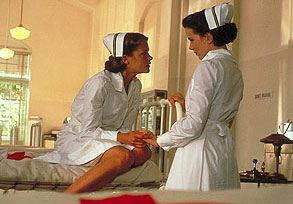
The immense dullness that is called “Pearl Harbor” (opening next week) left me with one thought to puzzle over. One of the leading characters in this story (though it is an act of enormous generosity to use the word “character” with this film) is an attractive young military nurse (nearly all the figures in this story are attractive, young and empty). With a group of other young nurses, she arrives in the general vicinity of Pearl Harbor early in 1941. Of course, we can’t help knowing what’s coming. But this handful of cheesecake is impressed only by the legion of sailor boys lined up to look at the new girls in town.
There’s a little bit of dialogue in which the nurses work it out that the ratio of horny guys to acceptable skirt is about 4,000-to-1. And since, later on, this is a movie that gets the Pearl Harbor casualties figures correct, I see no reason to challenge those numbers. If you’re spending close to $200 million on a movie (and if you’ve made all the obvious savings on the script, director and actors), you can surely afford a little research.
So no one would be amazed if a couple of these nurses discovered their true calling and began to embark on a system of full physical examination of as many of the boys as possible. Nor would it seem out of place if the essential desert-island lassitude of Hawaii in 1941 (with most of the Americans certain they were beyond being attacked) were undercut with an intense pursuit of sex. What are that warmth, the humid air, the beaches and the tropic air for? Why does America garrison such a paradise if it’s not for the young men to have an opportunity to learn about sex?
I thought of “From Here to Eternity,” a modest film version of the James Jones novel, which is now nearly 50 years old. It was made when censorship was as strict as any military discipline. Donna Reed isn’t named as a whore in that film. But she’s one of several attractive, pliant young women hired on as hostesses in a Honolulu club frequented by soldiers Frank Sinatra and Montgomery Clift. Clift falls for Reed, and while nothing more than kissing was shown in that movie, there was never any doubt about the sex that was being had. And then there was the Burt Lancaster-Deborah Kerr affair, and their splendid roll in the surf. The novel is a lot rougher, but the movie did a pretty good job for its day at admitting the need for sex, the boredom with the war and the ordinary man’s contempt for the military system.
The truly startling, horrendous thing about “Pearl Harbor” is its unflawed, gung-ho support of all things military, its unironic patriotism and its flinching from sex. These nurses have boyfriends — our heroine has two! I am not just complaining about the monotonous refrain of clichés in Randall Wallace’s script, the wooden simplicity of Ben Affleck and Josh Hartnett or the amazing immaturity and indifference to human beings exhibited by director Michael Bay. Nor do I mean to make a mountain of a film made in 2001 that prefers to ignore all thought of the political intrigue that may have lurked behind Pearl and the business of getting America into the war.
No, the thing I find most striking and alarming is the honest notion that all the “characters” were simply and completely dedicated to the idea of serving their country, their flag and their uniform and the subsequent idea that no one was ever intent on surviving or getting his and her rocks off.
“From Here to Eternity” was written by a rugged, recalcitrant, independent human being who, grudgingly, was there at Pearl on the day it was bombed. “Pearl Harbor” is made by and inhabited by people who have no independence, who have never been anywhere and who would rather stand as stuffed patriots tossed around by special-effects explosions than face the challenge of thinking for themselves.
David Thomson is the author of "A Biographical Dictionary of Film" (new edition just published), "Rosebud: The Story of Orson Welles" and "In Nevada." More David Thomson.
Massage therapists rubbed wrong by sex talk
A Jennifer Love Hewitt show and the Travolta allegations have masseuses tired of being confused for sex workers
(Credit: iStockphoto/sybanto) Joe, a licensed massage therapist, knows what it’s like having a famous client who expects something extra. He had an Academy Award-winning actor begin gyrating on his massage table before raising his hips in the air to show off his erection. “He was hoping that I would play with him in some shape or form,” he says.
Needless to say, Joe isn’t surprised by allegations by two masseurs that John Travolta got handsy during massages. (Travolta’s attorney has denied all the allegations, and called them “ridiculous.”) “It happens all the time,” he says, and not just with celebrity clients. He frequently encounters men who try to fondle him, usually while he’s working on their glutes or lower back and their hand happens to be level with his crotch. “They think they’re so original, but they’re all so much the same,” Joe says, his voice rising. “They all use the same tactics, the same body movements, the same gyrations and grinding my table, the [heavy] breathing.”
Continue Reading Close
Tracy Clark-Flory is a staff writer at Salon. Follow @tracyclarkflory on Twitter. More Tracy Clark-Flory.
A night at the vibrator museum
Early vibrators were hand-cranked, two-person jobs -- and prescribed by doctors. How far we've come since then
(Credit: Antique Vibrator Museum) I can now say that I’ve used a turn-of-the-century vibrator — on my hand, but still.
The silver, hand-cranked contraption is usually kept behind glass at Good Vibrations’ Antique Vibrator Museum in San Francisco — but staff sexologist Carol Queen made a rare exception. “This is very special,” she whispered, unlocking the case and carefully pulling out Dr. Johansen’s Auto Vibrator, a relic from 1904. The “auto” part is not so much: It was a two-person job, with her having to crank the device’s handle to get it thrumming. Pressing my finger tips to its inch-wide circular platform of pleasure, I was pleasantly surprised by its power.
Continue Reading Close
Tracy Clark-Flory is a staff writer at Salon. Follow @tracyclarkflory on Twitter. More Tracy Clark-Flory.
Maggie Gyllenhaal on sexual liberation
The beloved indie star tells Salon about her "vibrator movie" and why she loves playing transgressive women
Maggie Gyllenhaal (Credit: Reuters/Mark Blinch) When I met Maggie Gyllenhaal about six weeks ago, she was enormously and gloriously pregnant, stretching out on a sofa with her shoes off and feet up in a Manhattan office building. (Since that time, Gyllenhaal and husband Peter Sarsgaard have welcomed their second daughter, Gloria Ray, to the world.) We were there to talk about “Hysteria,” the charming, lightweight feminist farce from director Tanya Wexler that explores a key event in the history of female sexuality: the invention of the vibrator by Mortimer Granville, a Victorian doctor who was seeking to cure the mysterious “female malady” that lends the movie its title.
Continue Reading CloseMother-daughter sexperts
Susie Bright and her daughter, Aretha, make parental talks about sex look easy -- and fun
Most parents loathe talking to their kids about the birds and the bees, let alone pubic hair grooming, faked orgasms and “water sports” — but most parents are not legendary “sexpert” Susie Bright.
Better than talking about these things, she penned an advice column in 2009 with her daughter, Aretha, then 19, for the ladyblog Jezebel. Their answers to questions about everything from porn to Paxil were unflinching but playful, and at times controversial. Now the pair have collected those columns into a new e-book, “Mother/Daughter Sex Advice.” Together, they read as an irreverent version of “Our Bodies, Ourselves” for the Internet age. The mother-daughter team also reflect on what the experience of writing the column was like, and it turns out it wasn’t as weird as many would think: For the most part, it was just a continuation of conversations they had been having throughout Aretha’s life.
Continue Reading Close
Tracy Clark-Flory is a staff writer at Salon. Follow @tracyclarkflory on Twitter. More Tracy Clark-Flory.
On the rack: A cultural history of breasts
Did breasts evolve for lactation or to enhance sex appeal? A new book explores why they matter
(Credit: iStockphoto/NadyaPhoto) It’s hard to be boobs. Sure, breasts are cherished as givers of milk and the pinnacle of sex appeal, but the modern world hasn’t been good to mammaries.
As Florence Williams writes in “Breasts: A Natural and Unnatural History,” they’re the most tumor-prone organ in the human body. They “soak up pollution like a pair of soft sponges,” and transmit environmental toxins to babies through breast milk. “Breasts are bellwethers for the changing health of people,” she says. While we’ve “genetically modified our crops to be able to protect them from the ill effects of pesticides,” Williams writes, “we haven’t yet figured out how to modify our breasts.” Aside from using saline and silicone, of course.
Continue Reading Close
Tracy Clark-Flory is a staff writer at Salon. Follow @tracyclarkflory on Twitter. More Tracy Clark-Flory.
Page 1 of 403 in Sex