

Now that he’s lost the power of speech, now that he walks shakily, now that he can be safely trotted out before an adoring public with the surety that he will not offend mainstream sensibilities — now that he is no longer a threat — Muhammad Ali is universally loved. He was once a reviled revolutionary, but after he lit the torch to open the 1996 Olympics with a quivering hand and frozen expression, the drama of the moment jump-started a love affair — some would say a deification — that continues to this day. Suddenly, the one-time black nationalist and conscientious objector — some would say draft dodger — was the subject of an Academy Award-winning documentary (“When We Were Kings”), a bestselling book (David Remnick’s “King of the World”), even a Wheaties box cover, nearly 20 years after his last punch.
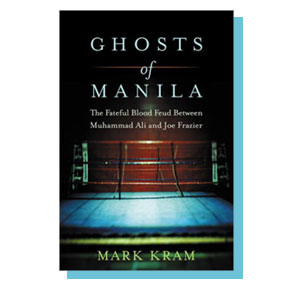
And now comes the latest twist to the Ali saga, yet more revisionism. In “Ghosts of Manila: The Fateful Blood Feud Between Muhammad Ali and Joe Frazier,” author Mark Kram turns a sharp eye to what he calls the “Ali myth.” “Current hagiographers have tied themselves in knots trying to elevate Ali into a heroic, defiant catalyst of the anti-war movement, a beacon of black independence,” writes Kram, who covered Ali during 11 years at Sports Illustrated. “It’s a legacy that evolves from the intellectually loose sixties, from those who were in school then and now write romance history.” In a fascinating narrative, Kram posits instead that Ali, duped by Muslims, was a Chauncey Gardiner figure straight from the pages of Jerzy Kosinski’s “Being There”: “For his every utterance, heavy breathing from the know-nothings to the trendy tasters of faux revolution … Seldom has a public figure of such superficial depth been more wrongly perceived — by the right and the left.”
Kram’s devastating, contrarian critique takes on a fawning intelligentsia; Norman Mailer (with whom Kram once tussled at a cocktail party), Bryant Gumbel and Howard Cosell are among those on the receiving end of Kram’s often lethal blows. For all the deification of Ali — during a recent appearance with Kram on HBO’s “On the Record With Bob Costas,” Spike Lee called Ali “Our shining black prince; to black people, he was like God” — Kram’s original reporting reminds us that Ali had a very real victim, a black man in his own right: his archnemesis Joe Frazier, still deeply wounded today by how Ali, a former friend, turned his own people against him. Time and again, Ali called Frazier a “gorilla” and an “ugly, dumb Uncle Tom”; if Kram’s story does nothing else, at least it will remind a baby-boomer press corps smitten with Ali that the fighter’s rhetoric was more than mere shtick, that it caused real damage.
Kram amply documents the dark side of Ali’s personality. Beyond that, his is the latest, and most complete, dissenting voice to the “Ali as social force” school of thought. According to Mike Marqusee’s “Redemption Song: Muhammad Ali and the Spirit of the Sixties,” black conservative commentator Stanley Crouch praises Ali’s athletic gifts but considers the fighter’s stand against the Vietnam War the action “of a dupe … not to be taken seriously.” Professor Gerald Early, editor of “The Muhammad Ali Reader,” posits that Ali “hadn’t a single idea in his head … [his] reasons for not wanting to join the army were never terribly convincing.”
Sports columnist Stan Hochman, who, like Kram, was there in the late ’60s and early ’70s during Ali’s banishment from boxing for refusing military induction, concurs. “I think Ali had only a small sense of the issues of the day and was willing to play the race card against another black man, to force people to take sides, to root for him so he could feed off their passion,” Hochman wrote after the debut of last year’s gripping HBO documentary, “Ali-Frazier I: One Nation … Divisible.” “He wanted a loud, passionate cheering section, in the arena, in the nation, in the world.” Similarly, Kram makes much of the fact that Ali couldn’t locate Vietnam on a map, let alone explain what the dispute was all about.
The question left hanging, then, by Kram and the other dissenters is: Does one need to know policy in order to become an agent of political change? At the time, another pop culture poet of the ’60s was nasally crooning that “you don’t need a weatherman to know which way the wind blows”; somehow, Ali sensed something, and he navigated swirling cultural winds to end up inspiring millions by coming to symbolize political truths even he, a simple boxer, might not have fully grasped.
Like so many of those who opposed the Vietnam War, Ali’s motives were, at first, personal. As Kram shows, he didn’t want to die at war and he didn’t trust that the Army would use him only as a kind of goodwill ambassador, the way it did with Joe Louis during World War II, keeping him far from harm’s way.
America’s presence in Vietnam was still popular in February 1966, when the then heavyweight champion was reclassified 1-A, fit for combat, by the Louisville draft board. In Miami, Ali was baffled. “Why me? I don’t understand it,” he said. The New York Times’ Robert Lipsyte spent the day with a disoriented Ali and chronicled how Ali finally blurted out what would live on as perhaps the most pithy of all antiwar expressions, at a time when few dared oppose the conflict: “Man, I ain’t got no quarrel with them Vietcong.”
Lipsyte presents the statement as off the cuff, a visceral reaction from a confused young man. Kram maintains that the line was “slyly dropped into his presentation by Leon X, an early Muslim watchdog and headbanger.” Whether impromptu or coached (are speeches written by speechwriters automatically inauthentic?) it was the beginning of Ali’s political awakening, one that would grow to take on internationalist proportions by the time the Supreme Court ruled in his favor in 1971.
But it was a gradual process. Ali was still confused and troubled in the late summer of 1966, when photographer and filmmaker Gordon Parks accompanied him through the Miami ghetto for a September issue of Life magazine. He was clearly basking in his newfound inner-city populism, a feeling that would inform his burgeoning radicalism. On the street, fans flocked to him, shouting their support. “These people like me around when they got trouble,” he told Parks. “Joe Louis and Sammy Davis and other Negro bigwigs don’t do that. Too busy cocktailin’ with the whites. I don’t need bodyguards. You don’t need protection from people who love you.”
Shortly thereafter, Ali’s global worldview expanded when, in Great Britain to fight Henry Cooper, he befriended Michael X, Britain’s torchbearer for black power. Michael X was widely portrayed in the British press as a hatemonger, but that didn’t stop Ali from accompanying him to meetings with community activists. It was a stunning alliance, made all the more stark the next year, when Michael X was first prosecuted for inciting racial hatred and then hanged in Trinidad for murder.
Back in the States, Ali was convicted in June 1967 by an all-white jury for draft evasion, which carried a five-year sentence. By now, the antiwar movement was picking up steam — though polls showed most Americans still supported the war — and Ali spoke to his first and only antiwar demonstration in Los Angeles. “Anything designed for peace and to stop the killing I’m for 100 percent,” he said. “I’m not a leader. I’m not here to advise you. But I encourage you to express yourself.”
By the late ’60s, many black athletes followed Ali and spoke out, including football’s Jim Brown, basketball’s Bill Russell and track and field’s Tommie Smith and John Carlos. But Ali continued to lead the sports world in radicalism. When Esquire gave him five pages to do with what he would, he crafted (or, as Kram would suggest, had crafted for him) a political manifesto: Black athletes should “take all this fame the white man gave to us because we fought for his entertainment, and we can turn it around,” he wrote. “Instead of beating up each other … we will use our fame for freedom.” He went on to make the case for reparations, long before the term ever entered the Zeitgeist, suggesting we take $25 billion earmarked for the war and instead build homes in Georgia, Mississippi and Alabama. “Each black man who needs it is going to be given a home,” he wrote. “Now, black people, we’re not repaying you. We ain’t giving you nothing. We’re guilty. We owe it to you.”
By the time of Ali’s 1970 interview in the Black Scholar, it’s impossible to deny that he’d become a full-fledged revolutionary. “I was determined to be one nigger that the white man didn’t get,” he said. “Go on and join something. If it isn’t the Muslims, at least join the Black Panthers. Join something bad … I hate to see black women and men, once they get prestige and greatness, where they can go into ghettos and pick up little black babies and make them feel good, to go leave and marry somebody else and put the money in that race … Now the white man’s got the heavyweight champion — Joe Frazier’s got a white girlfriend.”
Seen in the context of Ali’s evolution, could it be that, to Ali, such taunting of Frazier wasn’t just the mean-spirited nastiness we see it for today? That it was also political? There is no excuse for the way Ali belittled Frazier, a once-proud black man shown by Kram looking into a mirror and wondering aloud, “Do I look like a gorilla?” after Ali regaled one and all with his “Come on Gorilla, We in Manila” shtick, playing on timeworn racial stereotypes. But Ali saw Frazier — who would say “politics is a little out of my line” when asked about Vietnam — as a stand-in for his oppressors.
“Joe, in his innocence, was representing white America,” says football great turned activist Brown in the HBO documentary. “And that will incense a revolutionary who is trying to make change and knows doggone well there’s no equality.”
In the final analysis, to subscribe to the revisionism of Kram, Early, Crouch, Hochman et al. is to argue from the privileged perspective of hindsight, to ignore the circumstances of the day in which Ali reigned. As Marqusee points out, from 1967 to 1970, Ali had every reason to believe that if he persisted in refusing induction, not only would he never fight again — he’d go to jail. After all, had a prominent black man ever stood up to the U.S. government without paying a price? Paul Robeson hadn’t, nor had W.E.B. DuBois. And yet Ali forged ahead, even when facing five years in jail.
When Kram and Lee appeared last month on HBO’s “On the Record With Bob Costas,” Lee rightfully praised Kram’s book for advancing the parameters of debate when it comes to Ali’s cultural legacy. And he revealed that at last year’s Super Bowl, he apologized to Frazier. “I gotta admit, like a lot of young African-Americans, I got — I’m not going to say bamboozled — I got hornswoggled by Ali, and we bought into thinking that Joe was not a black man,” Lee said. But Kram also cautioned: “What cannot be underestimated is the effect [Ali] had on black America.”
And it wasn’t just black people — it was a lasting effect on the body politic. I sensed this at all of 7 years old. It was 1970 and we were gathered around the TV — me, my 17-year-old brother (who would, within two years, grow out his hair and join the counterculture) and our dad, a patriotic Cold War Democrat. As the show began, our father grumbled, VFW style, about Dick Cavett’s guest, this draft dodger. Who was he not to serve? Who was he to question America?
A half-hour later, though, something had changed. The guest forcefully and poetically repeated the practiced arguments he’d been making on college campuses across the nation. I don’t recall specifically what he said, but it was no doubt the full litany, statements like, “I ain’t got no quarrel with them Vietcong” and “I will die before I sell out my people for the white man’s money.” Suddenly, the Vietnam War was being posited for what it was: the sending off of poor black boys to kill and be killed by other dark-skinned boys, all at the behest of a privileged white elite. Slowly, softly, as though to himself, my father started muttering, “He’s right, he’s right,” over and over again, a lilt of surprise in his voice. There sat my brother and I, wide-eyed. We were in our living room and we were witnessing none other than Muhammad Ali altering our dad’s view of the world.
