
Rex Doane

A conversation with Terry Zwigoff and Daniel Clowes

The director of "Crumb" and the acclaimed cartoonist-author of "David Boring" team up on "Ghost World," a new film specifically for weirdos.

  • more
    • All Share Services

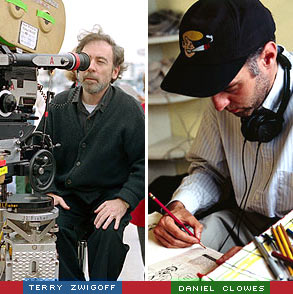
A conversation with Terry Zwigoff and Daniel Clowes

“Ghost World,” now in limited release, is not a summer blockbuster. It is not a remake or a sequel; there are no kung fu sequences or shower scenes. No Sandra Bullock. No Freddie Prinze Jr. No laser guns. There are no pop hits on the soundtrack. And as yet, there are no “Ghost World” action figures, board games or beach towels.

The film’s protagonists, Enid (Thora Birch) and Rebecca (Scarlett Johansson), have just graduated from high school and don’t know exactly what they want to do with their lives, but they do know what they don’t like — most other people. Two chronic misfits, they traipse through the blighted cultural landscape of America in search of meaning or at least a good garage sale. They hang out in sleazy diners and seek out oddballs like Seymour (Steve Buscemi), the obsessive record collector whom Enid eventually befriends. “Ghost World” is a collaboration of noted “Crumb” director Terry Zwigoff and screenwriter and acclaimed cartoonist Daniel Clowes. In the words of Clowes, it’s a film by and for “weirdos in the midst of this oversaturated corporate world.”

I know you both spent nearly five years trying to get “Ghost World” produced. There must have been some pretty horrific pitch meetings along the way.

Terry Zwigoff: Unfortunately, most people who are successful in Hollywood or any other business are not oddballs at all. They don’t get the type of characters we have in the film — the misfits and the alienated. They relate to some guy who drinks three beers, shoots some hoops and goes and sees “Shakespeare in Love.” That’s what their lives are all about. Now that’s something I can’t relate to at all.

Daniel Clowes: It was hard to convince them because they’d read my comics and watched “Crumb” and would think, “There’s no way these guys are going to make anything but a really depressing, slow art film.” One time we went to a meeting that we instantly knew wasn’t going to work. Terry and I were in such a horrible mood that you could almost feel this black cloud entering the room. Then, when the meeting was finishing up, when everybody was in a bad mood thanks to us, one of the executive guys noticed that one of his tropical fish had died — like our psychic energy had killed his fish. It was a great moment. I felt kind of proud of that.

Were there any particularly inane suggestions from prospective production companies when it came to casting?

Clowes: Oh yeah, sure. We were with almost every studio at some point and they all had their casting ideas — it was just whoever was the actress of the moment for the lead. “We see Jennifer Love Hewitt as Enid.” And I’m thinking, “Well, that’s sort of the opposite of Enid. That’s who Enid should not be, basically.” And it went from there to Alicia Silverstone to Claire Danes. There are very few actresses who have any sort of oddness to them or texture that was appropriate for this film. They also had these crazy ideas like Nathan Lane as Seymour. And I’m thinking, “Well, how about Dom DeLuise while you’re at it?”

Zwigoff: Yeah, at various times they were pushing Sarah Michelle Geller, Melissa Joan Hart. Everyone on the list they gave us was wrong for the part. A character like Enid should be a little bit of an outsider, and I don’t quite see Jennifer Love Hewitt in a role like that. She should be in a Gap ad. It was pretty ridiculous. I mean, there’s a reason we chose Scarlett and Thora. There’s something about both of them that’s a little eccentric. The subtle, idiosyncratic way they deliver their lines was just perfect.

Terry, you must have received several scripts following the success of “Crumb.”

Zwigoff: For a long time there was this rumor that I turned down doing “Austin Powers,” which is not true. While they did send me the script, I don’t think I was ever a serious consideration to direct it. I’m sure they probably sent it to 20 others as well. I did turn down “The Virgin Suicides.” I talked to the producers about it and I just honestly told them that I didn’t get it. Is it supposed to be funny, is it a thriller, what is it? Most of the scripts I was getting after “Crumb,” however, were just so false and contrived. It was stuff like a nuclear physicist named Dupree and he’s also a mountain climber. So, of course, when I read Dan’s script for “Ghost World,” it was so authentic, and it had characters that acted and talked like real people. You don’t know how rare that is to find.

Were you entirely comfortable developing a story from the perspective of two 18-year-old girls?

Clowes: It’s nothing I ever considered doing until the characters came to me slowly as a drawing I did in a sketchbook. The way you draw a character sort of indicates their personality and [Enid] sort of came to life in my head in a weird way. If I had to write a story about her right now, I could do it very quickly. I just hear her voice in my head — it’s a schizophrenic kind of thing, I guess.

Zwigoff: I tried to avoid thinking about them as 18-year-old girls. I just tried to think of them as people with their own set of problems. One of Enid’s dilemmas that I could certainly connect with was her inability to find a place for herself in this culture.

Much of “Ghost World” considers the overwhelming effects of consumer culture in America today. In fact, the film has a sense of anti-product placement.

Clowes: That sense of omnipresent corporate commercialism was something Terry and I both wanted in the film. We wanted that stuff to be viewed as oppressive. I mean, that’s the kind of world we live in, where we’re defined by the objects we choose to surround ourselves with, and I think that’s what the movie is about and what the character Enid’s about. She’s trapped in this world of very limited consumer choice. She doesn’t want to pick Pepsi or Coke; she wants some weird soda that she’s never heard of. She has a bigger imagination than what she’s offered.

In response to the corporate cola world, both Enid and Seymour choose to seek out and surround themselves with old, neglected stuff. I know both of you are also chronic collectors.

Zwigoff: You really have to dig in this culture to unearth the good stuff. For me, art, music and design all came together in the late ’20s. What would you rather have? In 1929 you could go see the latest Picasso exhibition and then go see Jelly Roll Morton play at a nightclub. In 2001, you can go see either ‘N Sync or the Backstreet Boys. There’s no comparison.

Clowes: Collectors like us are usually all really troubled people who find solace in their dank apartments filled with decaying old stuff, and they’re often a trial to deal with. Of course, I live in my own little sanctum/sanatorium with all my books covered with Mylar. I collected a lot of sleazy ’50s and ’60s sex paperbacks and recently found one from 1968 called “Ding-a-Ling Broad.” It has the dumbest-looking woman that I’ve ever seen on the cover. It’s something that is an endless source of joy for me.

That appreciation of the odd seems to have extended to some of the actors you chose for the film. Any favorites you couldn’t land?

Clowes: Timothy Carey was still alive when we started writing this script and we thought we might get him in the movie. We actually had an amazing meeting with Lawrence Tierney, which was probably the scariest moment of my life. He basically went berserk in the office, smashing a lamp on Terry’s desk. He was completely out of his mind. He was truly the personification of evil. He was truly devilish.

One of my favorite characters in the film was Doug (Dave Sheridan), the convenience store wacko. Where did you dig that guy up?

Zwigoff: We were at Mike Judge’s office in Austin when he was interested in producing our film. He got interrupted by an important phone call and suggested we order some food or watch some videos he had lying around. So he was gone for about an hour, and I pulled out this unsolicited audition tape this guy had sent in of all these different characters he did. One of the characters was the guy with the nunchucks, and it literally had me on the floor crying because it was so funny. So Mike put us in touch with the guy and it turned out great.

Clowes: Dave [the actor] actually showed up on the set with a sunburn and a tank top. He was a real trooper and he was really good with the nunchucks.

“Ghost World” features a scene involving a stuffed mongoose at a garage sale and that, of course, deserves special mention. Let’s hope the academy remembers it come Oscar time.

Zwigoff: The stuffed mongoose was something I got from Robert Crumb many years ago, and I wound up giving it to an ex-girlfriend of mine when we broke up about 15 years ago. I lost track of her, but was desperately trying to get in touch with her because I wrote that mongoose into the script of the movie. I kept leaving messages for her but I was never able to reach her, so I told the prop guy, “I need a mongoose fighting a snake.” At the last minute he turned it up at some antique store in Los Angeles.

Dan, did the scenes you wrote involving Enid’s art class evolve from any of your own experiences at Pratt Art Institute?

Clowes: Art school was four years of some of the funniest moments of my life — just one after the other. It’s such an absurd scenario to place kids who have no business being lofty and pretentious in a scenario where they have to be. They have to justify everything they do as being really meaningful and deep. There’s something so funny about kids making sculptures out of Circus Peanuts and trying to justify it as being great art.

Illeana Douglas was perfectly cast as the art instructor. Did she share any Martin Scorsese stories in between takes?

Clowes: Yeah, anything you wanted to know! We had all these questions about his movies and she was only too happy to tell us what we wanted to know.

Zwigoff: My first question was about the scene in a Chinese restaurant from “The King of Comedy” — just about my favorite film ever — where this extra in the background is staring at the camera through the whole scene and acting weird. Illeana laughed and said that was some deranged friend of Robert De Niro whom De Niro had insisted be used in the scene because the guy needed the work.

How did you come across that obscure Indian musical you use in the opening of the film?

Clowes: I had a 10th generation tape of that dance number and I would show it to every single person who entered my house. One day I showed it to Terry and he said, “We got to get that in the film somehow.” But no one could track it down. Luckily, John Malkovich (one of our producers) had done some promotion for an Indian film in 1998 and had a lot of contacts in the Indian film industry. So we sent a copy of the tape, and they quickly identified it as being “Gunaam” from 1965. Eventually we got in touch with the kids of the producer of the film and they remembered being on the set when “Gunaam” was being filmed. They actually were there the day we filmed the opening sequence of “Ghost World” with Enid dancing to it. It was a great thing. They were so excited to have it resurrected and they couldn’t believe how much we loved it. But we kept saying, “This is the greatest thing ever filmed, you don’t understand!”

Any small detail in “Ghost World” that first-time viewers can cite to impress their friends?

Zwigoff: Well, there’s a bit of genius that happened totally by accident (though we’re willing to take full credit for it). Three weeks after we filmed the high school graduation scene, I picked out some really repressed, Republican-looking guys to use as customers in the porn shop sequence. If you study the film closely, you’ll notice that the white-haired, respectable guy we have playing the high school principal during the graduation scene is the same guy I cast as one of the porn shop customers. Without knowing it I cast the same guy for both scenes! It’s a paranoid, cynical moment I could have never dreamed up.

Robert Smigel

The man who brought you a cross-dressing kangaroo, a necrophiliac lobster and Robert Goulet takes you inside the mind that made "TV Funhouse."

  • more
    • All Share Services

Robert Smigel

For years, Robert Smigel has been keenly aware of the robust comedic results that occur when live animals and puppets commingle in the Bob Guccione sense of the word. With a double decade’s worth of experience writing for “Saturday Night Live” and “Late Night With Conan O’Brien,” Smigel now has his own show and gives mounting proof that he is indeed America’s most perverse puppeteer. Largely inspired by the popularity of his Triumph, the insult comic dog character from “Late Night,” Smigel (along with Dino Stamatopoulos) developed “TV Funhouse” for Comedy Central.

In its first year, the show has proved to be less like a kiddie-show spoof and more like a version of “Caligula” staged by the 4-H Club. The cast members include a band of foulmouthed, surly and abusive animals known as Anipals, along with the well-meaning human named Doug, whom the Anipals generally ignore. So far this season, the Anipals have taken debauched road trips to places like Tijuana, Mexico, and Atlantic City, N.J., and have managed to engage in garden-variety degrading and deranged behavior. Can TV this good possibly last?

The cartoon show parodies you’ve become famous for, like “The Ambiguously Gay Duo,” are so accurate in look and detail that one starts to suspect that you did a lot of serious TV time as a kid.

I did, I did. I wouldn’t say I was a latchkey kid, but my parents let me spend a lot of time staring off into escapeland. Yeah, I’m a nerd when it comes to certain kinds of television. I know about the shows Bob Denver did after “Gilligan’s Island,” that sort of thing. I’m ill. I’ve been ill for years. I collected TV Guides. I told TV Guide this and it couldn’t even print it; it was too disturbing for a family magazine. For some reason, I hungered for that kind of information about TV. It’s the kind of stuff that’s now omnipresent and repellent. You know, all this media information that you can’t get away from now that obscures whether a show is good or not. Now they publish the Nielsen ratings in the paper every week — and that was the kind of information I was just desperate to know about when I was 8 years old and found such things interesting.

Any special shows that still have a resonance for you?

“Mister Ed” was the first show I remember wanting to watch every week. I hear Alan Young has since become a man of the cloth and now swears that Mister Ed didn’t get shocked or have an electric prod up his ass or anything. I had a Mister Ed record too. That was amazing — he started talking about the Bible. They must have licensed the rights to use Mister Ed’s likeness to some Christian fundamentalist.

I read somewhere that Charles Schulz’s “Peanuts” also played a major role during your rare forays away from the small screen as a child.

It was fantastic. Growing up it was a revelation to me. Now it’s been copied a million times, but rarely as well. Even though there’s plenty of shows and comic strips now with wisecracking kids, they always sort of have to win. They try to have it both ways in shows like “Doug,” where the kids are wiseacres and have personality quirks, but at the same time, there’s always some morality play. The beauty of “Peanuts” was that there was none of that. It was clearly for adults, and I just reacted to it profoundly because I couldn’t stand cartoons that talked down to kids. When Schulz died all the obituaries focused on the dark elements that he brought to comics. And that’s very important and very significant, but he also brought a lot of surrealism to comic strips that he really never got the credit for. You know, Snoopy resting on top of his doghouse and pretending to fight the Red Baron and that kind of nonsensical imagery didn’t exist in comics either.

Any favorite old cartoon shows that have stuck with you through the years?

Well, there are certain Hanna-Barbera voices I can never get out of my head. I love the fact that this guy Don Messick did the voices of both Bobo and Ranger Rick, so that even though one was a tiny bear and the other was a human, they both said “Yogi” the same way. They’re very lax about things like that. I guess they wanted to save money.

In your “X-Presidents” animated shorts, it’s great to see them spontaneously perform as a rock band, much in the tradition of those great hack cartoon shows of the ’70s. How did you match up the ex-presidents with their instruments?

I just wanted Jimmy Carter to play the tambourine because I wanted to feminize him as much as possible. Because he’s the only Democrat there, it’s fun to imagine that the three kick-ass Republicans think of him as a big pussy. So I had Carter play the tambourine because you never see a guy play the tambourine, and I had [Gerald] Ford play the drums because he seems to be the least capable of making music and just good for beating on something.

Were there early ancestors to the Anipals puppets we now know and love in “TV Funhouse”?

My wife found some cool puppets right when I started at “Conan O’Brien” that she knew would crack me up. And she was right, because their faces were detailed and realistic — these tiny little latex faces. One of them was Triumph. So I played around the house with them for months. (She tolerates this kind of idiocy and that’s why we’re a happy couple.) We both just laugh at how unrealistically cute and misrepresentative of the dark world they are. But we also love them because they’re so cute and misrepresentative.

Any trade secrets behind comedic animal and puppet work?

I had all these crazy rules when we started on “Conan O’Brien” that I tried to impose on the writers, and one of them was that in animal bits, the face always had to be realistic as an animal, because it’s just much funnier to see a realistic-looking animal talking than a cartoony-looking one. And I definitely [wanted] no human faces inside animal bodies and that kind of Fruit of the Loom crap. Generally we try to stay away from that stuff. I’m not interested in making animals do stuff and dealing with trainers — especially. In my years at “SNL” and with Conan, we had to deal with a lot of them and I could never believe they were in this business, because they seemed to hate animals more than anyone I’ve ever seen. And they don’t seem to have any skill at actually training the animal, other than yelling at it and manipulating it forcibly. I used to call some of the people we worked with at “SNL” “animal havers” instead of animal trainers because that was their big skill: They have the animal.

Along with the cross-dressing kangaroo and the serenading tequila worm, one of my favorite incidental characters from “TV Funhouse” is that ornery, homophobic, necrophiliac lobster. What’s the story behind him?

He’s just the classic hypocritical moralist. [In lobster voice] “This world is being overrun by freaks and queers!” And then he goes and fucks a dead lobster! It’s so much more fun to make these points when you’re doing it with lobsters instead of people.

How was it determined that this plastic lobster would speak with such a sibilant slur?

When we were coming up with a voice for him, the only suggestion I made was that he should sound like a male Ann Landers.

How did you ever get Robert Goulet to appear in that two-part Atlantic City episode of “TV Funhouse”? Did he know what he was getting into?

Well, I found a Robert Goulet Web site. Goulet has this personal Web site that is worth exploring. It’s got a great picture of Goulet in a tux, and then you click on and you can read Goulet poems and see Goulet doodles. There was an office number, so I called and practically had him booked for the show in 10 minutes. He had seen Triumph and I let him know it would be the same sort of raunchy stuff. He was OK with it, though he wouldn’t take his shirt off for the Jacuzzi scene.

It’s surprising that with your success at “SNL” you haven’t written a feature-length film. When are you going to go Hollywood?

I can’t seem to get movies past studios. It’s a different world. They all live by these formulaic screenplay rules and my stories have always been too joke-filled. I can’t tell you how many times I’ve been told my movie doesn’t have enough heart or enough story. I started in the “SNL” mill and I did a Hans and Franz that Arnold Schwarzenegger suggested — so we wrote a screenplay. It had a big part for Schwarzenegger, but he refused to do it because “Last Action Hero” bombed. That set me on a downward spiral of failures in movies. For example, I did a “Super Fans” movie [script] and that was the worst experience because it was like, “We love it, we love it, we love it … wait a minute, where’s the heart?” There was no corny bullshit. It was satire that I wrote with Bob Odenkirk about the corporatization of sports and that was it.

I’d like to end by dwelling on some more of your personal failures. As the head writer for the quickly canceled “Dana Carvey Show,” what did you learn from that experience?

Don’t follow “Home Improvement” with a lactating president. I also learned that you don’t go to a network that has never done anything remotely like what you’re doing. Even if they say, “Yeah, we don’t do this, but this is the kind of thing we want to start doing,” just run for your life. That show was like the loose girl that they wanted to pop their cherry with, but then dumped immediately so they could go settle down with “Drew Carey” and “Dharma and Greg.”

Continue Reading Close

Amy Sedaris digs wigs and baking

The star of "Strangers With Candy" likes "small woodland creatures" and wants to play Angie Dickinson as "Police Woman."

  • more
    • All Share Services

Amy Sedaris digs wigs and baking

The TV roundup of your local paper might
list href="/ent/col/mill/1999/04/05/strangers/index.html">“Strangers With Candy”
as a sitcom, but to assume that this
implies the show bears any relation to
something like “Home Improvement” or
“The Nanny” would be a grave mistake.

When “Strangers” first aired two years
ago as a piss-take on those weepy “After
School Specials” of the ’70s, the show
tipped the scales with a warped wit
rarely encountered on the small screen.
Now, signed on for a third season on
Comedy Central, “Strangers” remains a
trusted outpost for those who find their
funny well beyond the standard sitcom
fare.

At center stage of the show is actress
Amy Sedaris, who plays the rumpled
chum-pot Jerri Blank. Blank is a former
teen runaway who, after a lifetime of
prostitution and drug abuse, has
returned to high school as a freshman at
age 46. With the possible exception of a
special trailer park edition of “Cops,”
“Strangers” is the only place one is
likely to encounter someone like Jerri
Blank.

The character represents an amalgam of
the fringe dwellers and human ruin that
have held the imagination of Sedaris
over the years. “The more serious they
are and the more tragic they are, the
more I’m drawn to them,” she admits.
“I’m usually the only person who’ll ever
talk to them and they tell me
everything.”

First, there was Bobbie. “I lived over
this woman in Chicago and she was just
trouble,” relates Sedaris. “I mean, she
had tattoos that she had tried to take
off herself. She also always thought she
was smelling formaldehyde. She’d call up
and say, ‘Hey, this is Bobbie downstairs
… Do I smell formaldehyde?’

“And she’d always drink too much and
fall down. I’d constantly see her with a
broken leg or a broken arm.” While
Bobbie proved an undeniably rich source
for any performer to draw from, Sedaris
also found inspiration from a late-’60s
drug prevention film. “We found this
documentary of this woman in the ’60s
who was a drug addict and a prostitute
and she’d go to high schools and talk to
students. The woman’s name is Flurrie.”
Sedaris adds, “She looks like Michael
Dukakis. She’s horrific looking.”

The final touch came when Sedaris
approached the wardrobe people at Comedy
Central during pre-production of the
series and told them, “I just want to
dress like someone who owns snakes.”
They responded with an assortment of
outfits that overpoweringly evoked
slutty ’70s sleaze. Jerri Blank was
born.

Sans the saddlebag thighs and prison
tattoos that help define her TV
character, Sedaris herself is pretty and
diminutive. She is also considerably
more laid-back, several RPMs slower than
her TV persona, which comes off as a
sort of manic, perverse Lucille Ball. Of
her recent appearance on Conan O’Brien
she groaned, “God, with all that
fidgeting and unfocused energy I had, I
looked like a damn monkey. So annoying.”

Some call it quality entertainment.

Sedaris’ Greenwich Village apartment is
tidy, nearly sizable by Manhattan
standards and distinguished by several
personal decorative touches. Choice cuts
of plastic meat are placed throughout
the living room. The TV is adorned with
a large plastic turkey. “I covered it
with foil for Thanksgiving and the
people who came over were extremely
disappointed when they found out it
wasn’t real.” There is also a stuffed
squirrel featured prominently on a
coffee table. “I really like squirrels.
My whole family does. We all like small
woodland creatures.”

Hard to say why it comes as a surprise
that Sedaris and her family hail from
North Carolina. But it is her home state
nonetheless. When asked what her life
might have been like if she had remained
there instead of defecting to the North,
Sedaris quickly responds, “If I had
stayed in North Carolina, I’d be wearing
ruffles or a uniform. You know,
waitressing and taking care of a stroke
victim … I probably would have been
dating him, too, by now.”

Not surprisingly, Sedaris grew up in an
open, permissive household where
creative expression was never
discouraged. “We all did our little
plays in our house,” she says. “For a
long time I had an imaginary classroom.
I’d come home from school, put on my
mom’s high heels and go right to the
back bedroom where I had a wall that was
one big chalkboard and I would teach my
imaginary students. This went on for
years and years. Then I realized I was
too old to do this, so then I just kind
of did it to myself in my head. I still
do that — like if I’m making an omelet
I pretend it’s a cooking show and I’m
teaching someone.”

Sedaris’ lifelong fascination with
costumes and wigs has also been lovingly
nurtured. “In the first grade I got my
first wig. It was a fall and I still
have it,” she says, gesturing to her
closet. “Since then I get two wigs for
Christmas usually. When I was a kid I’d
go shopping with my dad every Friday
night and I wore a different wig every
time I went,” she adds.

True to her craft, Sedaris would remain
in character the entire time she and her
father were at the grocery store. “It
was mostly neighbors that I would
imitate. I think most kids probably did
that stuff, I just stuck with it,”
Sedaris says with a shrug.

The subject of wigs has Sedaris bounding
off to another room. She returns with a
photo she had done with the help of a
makeup artist friend. It is a large
color print of Sedaris as Angie
Dickinson at the peak of her “Police
Woman” period. The likeness is
staggering. Sedaris is a convincing
blond, and with a gold turtleneck and
pistol poised, the transformation is
utter and complete.

It’s not merely an act of cosmetological
genius; Sedaris herself is totally
committed to her dream role. “I want to
play Angie Dickinson … I want to do
‘Police Woman,’” she says wistfully. “I
want to be so beautiful that I’m ugly.”

For Sedaris, the urge to transform
herself in front of a camera seems too
great to overcome. “If someone wanted me
to pose in a bikini for the cover of
Vanity Fair, I’d make sure I’d have some
scars or grow a hairline. To look in the
camera and act like you’re beautiful is
too hard for me.” She continues:
“Photographers always seem to appreciate
when you come in with ideas. I mean,
I’ll do what they want, but half the
time they don’t know what they want. So
I come and say, ‘OK, I got this
prosthetic leg, what can we do with
it?’”

Sedaris did in fact pose with a
prosthetic leg for Index magazine with
remarkable results. “That fake leg fit
me perfect,” she says. “It must have
been for a little boy.”

With her TV series in summer reruns,
Sedaris can return to her other
passions: stage work and baking. After a
two-year hiatus, she has agreed to write
and perform a play once again with her
brother, David, the author of popular
short story and essay collections such
as “Barrel Fever” and href="/march97/sneaks/sneak970305.html">“Naked,” and a frequently featured
commentator on the nationally syndicated
radio show href="/people/lunch/1999/07/16/glass/index.html">“This American Life.”

Exactly what their upcoming
collaboration will entail is a mystery.
“We have no idea what the play’s going
to be about, what sort of characters
it’ll feature. Nothing,” Sedaris says.
The only certainty at this point is that
it will be opening in six months.

Judging from their previous stage
collaborations, it does promise to be
engaging. Earlier Sedaris and Sedaris
works, such as “Stitches,” centered
around the story of a young woman who
had her face disfigured by a boat
propeller only to eventually star in her
own sitcom.

Then there was “One Woman Shoe,” where
welfare moms had to perform onstage in
order to qualify for their benefits.
Sedaris adds the following to her
risumi: “I’ve done my
little brother before as a donkey in a
play at Lincoln Center. I had overalls
and had a hat on. It involved animals in
the forest and had witches in it.”

One constant in each of these
productions has been the recurring
character best known as Piglet. Like
some knocked-up malcontent working the
Wendy’s drive-through, Piglet is the
embodiment of the foulmouthed hardened
teen everybody knows and loves. “She’s
in every play my brother and I do
together; we just change her name for
each play,” Sedaris explains. “You know,
you can’t do a character like that on TV
cause every word is fuckin’, fuckers,
fuckin’, fuck. Every word is a cuss
word. Audiences just go nuts over her.”

At most of the theater productions she
appears in, Sedaris also performs double
duty: acting on stage and selling
cupcakes in the lobby after the show.
She also specializes in cheese balls. “I
always sell out of whatever I bring.”

Why is she compelled to peddle baked
goods after a show? “I just love making
money. Cash, you know? It’s such a great
feeling.” Besides, Sedaris adds,
“baking is something to do at 3 in the
morning. If you’re bored, bake.”

But the growing popularity of “Strangers
With Candy” might just cut into Sedaris’
cupcake production. Several notables
have expressed interest in doing the
show. “ href="/people/feature/2000/01/26/janeane/index.html">Janeane Garofalo wants
to do the show again and Winona Ryder
has expressed an interest. I’ve heard
that href="/people/bc/2000/02/22/cher/index.html">Cher and href="/ent/music/feature/1999/04/27/waits/index.html">Tom Waits are big fans
of the show, too.”

Asked about performers she admires,
Sedaris says, “Clint Howard and that guy
from href="/ent/movies/1997/10/17boogie.html">‘Boogie Nights’ with the big
forehead that looks like an ax went
through it [John C. Reilly]. They both
kinda look like cave dwellers –
Cro-Magnons with big ol’ hearts.”

Despite its growing cachet among
celebrities, the double-barrel bizarre
nature of “Strangers With Candy” may
never play in the Midwest, but cult
status is OK with Sedaris. “It’s not a
show for everyone,” she says.

As for what to expect on “Strangers”
next season, it’s anyone’s guess. Except
for one thing. “I want to do a Ben
Franklin episode,” announces Sedaris.
“You know, bring him back from the past.
I turned on the TV and saw an episode of
‘Bewitched’ where they did that. Darren
was having some company over and there
was Ben Franklin standing in the living
room and messing with a lamp. I want Ben
Franklin on my show!”

Continue Reading Close

A conversation with Errol Morris

Eating a reality sandwich at the Carnegie Deli with a connoisseur of the ironic, the naive and the appalling.

  • more
    • All Share Services

A conversation with Errol Morris

More often than not, documentary filmmaker Errol Morris’ camera is squarely aimed at the fringe-dwellers of society: men and women leading largely anonymous lives that, upon deeper inspection, become engagingly bizarre, endlessly fascinating and totally engrossing.

In his films “Gates of Heaven” (1978) and “Vernon, Florida” (1981), Morris investigated the stories behind two pet cemeteries and a community of eccentric swamp-dwellers, respectively. In his 1988 film, “The Thin Blue Line,” he focused on the case of Randall Adams, a Texas man wrongly convicted of murder. With “A Brief History of Time” (1992), Morris adapted Stephen Hawking’s book about the origins of the universe. And his 1997 project, “Fast, Cheap & Out Of Control,” was the study of a topiary gardener, a lion tamer, a mole rat researcher and a robot designer.

His recently released documentary, “Mr. Death: The Rise and Fall of Fred A. Leuchter, Jr.,” is the semi-tragic story of a diminutive, pocket protector-wearing man (Leuchter) who designs execution equipment for prisons across the country. Leuchter’s world comes crashing down on him when he becomes affiliated with the Holocaust denial movement.

As with his other films, in “Mr. Death” Morris dissuades viewers from making hasty assumptions about his chosen subject. While the absurd historical revisions Leuchter proclaims about the Holocaust are gently but emphatically rebuked, Morris patiently pursues the bigger issue at hand: Fred Leuchter himself. How has this delusional man, fueled by 40 cups of coffee a day, become totally convinced of his own infallibility?

Recently, I arranged to meet Morris at the Carnegie Deli in midtown Manhattan. When he arrives, he emanates intensity and quickly proves to be nearly eccentric enough to appear in one of his own films. I ask if meeting him at the Carnegie was a bad idea and he smiles broadly.

“I used to live on 54th Street between Broadway and 7th, which my wife called the ‘deli district.’ We lived over the Stage Deli,” Morris says, gesturing down the block. Pregnant pause. Bad memories of pastrami? I ask. “Well, it’s not as though someone holds up a pastrami sandwich and I cower in the corner and beg for mercy … but it’s close to that.”

As we’re seated inside, I make some lame excuse about the Carnegie’s central location being its primary asset and feebly offer a contingency plan. Morris launches into a Carnegie Deli monologue. “On one of my last visits here, it occurred to me that it must be the site of a number of unpleasant episodes. You know: thrombosis, coronary infarction — you name it. So I asked a waitress, ‘Have you ever seen anyone die? You know, just slumped over their six-pound sandwich dripping with fat. I mean, have you ever seen anyone just fold over into their plate of food?’”

“And she said, ‘Not really, because they usually make it out of the restaurant,’” Morris says, suppressing laughter, “and they get as far as Smiler’s [a New York convenience store chain], going for the antacid, before they keel over.”

In the spirit of the moment, I offer a few “Why I don’t eat at my local delicatessen” stories, one of them involving a bloody Band-Aid in a sandwich, which has Morris smiling with approval. Finally, having exhausted the topic of deli gore, I segue to one of Morris’ other obsessions: mass murders. He brightens immediately.

“I started interviewing murderers when I was at University of California, Berkeley,” he tells me. “That’s, in fact, how I met Werner [Herzog, the film director]. I was interviewing Ed Kemper in Vacaville. Do you remember Ed?” he asks cheerfully, as if Kemper were a mutual friend. I say I’m familiar with Kemper’s work. (The California serial killer was convicted of eight counts of murder in 1973.) “I interviewed Ed Kemper a whole bunch of times,” Morris continues. “He fascinated me. Werner was really quite taken with Kemper as well. And, unfortunately, he then got the mass murder bug from me.” After a long pause, Morris adds, “A lesson for all Jews, never tell a German your deepest innermost secrets.”

I introduce the subject of Ed Gein and Morris’ close personal relationship with the ghoulish grave robber turned murderer. It was back in the late ’60s when Gein turned “women into furniture,” as Morris delicately puts it. He was so taken with Gein’s bizarre series of crimes that Morris dropped out of the doctorate program in philosophy at Berkeley to relocate to Plainfield, Wis., the killer’s hometown, and moved in with Gein’s next-door neighbors. “I liked Ed,” Morris states calmly. “There was something incredibly naive about him. Maybe that’s something I just like or have an affinity for — the naive and appalling.” It is a quintessential coupling that succinctly sums up most of his films.

Morris shifts his weight and leans slightly forward. He has something remarkable to say and he’s making sure I’m ready. Our brief discussion of Gein has led us to the bedrock of Morris’ approach to his craft. I set down the complimentary kosher pickle I’m eating. Morris begins.

“I was taken to the Wisconsin crime lab to see the [Gein] artifacts, and at the time I was still kind of a graduate student of philosophy, dogged by one of those perennial, philosophical questions: What is real? It’s the ontological question.” Morris pauses for dramatic effect. “One of the guards at the Wisconsin state crime laboratory at that time gave me one of the most compelling definitions of what is real. He took me into the room of Gein artifacts and pointed to the cane chair where Ed had removed the cane and sewn in the buttocks of a woman. And without any trace of irony the guard looked at me and said, ‘You can tell it’s real, because you can see the asshole.’”

I’m relatively stunned, but Morris marches on. “So, when anyone ever asks me about my films or whatever — is it real? Somehow that definition flashes through my head.”

Of all Morris’ films, “Mr. Death” most effectively weds the question of what is real (asshole and all) with the naive and appalling. I ask Morris about the film. He responds rhetorically, “What have I done here? I’ve provided a fractured fairy tale. The story of a man who, hoping for the best, created the worst. Alas, Fred is my best attempt yet to plumb the greatest mystery of all … the mystery of personality. What in the hell goes on down there?” Morris laughs, ruminating on the possibilities.

“You know, I don’t even know if I’m being coy … I get the ‘What’s it about?’ question endlessly. Who is Fred? Is he a bad guy? Is he an anti-Semite? Is he misguided? Is he evil? Well, you can decide for yourself whether I’m self-deceived on this issue,” Morris is laughing. “I think there is something chameleon-like, something almost evanescent, ephemeral. It’s very hard to get closure on the question: Who is this man?”

Our food arrives. Morris isn’t hungry and he’s in a hurry. He gets a toasted bagel and tea and continues pondering “Mr. Death” and what is real. “Here you have this crazy character right out of Nabokov,” Morris says, referring to Leuchter, “the totally clueless narrator. He makes Humbert Humbert look like someone with intense self-knowledge.” Morris laughs. “You know, I’ve read a lot of reviews where I’ve been criticized that somehow I should have provided closure, that I should have plumbed the details of Fred’s history — defined, perhaps, that one illustrative event that would make everything come clear. It’s that fantasy picture that will identify the evil at the heart of the man; the imagined desecration of a Jewish cemetery … or a synagogue on fire.” He is laughing again. “But,” Morris proclaims, “it’s not there.”

As I eat my sandwich, Morris describes one of his favorite scenes in “Mr. Death” in which Fred Leuchter, electric chair designer, straps himself into his own execution machine. “I think it’s really hard to find a triple irony,” Morris remarks. “You know, as a connoisseur of irony, double ironies are good to come by, triple ironies are really good to come by.”

I say that the bits of archival footage used in “Mr. Death” have a forceful, lingering quality all their own. Morris agrees. “There are certain images that you see and somehow it’s very, very hard to take them out of your head. They remain in there and it’s like a chicken bone caught in the throat.”

Morris’ use of such footage — staged shots and reenactments, among other stylistic embellishments — has been the source of controversy among documentary film purists. I admit that I have a bit of an ax to grind with the overrated, overfunded Ken Burns, who seems to be the only documentary filmmaker acknowledged by mainstream America. “I’d like to grind an ax against his head,” Morris shoots back.

Morris has no shortage of opinions regarding the use of reenactments, which appear most notably in “The Thin Blue Line” and some of his more recent films. “Often we like to reduce documentary to journalism and we like to feel secure about journalism — that we’re not being tricked or betrayed or swindled or lied to. But no one really worries about it that much as long as it’s being presented in the right idiom. As long as it looks real, people are delighted. But what the reenactments do in, say, ‘The Thin Blue Line’ is provide this wealth of visual contradiction. They’re never illustrations of what I think the world is. They’re illustrations of lies. They’re all ironic. They, hopefully, teach you how images can’t embody truth.” Morris is smiling again.

“How’s that?” he asks abruptly.

It’s fine, I tell him. He then informs me that if any of what he’s been saying sounds too pretentious, I should tell him to stop. I appreciate the offer, but remind him that our interview is nearly over. I go with the standard closer and ask what we should expect next from him. He tells me about his upcoming Bravo series, “First Person”: “I’m interviewing people for the show this week. Hey,” he exclaims, “got any ideas for the show?” I suggest Mae Noell the gorilla woman and Hasil Adkins, the backwoods rockabilly legend, but it’s time for Morris to go to another appointment.

And for me, as he prophesized, it’s time for an antacid.

Continue Reading Close