Music

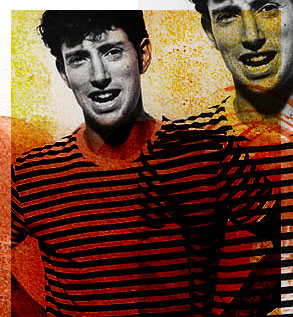
Jonathan Richman

The rough and charming godfather of punk sings quietly now and makes us nostalgic for a time that never existed.

  • more
    • All Share Services

Topics:

Jonathan Richman

Like Dylan, Springsteen, Waits, Paul Simon, Emmylou Harris and a half-dozen others, Jonathan Richman is the best living songwriter of his generation. He sings about parties, getting closer, skydiving, Bermuda and nighttime. He helped invent punk and then left to sing quietly. His followers are not to be gotten started. Their eyes get soft and they just about hug themselves; if you say, “Jonathan who?” their lower lips protrude just like Jonathan’s own.

Tender, dry, loving and rough people have been learning to be like Richman for three decades now. As founder of the Modern Lovers, he showed fussy teens everywhere that they, too, could be funny brats with smart songs. Then, in the ’80s, he did more and more quiet solo work, at times because it seemed that not a single other musician could stand how gentle the punk legend had become. Here he showed people that intelligent songs needn’t be clever, and sweet songs could be just a little sweet.

In “My Career as a Homewrecker,” he recalls the women who couldn’t resist his “certain traits” over the years: “My career as a homewrecker is not yet through — there’s all these homewreckin’ things to do.”

He’s not wrong, either. His certain traits make people rethink their relationships — it’s not always safe to introduce a lover to his charming songs, which he might sing in English, Italian, Spanish or French. When you finally see him in person, you laugh because he’s tiny — a small, handsome man with thick biceps and a huge, tough Massachusetts voice, like Lou Reed saying “Bah Hahbah.” As soon as he starts to sing, he also starts to dance, and he dances so exquisitely that he immediately becomes tall. Sometimes he gets carried away and puts the guitar down on the floor so he can dance better. Then he whirls around and kicks up into the rafters, wagging his finger here and there, and doesn’t stop frowning until he’s picked up the guitar again.

Magazines call Richman “eccentric,” and he probably is, insofar as Frank Sinatra is eccentric against a backdrop of preadolescent rappers, boy bands and 18-year-old pop sensations dancing in soda commercials so seductively that former presidential candidates are forced to make thinly veiled allusions to their own erections. Richman is simply an offbeat 50-year-old who sometimes dances on sidewalks outside clubs when the music’s too loud, and who sometimes speaks in Tonto syntax, like Hemingway sometimes did: Me play music for you now.

Richman is called an eccentric because his songs seem out of place. Those recorded in the last 20 years have a wryness that seems exceedingly contemporary, but they’re set to ’50s and ’60s rhythm guitar. The sentiment, also, feels too unironic to be modern, but not insipid enough to be regular old doo-wop. As sometime colleague Brennan Totten has pointed out, Richman’s music makes us nostalgic for a time that never existed.

Rock stories often involve discovery. Great talent is found, like a distant star, and what was once dark blinds us with brightness. Throughout the person’s great career, we reflect on the moment — there is always a moment in these stories — when the star was born. This moment happened for Aretha, for Elvis, for Eminem, and it proceeds directly from the Johnnie B. Goode allegory: Back up in the woods among the evergreens lives the next big thing. But Richman’s story was much closer to Horatio Alger. Yes, people have discovered him, but they did so in fits and spurts, and the guy doesn’t exactly need tinted windows.

The tired old Velvet Underground saw is that only 500 people listened to them, but each started his or her own band. If someone tells this to you and you actually say, “Like who?” this person will most certainly shrug. Unless he knows his Jojo trivia: Richman sat up straight in Boston the day he heard a record from Lou Reed et al. A self-described lonely, attention-starved teen, he’d spent the last couple of years playing the guitar in the Cambridge Commons. He was 18 when he heard the Velvet Underground. He left immediately for New York.

Richman charms all without exception, and the Factory people were no exception. Andy Warhol, John Cale and Reed let their new fan soak up their vibe, hang out on their couches. “The fact that we slept outdoors in Central Park and didn’t get killed tells you that it was 1970 and not a day later,” Richman says. Reed was once quoted as saying that he couldn’t be held responsible for Jonathan Richman. By then it was probably too late. Richman bought an electric guitar, went to Europe, came back 19 and got started.

The Modern Lovers brought the Velvets’ big, droning fuzz out of New York, leaving the heroin reference behind to eventually fester as cliché. The Lovers wrote songs about not doing drugs, with all the bratty self-righteousness of a band that did plenty. They made fun of hippies and complained a little and sang about what Boston was like for young people. People loved them almost right off the bat. It was weird to be mocking hippies in the early ’70s, and they did so with a catchy sound.

By the time they got an actual record out, they’d been playing almost five years, and they no longer sounded like the guys on the recording. The Modern Lovers were not even the same Modern Lovers: Keyboard player Jerry Harrison left and went on to join the Talking Heads, and drummer David Robinson went on to be in the Cars. Richman had left Boston for Berkeley’s Beserkley Records, and was on the verge of disappointing people for the first of many times.

Too nice, Richman’s fans began to say. They missed the angst and the self-righteousness — their Jojo was writing songs like “Hey There Little Insect.” Eventually they’d come around for the most part, even extol this new music as even truer punk for how quiet it was, but for years Richman endured complaints about his positive attitude.

Music shouldn’t hurt a baby’s ear, he said, and over the next 20 years not a single infant was harmed. Too bad, some griped. Indeed, when a surly punk rocker cuts his hair, brings out an acoustic guitar and starts singing lines like, “To win in love you must surrender,” it’s usually trouble. On the back of one album, Richman can even be seen squatting down to pet a cat. But like any troubadour worth his bus ticket, Richman is never edgier than when he’s singing about love. The songs are funny, the love lyrics subtle and the cat is honest rock music.

When I say “wife,” it’s cause if you said “lover” every day,
You’re gonna begin to gag.
But “wife” sounds like your mortgage,
Sounds like the laundry bag.

His is a revision of the rules codified by the paragons of sophisticated rock music. Slouching over a whiskey is not depth. Morose discomfort is not depth. Depth is not depth. What’s deep — what’s truly deep — is “She Doesn’t Laugh at My Jokes” and “When Harpo Played His Harp.”

Still, even today, old punks with good memories occasionally complain that their mentor went soft. It’s true that Richman was flicking at the punk ethic long before the Sex Pistols stuck their fingers up their noses. But the idea was to fuck shit up and, in punk terms, Richman decided nothing was more transgressive than spreading happiness. In “Government Center,” he wants to spread it around a building full of gloomy bureaucrats:

We won’t stop until we see secretaries smile
And see some office boys jump up for joy.
We’ll tell old Mr. Ayhern, “Calm down a while,
You know that’s the only way the center is ever gonna get better.”

Depending on who’s pontificating, Richman is dismissed or praised as childlike, naive, innocent and, worst of all, boyish. The boyish thing is understandable: He has big eyes and his toothy grins leave suddenly for a 10-point pout. The prose of his songs is straightforward and guileless, but not in the way that lets reviewers use favorite words, like “gritty.” Richman eschews Bruce Springsteen’s gravelly wisdom for a more refined candor about what love feels like. “When she kisses me, I get so ecstatic/She thinks I’m maybe being overdramatic.”

Like Tom Waits, Richman is an inventory taker. He documents hot nights, California desert parties, twilight in Boston, not enough parties, lonely thrift stores, vampire girls and then, famously, the something that there was about Mary. But where Waits finds the wonderfully mundane in the alien — the German dwarf dancing with the butcher’s son is really just you and me — Richman pulls the alien out of the normal. Twilight in Boston is out of this world if you know how to see it.

He’s a proficient anatomist, too. In one song he gets to the bottom of the Fender Stratocaster, which sounds like “a tin can falling on a dead-end street.” And like “taillights heading for another town.” Also, “the sound’s so thin that it’s barely there, like a bitchy girl who just don’t care.”

Whatever it is that’s lovable about him — and that’s the word, “lovable” — you can’t get close; picture a koala bear. Journalists who try talking to Richman report the following areas off-limits: his personal life and his musical life. Politely he will answer harmless questions as emptily as possible. One interviewer got this much out of him:

Interviewer: So what do you like to do when you’re not performing?

Richman: Nothing much. Hang around. Ride my bike. Hang around.

and

Interviewer: What do you think about when you wake up in the morning? Or the afternoon?

Richman: Depends if I’m hungry. Sometimes you wake up and want something to eat, and sometimes I just think of other things. Hard to say what. Varies every day.

Other questions, he’ll just try to get off the phone. Befuddled, interviewers finally ask the simplest thing they can think of: Well, are you touring? Oh yes, he’ll exclaim, it’s fun!

The impossibility of conducting a decent interview with Richman is well documented, and emerges as a theme in many of the write-ups. But plenty of famous people get quiet around journalists, so this alone is not revealing. The thing about Richman is that reporters keep coming back for more. Each believes he or she will be the one to finally pull the sword from the stone, because he or she is the one who truly understands the universe exalted when Jojo sings and dances just so. This tells more about him than them. Picture a koala bear with a fierce magnetic field.

And this is also where Richman lovers get caught in the brambles: In the end, their hero seems to care at most elliptically about what they think of him. For all that we locate in Richman — the funniness, the tenderness, the gruffness, the dramatic and the nasal sweetness — there is also indifference. If his interview persona is at all indicative, he doesn’t want to hear about all the levels on which he’s felt. The effect of the severely restricted access, then, becomes weird: Imagine a recluse who happens to sing and dance for people every chance he gets.

Richman says he wants his albums sold next to Maurice Chevalier’s in record stores, and this might be the only rupture in his enlightenment. Richman is indeed a worldly guy — he’ll sing about Paris, about van Gogh, about ancient Greece — but nobody could be more American. The things Richman understands are too diffuse to come from anywhere else. And what’s more, they are sung too urgently to be European:

I can’t take it slow and easy,
I can’t live like that.
If the music’s gonna move me,
Folks, it’s gotta be action-packed

Action, in the Richman cosmos, means a good deal — he’s talking about how music should be, but he’s also laying down the groundwork for a lifestyle. What kind of lifestyle, exactly? Hard to say what. Varies every day.

Continue Reading Close

Chris Colin is the author most recently of "Blindsight," published by the Atavist.

“Duets”: “Idol” via “Project Runway”

ABC's new "Duets" is super nice, has no clear rules -- and insists on calling Robin Thicke a superstar

  • more
    • All Share Services

Topics: , ,

“Duets,” ABC’s tardy attempt to fashion a musical competition show of its very own, debuted last week. Perhaps hoping no one would notice just how late it had arrived to the “American Idol” knock-off party if it behaved like it had always been there, it premiered with no explanation of its own rules. (“Oh, you must know all about me already! I have been standing by this punch bowl all night. Really!”) In the not highly rated debut, Kelly Clarkson, Robin Thicke, John Legend and Sugarland’s Jennifer Nettles — a quartet referred to at every possible opportunity as “superstars”—  each selected two amateur singers with whom to perform a duet. The amateurs then received feedback from the other superstars on their performances. At the end of the night the eight contestants were ranked on a “chart.” How were the rankings on the chart determined? What were they a measure of? Would the contestants at the bottom be kicked off the show? Would the contestant at the top win something? Would the contestants in the middle have to perform a cappella while doing an interpretative dance about the word “superstar” and hanging from a trapeze? Who could say? No one who watched the show.

Tonight’s episode of “Duets” then, in which the rules are largely, if not entirely explained, effectively works as a do-over. Each week, the performances are graded — anonymously — by the superstars, and it is their feedback that determines the amateurs’ chart standings. (There is a moment in tonight’s episode when the first performer of the night is told her place on the chart. Anti-climactically, it’s the top one, because she is the only person yet to have sung. “Duets” is still working out its showmanship kinks.) Starting next week, the two contestants at the bottom of the chart will have to face-off in an a cappella duel (no trapeze sadly), and the loser will be kicked off the show. In six weeks’ time, “Duets” will go live and the audience will begin to vote on the outcome of each episode. (As to how the victor of the duel will be determined or what the ultimate winner will win, see the “not entirely explained” clause above.)

When written out, these rules may sound boring enough to seem like the sort of yawn-inducing information a TV show could reasonably hope to spare its audience. But they matter. On all the other major singing competitions, after the winnowing down of the audition rounds — those dark weeks when it becomes clear that America lacks for neither competent singers capable of melisma or the disturbed and delusional — it’s the audience that decides who stays and who goes. On “Duets,” for the next six weeks four relatively articulate performing professionals will be the deciders. “Duets” is temporarily putting off the rowdy, democratic voting process, and its tendency to favor sleepy-eyed white boys, to practice the more aristocratic style of expert judgment found on Bravo’s competition shows. “Duets” may be ABC’s answer to “Idol” and “X Factor,” but in rare moments, it’s also the singing version of “Project Runway.”

Though the four judges are too nice (they start and finish each comment with something like, “I love you,” or “you’re great”) they are also informed. They give feedback — the singing is pitchy, too perfect, too scared, the mic is too close, the dancing is bad. “Duets” does not embrace the sort of serious crit sessions seen on “Runway,” “Top Chef” or “Work of Art,” and it would be much better if it did. The judges seem up to it — not only does Kelly Clarkson effortlessly remain more likeable than anyone who has ever appeared on reality TV, I suspect that there is a Nina Garcia lurking inside of John Legend, whose high standards and perfectionism are belied only by the goofy, childish, wide-eyed expression he gets whenever he is watching a performance he enjoys. Real criticism would also rescue the show from its current in-between state, in which it drags on like any bloated musical performance show, but without the energy or stakes of one since, thus far, “Duets” is pre-taped.

The judges’ participation adds a nice new wrinkle to the format. Though it may mean that we will never get to know the amateur contestants well (this show could be called “Singing with the Stars,” despite the reversal of expertise), it should fuel some future sharp exchanges. Kelly Clarkson may not want to lay in to a reality TV contestant, but she can feel no such compunction about digging in to the over-confident Robin Thicke.

That the judges are performers delivers the same message –albeit at a much softer, less-compelling volume — as those Bravo shows: Talent is great, but greatness is hard, hard work. Robin Thicke may seem most concerned with making himself appear sexy, and Jennifer Nettles may not be able to contain her inner cheeseball, but they, like Legend and Clarkson, are professionals in the most complimentary sense of the word: reliable, knowledgeable, focused, dedicated. What they demand of their duet partners is surely nothing compared to what they demand of themselves. Clarkson, especially, is the embodiment of this. Exactly a decade ago she won the first season of “American Idol,” and she is now back on reality TV mentoring the two least polished, most insecure contestants on “Duets.” She chose them, she says, because they both reminded her of herself. She may be right, but they have lots and lots of work to do before before I see it.

Continue Reading Close
Willa Paskin

Willa Paskin is Salon's staff TV writer.

Riot porn from Kanye and Jay-Z

The music video for "No Church in the Wild" depicts a graphic riot scene and shows the resonance of dissent

  • more
    • All Share Services

Topics: , , , ,

Riot porn from Kanye and Jay-Z

There is a name for videos capturing particularly dramatic riot scenes — the sort with fire, tear gas, charging police horses, careening masked crowds and, often, a hardcore backing track. We call it riot porn. I’ve always thought it’s a bad name. Not because the street scenes — shot from Egypt to Oakland to Greece — aren’t titillating spectacles (and pornographic in that sense), but because all porn — good or bad, exploitative or sex-positive — is staged for the filming. Riots very much are not.

In this sense, the new music video for Kanye West and Jay-Z’s track “No Church in the Wild” is the best actual riot porn I’ve ever seen. The video, directed by Romain Gavras, is five minutes of a graphic, fiery and entirely staged riot. It opens with a young man lighting a Molotov cocktail and lobbing it at a line of riot cops as masked comrades behind him raise their arms in support. Filmed in Prague, but presented as a non-specific yet decidedly European urban battleground, riot cops on horses violently beat the masked crowd, who fight back with fire and fists while Greco-Roman statues look on. Were it not for the surprising appearance of a chained elephant amidst the fray in the video’s final frames, the footage looks (almost) like something straight out of Athen’s Syntagma Square. Jay-Z and Kanye don’t feature in the video at all, which makes artistic sense: I’d be more surprised to see Hove in a riot than a two-tonne elephant.

So what to make of riot porn brought to you by those hip-hop moguls and emblems of excess Jay-Z and Kanye? As I noted last year when purveyors of eau-de-date-rape Axe came out with a scent called “Anarchy”, the depiction of anarchism and riotousness in commercial ventures are at least “a nod to the popularity of dissent.” Gavras, who directed the “No Church in the Wild” video, has long riffed on the idea of social upheaval and fierce state repression in his work. His short film for rapper M.I.A’s “Born Free” told the story of U.S. military forces brutally rounding up and executing ginger-haired civilians. The message was lost on no one, and the video was banned from YouTube. Gavras offers a stylized, gritty and startling depiction of social rupture; that his brutal vision of a street riot is deemed popular and consumable enough to accompany some the most mainstream of music is worth consideration. It’s not just anarchists getting off on riot porn anymore.

This isn’t entirely new: There was the Levi’s jeans commercial last year that featured a young man in Levi’s squaring up to riot cops under the tagline, “Now is our time.” The ad was pulled from British television in light of the summer riots in London. The video for Kanye and Jay-Z’s anthem with Rihanna, “Run This Town,” also featured gangs in black bandanas — but it was a far cry in terms of realism and police-on-protester brutality from the riot scenes in “No Church in the Wild.”

My friends at the New Inquiry magazine, Malcolm Harris and Max Fox, have argued that riot imagery and revolutionary calls in products can serve as genuine threats to capitalism, even though they may be expensive ad campaigns or music videos. In a published dialogue between the two (which is well worth reading in its entirety) Fox and Harris agree that subway ads and select lyrics from pop songs are ample materials for would-be rioters. So, while some might see the depiction and glorification of rioters in a hip-hop video as exemplifying capitalist recuperation (even Molotov cocktails can help sell records now!), Harris and Fox suggest that these images can be reappropriated by anti-capitalists — after all, the accessibility of a music video featuring a riot suggests, at the very least, that this sort of dissent resonates. Indeed, Harris quipped on Twitter today, linking to the Jay-Z and Kanye video, “Oh hey, capital, are you sure that’s such a good idea?” and continued to joke about whether the hip-hop artists endorsed black bloc anarchism. We don’t need to make new anti-capitalist propaganda; Kanye and Jay-Z can have Romain Gavras do it while they accidentally offer up revolutionary slogans in their otherwise problematic lyrics. The bridge for “No Church in the Wild”, sung by Frank Ocean, is an insurrectionist two-liner: “I live by you, desire; I stand by you, walk through the fire.”

Of course, none of this is to say Kanye or Jay-Z should be praised as agents for revolutionary change. Jay-Z, aside from celebrating a life of unadulterated excess, is a key voice behind developer Bruce Ratner’s controversial Atlantic Yards project in Brooklyn, which has been widely criticized for pushing people out of their homes and failing to provide affordable housing and jobs. Meanwhile, Kanye is a famous jerk; he walked by Zuccotti Park once to check out Occupy Wall Street last year, but, again, he is mainly a jerk.

And, it’s worth noting, that the way in which the rioters are glorified in the music video is problematic. I question Gavras’s decision to only feature male rioters. It’s a common criticism of black bloc tactics that they alienate women and perpetuate a masculinist expression of anarchist street actions. Problems of patriarchy in radical scenes certainly abound — indeed it’s an issue too huge to really address here. Suffice to say, however, women across the world who have fought riot police in the streets might take issue with Gavras’s ubiquitously male scene.

But what strikes me the most, and what might make a lot of anarchists and other proponents of street confrontation feel pretty smug, is that Kanye and Jay-Z have the resources to produce pretty much any kind of spectacular music video imaginable. And they opted for riot porn.

Watch the “No Church in the Wild” video below:

Continue Reading Close

Natasha Lennard covers the Occupy movement for Salon. A British-born, Brooklyn-based journalist, she has been covering Occupy Wall Street since before the first sleeping bag was unrolled in Zuccotti Park. One of the first journalists arrested at an Occupy action, she has managed to enrage Andrew Breitbart, Rush Limbaugh and Glenn Beck. You can follow her on Twitter (@natashalennard), and email her any Occupy updates/videos/ideas to natasha.lennard@gmail.com

Quick Hits: Anoushka Shankar performs ISHQ

Legendary sitarist and daughter of Ravi Shankar performs live at New York's City Winery

  • more
    • All Share Services

Topics: , , , , ,

There was a time when Anoushka Shankar’s music fell under her father’s shadow — how could it not, when you play the sitar and your father, Ravi Shankar, just happens to be the most famous sitar master in the world?  But Anoushka has established herself as an extraordinary musician in her own right, with her own distinct voice. In London she recently won the Songlines Music Award for Best Artist of 2012. Her new album, “Traveller,” finds her exploring the common roots of Indian classical music and Spanish flamenco.  She says the technical challenges were formidable, but the music explodes with an intensity that makes it all sound natural — and beautiful.

And as she explains to SOUND TRACKS reporter Arun Rath, she managed to get it all done through the pregnancy and birth of her first child, who now travels with her on tour.


Trust me on this: The Beatles’ “Let It Be”

The acclaimed author hopes his daughter finds her own musical path but still felt proud when she loved the Beatles

  • more
    • All Share Services

Topics: , ,

Trust me on this: The Beatles' (Credit: Johnathan M. Thomas via Shutterstock/Salon/Benjamin Wheelock)

How many more of these stories about dads playing music for their children? Every Father’s Day this story comes around! The kid agreeably listens to the beginning of the Goldberg Variations, and then repairs to his bedroom to play with blocks. The kid, no matter how we spin it, ex post facto, is not the center of the story. The dad is. Did I ever pay attention when I was the kid myself? My dad foisted Beethoven on me when I was in grade school, 9th Symphony. He also had a liking for show tunes. Neither rubbed off on me, not Beethoven, not show tunes.

What I remember is when my parents bought that brand-new album “Abbey Roadand played this LP on their brand-new faux-antique console hi-fi, right about when they were separating. That had some impact. I can remember feeling like “Golden Slumbers,” McCartney’s brief, melancholy lullaby from that Beatles album, was a lullaby for me in a time when I could have used one.

Well, now I am a dad myself, and I don’t want to make my daughter have to listen to stuff she doesn’t want to listen to (though, in fact, I have tried to sneak Sun Ra onto the stereo in her presence). I don’t want her to feel that music is an intergenerational chore. I would do almost anything to make sure that music, for her, is something to love.

And yet: Nothing makes me happier than when my daughter does take to a particular piece of music on her own. Recently, e.g., she became obsessed with a very excellent tune by the Pogues. It was “If I Should Fall From Grace With God,” which my daughter refers to as the loud-and-fast song. As in: Papa, play the loud-and-fast song. No delight is more delightful than dancing to the loud-and-fast song with a 3-year-old specialist in the pogo.

And yet, sometimes, it must be observed, the sadder songs are the more genuine songs, or: there are times when the sadder songs come into focus, or: perhaps affirmation in a song is a thing of which one should always be suspect. And so there was a day recently that I was spending the day with my daughter, just me and her, and after all the usual pastimes had been exhausted I said, at last, falling into the trap of so many dads, We still have a few hours here, how about we listen to some music?

I put on “Let It Be.” By the Beatles. In fact, I put on the song “Let It Be.” And I’m talking about the version from “Let It Be,” the Phil Spector production, not the George Martin-produced single that you can find easily, not the “Let It BeNaked” version, which I actually love, too, because I like hearing how guitarist George Harrison thought about what he did on the various recordings. I played my daughter the “Let It Be” I knew best, and which had bludgeoned me much as “Golden Slumbers” had, back in the day, when things at home were coming unglued.

I played the song for her while I was making her a sandwich. It’s really unusual for a 3-year-old to stop moving, unless she’s asleep, and my daughter was not asleep. But she was pretty still. She was transported by the song. Look, you have heard this song 10,000 times, I have heard this song 10,000 times, we are somewhat impervious to the charms of this song, even though it’s a very beautiful song, but when you play it for someone else, in this case someone else who has never heard the song at all, you get back something lost, the original emotional freight of the thing. And with “Let It Be,” which is apparently about a dream Paul had about his dead mother, and, self-evidently, also about the Beatles breaking up, it is hard not to feel that the title, the refrain, is sung with real insight, a real understanding about what it feels like to need the sentiment expressed therein. There really is a lot of misunderstanding and disagreement and dispute in the world, all of it essentially pointless, our time here is so brief, and it would be better if we could all just …

Now, when you’re 3, a sentiment of this kind has maximum impact when repeated, but it’s repeated a lot here, in the song, over and over, and my daughter picked it up quick, the theme, but not so quick that she didn’t want to hear the song again, and so I played the song again, and finished making the sandwich, and then she wanted to hear it again, and I played it again, and then again, and on the third or fourth repetition, that plaintive, moving quality had begun to empty out again, and I was just hearing the song I had heard 10,000 times, and then my daughter asked for it a few more times. We played it six times. That first day. And we have played it more times since. Papa, play that “Let It Be” song.

What’s it like to have resounding success in the dad-playing-music-for-the-kid sweepstakes? I am not sure I want my daughter feeling like she has to like something just because I played it for her. I would like to provide an opportunity, make the music available, then step out of the process, so that she’s absolutely liberated, so that she has self-determination in the matter of her musical interests. That way she can die for Uncle Rock or Dan Zanes if that is what she wants. But I can’t deny, and especially not here, the sense of pride that I feel when she likes something that I too liked, once upon a time in the suburbs. I hope she can do the same when she’s a parent. Maybe one day she’ll share with me things she likes with the same enthusiasm. And maybe one day I can sell her on Sun Ra.

Continue Reading Close

Rick Moody is the author of five books, including "Demonology."

Concord Music Presents: Joe Walsh – “Wrecking Ball”

Joe Walsh performs "Wrecking Ball" live at the Troubadour in West Hollywood, CA

  • more
    • All Share Services

Topics: , , , ,


"Wrecking Ball" is off Joe Walsh's new album, Analog Man, available June 5th. Pre-order now on CD and vinyl, plus exclusive T-Shirt bundles.

Page 1 of 285 in Music