
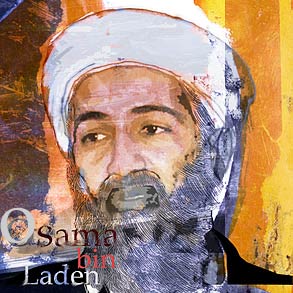

The American readers who have put Yossef Bodansky’s “Bin Laden: The Man Who Declared War on America” on bestseller lists across the nation are probably hoping that the book will tell them something about the inner Osama, the psychology of the man thought to be behind the terrorist attacks of Sept. 11. As my mother asked when I told her what I was reading, “Does it explain what makes him so crazy?”
But like all of the books and in-depth reports on bin Laden currently available, Bodansky’s was written before the attacks and published by a small specialty press; it wasn’t created with the demands of a general readership in mind. It’s odd to think of ordinary people across the nation dutifully plowing through this monumental conglomeration of facts looking for answers to why bin Laden would order the slaughter of thousands of American office workers just as they were finishing their first cups of coffee on a fine fall morning. Bodansky, an Israeli-born military analyst who is the director of the Congressional Task Force on Terrorism and Unconventional Warfare and has done consulting work for the U.S. departments of State and Defense, doesn’t really deal in that kind of explanation; he’s a professional speaking, for the most part, to other professionals and perhaps to the occasional buff. But burrow between the lines in “Bin Laden” and you can find clues about the character of America’s Most Wanted — intimations that paint bin Laden as a disturbingly impressive man.
First, let it be said that the book so many Americans are turning to in their efforts to learn more about our new archnemesis has its peculiarities. The title, for example, is misleading; throughout most of the book, bin Laden plays a decidedly supporting role. Often he vanishes for 20 or 30 pages at a stretch. It’s only in the later parts of the book that he takes center stage, and even then Bodansky doesn’t see him as the Napoleon of terrorism — Professor Moriarty in a turban and beard — as he’s been made out to be in the press. “Ultimately,” the author concludes, “the quintessence of bin Laden’s threat is his being a cog, albeit an important one, in a large system that will outlast his own demise — state-sponsored international terrorism.”
Bin Laden is a “cog,” Bodansky explains, because there is no such thing as an independent terrorist network capable of significant “spectacular” attacks. “Major terrorist operations,” he writes, “are conducted by agencies of states in pursuit of the long-term, strategic interests of the controlling and sponsoring states.” Since the Sept. 11 attacks, Bodansky has given numerous interviews in which he maintains that bin Laden “hasn’t got a penny” and that attention should be paid to the “states” that are footing the bill for his activities.
It’s clear from reading “Bin Laden” that the state Bodansky considers to be the primary culprit is Iran, and that his book is as much an indictment of that nation as of bin Laden himself. In order to provide deniability, the terrorism “controlled and sponsored by Iran” is “run via Sudan under the leadership of Sheikh [Hassan] al-Turabi.” If there’s a Professor Moriarty in Bodansky’s tale, it’s Turabi, the spiritual leader and de facto head of Sudan, a baby-faced cleric whose excellent English and cultured manner have lately made him a fixture in TV documentaries about militant Islamism. (“Islamism” — rather than “Islamic fundamentalism” — is the preferred term to use when referring to what’s essentially political extremism tied to religious ideology.)
Many experts on Islamist movements name Turabi as a significant coordinator of international terrorism, but this “Iran’s behind it all” scenario is dicier, which brings up the question of Bodansky himself. A former editor of the Israeli Air Force’s official magazine, he is hardly unbiased. He is reportedly an associate of superhawk Richard Perle, a former Reagan administration assistant defense secretary; the Arab-American Anti-Discrimination Association has gone so far as to suggest that he is an Israeli intelligence agent who helped run convicted Israeli spy Jonathan Pollard. This is another accusation that should be taken with a grain of salt, but one that gives a sense of how tricky this terrain can be. (Israel and Iran, of course, are implacable enemies: Iran set up and supports the radical Hezbollah organization, which is based in Lebanon and has battled the Israelis for years. Bodansky asserts that bin Laden plays a leading role in an Iranian-led group called Hezbollah International, which he asserts was established in 1996 at a terrorist summit to promote and coordinate terrorist activities around the world.)
If Bodansky is correct, Iranian intelligence leaders would have had to reach across not only the rift between Sunni and Shiite Muslims (Iran is Shiite; the Taliban and al-Qaida, Sunni) but between Islamists and the secular government of Iraq, which Bodansky depicts as an eager junior partner and newcomer to the conspiracies — all to advance a shared anti-Americanism. In that case, though, how would he explain the current warming of relations between Iran and the U.S.? (The latest example: Wednesday’s Wall Street Journal reported that the U.S. will ship wheat across Iran to help refugees on the Iran/Afghan border.) Is Iran’s hatred of the Taliban really enough to accomplish that?
Of course, in the strategic mare’s nest of the Mideast and Central Asia, any kind of doublecross is not only possible but quite likely to lead to resounding success, as the recent history of Pakistan (at least according to Bodansky) demonstrates. Bodansky maintains that in the late ’80s the ISI, Pakistan’s intelligence service and “a state within a state,” essentially tricked the CIA into funding training camps ostensibly for mujahedin warriors preparing to fight the Soviets in Afghanistan, but also used to train venomously anti-Western Islamist terrorists, many of whom were earmarked for operations against Indians in the disputed province of Kashmir. Others, “from all over the Arab and Muslim world,” were trained in Pakistani and Afghan camps, then sent to advanced training camps in Sudan and Yemen to be deployed elsewhere. The ISI, Bodansky says, “was actively courting and recruiting foreign Islamists” to train in the camps even after the “Afghan jihad was dwindling.” Saudi Arabia also funded the camps, at first hoping to protect its oil assets from the Soviets but eventually — and very foolishly — using the training centers as a way to siphon troublesome Islamists out of the kingdom and off to vent their zeal in the battles of faraway lands.
One of the most shocking examples of Pakistani perfidy related by Bodansky concerns a major offensive launched by the mujahedin on Jalalabad in March 1989, supposedly a “final push” against the Soviet-installed Democratic Republic of Afghanistan. Pakistan convinced the mujahedin’s light, irregular forces to launch a doomed attack, with the clueless backing of America and Saudi Arabia, against the “fortified defenses and large artillery forces in Jalalabad”:
Islamabad knew that such a frontal assault could only result in massive carnage of the attackers, who were not tightly controlled by Pakistan. As a result, the Afghan resistance that had endured almost a decade of fighting the Soviet-DRA forces was so decimated, it could no longer constitute a viable fighting force. The road was open for Islamabad to organize and field its own “mujahideen” force, now known as the Taliban.
Bin Laden is said to have participated in the battle, and according to Bodansky “witnessed and experienced the massive and essentially needless slaughter of dedicated mujahedin.” He and his spiritual mentor, Sheikh Abdallah Yussuf Azzam, “concluded that they were victims of a U.S. conspiracy, implemented through the Pakistanis.”
Like many of the stories Bodansky relates in “Bin Laden,” this one portrays bin Laden in an ambiguous light. The young Saudi’s grief and outrage are only natural, even if he directs them at an (allegedly) innocent party. It’s clear that, amid the schemers, weaklings, opportunists and tyrants of Bodansky’s Middle East, here is a man he can’t help but admire. Bodansky never attempts a real portrait of bin Laden, but from bits picked up here and there throughout this weighty book, an outline emerges nonetheless. The author describes bin Laden as “genuinely and selflessly committed to the cause of all-Islamic solidarity,” and as brilliant, judicious, modest, “efficient,” “loyal,” “resourceful” and “charismatic.” According to Bodansky, bin Laden’s proclamations are small masterpieces of Arabic prose, and the physical courage he showed in the Afghan jihad is legendary among his comrades. (Accounts of bin Laden’s fearlessness in battle have been contested in some quarters.)
To find any of this, however, readers will have to slog through vast deserts of lifeless prose listing the particulars of an endless parade of conferences and meetings at which, Bodansky insists, all the serious planning and authorization of international terrorism gets done. The sheer volume of detail Bodansky presents seems meant to balance out the fact that he relies largely on unnamed sources (many of whom appear to be Egyptian, as are several of bin Laden’s closest associates). While the need to protect vulnerable sources is understandable, this, along with the murky question of Bodansky’s own agenda, makes it hard to evaluate some of his more grandiose claims. One the other hand, some — like the links between the ISI and al-Qaida — are now making their way onto the front pages of major newspapers like the New York Times.
A less turgid and in some ways wider-ranging account of the current escalation in Islamist terrorism is “Unholy Wars: Afghanistan, America and International Terrorism” by John K. Cooley, a veteran foreign correspondent. Cooley harbors no theories about covert state-sponsorship of bin Laden, who he says has “effectively privatized global terrorism in the 1990s,” and he focuses more on the tentacles al-Qaida has extended into Algeria (where Islamists have participated in a bloody civil war) and the Philippines, another area of concern to the U.S. He also explores the role of the drug trade in financing a variety of Islamist and tribal insurgencies, something Bodansky barely goes into, perhaps because, given the CIA’s history of using drug money to finance its proxy forces, this would make it harder for him to depict the U.S. as a hapless victim of neglectful and uninformed foreign policy.
Following the intricate network of Islamist movements in over a dozen nations in the Mideast and Central Asia can be especially maddening due to the lack of standardized transliterations of Arabic names and the fact that many individual terrorists and organizations use multiple aliases. That makes “Usama bin Laden’s al-Qaida: Profile of a Terrorist Network” by Yonah Alexander and Michael S. Swetnam, although it is more of a dossier than a book, useful. It lists the various names al-Qaida members use, and when I found myself wondering why Mouhammed Atef, said by the New York Times to be suspected of masterminding the logistics of the Sept. 11 attacks, wasn’t even in the index of “Bin Laden: The Man Who Declared War on America,” it helped me figure out that Atef is the same man Bodansky calls Abu-hafs al-Masri.
Yet none of these books offers much more than the same basic biographical sketch of bin Laden that can be found in countless newspaper backgrounders. His father was a Middle Eastern Horatio Alger, a famously pious Yemeni bricklayer who emigrated to Saudi Arabia and became a billionaire construction magnate. The family company won the prized contract to restore the mosques in the holy cities of Mecca and Medina, and Osama proved to be as competent a businessman and project manager as his father. The 1979 Soviet invasion of Muslim Afghanistan galvanized his religious instincts, however, and he left for Central Asia to fight the jihad.
Dismayed when the Saudis invited the U.S. to fight off Iraq’s 1990 invasion of Kuwait and permanently alienated when he realized that the royal family would permit American troops to be stationed in the holy land of the Arabian Peninsula even after the Gulf War, bin Laden cut ties with his homeland and fled, first to Sudan and ultimately to Afghanistan. Some of the terrorist operations tied directly to him include: the 1992 bombing of a hotel in Yemen, a car bomb attack on the American-operated Saudi National Guard training center in Riyadh in 1995, the bombing of the Khobar Towers U.S. Air Force housing complex in Dhahran, Saudi Arabia in 1996, the simultaneous bombing of two U.S. embassies in Africa in 1998, the attack on the USS Cole in Yemen in 2000 and, of course, the attacks of Sept. 11, 2001.
It’s a grisly, monstrous résumé, and perhaps the most grotesque thing about it is that it belongs to a man who, according to Bodansky — no starry-eyed mujahedin, he — possesses so many sterling qualities. We’re used to tinpot bad guys like Muammar Qaddafi and Saddam Hussein, a strutting braggadocio and a sadistic dictator, both straight out of central casting. We can suspect them of intimidating their own people into going along with their policies. But it’s impossible to tell ourselves that Osama bin Laden doesn’t command a tremendous amount of sincere popular support among many Muslims, in part because he has some of the familiar traits of a hero, from his willing sacrifice of a life of luxury and ease to his incorruptibility in a region where crass self-interest usually comes first.
And yet all of this has been perverted in the service of religious fanaticism with a horrible indifference toward human suffering. The experts and journalists who have written the existing books on bin Laden have laid out the facts and their strategic implications, the vast chessboard where all these players make their moves. But we’ll need another kind of writer, another kind of thinker and, I suspect, a whole new understanding of evil, to map the shadow lands of the inner Osama.
