
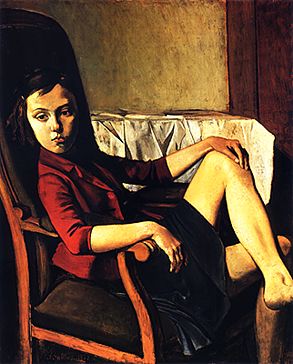

Surrounded as we are by blatant and pervasive sex, looking back at the work of Balthus can give us respite — and a more nuanced, playful vision of eroticism.
All the great modernist painters of the 20th century — Picasso, Dali, Matisse — drew frequently from the female nude and erotic themes for their art. Balthazar Klossowski, aka Balthus, presented a new vision that blended explicitly erotic and high art. His paintings are full of women and girls with their bodies on display, but they meander between the erotic and a direct confrontation of his audience. One of his hallmarks is a testy, teasing, relationship with his audience as he pulls them between considerations of the sexual and exquisite compositions in the same moment.
A new book is out from Rizzoli to accompany the largest exhibit of his work (now at the Palazzo Grassi in Venice through Jan. 6, 2002) and to commemorate his death in February, 2001.
Balthus’ most notorious and compelling painting, “The Guitar Lesson,” is a perfect example of his vision. It presents a woman with a girl draped over her lap. The girl’s skirt has ridden up to her belly as the woman pulls her hair and has her hand poised over the girl’s vagina. The girl’s hand is raised to pinch the woman’s erect nipple.
In a letter as he was preparing the painting Balthus described it as “a rather ferocious one.” “It’s an erotic scene. But you have to understand, it is not in the least quirky, none of the usual little naughtiness you show around under cover with winks and nudges. No, I want to proclaim in broad daylight, with sincerity and feeling, all the throbbing tragedy of a drama of the flesh, proclaim vociferously, the deep-rooted laws of instinct. Thus to return to the passionate content of art. Down with the hypocrites!”
The son of a highly cultivated family and a pupil and friend of renowned German poet Rainer Maria Rilke, Balthus arrived on the scene a young 26 at a fevered moment in the history of art. He had been a painter since he was 16, encouraged by a mother who also painted. He was also surrounded by many major cultural figures such as Rilke, who helped publish his first ink drawings in 1921, and painter Pierre Bonard, who further nurtured his talent.
As he gained his first successes as a painter in 1934, modernist art movements captivated Europe. The Bauhaus and expressionist movements had swept Germany, futurists were ardently followed by the cultural elite and future dictator Benito Mussolini in Italy, while France played host to a grand collection of artists and intellectuals like Man Ray, Picasso and Matisse. Most major artistic and creative movements in Europe were focused on defining the new and breaking from the old, classical orders that dominated 19th century culture.
While nearly all of these artists and groups were drawn to the erotic in one way or the other, Balthus made it his priority to present it as high art. His was a constant campaign to bring two potentially disparate camps together; for him they probably coexisted naturally. He called the erotic the “passionate content of art” and he gave it a passionate form. “The Guitar Lesson” is a rigorously classical composition, one borrowed from the pietá in the Western tradition, dressed with references to Dutch still life paintings and thoroughly informed by classical perspective. By combining his own sense of eroticism with formal elegance, Balthus got to have his cake and eat it too.
Balthus also played with nudes, confronting the viewer with the implied question: what is more erotic, nudity or suggestion? “Alice in the Mirror” confronts you with a seminude woman, her naked pubes at the exact center of the painting and a breast staring back at you. But her eyes are a dirty, cloudy blue that almost obscures the pupils entirely and suggests either an ethereal calm or complete removal.
The centrality of the nudity in this painting puts sex front and center, but there’s also the setting of the painting: Alice stands with one foot on a chair in a bare corner brushing out her hair. For a contemporary viewer it might elicit ruminations about how women’s identities are tied to their bodies or how we use nudity as a symbol for sex, but the original buyer, Pierre Jean Jouve, thought otherwise and described the painting as “having such an intense carnality, that I considered ‘Alice’ as being my companion.”
But Balthus plays a two-front game. He’s not merely concerned with carnality but with an exquisite form or vehicle for that eroticism. Despite his comments about “The Guitar Lesson” he also made other, more accommodating remarks that demonstrate his keen sense that his paintings’ subject matter might obscure the grace of their execution. In a letter about “Alice in the Mirror” he wrote, “I don’t believe it is obscene and I think the grave, severe atmosphere it is steeped in is such that even a young girl can look at it without blushing.”
It’s the clothed women in Balthus’ paintings that appear most erotically charged. In “Therese” a young girl stares languidly out of the canvas as her skirt slides up her thigh. A companion painting of the same model shows her sitting with eyes closed and legs open so that you can see her underwear as a cat laps milk from a bowl in the foreground.
Still other paintings of the same model like “Therese on a Bench-seat” feature her alone and oblivious to the viewer, apparently in a moment of quiet contemplation or lazy repose while her skirt inches up her thigh. Your eye moves instantly to the point where the skirt stands ready to reveal more — both because that’s the land of erotic potential, but also because Balthus has used composition, drawn it seems from early Dutch portraiture, that draws a viewer’s eyes where he wants them.
Balthus was forever borrowing and twisting the past into his version of an incredibly erotically charged present. You sense a man in full charge of his obsessions who gains even more power and release from playing his fantasies out on canvas and having viewers, buyers and connoisseurs share in his game and pleasure. Indeed, he painted erotic subjects right up to his death in February. His last, unfinished painting depicts a nude woman asleep on a couch, a mandolin about to fall from her hand.
That’s what’s so extraordinary for a contemporary viewer. Today we can easily find pornography to fulfill carnal urges. And artists today used nudity for political purposes as well as titillation. But it’s rare to find an artist both skilled and daring enough to breathe a vivid life into his erotic fantasies with formal elegance.
