
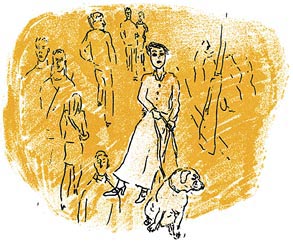

“Every baby is born with bread under his arm.” Eddie reminded me of this Spanish saying whenever we talked about our shaky financial future. I was due to have our first baby in the fall, and we were concerned because I’d be unable to work at that point.
As it turned out, the saying proved true: When our son was born in October, I no longer worked. But there was enough money to take care of all of our expenses, and the promise of more money to come. Eddie, who died on Sept. 11, became the bread under our son’s arm.
It is a bizarre time in my life: My beloved husband goes to work and dies when a plane hits his building. Then, as I attempt to deal with the loss, and learn the art of single motherhood, checks arrive in the mail, in various amounts, on a regular basis. One day I may receive $1,500 from the Cantor Fitzgerald Relief Fund and $1,000 for supplemental needs from the Red Cross. Another day I may receive more — from the United Way September 11th Fund, the New York Crime Victims Board and Social Security. And while the money comes in — from government agencies, charities and special funds set up in the aftermath of the tragedy — there is an additional chunk of change to be had from the Federal Compensation Fund, provided I accept it rather than choose to sue.
The arrival of each check reminds me of the debate about why 9/11 families are so significant, specifically as compared with families touched by the Oklahoma City bombing, and all other tragedies, past and future. Who deserves how much? I don’t know. But it is certain that I am fortunate, along with the rest of the unfortunate affected by Sept. 11, to be associated with this particular tragedy instead of one that is somehow less important in the public imagination.
The checks also make me think about the way Eddie died, compared with all the possible ways he could have died but didn’t. I think about the near misses of the year: What if Eddie hadn’t gotten up after falling face first when he went skiing last winter? What if he had fought the crazy, threatening guy at the pizza place last spring? What if he had hit the embankment on the parkway, with me in the car beside him, last summer?
A death of happenstance rather than of terrorism would have yielded significantly different results. Certainly there would not be all these checks in the mail. Instead it would have been quiet and calm. I would not have found myself so high in the hierarchy of the nation’s sadness and sympathy, a grieving widow with a post-9/11 baby, a newly minted American icon. This is the last thing I could ever imagine being; the last thing I could ever possibly want.
The only thing familiar to me these days is walking my 10-year-old dog, if, that is, I don’t bump into the neighbors who either offer consolation for the death, or congratulations for the birth, or, very awkwardly, both. When I make a foray through Manhattan, I feel assaulted by the post-9/11 flags and all the rest of the godblessamericana. It’s a marketing motif for store-window displays, some of them doubly dizzying dioramas of flag fashion in front of flag backgrounds. Frayed flags hang off antennae; there are little pins, patches, lots of jewelry.
The flags and WTC-ware keep me stuck in a place I don’t want to be. They stifle me so that my wounds cannot even begin to heal. Each item takes me back to how this all began, the phone call from my brother asking, “Didn’t Eddie just start working there?” My tragedy is personal, but I am forced to discover its terrible dimensions on the nightly news, in the daily papers and in every publication on the newsstand.
It may even be that I was forced to witness my husband’s final moments on the printed page. About a week after the tragedy, with no news about Eddie, I looked at a friend’s Time magazine. I had shielded myself from the images, listening to the radio instead for all the new developments. But this time, for some reason, I looked.
In the magazine, there was a photo with little people in the air, like fairies, on their way down from the tower. One person seemed to be hanging off the building, just about to jump. It was hard to see the details, but he had on a shirt the color of the shirt my husband wore that day — that jewel-colored electric blue that was so popular among the corporate casual. The man in the photo also had the same hair and skin tone as my Eddie. And there he was, grim-expressioned, ready to sky-dive with no parachute.
A few days later, detectives called me to say Eddie’s body had been recovered. His death certificate read: “Immediate cause: Multiple blunt trauma to head, torso and extremities.” He had jumped.
I still think about that image in Time. I’m sure that if I really want to verify it, Time would help me and perhaps would even be able to provide me with a whole series of photos, the entire sequence of the fall, fully documenting his actual death. I am sure the images would help me — force me — to accept Eddie’s death, still so unreal. But at the moment, I want nothing to do with them.
Now I am waiting for the WTC movie to come out, hoping it won’t be about me. I feel so exposed. I cynically imagine a request from Playboy to pose on red, white and blue satin, patriotically baring myself to suckle my post-9/11 son. And then I seriously wonder who will be the first among the families to do it.
Along with flag-waving, donating to victims’ families is now part of America’s patriotic duties. America wants us to be OK, economically sound, happy and sane. If we’re OK, somehow, by extension, all Americans will be OK too. It’s America’s way of healing.
I’d like to think that for every flag, there is at least $1 that may come my way. For every word in print, $5; for every sound bite, $500; and for every image, $1 million. In this way, I see the money I receive as royalties from feeding America the sort of media that it desperately needs to consume, day after day. It is the bread under my son’s arm, a blighted blessing that feeds us, day after day.
If Eddie had lived, we probably would have financial problems now, unless, of course, we won the lottery. They used to say, especially when the lotteries reached crazy amounts, that you have a better chance of being killed in a terrorist attack than winning the jackpot. If so, does that mean that my odds have now improved?
As I accept the money that admittedly helps — a lot — and stomach the sympathy that goes with it, I wait for the time when our stories will grow stale and I am left alone to normalize my life. After all, despite the emotional stirrings aroused by Sept. 11, America is still the home of the quick fix. Then again, as this new world birthed by the tragedy matures, I’m not so sure that I will be allowed to withdraw into anonymity. Sept. 11 may instead expose me forever, and leave my loss like ground zero, wide open to the public.
