
Sex
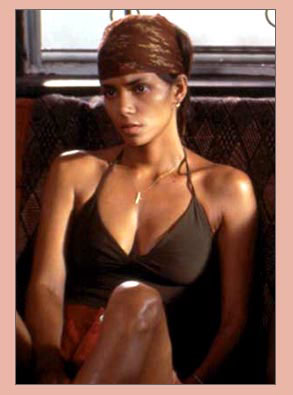
Hail Halle
We are looking at one of the more beautiful women on Earth: We know it -- and she knows it.
After just one viewing, I wouldn’t want to leave the impression that “Monster’s Ball is without fault. The final impression is that the movie has settled for a very appealing hope that “everything” between black people and white people can be all right one day. There are several implausibilities in the plot. I didn’t feel that Heath Ledger was or could be Billy Bob Thornton’s son — younger brother, maybe. And maybe there are too many convenient deaths in a short span of time that set the Thornton and Halle Berry characters up to be the great black and white hopes of our time. But I’ll forgive those things, and I’ll admit that I never thought Berry could be this good or touching. Then I want to say that the picture has the best lovemaking scene in too long.
I need to fill in some story background — but I won’t give away the very suspenseful ending. Somewhere in the rural South (it doesn’t quite feel like now), Billy Bob and his son are corrections officers at the state prison. (It is a family tradition: Billy Bob’s invalid father, Peter Boyle, did the same job once.)
An execution is looming, that of a black man, visited by his wife and their obese son of about 12. It’s another plot hole that Thornton never sees these visitors, or they him.
The black prisoner is electrocuted. Billy Bob is in charge of the execution, and Ledger throws up at the event. Billy Bob curses him out for such weakness. They fight. Billy Bob admits he hates his own son, and Ledger kills himself.
Shortly thereafter, Berry’s son is killed in a hit-and-run accident, after which a rather helpless or trapped Billy Bob takes them to the hospital. We are meant to feel he has been changed by the two deaths, and so he and Berry are quietly drawn together.
Billy Bob is very good. It is asking a lot — too much, even — to have a thorough bigot and redneck turned into the spirit of kindness on a dime. But just as Thornton gave us real (and tedious) nullity in the Coen Brothers’ “The Man Who Wasn’t There,” in this picture he is palpably present, sinking back into a kind of solitude, or grief, in which he might plausibly discover a better person. It’s all too quick, but it’s an honorable change for which the actor is working.
Then there’s Halle Berry. Even with modest makeup and dark circles under her eyes, this is Halle Berry — which is enough to stretch imagination that she passes as a nonentity in this southern backwater. We are looking at one of the more beautiful women on Earth: We know it — and she knows it, no matter how diligent she is at being anonymous. Never mind, for in that effort she has found a way of moving (sluttish, bored, aimless) and a way of speaking (melancholy, uneducated, lazy) that makes a believable flake — a pretty kid out of her depth. But an actress so assured that she can reach out and in one great needy embrace wrap up and consume the greater reticence or uncertainty in Thornton.
We know they’re going to make love, and there’s a way in which we know that once we see the half-naked Berry the real truth about her fruit is going to overwhelm the small-time narrative setup. But the ways in which Berry presents us with a wrecked creature, groaning, grunting, hissing, moaning for relief or abandon is not just heartbreaking and arousing. It’s enough to make us forget that she looks like a goddess. The scene is very powerful (and it plays off the ways, earlier, that Thornton and Ledger have used the town’s drab prostitute). Berry’s character demands confrontation, full frontal embrace. She wants it all. And it is in her plunging down to some erotic base line that the film does really locate a bond between blacks and whites that gives cause for hope.
It takes a very strong scene indeed to absolve a confused movie from so many faults. Go see and hear for yourself.
David Thomson is the author of "A Biographical Dictionary of Film" (new edition just published), "Rosebud: The Story of Orson Welles" and "In Nevada." More David Thomson.
Massage therapists rubbed wrong by sex talk
A Jennifer Love Hewitt show and the Travolta allegations have masseuses tired of being confused for sex workers
(Credit: iStockphoto/sybanto) Joe, a licensed massage therapist, knows what it’s like having a famous client who expects something extra. He had an Academy Award-winning actor begin gyrating on his massage table before raising his hips in the air to show off his erection. “He was hoping that I would play with him in some shape or form,” he says.
Needless to say, Joe isn’t surprised by allegations by two masseurs that John Travolta got handsy during massages. (Travolta’s attorney has denied all the allegations, and called them “ridiculous.”) “It happens all the time,” he says, and not just with celebrity clients. He frequently encounters men who try to fondle him, usually while he’s working on their glutes or lower back and their hand happens to be level with his crotch. “They think they’re so original, but they’re all so much the same,” Joe says, his voice rising. “They all use the same tactics, the same body movements, the same gyrations and grinding my table, the [heavy] breathing.”
Continue Reading Close
Tracy Clark-Flory is a staff writer at Salon. Follow @tracyclarkflory on Twitter. More Tracy Clark-Flory.
A night at the vibrator museum
Early vibrators were hand-cranked, two-person jobs -- and prescribed by doctors. How far we've come since then
(Credit: Antique Vibrator Museum) I can now say that I’ve used a turn-of-the-century vibrator — on my hand, but still.
The silver, hand-cranked contraption is usually kept behind glass at Good Vibrations’ Antique Vibrator Museum in San Francisco — but staff sexologist Carol Queen made a rare exception. “This is very special,” she whispered, unlocking the case and carefully pulling out Dr. Johansen’s Auto Vibrator, a relic from 1904. The “auto” part is not so much: It was a two-person job, with her having to crank the device’s handle to get it thrumming. Pressing my finger tips to its inch-wide circular platform of pleasure, I was pleasantly surprised by its power.
Continue Reading Close
Tracy Clark-Flory is a staff writer at Salon. Follow @tracyclarkflory on Twitter. More Tracy Clark-Flory.
Maggie Gyllenhaal on sexual liberation
The beloved indie star tells Salon about her "vibrator movie" and why she loves playing transgressive women
Maggie Gyllenhaal (Credit: Reuters/Mark Blinch) When I met Maggie Gyllenhaal about six weeks ago, she was enormously and gloriously pregnant, stretching out on a sofa with her shoes off and feet up in a Manhattan office building. (Since that time, Gyllenhaal and husband Peter Sarsgaard have welcomed their second daughter, Gloria Ray, to the world.) We were there to talk about “Hysteria,” the charming, lightweight feminist farce from director Tanya Wexler that explores a key event in the history of female sexuality: the invention of the vibrator by Mortimer Granville, a Victorian doctor who was seeking to cure the mysterious “female malady” that lends the movie its title.
Continue Reading CloseMother-daughter sexperts
Susie Bright and her daughter, Aretha, make parental talks about sex look easy -- and fun
Most parents loathe talking to their kids about the birds and the bees, let alone pubic hair grooming, faked orgasms and “water sports” — but most parents are not legendary “sexpert” Susie Bright.
Better than talking about these things, she penned an advice column in 2009 with her daughter, Aretha, then 19, for the ladyblog Jezebel. Their answers to questions about everything from porn to Paxil were unflinching but playful, and at times controversial. Now the pair have collected those columns into a new e-book, “Mother/Daughter Sex Advice.” Together, they read as an irreverent version of “Our Bodies, Ourselves” for the Internet age. The mother-daughter team also reflect on what the experience of writing the column was like, and it turns out it wasn’t as weird as many would think: For the most part, it was just a continuation of conversations they had been having throughout Aretha’s life.
Continue Reading Close
Tracy Clark-Flory is a staff writer at Salon. Follow @tracyclarkflory on Twitter. More Tracy Clark-Flory.
On the rack: A cultural history of breasts
Did breasts evolve for lactation or to enhance sex appeal? A new book explores why they matter
(Credit: iStockphoto/NadyaPhoto) It’s hard to be boobs. Sure, breasts are cherished as givers of milk and the pinnacle of sex appeal, but the modern world hasn’t been good to mammaries.
As Florence Williams writes in “Breasts: A Natural and Unnatural History,” they’re the most tumor-prone organ in the human body. They “soak up pollution like a pair of soft sponges,” and transmit environmental toxins to babies through breast milk. “Breasts are bellwethers for the changing health of people,” she says. While we’ve “genetically modified our crops to be able to protect them from the ill effects of pesticides,” Williams writes, “we haven’t yet figured out how to modify our breasts.” Aside from using saline and silicone, of course.
Continue Reading Close
Tracy Clark-Flory is a staff writer at Salon. Follow @tracyclarkflory on Twitter. More Tracy Clark-Flory.
Page 1 of 403 in Sex