
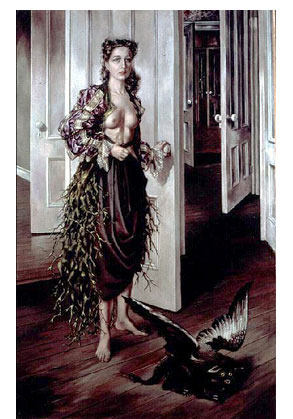

Dorothea Tanning’s paintings and sculpture are featured in “Surrealism: Desire Unbound,” a major exhibition that opened Feb. 6 at the Metropolitan Museum of Art in New York. She is one of the only surviving members of the movement that, more than 60 years ago, turned the perceived world — as well as the art world — on its ear.
“As for still being here,” says Tanning, 91, “I can only apologize.” And as for surrealism, maybe the movement itself should apologize to Tanning for casting such a long shadow over her subsequent efforts as a painter, sculptor and printmaker, and more recently, as a writer and poet.
Today, she still paints and draws, and attends exhibitions of her work from the last few decades — images that almost always evoke the female human form. But mainly she has been building a literary career for herself enviable to any young writer.
Her poetry has appeared in many publications, including the New Republic, the Yale Review, Partisan Review and the Paris Review. Last year, she was selected for inclusion in “The Best American Poetry 2000.” And last fall, Tanning published “Between Lives: An Artist and Her World,” a memoir of her long, heady and, one must say, romantically bohemian time on Earth.
Born in 1910 in Galesburg, Ill., Tanning moved by herself to Chicago at the age of 20 to study painting, where she met her “first eccentrics,” she writes in her memoir. “They float through antic evenings to the sound of jazz and the tinkling of glasses containing icy drinks.” A few years later, alone again on a bus and with no planned accommodations, she went on to New York.
In Manhattan, eking out a living doing advertising illustrations and trying to paint on the side, she “ate curry powder sandwiches, took Hindu dancing, read the ‘Bhagvad Gita’ and Emily Dickinson, impartially.” She also went to see the 1936 “Fantastic, Dada, and Surrealism” show at the Museum of Modern Art. She was well aware of the movement, “but here, here in the museum,” she writes, ” … are signposts so imperious, so laden, so seductive, and yes, so perverse that … they would possess me utterly.”
Her subsequent paintings caught the eye of gallery dealer Julien Levy. These include the well-known 1942 self-portrait “Birthday,” which showed her bare-breasted in a skirt of roots and a Elizabethan-looking jacket, surrounded by doors and thresholds, and with a rather strange friend: a lemur with wings. Through Levy she fell in with the French surrealist expats and other emerging artistic types such as, as she recalls, “Yves Tanguy, Max Ernst, Kurt Seligman, Bob Motherwell … Peggy Guggenheim, Max Ernst, Max Ernst.”
She and the dadaist icon Ernst became inseparable, and soon got married in a double wedding with photographer and painter Man Ray and Juliet Browner. Tanning found herself part of an inner circle that included André Breton, Marcel Duchamp, Joan Miró and René Magritte, and became friends with figures such as Salvador Dali, Pablo Picasso, Joseph Cornell, Dylan Thomas, Truman Capote and choreographer George Balanchine.
After the war, she and Ernst moved to France, where they lived for 28 years. Tanning’s work from this period is included in the collections of the Museum of Modern Art, the Tate Gallery in London, the Georges Pompidou Center in Paris, the Menil Collection in Houston, the Philadelphia Museum of Art and many others. During the ’40s and ’50s, she also created costume designs for Balanchine. She began making sculptures in the early ’70s — fabric and cloth pieces that conjured up limp ballet-dancing forms.
Tanning moved back to New York in 1979 after Ernst’s death. Among others, she found a friend in Pultizer Prize-winning poet James Merrill. It was Merrill “who more than anyone at that point of my life, made me realize that living was still wonderful even though I felt that my loss, Max, had left nothing but ashes,” she says. “So if I took up brushes again, and the pen, to work for 20 more solitary years — and am still at it — it was Jimmy who made me want to, and so proved himself right.” Tanning began to write and published her first book in 1986, a collection of reminiscences called “Birthday,” after her most famous painting.
“Youth is certainly the big Y word around here these days,” she says. Nevertheless, she is “not disappointed. I think I’ve been a renaissance man — if he could have been a woman.”
At the age of 91, how do feel about carrying the surrealist banner?
I guess I’ll be called a surrealist forever, like a tattoo: “D. Loves S.” I still believe in the surrealist effort to plumb our deepest subconscious to find out about ourselves. But please don’t say I’m carrying the surrealist banner. The movement ended in the ’50s and my own work had moved on so far by the ’60s that being a called a surrealist today makes me feel like a fossil!
Surrealism must have had a strong appeal for you at the time.
When I saw the surrealist show at MOMA in 1936, I was impressed by its daring in addressing the tangles of the subconscious — trawling the psyche to find its secrets, to glorify its deviance. I felt the urge to jump into the same lake — where, by the way, I had already waded before I met any of them. Anyway, jump I did. They were a terribly attractive bunch of people. They loved New York, loved repartee, loved games. A less happy detail: They all mostly spoke in French. But I learned it later.
You came to New York to be an artist in the midst of the Depression — just got on a bus one day from Chicago — with no plan and without knowing where you would stay. I don’t imagine there were many young woman doing that. Did you see yourself as a pioneer?
Not a pioneer but headstrong. Now when I look back, I’m amazed at my stupid bravery, going off like that with just $25. My head was full of extravagances, I’d read Coleridge and a lot of other 19th century dreamers and I had to be an artist and live in Paris. So New York was on the way. I finally got to Paris, just four weeks before Hitler started his March. Americans were told to go home; I went to my uncle’s in Stockholm on a train with Hitler Youth. I got the last boat out of Gothenburg in September of 1939. In 1949, I went back to France and stayed there for 28 unbelievable years.
You write in your recent memoir that, even in those days the art world was “a kind of club based on good contacts, correct behavior, and certain tactical chic.” How chic were you in those days, Ms. Tanning?
Chic! I didn’t have any money to throw away on frivolities. I wore discount $5 dresses from a wonderful place on Union Square called Klein’s. Also thrift shop stuff. A few of us took to wearing old clothes, but they had to be really old, from another time, way back. We’d show up in these rags as if it were perfectly natural. You had to be deadly deadpan about it. One of these appears in my painting “Birthday.” It was from some old Shakespearean costume.
Well, excuse me for this, but “Birthday” is among other dreamlike things, a topless self-portrait. Is it fair to say that at that time, 1942, people thought you were immodest?
Well, I was aware it was pretty daring, but that’s not why I did it. It was a kind of a statement, wanting the utter truth, and bareness was necessary. My breasts didn’t amount to much. Quite unremarkable. And besides, when you are feeling very solemn and painting very intensively, you think only of what you are trying to communicate.
So what have you tried to communicate as an artist? What were your goals, and have you achieved them?
I’d be satisfied with having suggested that there is more than meets the eye.
In your memoir, you advise pretty girls who want to be artists to get ready for a lot of frustration. How frustrated were you?
I don’t want to give the impression that I was a beauty. Just the same, I always noticed a curious reaction as if there were something unnatural about a really nice-looking girl doing something dead serious. It may be different today. Or maybe there are more pretty girls.
Is there any specific advice you can give to artists and writers cursed with good looks?
Yes. Keep your eye on your inner world and keep away from ads and idiots and movie stars, except when you need amusement.
I imagine you have struggled with the label of being a “woman artist” as well as the “wife of” Max Ernst, who was a founder of surrealism and a seminal figure in 20th century art. Would things be different for you today?
Yes and no. You need fortitude and patience. This goes with a big dose of indifference to the art world; you absolutely need that indifference. If you get married you’re branded. We could have gone on, Max and I, all our lives without the tag. I never heard him use the word “wife” in regard to me. He was very sorry about that wife thing. I’m very much against the arrangement of procreation, at least for humans. If I could have designed it, it would be a tossup who gets pregnant, the man or woman. Boy, that would end rape for one thing. And “woman artist”? Disgusting.
Many people have been using the word “surreal” to describe the events of Sept. 11th. The horrors of the world wars were a factor in bringing about dadaism and surrealism. Do you think artists will have a similar impulse now?
“Surreal” has become such a buzzword. There may be a need for something equally moving but certainly not for going back to something. Anyway, yes, there is certainly a need for hard and different thinking after what has happened and before what may happen.
But what kind of thinking? You’ve lived through the Depression and several wars. What is the role of art in such times?
Art has always been the raft onto which we climb to save our sanity. I don’t see a different purpose for it now.
What do you think of some of the artwork being produced today?
I can’t answer that without enraging the art world. It’s enough to say that most of it comes straight out of dada, 1917. I get the impression that the idea is to shock. So many people laboring to outdo Duchamp’s urinal. It isn’t even shocking anymore, just kind of sad.
As you mentioned, there was a lot of shock value in the work of the dadaists and the surrealists that you fell in with. Was that somehow different?
In its beginning, surrealism was an electric time with all the arts liberating themselves from their Snow White spell. There is a value in shaking people up, meaning those who have forgotten to think for themselves. Shock can be valuable as a protest. Like the dada fomenters, sitting there in the Cafe Voltaire in 1917 — their disgust with the world they lived in, its lethal war, its politics, its so-called rationales. Shock had value at that time. But ideas and innovation will always prevail without any deliberate effort to shock.
What about folks like Dali, walking his lobster on a leash?
Dali used his silly shenanigans to get publicity, to which he was extravagantly addicted. He made some sublime paintings, he was a master painter and his exhibitionist tricks didn’t enhance him as a person or as an artist. It was a pity really.
What’s your take on recent controversies at the Brooklyn Museum: the “Sensation” exhibition, the elephant dung and the more recent Last Supper in which the artist portrayed herself, nude, as Jesus Christ?
The Brooklyn show was blatantly shock-hopeful. And our mayor took the bait like a fish. I probably would not have liked it any more than the mayor if I’d bothered to go.
Were you in favor of the Guiliani’s moral standards panel on art?
Hitler banned and burned “degenerate art.” Stalin did the same. I suppose they had their moral standards too. I can only say that if a work doesn’t make being sane and alive not only possible but wonderful, well, move on to the next picture.
We live in an age when so many people seem to want to be artists of some kind. Why do you think that is? And what does it say about our culture?
All these young hopefuls swarming the big city and getting nowhere fast; that’s such a sad thought. But if there has been a big surge in the number of people making art, it’s because our prosperity has released so many of us from need. It has allowed our creative impulses to test themselves without starving the body. Many people find joy in actually doing something the pragmatist would call useless.
We are also obviously living in a society that prizes youth. Has this larger cultural bias had any effect on you in recent years?
You are so right. Even old people want to be teenagers. But if my memory serves me well it wasn’t all that glorious. To my surprise, I have come to like being old. You can do what you want.
You have been friends with so many important cultural figures. May I ask you to play a little pseudo-surrealist free-association game? How about your husband Max Ernst?
His humor. Ironic, amused, bemused. We laughed a lot. Even today, I have to keep from finding things absurd, which mostly they are. At the same time I’m crying my eyes out.
How about André Breton, founder of surrealism and dadaism?
Severely: “Dorothea, do you wear that low neckline just to provoke men?”
René Magritte?
Sweet.
Truman Capote?
A neat little package — of dynamite.
Orson Wells?
Scowler.
Joseph Cornell?
The courtly love of the 13th century troubadours.
Dylan Thomas?
How could anyone resist his bardic exuberance, his dithyrambs?
Duchamp?
Peerless.
Picasso?
One time when I was at his house, Jhuan-les-pins, for an afternoon visit, we stood at the kitchen door yard for farewells and he broke off the last flower from an old rose bush and handed it to me. How would you feel?
James Merrill?
Best poet, best friend, best fun. He died much, oh much, too soon: seven whole years ago.
What are you working on now?
I still write poems. Not that I overestimate them, but it gives me such pleasure why deny myself? The other day I read a beautiful pair of lines by Stanley Kunitz: “I have walked through many lives/some of them my own.”
If you could change anything in your life, or lives, what would it be?
More color in my dreams.
