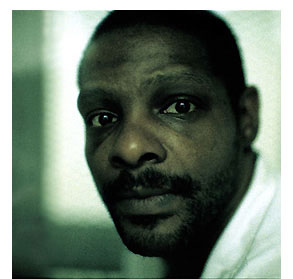

As the number of death-row prisoners exonerated by DNA evidence continues to mount, some innocent inmates are still being freed the old fashioned way, when new evidence emerges to implicate another suspect, or supposed witnesses recant their stories. But Joseph Amrine, a black man convicted by an all-white jury of killing a fellow prison inmate 17 years ago, still sits on Missouri’s death row, even though all the witnesses against him now say he didn’t do it, new witnesses have identified another inmate as the killer, and at least three of the 12 jurors who convicted Amrine, including the jury foreman, now say they think he is innocent.
Death penalty opponents say Amrine’s case is among the most egregious examples of the flaws in the nation’s capital punishment system. His legal appeals completely exhausted, Amrine’s fate now lies in the hands of Missouri Gov. Bob Holden, a pro-death penalty conservative Democrat who has been authorizing executions at a rate of about one per month throughout his term, and who has yet to commute or even stay a single prisoner’s sentence.
Amrine, now 45, was serving a short sentence at the Missouri State Penitentiary (now known as Jefferson City Correctional Center) for check kiting when he was accused of the October 1985 knife slaying of Gary Barber, a fellow prisoner. He is facing execution despite the fact that the three prisoners who testified against him at his trial have subsequently recanted their testimony. They say they were pressured by prison authorities to lie, and then rewarded for it.
The way Amrine’s lead appellate attorney, Sean O’Brien, describes his client’s legal odyssey might be darkly comic, if a man’s life wasn’t at stake. When the first two of the prosecution’s three witnesses recanted their testimony, the federal judge hearing Amrine’s appeal, Fernando Gaitan Jr., ruled that they weren’t credible, because the third witness had not disavowed his testimony that Amrine was the killer. But later, after that third witness came forward to say that he too had lied at the trial, the same Judge Gaitan ruled that this recantation was not credible. The judge went on to muse that none of those recanting could really be believed because they were all prison inmates, and thus inherently not believable — reasoning that of course could have been used to dismiss their earlier testimony against Amrine, but wasn’t. Gaitan also ruled that he didn’t need to reconsider the earlier recantations, in light of the third one, because he had already considered and rejected them, so they were no longer “new.”
The St. Louis Post-Dispatch, after describing Gaitan’s rulings in a May 5, 2000, editorial headed “Executing Without Justice,” asked rhetorically, “Should the state execute a person when no evidence is left standing against him?” But that appears to be exactly what Missouri is set to do. Amrine, who was featured in controversial Benetton ads spotlighting death-row prisoners in 2000, could be executed as soon as the governor signs off on a state Supreme Court death warrant, which could happen at any time.
Amrine’s case is important beyond his own personal situation, because the 8th Circuit Court of Appeals actually used his appeal in establishing an important precedent limiting the ability of criminals to introduce new evidence of their innocence. A three-judge panel held that the testimony of other inmates who say they saw another prisoner, Terry Russell, kill Barber was not sufficient to require a new hearing, because the defense could have obtained that evidence at the original trial, through due diligence, but did not. Despite acknowledging that Amrine might well be innocent, the appeals court ruled that the witnesses who might prove that could not be heard.
Legal experts say that precedent placed a chilling new limit on death-penalty appeals. In plain language, it means there may be eye witnesses to a murder discovered after a trial, who were never heard by a jury, who can attest to a person’s innocence. But if for some reason the defense overlooked them or failed to call them at the trial, the person should die anyway.
While experts disagreed with the appellate court’s decision on that point, many of them back the panel’s contention that the public defender in the case, Julian Ossman, failed to give his client the best possible defense. At the time of the 1986 Amrine trial, Ossman was the Cole County public defender. Six of his clients currently sit on death row, and two of his clients’ death-penalty convictions have been overturned at the federal level, including one by the 8th Circuit, on the grounds that they had ineffective counsel.
Jurors say in Amrine’s case, Ossman didn’t introduce evidence to challenge prosecution witnesses, failed to interview and thus prepare defense witnesses before putting them on the stand, and made little effort at the penalty phase of the trial to provide evidence of mitigating circumstances against the imposition of the death penalty. Efforts to reach Ossman by phone were unsuccessful.
Now Larry Hildebrand, one of the jurors who helped convict Amrine, is adamant that the governor needs to grant a pardon in this case. “At a minimum he deserves a new trial,” he says. “All the witnesses are saying something different now, and if they’d been saying what they’re saying now, I never would have voted to convict him.”
Hildebrand, a Catholic who says he supported the death penalty back in 1986, now says he opposes it, based in part on the Amrine case. “If we kill Joseph Amrine, we’ll have killed an innocent man, and that would be the end of it,” he explains. “Saying ‘oops’ at that point isn’t enough!”
But Scott Holste, a spokesman for the Missouri Attorney General’s Office, which has been defending Amrine’s conviction against appeals for 16 years, says there is no reason Amrine should be spared. He says that the courts have ruled on the recanted testimony of the prosecution’s witnesses, determining that those recantations are not credible. But he says that his office will not interfere with the governor’s decision on Amrine’s parole petition, unless asked for an opinion by Gov. Holden. “It’s in the governor’s authority to grant pardons, and that’s a decision he has to make,” Holste said.
Certain facts of the case are not in dispute. On Oct. 18, 1985, Gary Barber, Joseph Amrine and the three witnesses who testified against Amrine at his trial — Terry Russell, Randall Ferguson and Jerry Poe — were all in the prison recreation room, along with several other inmates. At some point, Barber was fatally stabbed with a knife. He briefly attempted to chase his assailant, then collapsed and died.
A prison guard, John Noble, did not see the actual stabbing, but saw the chase. He told other guards that the man running from the scene of the crime was Terry Russell, who was subsequently taken into custody and read his Miranda rights. There were other witnesses who claimed they actually saw Russell stab Barber, but for reasons that remain unclear, they were not called at Amrine’s trial. (One inmate, Kevin Dean, was standing in shackles in the hall outside the courtroom, ready to testify for the defense that he had seen Russell kill Barber, but he was never called.)
Russell, after first claiming that he didn’t know what had happened, changed his story to say that Amrine had been the killer. Amrine had killed Barber, Russell told authorities, because Barber had been claiming he had had sex with Amrine. Although other inmates insisted that Amrine was innocent, and that he had been seated at a table with them playing cards during the incident, two other inmates, Ferguson and Poe, later joined Russell in accusing Amrine.
Cole County, Mo., prosecutors chose to charge Amrine, rather than Russell, which was the first head-scratcher in the case. Only a week before the slaying, Russell and Barber had been in a violent altercation and had only just been released from segregated detention, which would seem to make Russell a more likely suspect. And while Russell still denies that he killed Barber, he nonetheless now admits he falsely accused Amrine of the murder because he had already been informed by investigators that he himself was the prime suspect in the case, and he wanted to deflect attention onto someone else. The ploy worked for Russell: His cooperation with the prosecution in the Amrine case earned him an early parole from prison, shortly after which he killed another man.
Ferguson and Poe backed Russell’s story about Amrine being the killer. Now both say they lied about it, because they were being sexually threatened by another inmate, and that prison authorities and investigators promised them protective custody if they testified against Amrine. Ferguson, who also had felony weapons possession charges dropped by the prosecutor in return for his testimony against Amrine, reportedly began regretting his role in convicting Amrine as soon as the sentence was read. He immediately began writing letters to various authorities saying he had lied and wanted to straighten things out. But he was ignored until Amrine’s appellate lawyers learned years later that he’d changed his story. O’Brien says Ferguson was recently tested by a polygraph expert, who found him to be telling the truth about his recantation.
Poe, who told prison authorities that Amrine killed Barber after he saw Amrine arrested for the murder, now says that he decided to offer false testimony in hopes of getting protective custody to prevent his being accosted by another inmate who was a sexual predator within the prison. But he took 10 years to come forward, and it was his recantation that Judge Gaitan ruled wasn’t credible.
Missouri is one of the nation’s leading death-penalty states, with 72 inmates currently on its death row and 55 executed since the death penalty was reinstated in 1989 (placing it third, in total number of executions, behind Texas and Virginia, according to statistics compiled by the Death Penalty Information Center.) It gained international attention when Pope John Paul II succeeded in getting one man’s death penalty commuted by an appeal to the late Gov. Mel Carnahan in January 1999.
As a historical footnote, it was under then-state Attorney General John Ashcroft, now the U.S. attorney general, that the initial decision was made to fight Amrine’s appeal, even though witnesses had recanted. Sean O’Brien, director of the Public Interest Litigation Clinic at the University of Missouri Law School in Kansas City, says that decision was vintage Ashcroft.
“While his fingerprints aren’t on this case, he set the tone in the office,” O’Brien charges, “that the attorney general’s office is duty-bound to oppose all applications for relief, no matter how meritorious. In other words, they would continue to press for execution even if there is some doubt about guilt.”
Cole County’s current prosecutor, Richard Callahan, who took office a year after the Amrine trial, says that as a matter of policy, he has never brought a murder case where all the prosecution witnesses are jailhouse snitches. He says he would not have brought this particular case, and adds that the fact that all the witnesses have since recanted is “deeply troubling to me.”
“There have been so many cases of jailhouse snitches being proven to have been unreliable, and here where you have all these recantations, you really have to question the original conviction,” agrees Barry Scheck of the Innocence Project. “Even many prosecutors and judges have spoken out against the use of jailhouse snitches as critical witnesses, especially in death-penalty cases.” Scheck notes that a large number of the 102 cases his organization has succeeded in overturning based on DNA evidence involved jailhouse witnesses testifying for the prosecution.
In a major development in the 24-year-old death penalty case of Philadelphia journalist and former Black Panther Mumia Abu-Jamal, a panel of three judges of the 3rd Circuit Court of Appeals issued a ruling Tuesday that Abu-Jamal can appeal his murder conviction on three separate grounds.
The court put the case, which has been in legal limbo for several years, on a “fast track,” with the defense brief on the three claims scheduled to be filed Jan. 17.
The decision caught both the defense and the Philadelphia district attorney’s office by surprise, because the appellate court had been compelled to consider only one possible avenue of appeal by Abu-Jamal. Pending before the same court is the district attorney’s appeal of the 2001 lifting of Abu-Jamal’s death sentence.
“Today we achieved a great victory in the campaign to win a new trial and the eventual freedom of Mumia,” said a jubilant Robert Bryan, of San Francisco, who took over as lead attorney in Abu-Jamal’s case in 2004.
Bryan said all three claims accepted for argument by the 3rd Circuit panel “are of enormous constitutional significance and go to the very essence of Mumia’s right to a fair trial, due process of law, and equal protection of the law under the Fifth, Sixth and Fourteenth Amendments to the Constitution.”
A spokeswoman for Philadelphia district attorney Lynn Abraham said her office had no comment on the court’s announcement.
Back in December 2001, U.S. District Judge William Yohn overturned Abu-Jamal’s death sentence, saying that the jury verdict form used in Abu-Jamal’s trial had been flawed and that the judge’s instructions to the jury had been confusing. That decision was immediately appealed by the district attorney’s office. At the same time, Yohn had rejected all 20 of Abu-Jamal’s claims concerning constitutional errors in his trial and state appeal process, certifying only one of those claims for appeal to the 3rd Circuit.
Under federal court rules, an appeals court is not required to consider any appeal from a defendant in a capital, or death penalty, case unless that appeal has been certified by a lower court judge.
The only appeal certified by Yohn for appeal was a claim by Abu-Jamal that the jury selection in his case had been racially biased because the prosecutor rejected 10 or 11 of 15 qualified black jurors, using peremptory challenges, for which no reason had to be given. The jury that ultimately convicted Abu-Jamal had only two black members, in a city that is 44 percent black.
The appellate court has agreed to hear defense arguments on the jury bias issue, which is known as a Batson claim.
But the 3rd Circuit also agreed to consider appeals on two other grounds. The first is a claim, rejected by Yohn and not certified for appeal, that the prosecutor in the case, Joseph McGill, had improperly attempted to reduce jurors’ sense of responsibility during the so-called guilt phase of the trial, by telling them that any guilty verdict would be vetted later. As McGill put it in his trial summation, “If you find the defendant guilty, of course there would be appeal after appeal and perhaps there could be a reversal of the case, or whatever, so that may not be final.” In other Pennsylvania cases, including one prosecuted by McGill, the 3rd Circuit has overturned capital-case convictions on the basis of the same wording used in trial summations.
The other uncertified defense appeal accepted for argument by the 3rd Circuit was a claim that the trial judge, the late Albert Sabo, was biased during the Post-Conviction Relief Act hearing. That hearing, which was held in 1995-96 to consider the validity of the facts presented at trial, as well as new evidence brought in by the defense, was controversial. At the time, the Philadelphia Inquirer stated in an editorial that the judge was displaying overt bias against Abu-Jamal.
Any one of the three claims, if upheld by the 3rd Circuit next year, could lead to a new trial for Abu-Jamal, who was convicted of the 1981 slaying of white police officer Daniel Faulkner. The most likely first action on upholding an appeal claim, however, would be an order sending the issue back to Judge Yohn for reconsideration, not an order for a new trial. A finding of bias on the part of Sabo could also lead to a reopening of the post-conviction hearing in a state court, legal experts say.
For Abu-Jamal, who has been in jail since December 9, 1981, and on Pennsylvania’s death row since July 1982, the latest turn of events represents a major breakthrough. Up to now, no court at any level has accepted his arguments that his conviction was flawed. Judge Yohn’s rejection of all the claims regarding the guilt phase of the 1982 trial had appeared to limit Abu-Jamal’s options considerably.
Now Abu-Jamal has three avenues to challenge that conviction, two of which could lead directly to a new trial, and a third that could lead to a reconsideration of evidence or presentation of new evidence.
Meanwhile, the district attorney’s appeal of the lifting of Abu-Jamal’s death penalty is also moving forward, with a brief on that appeal scheduled to be filed with the 3rd Circuit panel on Feb. 16. If the lifting of his death sentence is upheld by the 3rd Circuit, and there is no order for a new trial, the district attorney will have 180 days to decide whether to leave Abu-Jamal sentenced to life without parole or to request a new trial on just the sentencing issue, in an effort to get a jury to impose a new death sentence. The appeals court could also overturn Yohn and order the death penalty reinstated.
None of that is likely to happen, however, while the court is hearing and ruling on appeals of the conviction itself.
There has been considerable turmoil in Abu-Jamal’s case in recent years. In 1999, as his appeal was being considered by Judge Yohn, Abu-Jamal fired his attorneys, Leonard Weinglass and Daniel Williams. The cause of the dispute was a book, “Executing Justice,” written by Williams, which was critical of both his client and of some of his supporters.
Abu-Jamal then hired two attorneys, Eliot Grossman and Marlene Kamish, neither of whom had any appellate experience in death penalty cases. They drove away many of his supporters with demands that they support Abu-Jamal’s claim of absolute innocence, and their efforts to introduce into the case a man, Arnold Beverly, who claimed to be the “real killer” of Faulkner.
Abu-Jamal eventually dropped Grossman and Kamish from his case, the Beverly claim was abandoned, and Bryan was hired.
With the latest decision, a case that during the late 1990s aroused passions across the nation and around the globe, both among Abu-Jamal supporters and among police organizations and their supporters, is likely to be back in the headlines.
Continue Reading
Close
Speculation continues to run wild about President Bush’s mystery bulge. Since Friday, when Salon first raised questions about the rectangular bulge that was visible under Bush’s suit coat during the presidential debates, many observers in the press and on the Internet have wondered aloud whether the verbally and factually challenged president might be receiving coaching via a hidden electronic device.
Now a technical expert who designs and makes such devices for the U.S. military and private industry tells Salon that he believes the bulge is indeed a transceiver designed to receive electronic signals and transmit them to a hidden earpiece lodged in Bush’s ear canal.
“There’s no question about it. It’s a pretty obvious one — larger than most because it probably has descrambling capability,” said Alex Darbut, technical and business development vice president for Resistance Technology in Arden Hills, Minn. Darbut examined photographs of the president’s back taken from the Fox News video feed at the first presidential debate in Coral Gables, Fla., as well as 2002 photos of the president driving and working in a T-shirt on his Crawford ranch, which were posted on the White House Web site.
Darbut speculates that the device the president wears is provided by the Secret Service, noting, “They’re not going to have him driving around the countryside on his ranch without being in instant contact with him.”
No one in the White House or Bush campaign, however, has offered such an explanation. In fact, the Bush camp has shed little light on the mysterious protuberance, turning aside questions with dismissive humor or rising tones of exasperation. The president is “a regular guy,” White House chief of staff Andy Card told Salon before the second debate last week. “Maybe his suit had a little lump in it or something.” Campaign spokeswoman Nicolle Devenish took the same line with the New York Times on Saturday: “It was most likely a rumpling of that portion of his suit jacket, or a wrinkle in the fabric.” But Devenish, the Times dryly noted, “could not say why the ‘rumpling’ was rectangular.” Campaign spokesman Scott Stanzel brushed aside a questioner in a Washington Post chat session by saying, “I think you’ve been spending a little too much time on conspiracy Web sites.”
On Tuesday, in response to repeated questions from Salon, the Bush camp finally issued a flat denial. Campaign spokesman Reed Dickens denied that Bush has ever used an electronic device to aid his public speaking, insisting the president was wearing “nothing during the debates.” When asked about the pictures taken at the Bush ranch, Dickens said the president has never used any devices except for cutting tools and earplugs to protect his ears from the high-decibel chainsaw. Nor has the Secret Service outfitted Bush with a hidden communications device, according to Dickens: “He doesn’t need something like that because the Secret Service is always with him. They ride in the truck in the back. Wherever he goes, they’re with him.”
Despite the official denials, the bulge brouhaha is still ballooning. On Tuesday, the New York Daily News produced a master tailor named Frank Shattuck who, after viewing photos from both debates, confirmed, “There’s definitely something there, in between the shoulder blades. I can’t say what it is, but it’s not hidden very well. They should have come to me. I can hide a pistol under the breast.”
In Orlando, Florida, TV station WFTV polled its viewers, asking, Do you believe the accusations that President George W. Bush was wired during the presidential debate? Of 35,000 respondents, only 42 percent answered no, while 36 percent replied yes, and 22 percent said possibly.
Meanwhile, blogs, chat rooms, bulletin boards — and Salon’s letters pages — continue to buzz with discussion about Bush’s possible electronic enhancement. Reports are flying around the Web about earlier televised events where audio glitches allegedly permitted TV viewers to hear someone directing what Bush to say, including his public remarks at the Sea Island G-8 summit meeting in June, his D-day anniversary speech in France, and a New York speech following 9/11.
One thing is certain: During the final presidential debate in Tempe, Ariz., on Wednesday night, all eyes will be on Bush’s back.
Continue Reading
Close
Was President Bush literally channeling Karl Rove in his first debate with John Kerry? That’s the latest rumor flooding the Internet, unleashed last week in the wake of an image caught by a television camera during the Miami debate. The image shows a large solid object between Bush’s shoulder blades as he leans over the lectern and faces moderator Jim Lehrer.
The president is not known to wear a back brace, and it’s safe to say he wasn’t packing. So was the bulge under his well-tailored jacket a hidden receiver, picking up transmissions from someone offstage feeding the president answers through a hidden earpiece? Did the device explain why the normally ramrod-straight president seemed hunched over during much of the debate?
Bloggers are burning up their keyboards with speculation. Check out the president’s peculiar behavior during the debate, they say. On several occasions, the president simply stopped speaking for an uncomfortably long time and stared ahead with an odd expression on his face. Was he listening to someone helping him with his response to a question? Even weirder was the president’s strange outburst. In a peeved rejoinder to Kerry, he said, “As the politics change, his positions change. And that’s not how a commander in chief acts. I, I, uh — Let me finish — The intelligence I looked at was the same intelligence my opponent looked at.” It must be said that Bush pointed toward Lehrer as he declared “Let me finish.” The green warning light was lit, signaling he had 30 seconds to, well, finish.
Hot on the conspiracy trail, I tried to track down the source of the photo. None of the Bush-is-wired bloggers, however, seemed to know where the photo came from. Was it possible the bulge had been Photoshopped onto Bush’s back by a lone conspiracy buff? It turns out that all of the video of the debate was recorded and sent out by Fox News, the pool broadcaster for the event. Fox sent feeds from multiple cameras to the other networks, which did their own on-air presentations and editing.
To watch the debate again, I ventured to the Web site of the most sober network I could think of: C-SPAN. And sure enough, at minute 23 on the video of the debate, you can clearly see the bulge between the president’s shoulder blades.
Bloggers stoke the conspiracy with the claim that the Bush administration insisted on a condition that no cameras be placed behind the candidates. An official for the Commission on Presidential Debates, which set up the lecterns and microphones on the Miami stage, said the condition was indeed real, the result of negotiations by both campaigns. Yet that didn’t stop Fox from setting up cameras behind Bush and Kerry. The official said that “microphones were mounted on lecterns, and the commission put no electronic devices on the president or Senator Kerry.” When asked about the bulge on Bush’s back, the official said, “I don’t know what that was.”
So what was it? Jacob McKenna, a spyware expert and the owner of the Spy Store, a high-tech surveillance shop in Spokane, Wash., looked at the Bush image on his computer monitor. “There’s certainly something on his back, and it appears to be electronic,” he said. McKenna said that, given its shape, the bulge could be the inductor portion of a two-way push-to-talk system. McKenna noted that such a system makes use of a tiny microchip-based earplug radio that is pushed way down into the ear canal, where it is virtually invisible. He also said a weak signal could be scrambled and be undetected by another broadcaster.
Mystery-bulge bloggers argue that the president may have begun using such technology earlier in his term. Because Bush is famously prone to malapropisms and reportedly dyslexic, which could make successful use of a teleprompter problematic, they say the president and his handlers may have turned to a technique often used by television reporters on remote stand-ups. A reporter tapes a story and, while on camera, plays it back into an earpiece, repeating lines just after hearing them, managing to sound spontaneous and error free.
Suggestions that Bush may have using this technique stem from a D-day event in France, when a CNN broadcast appeared to pick up — and broadcast to surprised viewers — the sound of another voice seemingly reading Bush his lines, after which Bush repeated them. Danny Schechter, who operates the news site MediaChannel.org, and who has been doing some investigating into the wired-Bush rumors himself, said the Bush campaign has been worried of late about others picking up their radio frequencies — notably during the Republican Convention on the day of Bush’s appearance. “They had a frequency specialist stop me and ask about the frequency of my camera,” Schechter said. “The Democrats weren’t doing that at their convention.”
Repeated calls to the White House and the Bush national campaign office over a period of three days, inquiring about what the president may have been wearing on his back during the debate, and whether he had used an audio device at other events, went unreturned. So far the Kerry campaign is staying clear of this story. When called for a comment, a press officer at the Democratic National Committee claimed on Tuesday that it was “the first time” they’d ever heard of the issue. A spokeswoman at the press office of Kerry headquarters refused to permit me to talk with anyone in the campaign’s research office. Several other requests for comment to the Kerry campaign’s press office went unanswered.
As for whether we really do have a Milli Vanilli president, the answer at this point has to be, God only knows.
Continue Reading
Close
The community draft boards that became notorious for sending reluctant young men off to Vietnam have languished since the early 1970s, their membership ebbing and their purpose all but lost when the draft was ended. But a few weeks ago, on an obscure federal Web site devoted to the war on terrorism, the Bush administration quietly began a public campaign to bring the draft boards back to life.
“Serve Your Community and the Nation,” the announcement urges. “If a military draft becomes necessary, approximately 2,000 Local and Appeal Boards throughout America would decide which young men … receive deferments, postponements or exemptions from military service.”
Local draft board volunteers, meanwhile, report that at training sessions last summer, they were unexpectedly asked to recommend people to fill some of the estimated 16 percent of board seats that are vacant nationwide.
Especially for those who were of age to fight in the Vietnam War, it is an ominous flashback of a message. Divisive military actions are ongoing in Iraq and Afghanistan. News accounts daily detail how the U.S. is stretched too thin there to be effective. And tensions are high with Syria and Iran and on the Korean Peninsula, with some in or close to the Bush White House suggesting that military action may someday be necessary in those spots, too.
Not since the early days of the Reagan administration in 1981 has the Defense Department made a push to fill all 10,350 draft board positions and 11,070 appeals board slots. Recognizing that even the mention of a draft in the months before an election might be politically explosive, the Pentagon last week was adamant that the drive to staff up the draft boards is not a portent of things to come. There is “no contingency plan” to ask Congress to reinstate the draft, John Winkler, the Pentagon’s deputy assistant secretary for reserve affairs, told Salon last week.
Increasingly, however, military experts and even some influential members of Congress are suggesting that if Defense Secretary Donald Rumsfeld’s prediction of a “long, hard slog” in Iraq and Afghanistan proves accurate, the U.S. may have no choice but to consider a draft to fully staff the nation’s military in a time of global instability.
“The experts are all saying we’re going to have to beef up our presence in Iraq,” says U.S. Rep. Charles Rangel, the New York Democrat. “We’ve failed to convince our allies to send troops, we’ve extended deployments so morale is sinking, and the president is saying we can’t cut and run. So what’s left? The draft is a very sensitive subject, but at some point, we’re going to need more troops, and at that point the only way to get them will be a return to the draft.”
Rangel has provoked controversy in the past by insisting that a draft is the only way to fill the nation’s military needs without exploiting young men and women from lower-income families. And, some suggest, by proposing military service from middle- and upper-class men and women, Rangel may be trying to diminish the odds of actually using them in combat. But Rangel is hardly alone in suggesting that the draft might be needed.
The draft, ended by Congress in 1973 as the Indochina War was winding down, was long a target of antiwar activists, and remains highly controversial both in and out of the military. Most military officers understandably prefer an army of volunteers and career soldiers over an army of grudging conscripts; Rumsfeld, too, has long been a staunch advocate of an all-volunteer force.
According to some experts, basic math might compel the Pentagon to reconsider the draft: Of a total U.S. military force of 1.4 million people around the globe (many of them in non-combat support positions and in services like the Air Force and Navy), there are currently about 140,000 active-duty, reserve and National Guard soldiers currently deployed in Iraq — and though Rumsfeld has been an advocate of a lean, nimble military apparatus, history suggests he needs more muscle.
“The closest parallel to the Iraq situation is the British in Northern Ireland, where you also had some people supporting the occupying army and some opposing them, and where the opponents were willing to resort to terror tactics,” says Charles Peña, director of defense studies at the libertarian Cato Institute. “There the British needed a ratio of 10 soldiers per 1,000 population to restore order, and at their height, it was 20 soldiers per 1,000 population. If you transfer that to Iraq, it would mean you’d need at least 240,000 troops and maybe as many as 480,000.
“The only reason you aren’t hearing these kinds of numbers discussed by the White House and the Defense Department right now,” Peña adds, “is that you couldn’t come up with them without a return to the draft, and they don’t want to talk about that.”
The Pentagon has already had to double the deployment periods of some units, call up more reserves and extend tours of duty by a year — all highly unpopular moves. Meanwhile, the recent spate of deadly bombings in Baghdad, Falluja and other cities, and increasing attacks on U.S. forces throughout Iraq have forced the U.S. to reconsider its plans to reduce troop deployments.
Those factors — combined with the stress and grind of war itself — clearly have diminished troop morale. And many in the National Guard and reserves never anticipated having to serve in an active war zone, far from their families and jobs, for six months or longer. Stars and Stripes, the Army’s official paper, reports that a poll it conducted found that half the soldiers in Iraq say they are “not likely” or are “very unlikely” to reenlist — a very high figure.
Consider that the total enlistment goal for active Army and Army reserves in the fiscal year ended Oct. 1 was 100,000. If half of the 140,000 troops currently in Iraq were to go home and stay, two-thirds of this year’s recruits would be needed to replace them. And that does not take into consideration military needs at home and around the globe.
“My sense is that there is a lot of nervousness about the enlistment numbers as Iraq drags on,” says Doug Bandow, another military manpower expert at Cato. “We’re still early enough into it that the full impact on recruiting/retention hasn’t been felt.”
The Pentagon, perhaps predictably, sees a more hopeful picture.
Curtis Gilroy, director of accession policy at the Department of Defense, concedes that troop morale is hurting. “There are certainly concerns about future reenlistments. Iraq is not a happy place to be,” Gilroy says. “[But] I think a certain amount of that is just grumbling. What we’re interested in is not what people are saying, but what they do.” So far, he reports, reenlistments and new enlistments remain on target.
Beth Asch, a military manpower expert at the Rand Corp. think tank, agrees that current retention and new enlistment figures are holding up. But she cautions that it may be too soon to know the impact of the tough and open-ended occupation in Iraq. “Short deployments actually boost enlistments and reenlistments,” Asch says. “But studies show longer deployments can definitely have a negative impact.”
While she thinks it is unlikely that the military will have to resort to a draft to meet its needs, Ned Lebow, a military manpower expert and professor of government at Dartmouth College, is less confident.
“The government is in a bit of a box,” Lebow says. “They can hold reservists on active duty longer, and risk antagonizing that whole section of America that has family members who join the Reserves. They can try to pay soldiers more, but it’s not clear that works — and besides, there’s already an enormous budget deficit. They can try to bribe other countries to contribute more troops, which they’re trying to do now, but not with much success. Or they can try Iraqization of the war — though we saw what happened to Vietnamization, and Afghanization of the war in Afghanistan isn’t working, so Iraqization doesn’t seem likely to work either.
“So,” Lebow concludes, “that leaves the draft.”
Purely in mechanical terms, a draft is a complicated and difficult thing to get off the ground. It would require an act of Congress, first, and then the signature of the president. Young men are already required to register with the Selective Service system, but if the bill were signed into law, it would still take half a year or more to get the new troops into the system. Federal law would require the Selective Service to immediately set up a lottery and start sending out induction notices. Local draft boards would have to evaluate them for medical problems, moral objections and other issues like family crises, and hear the appeals of those who are resisting the draft.
Under law, the first batch of new conscripts must be processed and ready for boot camp in 193 days or less after the start of the draft.
But if the mechanics of the draft are difficult, the politics could be lethal for Bush or any other top official who proposed it.
Already, the American public is almost as split today over the war in Iraq as it was about the war in Indochina nearly four decades ago, though not yet as passionately. But a new draft would likely incite even deeper resentment than it did then. In the last war fought by a conscript army, draft deferments for students meant that nobody who was in college had to worry about being called up until after graduation, and until late in that war, it was even possible, by going to grad school (like Vice President Dick Cheney), to avoid getting drafted altogether. In the Vietnam War era, college boys could also duck combat, as George W. Bush did, by joining the National Guard.
But that’s all been changed. In a new draft, college students whose lottery number was selected would only be permitted to finish their current semester; seniors could finish their final year. After that, they’d have to answer the call. Meanwhile, National Guardsmen, as we’ve seen in the current war, are now likely to face overseas combat duty, too.
“If Congress and Bush reinstitute the draft, it would be the ’60s all over again,” predicts Lebow. “It’s hard to imagine Congress passing such a bill, but then, look how many members of Congress just rolled over and played dead on the bill for $87 billion for Iraq and Afghanistan.”
New York Rep. Rangel and Sen. Fritz Hollings, D-S.C., introduced companion bills in the two houses of Congress to reactivate the draft last January, at a time when Bush was clearly moving toward an invasion. While both bills remain in the legislative hopper, neither has gone anywhere.
Even among those who think the public might support a draft, like Bandow at the Cato Institute, few believe Bush would dare to propose it before the November 2004 election. “No one would want that fight,” he explains. “It would highlight the cost of an imperial foreign policy, add an incendiary issue to the already emotional protests, and further split the limited-government conservatives.” But despite the Pentagon’s denials, planners there are almost certainly weighing the numbers just as independent military experts are. And that could explain the willingness to tune up the draft machinery.
John Corcoran, an attorney who serves on a draft board in Philadelphia, says he joined the Reserves to avoid the draft during the Vietnam War. Today, he says, the Bush administration “is in deep trouble” in Iraq “because they didn’t plan for the occupation.” That doesn’t mean Bush would take the election-year risk of restarting the draft, Corcoran says. “To tell the truth, I don’t think Bush has the balls to call for a draft.
“They give us a training session each year to keep the machinery in place and oiled up in case, God forbid, they ever do reinstitute it,” he explains.
“They don’t want us to have to do it,” agrees Dan Amon, a spokesman for the Selective Service. “But they want us to be ready to do it at the click of a finger.”
Continue Reading
Close