

“Have you seen Rambo III?” Chris Csikszentmihalyi asks over the phone from his office at the Massachusetts Institute of Technology. “I went to Blockbuster to see what movies they had on Afghanistan, and it was the only one I could find. It’s amazing to watch now. The mujahedin are portrayed as Western cowboys, and the gist is that Afghanistan is this peaceful, freedom-loving country, and we should give them all the weapons they want.”
Csikszentmihalyi (pronounced “Chick-sent-me-hi-yee”) is digressing from the topic at hand, which is his explanation of why he has built a satellite-linked, Net-operated robot that he intends to send into a combat zone ASAP. Since the invasion of Grenada, he notes, the U.S. Armed Forces have limited journalists’ access to areas where fighting is taking place, and he finds this troubling, to say the least. He thinks the “pre-censored” war coverage on CNN is as one-sided as Rambo III, and he’s especially terrified by the recent news that an unmanned Predator drone fired upon and killed three men who may turn out to be Afghan civilians — a sure sign, he says, that we need to expand public discussion of the use of unmanned war machines.
“It will always be better if a human journalist is able to move freely,” Csikszentmihalyi says. “But since they’re not, I thought, If the military can have drones, why can’t we?”
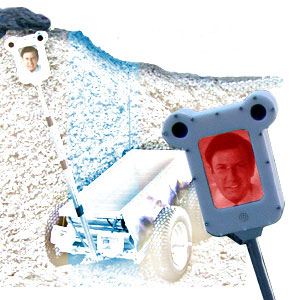
To answer his own question and drive forward the broader debate about remote-controlled drones, the 33-year-old engineer, artist and director of MIT Media Lab’s Computing Culture Group began last December to create the first nonmilitary, nonhuman roving war correspondent, dubbed the Afghan Explorer. The Explorer completed several tests on the streets of Somerville, Mass., in mid-February.
“This is not a media virus,” Csikszentmihalyi says, well aware that similar, provocative projects have been proposed, but rarely completed. “We’re doing this.”
No stranger to computer automation, Csikszentmihalyi previously helped invent a robotic disk jockey — the “DJ I, Robot.” Essentially little more than three turntables and a PC, it can randomly access a beat or sound anywhere on a record, as well as spin a platter at up to 800 rpm (although skipping gets frequent at 350 rpm). The robot DJ has even gone head-to-head with human DJs, Kasparov vs. Deep Blue-style, at electronic arts festivals and nightclubs. (It last preformed in Stuttgart, Germany, in January.) At present, he and co-creators Jonathan Girroir and Jeremi Sudol are adding a motion-capture device so the DJ I, Robot can mimic the way human DJs scratch. In a lighthearted mood, he writes of the robotic DJ, “I can’t believe I’m paid to do this stuff. I’m as filled with wonder as a 22-year-old in a dot-com circa ’99.”
Csikszentmihalyi wanted to get the Explorer done in a hurry, so he relied on off-the-shelf parts, and modeled it on the Mars Pathfinder. Three feet long, 2 feet wide and moving on 14-inch diameter wheels, the Explorer has a video screen and a microphone on a “neck” pole that extends up 4 feet, so it can interview standing adults. “It’s a teleconference on wheels,” its inventor says.
Csikszentmihalyi’s droid has some distinct advantages over its human counterparts. It needn’t stop for food or nature’s calls, and the delivery from its speakers may actually improve on Wolf Blitzer. On the other hand, it needs more sleep (only a strong sun can keep the solar-powered go-cart going), requires more prompting from the newsroom and there’s always a chance it’ll get stuck in a corner somewhere.
“I really like the idea of a robo-reporter,” says Natalie Jeremijenko, an engineering professor at Yale, and a New York techno-artist. “It comes down to a question of who gets to generate the facts,” she says. Too often, she contends, artists are called upon “to congeal the sentiment, rather than engage and understand the political crisis. Whether Chris succeeds or not, he’s making a great point — that for most Americans, Afghanistan might as well be Mars.”
A somewhat notorious provocateur, Jeremijenko has been known to work with the Bureau of Inverse Technologies, a cabal of high-I.Q. artists with decidedly dissident impulses. The BIT once flew an unmanned spy plane over Silicon Valley’s secretive research parks. They also placed audio sensors and microphones that locals maintained in war-torn Kosovo. Called BANG!BANG! radio, these devices came on when they detected gunfire or explosions, indicating on a Web site when and where this violence was taking place. But as much as she favors Csikszentmihalyi’s robo-reporter, she cautions that it may not get very far.
“Robots require four orders of magnitude more care than the littlest kitten,” she notes. “Even the most robust industrial robots require constant maintenance, and the terrain in Afghanistan will be difficult.” Nevertheless, she adds, “What could be interesting is if the Afghan people take an interest in Chris’ machine. If they repair it. Send it on its way.”
“The social aspects are always the most interesting part of robotics,” reflects U.C. Berkeley robotics specialist Ken Goldberg. “Seeing how people interact with each other and the person or robot on the other side. That’s why I’ll be interested to see not only where the robot can go in Afghanistan, but who drives — and how they react to what it ‘sees'”
Even before its deployment, Goldberg says the Explorer is just the latest project to signal a second coming of Net robots, a trend anticipated in the recently published primer “Beyond Web Cams: An Introduction to Online Robots,” which he co-edited. In the bright orange anthology, Goldberg and Ronald Siegwart gather what engineers have learned from the first wave of Net robots, circa 1994-’97. These include the University of Southern California’s Mercury Project, the first robot controlled over the Web, in 1994; U.C. Berkeley Ph.D. Eric Paulos’ memorable Net blimp and other probes; and the Net-based ground operation systems for the 1997 Mars Polar Lander and Rover Missions.
“Remote presence will be one of the next big applications of the Internet,” predicts Rodney Brooks, director of MIT’s Artificial Intelligence lab and chairman of iRobot, in Somerville, Mass. Or at least Brooks has good reason to hope so. IRobot’s Coworker — one of the first programmable and Web-accessible robots intended for widespread commercial use — goes on sale this fall.
But by the time it completes its “boot camp,” the Afghan Explorer may need to be renamed the Iraqi- or Gaza Explorer, Csikszentmihalyi admits. As flesh-and-blood journalists gain greater access to Afghan battlegrounds, it may make more sense to send it to some new hot spot to make his twin points about access and the unreliability of unmanned missions. He also acknowledges that compared with building the robot, delivering it into a contested region may be the far greater challenge.
“Our plan is to work with artists groups here and in Afghanistan or wherever, to script messages to tell the people what it is, what they can do with it,” Csikszentmihalyi says. “Probably it’ll get shot on the first day and sold for parts,” he gives a little laugh. “But it will have been an attempt.” And if it gets a scoop? Who knows, he jokes, maybe “this could turn out to be the Pentagon Papers of robots.”
