
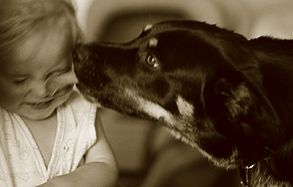

My year-old son Isaiah senses an approaching dog the way I used to locate a sexy man in the vicinity: by shape, smell and sound. If the dog is a block away or across the street, Isaiah’s little back jolts upright, his arms extend and flap, and he tries to propel himself into the air — a dog-copter. His breath comes out in rapid sighs, eh-eh-eh. I push the stroller faster, fearful that the dog’s master — oblivious to this drama — will steer his four-legged mate in another direction, and my son’s heart will break. But no, we catch up with the dog, Isaiah leaps up, straining against the stroller’s strap: “Ahhhhyyyiii!”
This instinctive attraction to dogs is the first significant way in which my child is different from me. There are many other things we do not share that might seem more important, including gender. But this strikes me as a very big difference: Isaiah loves dogs. He always has, and his love for them just keeps growing stronger.
I have never liked dogs. It’s not just that I don’t have a dog myself; until a year ago, I ignored them out of existence. They didn’t live in the same three dimensions that I inhabited. They occupied their own dog world, a planet of poops, pooper scoopers and pooper leavers, a planet of barking and biting, endless noises and secretions.
Now, suddenly, I have a child who is a dog-lover, dog-watcher, dog-stopper, dog-dogger. Dog is on Isaiah’s mind even when a dog is not in sight. He is ready, prepared at all times for an encounter. He loves to get in the stroller, tolerates the belting in and sweatering up and whatever else must be gotten through in order to go outside. He longs to greet the world, knowing that the world is filled with dogs. He goes out, arms flung open and willing.
At first, I was skeptical. The passion that provoked Isaiah to crow with delight at the approach of a shaggy canine was completely foreign to me. But now, I am won over. I have witnessed the dog’s heart-stopping hello — the wet nose, the long tongue meeting Isaiah’s for a quick French kiss. I have smelled the various fur smells of wet, dry, oily and hot dogs, seen a paw lifted in greeting, a tail draped provocatively across the bar of Isaiah’s stroller like a cabaret singer’s boa resting on a man’s shoulder.
I have discovered the thrill of anticipating a dog, the excitement in the mere idea of a dog. Down any block, around any corner, exists the prospect of comfort, love, welcome, wet eyes, velvet muzzles, deep, deep fur to lose your fingers in. The possibility of nose pulls, yowps, tongue rolls, fists of fur, ear flicks, paw dances, a brush with ecstasy. Perhaps, for the dog, it’s all about salt; for Isaiah, it’s all about love. Love for something animated, roughly his own height, that runs to him as he runs to it. It? No, not an it. Not a he or a she either. A supreme being.
The power of Isaiah’s joy is so strong I am converted. I believe in dog, and in this heightened, devotional consciousness, I, too, seek out dogs wherever I go. I am not so much a human being, woman, or mother as a dog-finder. The extra three feet of height that I have over Isaiah is an adaptive trait that has evolved so I can spot dogs from farther away.
I know things now I never knew I could know: I know that basset hounds have the long ears that drop like tablecloths to the ground. I know who’s a mutt and who’s not. I know that in a cocker-poodle mix, the brains come from the poodle side of the family. The higher power is lower to the ground and walks on four feet.
Day by day, we log more encounters of the doggie kind: We pass a couple sitting on a bench, a dog sitting on his haunches between them. Isaiah’s dog-alert goes off — the arms whirring up and down, the siren of delight — and the woman in this couple falls in love with my son.
“Here, want to feed Coco?” she asks. She gives Isaiah a dog biscuit. He holds it out to the dog, who licks it up. He laughs as the dog keeps licking, licking his empty hand and his wrist all the way to the elbow and beyond. Isaiah shrieks with pleasure and holds his hand out like a prize. Even after the couple leaves and the dog’s tail wags away, he holds his dog-licked arm up like a trophy.
Why didn’t I like dogs for so many years? Fear. And why, for so many years, didn’t I want to have a baby? Fear. When I was a child, growing up in Los Angeles, a huge red dog lived behind my house. On my side of a very short chain link fence grew some agapanthus and jade plants; on the other side was a fierce, salivating, jaw-snapping attack machine. I feared being eaten by that dog.
As an adult, I outgrew my fear of being eaten by a dog, but not the fear of being consumed. People with dogs, and babies, love them beyond measure. They are consumed with love. I never believed that I could survive such inordinate passion.
When I was a child, I never asked to have a dog. I thought that dogs were dirty, noisy, mean. I also believed that there was not enough time, energy or space (love) in our house for children and a dog. What no one told me, until my husband mentioned it, is that love breeds more love. Love of a dog just makes room for more love. My husband can, it now appears, love me and our baby. More marvelous: I, too, love them both.
There is, of course, a developmental explanation for the phenomenon of dog love in both Isaiah’s life and mine. The rationalist will point to Isaiah’s growing capacity to retrieve memories over the course of his first year of life. Isaiah is not simply experiencing dog for the first time, over and over, but linking memories and fitting them into the concept of dog. Thanks to object permanence, Isaiah has, from six months, known that dogs do not cease to exist when he cannot see them.
I, too, have entered a new developmental phase, in which the ability to love a dog is connected to the experience of generativity that pulled me into parenthood. Yet science cannot explain everything. I managed to avoid my biological destiny for two decades, and might have avoided it permanently.
Instead, I have taken a leap of faith. I am listening to the part of me that says: Let’s try it, let’s see what happens. I feared I would not be even remotely decent as a mother. Now I am doing the thing I cannot do perfectly and loving myself a bit, loving Isaiah all the more. Why is it that I didn’t see dogs before? I think I didn’t know — didn’t want to know — that I am like a dog, out in the world looking for scraps of food, warmth and love, maybe some shade on a hot day.
I don’t see sexy men on the street anymore. Like the invisible dogs of my past, the sexy men have been removed to some other dimension far from mine. Now I live in dog’s world, and I can sense that there is a dog out there now, already smiling, a bit of drool coming off his long tongue, waiting for me to notice and smile back.
