
Catholicism

A pedophile’s accomplice?

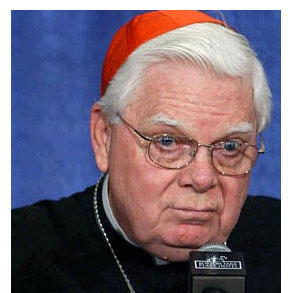
Boston Catholics want Cardinal Bernard Law to resign because of his role in protecting a priest who molested boys. Why isn't he being charged for his role in covering up the crime?

Boston has been outraged by the revelation that Cardinal Bernard Law knew of the many sexual abuse complaints against ex-priest John Geoghan for years, but shifted him from parish to parish anyway, and Boston Catholics are angriest of all. Yet Law shrugs off calls for his resignation. “Our faith doesn’t rest on the shifting winds of popular opinion,” the cardinal said, giving a beautiful example of the way Catholic Church leaders evade criticism on the pedophilia issue, while reiterating their lordly authority.

Note the language. It’s not Law or his decisions that are being questioned by detractors, it’s the Catholic faith itself, as if the two are the same thing. Many religious Americans may believe that the laws of God should take precedence over the laws of man — but most of them obey the laws of man anyway. The pedophilia scandal shows the extent to which the Catholic Church has been allowed to essentially ignore the law, and raises real questions about whether a true separation of church and state exists in America.

Whether Law will resign is still up in the air. What’s already clear is that he should be prosecuted as an accomplice in Geoghan’s crimes.

While the media has done some good work uncovering church sex abuse scandals, it’s done less well looking at the roots of the problem. Sensitivity about religion seems to blend with overall newsroom political correctness — we don’t want to make any group uncomfortable anymore — to mute tough questions as to what the scandal might tell us about Catholicism. Newsweek’s recent cover story on the child sex-abuse scandals is a case study. While it detailed the extent of the problem, it contained this boilerplate disclaimer: “Of course, priests have no monopoly on child abuse.”

Of course they don’t — men in all walks of life sexually abuse children, and the vast majority of priests are not child molesters. But the sentence also serves to minimize the problem. The sheer numbers involved in the recent scandals show that sexual abuse by priests is not a freak occurrence. Law turned over the names of 80 priests to authorities in Massachusetts; bishops in Maine, New Hampshire and Philadelphia have begun to follow suit. News of a cover-up in Tucson has come to light. Los Angeles’ popular Cardinal Roger Mahony is being pressured to turn over abuse complaints to the LAPD. And the National Catholic Reporter estimates the church has paid out more than $1 billion to settle sex-abuse suits in the last two decades (the U.S. Conference of Bishops insists the figure is closer to $250 million — still, not exactly a small sum).

Reporters have seemed reluctant to ponder the reasons for the prevalence of pedophilia among priests. Are pedophiles attracted to the priesthood because it gives them easy access to children? Do men with such sexual desires become priests seeking a way to curb those impulses? There’s something to be said for both positions. What seems clear is that, through a combination of its teachings on sexuality and its repeated willingness to shelter and cover up priest-pedophiles, the Catholic Church has created a safe haven for child sexual abuse, if not a breeding ground for it.

Asceticism plays a role in many religions of the world, not just Catholicism, of course. But it seems obvious that the risk of child sexual abuse is greater in a church that insists its clergy take a vow of celibacy. Insisting that priests cannot marry, let alone have sex, and then giving them power over the most vulnerable of beings — kids who are trained from birth to think of priests as God’s representatives on Earth (and thus almost unable to do wrong) — would seem to create the conditions for this scandal.

The church’s teaching that sin can be expiated by confession and sincere contrition may also play a role in allowing pedophilia to flourish. When crime is treated solely as a sin, there is nothing to prevent it from happening again. And when that crime is a sexual compulsion — which, as all compulsions do, follows a recurring pattern, with the need to act building up again after each release — it doesn’t matter how contrite the penitent is. Part of the thrill for sexual predators is the transgressive nature of their desires. What, for a child rapist, could be more thrilling than committing his crime in an atmosphere where the object of their desire is revered, bathed in blessed innocence?

These questions are missing from most mainstream media reports on the scandal. In fact, the liberal National Catholic Reporter has been braver than most secular media in suggesting that the church’s celibacy requirements mean the priesthood disproportionately attracts men with sexual problems. But whatever the reasons for priest-pedophilia, there is no mystery about what the Catholic Church did in Boston in response to years of charges against Geoghan. I honestly don’t understand why Cardinal Law hasn’t been charged as an accomplice in Geoghan’s crimes. The only justifiable answer can be that the Boston authorities are still in the process of gathering evidence.

Law, who has been Boston’s cardinal since 1984, has admitted that he knew of Geoghan’s pedophilia and, instead of reporting it to authorities or alerting parents in the parishes where Geoghan worked, he simply reassigned the priest — though he flat-out lied about that in the diocese’s newspaper last year. (The shuffling of Geoghan went on for 30 years. Law’s predecessor, the late Cardinal Humberto Medeiros, was also guilty.)

The facts about Geoghan became known only after the Boston Globe took the diocese to court to have the records on him unsealed. It was only this public revelation that prompted Law to turn over the names of other priests, more than 80 in all, who have been accused. When Law previously addressed the issue of how the church should proceed in cases of child sexual abuse in 1993, there was no mention of notifying authorities. Instead, priests have been sent to church-run “treatment centers,” again keeping these scandals under wraps.

Even viewed in the most charitable light, Law’s actions have been remarkably callous. How can he, or any Catholic official who has covered up allegations of abuse, be said to have demonstrated any Christian concern for his charges? His mealy-mouthed statements of regret (“We do not always make holy decisions, and we turn to God for the forgiveness he is always ready to give”) show no awareness that he should have to answer to any authority other than God, and confidence that there, at least, he will find forgiveness. In one statement he said that he is not like the CEO of a business. That is exactly what he is. As the head of a large division of a rich and powerful international organization, he must take responsibility for its decisions, especially the ones he makes. There is no reason to think that Law showed any more concern for the people in his care than did Enron’s Kenneth Lay (in fact, he sounds more like former CEO Jeffrey Skilling, parsing language to try to evade responsibility).

But Law is not alone. Cover-up has long been the church’s modus operandi when dealing with sexual abuse cases. The problem first made national headlines in 1984, when the story of a child-abusing Louisiana priest became news. In 1986, the National Conference of Catholic Bishops rejected the recommendation of a committee that the public be notified about priests who committed sexual abuse. Instead, to this day most cases are settled out of court and come with a gag order. The Newsweek story revealed that records are often shipped outside of U.S. jurisdiction to further protect the priests.

Finally, the law seems to be taking steps to end the extraordinary privilege the church has enjoyed in dealing with the pedophiles in its midst. On Feb. 26, the Massachusetts legislature passed a bill requiring clergy to report suspected cases of child abuse. California already has a similar law, and Los Angeles authorities have been questioning whether L.A.’s Cardinal Mahony has complied with it in the way he’s faced his diocese’s priest-pedophilia scandals.

What’s been oddest about the Boston case is that before the legislature’s vote, Cardinal Law had been under greater pressure from Catholics than he had from secular authorities. The 66-year-old Geoghan recently was sentenced to 10 years for one incident of assault. (Newsweek reported that there are 129 other potential victims.) But that’s not enough. In this case, as in all others where church officials knew of pedophile priests and didn’t make the accusations known to officials, those officials must be held legally culpable. There is no dispute about what Law did. His Eminence has very considerately detailed his prior knowledge of Geoghan’s crimes and provided the most damning evidence against himself. The question now is, do prosecutors in a largely Catholic city like Boston have the guts to put Law on trial, instead of bowing and scraping to him?

Certainly the laws vary from state to state, but there seems to be widespread national support for requiring people in care-giving professions to report evidence of a crime, especially child abuse. How is it that for so long, the church has escaped this trend and been allowed to make its own rules for dealing with pedophiles — rules that almost never include informing the police? Are the formation of those guidelines protected by the same violation of the separation of church and state that has provided us with the legal protection conferred on the confessional?

Finally the Massachusetts legislature has made it clear that church officials are legally obligated to report allegations of child sexual abuse. That’s a good first step. Now the authorities have to demonstrate that they are willing to act on clergy who cover up, no matter how high up in the church.

The church can go on insisting that pedophilia is a spiritual problem. But while its leaders prepare all they want to for the next world, they live in this one, and they have to obey its laws. A church that believed in the human sacrifice of children would not be allowed to carry out that practice. A church that has regularly sacrificed the souls and spirits of children to protect its public image has to suffer the consequences. It’s time for everyone involved to do their jobs. Leave the souls to Cardinal Law, and let the law have a shot at his flesh.

Charles Taylor is a columnist for the Newark Star-Ledger.

The bishops go off the deep end

Rejecting the Obama contraception compromise, they display their irrelevance to moral and political dialogue

Archbishop Timothy Dolan (Credit: AP/Patrick Semansky)

Just as I was publishing my post about Catholic tribalism on Friday, predicting that the brilliant White House “accommodation” on contraception wouldn’t mollify the U.S. Conference of Bishops, the bishops released a statement that made them seem, well, mollified, at least a little. The new Health and Human Services regulations were “a step in the right direction,” their statement read, and so I softened an assertion that the bishops would continue to wage war against the compromise.

I needn’t have soft-pedaled. Only a few hours later the bishops came out, guns blazing, insisting the only solution they would accept would be for “HHS to rescind the mandate for those objectionable services.” By any employer, for any employee in the entire country — a country where the vast majority of voters, and of Catholics, support Obama’s stand. And at Sunday Mass, bishops and parish priests throughout the nation read aloud the stunningly political letters about the controversy they already had planned. Now, with the bishops’ blessing, Republican are hard at work on legislation that would force HHS to strip the contraceptive coverage requirement for all employers, not just religious employers. Sen. Roy Blunt would allow employers to decline to cover any service they deem objectionable; Sen. Marco Rubio would restrict the legislation to contraception coverage.

I have a couple of reactions to the bishops’ extremism. First of all, as someone raised Catholic, I wonder why they’ve never read letters about any of their social justice priorities: universal healthcare, increased protection for the poor, labor rights, or action to curb climate change? Why does this topic  – not even the morally challenging issue of abortion, but the universally accepted practice of birth control – merit such a thundering reaction from the pulpit?

Second, as an American, I also wonder: How do they continue to demand tax-exempt status when they’re railing in their churches about blatantly political – and divisively partisan – public concerns? As the first writer on my remarkably sane Catholic tribalism letters thread remarked, their public support for the extremist GOP position makes me think they should register as a Republican political action committee rather than remain a tax-exempt religious institution outside the bounds of politics.

Even as the bishops became more shrill and extreme, the debate over contraception coverage became smarter and calmer last week. Major Catholic organizations supported Obama’s Friday move, including the Catholic Health Association, Association of Jesuit Colleges and Universities and Catholic Charities USA. Before the president’s announcement, famed attorney David Boies did the most to usher in the new tone by framing the HHS rules as a matter of labor law. Boies doesn’t believe, by the way, that HHS is in any way required to provide the exemption for churches it wrote into its regulations even before the compromise. If the church is employing people, whether co-religionists or not, it has a responsibility to comply with employment law. He proved that even the administration’s initial regulations, exempting churches, was a strong attempt at accommodating anti-contraceptive religious groups.

But maybe the best argument on behalf of the Obama administration’s position comes from a very unlikely source, as Jay Bookman points out: Supreme Court Justice Antonin Scalia. In two different decisions, the conservative Catholic Scalia has sided with the court majority in finding that religious teachings can’t justify religious employers – or employees — failing to comply with labor law. In the 1990 Employment Division v. Smith decision, regarding an employer’s ability to fire a Native American employee who used peyote, despite the employee’s claim that using the drug was a religious rite, Scalia wrote:

“We have never held that an individual’s religious beliefs excuse him from compliance with an otherwise valid law prohibiting conduct that the State is free to regulate. On the contrary, the record of more than a century of our free exercise jurisprudence contradicts that proposition.” In an even more directly relevant 1982 decision holding that Amish employers must comply with Social Security and withholding taxes, though their faith bars participation in government support programs, Scalia wrote:

Respondents urge us to hold, quite simply, that when otherwise prohibitable conduct is accompanied by religious convictions, not only the convictions but the conduct itself must be free from governmental regulation. We have never held that, and decline to do so now.

I’ve written repeatedly that my inability to quit the Catholic Church entirely comes from the fact that its social teachings formed my social conscience, and to this day some of the people doing the most good for the poor and the excluded are devout Catholics. But the bishops are impossible to defend. Today, they are working on behalf of the Republican Party. “They have become the Pharisees,” says Andrew Sullivan, a conservative practicing Catholic. “And we need Jesus.”

I’ll be discussing the bishops’ GOP politicking on MSNBC’s “The Ed Show” at 8 pm ET.

Continue Reading Close
Joan Walsh

Joan Walsh is Salon's editor at large.

Catholic tribalism and the contraceptive flap

Watching liberals defend a church they disagree with showed us that even Catholic insiders can feel like outsiders

Rick Santorum and David Boies (Credit: Reuters)

The resolution to the contraception contretemps seems mainly designed to do one thing: mollify the Catholics who defied the U.S. Conference of Bishops to support the Affordable Care Act in 2010. Church leaders are unlikely to officially back this so-called accommodation – the White House isn’t calling it a compromise — just as they continued to oppose the ACA even after President Obama did everything imaginable to insist the new law wouldn’t provide federal funding for abortion.

But the new agreement makes it possible for women’s groups and some liberal Catholic leaders to maintain a truce on hot-button social issues while working together around issues of women’s health and universal access to healthcare. Planned Parenthood and NARAL Pro-Choice America are happy with the solution, and so is Sister Carol Keehan of the Catholic Health Association, who endured withering heat from the bishops and their right-wing allies over the ACA. Kristen Day of Feminists for Life likewise backs the deal. Even New York Archbishop Timothy Dolan called it “a step in the right direction,” though he demanded more time to examine the fine print and suggested “legislation will still be required” to protect the church’s right to discriminate against women.

The bishops and the entire 2012 GOP field will continue to fight their culture wars, but the White House apparently believes the non-compromise will win them the middle ground and make the 24-7 cable news show wailing and hand-wringing – even by some liberals – go away. We’ll see.

But what just happened? Why did we spend 10 days listening to prominent Catholics, including even some liberals and Democrats, insist that the White House had overreached and trampled on “religious freedom” – in this case, the “freedom” of the Catholic hierarchy to impose rules that even most Catholics don’t live by?  The great E.J. Dionne led the charge, but Catholic Democrats like Sens. John Kerry and Bob Case and Virginia’s Tim Kaine joined in, and occasionally, liberal TV hosts like MSNBC’s Lawrence O’Donnell and Chris Matthews seemed inclined to depict the controversy as being about the church’s right not to violate its own values. Vice President Joe Biden was said to be the leading voice within the administration warning Obama away from the issue.

“This has struck a tribal nerve in Catholicism,” conservative Catholic scholar George Weigel said to Chuck Todd on “The Daily Rundown” last Monday. “The Catholic Church has been beaten up over the last 10 or 11 years and I think Catholics are tired of the government and others beating up on the church.” His liberal co-religionist on the panel, E.J. Dionne, agreed. I found that fascinating, especially because most of us consider tribalism a bad thing in a multi-ethnic democracy.

Still, while I didn’t share that reaction, I recognized it. It amazes me sometimes, the extent to which Catholics still see themselves – ourselves — as outsiders. There’s a vestigial impulse to circle the wagons and protect our right to practice our persecuted religion (even if it’s no longer persecuted, and many of us don’t practice very much of it anymore). Where does it come from? I’ve spent a lot of time thinking about this lately, because the importance of Catholics to the old New Deal coalition, and their ongoing status as key swing-voters in key swing states, makes understanding them – us – important. This same old tribalism leaves many Catholics receptive to GOP blathering about out-of-touch “elites” who supposedly disrespect their religious freedom. It helped shift many white working-class Catholics to the Republican Party in the ’60s and ’70s.

There may be an element of remorse involved when liberal Catholics defend their faith, especially among those who defy the church (rightly, in my opinion) on its most blinkered teachings in the realm of women’s rights, gay rights and sexuality. For some it may be guilt: OK, I might not listen to the bishops, but I think we ought to demand that they’re respected in the public sphere. And for some it may be grief: We grew up with a rich tradition of social responsibility and spiritual meaning that’s unfortunately been warped by leaders who worship worldly power and have odd views about sex as well as women. While the child abuse scandal makes most Catholics sick, sometimes even I wince when non-Catholics judge the whole church by the corruption of a comparative (though very powerful) few.  I have cousins and uncles and aunts who’ve joined religious orders (though, truthfully, most of them left). I don’t like seeing all of them considered perverts or pedophiles, or people who cover up for predators.

How Catholics work out their complex feelings about the church matters beyond the tribe, if only because they’re crucial to the 2012 election. One in four voters is Catholic, and Obama won a majority in 2008, while Republicans won them back in 2010. Obama lost white Catholics, however, although he won among those who say they aren’t regular churchgoers.  I think Catholics remain an important, not always predictable constituency at least partly because of their own unresolved, unpredictable feelings about their religion, and their status as Americans.

I found myself thinking a lot about my own complicated feelings about my heritage as I watched Catholics grapple, not always rationally, with the contraceptive controversy. Even when I didn’t agree, I empathized.

- – - – - -

I grew up in a huge Irish Catholic clan on Long Island, but as an adult, I put away childish things (in the words of St. Paul, though not as he intended them) and became a secular feminist liberal Democrat. The first time I remember feeling anything like tribalism was after Sept. 11.

Many liberals around me criticized the overt religiosity of the public mourning for those killed that day, all that talk about God, which struck me as reflexively and needlessly anti-religion at a time when many Americans — dare I say most — found comfort in their faith. Then, after a benefit for survivors’ families turned a little rowdy, with one cop taking to the stage to say “Osama bin Laden can kiss my royal Irish ass,” the heavily Irish and Catholic cops and firefighters in attendance were roundly derided as right-wing tribalist rubes. That bothered me, too: Who did we think died trying to rescue those trapped in the World Trade Center, Susan Sarandon and Michael Moore? Members of my own family had worked in the rescue operation after the towers fell. I wasn’t down with the mockery.

A lot of my belated tribalism was a class thing: I’m not workin-class, but my parents and aunts and uncles were, and some of my cousins are still part of that ill-defined and disappearing demographic. There’s clearly an element of snobbery in the way the white working class is routinely run down as backward, racist, narrow-minded yahoos, and I’ve grown to resent it.

Yet in general, Catholics are doing pretty well for themselves. We’re well represented in certain segments of the American elite, especially elite punditry, it seems.  It’s understandably hard for some people to imagine, in a world so striated by race and class, how Catholics could feel like oppressed outsiders. Yet it’s also true that while we’ve only elected one black president, we’ve only elected one Catholic president as well. I’m not trying to equate the struggles of black people and Catholics. In fact, it’s especially when you understand how relatively privileged Catholics have been, compared to African-Americans, that having only one Catholic president stands out, and makes you wonder: Why?

It’s hard not to conclude that some residue of the religious nativism that persecuted and stigmatized Catholics in the 19thcentury, defeated Al Smith in 1928, and forced John F. Kennedy to promise he wouldn’t take orders from the pope in 1960 persists to this day. So even if we haven’t personally experienced anti-Catholic prejudice, and I can’t say I have, there’s an atavistic memory, something bred in the bone, that forces many of us to defend our once-persecuted church, even when we profoundly disagree with it.

But it wasn’t until I debated the Family Research Council’s Tony Perkins on “Hardball” this week that the craziness of the right-wing Catholic alliance with conservative evangelicals became particularly obvious to me. They’ve locked arms with some of the very forces that once persecuted their ancestors – some of whom still despise Catholicism to this day. On “Hardball,” Perkins posed as a defender of the Catholic bishops’ position on Obama’s contraception rules. But he’s also been an ally to virulent anti-Catholics like Rev. John Hagee, who called the church “the great whore” and a “false cult.” And Rev. Robert Jeffress, who likened the church to Satan and labeled Catholicism a “fake religion.” Like Zionist Jews who’ve made common cause with right-wing evangelicals over Israel, some Catholics are lining up, in the name of religious freedom, alongside folks who want to wipe out their religion. I’ve heard some liberals express disdain for some of the church’s teachings, but I’ve never heard anyone compare it to Satan or call it a whore.

Zealous right-wing Catholics are in the minority, even if blowhards like Bill Donohue sometimes make the most noise. In the end, I think the contraceptive flap forced a lot of Catholics to reckon with the gulf between what they practice and what their church preaches.  The truth was always there, if we wanted to find it, not merely in polling data that said 98 percent of sexually active Catholics have used birth control, but that solid majorities of Catholic voters supported Obama’s contraception regulations applying to large Catholic institutions, like hospitals, charities and universities, that employ non-Catholics. I loved the fact that students at Catholic universities held a press conference Thursday to support the president, and that organizations like Catholic Democrats and Catholics for Choice were active and vocal in standing up to their own bishops.

There are a lot of outstanding questions about the implementation of the administration’s non-compromise. But I have to disagree with Esquire’s Charles Pierce – I’m not sure that’s ever happened before – and say I don’t consider this any kind of cave on the president’s part or victory for the bishops. I prefer the interpretation of Frances Kissling, founder of Catholics for Choice, who wrote on Friday that the “accommodation” made the bishops the “losers” and women the winners. ”When the White House cares more about what a simple Catholic sister, [Sister Carol Keehan], thinks than about what the bishops think, Catholic women can applaud. Perhaps the crack in the patriarchy is becoming a deep canyon.”

I can’t go that far – especially after seeing this Think Progress report that documented what we all knew: that men dominated the debate over the controversy on cable news. It’s also a little sobering that so many of the liberal Catholic voices questioning the president were male, while most of the liberal voices backing him were female. But between this and the victory for Planned Parenthood in the Komen mess a week ago, I see evidence that we’re reaching a new place in the battle over gender. At the very least, being a woman is no longer a preexisting condition, as the Catholic Nancy Pelosi likes to say.

Continue Reading Close
Joan Walsh

Joan Walsh is Salon's editor at large.

Rick Santorum channels Saint Augustine

His repressive sexual politics are a rear-guard rebellion against modernity

Rick Santorum, Augustinian moralist (Credit: AP)

Following his eight-vote near miss in the Iowa caucuses, former Pennsylvania Sen. Rick Santorum is the man of the hour. Many people have commented on his profoundly conservative views on human sexuality. Santorum has clearly supported making abortion criminal and repealing all same-sex marriages, which he once compared to man on dog sex.

Santorum’s sexual policy clock, however, does not stop turning back in 2003 when the Supreme Court struck down sodomy laws or 1973 when the Supreme Court protected abortion. Santorum would turn it all the way back to 1964, when birth control was criminal in many states. Actually, Santorum’s sexual policy prescriptions start in the fourth century, when the Catholic theologian Augustine of Hippo confronted his unruly dick. After years of Gingriching around with every female in sight, Augustine came to Jesus. Despite his newfound commitment to disciplined, godly behavior, he just couldn’t keep the good man down. But he decided that at least he could justify, if not control, his irrepressible sexual desires by confining them to the otherwise consecrated ends of monogamous marriage and the reproduction and rearing of children. The only acceptable sex is marital reproductive sex. All the rest of the Catholic teaching on sex is commentary.

Criminalizing abortion and forbidding gay marriage are still, regrettably, outside the total nutbag category in contemporary American politics. But if the only allowable sex is Catholic-approved reproductive sex, the picture starts to look distinctly weird. Birth control, for example. Santorum has said repeatedly that he would work to overturn the Supreme Court’s 1965 decision in Griswold v. Connecticut, which stopped the states from making birth control criminal. And just in case you’re thinking that’s just to take the pill from those uppity women, the Catholic teaching is quite clear: All artificial birth control is forbidden, including the good old familiar male condom. Indeed, if the only allowable sex is marital sex, fornication and adultery would be similarly acceptable. The same doctrine forbids masturbation.

Sometimes Santorum tries to moderate the extremism of his views on sexual regulation by saying that he thinks the states should decide whether to make sex acts or birth control criminal; his quarrel is with the Supreme Court butting in and telling them they couldn’t throw the Planned Parenthood docs in the slammer. If states do “dumb” things like outlawing masturbation and condoms, the solution should be to elect different state officials. But in fact Rick Santorum doesn’t think criminalizing birth control and fornication is dumb. Consistent with his Catholic faith, he believes all artificial birth control is wrong and that sex outside of marriage is not a healthy thing for the country.

And he advocates the legislation of morality: “(I)f family and moral values break down, government gets bigger and bigger. Social issues are central to every issue we deal with in America. Unless we get the moral issues right, we will never get the economic and foreign policy issues right.”

That an advocate of legislating strict Roman Catholic sexual doctrine came within eight votes of winning the first contest for the nomination of one of the two major American political parties warrants attention. Twenty-five years ago, opposition to Griswold helped sink the Supreme Court nomination of Judge Robert Bork. And the country has only become more sexually and gender diverse since then. Six states and D.C. authorize same-sex marriage. The second secretary of state in a row is a female, and she gathered 18 million primary votes in her bid for the presidency. Congress repealed the exclusion of openly gay and lesbian service members from the military. Even Mississippi didn’t adopt a law making two cells a “person.”

In this context, Rick Santorum’s candidacy, and the Republican Party that hungers for it, looks like a handful of the left-behind fighting a rear-guard action against modernity, which has passed them by. It’s understandable that they would focus their efforts on sex, where Augustine struggled so hard for control. Like Augustine and his unruly member, the modern world, especially modern capitalism, makes people feel like they have lost control. As recent events reflect, this is not foolish. They have suffered from forces way beyond their control. But the solution to gaining some mastery over the environment lies in embracing modernity through modern institutions like the rule of law, collective action, proper regulation, counter-cyclical economic policy, rather than rejecting it. There’s a reason modern contraception is called birth control. Control is good. The mistake is in mistaking Wall Street for your dick (or your wife).

Western history since the Enlightenment has been peppered with such revolts against the modern world. Usually they are a sign of desperation and find their way, unassisted, to the dustbin of history. On the rare occasion when they take hold, however, they can be extremely dangerous.

Continue Reading Close

Linda Hirshman is the author of “Victory: The Triumphant Gay Revolution,” forthcoming in June 2012. Follow her on Twitter @LindaHirshman1

Iowa evangelicals still can’t find a good non-Romney candidate

Each acceptable candidate keeps imploding, to the annoyance of the religious right

Mitt Romney and Newt Gingrich (Credit: AP)

Pity the poor Iowa evangelicals, who have no one to vote for in the upcoming caucuses. I mean, they have far-right Catholic Rick Santorum and genuine millennialist evangelical believer Michele Bachmann, but Bachmann is crazy and Santorum is creepy, so what they’re actually looking for is someone electable who isn’t also a Mormon.

Jason Horowitz has the story, for the Washington Post, and I bet he was thrilled to get this bit of color into the paper:

In 2008, evangelical support washed over former Arkansas governor and Southern Baptist preacher Mike Huckabee, but this year [Iowa Right to Life executive director Jenifer] Bowen expressed bewilderment at the theological and electoral calculations that were leading conservative-values voters to bestow their blessing on one candidate after another.

“It doesn’t make any sense,” Bowen said, as she set down a basket filled with fetus dolls.

Mitt Romney is largely unwilling to submit to public inquisitions regarding his faith, which means he can only pander so much to evangelical voters. We’re talking about people who still need some convincing before they’re willing to vote for a Catholic, so he’s probably correct to write off the real fundamentalists.

The story begins with Rick Perry, Newt Gingrich, Bachmann and Santorum appearing at an Iowa antiabortion event that Mike Huckabee headlines, but all anyone wants to talk about is Romney’s faith and Gingrich’s marital (and religious) history. Attention-seeking religious right windbag Bob Vander Plaats offers his take (Catholicism is basically OK now, Mormonism is weird, Ron Paul doesn’t like Israel enough). Santorum is still banking on his hating gays and abortion more than all the other candidates, but most people quoted seem to be talking themselves into supporting a surging Gingrich.

But the tale of evangelicals looking for a candidate is fun mostly because it involves moralistic people choosing between adulterers and buffoons. Polling suggests evangelicals — like other GOP primary voters — are simply looking for an electable not-Romney, and they are not finding one. (Though they should swing wildly to Paul or, god help us, Santorum sometime this week.)

(OK, one more bit worth quoting: “‘When you go to bed at night and bend your knees, who are you bending your knees to?’ Vander Plaats asked.”)

Continue Reading Close
Alex Pareene

Alex Pareene writes about politics for Salon and is the author of "The Rude Guide to Mitt." Email him at apareene@salon.com and follow him on Twitter @pareene

The National Review wants you to get pregnant

The kids at The Corner launch multiple attacks on the new mandate requiring health insurance contraception coverage

The Department of Health and Human Services, acting on recommendations from the National Academy of Sciences’ Institute of Medicine, will require health insurance companies to fully cover a wide array of preventative health measures for women, beginning next year. You know, breast pumps, physicals, birth control, that sort of thing. Who could have a problem with this? The National Review, of course!

Kathryn Jean Lopez says “Obamacare strikes again” (when did it strike last time?) and then writes some lies about how now Obama will force Catholics to give prostitutes abortions, or something. I dunno. The Catholic church’s prohibition against contraception is pretty medieval and stupid, I don’t have a lot of sympathy for her argument. The Archbishop of Galveston-Houston threatens to shut down every single Catholic hospital, school, and charity in America if they don’t get an exemption from the rule. Why does every minority want Special Rights?

I thought that would be enough, because surely birth control-bashing is a bit embarrassing for everyone at the National Review under the age of… 70? But I was wrong! Helen Alvare, “associate professor of law at George Mason University School of Law,” weighed in next, with a post calling the birth control mandate “Orwellian.”

The word “Orwellian” is overused. Americans’ ears are nearly stopped to it. This makes it hard to characterize really Orwellian moments when they arise.

But this decision, to require that birth control be covered by insurance companies, is really Orwellian because… Alvare doesn’t like it. It’s a bad, liberal thing! Bad liberal Orwell thing! HE TRIED TO WARN US ABOUT EXPANDING ACCESS TO CONTRACEPTIVES! (Boy, do you know who really hated the Catholic Church? George Orwell. “It seemed that the Fascists always heard mass before going into action.”) Alvare also insists, as Lopez did, that Plan B counts as abortion, which it does not.

There is also a bit where Alvare accuses the Institute of Health of cherry-picking studies showing that increased access to birth control leads to… less unwanted pregnancies and abortions. Alvare insists this is untrue, because if you look at some other data that she does not specify or link to or even really describe in detail, it says something else.

But the real problem with these two pieces is that they relied on religious objections and (vague) appeals to data instead of hilariously insulting analogies and bad economics. Thanks, Greg Pfundstein, for your entry, “The Misguided Birth-Control Crusade Continues”:

Several economic studies, notably one by Berkeley economists Akerlof, Yellen, and Katz, indicate that access to contraception and abortion alters the sex and mating markets and, through risk compensation, actually increase the number of unintended pregnancies. Just as anti-lock brakes lead drivers to drive faster, follow closer, and brake later, the already nearly universal access to contraception seems to increase the number of sexual encounters, thereby increasing the number of contraceptive failures. We know risk compensation is at work with bicycle helmets, seatbelts, ski helmets, and skydiving gear. To deny its obvious role in the sex and mating markets is to let ideology triumph over reason and science.

As a commenter explains: “The problem with the author’s comparison to anti-lock brakes in cars is that anti-lock brakes are a good thing.”

But this is conservative economics that I’m sure they’ll be able to sell to the rest of the nation. “Ladies, back when every sexual encounter carried with it the risk of unwanted pregnancy followed by your death during childbirth, you would’ve been much more careful about selecting your sexual partners — we’d like to go back to that model.”

Continue Reading Close
Alex Pareene

Alex Pareene writes about politics for Salon and is the author of "The Rude Guide to Mitt." Email him at apareene@salon.com and follow him on Twitter @pareene

Page 1 of 37 in Catholicism