
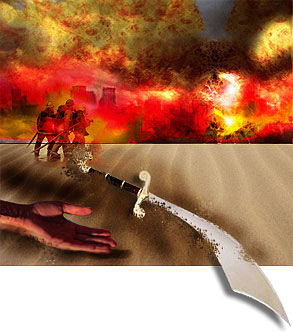
Is the kind of militant Islamism that inspired the attacks of Sept. 11 a grotesque aberration of an otherwise peaceable faith or the logical extension of the religion’s warlike undercurrents? Do Osama bin Laden and his fellow terrorists speak for any significant percentage of Muslims? What do they want? How big a threat are they to the West?
In the immediate aftermath of the attacks, these questions and others sent flocks of Americans to college classes and public lectures, promoted cable channel documentaries to the status of appointment viewing, and landed once-obscure university press books on national bestseller lists. Yet what answers we got were often vague, unsatisfying and driven by agendas that ranged from the obvious to the covert. Some authorities seemed more intent on quelling an anticipated tidal wave of virulent anti-Muslim sentiment than on explaining how the religion came to be used to justify such horrible acts; others seized on the attacks as a confirmation of their dire scenarios about a “clash of civilizations” (after Samuel P. Huntington) and the irredeemably savage nature of Islamic culture. Paranoid dispatches from the shadowy realms of the spook-watchers got equal play with the abstract pronouncements of eminences grises.It just didn’t add up.
Although some of the hunger for information has subsided, the books keep on coming, with Bernard Lewis’ “What Went Wrong” currently leading the pack at No. 15 on the New York Times bestseller list. Lewis is a professor emeritus of Near Eastern studies at Princeton, an esteemed but polarizing historian (he is more supportive of Israel and less sympathetic to the Palestinians than many of his colleagues) who is said to have been frequently consulted by the White House and Pentagon since Sept. 11. “What Went Wrong” was written before the attacks and doesn’t specifically address them, but its survey of 300 years of the decline of Muslim civilization (relative to the West) is meant to offer some broad cultural and historical explanations for the angry faces and Osama bin Laden T-shirts we see in footage from Middle Eastern and Asian streets.
Lewis’ book, the major portion of which consists of three lectures given in 1999, describes Islam’s ascendance over the West in the early medieval era and its subsequent long decline. He ties Islam’s failure to embrace the concept of secularism to its eclipse by the West. Still, there isn’t much in “What Went Wrong” that shows how the humiliation of dar-al-Islam (the house or world of Islam, which is how the faithful envision the part of the world occupied and governed by Muslims) led 19 Arab men to make a suicidal assault on two mammoth symbols of American power. And it doesn’t provide a sense of how prevalent or deeply felt this kind of Islamic militancy now is in the Middle East and other Muslim regions.
Early jitters about the instability of Gen. Musharraf’s hold on power and the threat of an Islamist takeover of Pakistan and its store of nuclear arms seem to have subsided, notwithstanding this week’s terrorist blast in Karachi that killed 14 people, including 11 French citizens. How serious was the danger to begin with — in Pakistan, in the Philippines (where the U.S. has sent troops and counter-terrorist advisors), and in places like Yemen, Saudi Arabia, Egypt and Algeria, where so many of the al-Qaida fighters in Afghanistan originally came from?
Gilles Kepel’s “Jihad” answers more of those questions than Lewis’ book does; it makes an ideal companion to morning newspapers filled with frustratingly context-free briefs from the war on terrorism. Kepel is French, a professor of political studies who has traveled extensively in the Middle East, Asia and Africa, observing first-hand the evolution of Islamism as a political force and interviewing many of the participants in its various struggles. His “Jihad” is a far cry from the lofty assessments of cultural differences delivered by Lewis and Huntington. This is a decidedly grounded book; it’s political in the most elemental sense of the word. Although Kepel clearly believes in the Western ideal of civil society, he puts himself in the place of ordinary Muslims in the nations he writes about, rather than viewing their problems from a Western perspective.
Kepel (who does address the Sept. 11 attacks in “Jihad”) makes the provocative argument that militant Islam is in serious decline, a decline that’s been going on for 10 years, despite a record that “might at first glance give the appearance that the power of political Islam was growing in all areas.” This may seem like good news to everyone who’d prefer not to see big segments of the population in Muslim nations enlisting in repressive Islamist movements. But if you read between the lines in Kepel’s book, the bad news is that the failure of political Islam doesn’t mean that anti-American terrorism is dwindling as well. In fact, it’s quite likely to get worse.
Kepel’s approach to his subject — a remarkably detailed but never tedious 25-year history of the political fortunes of Islamism in such nations as Egypt, Algeria, Jordan, Malaysia, Afghanistan, Pakistan, Sudan, Saudi Arabia, Bosnia, Iran, Israel, Turkey and others — allows Western readers to see that the terrorism used against us is more a byproduct of power struggles within those nations than it is a reaction against “our way of life.” The West, and specifically the U.S., often resembles a cop trying to break up a bitter private fight who winds up being attacked by whichever combatant seems to be getting the worst of the contest. (We don’t always take the right side, either.) Of course, Muslim antipathy toward Israel — and, by extension, the U.S. — has become a constant, but the real roots of Islamist extremism lie in fury directed at other Muslims.
What “Jihad” illustrates (and what often gets lost or glossed over in other books on the subject) is how foolish it is to generalize about Islam. Beyond the familiar schism between the Sunnis and the Shiites, the faith is spectacularly diverse, from the mystical brotherhoods of the Sufis, to the puritanical Wahabbites, to (what remains of) the relatively secularized cosmopolitan elites of more developed countries like Egypt. It makes as much sense to draw conclusions about all Muslims on the basis of the beliefs of the Taliban or bin Laden as it does to expect a Quaker to light candles to Santa Barbara or a Unitarian minister to plant bombs in abortion clinics simply because other people who call themselves Christians do so.
Militant political Islam was born in the early part of the 20th century; its intellectual fathers are Sayyid Qutb, an Egyptian, and Mawlana Mawdudi, a Pakistani (which makes it an Asian movement as well as an Arab one). Although some Western writers have gotten it into their heads that Qutb’s radicalism was inspired primarily by two years he spent in the U.S. and his disgust at the bare female arms and Elvis Presley recordings he encountered here, in fact, his quarrel was always with Gamal Abdel Nasser’s nationalist regime.
Qutb, and the Muslim Brotherhood — an organization of which he was a founding member and which exists in varying forms of varying degrees of politicization in many Muslim nations — wanted to establish a strictly Islamic government based on the original community of the faithful founded by the Prophet and ruled by Islamic law, or sharia. Qutb advocated a clean, revolutionary break with the “impious” establishment (and wound up imprisoned and hung for it), while Mawdudi preferred a more moderate approach and founded the Jamaat-e-Islami political party, still a force in Pakistan today.
The third and most successful Islamic ideologue, as Kepel sees it, was Ayatollah Ruhollah Khomeini, who led the Iranian revolution in 1979. Kepel depicts Khomeini as a political genius of sorts, the only Islamist leader ever able to successfully and lastingly unite the crazily disparate groups that tend to be drawn to such movements. The essential — and to Kepel’s mind usually unconquerable — challenge facing any Islamist group is to get the poor, young, urban have-nots to work with what Kepel calls the “devout bourgeoisie,” modest, traditional members of the middle class who are shut out of real political power and offended by secularized elites and the Westernized behavior they often adopt.
When push comes to shove, Kepel insists, a political movement only holds onto its supporters when it can give them what they want and need: jobs, education, access to power and other opportunities to better their lots. Muslims, it turns out, aren’t that different from Westerners in this, and the extremity of the Islamist impulse is in direct proportion to how desperate people’s situations have become and how fed up they are with whoever’s in charge. The first real surge of Islamism came when an entire generation had grown up without any memory of the colonial era — and without a shot at the wealth and perks that got redistributed when the European occupiers departed. “The first Islamist onslaught was against nationalism,” Kepel writes, with Egypt being the quintessential case.
As Kepel runs through the history of nation after nation, he finds again and again the same mid-century recipe for an Islamist groundswell: a nationalist government whose fabulous promises of the bounties of independence have devolved into authoritarianism, poverty, no social mobility, corruption and insensitive pushes to modernize. In such straits, “the devout Muslim capitalist could make common cause with the slum-dweller.” The third ingredient was young Islamist intellectuals, educated in universities where militant groups thrive and proselytized, who provided the ideas and propaganda to hold the patchwork alliance together. (These, like the Sept. 11 hijacker Mohammed Atta and early leaders of the Egyptian militants, tended to have engineering and vocational degrees.)
Sometimes Islamists did gain power — in Iran and Afghanistan, and on a smaller scale in Algeria. In other cases, nationalist regimes tried to placate the malcontents with moral crusades. (Quite a few also found the Islamists to be a useful wedge against Marxist and socialist movements.) “By making concession after concession in the moral and cultural domains,” Kepel writes, “governments gradually created a reactionary climate of ‘re-Islamization.’ They sacrificed lay intellectuals, writers, and other ‘Westernized elites’ to the tender mercies of bigoted clerics, in the hope that the latter, in return, would endorse their own stranglehold on the organs of state.” (As a result, many Muslim nations lack the kind of educated, secular-minded thinkers needed to lead the push for democracy, political pluralism and other bulwarks of civil society.)
These orgies of finger-pointing enabled the devout middle classes to take over the elite positions once held by their Europeanized counterparts, while the urban poor got to act as enforcers. In one of his shrewder analyses, Kepel writes that the campaigns “allowed impoverished young men, humiliated and forced into abstinence or sexual misery by the crowded family conditions in which they lived, to become heroes of chastity who sternly condemned the pleasures of which they had been so wretchedly deprived.”
Iraq’s invasion of Iran shortly after Khomeini took power played into his theocratic hands: He used the bloody war with Saddam to systematically eliminate any possible challengers to his authority. The war enabled him to siphon off the potentially destructive energy of the same poor young men by reviving the Shiite cult of martyrdom: “The killing of so many young men brought about the symbolic death of their class as a collective political protagonist in Iran.”
Now, however, the first generation that has known only the Islamic Republic has finally come of age, and the same class of young men who once took to the streets chanting “Death to America!” are now out there chanting “Death to the mullahs!” In most cases, though, the ascendancy of Islamism didn’t last even that long. The “fragile alliance” of the urban poor and the pious shopkeepers was “ill-prepared for any kind of protracted confrontation with entrenched state authorities.” The middle class tended to defect once the regime started offering them tidbits of power, while the underclass Islamists and some of the intellectuals often became so extreme in their views that they frightened and alienated their former allies. Kepel quotes a disillusioned Sudanese Islamist who thinks the movement was “better off when it was frankly repressed” because “when Islamists achieved power, they ignored all democratic procedures” needed to peacefully resolve conflicts.
For Kepel, the emergence of the kind of militant groups that committed acts of terrorism in Algeria, Egypt, Pakistan and other breeding grounds of fanatics, groups like Egypt’s Al Jihad (where Osama bin Laden’s right-hand man, Ayman al-Zawahiri, cut his terrorist teeth) and the fearsomely brutal GIA in Algeria, were signs that Islamism had spent itself as a political force. After several years of grisly terrorism in Egypt, culminating in the massacre of a group of tourists at an ancient temple in Luxor in 1997, he says, the government had learned its lesson. It decisively cracked down on militant groups like the Gamaat Islamiya, and privatized and modernized the economy to woo the pious middle class who once supported the militants.
Yet there were leftover, intransigent jihadists, like Zawahiri, and these seemed inevitably to wind up in Pakistan or Afghanistan, where many of them (funded by the Americans and the Saudis) had fought against the Soviets in what they saw as a resounding triumph and divine endorsement of their cause. This hard core of militants — some the educated products of various Arab homelands, others poor locals brainwashed in the madrassas that provided the only available form of schooling (in addition to free room and board) — are what al-Qaida is made of, although it’s likely that the “al-Qaida troops” currently being mopped up by American forces are all low-level Pakistani and Arab recruits. The group’s brains, the engineers, like bin Laden and Zawahiri, are surely long gone.
When he turns to the likes of bin Laden and his cohorts, Kepel’s energetic political pragmatism hits a bump. “The attack on the United States was a desperate symbol of the isolation, fragmentation and decline of the Islamist movement,” he argues, “not a sign of its strength.” Perhaps so; certainly the attack mostly served to bring on the destruction of the Taliban, meaning there’s one less Islamist regime in the world. But as Kepel points out, the goal of the Sept. 11 attacks remains obscure, and no one has officially taken responsibility for them.
Clearly, Kepel, who sees all the political groups he describes here as serving specific constituencies with concrete needs, finds this baffling. “Resorting to spectacular terrorism was a high-risk gamble,” he writes, figuring it as an attempt to “regain popular favor by way of television, in the absence of any effective work at the grassroots level.” Despite any momentary, purely emotional rallying of the faithful, such terrorism is likely to “engender a far greater, far deeper angst among the devout middle class who feared that such explosions of violence might threaten their vital interests in the long run.”
Ahmed Rashid’s survey of militant Islamism in Central Asia, also called “Jihad,” describes a scenario in that region (the “‘Stans”) that seems, with a few tweaks, to be an instant replay of those that fostered Islamism in the Arab nations 25 years ago: Authoritarian regimes bailing on the promise of post-Soviet prosperity and viciously squelching even the most innocuous display of faith outside of state-sanctioned venues. Kepel, who doesn’t cover Central Asia at all in his “Jihad,” would no doubt predict a bloody efflorescence and a subsequent fading of political Islam there as well.
Kepel sees signs of democratic yearnings in many parts of the world where he feels Islamism has exhausted itself, and he quotes a Malaysian militant who came to embrace Western civil ideals when the regime in his own country turned on him and Western human rights groups became his only defenders. Kepel may be right that eventually more democratic institutions will emerge in the Middle East. Perhaps they’ll even appear in Central Asia (although Rashid would like to see Western powers help those nations skip over the period of violent Islamist insurgency suffered by their Arab counterparts by pressuring their governments for reforms now).
That will be well and good, but it leaves the matter of bin Laden and other anti-American terrorists scarily up in the air. Perhaps highly ideological militant movements like Islamism do all eventually fail to seize any real power, but in the process of flaring up and dying out, they also give off a kind of waste product: deposits of fanatical, even nihilistic men for whom access to political power has become irrelevant.
Initially it strikes Americans as paradoxical to describe Islamism as gravely weakened because it was Islamists who hurt us, and badly. But the lesson of Sept. 11 may be not that militant Islam is a legitimate force in the world that we’ve foolishly ignored, but rather that small, isolated and sometimes frankly crazy elements of the world’s society can nevertheless cause us a lot of pain. That’s the nature of terrorism — the military doesn’t call it “asymmetrical warfare” for nothing. The question of whether terrorism “works,” like the question of how much militancy is inherent in Islam itself, has been batted around a lot since the towers fell in New York City eight months ago, but both are actually fairly irrelevant. Revenge is an end in itself for people who have given up ever seeing the Kingdom of God on earth. It doesn’t take an entire world religion to either hijack a plane or shoot an abortion doctor; it just takes a maniac — or two or 20 — with nothing to lose.
