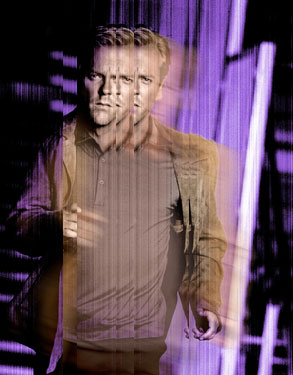

24

“24″: Split screen’s big comeback

From Fox's "24" to Destiny's Child videos to Hollywood, the splintered aesthetic of multichannel storytelling -- once the province of the '60s avant-garde -- is suddenly everywhere.

  • more
    • All Share Services

In Fox TV’s cult-hit series “24″ (which has its penultimate episode tonight and concludes next week), the screen serenely fractures into two and three frames against a black background. It does this for scene changes, for cellphone conversations, before and after commercial breaks and sometimes just to be beautiful. In doing so, “24″ has quietly become the first prime-time dramatic series to employ multiple screens as an active storytelling technique: Playing federal agent Jack Bauer, Kiefer Sutherland drives through the San Fernando Valley, his ex-lover on one phone in one panel, his wife on another. Far and wide, close shot and medium shot, assassin and hero, mother and daughter; as many as six simultaneous images, often locked by the visuals of a ticking digital clock, keep the concurrent stories lines careering past us.

Splitting up the screen has slipped into movies and TV shows so deftly that almost no one has pointed out what a break it makes with the past. Except for a brief, astonishing moment in the late ’60s, with movies like Richard Fleischer’s “The Boston Strangler” and Norman Jewison’s original version of “The Thomas Crown Affair” and, of course, “Woodstock,” edited by the brilliant Thelma Schoonmaker (among others, including a then-unknown Martin Scorsese), the history of film has been a history of the single screen: one image, one shared moment in time. An artist once insisted to me that you couldn’t have it otherwise; the moment you break up that screen, you destroy the illusion that allows you to carry off your audience.

No longer. A new story form is here, where the splintered frame is not an aberration, not a trick, but an integral part of the story’s syntax. Take the three-channel Destiny’s Child video, “Emotions,” directed by Francis Lawrence and released in August of last year. Each panel follows the three singers simultaneously through a triptych of frustrations and petty disappointments until they join, in the end, to comfort each other. In “Timecode,” director Mike Figgis’ four-quadrant take on Hollywood development hell, an ensemble of actors improv their way through 90 uncut minutes, divided solely by their placement in one of the four squares that are always on the screen. “The Laramie Project,” a Sundance film (adapted from a New York play) that premiered this spring on HBO, uses an array of divisions to navigate through a complex series of flashbacks that tell the story of Matthew Shepard’s death and its impact on the eponymous Wyoming city.

Director Stephen Hopkins says he first got the idea for “24″ because “there were so many phone calls in the script that these people would never share any screen time together.” A great fan of “The Boston Strangler,” Hopkins had just had a two-channel independent film felled when he was approached by the producers of “24.” He immediately saw that the show offered a unique opportunity to use the divided screen. “I loved the idea of showing what people were saying on the phone but also what they didn’t want other people to see,” he says.

A handful of filmmakers have been trying to divide up the single screen almost since film began. In 1927, Abel Gance made the three-screen silent classic “Napoleon,” using a process he called “Polyvision.” To those whom Polyvision confused, he wrote: “Do me the favor of believing that maybe your eyes do not yet have the visual education necessary for the reception of the first form of the music of light.”

The music of light, he called it. Which is what you could call New York’s Times Square, whose very buildings blink and shimmer. “It is the future of the cinema which is at stake,” Gance continued. “It will become a universal language if you make the effort to try to read the new letters which, little by little, it adds to the alphabet of the eyes.”

Could Gance have foreseen that the necessary visual education would come from our contemporary glimpse culture: computer screens, channel-zapping, video games, CNN crawls, JumboTrons, surveillance cameras, Web sites, screens in our stores, on our desktops and in our nurseries? The much-maligned shortened attention span is actually, as Gance predicted, an ability to navigate through simultaneous images. It’s the alphabet of our eyes.

When so many images flicker at you, you see differently. You glance. You glimpse. Your eyes keep moving, and you use your peripheral vision, the kind of sight connected to fight or flight (and actually processed in a separate part of the brain than the direct gaze). You don’t get the entire picture; you can’t, and you learn to take this partial experience as being accurate enough.

In his fascinating DVD commentary for “Timecode,” Figgis talks frankly about how there are times when you just can’t take in what’s going on in his four-screen film, even when, occasionally, he keeps one screen on a subject long enough that you’re effectively only watching three, as when a woman eavesdrops for several minutes on her lover. The point is, you don’t need to. This very incompleteness, this partialness, creates its own tension, which becomes part of the story, as it does in “24,” where absence of information is a theme.

What starts as necessity becomes a skill, even a pleasure: There’s an unnamed satisfaction in stretching this newfound ability to navigate through images. We’re actually hungry to use this ability, to feed it with something more substantive than frenzied Web animations and stock tickers. We crave stories. The single-channel film is the visual art form of the gaze; multichannel is the art form of the glimpse.

It’s an art form increasingly found in galleries and museums, where more artists than I can possibly list here have been creating multiscreen environments and multichannel works, many entirely narrative in nature. The French artist Pierre Huyghe created a double-screen piece that parallels excerpts from Sidney Lumet’s “Dog Day Afternoon” with his own film of the actual bank robber, now 30 years older, reenacting the crime with actors on a set. Cecilia Dougherty’s “Gone” uses a double screen to reinterpret the story of the gay son in the PBS vérité series “An American Family.”

The Iranian artist Shirin Neshat frequently uses two screens facing each other to vividly convey the rigid divisions in gender between Iranian men on one screen and Iranian women on another. Doug Aitken used three rooms with multiple screens to evoke a lonely man’s walk through a Los Angeles night. Sam Taylor-Wood’s seven-screen piece “Party” peels away the dynamics of a cocktail party by filming one with seven cameras in real time. Nam June Paik, Bill Viola, Gary Hill and other video artists have long used multiple monitors to fracture time and images.

The last time people were chopping up images like this was way back in the ’60s, when sex and drugs were good for you. In what came to be called “expanded cinema,” underground filmmakers put projectors on light shows and threw images around galleries. In 1957, Jordan Belson and Henry Jacobs began massive multiprojector shows on the ceiling of a San Francisco planetarium. In 1959, Charles and Ray Eames (best known for the Eames chair) put a seven-screen display called “Glimpses of the USA” together to show America to Nikita Khrushchev, who loved its seven simultaneous images of Marilyn Monroe blowing kisses. The Eameses made a six-screen presentation called “House of Science” the next year, and then the incredible 17-screen “Think” for the IBM pavilion at the New York World’s Fair of 1964.

Superimposition became — and remains — the quintessential way to show an LSD trip. Andy Warhol’s films began to split in 1965; the most famous of these was “Chelsea Girls,” where he paired up reels — some color, some black-and-white — he’d been shooting of his friends in New York. That became the first commercially released double-screen film.

This visual adventuring culminated in the screen-drenched pavilions of another World’s Fair, Montreal’s Expo ’67: One pavilion had two 70-foot screens placed vertically facing each other, Francis Thompson’s six-screen “We Are Young” played in another and the Czechoslovak pavilion featured 130 continuously changing images. Both Fleischer, a studio veteran by that time, and Jewison went to Expo ’67 and were inspired by the visual vocabulary they encountered there. Which is why the two greatest split-screen movies — theirs — came out in 1968. (And why the fracturing frames of “24″ can trace their lineage from Hopkins’ love of “The Boston Strangler” straight back to expanded cinema.)

Mysteriously, while video and film artists continued to use multiple projectors and monitors from that point on, in Hollywood, split screen went from cutting edge — in movies like “Charley” and “The Andromeda Strain” — to passé in about two minutes. “Wicked, Wicked,” a 1973 film directed by Richard L. Bare, used split screen — dubbed “Duovision” — in its entirety. Deemed a bomb, it never made it to video. But despite its clumsy writing and acting, “Wicked, Wicked” is well worth watching for its exploration of reasons to divide a story’s screen: fantasy vs. reality, memory vs. present, truth vs. lies, hope vs. fear and — since it’s the story of a peeping Tom — watcher vs. watched, stalker vs. stalked.

By 1979, split screens were being used in “More American Graffiti,” another bomb, to convey a dated ’60s look. When I interviewed Fleischer, director of “The Boston Strangler,” in 1998, he said, “I think what happened when directors got into that stuff was, it was too difficult, you had to plan it, and they didn’t want to take the trouble.”

In the days of optical printing, a huge amount of trouble, time and expense went into those multiple on-screen images. Each image in each box had to be resized and refilmed on an optical printer using a matte screen. Pablo Ferra, who designed the multiple boxes for the original “Thomas Crown Affair,” says the process took months. (The lowly status of split-screen movies is reflected in the fact that “The Boston Strangler” is also unavailable on video. AMC airs it occasionally, along with an interesting back-story documentary, which is the only way you’ll see it until Fox sees fit to release it. Fleischer is still alive, as is star Tony Curtis; they could make a great audio commentary. The original “Thomas Crown Affair,” however, is available in a new DVD, on which Jewison discusses the influence of Expo ’67 and describes the design of the multiple boxes in detail.)

None of the greatest directors working in the ’60s, such as Alfred Hitchcock or David Lean, ever ventured near a split screen, and among name American filmmakers only Brian De Palma has continued, Quixote-like, to use split screen as part of his arsenal: in “Sisters,” “Carrie,” “Dressed to Kill” and even 1998′s “Snake Eyes.”

The arrival of nonlinear — that is, computer-based — editing systems like Avid, the low-priced Final Cut Pro and After Effects is perhaps the biggest reason why divided frames are back. For the first time, it’s easy. Even the lowest-end computers can juggle several images with tremendous precision, if not always speed. (Peter Greenaway had Avid make up a special software program just for his 1996 multiscreen film “The Pillow Book.”)

The Avid has been the mother of multichannel work in another sense: When you edit on the Avid, two images appear in side-by-side rectangles at the same time in a function called “Trim Edit.” Figgis shot his film of the Strindberg play “Miss Julie” on two cameras and thus found himself looking at these side-by-side images in the editing room all day long. He found the effect so pleasing that he decided to make the film’s crucial central love scene in two channels. He made the leap to “Timecode,” an entire movie split into four sections, from there.

Moisés Kaufman, director of “The Laramie Project,” was also inspired by Trim Edit mode as he and his editors struggled to put together hundreds of hours of footage. “The playfulness of the ’60s split screens has ideology behind it,” says “Laramie” editor Brian Kates. “Now it’s more because the Avid lets me do it.”

The single biggest question when the screen divides is: where is now? Which panel is the single shared moment in time that heretofore defined single-channel movies? And when are the other panels happening: earlier, later or at the same time? Cutting up the screen unmoors the images in time. Clearly the simplest answer is to say that the frames are all now, all the same moment. You’ve divided up the screen but not the time. In “Timecode,” we’re always at the exact same time on all four screens. “24″ uses cuts and shifting angles, but the screens depict the same moment, often showing the precise seconds ticking by. Music videos like “Emotions” or Semisonic’s “Closing Time” do the same thing: The joy is in simultaneity, disparate events and angles divided in place but not in time.

But “The Laramie Project” uses multiple screens to navigate several simultaneous strands of time. There is the “now” of the New York actors visiting Laramie juxtaposed with the “then” of their earlier visits to the town. There’s the “now” of the town’s inhabitants — a Laramie bartender, say, talking to the visitors — and the “then” of his remembering Matthew Shepard at a table with his tormentors. You might call this “speaker and subject”; it’s one of the basic multichannel divisions, and you see it every night on the TV news. Jewison’s “Thomas Crown Affair” has one wonderful moment near the end when Faye Dunaway and Steve McQueen stare pensively into their bonfire on the beach, while — in another panel — the second bank robbery that will destroy their relationship begins the next day.

The world of Hollywood and prime-time TV seldom overlaps with experimental film or art installations, but remarkably, wherever multichannel is tried, its users invariably rely on the same vocabulary. There’s the technique we might call “close and closer”; no matter how pragmatic the reason for dividing the screen may be, sooner or later everyone simply puts two lenses on the same thing at the same time just for sheer visual pleasure. You can see this at work in “24,” in the ads for Bravo’s “Inside the Actors Studio” and in Jean-Luc Godard’s 1979 “Numero Deux,” a film made from video that includes a beautiful scene of a couple arguing while the dishes are being washed, shot from two angles, one in silhouette.

“In effect, you do your own editing, as you look from one [image] to the other,” says Fleischer, and this is as true of Warhol’s “Chelsea Girls” as it is of “The Boston Strangler.” At Expo ’67, Fleischer says, he saw a full figure next to a close-up: “It opened a whole new vista; this is very interesting, to see things from more than one point of view simultaneously.” The contrast can be between locations, between film stocks — “Laramie” pairs actual news footage with filmed scenes — or between film speeds, as in Dougherty’s “Gone,” which pairs (among other combinations) the sped-up rectangular fracturing of digital fast-forward on one side of the screen and regular time on another.

Sometimes a split screen tells us more than we could know with just one, something at which “The Boston Strangler” excels. A camera waits, poised, over the foot of a murdered woman while, in another panel, her roommates chat about her as they climb the stairs. We wait for the door to open and the two screens to become one, front and back of the same horrific moment, as they invariably do.

There’s also simultaneous montage: The elegance of “Thomas Crown” is in the title character’s brilliant planning — five men who never meet will pull off a bank heist, and we watch all five at once. Sound is crucial in telling us where we are: What you see is what you hear. Both “The Laramie Project” and “The Boston Strangler” use multiple images to convey a sense of a city as a character in the movie (Boston and Laramie themselves being multichannel experiences). “Laramie” also interweaves news footage with its fictional filmed scenes to capture a sense of the media frenzy surrounding the Shepard case.

Once you put the lens on this particular focal length, you not only have a new vocabulary for telling stories, you start to see multichannel everywhere. The Oscars telecast was relentlessly multichannel this year; nearly every category had some kind of divided imagery, not least on the five screens behind the podium. On MTV, a group of guys in one frame comment on their favorite sexy videos, which are shown at the same time on another. (“If Tupac was a white woman, he’d be Madonna,” comments one guy. “Of course, we’re talking about a pretty big if.”) A VH1 multichannel show plays a Janet Jackson video while fans talk about why they love it or sing along. “Dismissed” interrupts its blind dates to have little instant replays and commentary play at the same time.

Acura has multiple angles on cars; Fidelity Investments has two and three screens of broker and confused client, and Microsoft has a four-channel commercial that is a study of close and closer. Interstitial material (the promotional material that plays between ads) — for South Park or MTV’s music awards or the Cartoon Network — are almost invariably multichannel.

Other recent movies dip into and out of split-screen moments without missing a beat. Watching my nieces’ and nephews’ favorite movies over the holidays, I noticed random split-screen moments in movies from “Remember the Titans” to “Selena” and “The Princess Diaries.” Darren Aronofsky’s “Requiem for a Dream” opens with the split screen of a mother locked in a closet by her drug addict son, and has some compelling six-panel sections in its deleted scenes on its DVD (and an awesome menu, by the way). In Alison Maclean’s “Jesus’ Son,” two junkies overdose on the same heroin in split screens: One is discovered and saved, the other dies. The French import “Amélie” features a Fotomat-style picture with all four images speaking at once — and saying different things. The climactic scene of Tom Tykwer’s “Run Lola Run” splits three ways, with one image the second hand of a clock.

There will only be more. Actor and director Alan Cummings’ talk show, due soon on Oxygen, will often use four simultaneous cameras on his interviews (the first is with Gwyneth Paltrow). Figgis has already made a second multiscreen film, the as-yet-unreleased “Hotel.” “24″ has taken prime-time TV far beyond the convention of splitting the screen for a telephone conversation (a tradition that actually goes back to a 1913 silent film by pioneer Lois Weber). We are destined to watch more than one image at a time, to connect them and have them connected for us, spelling out stories with the alphabet of our eyes.

Julie Talen is a writer and director living in New York.

The coverup continues: The Kennedys in Hollywood

The "Kennedys" miniseries is the latest proof tinseltown just can't handle the truth. I should know

  • more
    • All Share Services

The coverup continues: The Kennedys in HollywoodPresident Kennedy with wife Jackie, daughter Caroline and son John Jr. in 1962 (left); Greg Kinnear and Katie Holmes in "The Kennedys"

Although it lasted a mere 1,000 days, the Kennedy presidency has been entombed under 1,000 layers of junk history. Now — with the 50th anniversary of JFK’s brief reign upon us, and the half-century mark coming up on his 1963 assassination — we will soon be neck deep in Kennedy sludge. A flurry of Kennedy projects are in various stages of production in Hollywood, which has long been dazzled by the family’s glamour. But none of them promises to go beneath the surface and capture the deeper essence of their tragic story. When it comes to the Kennedys, Hollywood still can’t handle the truth.

The first Camelot drama out of the chute is “The Kennedys,” the controversial miniseries that was canceled by the History Channel under pressure from Carolyn Kennedy and historians, who argued that the channel should at least make some effort to root the story in, well, history. This was a quaint argument, since the History Channel abandoned history long ago in favor of ice-road truckers, gator wrestlers and other reality sideshows. But the network owners were sufficiently embarrassed by the ruckus to dump the series. “The Kennedys” then took a long, downward trip through television’s alimentary canal, ending up in some dark cavity called the Reelz Channel. The six-episode series begins plopping out on Sunday.

“The Kennedys” is a hatchet job pure and simple. The saga is produced by Joel Surnow, which is sort of like Mel Gibson making “The Anne Frank Story.” Surnow is the right-wing, Dick Cheney fluff boy who brought us “24,” the show that told America not to adjust its dials, that the Constitution was now obsolete. The Camelot noir miniseries, which wallows in mobsters, mistresses and self-medication, is basically the Kennedys as Sopranos, minus the good writing and direction. The early reviews have not been kind, even in the normally charitable Hollywood trade press. “The whole thing,” Variety gagged, “plays like a bad telenovela filtered through a ‘History for Dummies’ text.”

All right, I admit, I’m a little bitter. I had a dog in this fight, a rival Hollywood project. I’m the author of a 2007 bestseller about the Kennedy brothers that tells the story of Robert Kennedy’s secret quest to solve JFK’s murder. My book, “Brothers: The Hidden History of the Kennedy Years,” focuses on the brothers’ heroic struggle with the national security state to ease America away from the nuclear brink and end the Cold War. I show that Bobby Kennedy became the country’s first conspiracy theorist after his brother’s assassination, immediately suspecting that the same CIA and Pentagon officials with whom they had bitterly dueled were behind JFK’s murder. Bobby realized that he couldn’t bring President Kennedy’s killers to justice unless he fought his way back to the White House. RFK’s presidential campaign in 1968 was not only a fight for the soul of America — a country poisoned by war and racial strife — it was a breathtakingly bold, and ultimately fatal, confrontation with his brother’s assassins.

This, to me, is the most dramatic story to tell about the Kennedys. They tried to save America, and they were killed by the Saurons who have kept our country in a permanent state of fear and war for the past half-century — virtually my entire life. It’s a grand epic, as old as ancient Rome, as beautiful and horrible as Shakespeare.

The executives at Lionsgate, one of the bigger independent studios in Hollywood, saw it the same way and they optioned my book for a TV miniseries in 2008. They treated “Brothers” as a hot property, the ultimate political thriller. Joining forces with a high-profile producer — Sid Ganis, then president of the Academy of Motion Picture Arts and Sciences — and an A-list TV writer, the studio began aggressively pitching “Brothers” to TV networks. Jon Hamm — the star of Lionsgate’s hit series “Mad Men” — was chatted up as the perfect JFK. No wardrobe changes necessary.

The traveling “Brothers” road show roamed all over the entertainment capital. Because of the industry names attached to the project, we got high-level meetings at HBO, Showtime, ABC and Starz, among other stations of the Hollywood cross. At one point, Todd Haynes was interested in directing, before peeling away to do “Mildred Pierce.”

There was buzz, there was excitement, there was love in the room. And then nothing. Chris Albrecht — the programming wizard who had made HBO not just television (“The Sopranos,” “Six Feet Under,” etc.) and then resurfaced at Starz — talked about making “Brothers” the centerpiece of his first season at his new network home. Albrecht was all Roy Cohn, hooded-eye intensity, and fuck-’em-let’s-do-this swagger. And then, he had a sudden change of heart. The fearless TV mogul didn’t want to compete with the Joel Surnow miniseries, or at least that was the explanation. In Hollywood there are always murky back stories.

Yes, I know — “It’s Chinatown, Jake” — get over it. There are a million sad stories in Naked Hollywood. But something seemed rigged here, as one network after the next turned down “Brothers” — something political under the surface. Oliver Stone, whom I met somewhere along the way, told me in a matter-of-fact tone, “‘Brothers’ will never get made in this town.” Stone knew something about the subject. His “JFK,” released back in 1991, was the last movie to offer a deep and brave interpretation of the Kennedy tragedy. For his efforts, Stone was so savagely pilloried, he still hasn’t fully recovered his reputation or — it seems to me — his political self-confidence.

Apparently, Stone knew what he was talking about. Now, three years after Lionsgate bought the rights to “Brothers,” my book is an orphan in Hollywood, owned by nobody but me. Meanwhile, a slew of other Kennedy projects have rushed forward. A low point in my Hollywood tragicomedy came when the screenwriter of the widely reviled Surnow miniseries, a man named Stephen Kronish, tried to defend himself against the rising chorus of criticism by citing “Brothers” as one of his sources. This is the very definition of adding insult to injury.

Now, in addition to Surnow’s “The Kennedys,” Matt Damon is preparing to play Bobby in yet another bland biopic; Leonardo DiCaprio is working on a Kennedy conspiracy movie based on Lamar Waldron’s books — heavy tomes that propose such a convoluted explanation for the JFK assassination that they make “Inception” look linear in comparison; and, worst of all, Tom Hanks’ Playtone company is preparing an assassination miniseries for HBO based on celebrity prosecutor Vincent Bugliosi’s massive phone book, “Reclaiming History,” which took a whopping 1,648 pages to argue that Lee Harvey Oswald did it all by himself, and was still unconvincing.

For the past 50 years, every Kennedy drama except Oliver Stone’s has fallen into the same predictable categories. They are either safe — i.e., weepy valentines to the suffering, stoic family — or sleazy (see Surnow above). When filmmakers do screw up their courage to dig a little deeper, they invariably end up blaming the Mafia for killing Jack and changing American history. Yes, the mob played a role in Dallas. But the crime lords never participated in anything this epic without their overlords — the CIA, their longtime partners in crime.

Here’s my advice to the viewing public as the Kennedy mudslide begins. Run, and don’t look back. There is nothing you need in these movies and TV “events” to understand the true Kennedy story.

This is all you need to know. The Kennedys died for a reason. They died because they told America that our enemies were human, like us, and loved their children too. They died because they vowed to shatter the CIA into a thousand pieces, and because they told the generals who wanted to launch a nuclear war over Cuba that they were mad. While Barack Obama outsources his presidency to Wall Street, the Pentagon and the CIA, John Kennedy tried to tell his fellow citizens that we must no longer dominate the world.

This is what you need to know. The Kennedys died for America’s sins.

Continue Reading Close
David Talbot

David Talbot is the founder and CEO of Salon.

Dear “24″: I loved you, but I’m glad it’s over

As the once-glorious show ends on its own solid terms, a loyal fan assesses the bad times, and the good

  • more
    • All Share Services

Dear 24: Jack (Kiefer Sutherland) contemplates his next move in the climactic two-hour 24 series finale episode "2:00-4:00 PM" airing Monday, May 24 (8:00-10:00 PM ET/PT) on FOX. ©2010 Fox Broadcasting Co. Cr: Kelsey McNeal/FOX

May 24, 2010, 10:01 p.m.

Dear “24“:

So it’s over. After nine years, our time together has come to an end. Lord knows, we’ve had our ups and downs, and there have been times, like with Kim and the cougar, when perhaps we should have called it quits. But I’m glad we stuck it out, even though I’m not sorry to say goodbye.

It could have been worse. Somewhere in season six, the one where you set off your second nuclear explosion, we drifted apart, and I thought I was done. The first time you did it, back in season two, it was a genuine shock, even if the bomb did detonate in the middle of the desert. But the second time, it just seemed sad. I know it’s hard to keep things fresh over the long haul, and there are days when the best any of can do is go through the motions. But by that point, it seemed like you weren’t even trying.

I still remember the moment I first loved you. It was at the end of your first season, when Nina, who’d been revealed as a terrorist mole the week before, made the mistake of plotting her escape with Jack’s pregnant wife in earshot. The man on the other end of the phone warned Nina to eliminate anyone who might know where she was headed, and she cast a steely glance at Teri before you went to commercial. I remember wondering how you were going to dig yourself out of that hole, since you obviously couldn’t kill the main character’s wife. And then, of course, you killed her. I was blown away by the sheer audacity of it; I’m pretty sure I let out an audible whoop. That required some explaining to my girlfriend, who I’d only been dating a month or so, but whatever I said must have sounded all right. We sat next to each other for every episode of the next seven seasons, and watched the finale as our daughter slept upstairs.

Those were heady times, when everything seemed new. People went nuts for your continuity-driven concept, which seemed to flout every canard about TV’s dwindling viewership. Rather than chase after an audience’s attention, you demanded it, and promised to reward it as well. The heedless momentum of your real-time rush turned the rules of television inside-out. Rather than returning to the status quo ante at the end of every episode, you promised that things would change, and keep changing. There was no going back.

To be honest, I thought you were a bit full of yourself early on, acting as if the season-long story had never been tried before. You weren’t the first, or my first. I don’t know if I ever felt about you the way I did about “Murder One,” with its exquisitely detailed take on a single murder trial, including an entire episode devoted to jury selection. (Ah, youth.) If only more people had seen what I saw, maybe that relationship would have had a chance, but I knew it was doomed from the start.

You took that idea and dressed it up in a shiny new suit, promising non-stop thrills rather than wonky legalese. And then there was the whole 9/11 thing. I know you don’t like to talk about it, and it’s easy to be glib. But you have to admit that, at least as far as you were concerned, the World Trade Center attack was a terrible stroke of luck. Sure, you cut out a few shots of an exploding plane in facile deference to the national mood. But deep down, you knew you were right where you wanted to be.

As audiences responded in growing numbers, everyone tried to lay claim to a little piece of you. Conservatives heralded Jack Bauer as a role model, and exploited the ticking-time-bomb scenario to make their political agendas seem more urgent and less debatable. Liberals bemoaned your scant regard for civil liberties, your quasi-fascist endorsement of the idea that free societies can only remain so with the aid of extralegal guardian angels. The New Yorker’s Jane Mayer took you to task for making torture seem effective, even attractive, and providing dark inspiration to U.S. interrogators who saw themselves as real-life Jack Bauers. But it didn’t seem quite fair to blame a TV show for the combination of intense pressure and a lack of ground rules that prompted those charged with keeping the country safe to look to their DVD sets for fresh ideas.

Like any product of a system as intensely profit-driven as network television, your ideology was flexible, which is to say opportunistic and situational. Clearly, you endorsed the idea that threats to national security had to be dealt with immediately, and harshly, but those threats came from within as well as without, inside governments that skewed both left and right, hawk and dove. The low point was your scurrilous portrayal of “Amnesty Global,” a human-rights group whose well-heeled lawyers turn up in the dead of night and spring suspected terrorists from federal custody, as if Amnesty International was staffed by sharkskin-wearing ambulance chasers in Prada shades. Making the lawyer Jewish was gilding the lily a bit, no?

In more subtle ways, you were positively progressive, most dramatically in your choice of commanders-in-chief. You gave us an African-American president two administrations before Barack Obama, and a female leader who combined gravitas with compassion. (It was worth sticking it out just to see Cherry Jones in the Oval Office.) In Gregory Itzin’s Charles Logan, you created a deliciously repellant caricature of ambition run amok, a chinless, amoral and supremely cunning political animal who managed to escape jail time despite conspiring to assassinate a former president. He was just the adversary Jack needed — devious, cowardly and utterly without remorse, and he lasted until (almost) the very end. Maybe longer, even, since his attempted suicide fell just wide of the mark.

I know these last few months have been difficult ones. It must be hard to look at the brass-band sendoff for “Lost,” whose serialized story was made possible by your success, and not compare it to your own less-glorious finish. Cancellation always hurts, and a handful of desultory think pieces barely numbed the pain. No collectible magazine covers or wistful good-byes for you. A few years ago, your plot developments were major news, each prodded wound or electrical shock prompting a fresh wave of outrage. But that moment has passed, the bring-’em-on rhetoric replaced by lawyerly prose less conducive to pulse-pounding drama. A few weeks ago, Jack shot an unarmed woman in cold blood, and the zeitgeist rolled over and hit snooze.

And yet, the night after “Lost” gave its audience a big wet kiss in lieu of answers, you went out solidly on your own less grandiose terms. After a bloodthirsty rampage that climaxed with a corrupt Russian envoy taking a fireplace poker in the gut — that, I admit, made me love you all over again — Jack pulled back from the brink with the help of his ever-steadfast Chloe, whose sullen determination never failed to elicit a knowing chuckle on our couch. Betrayed by a president he once revered, Jack was left as a man alone, a ghost of liberty who dissolved in a hail of pixels and passed into the realm of myth. True, there was repetition here as well, echoing the final shot of your fourth season, with a purportedly dead Jack walking down the train tracks into a glowing sunrise. But at least there was no glowy white light, no promise that everything would be all right in the end. The world remained an unsafe place, for you and for us.

If nothing else, “24,” you helped changed television forever, pushing the networks towards uninterrupted seasons and redefining the way the industry used DVDs to market their shows. Every time someone devours a complete season to prepare for the next one, they have you to thank. Your example also served as a warning on the dangers of stretching a story too thin. By the end, even you no longer believed in yourself, disregarding the laws of time and space to which you’d sworn such fidelity, compressing off-screen events in ways you would have shunned a few years before. The real-time concept became mainly a matter of structure: “in 20 minutes” meant after the next commercial; “in one hour” meant next week. It was probably for the best, and it beat all those filler scenes and plot contortions necessary to cover the drag of long car rides; even in your implausibly traffic-free Los Angeles, it took time to get places. There’s no fighting the fact that ideals soften as we age, and principle gives way to pragmatism.

I’m glad it ended when and how it did. Part of me wishes you hadn’t killed Renee, and left Jack with a final chance at hard-won happiness. But I know you’ve got a franchise to protect, and a movie in the works. Personally, I think you’d be better off letting go, but you’ve never been one to quit, even when you should. I think you know I’ve moved on; I’m more of a Mad Men person these days. But I’ll always cherish the memories of our best moments, and the disappointments will fade in time. We’ll always have Teri.

All my love,

Sam

Sam Adams is a regular contributor to the Los Angeles Times, the Philadelphia Inquirer and the Onion A.V. Club, and a Contributing Editor at Philadelphia City Paper, where he edited the film section from 1999 to 2007. His writing has appeared in Entertainment Weekly, the Boston Globe, the Hollywood Reporter, Film Comment, and the National Society of Film Critics anthology, The B-List. He blogs at Breaking the Line and tweets as <em>@SamuelAAdams.

Continue Reading Close

Sam Adams writes for the Los Angeles Times, the Philadelphia Inquirer, the Onion A.V. Club, and the Philadelphia City Paper. Follow him on Twitter at SamuelAAdams or at his blog, Breaking the Line.

“24,” the show that defined a decade

A video essay looks at the profound impact of Fox's real-time political thriller, whose finale airs tonight

  • more
    • All Share Services

Kiefer Sutherland as Jack Bauer in "24"

It’s hard to imagine the last decade without Jack Bauer. As “24” takes its final bow tonight on Fox, Matt Zoller Seitz and Aaron Aradillas have unpacked the show’s far-reaching cultural impact in a terrific five-part video series for the Museum of the Moving Image. As the first installment begins:

“If you’re looking for a series to remind you what it felt like to be alive and American in the aughts, ’24′ is the show to beat. ‘The Sopranos,’ ‘Deadwood,’ ‘The Shield’ and other cable series were more acclaimed for their artistry, perhaps rightly so, but ’24′ was as conceptually bold as its peers, and it aired on a broadcast network, a venue in which job 1 was to thrill. And with its combination beat-the-clock plotting, R-rated violence, and straightforward engagement with the dominant political issues of the day, ’24′ changed our perceptions of what a dramatic series could do.”

Watch the entire first video below, and to watch the full series at The House Next Door, click here.

Continue Reading Close

Zen and the art of serial-drama maintenance

"Lost," "24" welcome us into their comfortingly stupid nowhere lands

  • more
    • All Share Services

Zen and the art of serial-drama maintenance24: Cole (Freddie Prinze Jr., L) and Dana (Katee Sackhoff, R) face a dangerous situation in the "12:00 - 1:00 AM" episode of 24 that aired Monday, Feb. 22 (9:00-10:00 PM ET/PT) on FOX. ©2010 Fox Broadcasting Co. Cr: Kelsey McNeal/FOX

On the small screen, anything is possible: The hooker can have a heart of gold, the cloud can have a silver lining, the tunnel can have a light at the end of it. In real life, the tunnel is dark, the cloud dumps rain for days, and the hooker is indifferent and has Chlamydia.

No wonder we turn to our televisions for novelty, to see if the lovely downhill skier weeps tears of joy or disappointment, to find out if the patient’s heart surgery saves his life or kills him, to discover if the castaways live happily ever after, or spend another week wandering through the jungle, searching for more clues.

If your life is stable, it’s hard not to experience its details as predictable, if not a little mundane. If your life is unstable, it’s hard not to experience its twists and turns as dismaying instead of entertaining or suspenseful. You’re too close to enjoy yourself.

So you mumble distractedly to your co-workers and your family all day long, then weep openly for the fictional heart patient on your TV screen at night.

Jacking around

What’s interesting to me these days is that I still find myself addicted to shows that I have no emotional stake in whatsoever.

Take “24.” Last Tuesday Jack was tortured yet again, the week before that Renee stabbed a man in the eyeball, and yet, there I am, calmly taking it all in, wondering how the writers are going to pull themselves out of this junk heap that they set out for themselves at the beginning of the season.

Why is it so relaxing and enjoyable — so relaxing, in fact, that it often lulls me into a deep and dreamless sleep?

Sometimes I think it’s the predictability of the unpredictable suspense drama that keeps me coming back for more. It’s like my old roommate in San Francisco who came home from work every single night, smoked a big bong hit, and then watched a “Law & Order” rerun. For him, the bong and Sam Waterston were like a wife holding out a martini and a pair of slippers for him when he walked in the door.

Personally, I find the utter flavorlessness of Jack Bauer comforting. I appreciate his complete lack of flair. I like the bland resignation with which he endures yet another Russian thug hanging him by his wrists and applying jumper cables to his nards. While I can recognize, intellectually, that these scenes of torture are depraved and wrong and to repeat them, over and over, is to make torture itself mundane, I can’t get very worked up about it, perhaps because “24″ has already made torture mundane for me, or maybe because “24′s” quaint little terrorist puppet show feels about as far removed from anything menacing or weighty as it possibly could be. Did “The A Team” celebrate vigilantism or criminal misdeeds? Weren’t they technically domestic terrorists? I’m pretty sure that no one got the wrong impression about driving around in a van with your buddies, building homemade bombs, from Mr. T.

It also helps that the people getting tortured on “24″ are usually either a) Jack Bauer, who is about as human-like as a bag of sod, or b) some clownish terrorist with a really bad accent who looks and acts just like every other clownish terrorist who has ever appeared on this twisted neocon flea circus.

Do these non-characters make us immune to the horrors of war? Or do they just provide a sort of modern, surreal Kabuki theater, some odd little stylized fable that teaches us that, no matter how big and scary the world might be, there are men like Jack Bauer somewhere out there, men who stage-whisper in hoarse voices and choke people with their bare hands in order to save our asses from certain destruction. We need not do a thing but sit back and spoon pudding into our empty heads.

No wonder “24″ doesn’t need to be good for me to watch it. It was never really “good” so much as difficult to turn away from in the first place. Sure, there was a time when it made my heart race uncontrollably. I miss those days. Now, most long, long interrogation sessions or intense emotional scenes put me right to sleep. Something about the extreme close-ups, those monotone voices they use, those featureless, empty rooms of CTU: It’s institutional hypnosis.

The only scenes that keep me awake and curious this season are the ones that feature Katee Sackhoff, formerly of “Battlestar Galactica,” who plays Dana Walsh. Dana is a CTU agent with a redneck ex-boyfriend who has pretty much thrashed her whole life simply by showing up at CTU and threatening to reveal her true name (Jen Scott) and troubled past (building homemade bombs in Shaggy’s van?). Dana wisely responded by tossing her ex the keys to her apartment. Next she helps him steal some cash and – whoops! – beat up a cop. Then, once the ex escapes and he’s celebrating with floozies and hard liquor and he’s sure to be passed out or hung over for at least the next 12 hours, what does Dana do? She grabs a gun with a silencer and tracks the ex down, either to threaten him or blow his head off, it’s not clear which. The whole subplot has been so preposterous and tangential to the main story (which isn’t such great shakes itself this season) that I couldn’t look away: It was too delightfully awful. This is the Kim-being-kidnapped-then-chased-by-mountain-lions plot of the season. This role is not doing Katee Sackhoff, whom I love, justice.

But maybe that’s how you can remain addicted to shows long after they jumped the shark. There’s fun in witnessing exactly how ridiculous things will get.

Of course, there’s also the fear that you’re going to miss something really important. Jack probably won’t put the president in a chokehold, but if he does? I need to be there.

Lighthouse hunting

Jacob: Sometimes you can just hop in the back of someone’s cab and tell them what they’re supposed to do. Other times, you have to let ‘em look out at the ocean for a while.

Hurley: Well, next time, how ’bout you tell me everything upfront? I’m not big on secret plans.

I feel you, Hurley. Maybe that’s why “Lost” makes me so impatient. Nonetheless, I feel that it’s my duty, as a guide to the TV world, that I continue to watch in spite of the obvious endless-maze, unraveling-yarn, black-hole, Möbius-strip, tedious-baby-shower nature of this beast.

After all, it is true that on “Lost,” anything at all could happen, anything in the world! And what if I wasn’t watching when it did? Someone else turns into a smoke monster or comes back to life or has a kid that we never even knew existed before, and then what? Hell, Jack could move to Des Moines to start a record shop, Kate could turn purple and start foaming at the mouth, Sawyer could grow wings and big claws and eat everyone’s heads off, Jin could morph into Lady Gaga in patriotic Princess Leia drag with a firecracker strap-on, and I might miss the whole thing!

Because the writers of “Lost” are a lot like John Locke, who keeps brattily insisting that no one should be able to tell him what he can and can’t do. And look, they’re right, because the more ridiculous things get, the more people try to make sense of the ridiculousness. If reading this gigantic list of theories about “Lost” doesn’t make your head hurt — and no, not because it’s an elaborate, thoughtful riddle, but because it’s a big, jumbled mess of interconnected nothingness — then you have a lot more patience for chaos that can only end badly (like life itself, dude!) than I do.

No, no, say the show’s die-hard fans, it all adds up to pure brilliance, with numbers and mirrors and alternate realities! But ask any actual screenwriter or fiction writer or seasoned storyteller, and he or she will agree: There is no glorious final answer that can justify pulling a deus ex machina out of your ass every other episode.

Giving your lead character a kid that no one knew existed before is just a little bit like bringing dead characters back to life (Locke, Jacob, Sayid) or traveling through time or making the island disappear or creating an alternate universe to flash to because flashbacks and flash forwards had been exhausted. Now, of course, fans are going wild with speculation over the “new” timeline of this alternate world, when it started (1977?), and who Jack’s alternate-universe wife might be. Juliet? Linda Carter? You know, I bet when Carly Simon whispered “David” backward in the new version of “You’re So Vain,” she wasn’t referring to David Geffen at all, but was referring to Jack’s musically talented son David, who’s obviously going to travel back in time, become a record executive, and screw up Carly’s career but good! And remember Carly’s 1976 album was called “Another Passenger”? Oh my god, I’m blowing my own mind here!

Yes, yes, I know, David exists in the alternate timeline universe, and naturally there are no rules guiding that universe because what fun would that be? Maybe he only exists in the mirror or in Jacob’s mirror-mind or maybe he’s from the planet Zornular (where Michael and Walt were beamed before the tanker exploded) and he comes bearing a message about good and evil. You know, it’s all about mirror worlds and redemption and the lighthouse is religious but the temple represents secular man’s ability to enact miracles on earth without God, but smoke monster and Claire are forces of evil who are looking for “candidates,” sort of like the GOP except with trekking through the jungle aimlessly where prattling on about healthcare reform aimlessly should go.

Look, there is actually a difference between an elaborate, multitiered maze created by a mathematical genius and an enormous, tangled mess of scrap metal dumped there by someone who read a few Wikipedia entries on chaos theory and quantum mechanics and thought they were seriously cool. When thousands of people are picking through the scraps while playing make-believe that they’re in some wise and complex microcosm filled with deeper meaning?

Well … it’s strangely fascinating, isn’t it? To watch, week after week, as the world scrambles and strains to sift through a junk heap? And to think, without the Internets, we’d never have such a front row seat to the ease with which the populace is drawn into a giant narrative roach motel.

Addictive, silly, and yet, oddly calming. It’s not a guilty pleasure because there’s no guilt and even less pleasure. Like staring into a washing machine as it spins, the repetitive nothingness of “24,” “Lost” and so much of current popular media and culture offers a means of coaxing us out of our rage and disempowerment and into a state of soothing indifference.


Continue Reading Close

Heather Havrilesky is Salon's TV critic and author of the rabbit blog. Her memoir, "Disaster Preparedness," published in 2010.

“24″: Jack Bauer goes soft

Terror alert red! "24's" ballsy agent now a cooing grandpa, nation's security hangs in the balance!

  • more
    • All Share Services

Losing your edge is underrated. Suddenly you’re free to drop out of the media loop. Suddenly you don’t have to feel guilty about ignoring things you never cared about to begin with, hipster bands in skinny jeans, tweets about late night shake-ups and all of the other cultural obsessions of a precious handful of busybodies huddled together, drinking overpriced wine in their drafty apartments by the sea.

Now you can focus on what’s really important in life.

Which is … Um.

Huh. I sort of want to go online and do a Google search on “important things in life.” Maybe someone has tweeted about this lately…

It’s my Jack in a box!

Thankfully, Jack Bauer has just discovered what’s really important in life, and he’s here to show us about it. The first time we see Bauer in the eighth season premiere of “24” (four-hour, two-night premiere airs 9 p.m. Sunday, Jan. 17, and 8 p.m. Monday, Jan. 18, on Fox) he’s smiling and chatting happily with his young granddaughter. Of course we’re meant to be gratified by this kinder, gentler image of Bauer, finally having lost his edge, finally at peace with himself, finally open to making real, intimate connections with others, just like a real human being with blood in his veins.

Instead, all we can think is: Upgrade the terror alert to red! The one man who has the power to save this great country of ours from annihilation at the hands of terrorists, the one man who stopped at nothing to deliver us from widespread death and destruction countless times before is now watching Barney and fetching juice boxes!

We’ve certainly seen this before. One minute, our friends have thriving careers and active social lives but they can still be counted on for two-hour-long phone sessions concerning the overwhelming obstacles to a consistent hair removal regimen. The next minute, they’re unemployed hermits who can’t talk for more than a full minute without interruption because some small person just shat on the floor or ate something off the ground or a tiny Cinderella doll needs her microscopic glass slippers put on with miniature tweezers.

The point is, little children may bring great joy to the world, but they also make it more likely that a) good female doctors and lawyers and bookstore clerks and waitresses will exit the workplace, leaving far less nurturing ball-scratchers in their places b) countless really scintillating conversations about hair removal will be cut short unnecessarily and c) the free world will be crushed under the hobnailed boots of a ruthless band of terrorists with really bad Russian accents, one of whom always seems to have a graying ponytail (or an “executail” as a friend likes to call it).

Now, naturally we all assumed that Jack Bauer would remain immune to the charms of small children indefinitely. Time was when Jack Bauer would sooner have his fingernails forcefully removed by a mouthbreathing thug with an executail than spend time in the company of a little child. In fact, the Jack Bauer we once knew and loved would happily murder his way through a throng of black-turtleneck-wearing terrorist psychos, biting their faces off and breaking their necks using only his thigh muscles and stabbing them in the jugular with sharpened pencils, just to escape an afternoon with a drooling toddler.

The old Jack is long gone, though, replaced with this sad little half-caf Jack, who takes other people’s feelings into account and looks straight into his own daughter’s eyes when he’s speaking to her. I mean, come on, Jack! What have you become?!

Of course they gave Wilty, Thoughtful Jack a totally lame impromptu assignment: Save the peace-loving president of some country in the Middle East from being assassinated by his brother (who quite obviously isn’t from the same country, let alone the same family). Yes, that’s right, we’re supposed to go from nuclear warheads and deadly nerve agents and biological warfare and dirty bombs to one little half-assed assassination attempt. This is what’s known as devolution: Tune in for the next season of “24″ when Jack saves a really crowded Starbucks from a man with bad gas!

Now, granted, “24″ has relocated to New York City, which means that when we’re treated to more gloomy interiors of warehouses and murky back alleys and dim apartment buildings filled with piles of AK-47s and plastic explosives, we can say to ourselves, “Cool, they’re in New York City right now!” Also, the new and improved NYC CTU offices have really cool computer graphics instead of those sad IBM mainframes they were saddled with back in L.A. Chloe (Mary Lynn Rajskub) is back, and Kara Thrace (Katee Sackhoff) is even there, grappling with some terrible subplot about a scorned stalker exboyfriend from her white trash past who tracks her to CTU and growls at her until she tosses him the keys to her apartment and warns him, “But you can only stay for one night, ‘kay?” I’m sure that maneuver is straight out of the pages of the Safely Avoiding Stalkers handbook.

Nonetheless, Sackhoff as Sexy Lady Victim Du Jour is the least of our worries. Just when Jack is about to leave CTU to move out to LA with Kim and her dumb husband and their adorable time-suck of a child, just when Jack is saying goodbye and expressing his feelings so openly and honestly along the way that you want to grab him by the shoulders and shake some sense into him (the way he taught us to, in the good old days), along comes last season’s Sexy Lady Victim Du Jour. I’m not naming any names, but suffice it to say that instead of whimpering and gasping at the inherent violence and grotesque nature of every single task involved in saving this great nation of ours from the black-leather-gloved clutches of the terrorists (tasks that she somehow didn’t confront in her training at Quantico or wherever, because now presumably they skip the classes on interrogation techniques involving household appliances and they just grow organic beets and do Pilates), now this Former Sexy Lady Victim lacks affect and has dead eyes, because – pay attention! – she’s dead inside.

Dead inside, people. In case you’re wondering what that looks like, well, you make your face go all flat and you stop styling your pretty, shiny mane of hair, favoring a messier sort of knot that says “I don’t care anymoh-whoa” (even though you’re still carefully applying thick mascara and lip gloss so Wilty Jack might find you well nigh irresistible).

But does Wilty Jack find Dead Inside appealing? Because, let’s face it, Wilty Jack is more like a Sexy Lady Victim Du Jour this season, and Dead Inside is more like Classic, Casually Murderous Jack, which means that Dead Inside is likely to ignore Wilty Jack’s pleading for sanity and mercy, sallying forth heedlessly kicking ass and taking names as necessary to round up plenty of wayward executail.

But we don’t want someone with carefully applied mascara on to save the world! We want Jack Bauer to do it, damn it!

And besides, the world doesn’t even need saving this season. Based on what I’ve seen so far, we’re going to spend the next 24 hours bickering with exboyfriends only to give in suddenly and toss them our keys. We’re going to sit on our hands all season as lukewarm thugs pull lukewarm stunts and lady journalists fall in love with world leaders. We’re going to pick at our fingernails and hope that Chloe eventually gets a promotion.

But it’s not just CTU that’s lost its edge. You know who else is back? President Taylor (Cherry Jones) from last season. Here the problem isn’t mascara so much as a general lack of flair and/or bluster and/or swagger and/or toughness. What I wouldn’t do for good old snakey, slimey President Logan or macho but honorable President Palmer! Because, if you’re going to put a woman in the White House, at least give the role to someone vaguely charismatic, Allison Janney or some Glenn Close type, not a woman who spent the entire seventh season whining unconvincingly about things that were totally wrong and no fair, as if, instead of campaigning relentlessly and sucking up to evil lobbyists and biting the heads off squirrels like any woman destined to lead the free world would have to do to get as far as she had, she’d been shopping at vintage stores and puttering around in her herb garden for the past few decades.

In short, after watching the first four hours, I can tell you that the eighth season of “24″ does not look good. You know how much I adore this stupid show, but please, don’t waste your time. If Dead Inside goes off the tracks entirely or Jack locates his lost testicles or some thug gets bored and pipes poisonous gas into President Taylor’s office, I’ll let you know.

In the meantime, you should really focus on the important things in life.

And hey, when you find out what they are, could you let me know?

Continue Reading Close

Heather Havrilesky is Salon's TV critic and author of the rabbit blog. Her memoir, "Disaster Preparedness," published in 2010.

Page 1 of 8 in 24