
Gary Shteyngart

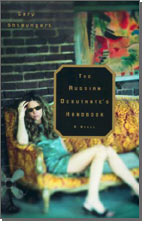
“The Russian Debutante’s Handbook” by Gary Shteyngart

A Russian-born nebbish joins the mafiya and finds success swindling gullible young American tourists in Eastern Europe.

  • more
    • All Share Services

The experience of the immigrant in America is one of doubled displacement, of feeling torn between two identities and at home in neither one, and if you read much contemporary fiction you’ve probably seen so many variations on this theme that, unless you happen to belong to the immigrant group in question, it’s hard to muster much enthusiasm for the latest iteration. But it would be a mistake to write off Gary Shteyngart’s rambunctious new novel as one of those solemn tales of wistful dislocation.

For one thing, the immigrant in question, one Vladimir Girshkin — born in Leningrad and dragged kicking and screaming to the U.S. by his parents during the 1970s when “Jimmy Carter swapped tons of Midwestern grain for tons of Soviet Jews” — hightails it to Eastern Europe early on in the book. So no moping around the Wal-Mart. For another, “The Russian Debutante’s Handbook” is a blisteringly funny, almost frighteningly energetic novel of adventure, perfidy and even a car chase or two. So no New Yorkerish moments of quiet epiphany here, either. There’s epiphany, all right, but Shteyngart, like his protagonist, is a Russian at heart, and nothing about Vladimir Girshkin, for all his sad-sack ways, is quiet.

Vladimir, who works for near-minimum wage at the Emma Lazarus Immigration Absorption Society, is the throwback in the Girshkin family, and the cause of endless lamentation for his parents. He still broods over the trauma of being called a “Stinky Russian Bear” at his American kindergarten and pines for the Motherland, or at least his childish recollection of it. His best friend tells him “you have the bearing of an emancipated serf.” His mother, a successful CEO, is worried that the only thing her son’s education at a “progressive Midwestern university” has suited him for is advising her on the most “sensitive” (i.e., non-actionable) way to sack her black marketing director. And as for Vladimir’s physician father, among the first things we hear him say is “Medicare fraud is not really a crime.”

Despite Vladimir’s meek and melancholic propensities, the apple doesn’t fall far from the tree. In a naive attempt to collect a little extra cash with which to impress his American girlfriend, he manages to offend a Catalan drug dealer and is forced to flee to Prava (Shteyngart’s inexplicably coy pseudonym for Prague). There, he goes to work for a Russian gangster nicknamed the Groundhog, who sees great financial promise in Vladimir’s ethnicity (“All you need is three Yids to rule the world”).

Galvanized in some mysterious way by finding himself amid the ruins of his Soviet Eden, Vladimir launches a successful plan to bilk gullible Americans in a pyramid investment scheme comprising a chimerical “brand-new high-technology industrial park and convention centre,” “modernized” Uzbek film studios and “a vocational school for the Yupik Eskimo in Siberia.” There’s also an actual nightspot dubbed the Metamorphosis Lounge, where intimate services and ample quantities of horse tranquilizer can purchased. Oh, and a literary magazine, too.

The literary magazine makes Vladimir a big shot in the cooler reaches of the American expat scene, and Shteyngart finds plenty of opportunity for satire in “white Middle Americans with a fashionable grudge.” But it’s the Russians, and the Stolovans (Czechs), who get the largest portion of his strangely loving yet merciless attention. In his eyes, they’re incorrigible hustlers and cheats, operating on the principle that “The world owes us for the last 70 years.” The Groundhog is both casually brutal and plaintive: “Why don’t you ever spend time with your Russian brothers?” he asks Vladimir before authorizing the American to lead a Savonarolan purge of the operation’s kitschiest trappings. Into a bonfire of the vanities go “the nylon tracksuits, the Rod Stewart compilations, the worn Romanian sneakers, everything that had qualified the Groundhog’s vast crew as Easterners, Soviets, Cold War-losers.”

At one point, Vladimir gets a call from a friend, a former Soviet apparatchik, looking to unload 300 ill-gotten Perry Ellis windbreakers. Vladimir in turn asks the older man, named Frantisek, for advice on how to handle the more troublesome elements in the Groundhog’s ranks. Their conversation is worth quoting at length, since it captures the irresistible blend of the grandiose and the crass in Shteyngart’s post-Soviet characters:

“‘The Russians of this calibre [said the apparatchik], they only understand one thing: cruelty. Kindness is seen as a weakness; kindness is to be punished. Do you understand? You’re not dealing with Petersburg academicians here or enlightened members of the fourth estate. These are the people that brought half this continent to her knees at one point. These are murderers and thieves. Now, tell me, how cruel can you be?’

‘I have a lot of anger in store,’ Valdimir confessed, ‘but I’m not very good at expressing it. Today, however, I lashed out at the Groundhog, my boss –’

‘Good, that’s a good start,’ Frantisek said. ‘Ah, Vladimir, we are not so different, you and I. We are both men of taste in a tasteless world. Do you know how many compromises I have made in my life? Do you know the things I have done … ‘

‘Yes, I know,’ Vladimir told the apparatchik. ‘I do not judge you.’

‘Likewise,’ Frantisek said. ‘Now remember: cruelty, anger, vindictiveness, humiliation. These are the four cornerstones of Soviet society. Master them and you will do well. Tell these people how much you despise them and they will build you statues and mausoleums.’

‘Thank you,’ Vladimir said. ‘Thank you for the instruction. I will lash out at the Russians with my last strength, Frantisek.’

‘My pleasure. Now, Vladimir … Please tell me … What the hell am I supposed to do with these goddamn windbreakers?’”

Will Vladimir’s innate wimpiness or his newfound braggadocio win out? Will he choose the staid, clean, straight-arrow American side of himself, or succumb to his wild and wooly inner bear? Unlike the immigrants in more genteel literary fiction, he won’t find this to be a subdued and poignant struggle. Before this dilemma is resolved, there will be tragic moments, yes, and violence, and, heaven knows, lots of exclamation points. These are Russians, after all.

Laura Miller

Laura Miller is a senior writer for Salon. She is the author of "The Magician's Book: A Skeptic's Adventures in Narnia" and has a Web site, magiciansbook.com.

Moby Awards honor best, worst book trailers of 2011

From a grumpy Jonathan Franzen to a wacky Gary Shteyngart, a celebration of the viral videos of literary promotion

  • more
    • All Share Services

Moby Awards honor best, worst book trailers of 2011Trailer for Sloane Crosley's "How Did You Get This Number," which won a Moby for "Book Trailer As Stand Alone Art Object."

 On the surface, book trailers seem like a fairly ridiculous concept: trying to market literature to people who would rather wait until the movie version comes out. Most of the time, publishing houses create trailers that are visually arresting or entertaining, but have nothing whatsoever to do with the book they’re trying to sell. That’s where the Moby Awards  come in.

Celebrating the best and the worst of book trailers with a statuette of a golden sperm whale, last night’s Second Annual Moby Awards were held at the Powerhouse Arena in Brooklyn. With categories like “Most Celebtastic Performance,” “Best Small House Press Trailer” and “What Are We Doing to Our Children? (good or bad, you decide),” the ceremony is more tongue-in-cheek McSweeney’s party than Paris Review gala.

According to Salon’s senior book writer and Moby Awards judge Laura Miller, the best book trailer of the year didn’t even take home a prize, though it was nominated in the category for best “Book Trailer as Stand Alone Art Object”:

“The Sound of a Wild Snail Eating” didn’t win anything because it sort of fell between categories. Some trailers are better than others as videos, but this was the only one that conveyed any sense of what the book was like.

Judge for yourself with the trailer for Elisabeth Bailey’s  “The Sound of a Wild Snail Eating“:

Jonathan Franzen also “won” in the category of “Worst Performance by an Author,” in which the “Freedom” scribe rails against book trailers as he is interviewed for a trailer to promote his second novel.

Though wow, he pretty much nailed it on what’s silly about book trailers, doesn’t he? Let’s all go to our still place now, and meditate on Patty.

Another “Worst Performance by an Author” finalist (and crowd favorite) went to Brandon R. Benjamin for “Atlantis”:

Winning two golden whales this year (including the coveted “Grand Jury/We’re Giving You This Award Because Otherwise You’d Win Too Many Other Awards”) was Gary Shteyngart’s “Super Sad True Love Story.” Which does have an amazing trailer (albeit one that has nothing to do with the story) that’s more reminiscent of a Funny-or-Die sketch than a promotion for a piece of literature.

“Super Sad” also won for “Most Celebtastic Performance” with its James Franco cameo, though personally I would have given it to Jay McInerney for his role in the video.

See all the winners and finalists for the Moby Awards over on the official website, and congratulations to all the winners.

Continue Reading Close

Drew Grant is a staff writer for Salon. Follow her on Twitter at @videodrew.

“Super Sad True Love Story”

Gary Shteyngart's biting satire of a tech-mad America in decline has a surprisingly tender heart

  • more
    • All Share Services

In his first two novels, “The Russian Debutante’s Handbook” and “Absurdistan,” Gary Shteyngart sent his gentle, nebbishy heroes (Americanized Russian Jews) on a rough ride through post-Soviet Eastern European wonderlands teeming with gangsters, hustlers and religious fanatics. That madcap, semi-Slavic milieu — with its unstable mixture of sentiment and brutality, fatalism and parvenue initiative — really got his satirical genius percolating. In Shteyngart’s third novel, “Super Sad True Love Story,” he saves himself the trip, making an Absurdistan of America itself by imagining the near-future disintegration of our nation under a combined load of foreign debt, plutocracy and delusions of personal exceptionalism.

Also, it’s a love story, and as super-sad as the title promises. Sometime in the next decade or so, Lenny Abramov, an indifferently effective sales representative for an outfit called Post-Human Services, meets Eunice Park, a Korean-American recently graduated from Elderbird College (the equivalent, I’m guessing, of Andover) with a double major in Images and Assertiveness. He’s 39 and preoccupied with the bodily decay he hopes to correct if he can ever afford his own company’s services: They sell “life extension” and “dechronification,” but only to HNWIs (High Net-Worth Individuals — this is an acronym-crazed world we’re talking about). Lenny is instantly smitten, bewitched by Eunice’s blend of youthful beauty and surly attentiveness. She calls him “nerd face” and “old,” but kindly adjusts his shirt cuffs and shows him how to properly brush his teeth.

Lenny and Eunice’s rickety affair unfolds in a New York City smartening itself up for a visit from China’s central banker, “unofficially the world’s most powerful man.” In this economy, the most desirable commodities have prices pegged to the yuan. Something called the Bipartisan Party has taken over the government, and the hardline policies of Secretary of Defense Rubenstein are applauded by Lenny’s parents — Soviet émigrés from way back who watch nothing but FoxLiberty-Prime and FoxLibertyUltra in the sanctity of the Long Island enclave Lenny describes as their “vibrant right-wing habitat.”

The most slicing satire in this novel, however, is reserved for the technologized culture of everyday urban life; Shteyngart is the Joseph Heller of the information age. His characters carry networked devices called äppäräti wherever they go, emitting (willingly or not) such data as their cholesterol and stress levels, credit rankings, self-esteem and relationship history, as well as their off-the-cuff evaluations of friends and strangers. “Learn to rate everyone around you,” a co-worker admonishes Lenny: The instantaneously broadcasted metrics include such categories as Personality, Sustainability and Fuckability. When a friend suggests that they “FAC” while hanging out in a bar, clueless Lenny has to be told that this acronym means “‘Form A Community’ … It’s, like, a way to judge people. And let them judge you.” (Lenny, by the way, comes in last place among 40 in the category of “Male Hotness.”)

Shteyngart’s future America is a land of run-on corporate monikers (“LandOLakesGMFordCredit”) and capitalized yet disturbingly vague careers: middle-class people work in either Retail, Credit or Media. Journalism as we know it has been replaced by “streaming” narcissists, whose “shows” consist of a mishmash of political commentary, health tips, celebrity gossip, nostalgia, porn and discussions of such Seinfeldian trivia as “the ‘wah-wuh’ sound of the doors closing on the 6 train versus the resigned ‘sheesh’ sound on the L.” One of Lenny’s best friends dates a woman “who spends about seven hours a day streaming about her weight” (her show’s signature line is “Hey, girlfriend, gots muffintop?”) Another friend streams critiques of U.S. foreign policy “intermixed with his own hardcore gay sex.”

The peril in writing about satire this accurate is that it’s tempting to list every clever little dart that lands right in the bull’s-eye. I could go on about how perfectly Shteyngart captures the poignant, adolescent crudity adopted by Eunice and her girlfriends; their pet names for each other include “ass hoo-kah,” “slut” and, of course, “betch.” (They also shop for sportswear in the JuicyPussy line on a website called AssLuxury.) Since the narrative is divided between Lenny’s old-fashioned diary entries and Eunice’s e-mails and IMs, we know that behind all that pornographic faux swagger these girls are perilously vulnerable.

That’s the difference between Shteyngart and the average literary satirist (or even an above-average one, like Martin Amis): his warmth. I almost attached the “mercilessly” to the word “accurate” in the first sentence of the paragraph above, but had to stop myself, because “Super Sad True Love Story” is in fact overflowing with mercy. In Eunice, Lenny sees two elements: the tough, family-first immigrant fiber inherited from her parents, which is what the two of them have in common, and a history-free American optimism manifested as commodity worship. He loves both. Watching her shop for clothes, he marvels at, and pities, her “attempt to extract meaning from an artifact that contained mostly thread. If only beauty could explain the world away. If only a nippleless bra could make it all work.”

It’s a high-wire act, pulling off a novel that’s simultaneously so biting and so compassionate, and in his earlier books Shteyngart, while unfailingly shrewd and funny, wasn’t always this tender. “Super Sad True Love Story” is indeed a sadder, and also a better, book. Perhaps it’s the setting that brings it out in him: an America he could only truly love now that he thinks it’s melting away. (He can make you feel the loss of Lenny’s co-op apartment as a muted Chekovian tragedy, the passing of an era in 750 square feet.) That’s what slips through Lenny’s fingers in the personified form of Eunice Park, the fleeting, hopeless dream of escaping the universal fate of humankind. “Forget it, Lenny,” you want to whisper in his ear. “It’s Absurdistan.”

Referenced in this article:

Salon’s review of “The Russian Debutante’s Handbook”

Salon’s review of “Absurdistan”

Continue Reading Close
Laura Miller

Laura Miller is a senior writer for Salon. She is the author of "The Magician's Book: A Skeptic's Adventures in Narnia" and has a Web site, magiciansbook.com.

“Absurdistan” author’s A-list book trailer

Gary Shteyngart rounds up his famous pals to promote his new novel -- and delivers a comic masterpiece

  • more
    • All Share Services

Whether book trailers do anything whatsoever to sell books is debatable, but every now and then, one comes along that at least successfully tickles the daylights out of us. Such is the case with “Absurdistan” author Gary Shteyngart’s epic promo for his new novel, “Super Sad True Love Story.” Boasting an A-list cast of authors, a well-placed cameo from Salon’s sexiest man and enough literary in-jokes to make you chortle knowingly into your brandy snifter, the behind-the-scenes look at the man who refers to Oscar Wilde as a “a famous homo” and Chekov as the “guy from Star Trek” is five minutes of pure, hot bookworm delight.

Is Mary Gaitskill right in accusing Shteyngart of being, like Olivia Munn, successful because he’s “so good-looking”?  Well that’s obvious. But this being the publishing world, it’s also true that “He came from nowhere…. And he’s still kind of nowhere.” As long as we can be nowhere with him until he can “cash in on this whole Hollywood vampire thing,” it turns out nowhere is a hell of a fun place to be. 

Continue Reading Close
Mary Elizabeth Williams

Mary Elizabeth Williams is a staff writer for Salon and the author of "Gimme Shelter: My Three Years Searching for the American Dream." Follow her on Twitter: @embeedub.