
Sex
Make beauty, not war
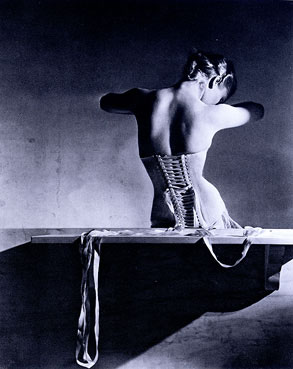
Horst's photo of a woman in a corset, taken in 1939, is a vision of human sensuality that rebukes the inhumanity about to darken the world.
“He walked down Marbeuf onto the Champs-Elyseés. At twilight the city throbbed with life, crowds moving along the avenue, the smells of garlic and frying oil and cologne and Gauloises and the chestnut blossom on the spring breeze all blended together. The cafés glowed with golden light, people at the outdoor table gazing hypnotized at the passing parade. To Casson, every face — beautiful, ruined, venal, innocent — had to be watched until it disappeared from sight. It was his life, the best part of his life, the night, the street, the crowd … He’d made love all his life … but this, a Paris evening, the fading light, was his love affair with the world.” — Alan Furst, “The World at Night”
She sits with her back to the camera, her long, elegant neck arched down, a hint of profile as her head inclines to meet her right shoulder, as if she were hiding her face, or were caught at the beginning of a luxuriant stretch. The light and shadows accentuate the deep concave slopes of her lovely back, and draw our eyes downward to the unlaced corset, its satin ribbons falling behind her, spilling over the edge of the marble ledge she leans against, looking for all the world like discarded party streamers. It could be anytime between midnight and dawn, as the silence of the city outside descends, pushing the revels of the night further back into memory.
Actually it was just after midnight one evening in late 1939. The city was Paris. The man behind the camera was the great German fashion photographer Horst P. Horst. And the subject was not the model but, ostensibly, the Mainbocher corset she was wearing. Horst, along with his colleague and lifelong friend (and, briefly, his lover) George Hoyningen-Huene, pioneered what we’ve come to regard as the essence of classic fashion photography — silver gelatin prints of elegant and formal stylization. Vogue and Vanity Fair were their main outlets in the ’30s, the decade in which they did their most characteristic work, though both worked in fashion photography and portraiture for years after (Hoyningen-Huene died in 1968; Horst just a few years back, in 1999).
It’s easy to look at their work as frivolous, the denial of the decade’s horrible undercurrents that were to burst forth in 1939 with the outbreak of war in Europe. I prefer to look at it as an early form of resistance, a way of seeing beauty as a vestige of everything civilized and humane. It was a reaction to a time when, as Sir Isaiah Berlin wrote, “all was dark and quiet … and little stirred, and nothing resisted.”
For me, the photo of the Mainbocher corset is the heart of this. It was taken after midnight on the day Horst fled Paris, a few months ahead of the Occupation. (He settled in New York and spent the last few years of the war as a U.S. Signal Corps photographer.) Unlike his other fashion shots of women immaculately groomed for an evening out, this is a photo of undressing. And the model’s supplicant pose — suggesting the weariness, the reflection, even the mournfulness, that come at the end of an evening out — is vulnerable, exposed in a way that all his other meticulously put-together subjects never were. It’s Horst’s farewell to the elegance that he had epitomized, an implicit acknowledgment that upholding civilization and humanity would now mean donning other uniforms.
In a few months the Paris fashion houses would be shut down, and French Vogue would be closed after being raided by Occupation forces. (The editor, Michel de Brunhoff, would be discovered working for the Resistance shortly before the end of the war.) The meaning of the photo, a lingering kiss goodbye, was the opposite of what students in the ’60s meant by “make love, not war.” There is no contradiction in the photo. This was making love as a form of war, an embrace of sensuality as a rebuke to the inhumanity bent on taking over the world. An act of sabotage is no less potent because it takes place in private, with lovers becoming comrades on the most intimate of battlefields.
Charles Taylor is a columnist for the Newark Star-Ledger. More Charles Taylor.
Massage therapists rubbed wrong by sex talk
A Jennifer Love Hewitt show and the Travolta allegations have masseuses tired of being confused for sex workers
(Credit: iStockphoto/sybanto) Joe, a licensed massage therapist, knows what it’s like having a famous client who expects something extra. He had an Academy Award-winning actor begin gyrating on his massage table before raising his hips in the air to show off his erection. “He was hoping that I would play with him in some shape or form,” he says.
Needless to say, Joe isn’t surprised by allegations by two masseurs that John Travolta got handsy during massages. (Travolta’s attorney has denied all the allegations, and called them “ridiculous.”) “It happens all the time,” he says, and not just with celebrity clients. He frequently encounters men who try to fondle him, usually while he’s working on their glutes or lower back and their hand happens to be level with his crotch. “They think they’re so original, but they’re all so much the same,” Joe says, his voice rising. “They all use the same tactics, the same body movements, the same gyrations and grinding my table, the [heavy] breathing.”
Continue Reading Close
Tracy Clark-Flory is a staff writer at Salon. Follow @tracyclarkflory on Twitter. More Tracy Clark-Flory.
A night at the vibrator museum
Early vibrators were hand-cranked, two-person jobs -- and prescribed by doctors. How far we've come since then
(Credit: Antique Vibrator Museum) I can now say that I’ve used a turn-of-the-century vibrator — on my hand, but still.
The silver, hand-cranked contraption is usually kept behind glass at Good Vibrations’ Antique Vibrator Museum in San Francisco — but staff sexologist Carol Queen made a rare exception. “This is very special,” she whispered, unlocking the case and carefully pulling out Dr. Johansen’s Auto Vibrator, a relic from 1904. The “auto” part is not so much: It was a two-person job, with her having to crank the device’s handle to get it thrumming. Pressing my finger tips to its inch-wide circular platform of pleasure, I was pleasantly surprised by its power.
Continue Reading Close
Tracy Clark-Flory is a staff writer at Salon. Follow @tracyclarkflory on Twitter. More Tracy Clark-Flory.
Maggie Gyllenhaal on sexual liberation
The beloved indie star tells Salon about her "vibrator movie" and why she loves playing transgressive women
Maggie Gyllenhaal (Credit: Reuters/Mark Blinch) When I met Maggie Gyllenhaal about six weeks ago, she was enormously and gloriously pregnant, stretching out on a sofa with her shoes off and feet up in a Manhattan office building. (Since that time, Gyllenhaal and husband Peter Sarsgaard have welcomed their second daughter, Gloria Ray, to the world.) We were there to talk about “Hysteria,” the charming, lightweight feminist farce from director Tanya Wexler that explores a key event in the history of female sexuality: the invention of the vibrator by Mortimer Granville, a Victorian doctor who was seeking to cure the mysterious “female malady” that lends the movie its title.
Continue Reading CloseMother-daughter sexperts
Susie Bright and her daughter, Aretha, make parental talks about sex look easy -- and fun
Most parents loathe talking to their kids about the birds and the bees, let alone pubic hair grooming, faked orgasms and “water sports” — but most parents are not legendary “sexpert” Susie Bright.
Better than talking about these things, she penned an advice column in 2009 with her daughter, Aretha, then 19, for the ladyblog Jezebel. Their answers to questions about everything from porn to Paxil were unflinching but playful, and at times controversial. Now the pair have collected those columns into a new e-book, “Mother/Daughter Sex Advice.” Together, they read as an irreverent version of “Our Bodies, Ourselves” for the Internet age. The mother-daughter team also reflect on what the experience of writing the column was like, and it turns out it wasn’t as weird as many would think: For the most part, it was just a continuation of conversations they had been having throughout Aretha’s life.
Continue Reading Close
Tracy Clark-Flory is a staff writer at Salon. Follow @tracyclarkflory on Twitter. More Tracy Clark-Flory.
On the rack: A cultural history of breasts
Did breasts evolve for lactation or to enhance sex appeal? A new book explores why they matter
(Credit: iStockphoto/NadyaPhoto) It’s hard to be boobs. Sure, breasts are cherished as givers of milk and the pinnacle of sex appeal, but the modern world hasn’t been good to mammaries.
As Florence Williams writes in “Breasts: A Natural and Unnatural History,” they’re the most tumor-prone organ in the human body. They “soak up pollution like a pair of soft sponges,” and transmit environmental toxins to babies through breast milk. “Breasts are bellwethers for the changing health of people,” she says. While we’ve “genetically modified our crops to be able to protect them from the ill effects of pesticides,” Williams writes, “we haven’t yet figured out how to modify our breasts.” Aside from using saline and silicone, of course.
Continue Reading Close
Tracy Clark-Flory is a staff writer at Salon. Follow @tracyclarkflory on Twitter. More Tracy Clark-Flory.
Page 1 of 403 in Sex