
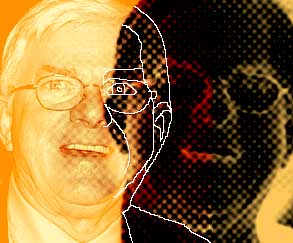

On the long drive back from Secaucus, I kept thinking about all the things I should have said. I had just gotten my ass whupped on “Donahue.” Looking for comfort, I called my mother on the cell. She thought my suit looked good and my hair was combed straight. Somehow, it didn’t help.
I am the director of MIT’s new comparative media studies program. I’ve been writing about video games for more than a decade, have testified before the Senate Commerce Committee and the Federal Communications Commission, have conducted workshops with game designers, spoken to PTA meetings and the American Library Association, and been interviewed by more reporters than I can count. I agreed to appear on “Donahue” to talk about games because I knew I should have owned the issue. But I blew it.
The first thing I told my wife after I got off the phone from my first conversation with the “Donahue” producers was that I was flying to New York to get beaten up on national television. She asked if she should have my head examined.
But the producers were so, so reassuring. They wanted to have an intelligent discussion, to avoid sensationalism, to give me a chance to make my arguments. They would have some representatives of the games industry and someone from one of the media reform groups. One producer almost convinced me that “Donahue” was a serious news discussion program.
I really wanted to believe. I remember Phil Donahue publicizing the issue of sexual harassment in the workplace long before Anita Hill; I remember his program as one of the first to allow gays, lesbians and bisexuals to talk openly about discrimination. I recalled how he quit the talk-show business in disgust and how they lured him back with the promise that he could be a progressive alternative to O’Reilly. There were signs all over the Boston subway telling us “Donahue’s Back. Be Thinkful.”
That ungrammatical slogan should have been the first clue that something was wrong with the new “Donahue.” But I had also watched the opening episode: Phil was trying so hard to escape the “wimp” label that he was practically frothing at the mouth. “Donahue” was mimicking the style of right-wing talk television as if that style didn’t carry its own insidious political messages. Marlo Thomas’ hubby had been lured to the dark side of the Force.
So, yeah, I should have known better. I did know better, sorta. I did it anyway. And after the fact, the only person I could kick was myself. I was ambushed, and forgot how to fight back.
I knew what the activists opposed to gaming violence would say — that computer games are too violent and are bad for young people. I was ready to tear them apart on the evidence. Despite all of the publicity about school shootings, the rate of juvenile violent crime in the United States is currently at a 30-year low. When researchers interview people serving time for violent crimes, they find that they typically consume less media than the general population, not more. A 2001 surgeon general’s report concluded that the strongest risk factors for school shootings centered around the quality of the child’s home life and their mental stability, not their media exposure.
The field of “media effects” research includes around 300 studies of media violence. But most of those studies are inconclusive. Many have been criticized on methodological grounds, particularly because they attempt to strip complex cultural phenomena down to simple variables that can be tested in the laboratory. Most found a correlation, not a causal relationship, which means they could simply be demonstrating that aggressive people like aggressive entertainment.
Only about 30 of those studies deal with video games specifically. And if you actually read the reports, most responsible researchers are careful to qualify their findings and are reluctant to make sweeping policy recommendations. None of them buy a simple monkey-see, monkey-do hypothesis. But the activists strip aside any qualifications, simplifying their conclusions and mulching together all of those contradictory findings. What they want is the aura of scientific validation, since that provides cover to all of their liberal allies who wouldn’t support the Moral Majority but love to sound off about cultural pollution.
Activists exploit any data point and any tragic event as grist for their cause. They will cite studies which show that 8-year-olds have difficulty separating out fact from fiction and use them to justify restricting 17-year-olds’ access to violent entertainment. 90 percent of American boys play video games, so it’s a pretty good bet that if the killer is an adolescent boy, they can find the proof that he was a gamer.
Parents are demanding that the government do something even if it’s wrong, and once we reach that point, we tend to do all the wrong things. This is doubly dangerous. First, constitutional protections make it unlikely that the government is going to take decisive action against the media industries. So all of the fears get redirected onto the kids who play these games. We may not have an epidemic of youth violence in this country but lots of adults are ready to lock up teenage boys and throw away the key. Second, every moment our government focuses on the wrong problems, they take away time and resources that could be used to combat the actual causes of youth violence. Banning games doesn’t put a stop to domestic violence, doesn’t ensure that mentally unstable kids get the help they need, doesn’t stop bullying in the hallways, and doesn’t deal with the economic inequalities and racial tensions that are the real source of violence in American culture.
But, during my 15 minutes on “Donahue,” I never got to say any of this. I was intellectually ready for this discussion, but nothing prepared me emotionally. I was the captain of my high school debate team, but debating on “Donahue” is a whole different ball game. The first thing you’ve got to do is throw away the notecards.
I walked tall into the studio, having been reassured once again by the producer that they weren’t planning any cheap shots. They lied.
No sooner do I sit down then I glance at the teleprompter and get a preview of what Donahue had in store for me: “I want to show you a picture. This is 13-year-old Noah. While reenacting the video game Mortal Kombat, he was stabbed to death by his friend.” I hear the producer coach Donahue on how to speak with Noah’s mother so that it looks like she called spontaneously when they really had prearranged the call. I hear him reassure Daphne White, spokeswoman for the Lion and the Lamb Project and my sparring partner for the show, that he has some especially gristly footage from Grand Theft Auto 3 at the ready and she clucks with glee. And then, whoosh, we are going live in, five, four, three, two, one, seconds — and you’re ON THE AIR. I stare blankly into the camera as a freight train comes barreling toward me.
I hear Donahue explaining about how some school kids got shot in the back of their heads because their slayers had learned about “kill zones” from a video game. I find myself wondering why anyone would imagine a kid needed to play Quake to learn that you can kill someone by shooting them in the back of the head when just moments before, MSNBC was interviewing a former Mafia hit man.
Then, the first question goes to White, who uses it to remind viewers that she is a concerned mother. Never mind that I am a father and have raised a son successfully through his teenage years. On Donahue, activists are moms and intellectuals are presumed to be childless.
White explains how parents across the country had purchased Grand Theft Auto 3 for their children without any idea of its distasteful contents. Hello! The game is called Grand Theft Auto 3. It’s rated M for Mature Audiences — not appropriate for children under 17 — “violence, blood, strong language.” The hit men and prostitutes are right there on the package. If you are a thoughtful — er, I mean, “thinkful” — parent, how much more information do you need before alarm bells start going off in your head?
White notes that the Federal Trade Commission had cited overwhelming evidence that video games were aggressively marketed to youth. The same FTC study found that 83 percent of all video game purchases were either made by parents or by parents and children together. Moms and dads still control the purse strings on what remain high-ticket items in most family budgets. As parents, my wife and I took responsibility for knowing something about the media we bought our son. We didn’t expect the storekeeper to protect us from ourselves.
And suddenly, it’s my turn. I had composed a little speech debunking the evidence but it seemed beside the point because her last speech was backed by nothing more than her personal distaste for Grand Theft Auto 3. Uncomfortable with the black-and-white framing of the discussion, I search for middle ground, praising the Lion and the Lamb Project for helping parents to make informed choices. And I really meant it. Education, not regulation, is going to ensure that parents get to decide what kind of media their children consume. Maybe we could all work together to improve the quality of resources available to parents.
But seeking middle ground was a classic liberal mistake. On these “Crossfire”-style programs, any compromise is read as weakness. Make no mistake about it, everything here works to exaggerate the differences between you and the person sitting on the other side of the table. It isn’t a conversation, a discussion or even a debate by any classical standards. You are opponents, whether you want to be or not. The producers actually keep you in separate rooms before they bring you on the air. They encourage you to interrupt each other and to show as much passion as possible, because what they want is controversy and entertainment. The producers rattle your cages until your blood is pumping and you want them to go down. They flash up captions underneath your image and you have no say over how they shorthand your position. When you cede a point, you can almost hear the folks on your own side booing.
Then, Donahue spooks moms with a clip from GTA3. You can tell he enjoys it: “We’re going to kill a cop, or more than one cop, and a prostitute … This is gratuitous violence here. We’re beating, beating. We’ll get a little blood here in a minute. The blood, you’ll see. Look at this.” He shows it over and over like we were watching the Zapruder film. Of course, any violence we see was staged by the show’s producers, this being a game and not a movie. If Donahue really believed watching these scenes was harmful to minors, why was he showing them without parental warnings during what used to be considered the family hour? Pay no attention to the man behind the curtain.
Then, he asks me to justify what we just saw. Where does one start? The idea that we are going to get rid of violent entertainment is preposterous. Every storytelling medium in the history of mankind has included violent themes and stories, because we depend on stories to help us sort through our conflicting values and our mixed feelings about aggression. We turn to violent entertainment for the same reason moral reformers turn towards apocalyptic rhetoric — because it gives us a sense of order in a world which otherwise can seem totally chaotic. We fantasize about a lot of things we’d never want to do in real life, and through fantasy we bring those impulses momentarily under control. What is bad about a lot of games isn’t that they are violent but that they trivialize violence. They tell us little about our inner demons because they fall back too quickly on tried-and-true formulas. Without fail, the works that moral reformers cite are not the ones that are formulaic but those that are thematically rich or formally innovative. It is as if the reformers responded to the work’s own provocation to think about the meaning of violence but were determined to shut down that process before it ever gets started.
If you want to actually change the quality of popular culture, the best way to do it is not to throw rocks from the sidelines but to get involved in thinking through the creative challenges confronting the games industry. And that’s what I’ve been doing, speaking at trade shows, doing workshops with individual companies, trying to figure out how to develop a richer and more complex vocabulary for representing violence in games.
And that’s where Grand Theft Auto 3 enters the picture. I feel about GTA3 the same way I feel about the film “Birth of a Nation” — it’s a work that includes lots of distasteful aspects but I respect, even admire it, as a huge step forward in the evolution of computer games as a medium. There are elements in the game which are hard to defend — your health can be replenished by “powerups” gained from visiting prostitutes; you are encouraged to club passers-by with baseball bats just to watch their blood splatter. No one, not even the people who made this game, think it’s the best plaything for small children. This game was made for adults. People over the age of 18, by the way, constitute 61 percent of the total market for computer games.
GTA3 is a story about a mobster, not unlike such critically praised works as “The Godfather,” “Goodfellas” and “The Sopranos.” Maybe not as good, but asking some of the same questions. You have escaped from prison. What kind of life are you going to build for yourself?
Contrary to what Donahue said, you don’t score points by killing people. This isn’t a virtual shooting gallery. Unlike earlier video games that give you no way forward except to slaughter everything that moves, this game offers an enormously expansive and responsive landscape. Certain plot devices cue you about possible missions, but nothing stops you from stealing an ambulance and racing injured people to the hospital or grabbing a fire truck and putting out blazes or simply walking around town. This open-ended structure puts the burden on you to make choices and explore their consequences. If you choose to use force, you are going to attract the police. The more force, the more cops. Pretty soon, you’re going down. GTA3 is only as violent as we choose to make it and, used wisely, the game can tell us a lot about our own antisocial impulses. White dismissed all of this as “purely technical.”
Assuming the role of host, White asks me whether I can identify video games that fully meet my ideals and I yammer like an idiot. I should have said that the medium has not achieved its full potential but any number of games in recent years have tried to offer more morally complex and emotionally demanding representations of aggression, loss, and suffering, everything from Black & White where your moral choices get mapped onto the physical landscape of the game to The Sims where game characters mourn those who have died or Morrowind where how other characters treat you reflects your history of violent actions. Over the past year or so, the games industry has assembled the building blocks that can lead toward a much more complex portrayal of violence, but no one has put them altogether yet. None of this is apt to look much like progress to someone who believes that teens should only inhabit an imaginary world where the lamb shalt lay down with the lion and Barney shalt hug the Teletubbies.
After the commercial break comes the prearranged phone call from Noah’s poor mother, then a call from a 14-year-old girl who is told that she doesn’t represent the core of the video game market, and then a hostile question from Donahue, who attempts to reduce my efforts to reform the video game industry from within to the issue of whether I have ever taken money from the games industry.
The moral reformers always want to peg me as an apologist for the video game industry. I won’t lie — the games industry likes what I have to say and they shove the media my way whenever they get a chance. Lately, I’ve even engaged in some sponsored research to help explore how games could be used to improve the quality of American education. Sponsorship covers the expenses of the research. Trust me, if I wanted to sell my mind to the highest bidder, I could command a whole lot higher price. What motivates me is, more or less, the same thing that drives Daphne White — a concern for American youth. This debate always gets presented as though there were only two sides — mothers battling to protect their kids and the cigar-chomping entertainment industry bosses who prey on American youth. This formulation allows no space to defend popular culture from any position other than self-interest. When Congress calls witnesses, it calls the usual reform groups and then allows the industry to name a few spokespeople. When Donahue sets up a discussion, his producers do the same. I enter the room already tainted with having been recommended by the industry. Meanwhile, the media-effects researchers find themselves beholden to social conservatives. There are only two seats at the table.
Even though I am sometimes disappointed with their content, I refuse to give up on games. White kept harping on the fact that GTA3 was the top-selling game in the country, as if it were representative of the industry as a whole. If we went only a few more notches down the charts, we would have found games like Harry Potter, Star Wars, The Sims, Civilization 3, Spiderman, and Rollercoaster Tycoon. M-rated games make only about 9 percent of the gross revenue from the American games industry. The game industry is more diverse than it was a decade ago, the technology and storytelling more sophisticated, the market more far-reaching, but the reformers keep beating the same dead horses. White and her allies describe games as commodities no more valuable and every bit as dangerous as cigarettes. I call games an art, and challenge game designers to live up to their responsibilities as artists and storytellers.
Only after the fact does it occur to me that most of the research dollars our program has accepted to look at games and education come from Microsoft, the same company that partially owns MSNBC and cuts Phil Donahue’s paycheck. You got to love living in an age of media concentration!
By this point, however, I am caught looking like a kid with his hand in the cookie jar, trying to explain to someone who really couldn’t care less how contemporary universities get funded.
Sometimes it was three against one. At others two against one. Sometimes, Phil even tossed me a lifeline. But at all points, it was me struggling with my own emotional responses. I should have picked a point, preferably a simple one, and hammered it over and over like White did. Instead, I was self-censoring, getting bogged down in the complexities, uncertain what distortion to correct. Most people watching the show probably read me the way the producers wanted — as a pointy-bearded civil libertarian and a paid corporate apologist trying to talk down to a concerned mom.
And then, it’s over. As I exit the studio, I hear Donahue grumble to his producer that those GTA3 clips seemed a whole lot more bloody when he was watching them before the show.
I wanted to tell them that media does have influence but media is most powerful when it reinforces our existing beliefs and behaviors, least powerful when it seeks to change them. Advertising, for example, is pretty effective at getting us to try a new product but ultimately, if the product turns our teeth a funny color, we are unlikely to buy it again no matter how much marketing gets thrown at it. We typically test media representations against our direct experience and dismiss them when they don’t ring true. I wanted to tell them that if you look closely at the personal background of those kids who have been involved in school shootings, you will find a history of real-world aggression and violence. They don’t need games to teach them to hate and hurt; they learned that at home or at school.
I wanted to tell them about spending an afternoon brainstorming about games with the Royal Shakespeare Company and discovering that they were all GTA3 fans. I wanted to tell them what I learned when I went around the country talking with teens about school violence — that the adults were focused in the wrong places if what they wanted to do was to stop kids from hurting each other. I wanted to talk about the importance of media literacy education not simply for teens but for their parents.
I wanted to tell them lots of things but it was over.
I was driving back to Cambridge, my tail between the legs, and all I could think about as we got bogged down in the repair work on I-95 were all of the things I should have said.
When I got home in the wee hours of the morning, I found that I had already started to receive hateful e-mails from the “Donahue” dittoheads.
“You are obviously not a mother trying to raise teenagers you stupid freaking moron idiot.”
“I’d like to take that stupid X Box and crack that moron from MIT over the head with it.”
“By the way, Moron, get a shave.”
Guess Mom was wrong about the hair.
Donahue’s Back. Be Thinkful.
