Sex
The erotics of reading
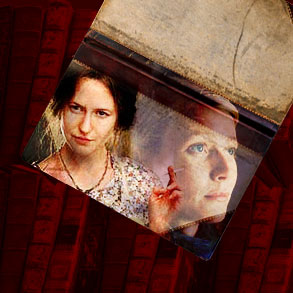
Nicole Kidman playing Virginia Woolf is far more possessed, and thus far sexier, than Gwyneth Paltrow in "Possession."
“Can Bookish Be Sexy?” asked the New York Times Sunday Arts and Leisure story in a way that could only offend or alarm those people whose life has to do with words. A book, for some of us, is not just a page-turner but a turn-on. Those truly possessed by books (and the rough occasion of this piece is a movie called “Possession”) would not purchase a book without first smelling it, weighing it in the hand, feeling the taut, well-toned musculature of the binding, and generally seeing that the creature had a front end and a back end where entry was possible, and might be welcome and rewarding. I like to own books as well as read them, and I enjoy airing a volume out, taking it down from the shelf, riffling through the pages, bending the spine back to a point where the gentle, glued and sewn constitution sighs and gives up some private inner aroma — not just paper, or the materials of binding, but the last reserve that waits to be opened.
I daresay the myth prevails in some quarters that people who have their head in a book a lot of the time are not terribly “sexy.” Those people are said to live in their own heads — a residence that is sometimes regarded as close to prison or madness. Yet where else do the out-of-doors types reckon that sexuality waits (and rehearses) but inside the head? Let’s try to put it this way: In all the practices available to men and women to foster sexual and romantic feelings I don’t know one that is as intense as reading. There is no need to rate the several arts in terms of their potential for getting deeper into experience, or into our souls. Still, I believe that the formulation and articulation of ideas and feelings through prose has no superior. And when that delight comes in the solid form of a book, why, the bookish have nothing to be ashamed of. I will say it here and now: The sexual capacity of the well-read has struck me as being far beyond that of people less literate.
For one thing — and this is not the only thing — the lifelong reader has learned the irony and the sheer playfulness of having a world spread open in his or her lap. He and she can anticipate how far the primitive physical actions are one climbing plant that is always intertwined with and writhing against another that is intellectual self-awareness — the naming of parts and reactions. Thus “What do we call that?” is not just a basic step in learning, but an erotic threshold.
And then there is Gwyneth Paltrow. Alas. The hard task I have in talking about “Possession” is to admit that I have had enough of Ms. Paltrow. Yes, I daresay she was pushed into too many minor films for her own good. But in “Possession” she has to play a literary scholar, a blue-stocking, an intellectual snob, a bespectacled bookworm — call her what you like. I have known such people and I am here to assure you that many of them were very sexy. I’ll go further: The better they understood a book, the more fascinating they were as people. Now I know that Ms. Paltrow comes from a civilized, educated household. And I can see that she’s striven to be “academic” for “Possession.” But the film never worked for me because I could not believe that she had been altered by a book. Let alone possessed.
Let me now give an example of another film where I never had the least doubt about possession. There is a film coming of Michael Cunningham’s novel “The Hours,” directed by Stephen Daldry. It won’t be out for several months, but anticipation will do you no harm. In this film, Nicole Kidman plays Virginia Woolf.
It’s probably wise there to take a paragraph break in that several of the bookish class may be protesting, “This cannot be so” — as if the woman in “Eyes Wide Shut,” “To Die For,” “Moulin Rouge,” “The Birthday Girl” and so on has so little need to open, let alone write a book. But that’s exactly where we come to the delicate ground where acting and reading meet. Ms. Kidman has worked hard to adjust her looks to be Virginia Woolf. Many people seeing the film will not quite recognize the actress — others may grasp that they are seeing an actress take flight.
For what you get in “The Hours” is the full prospect of a woman who is so possessed by writing, by paper and ink, and by the overwhelming passion in books, that she is being destroyed by their creation. I do not mean to say that Virginia Woolf was a sexpot — all I know is that this is a performances that carries Nicole Kidman to richer and more troubled depths of being a sexual creature who cannot stop thinking than any of her earlier films. Is Ms. Kidman well-read in fact? I neither know nor care. When I saw “The Hours” I felt that her pen on paper was the slow laceration of her soul, a process in which creation could not be disentangled from self-destruction.
David Thomson is the author of "A Biographical Dictionary of Film" (new edition just published), "Rosebud: The Story of Orson Welles" and "In Nevada." More David Thomson.
Massage therapists rubbed wrong by sex talk
A Jennifer Love Hewitt show and the Travolta allegations have masseuses tired of being confused for sex workers
(Credit: iStockphoto/sybanto) Joe, a licensed massage therapist, knows what it’s like having a famous client who expects something extra. He had an Academy Award-winning actor begin gyrating on his massage table before raising his hips in the air to show off his erection. “He was hoping that I would play with him in some shape or form,” he says.
Needless to say, Joe isn’t surprised by allegations by two masseurs that John Travolta got handsy during massages. (Travolta’s attorney has denied all the allegations, and called them “ridiculous.”) “It happens all the time,” he says, and not just with celebrity clients. He frequently encounters men who try to fondle him, usually while he’s working on their glutes or lower back and their hand happens to be level with his crotch. “They think they’re so original, but they’re all so much the same,” Joe says, his voice rising. “They all use the same tactics, the same body movements, the same gyrations and grinding my table, the [heavy] breathing.”
Continue Reading Close
Tracy Clark-Flory is a staff writer at Salon. Follow @tracyclarkflory on Twitter. More Tracy Clark-Flory.
A night at the vibrator museum
Early vibrators were hand-cranked, two-person jobs -- and prescribed by doctors. How far we've come since then
(Credit: Antique Vibrator Museum) I can now say that I’ve used a turn-of-the-century vibrator — on my hand, but still.
The silver, hand-cranked contraption is usually kept behind glass at Good Vibrations’ Antique Vibrator Museum in San Francisco — but staff sexologist Carol Queen made a rare exception. “This is very special,” she whispered, unlocking the case and carefully pulling out Dr. Johansen’s Auto Vibrator, a relic from 1904. The “auto” part is not so much: It was a two-person job, with her having to crank the device’s handle to get it thrumming. Pressing my finger tips to its inch-wide circular platform of pleasure, I was pleasantly surprised by its power.
Continue Reading Close
Tracy Clark-Flory is a staff writer at Salon. Follow @tracyclarkflory on Twitter. More Tracy Clark-Flory.
Maggie Gyllenhaal on sexual liberation
The beloved indie star tells Salon about her "vibrator movie" and why she loves playing transgressive women
Maggie Gyllenhaal (Credit: Reuters/Mark Blinch) When I met Maggie Gyllenhaal about six weeks ago, she was enormously and gloriously pregnant, stretching out on a sofa with her shoes off and feet up in a Manhattan office building. (Since that time, Gyllenhaal and husband Peter Sarsgaard have welcomed their second daughter, Gloria Ray, to the world.) We were there to talk about “Hysteria,” the charming, lightweight feminist farce from director Tanya Wexler that explores a key event in the history of female sexuality: the invention of the vibrator by Mortimer Granville, a Victorian doctor who was seeking to cure the mysterious “female malady” that lends the movie its title.
Continue Reading CloseMother-daughter sexperts
Susie Bright and her daughter, Aretha, make parental talks about sex look easy -- and fun
Most parents loathe talking to their kids about the birds and the bees, let alone pubic hair grooming, faked orgasms and “water sports” — but most parents are not legendary “sexpert” Susie Bright.
Better than talking about these things, she penned an advice column in 2009 with her daughter, Aretha, then 19, for the ladyblog Jezebel. Their answers to questions about everything from porn to Paxil were unflinching but playful, and at times controversial. Now the pair have collected those columns into a new e-book, “Mother/Daughter Sex Advice.” Together, they read as an irreverent version of “Our Bodies, Ourselves” for the Internet age. The mother-daughter team also reflect on what the experience of writing the column was like, and it turns out it wasn’t as weird as many would think: For the most part, it was just a continuation of conversations they had been having throughout Aretha’s life.
Continue Reading Close
Tracy Clark-Flory is a staff writer at Salon. Follow @tracyclarkflory on Twitter. More Tracy Clark-Flory.
On the rack: A cultural history of breasts
Did breasts evolve for lactation or to enhance sex appeal? A new book explores why they matter
(Credit: iStockphoto/NadyaPhoto) It’s hard to be boobs. Sure, breasts are cherished as givers of milk and the pinnacle of sex appeal, but the modern world hasn’t been good to mammaries.
As Florence Williams writes in “Breasts: A Natural and Unnatural History,” they’re the most tumor-prone organ in the human body. They “soak up pollution like a pair of soft sponges,” and transmit environmental toxins to babies through breast milk. “Breasts are bellwethers for the changing health of people,” she says. While we’ve “genetically modified our crops to be able to protect them from the ill effects of pesticides,” Williams writes, “we haven’t yet figured out how to modify our breasts.” Aside from using saline and silicone, of course.
Continue Reading Close
Tracy Clark-Flory is a staff writer at Salon. Follow @tracyclarkflory on Twitter. More Tracy Clark-Flory.
Page 1 of 403 in Sex