
Heather Havrilesky

The selling of 9/11

We're buying schlock because we want to remember. But the more we stock up on canned memorabilia, the faster we'll forget.

  • more
    • All Share Services

The selling of 9/11

In America, we grieve by buying stuff. Shopping soothes us, reassures us that we’re coping, that we’re moving on. Less than a month after Sept. 11, the “America: Open for Business” campaign was born, calling upon citizens to seek revenge and healing through retail. One year later, despite our diminished purchasing power, there is more succor for sale, this time through products aimed at reconciling the avalanche of emotions we experienced after last fall’s tragedy.

Suddenly a dizzying range of merchandise is available to commemorate the tragedy, from full-color photography books to NYPD policeman dolls to crystal replicas of the twin towers. Sifting through the consumer fallout from 9/11 can incite the kind of cultural vertigo heretofore only achieved by spending several hours in a Graceland giftshop. The same sad images adorn every mug, ashtray, T-shirt and figurine imaginable, each the reflection of a nation that embraces and commodifies tragedy. By trivializing the tragic, we reduce its proportions enough to put it behind us.

Are the creators of these products giving voice to the pain we share, or are they exploiting that pain by shamelessly cashing in on tragic circumstances? In a country as commercially saturated as ours, maybe we’re past the point of caring either way. We’re soaking in it. The more important question may be, could any event have an impact dramatic enough to bestride our culture’s ability to swallow it whole, only to excrete beach towels and bumper stickers a few months later?

Sept. 11 was supposed to be that big event, the one that would remain immune to our culture’s chirpy, reductive forces once and for all. We watched the towers collapse on live TV, and felt ourselves a part of the tragedy. We would not let the hungry demon of pop culture near this one, no matter how loudly it whined and drooled over the commercial potential of human suffering — American human suffering — on such a large scale.

This was the horror to end all whores. There would be no tasteless jokes, no chipper, digitally rendered news logos spinning toward us declaring “A Nation Mourns” or “Avenging the Dead,” no pseudo-serious lifestyle stories about fashion in the wake of Sept. 11. Of course, the cheesy slogans and news logos began after only a few days — TV news has all the self-restraint of a hyperactive 3-year-old. But for weeks, even the most blatant huckster was hesitant to push his wares on a country in pain. There were supportive messages: American flags, I heart NY T-shirts, but nothing too expensive or weird, just the sort of rah-rah merchandise you’d find at Astro games and cheerleading camps. We were in pain. We wanted to help. Selling stuff — and buying it — was beside the point.

But without stuff, how would we heal? How would we signal to ourselves that the coast was clear, that life could get back to normal? Thus, one year later, the grace period for good taste has officially expired, and the stores are brimming with 9/11 merchandise. While the heartfelt homemade memorials to victims might’ve made you swallow back tears, the commercial artifacts of this tragedy will make you swallow back something else entirely.

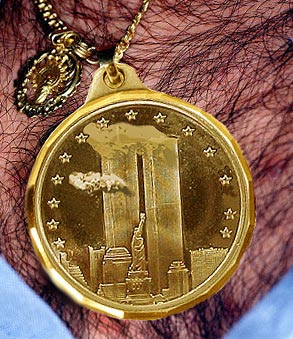
From twin towers commemorative pins to “Gone But Not Forgotten” sweatshirts, businesses are scrambling to give you a purchasable outlet for your pain. Who would’ve thought a year ago these two buildings, buildings that many claimed scarred an otherwise classic skyline with their blocky modern outline, would be replicated on everything from pendants to porcelain plates? Even more remarkable, perhaps, is that just five years after the Abner Louima brutality case, kids would cherish a doll dressed up as an NYPD cop.

And here we are, a part of the problem, digesting the unbearably sad and spitting it out as a rant to read over your coffee break. Still, is it possible to navigate the mountain of bizarre products related to Sept. 11, to gaze at the cultural digestive process in action, without an occasional derisive snort? These aren’t just commemorative pins, mind you. Instead it seems that there’s a 9/11 product to match every target demographic: Love kids? Then you’ll want to pick up “The Day Our World Changed: Children’s Art of 9-11.” Art buff? Maybe you’d like a $440 replica of the New York skyline. Self-help enthusiast? Perhaps you’d like to browse “The Sept. 11 Syndrome: Seven Steps to Getting a Grip in Uncertain Times.” Prefer to tackle your emotions by purchasing a painted commemorative plate instead? You’ve got it.

Or maybe those stickers of Calvin peeing on stuff are more your speed. Why not get a sticker of Calvin peeing on the words “bin Laden”? Finally, a cultural artifact with all the sophistication and subtlety of a “The Ayatollah is an Assahollah!” T-shirt. And don’t forget the Osama bin Laden golf balls, the “Wanted Dead or Alive” posters, the Osama toilet paper (“Help wipe out terrorism!”), and Osama “Pin” Laden voodoo dolls.

And that only covers the products directly related to the events of last September. For every World Trade Center blown glass ornament, there’s a universe of New York skyline T-shirts, an American flag ashtray, and a beach towel adorned with American eagles. Thomas Kinkade, marketing savant and so-called “Painter of Light,” has released a new series of paintings craftily titled “Hometown Pride,” the first in his remarkably timely “American Memories” series.

And the rampant overuse of the word “hero” in everything from political speeches to pop songs continues, as we strain to turn the most depressing event and circumstance into a chance to perform our favorite song and dance of enforced cheer and virile chest-beating. The FDNY even put out a “Calendar of Heroes” — a calendar of heroes with their shirts off, more specifically. Firemen striking macho poses with their man-titties shining in the sun like huevos rancheros may have always turned you on, but this year you can take pride in knowing that your dollars go to a good cause, and that those fireman fantasies you’ve nurtured since high school are utterly patriotic.

Ultimately, nothing personifies our tweaked love of media-as-spectacle more than a coffee table book filled with page after page of full-color tragedy. Imagine: One thrillingly apocalyptic scene after another, printed on thick, high-quality paper, for guests to absentmindedly peruse while sipping cocktails before dinner. As horrifying as it may have felt for that unknown office worker to be covered from head to foot in fine gray ash, it’s perhaps more horrifying that we might gaze idly at her moment of terror as a means of stirring up our emotions and reacquainting ourselves with our own mortality — but just for a few minutes, while we’re waiting for those game hens to come out of the oven.

The grandiose language bandied about by these tchotchke makers is worth the price of admission alone:

“The season of color — the colors are red, white, and blue. Colors that honor America — the volunteers, firefighters, police, families and victims of the tragedies in New York, Washington, and Pennsylvania on Sept. 11. Now, there are two more colors — sterling silver and 14k gold. Drue Sanders Custom Jewelers is proud to announce the creation of a commemorative pin, in either 14k gold or sterling silver. The pin is in the shape of the Pentagon, with the design featuring the American flag, the shape of New York State, and the words “United We Stand” and “God Bless America.” These beautiful pins are available at a fraction of their retail value, and partial proceeds from their sale will be donated to the New York City World Trade Center Relief Fund.”

Naturally, most of the retailers donate part of their proceeds to one of the many 9/11-related funds. Whether this is the main point of the product or merely a necessity to ensure sales, it’s impossible to tell in most cases. Some claim that all of the proceeds and profits will go to the fund, others reveal that a specific amount — from $1 to $5, generally — will go to the fund; still others claim that “some portion” of the profits will be donated, but presumably we’re supposed to leave it up to the creator of the product how much they’d like to donate once they turn a profit.

But as easy as it may be to write off all 9/11-related merchandise as the work of opportunistic trinket peddlers, it’s realistic to assume that many of these efforts began, at least, in an attempt to translate some difficult feelings into action. Given the vast numbers of us who felt moved to do something, anything, in the wake of 9/11, whether to honor its victims, reconcile our guilt at surviving, guard against further attacks, or simply peel ourselves from the TV and the papers and escape an overwhelming feeling of frustration, anger and helplessness, the current glut of commemorative commodities makes perfect sense.

Most of us in this country went through hell that week a year ago. However self-centered and pathetic we might be for shuffling around in our socks for weeks after Sept. 11, glassy-eyed and stunned, while we barely let the slaughter of millions of Rwandans spoil our breakfasts, the fact remains that we experienced something horrifying, and we experienced it together. To chalk up all the merchandise to blind greed is to ignore the obvious fact that we shared an unforgettable experience, and in America, we mark the unforgettable less with ceremonies than with souvenirs.

Ultimately, attempting to discriminate between genuinely motivated and authentic products and those that emerged, full-formed, from the heads of the cynical and the greedy may be beside the point. More telling than why we create such merchandise may be the question of why we buy it. Why do we seek to relive the tragedy over and over, through memorials, documentaries, tours of Ground Zero, and full-color photography books?

Many of the sites dedicated to Sept. 11 merchandise repeat the mantra that it’s important to remember, to never forget, what happened last fall. But do we want to remember in order to honor those who died, or have we tethered our boats to Sept. 11 out of a hunger for meaning, at a time when events with irrefutable, long-lasting impact are hard to come by, and news of an end-of-summer clearance sale is delivered with more hysteria than news of a typhoon in South Korea that killed 100 people?

While most of us are undeniably making a genuine attempt to remember the victims of 9/11, there’s also a strange part of us that wants to experience a piece of the pain for ourselves. No matter how many times we see those planes slamming into those skyscrapers, we’re never satisfied that we’re close enough to the center of the suffering. Those of us who weren’t directly affected, who didn’t lose someone close to us, may have been searching for some big event to focus on.

We take to distraction naturally, as a society — we’re constantly in search of the next big event that can focus us outside of ourselves, whether it be a tropical storm brewing off the coast of Florida, a baseball strike threatening to delay the World Series, or a wildfire raging out of control in East L.A. We’re unduly fixated on the steady flow of novelty fed to us through minute-to-minute updates, a constant barrage of breaking news, the latest numbers from the stock market, the latest horoscope, the latest figures on which movies pull in the most each weekend, the latest college football scores.

Maybe it’s the ease with which we took in the spectacle of Sept. 11 and then cast it out again that haunts us. After weeks of watching TV and reading the paper and feeling sick to our stomachs, when we thought we’d never get over it, life suddenly returned to normal. Purchasing these little trinkets might be our way of pledging that we won’t forget this event like we forget everything else on the pop-cultural conveyor belt.

But in some ways, buying stuff means we’ll forget even faster. In America, pledging to remember is just another step on the road to forgetting. We buy new games and plan trips and put together photo albums and take vacations and shoot video and save ticket stubs, just to file it all away and move on to the next style, the next technology, the next car, couch, dress, job, the next distraction. Our screens are updated and refreshed constantly, we don’t have to move a muscle to move forward, we don’t have to think at all to change our minds, to put the last choice behind us.

Five basketball seasons, 53 movies, seven hair colors, two gym memberships, four long distance carriers, three girlfriends and two e-mail addresses from now, we’ll be scrapping those commemorative plates at a yard sale. In America today, those who can’t remember the past for more than two seconds without getting interrupted by their cellphones may be condemned to repeat it.

Havrilesky says goodbye to Salon

A thank you to Salon's readers

  • more
    • All Share Services

After seven years as Salon’s TV critic, I’m leaving. I’ve thoroughly enjoyed writing for Salon all these years: My very supportive editors let me cover everything and anything, from the seething boozehounds of Drunk Asshole Hotel to the seething boozehounds of “Mad Men.” And whether I was tackling dying undertakerswhoring sea donkeysambivalent mobsters or aging boomers, I was given an alarming amount of creative freedom — alarming to readers, most of all — and took full advantage of it. I indulged in caffeine-fueled digressions and rambling parodies, created TV-themed puppet shows, and crafted not one but two “Deadwood”-speak columns that made ample use of the word “cocksucker.”

To all of Salon’s readers: You’re some of the most engaged and outspoken readers on the Web, and my writing has benefited from both your criticism and your encouragement. I genuinely appreciate your support over the years. Please feel free to drop me a line via Twitter, keep up with my latest work through my website, the rabbit blog, and look for my memoir, “Disaster Preparedness,” on Dec. 30 from Riverhead Books.

Few writers ever get the chance to enjoy a job that’s as creatively fulfilling as this one, or to write for an audience as smart and as insightful as Salon’s. Although it’s time for me to move on to new challenges, I will look back fondly on my years at Salon and feel grateful for them.


Continue Reading Close

The best TV shows of 2010

Slide show: Killer zombies, glorious "Mad Men," Zach Galifianakis -- the shows that blew our minds this year

  • more
    • All Share Services

The best TV shows of 2010

View the slide show

If you think 2010 was a bad year for TV, well, you need to reacquaint yourself with that big appliance in your living room. Although very few new series became giant hits, the best established shows got even better this year. Yes, the world fell in love with “Mad Men” like never before (and with good reason), but it was the comedies that really surprised us this year. Remember when nothing on TV made you laugh out loud? These days you have 10 to 15 flavors of laughter to choose from, so many that it’s pretty challenging to narrow them down to just a handful.

From disturbing zombie parables to madcap stoner nostalgia, from grumbling middle-aged men to grandstanding TV executives, the cream of the crop this year transcended their earlier peaks to bring us great entertainment in the comfort of our soft pants. Notable for their sharpness, originality and ability to make us feel uncomfortably human emotions, here are the 10 best TV shows of 2010.

View the slide show

Why you should be watching Jimmy Kimmel

In the wake of the late-night wars, one host emerges victorious -- and his name isn't Jay or Conan or Dave

  • more
    • All Share Services

Why you should be watching Jimmy KimmelClockwise from lower left: Jimmy Fallon, David Letterman, Jimmy Kimmel, Jay Leno, Conan O'Brien and Jimmy Kimmel

Shots were fired, angry accusations flew, risky stands were taken, and gigantic egos were bruised — but did anyone really win the late night wars? Since waging a valiant crusade against NBC and Jay Leno, Conan O’Brien finally retreated to TBS, comforted by the rabid devotion of Team Coco members nationwide. But even as his ratings remain impressive, he’s faced with one recurring question: How many self-deprecating basic cable jokes does it take to mask the defeat inherent in trading in a lifelong dream of hosting “The Tonight Show” for a spot in television’s hinterlands? Meanwhile, Jay Leno continues to play the clueless country uncle who came home from the state fair with a shiny new Corvette he won at the ring toss, gamely telling his ultra-sophisticated fat jokes and terrorist jokes and ugly-sister jokes on a set about as stylish and edgy as the lobby of the Cheesecake Factory. Snickering on the sidelines, as always, is David Letterman, who delighted at playing the bemused onlooker in this bloody conflict, but still never emerged as the clear ratings winner of the lot. Although he must’ve taken some real satisfaction in demonstrating just how much pain and anguish NBC could’ve spared itself by awarding him “The Tonight Show” gig almost two decades ago, Letterman has been doing the same incredulous snark routine for so long now (without many variations or imaginative twists), that not even an awkward admission of infidelity could shake us out of our indifference.

While the old familiar faces of late night don’t do much more than make us chuckle ourselves to sleep at night, one man has been calmly and quietly upping his game: Jimmy Kimmel. Despite his distance from the action, it was Kimmel who took some of the most direct shots at Leno during the late night wars. In addition to imitating Leno on “Jimmy Kimmel Live!” and then appearing on Leno’s show and insulting him to his face, Kimmel has been more outspoken than Conan himself about Leno’s sneaky strategy to take back “The Tonight Show” (although Bill Carter’s new book, “The War for Late Night,” seems to suggest that Leno wasn’t quite so calculating as Kimmel and others seem to assume). When asked in an interview with GQ this month what he learned from the late night dust-up, Kimmel replied: “The lesson is, it pays to be sneaky. I think that’s the main thing I learned. That, and don’t trust Jay Leno.”

It’s this frank talk that sets Jimmy Kimmel apart from his peers. Throw in the sharpest and funniest opening monologue on late night, an incredible knack for improv, and liberal use of off-kilter gimmicks and skits, and it’s no wonder that Kimmel has risen to the rank of late night king. Whether he’s launching a multitiered attack on Facebook idiocy with his National Unfriend Day, finding creative new ways to insult Matt Damon, or shooting an entire episode during a power outage using only his webcam, Kimmel has always had that combination of swagger and imagination that separates the good talk show hosts from the great ones. Like Johnny Carson and Letterman in his heyday, Kimmel has the bluster and the quick wit to make every moment watching him on the air feel dynamic and exciting.

That’s no small feat, of course, but it’s what real late night heroism demands. Kimmel tackles pop culture with more sharp wit and weirdo flair than any of the other late night hosts, whether he’s addressing the new Spider-Man musical (“I’ve been working on a superhero show myself, it’s called ‘Aquaman on Ice.’ Aquaman on skates, trying desperately to speak to his friends who are trapped under the layer of ice. That’s a musical!”), rumors that Snoop Dogg will play at Prince William’s bachelor party (“I’m excited for His Highness, and by His Highness, I mean both of them”), airline security pat-downs (“We freak out if a TSA agent touches us on the outside of our pants, but Black Friday, we will hump each other’s heads to get at Walmart to save 8 bucks on a PSP”), or even the plans to have Lindsay Lohan appear on “Dancing With the Stars” (“I would love to see her vomit on Len Goodman”).

When he’s interviewing guests, Kimmel is arguably better on his feet and more ready with unexpected quips than any other host. On a recent episode when Ben Affleck waxed sympathetic about hard economic times in America, Kimmel soon hinted that no one wants to hear a megastar fake emotion for the little people.

Affleck: I don’t think there’s anybody in the United States that hasn’t been affected (by the recession) in some way or another.

Kimmel: Oprah hasn’t been affected at all.

On another recent episode, Kimmel took an otherwise bland interview with Kate Bosworth and livened it up. (And let’s face it, the real test of good late-night hosting lies in finding some way to spice up interviews with dull, self-involved young actors and actresses. In addition to Kimmel, only Letterman and Craig Ferguson manage it with any regularity.)

Bosworth: (on her Korean co-star) He literally is the Brad Pitt of Korea. It’s pretty wild.

Kimmel: Really? ‘Cause I was told I was the Brad Pitt of Korea. That’s disappointing. I feel like I was lied to. (pause) He’s the Brad Pitt of Korea. And so does that mean he adopts a whole bunch of white kids, or how does that work?

He even managed to save an interview with Paris Hilton from the bowels of hell:

Hilton: (on her current boyfriend) Right now, I’m just so happy. He’s my best friend.

Kimmel: Wait a minute, now. I saw a television show in which you picked a best friend and he wasn’t it. Are you telling me that was not your real BFF?

Later, when Hilton called her new perfume “my tenth fragrance,” Kimmel countered, “That seems like too many fragrances to me.”

This is where the fans of Jimmy Fallon, who have been rallying lately to crown their contagiously giddy leader the supreme ruler of late night, really must admit defeat. While Fallon’s antics try our patience in all the right ways (Zach Galifianakis’ recent appearance, followed by a skit the very finest flavor of stupid, marked a recent high point), Fallon is a pretty bland interviewer, sometimes resembling Chris Farley’s guffawing yes-man talk show host of “SNL” legend. Nonetheless, Fallon is undoubtedly in the groove lately, with such sure-footed oddball gimmicks and quirky enthusiasm that it makes you wonder if “The Chris Farley Show” itself wouldn’t have morphed into something deliciously strange, if given enough time. And let’s face it, anyone who makes Helen Mirren play beer pong deserves at least an honorable mention, if not an Emmy.

While he might be the best Neil Young impersonator on late night (or anywhere else), Fallon has none of the subtle snideness that made Carson, Letterman and now Kimmel masters of the craft. Sure, the kind folks down at the local elementary school’s bake sale might find such a tone distasteful, but the rest of us, who’ve been marinating in a toxic mix of “The Love Boat,” People magazine and celebreality shows for years now, need a healthy dollop of scorn to make the celebrity promotional appearance go down a little more smoothly.

Fans of Craig Ferguson will point out that he shares the requisite doubting tone in his interviews, and also scores very high for sheer courage of conviction. And it’s true that to watch half a second of Ferguson’s show is to love him, from his googly-eyed knowing looks to his perverse but genius rambling asides. His self-effacing charms make his perhaps the most unpredictable and unruly of the late night shows. However enchantingly strange Ferguson’s monologues and interviews may be, they just don’t stack up to Kimmel’s.

And like Letterman, Kimmel carries the torch of bemoaning his network overlords, lamenting the dumb stuff ABC makes him promote. The imbedded advertising — Bud Light signs on the stage, Old Navy promotions at the start of the show, constant appearances by “Dancing With the Stars” contestants — isn’t all that easy to ignore, but Kimmel makes the best of it. He’s taken to calling himself “the three-headed dog the stars must pass on their way to no-dancing hell,” and after that show’s big finale, he told his audience, “I tell you something, I had a good morning. I woke up this morning, and for about three minutes, couldn’t remember who won “Dancing With the Stars” this year. It felt great, it really did.”

But Kimmel should wake up feeling great every morning. After all, who would’ve thought that this guy would be the big winner of the late night debacle of 2010? When you flip from Conan to Leno to Letterman, or stay up for Carson Daly or Fallon or Ferguson, even though you might appreciate Ferguson’s bizarro self-deprecating digressions or Fallon’s raw enthusiasm, Kimmel is the only host who will make you laugh out loud more than a few times per episode. He’s got the sharpest monologue, the most interesting digressions and skits, and the best interviewing skills. Now that the dust has cleared, “The Tonight Show” doesn’t look like a prize worth squabbling over, because, with or without the Cheesecake Factory backdrop, Jimmy Kimmel is the new Johnny Carson.

Continue Reading Close

“Men of a Certain Age”: Cool is overrated

TNT's moving, understated drama focuses on the disappointments and the sweetness of growing old among old friends

  • more
    • All Share Services

Scott Bakula, Andre Braugher and Ray Romano in "Men of a Certain Age"

The older you get, the less cool you are. The less cool you are, the nicer you are. This is why old people are so nice to each other.

When we’re young, we think old people are nice to each other because they’re fake. I was walking the dogs with my 14-year-old stepson yesterday and we passed a couple on the sidewalk. “Hi, how are you?” the man said. “Great, how are you?” I replied.

“That was weird,” my stepson said. “It’s like he says the same thing to everyone.”

“OK, have a great weekend!” I replied.

Old people are a little checked out, it’s true. But we’re amiably comatose. This friendly state of autopilot is the only way we’ve found to manage our dashed dreams, our growing contempt for the culture, our creeping disappointments, our fibromyalgia. We grind our teeth at night and have vivid dreams about screwing cheerleaders. We resent the unflattering shape of matchstick jeans and daydream about gigantic claw-foot bathtubs we can’t afford. Our elbows hurt and our hair always looks bad and we secretly think all electropop sounds like Kraftwerk.

Recognizing the defeat in each other’s eyes, we smile warmly and say things like, “Of course! We’d love to,” and “Fantastic! I can’t wait!” because we recognize that everyone is flawed and just barely able to accept their own mediocrity or tolerate the frustrations of advancing age. The least we can do is be nice about it.

Youngish (under 35) skeptics will tell you that the men of “Men of a Certain Age” (premieres Dec. 6 on TNT) don’t talk like men at all, they talk like post-menopausal book club members. This show isn’t made for those youngish people, though. It’s made for the oldish (over 35) among us, who recognize the self-doubting, second-guessing, pot-bellied guys on their TV screen as a painfully palpable embodiments of the humiliations and tiny little ego victories of middle age.

The charms of “Men of a Certain Age,” like the charms of growing old, are lost on the common whippersnapper. While youngish people tend to reevaluate and reappraise their oldest friendships constantly, questioning whether this or that old friend is up to speed with just how advanced and mature and evolved the new “me” is, old people recognize that they haven’t actually advanced or matured or evolved much over the years. Thus do they humbly turn to each other, all rumpled feathers and matted fur, and sigh deeply. Less important than how far you’ve come, to old friends, is how far you haven’t come — and also, where you were before you got old. The fundamental importance of old friendships, plus that peculiar flavor of shared, comfy nastiness that bounces around between old friends — these make up the soft center of “Men of a Certain Age.” We grow old, we fail, we reproach the gods and grimace in pain, and then we meet to eat pie and complain at the same diner each week.

“Everybody’s like, ‘Oh, don’t give up on your dream, Terry!’” Terry (Scott Bakula) tells lifelong friends Joe (Ray Romano) and Owen (Andre Braugher) of his acting career. “What would’ve been so bad if I had, huh? We’re at this place in our lives, we’ve come all this way, and I’ve got nothing to show for it. You’ve got something — families, careers …”

“Families suck,” Joe replies. This harshness, which of course we don’t expect and don’t believe entirely (even from a divorced guy with an anxious teen son and a moody teen daughter), is what balances out the vulnerability of “Men of a Certain Age.” As hand-holdy as the talk can get, these guys are still just guys.

And if you think their confessional, supportive tone with each other comes out of left field, tell that to the wood fence contractor who volunteered to me last week that he’d been “journaling a lot” about his dad’s death, or the plumber who, apropos of nothing, discussed the struggles of raising teenagers. Middle-aged strangers tell each other emotional stuff out of the blue, and middle-aged friends tell each other everything. (The only exception may be certain varieties of hipster intellectual, who could literally chat about Sufjan Stevens’ latest album on their deathbeds instead of confessing the hopes, fears and regrets of their final hours.)

But the utter lack of hipness of “Men of a Certain Age,” the total lack of concern for what’s deemed cool and what isn’t, the complete disregard for matching the breakneck pace, the action, the swooning romances, the spitty outbursts, the shiny thrills of other TV shows, is exactly what makes this drama so lovable. Where other dramas would pack in more zaniness and intrigue in every available second of airtime, “Men of a Certain Age” rolls out the familiar, the ordinary, and locates poetic folds and sweet pockets of emotion therein: Joe’s employees are two pure-intentioned teenagers who are genuinely confused by his old-guy ways, and one slow-moving old Spanish-speaking guy, Carlos, who sleeps on the job but Joe still can’t stand to fire him (he lays him off then hires him back at the end of the first season). Owen works at a car dealership owned by his dad, a thoroughly mundane job that Owen dislikes most of the time, but also occasionally excels at. When he breaks away to work for another dealership at the start of the second season, his father is angry, but his respect and investment in his son finally start to emerge out of the fog of his constant hectoring. Even Terry, with his acting career, has encounters with the film industry that will strike anyone who’s actually worked production as hauntingly authentic, less focused as they are on stars and perks and glamour than on a steady flow of deeply humiliating interactions with the most unsavory sorts of egomaniacs imaginable. The big promises and untrustworthy allegiances Terry forms with one director (who refers to him, tellingly, as “T-bag”), only to have the rug pulled out from under him on a whim, echo some essential Hollywood experience that’s rarely portrayed with quite as much clarity and empathy.

But the big impact of this drama comes in its quietest moments: Joe and his son, Albert (Braedon Lemasters), are driving home from the movie theater after Albert has had an anxiety attack and insists that they leave. Suddenly, Albert wants to know if Joe is embarrassed by him. “Embarrassed? No, man. Never,” Joe says, his eyes starting to well up a little. “You’re my hero. I mean that. You’re doing great, man. I’m proud of you.” It’s simple dialogue, nothing fancy, nothing too clever or provocative, but that’s what gets you in the throat sometimes.

Like the oldish and crumpled and vaguely resentful among us, “Men of a Certain Age” casts aside sophistication and witty banter for the comfort of what’s real — even when what’s real is disappointments, missed connections and inadequate attempts to reassure. In accepting our frailty, we locate our souls.

You’re doing great, “Men of a Certain Age.” We’re proud of you.

Oh, and have a great weekend! 

Continue Reading Close

“Public Speaking”: Scorsese’s Fran Lebowitz doc delights

Fran Lebowitz famously hasn't written a book in 20 years, but HBO makes the case she's as relevant as ever

  • more
    • All Share Services

Fran Lebowitz in "Public Speaking"

At the start of “Public Speaking,” Martin Scorsese’s documentary on Fran Lebowitz, you might find yourself wondering, “Just how much adoration does an author of exactly two books deserve?” After all, the woman hasn’t written a book for almost 20 years, yet she’s heralded as one of the singular wits of her generation.

But then, if you take the time to flip through the pages of “Metropolitan Life” or “Social Studies” yet again, you’ll find two truly great books that stand the test of time. And how many truly great books do most authors have in them?

The answer to that question, of course, is zero. Or as Lebowitz herself puts it when speaking to a roomful of young people, “There are too many books, the books are terrible, and it’s because you have been taught to have self-esteem.” This is Lebowitz’s distinct talent: making elitist contempt sound charming.

Toni Morrison, a friend of Lebowitz’s, puts it a little differently. “You seem to me almost always right,” she tells Lebowitz. “But never fair.”

“That’s why,” Lebowitz responds. “I’m always right because I’m never fair.”

Most of us secretly wish that we could be as right and as unfair as she is. But the world has changed a lot since “Metropolitan Life” was first published in 1974. Being unfair isn’t nearly as acceptable as it used to be. Today, people demand prose that is polite, respectful, nonjudgmental, and that never employs terms, phrases, suggestions or hints that could offend any segment of the population. People demand prose that isn’t prose, in other words.

Contrast that with almost any assertion made by Lebowitz in “Metropolitan Life” or “Social Studies”: Jews make good stand-up comedians. Sports are “dangerous and tiring activities performed by people with whom I share nothing except the right to trial by jury.” Communism is unpleasant because “I do not work well with others and I do not wish to learn to do so.” Children “tend to be sticky” and “respond inadequately to sardonic humor and veiled threats.”

“Public Speaking” (premieres 10 p.m. Monday, Nov. 22, on HBO) is also packed with Lebowitz’s clever observations, the most gratifying of which may be her reflections on the ways our culture has changed since her books were first published. “An audience with a high level of connoisseurship is as important to the culture as artists. That audience died in five minutes,” she says, referring to the AIDS epidemic. These days, Lebowitz says, “everything has to be broader, more blatant, more on the nose.” The problem? “Too much democracy in the culture, not enough democracy in the society.”

Lebowitz’s real strength, though, lies in explaining the different social classes to each other, either in her books or in Scorsese’s film. In “Social Studies” she includes a “Glossary of Words Used By Poorer People” including meatloaf (“A gloriously rough kind of pate”) and overworked (“an overwhelming feeling of fatigue, exhaustion, weariness. Similar to jet lag”), and outlines the trivializing effects of the international jet-setter (“What, after all, is London to a man who thinks of the whole Middle East as just another bad neighborhood and the coast of South Africa as simply the beach?”).

In “Public Speaking,” it’s clear that, although Lebowitz might mingle with elites, her underlying affections lie with the common man — as unsuitable as she might find his pants or his penchant for installing wall-to-wall carpeting in bathrooms. When the topic of how New York City has changed over the past two decades arises, Lebowitz says, “When a place is too expensive, only people with lots of money can live there. That’s the problem. You can like people with money, hate people with money. But you cannot say that an entire city with people with lots of money is fascinating. It isn’t.”

Even if her writers block continues for another three decades, Lebowitz herself remains undeniably fascinating. Scorsese’s documentary offers us a long overdue taste of her unique, queasily accurate perspectives on our culture — always right, never fair and never disappointing. 

Continue Reading Close

Page 1 of 126 in Heather Havrilesky