San Francisco

Bummed out

San Francisco is the capital of bohemian liberalism. It's also a homeless horror show. On Tuesday voters will decide the limits of their compassion.

The city of St. Francis, the capital of American liberalism, goes to the polls Tuesday for a vote on a ballot measure that’s been described with only a little bit of melodrama as a struggle for the city’s soul, and could be seen as a vote on the future of liberalism itself. San Francisco voters will decide if their famously tolerant city will follow the lead of most large American cities by slashing the cash grant it gives single homeless adults, providing vouchers for housing and services instead.

Known as Care not Cash, Prop. N has divided old friends and political allies, sparked fights and debate, street theater, vandalism and almost daily protest. Despite cries from homeless advocates, the liberal electorate that two years ago sent a lefty majority to the Board of Supervisors is expected to vote overwhelmingly for the measure, which has been bankrolled by conservatives and the business community. Its popularity reflects the growing sense of hopelessness, even among many liberals, over the two-decade-old, ever-worsening homeless crisis.

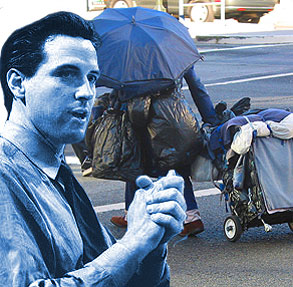
These are hard times in San Francisco. The high-tech party is over, this glittering dot-com capital is trying to get over its hangover, and the street people are like the phantoms of urban delirium: They’re everywhere, increasingly scary and wild. Some sleep on the streets alone; some in vagrant tribes. On a recent Friday night in the Financial District, under the glare of an ambulance’s red and orange lights, medical workers took care of one injured homeless man in the middle of a mini-encampment, while in a nearby doorway, another stood hunched over, pants around his knees, vomiting and defecating at the same time. A father and his two horrified young sons hurried past after dinner, rushing back to their car.

And they’re not just downtown anymore. These days the homeless sleep in the doorways of closed businesses and failed restaurants, in parks and alleys, all over the city, and what to do about it is setting once-friendly neighbors against one other. Filmmaker Francis Ford Coppola brought down the wrath of nearby businesses by funding a homeless drop-in center in picturesque North Beach that critics say only attracted more street people to the area. In progressive Bernal Heights, there’s increasing debate about the homeless folks camped on the neighborhood’s landmark hill and in its parks. Business owners in the gay Castro district are saddled with the man who could be the poster boy for the Yes on N campaign: Paul Sanchez, a homeless alcoholic who’s been arrested 128 times at last count, who has to be wrapped in a biohazard bag when he’s picked up because he’s covered in human waste, who spits in the face of the cops and nurses who try to help him.

So Prop. N seems almost unstoppable. Its opponents’ only hope has been to demonize its sponsor, Supervisor Gavin Newsom, who’d be a liberal in any other city but is on the right of the left-dominated board. Ever since Mayor Willie Brown appointed Newsom to fill a vacancy in February 1997, and he became the only straight white male on the 11-member board, he’s been the face of evil to San Francisco’s loud, lefty fringe. He wasn’t just any straight white male, mind you, but a Marina-district millionaire restaurateur with a girlfriend (now wife) who’s a model turned district attorney; a friend, protégé and business partner to two generations of one of the city’s most powerful and patrician families, the Gettys, and lately, the business community’s dreamboat candidate for mayor. San Francisco magazine put him on its cover a year ago, calling him a “West Coast Kennedy,” and thanks to the photo of Newsom on the front — his trademark gelled-back hair, his soulful blue eyes — the issue could have been mistaken for GQ.

The profile was mostly flattering — it noted that, despite his business ties, Newsom was one of the human service community’s best friends, having sponsored drug-treatment on demand legislation — but it did ask whether the likable fourth-generation San Franciscan was tough enough to govern this fractious city. That was before Prop. N, which has proven Newsom is tough, if nothing else. Opponents have set off stink bombs in his restaurants and clogged the phone lines with phony reservations, posted his photo and his home number and address on posters in the gay Castro district (“He’s so hot, come party with Gavin Newsom”), hit him with pies, and picketed his City Hall office and his businesses.

The campaign against Newsom could hurt him politically in the long run, but it’s not likely to bring down N, which would reduce the cash grant this liberal city provides from $395 to $59 a month, and replace the rest with vouchers for housing, drug and alcohol treatment and other services. By doing so, N will reallocate $13.9 million of the staggering $104 million the city spends on direct assistance to the homeless. Prop. N targets the roughly 2,700 single homeless adults who rely on what’s called county adult assistance. (Homeless families are served by other welfare programs, and the single adults who receive county assistance but use it to pay for housing — two-thirds of the overall caseload — are exempt from Prop. N.)

Clearly the measure’s real target are three unpopular homeless subgroups, which are not mutually exclusive: Those drawn by San Francisco’s generous grant who take up residence here (“immigration” cases); scam artists who may live in other cities and come in to collect San Francisco bucks (almost all of the counties that ring this city have replaced their cash grants with voucher systems much like the one Prop. N would create); and the quality-of-life degraders: the increasingly numerous, often belligerent drunks and druggies who blight the streets and sometimes menace passersby, giving sections of once-beautiful downtown San Francisco a surreally Third World feel. The poster boys and girls for the Prop. N campaign are the homeless who refuse housing and services and spend their welfare checks on drugs and alcohol; who eat, sleep and perform bodily functions; panhandle, party and fight; get drunk, get high, get sick and sometimes die in plain view of the rest of us.

One of the biggest problems in assessing Prop. N is that nobody knows just how many people there are in each category. How many fraud cases are there? How many people who would otherwise have stayed in Omaha or San Diego are lured here by grant money? And, perhaps trickiest of all: How many hopeless cases are there? What percentage of the homeless population are the drunken or stoned or crazy ones, passed out on sidewalks or defiling public space? Will Prop. N hurt thousands of needy people just to punish a visible, despised few?

Sister Bernie Galvin, the leader of Religious Witness for the Homeless, says that “until this city can substantiate the claim” that many if not most of those targeted by Prop. N are committing fraud or spending their check on drugs or liquor, “I will refute it.” Galvin insists the measure can’t begin to provide the housing, drug treatment and job training that are needed to truly address the homeless crisis. “They’re just trying to chase people away.”

Prop. N supporters don’t really deny that point. By weeding out fraud, discouraging homeless from moving here and not catering to those who want cash, not services, the measure will indeed reduce the welfare caseload, they say — and they argue that this will let the city do more for the homeless who genuinely need and want help. But the moral cornerstone of Newsom’s argument is that the current system hurts all of the homeless, even those who abuse it. Everywhere he goes, he talks about the 1,000 people who’ve died on the streets in the five and a half years since he took office, more than half of whom were victims of drug or alcohol abuse, according to the coroner. “True compassion isn’t handing people an insufficient sum of money to live — and letting 1,000 people die. It’s getting them into a system of housing and services that can truly help them.”

For a while, the perception that N was unbeatable neutralized much of the opposition. One of the city’s most left-wing supervisors, Tom Ammiano, was widely quoted telling supporters to “bite the reality sandwich” and accept that Newsom’s plan was too popular to oppose. The left’s leading candidate for mayor, Ammiano stayed neutral on Prop. N for months.

Then opponents decided to recast the debate, and make the issue not the homeless but Newsom, who is widely hailed as the perennially beleaguered business community’s great white hope for mayor in next year’s election. (Although San Franciscans love to hate the business community, it has pretty much gotten its way for decades, with two glaring exceptions — homeless issues and rent control — and it has managed to survive despite a business-bashing board of supervisors.) So Ammiano, trailing Newsom in most polls, pulled together his own homeless ballot initiative, Prop. O, which would provide an extra $24 million for housing and drug treatment, as well as invalidate some provisions of Prop. N, should it pass. Later he jumped off the fence and joined the No on N side.

The powerful Service Employees International Union, which represents city workers and sees Newsom as an anti-labor tool of business, also joined the fray. “I think the business community is using a populist issue to support Gavin Newsom for mayor,” SEIU spokesman Sal Rosselli told the San Francisco Chronicle last week. The No on N folks are trying to depict the measure as the revenge of the haves vs. the have-nots, and they’ve picked up a little momentum lately. Now the No side boasts slick fliers and placards just like the Yes side, only fewer of them, and TV ads to combat the measure started airing last week. They probably won’t be enough to defeat it, but they might tarnish Newsom with voters, tagging him as a pretty-boy pawn of the business community, and that could be worth the price of a futile campaign.

Lately business has begun to fight back. Two weeks ago a new corporate-sponsored group, SF SOS, threw a “Save Our City” rally — which raised certain questions like: Save it from whom? And for whom? — that was billed as a way to muster support for Prop. N. “I was not happy about it,” fumed Prop. N campaign chair Jim Ross, who would prefer to emphasize the measure’s grass-roots support, its 1,000 volunteers and its sky-high poll numbers in this liberal city — not the $200,000 it got from the business community’s political arm, the Committee on Jobs, or its solid corporate backing. Plus, Prop. N didn’t need the help. The SOS rally looked like an attempt by the business community, whose political fortunes hit Skid Row when the Board of Supervisors was taken over by the rabble in the last election, to glom onto N’s popularity. “Jim feels that way; I don’t,” Newsom tells me, smiling. “If the business community wants to support Prop. N, God bless them. We’re all part of a ‘web of mutuality,’” he says, borrowing from Martin Luther King Jr. Yes, he really talks that way, but you get used to it after a while.

Some days it seems that the vote on Prop. N could come down to which side’s backers are more reviled by voters: arrogant, entitled business people and their allies, or belligerent, entitled homeless people and theirs. But that’s too cynical. The battle over Prop. N has been heartfelt and substantive, a debate about the way liberals should define compassion, about the best way to help the homeless, about what we owe the worst off among us.

“Is Care not Cash paternalistic? Yeah,” admits the city’s human services director, Trent Rhorer, who supports the measure. “But our present system represents the victory of one kind of liberalism, where there’s no accountability. The advocates play into liberal guilt, and it’s troubling. Sometimes government needs to step in and improve people’s lives.”

Prop. N opponent Steve Fields, whose respected Progress Foundation provides residential treatment programs for the mentally ill and substance abusers, agrees that San Francisco liberalism sometimes goes too far. “I honestly think Gavin is sincere about thinking this is the way to help people, but the measure doesn’t have the courage to fund the services people need.”

Newsom insists the measure will serve far more people than opponents assume, thanks to the $13.9 million it will capture in redirected money. And he argues liberals shouldn’t ask for more money until they’re sure they’re spending what they’ve got effectively. “I used to be part of the problem. I was one of those people who said more money, more services — more is always better. Well, more isn’t always better. Better is better.”

“Oh sure,” says Paul Boden, the irascible director of the Coalition on Homelessness. “It takes a millionaire to decide money is bad for poor people.” Boden calls Prop. N. “a vicious shell game”; he dismisses Newsom and his supporters as “assholes.”

That’s the debate in a few sound bites, but the reality on San Francisco’s streets is even more complicated.

Newsom is right about at least one thing: San Francisco has seen its homeless problem worsen even as it spends more money on services. Homelessness became a phenomenon in San Francisco, as in other cities, in the early 1980s, after a range of misguided state and federal policies — cutbacks in federal housing subsidies and other services, the push to deinstitutionalize the mentally ill without funding community-based programs, plus the loss of manufacturing jobs in big cities — threw a new and visible population onto the streets.

There were an estimated 5,000 homeless people by the time Mayor Dianne Feinstein ended her term in 1987, 6,000 under Mayor Art Agnos in the fateful earthquake year, 1989. Homelessness helped cost Agnos reelection, after he let them camp in a park across the street from City Hall, which his opponent, former Police Chief Frank Jordan, dubbed Camp Agnos. But the problem didn’t get any better under Jordan, another one-term mayor done in at least partly by the air of futility that surrounded his efforts to clean up the streets. The centerpiece of Jordan’s homeless policy was a clean-up-the-streets program called Matrix, which continued the city’s history of generous cash grants to the homeless but beefed up law enforcement focusing on nuisance violations like public urination, loitering and camping in the parks. The Matrix program temporarily made the homeless less visible in certain high-profile areas like the Civic Center, but it did not appear to have any significant impact on the homeless problem one way or the other.

Willie Brown succeeded Jordan, and while he tilted more liberal than the ex-police chief did on the homeless during his campaign, he ended up punting on the issue. Brown made headlines by canceling a scheduled “homelessness summit” his first year in office, because he didn’t want to risk political capital on a problem that he admitted “may not be solvable.”

In the meantime, during the mid to late 1990s, counties around San Francisco were cutting their cash grants and replacing them with vouchers for housing and services, but this city resisted the trend. Coincidentally or not — the two sides disagree on that — the number of homeless San Franciscans continued to grow. Pegged at 6,000 in 1995, the city’s official homeless estimate is now 12,000, though people use numbers ranging from 8,000 to 14,000. But there’s one set of numbers no one can quarrel with: San Francisco’s cash grant to indigent adults amounts to $3.58 per city resident, compared to $1.34 in Los Angeles; $0.70 in Alameda County, across the bay, and a mere $0.15 in adjacent San Mateo. This, California’s 12th largest county, has the second largest county assistance caseload, and almost everyone agrees the comparative generosity of its cash grant is the reason why.

The cash grant is a mere fraction of the total amount city taxpayers pay for the homeless. A recent survey by San Francisco’s controller found the city spends $104 million in direct services to the homeless. Another $100 million or so goes to public works to clean up the streets, to the criminal justice system, and to healthcare. Newsom likes to flash a gruesome statistic: The single largest healthcare cost at San Francisco General Hospital, which serves most of the indigent, comes from treating soft-tissue infections that come from intravenous drug use — to the tune of roughly $14 million a year.

There’s also a huge cost to the criminal justice system: In the last 10 years, the city has given the homeless more than 135,000 criminal citations, mostly for nuisance “crimes” — sleeping in doorways or other public spaces, aggressive panhandling, public urination — according to Sister Bernie Galvin, whose group tracks them. On any given night, the controller’s report estimated, an average of 959 homeless people are in the city jail, at an annual cost of $30.8 million. And while there are no completely reliable studies, most people on both sides of Prop. N agree that substance abuse is a huge problem for the homeless — between 40 and 50 percent, some say more, are addicted to drugs or alcohol.

When you really look at it, San Francisco’s approach to homelessness seems like a dystopian combination of the worst of both worlds: Permissive liberalism — the cash grant, with no mandate to accept housing or services — with flashes of an arbitrary, punitive, law-and-order conservatism. Both sides agree there’s got to be a better way: They just disagree about what it is.

Newsom’s alternative is clear. He admits Care not Cash got its inspiration from Rudy Giuliani’s system in New York, which also combines liberal and conservative approaches to homelessness, but creates a less dysfunctional hybrid. Though the left disdained Giuliani’s model for its focus on cleaning up city streets for tourists and business people, and hiding the homeless in outer-borough shelters, in fact New York’s plan is expansive, and expensive. Thanks to New York’s court-imposed guarantee of shelter for everyone who wants it, the city served roughly 30,000 homeless last year and spent almost half a billion dollars doing it, providing not just housing (mostly in shelters) but job training, drug treatment and mental health services — roughly five times as much as San Francisco spends, though New York only has three times as many homeless.

Newsom and his supporters traveled to New York early this year to look at how the system works, and the supervisor says he partly modeled his program on what Giuliani did. Except for one thing: There’s no new money for services in his plan. That’s what makes Prop. N seem like a little bit of a shell game, as Boden calls it. Disarmingly, its supporters kind of admit to that. In fact, Trent Rhorer walks me through the way they plan to move the pieces around.

“We know the caseload is going to go down,” he says. “For one thing, we know there’s fraud — folks coming from other counties to get the cash grant.” When I bring up Sister Bernie Galvin’s complaint that the city can’t prove that, he throws up his hands. “We’ve never studied it because we’ve never wanted to put our limited funds into tracking fraud,” he says, asking me to imagine the outcry from advocates if his welfare department spent scarce resources that way. I’ve got to give him that one.

“So there’s gonna be a winnowing of people from other counties,” Rhorer says. Then there are the people who only want cash — they don’t want shelter or services, and the expectation is that they’ll drop off too. Rhorer points out that Prop. N captures the roughly $13.9 million (based on the controller’s estimate) that will be saved by cuts in the current caseload, even if the caseload drops because the city weeds out fraud as well as those who just want cash, not services. “Basically, this is a new revenue stream for supportive housing, which everyone agrees is the answer — but none of the advocates admit that.”

How will the targets of Prop. N be housed? With difficulty — but Rhorer says it can be done. The city has roughly 2,500 homeless-shelter beds, but very few vacancies — only 150 or so — on any given night (the number varies with the weather). Affordable housing is an oxymoron in San Francisco, which boasts among the highest housing prices in the nation. The city does have an innovative master lease program, through which the Human Services Department has taken over management of a range of low-income and single-room-occupancy buildings, paying rent directly for the tenant. San Francisco currently houses more than 800 formerly homeless people in the master lease program, and Rhorer says he’ll use about $8 million of the $13 million Prop. N captures on 1,000 new units through that program.

But neither side can say with any certainty how many people will remain on the caseload needing housing after the measure passes. Based on what happened in Alameda and San Diego counties when they imposed similar systems, Rhorer says the caseload will drop between 33 and 50 percent, by eliminating fraud and cutting off those who don’t want services instead of cash. Estimating conservatively, if the caseload drops by a third, that would leave about 1,800 who need housing, 1,000 of whom could be served in the expanded master lease program. But that leaves at least 800 people without housing and not quite $6 million left over for the housing and services the Care not Cash campaign says the measure will provide. Maybe a couple hundred more can be served by the existing shelter system, but that could leave a lot of people with nowhere to go.

Sister Bernie Galvin predicts most of the “housing” provided by Prop. N “will be a mat on the floor of a shelter.” Rhorer points to a key provision of N that says the city won’t cut a recipient’s grant if it can’t provide housing. “Yes, some people will be served in shelters,” he says wearily. “We don’t know how many. We will phase the program in gradually — and again, nobody will have their grant cut unless we can house them.”

It’s clear that voting for N requires some kind of leap of faith — that the city of St. Francis won’t warehouse its poor on mats in Dickensian shelters. You either trust folks like Rhorer to phase it in humanely, or you don’t.

Calvin Davis doesn’t trust Trent Rhorer, or anybody who works for his Human Services Department. An activist with the militant People Empowered for Welfare Employment Rights, or POWER, Davis was standing in a light rain on the day we met, picketing the office that administers the County Adult Assistance program, which the 52-year-old Davis has relied on for the last eight years.

All battles over poverty programs come down to our ideas about the deserving poor — who is, and who isn’t — and men like Davis are a kind of Rorschach test of worthiness: Reasonable people will disagree about whether and how to help him. In many ways, Davis fits the profile of the typical homeless county assistance recipient: Most are African-American men who stay intermittently in shelters, who’ve been on the program for an average of more than three years. “Some of these guys, they started out in our foster care system,” says Trent Rhorer. “It’s a shame.” George Smith, who heads the mayor’s office of homelessness, says that’s why the system has to be shaken up by Prop. N. “When you see the number of black men in this system, and try to say this system works … ” Smith trails off angrily.

The rail-thin Davis, missing a few teeth, is proof that the system doesn’t work. He’s wearing a leather-look jacket under a stained blue and white striped button-down shirt, both shirt and jacket buttoned up to his neck, and still shivering in the penetrating late-October cold. He says he sleeps most nights down at the South Beach shelter. Davis stands a little too close when he talks, edging me up against a wall of the building, not out of malice but out of a desire to be understood.

He’s lived all over the country, he tells me, and he came to San Francisco from Berkeley, after the city unfairly shut down his “auto-detailing business.” When pressed, he says he used to wash cars in public parking lots, until Berkeley cracked down on the practice. So he moved here and went on county assistance, though he’s been thrown off several times for resisting the workfare requirement — able-bodied recipients must work eight hours a week to receive their grants, some at tasks like street cleaning and washing MUNI buses. But about half do their work for local nonprofits, including the militant Coalition on Homelessness, which sort of adds up to the city subsidizing its own critics, but that’s San Francisco. Another cadre of Prop. N opponents, the folks at Poor Magazine, have had contracts from Rhorer’s department to train welfare recipients in journalism skills.

POWER made its name by first opposing the eight-hour a week workfare requirement for people like Davis, and then advocating that they receive union-scale wages if they did the work. Fewer than 10 percent of county assistance recipients are currently forced to work. Davis insists social workers have never given him any help or services to find a real job — “They’ve never done nothin’” — but he won’t give me his county caseworker’s name so I can ask about how he’s been treated. There’s no evidence he’s spending his check on drugs or alcohol, he’s not committing fraud, and yet you know he’s the sort of guy Prop. N is targeting, too. Empowered by POWER, he insists he’s entitled to his grant, with no strings attached.

POWER organizer Julie Brown, an intense, sweet-faced white woman with cropped black hair, seems to know Davis isn’t necessarily the best public face of Prop. N’s victims. So she brings over Emma Harris. A heavyset, spunky 50-year-old, Harris organized her workfare co-workers when she was cleaning MUNI buses so they’d be allowed to use the same bathroom as the regular MUNI workers. “Can you imagine? They had us using porta-potties!” But it turns out Emma’s not on county assistance, or workfare, anymore; last year she got approved for the federal SSI program for the disabled. What’s her disability? “It’s my back. It’s a back injury. It won’t let me work. And … well … I’m a little slow. You have to tell me things a few times before I understand.”

Harris wouldn’t be affected by N even if she was still on the county’s program, though, because she applied to the master lease program and now lives in a city-run hotel. (Prop. N won’t take money from clients who use their grants that way.) When Calvin Davis hears Harris tell me that, he butts in: “I would never go in that program. Those places are nasty, and they’re run by foreigners. Arabs, I think. They’re all rude! Don’t speak English.”

Harris admits there are a few problems where she lives. “But I’m the tenant rep, so I’m trying to make things better.” Soon Julie Brown is back: It’s time for the rally to begin its march to Newsom’s office. Today they’re demanding “reparations” for the “slavery” of the workfare program. Davis and Harris wave goodbye and walk away, chanting, “Pretty boy Newsom, shame shame shame, Stop using the poor for political gain!” In the war between the deserving poor and the undeserving, most San Franciscans would probably be happy to help Harris, and to tell Davis to hit the road, and that’s pretty much what Prop. N will do. The POWER march doesn’t seem designed to convince anybody who’s on the fence about Prop. N, but merely to show its power.

But the Yes on N campaign is saddled with problematic poster children of its own. One set of them came courtesy of the San Francisco Hotel Council, the political arm of the tourist industry, which has been hurt by the encampments on downtown streets. In the middle of the year, the Council began a slick billboard campaign, starring white yuppies and hipsters in pastel shirts and designer eyewear complaining about the homeless, and it made the crusade to clean up the streets appear to be the revenge of the haves.

On the billboards, which for a while were everywhere, aggrieved citizens hold handwritten cardboard signs made to look like those used by panhandlers: “I want to know why homelessness is still a problem, after we spend $200 million a year,” one reads. “I want the Board of Supervisors to stop playing politics and actually do something about the streets.” A third billboard features a middle-aged woman holding a sign reading, “I want the Supervisors to realize I have rights, too!” but at the corner of Jackson and Hyde Streets on Nob Hill, it’s been defaced to read, “that far exceed those of other human beings.” Although the billboards don’t mention Prop. N, they went up around the same time its backers were gathering signatures for the measure, and helped it look like the backlash of the white and entitled, perhaps costing it as many votes as it gained.

Then came SF SOS. Only in San Francisco would a bipartisan grass-roots group openly backed by the business sector be demonized as the second coming of the Trilateral Commission. A rowdy 50 people picketed its kickoff campaign rally, their numbers swollen by the appearance of Sen. Dianne Feinstein, fresh off a vote to support intervention in Iraq.

Clearly, after being routed in 2000 by the election of a lefty slate to the Board of Supervisors, the business community is fighting back with SOS, as well as with big-money campaigns behind several ballot initiatives, including Prop. N. They’re also backing Prop. R, which would loosen condo-conversion restrictions, creating homeownership opportunities but also displacing tenants. And they’re putting muscle behind the No campaigns on two progressive initiatives: Prop. D, which would create a local public power authority, and Prop. L, which would increase the real estate transfer tax. With few hot races for supervisor seats this year, the ballot measures are attracting most of the debate, and there’s a clear “Which side are you on?” feel at the SOS rally.

Yet SOS has hired a Democratic fundraiser, Wade Randlett, and is insisting it’s open to all points of view. “We are not just the ‘straight white male’ group,” says spokeswoman Julie Chase, who proves the point since she’s female, though she is in fact white — as are the vast majority of folks who turn out for the kickoff rally. There are some Latinos and African-Americans in the crowd, for sure, some nicely dressed prosperous looking folks who mix and mingle. (Eventually I realize that most of the black men I see, and there are a fair number of them, are doing security, when they’re mobilized to deal with the presence of a handful of demonstrators who’ve sneaked in to heckle Feinstein.) But the white folks there aren’t all swells and socialites — there are plenty of young families, dads wearing babies in backpacks, senior citizens scarfing down bagels in the back.

The group’s best effort at diversity that day involved bringing in 100 or so folks from Chinatown on cable car buses. San Francisco’s ever-growing Chinese population is fairly conservative, especially on social-spending and crime issues, so they have become a coveted voting bloc for moderate and conservative politicians and causes. At the SOS rally, the Chinatown contingent surged in, en masse, about a half-hour before Feinstein spoke, in the blue jeans and windbreakers and sweatshirts and sneakers of the immigrant working to middle class. They headed for the food tables and began eating the bagels and pastries that were left. Almost none of them spoke English. They were fairly indifferent to the speakers, except for one man who spoke in Cantonese for about 15 minutes, who got loud cheers from the whole crowd, not just the Chinese. A black security guy sidled up to me and whispered, “I don’t cheer for anything I don’t understand,” and I had to laugh. It was a tableaux of San Francisco balkanization — this city clearly lacks a civic center right now, but SOS can’t be faulted for failing to create one in a day.

There was nothing sinister about the SOS rally. The speakers wanted clean streets, good schools, nice parks, a healthy business climate. But nobody had a shining vision of community, either. Nobody talked about the poverty or suffering among us; the homeless were referenced only as faceless folks who’ve turned downtown into a place where good people “are hassled every day,” in the words of Randlett. Nobody referenced Dr. King’s “web of mutuality.” When Feinstein urged the group to support Care not Cash, to loud applause, one of the protesters who’d made it inside began to chant, “There is no cash! There is no care!” Gavin Newsom was standing right behind him, and stepped back a little so the security guys and police could muscle the guy outside, where he was allowed to leave without being arrested.

I asked Newsom why he wasn’t on the dais with Feinstein and he grinned. “I didn’t want to make it too political.” It was a good call. For now this group needs him more than he needs it. The SOS rally got almost no media coverage, and that was probably a win for Care not Cash.

Some people will be thinking about SF SOS when they go to the polls Tuesday; some will be thinking about the rabble-rousers from POWER; some will be thinking about the prospect of Newsom as the next mayor. I’ll be thinking about the downtown campus of San Francisco City College, a block from where I work. It’s a charmless building on the corner of 4th and Mission that’s set back from the street, with a small, covered mini-plaza on two sides. It’s not enough room for students to hang out and congregate, there are no tables and chairs where they can read or socialize, not even park benches to wait for the bus. But it’s just enough room for the homeless to sleep on cardboard and in raggedy sleeping bags and stay out of the rain.

So that’s what they’ve done every winter over the four years I’ve worked downtown. Early in the morning, urine streams from the walls of the building over the sidewalk to the street. There are still some sleeping homeless folks to be stepped over when early birds arrive for the first classes of the day. Some sit under the overhang all day long to stay dry, or try to — panhandling, drinking, socializing, fighting. It’s not all Hobbesian; I once watched a man tenderly shave his friend, while they listened to Curtis Mayfield’s “People Get Ready” on a boom box. One old black man is there almost every day and always says hello to me, protecting me from catcalls; I give him $20 every Christmas but try not to give out cash the rest of the time, because I think this space should belong to City College students, not the homeless. The city cares enough to try to wash the sidewalks most mornings, but not enough to try to clear the area for the students, most of whom are working-class Latinos, blacks and Asians. On this corner, it’s the have-nots against the have-a-littles, and in San Francisco, the have-a-littles always get the shaft. Will Care not Cash change any of that? That’s what I’ll have to figure out before I vote. The rainy season is starting again.

But for a lot of people, Prop N. is going to be a referendum on Gavin Newsom: whether they trust him — trust that the measure will provide care for the homeless, not merely chase them out of San Francisco. And whether they want him to be the next mayor, or want to use a vote on N as a brake on his political fortunes.

Rhorer trusts him. “Gavin’s a progressive. You’ve got the advocates calling him a racist, but it’s crazy. He knows and cares more about these issues than most supervisors, by far. He does his homework. He’s taken tremendous hits on the left, and it’s unfair.”

Steve Fields partly agrees. “Ten months or so ago, I would have told you I could vote for Gavin Newsom for mayor,” he says. “He was receptive and informed on substance abuse issues. He was an unequivocal supporter. That’s what bothers me: How can he not see the serious flaws in this approach?”

I push Fields: After his 20-plus years in the human services business, can he deny San Francisco’s generous cash grant is a magnet to area homeless, and complicates the problem of serving those who need help? “You can’t deny it. There’s no logical way to argue that it isn’t a magnet to show up here.” But Fields thinks Newsom is peddling a measure that promises “care,” which is crucial to San Francisco’s liberal voters, when it won’t provide enough to make a difference.

“Look, if he had said to the moderate human service community: Here’s a package of approaches, including a reasonable commitment to services — not everything we want, but some — and it included cash grant cuts? I think he would have gotten supporters. I might even be one of them. Sure, they’d have lost Paul Boden and the coalition folks, but they’d have won over the moderate left. But he didn’t even try. It was important to tell taxpayers: Here’s a solution that won’t cost any more money, which is dishonest. It was fashioned to help win over the business sector.”

Trent Rhorer denies that, on Newsom’s behalf. “I respect Steve, but I don’t think Gavin did this to court the business community. I think he believes it’s easier to target services to people when they’re housed, and he thought it could be revenue-neutral, that we didn’t need more money for services. And I think so too. Maybe there aren’t all the resources we need for treatment right now, but if we begin the process of directing money from bad programs to good ones, and we weed out folks who don’t want help — well, I think it can work.”

For his part, Newsom laughs at the idea that Care not Cash is part of his grand strategy to become the next mayor.

“The irony is that absolutely no one I’ve talked to said to me, ‘Cutting cash to poor people is the way to run for mayor,’” Newsom says. “Can anybody believe that? The day I proposed Prop. N, the Chronicle’s headline was ‘Newsom wants to cut cash to homeless.’ Outrageous! Who is this guy?”

We’re sitting in his City Hall office, which is decorated with photos of various Kennedys and books about them too. Bobby is his role model. There are also tomes about government reform and urban politics, including Robert Caro’s nightmare-of-urban-reform classic “The Power Broker.” Newsom gets going again. “You know that everybody who has associated himself with the homeless issue in this city has failed. Is that really a winning strategy to become mayor? Come on.”

Fields actually agrees with Newsom on that last point. “Oh, I think he’s hurt himself. Definitely. You can’t carve out what’s perceived as an anti-human services, anti-poor people campaign and become mayor in this town, I don’t think. That’s the sad thing. I don’t think he really needed to do this to win over the business community — they’d have supported him anyway. Where else are they gonna go? But he’s written off a lot of people who would have backed him on the left.”

Newsom says he hasn’t decided to run for mayor — that he’s going to leave the decision to his wife, Kimberly Guilfoyle, the photogenic district attorney who made her own name prosecuting Marjorie Knoller and Robert Noel in the dog-mauling trial last year, and who is said to have reservations about being the mayor’s wife. “There’s a huge cost. And I really don’t want to be a career politician. But on the other hand, I think we need someone who’s socially progressive, but practical. And wouldn’t you love to see someone new, someone young, who hasn’t made 3,000 deals?”

Wouldn’t you? Newsom has a winning way of pulling in a listener, presuming agreement, entwining everyone in his web of mutuality. When we start talking about my daughter’s public school, he confides that whatever happens to Prop. N or his mayoral future, he’s taking on the school district next. He starts ticking off the problems, and naming all the forces in the way of reforming public education, and soon his aide, Mike Farrah, comes over and playfully tries to confiscate my notebook before news of his boss’s latest crusade gets out to make them both more enemies. But Newsom makes it all seem like great fun.

I find myself wondering about Newsom’s insistence that running against the homeless is no way to become mayor. Maybe it hasn’t been in the past, but it might be today, when even liberals have gone beyond compassion fatigue to compassion catatonia, a condition in which the sufferer isn’t able to care what happens to the homeless, he or she just wants them to go away. That said, he’s taken a huge risk by sponsoring Prop. N. He could well be a West Coast Kennedy, politically martyred on the third rail of San Francisco politics.

But the viciousness of the campaign against Newsom has made me like him more, and I’m probably not the only one having that reaction. It seems a peculiarly San Francisco thing, and not one of the good San Francisco things, that Newsom’s years of caring about human service issues can be wiped away because he thinks it’s time to do what virtually every other California county has already done, and stop giving away big cash grants to the homeless. The way the other side has demonized him, and demonized the business community, too, seems part of why so many city institutions are broken. Even though I think Prop. N has flaws — and I’m still not sure how I’m going to vote on Tuesday — I think it’s great that a millionaire Marina restaurateur cares about poverty. I wish there were more like him.

Not that I’m too worried about Newsom. Stink bombs and all, he seems to be having the time of his life. “I’m proud of this campaign,” he tells me. “Even if I fail, I make it easier for the next person to take this on. There’s great nobility in failure.”

But he doesn’t look like somebody who expects to fail.

Joan Walsh

Joan Walsh is Salon's editor at large.

A heaven made in hell

Even as he slid deep into madness in his jungle “paradise,” Jim Jones found support in high places in San Francisco

This November 1978 photo shows bodies of followers of cult leader Jim Jones at the Jonestown commune in Guyana, where more than 900 members of the Peoples Temple died. (Credit: AP)
This is the final part in a series of excerpts from “Season of the Witch,” Salon founder David Talbot’s new book about the wild and bloody birth of San Francisco values. Read Part 1 and Part 2.

By early 1977, it seemed that Jim Jones had conquered San Francisco. He had Mayor George Moscone in his pocket and commanded the fawning loyalty of power brokers such as Willie Brown and rising stars like Harvey Milk. Using San Francisco as its power base, the Peoples Temple was ready to expand its operations in Los Angeles, Seattle, and other cities where it had already sunk roots.

But in July — on the eve of a Peoples Temple expose in New West, a California magazine owned by Rupert Murdoch – a spooked Jones suddenly uprooted his flock and fled to the jungles of Guyana, far from the reach of curious reporters and government investigators.

Dave Reuben and his team in the district attorney’s office were stunned by Jones’s sudden flight. They thought the timing of his escape was suspicious, prompted not just by the imminent publication of the New West expose but also by their own investigation. Somebody in the Hall of Justice had clearly tipped off the temple. “We were ready for grand jury indictments; we were this close,” said Reuben. “And [DA] Freitas would’ve had to go along with it, because he had no other choice. The next thing I know, I get a phone call in the middle of the night. ‘Guess what, he’s gone.’ Jones is gone, and the temple is packing up and getting ready to join him. I remember, we had a meeting in the office, and we said, ‘Somebody snitched us off.’”

In the fall of 1977, as Jim Jones hunkered down in Guyana’s steaming tropical wilderness with his flock of more than 1,000 souls, disturbing reports about the “utopian” community began filtering back to the Bay Area. But political supporters like Harvey Milk, newly elected to the board of supervisors, stuck by the increasingly fanatical leader, out of fear, expedience, or stubborn loyalty. In December 1977 Milk wrote to Joseph Califano, President Carter’s secretary of health, education, and welfare, protesting HEW’s decision to stop forwarding Social Security checks to elderly temple members in Guyana — a key financial pipeline for Jones. “Peoples Temple,” Milk informed Califano, “[has] established a beautiful retirement community in Guyana, the type of which people of means would pay thousands of dollars to patronize.”

Other icons of the Bay Area left, including Angela Davis and Huey Newton, also continued to rally around Jones. Longtime Black Panthers attorney Charles Garry agreed to represent the preacher in his legal battles. Garry became an aggressive mouthpiece for the temple back in the United States, telling the press, “There is a conspiracy by government agencies to destroy the Peoples Temple.” Privately, Garry began to question Jones’s mental stability, but he kept his doubts to himself. After visiting Jonestown in October 1977, the radical lawyer announced, “I have seen paradise.”

In reality, the Jonestown “paradise” was a nightmarish Third World police state. Everyone but the youngest and oldest were forced to work like mules from dawn to dusk in the sweltering fields, scratching out a living from the wild jungle terrain. Chronically short of food, residents struggled to keep their weight up with starchy meals like cassava bread drenched in brown syrup and rice soaked with gravy. Families and lovers were forced to live apart, relatives were pitted against one another, neighbors were ordered to inform on each other.

After dinner, the exhausted community was forced to assemble for interminable “emergency meetings” and listen to Jones’s increasingly mad ravings late into the night. Punishment was swift for those who nodded off. One evening a 60-old father of five named Charlie, worn out from fieldwork, slumped to the ground. An incensed Jones commanded Charlie’s son to wrap a boa constrictor around his father’s neck, releasing him only after the poor man’s face was turning red and he had humiliated himself by pissing his pants.

Jones and his heavily armed security team kept the community in a state of terrorized obedience. Minor infractions could send malefactors of all ages, even children, to the dreaded Box, a stuffy underground cubicle where they could be held for days. Those who dared to dissent were dispatched to the medical unit, where they were forcibly drugged and kept in a zombified state indefinitely.

While his followers lived hungry, Spartan lives, Emperor Jones resided in relative splendor in a cottage well stocked with electric appliances, delicacies like hard-boiled eggs, snacks, and soft drinks, and a cache of medications that he had expropriated from his aging and feeble residents. His drug supplies were endless.

The temple leader had been dependent on amphetamines, sedatives, and other drugs for years. Jim Jones Jr. remembered that as far back as the family’s days in Redwood Valley, his father kept a tray of white liquid in the refrigerator and would fix syringes with the fluid and inject himself. One time he overdosed, flailing around on the floor, and the worried kids were told that their father had suffered a heart attack. But years later, after working in a hospital, the younger Jones came to realize his father had displayed the symptoms of a speed addict.

In the glorious isolation of Jonestown, under his tropical canopy, Jones surrendered fully to his drug-fueled manias. He created an Orwellian dystopia and forced his captive followers to live in it. The nights were the worst, as the jungle’s dark silence was broken by a ghastly soundtrack of howler monkeys’ screechings and Jones’s sudden eruptions over the loudspeakers. Father’s voice was everywhere: in the huts, outhouses, fields. There was no getting away from his sleepless rants.

“White Night!” Father would yell in the deepest black of night, jolting his followers from their exhausted slumber. “White Night!” Residents were rushed toward the glaring lights of the pavilion, the elderly shuffling along in a daze, the children crying. When they were all gathered there, Jones — spazzy and hot-wired on speed — told them that the US government was about to pounce. They had to act quickly.

“Hear that sound?” Father told them. “The mercenaries are coming. The end has come. Time is up. Children . . . line up into two queues, one on either side of me.”

The guards stood solemn vigil over a large vat next to Jones.

“It tastes like fruit juice, children. It will not be hard to swallow.”

The White Night drill. It was terrifying but not real. Until the day it was.

Excerpted from “Season of the Witch” by David Talbot. Copyright 2012 by David Talbot. Excerpted by permission of Free Press, a division of Simon & Schuster. All rights reserved. No part of this excerpt may be reproduced or reprinted without permission in writing from the publisher.

Continue Reading Close
David Talbot

David Talbot is the founder and CEO of Salon.

Peoples Temple’s inside man

When investigators began uncovering Jim Jones’ sordid web of violence and corruption, he was one step ahead of them

Former Peoples Temple leader Rev. Jim Jones (Credit: AP)
This is Part 2 in a three-part series of excerpts from “Season of the Witch,” Salon founder David Talbot’s new book about the wild and bloody birth of San Francisco values. Read Part 1 here.

David Reuben — a short, scrappy investigator with the kind of commanding beak that looked like he enjoyed sticking it in people’s business — leaned back in his chair in San Francisco’s Hall of Justice building, nursing a cup of jailhouse java. Reuben listened with growing intensity as a middle-aged couple named Al and Jeannie Mills unraveled a jaw-dropping story about their lives in Jim Jones’s peculiar church. The Millses were the kind of homespun, American Gothic–looking people you wouldn’t glance at twice on the streets. But if 10 percent of what they were saying was true, Reuben figured, this case was going to rock the city — and the tremors would radiate far and wide.

Reuben had been recruited by San Francisco District Attorney Joe Freitas after the DA was swept into office with progressive mayor George Moscone in 1975. Like Moscone, Freitas was a Kennedyesque Catholic politician with wavy-haired, Mediterranean good looks. Raised in a Portuguese family in the Central Valley, Freitas had served in all the stations of the liberal cross, including the National Urban League and Common Cause, before running for San Francisco DA at the age of 36. Brimming with youthful self-confidence and political ambition, the new district attorney created a special prosecutions unit, filling it with young “red hots”—as Reuben described himself and his gung-ho colleagues. Freitas promised his mod squad a free hand in going after city corruption. “He told us there were no holds barred: dirty cops, dirty politicians, payoffs,” recalled Reuben. “Joe said, ‘I don’t care who it is, you go after them.’”

Freitas recruited crusading lawyers and investigators from all over the country for his new unit. Reuben and his crew came in with guns blazing, targeting the deep corruption in the San Francisco police force, including payoffs to cops by the skin trade moguls in North Beach. But Reuben soon found that the San Francisco justice establishment was more impregnable than he had imagined.

Coming from Chicago, where he had broken in as an investigator for the state attorney’s office, pursuing corruption in Mayor Richard Daley’s permanent regime, Reuben thought he had seen it all. But the San Francisco cop culture proved an even tougher nut to crack. “I thought that coming from Chicago, I knew old-boy’s networks,” he said, “but this was really something out here. It’s a true old-boy’s network. All the cops and prosecutors know each other, they’re all friends and family, they all went to the same parochial schools. And here we all come into the DA’s office: we were all in our twenties, and we’re all ballbusters. I mean, I took on the Daley machine. We didn’t care, we were going to investigate everybody. Well, it turns out that you don’t do that in San Francisco — not unless you have the inside support. And I’m Jewish, from Chicago. So I was more outside than you can ever imagine.”

By the time that Al and Jeannie Mills walked into his small office at the Hall of Justice in early 1977, Reuben and his team were beginning to feel demoralized. They had won some minor victories in their campaign against police corruption, but they were feeling increasingly isolated—not just within the Hall of Justice, where police inspectors feared and hated them, but within the DA’s office itself, which was bitterly divided over Freitas’s progressive reign. But the Peoples Temple investigation could make up for all the frustrations, Reuben realized. It was the kind of case that could make an investigator’s career.

The Millses, who defected from the Peoples Temple in 1976, told Reuben and his team that Jim Jones was a violent, drug-crazed despot. They accused him of ordering the murders of disaffected members and subjecting others to savage beatings, including their 16-year-old daughter, who was whipped so severely, according to Al, “her butt looked like hamburger.” The couple — who had changed their names from Elmer and Deanna Mertle to evade temple enforcers — told the investigators that Jones forced members to turn over their property and possessions to the church and confiscated their welfare and Social Security checks. They said Jones had also built his organization into a potent political machine, manipulating elections and politicians and working his way into the inner circles of power in San Francisco.

Reuben and his colleagues immediately recognized how explosive the Millses’ charges were. “At the time, Jim Jones was an acknowledged civic leader,” recalled Reuben. “I mean, he was the Second Coming in this city, bringing together black and white, rich and poor. He had presidents and governors and congressmen kissing his ring. And Joe Freitas was one of those people.”

Reuben and the chief of the special prosecutions unit, a former US prosecutor named Bob Graham, girded their loins and walked into their boss’s office to present the accusations against the Peoples Temple. As Reuben and Graham itemized the charges to Freitas and his number two man, Danny Weinstein, the room grew tense. “We lay it all out, and you could’ve heard a pin drop,” Reuben said. “And then Joe looks at us and says, ‘What, are you guys nuts?’”

Freitas heatedly pointed out to his special prosecutions team that people walked into the DA’s office all the time with wild charges and personal grudges. “You guys can’t just buy this stuff,” Freitas admonished them.

Reuben and Graham were incensed. The hard-charging, windmill-tilting DA who had hired them — and told them they had carte blanche — was now suggesting that they back off what could be the hottest case they’d ever worked. They immediately knew what was going down. They’d read the newspapers and knew all about the furious allegations swirling around the city: that Jim Jones and his zombie flock had stolen the election for Mayor Moscone, and had worked hard for Freitas too.

“We were pissed,” Reuben recalled later. “It was too dynamic for us not to dig into. All the names mentioned — Willie Brown, Dianne Feinstein, George Moscone — the whole gang was in there, I’m sure. And, of course, it was obvious to us — we’re not idiots — Joe was in the middle of the thing. He knew that if we started doing this thing, his career might be affected.”

Freitas was too politically savvy to simply shut down the Peoples Temple investigation. He knew that his angry investigators’ suspicions could wind up in the press. So he gave his special team just enough leash to quietly look into the Millses’ accusations. And to make sure that Reuben and Graham did not dig too deeply, Freitas appointed a young deputy named Tim Stoen as his liaison on the case.

Reuben did not know much about Stoen. The deputy DA, who wore horn-rimmed glasses and three-piece suits, was a straitlaced loner. “He was a nerdy kind of guy,” Reuben recalled. “Very bright, well spoken. We thought he was one of us, a reformer. But we joked about it, because he seemed too idealistic. He really wasn’t friendly with anybody, just did his own thing.”

As Reuben and his team dug deeper into the Millses’ hair-raising stories about the Peoples Temple, the allegations were checking out. Interviewing other defectors and anxious relatives of temple members, the investigators soon learned how fearful these people were of reprisals from Jones’s security guards — all of whom, Reuben discovered, had long rap sheets. Reuben promised his witnesses that he would protect their anonymity. But when he and his colleagues casually referred to their partner on the case, Deputy District Attorney Tim Stoen, the witnesses looked stunned. “Tim Stoen?” said one defector to Reuben, with panic in his eyes. “He’s Jim Jones’s top legal advisor.”

A chill ran up Reuben’s spine when he heard this. Afterwards he and Bob Graham stumbled in a daze over to a cop bar across the street from the Hall of Justice, to compare notes. What the hell was going on? The question hung over them like a noose as they hunched over their drinks. “So now we’re figuring, Is Stoen a plant? Does Freitas know who he is, or did this guy just weasel his way in? Does this all go back to Jones? Even before this, we didn’t know who to trust in the office. But now we’re really paranoid, because we don’t know who’s calling the shots.”

The two investigators marched into Freitas’s office to confront their boss. “We blew up,” recalled Reuben. “We said, ‘What’s going on here? Are we being made patsies in this whole thing?’”

Freitas acted surprised. “He said, ‘Are you guys sure?’ And this and that, like he didn’t know anything about Stoen.” But the investigators realized that Stoen was far too cozy with their boss for him not to have known.

Joe Freitas would later tell the press he had no idea that Tim Stoen was Jones’s right-hand man when he hired him; that he had simply plucked his resume out of the slush pile. But in truth, the Peoples Temple, which had contributed money and campaigned for Freitas, engineered Stoen’s insertion into the DA’s office as a political reward for its efforts. And in a brazen move to cover up the voter fraud committed by the temple during the 1975 election, Freitas put the temple’s lawyer in charge of the investigation. In doing so, he ensured that San Francisco would never find out who’d really won the mayoral election. Stoen brought in Peoples Temple clerical volunteers to help with his politically sensitive probe. The foxes had free run of the henhouse, and they left only feathers.

Three years later, after the name Jim Jones had gone down in infamy, state and federal investigators finally began looking into the shady election. When they asked for all the rosters showing who voted, the city’s deputy registrar of voters went searching for the records in three locked vaults where they were kept. All the records were missing.

After they found out about Stoen, Reuben and Graham began taking their files home at night, no longer sure that they could protect the confidentiality of their Peoples Temple witnesses, some of whom feared for their lives. The investigators’ suspicions were well founded. Stoen, it turned out, was literally a sleeper in the DA’s office. He often spent the night there, though he had a residence on Page Street, giving him free access to the office’s most sensitive documents for almost a year. Stoen and his wife, Grace, whom he had brought into the temple, enjoyed “a free romp through the place after hours,” one source reported. Freitas later shrugged off his deputy’s after-hours routine. “He was a hard worker,” the DA explained, and after toiling late into the night he often needed to avail himself of his office couch.

Excerpted from “Season of the Witch” by David Talbot. Copyright 2012 by David Talbot. Excerpted by permission of Free Press, a division of Simon & Schuster. All rights reserved. No part of this excerpt may be reproduced or reprinted without permission in writing from the publisher.

Continue Reading Close
David Talbot

David Talbot is the founder and CEO of Salon.

Jim Jones’ sinister grip on San Francisco

How the Peoples Temple cult leader ensnared Harvey Milk and other progressive icons

Left: Former San Francisco Supervisor Harvey Milk. Right: The Rev. Jim Jones, pastor of Peoples Temple in San Francisco (Credit: AP)
“Season of the Witch,” the new book by Salon founder David Talbot, tells the story of the wild and bloody birth of “San Francisco values.” The following excerpt – Part 1 in a three-part series -- recounts one of the darker dramas before the ultimate triumph of those values.

Jim Jones, the strange and charismatic leader of Peoples Temple, proved a master at politically wiring San Francisco in the mid-1970s. The driven preacher had begun his climb up the political pyramid by planting roots in the Fillmore district, the city’s devastated black neighborhood. Jones moved into the Fillmore at its most vulnerable moment. Urban renewal czar Justin Herman – the Robert Moses of San Francisco — had “literally destroyed the neighborhood,” observed community activist Hannibal Williams, “[and] people were desperate for solutions, something to follow. Jim Jones was another solution. He had a charismatic personality that won the hearts and souls of people. And people followed him to hell. That’s where Jim Jones went. That’s where he took the people who followed him.”

Jones’s flock, ignored and scorned by society, was electrified by the preacher’s vision of a new Eden. Everybody was exalted in his services, even the lowliest recovering drunks and addicts. “He made us feel special, like something bigger than ourselves,” said one temple member. “Total equality, no rich or poor, no races,” said another. “We were alive in those services,” testified one more. “They had life, soul power.”

Jones — an oddball and renegade his entire life, someone who never felt at home in his own skin — had found his identity by taking on a black persona. He saw himself following in the footsteps of Malcolm and Martin, leading “his” people out of bondage and into the promised land.

In reality, Jones maintained a racial hierarchy within the organization. While church membership was primarily black, the 37-member planning commission, as Jones called his leadership council, was dominated by white women — at least six of whom were his sexual conquests and firmly under his sway. “When people talk about my father manipulating black people, that’s true,” said Jim Jones Jr., the preacher’s black adopted son. “It was politically advantageous for him to give me his name.”

There was something exhibitionistic about the way that Jones and his wife treated their black son. “I was the chosen one,” he said. “I was more loved in my family than the other kids, even their biological son, Stephan. I remember Mom wiping charcoal off a dirty pot one day and rubbing it all over her face — to show that we were all black.”

Jones soon learned that his control over a well-organized, mixed-race army of some 8,000 dedicated followers gave him major stature with San Francisco’s liberal elite. Redevelopment had bulldozed the Fillmore’s political power into the ground. But now this strange white man with the hipster shades, Indian-black hair, and cadences of a black Bible-thumper seemed to be erecting a new political power line into the rubble-strewn, crime-ridden no-man’s-land. Jones could be counted on to deliver busloads of obedient, well-dressed disciples to demonstrations, campaign rallies, and political precincts. The city’s liberal Burton machine — run by congressional powerhouse Phil Burton — quickly identified the Peoples Temple juggernaut as a potentially game-changing ally in its long battle to take over city hall.

It was Burton ally Willie Brown – a rising force in California’s state capital — who first recognized that Jones’s organization could play a pivotal role in his friend George Moscone’s run for mayor. Moscone, a charming and handsome state legislator, had electrified San Francisco progressives with his campaign for city hall. A champion of gays, women, minorities, tenants and organized labor, Moscone was locked in a tight race with a pack of opponents led by conservative realtor John Barbagelata, whose campaign evoked a nostalgia for an older San Francisco, when it was ruled by traditional Catholic values. A meeting was set up between Jones and Moscone in the office of Don Bradley, the candidate’s veteran campaign manager. Bradley was initially cautious. “I was a little leery we were getting into something like the Moonies,” he later recalled. But after he looked into the temple’s campaign history and saw how effective it was in delivering victories, Bradley enthusiastically embraced Jones’s volunteer army. Nearly 200 temple members showed up at Moscone headquarters, fanning out to campaign in some of the city’s toughest neighborhoods, and helping the candidate finish first in the November 1975 election.

In the December runoff between Moscone and Barbagelata, Peoples Temple went even further to secure victory for its candidate. On the eve of the election, Jones filled buses with temple members in Redwood Valley and Los Angeles and shuttled them to San Francisco. Security at polling places was lax on Election Day, and many nonresidents were able to cast their ballots for Moscone, some more than once. “You could have run around to 1200 precincts and voted 1200 times,” said a bitter Barbagelata later, after losing by a whisper of a margin. But he was not the only one who claimed that the Peoples Temple stole the election for George Moscone. Temple leaders also claimed credit.

“We loaded up all 13 of our buses with maybe 70 people on each bus, and we had those buses rolling nonstop up and down the coast into San Francisco the day before the election,” recalled Jim Jones Jr. “We had people going from precinct to precinct to vote. So could we have been the force that tipped the election to Moscone? Absolutely! Slam dunk. He only won by 4,000 votes. I’m sorry, but I’ve got to give my father credit for that. I think he did the right thing. George Moscone was a good person; he wanted what was best for San Francisco.”

Jim Jones made sure that George Moscone never forgot his political debt to Peoples Temple. The man who began his term in city hall with a ringing promise to make San Francisco a beacon of enlightenment would start off his administration with a wretched burden on his back. The mayor could never rid himself of the stench of contagion that Jones brought with him, and as time went by, the power-hungry preacher only sunk his fangs in deeper. The pastor was a wickedly smart reader of a politician’s character, and he knew that the way to enchant Moscone was with young women, not money. When it came to bribing politicians, the temple leader had ample supplies of both. Jones bragged of supplying Moscone with black female members of his congregation. Jim Jones Jr. remembered the mayor as “a party guy. He’d always be there at temple parties with a cocktail in his hand and doing some ass grabbing.”

Temple insiders talked about how Mayor Moscone was one of the politicians under the control of “Father.” They gossiped about the night that the mayor had fallen into Jones’s hands. “Moscone was known to be a boozer; he liked to drink at parties,” recalled temple member Hue Fortson, now a pastor in Southern California. “One night there was some sort of temple event that the mayor attended. The next morning I heard that Jones phoned Moscone and told him it was a pleasure to see him the night before and to see him having such a good time. ‘But I want to let you know that the young lady you went off with is underage,’ Jones told him. ‘Now don’t worry, Mayor, we’ll take care of you — because we know that you’ll take care of us.’”

Jones might have made up the stories of sexual blackmail. He was known to concoct outlandish tales. “Jim was always bragging that he had sexually compromising information about politicians,” remembered Terri Buford, an on-again, off-again mistress of Jones who belonged to the temple’s inner circle. “But you never knew if what he said was true. He once told me that Willie Brown was sexually attracted to him. He just made stuff up.”

Whether or not Moscone was sexually compromised by Jones, he was certainly politically ensnared. The mayor initially resisted the temple’s efforts to insert its members throughout city government. And when Jones himself pushed for a high-level appointment, Moscone at first tried to appease him with a harmless post on the human rights commission. But the temple leader insisted on a position that had more clout, and the mayor decided he was in no position to alienate Jones. In October 1976 Moscone announced that he was naming Jones to the San Francisco Housing Authority, which oversees the operation of the city’s public housing. The agency, the largest landlord in the city, was a notorious maze of corruption, and it provided Jones’s organization with ample opportunity for shady self-dealing. A few months later, Moscone pulled strings to promote Jones, making him chairman.

Jones swept into the normally tedious meetings of the housing commission like a banana republic despot, surrounded by an entourage of aides and grim-faced security guards. Looking stern and inscrutable behind his aviator sunglasses, Jones ran the meetings with scripted precision while sipping a frothy white drink brought to him by a hovering retainer. The audience, packed with elderly black temple worshippers, erupted into wild cheers at his most routine pronouncements. Temple enforcers roamed through the meetings, keeping a watchful vigil, and even blocking people from entering the bathroom while Jones was inside.

Jones used his position to take possession of public housing units and install temple members in them, and he put other followers on the housing authority payroll. The preacher was building his own power base within city government. “He was using his power to recruit members and to put the hammer on people,” said David Reuben, an investigator for San Francisco District Attorney Joseph Freitas, another politician under Jones’s sway. “He had a lot of authority.”

“Jim Jones helped George Moscone run this city,” said Jim Jones Jr., a chillingly matter-of-fact assessment of the temple leader’s creeping encroachment in San Francisco.

Political leaders, aware of Jones’s ability to deliver — or manufacture — votes, lined up to pay tribute to the preacher. He worked his way into the good graces of officials high and low — most of them Democrats, since that was the party in power in California and San Francisco in the mid-1970s. But Jones was also happy to exchange mutually complimentary correspondence with the offices of Ronald Reagan and statesman Henry Kissinger.

During the 1976 presidential campaign, Jones wangled a private meeting with Jimmy Carter’s wife, Rosalynn, at the elegant Stanford Court Hotel on Nob Hill, arriving with a security contingent that was larger than her Secret Service squad. Later Jones accompanied Moscone and a group of Democratic dignitaries who climbed aboard vice presidential candidate Walter Mondale’s private jet when it touched down at San Francisco International Airport.

Governor Jerry Brown sang the preacher’s praises. Congressman John Burton, Phil’s brother, lobbied the governor to appoint Jones to the high-profile board of regents, which oversaw California’s sprawling public university system. San Francisco Supervisor – now U.S. Senator — Dianne Feinstein accepted an invitation to lunch with Jones and to tour Peoples Temple.

But no political figures were more gushing in their praise of Jones than Willie Brown and Harvey Milk, San Francisco’s rising tribune of gay freedom. Milk, a perennial candidate for office until he finally won a supervisor’s seat in 1977, aggressively sought Jones’s political blessing. “Our paths have crossed,” Milk wrote Jones during an earlier campaign for supervisor, in a letter filled with the kind of awed reverence that the cult leader demanded from his followers. “They will stay crossed. It is a fight that I will walk with you into . . . The first time I heard you, you made a statement: ‘Take one of us, and you must take all of us.’ Please add my name.”

Not content to hear dignitaries whisper flatteries into his ear, Jones staged a testimonial banquet in his own honor and demanded that politicians in his debt offer him public tribute. On the evening of September 25, 1976, the Peoples Temple headquarters on Geary Boulevard was converted into a formal dining hall with linen tablecloths and floral arrangements. At the head table sat Mayor Moscone, District Attorney Freitas, and Assemblyman Willie Brown, who acted as the evening’s exuberant master of ceremonies. As he introduced the man of the hour to the overflow audience, Brown reached new heights of shameless, ass-kissing puffery. “Let me present to you,” Brown roared, “a combination of Martin King, Angela Davis, Albert Einstein . . . Chairman Mao.” By the time Jones rose to tumultuous applause, he seemed likely to walk on water.

Privately, San Francisco political leaders expressed doubts about Jones and his strange church. One day a friend of Milk’s named Tory Hartmann dropped off some boxes of campaign brochures at Peoples Temple, so that Jones’s army could distribute them. Hartmann was immediately unnerved by the uptight, high-security atmosphere inside the temple, where sentries stood at attention outside each room, like the palace guards in the Wicked Witch’s castle. “This is a church?” Hartmann said to herself. Later, after she sped back to the Castro and told Milk about her bizarre experience, the naturally cheery politician turned deadly serious. “Make sure you’re always nice to the Peoples Temple,” he told her. “They’re weird and they’re dangerous, and you never want to be on their bad side.”

Cleve Jones, a young Milk aide, accompanied him to Peoples Temple for a couple of Sunday services. “Harvey told me, ‘Be careful, they tape everything.’ Everyone knew Jim Jones was creepy, everyone knew he was a megalomaniac. But everybody also saw this church full of black and white people — black people from the Fillmore who had been subjected to apartheid-like policies and seemed to finally be getting some respect.”

Members of Moscone’s staff were also beginning to hear troubling reports about Peoples Temple. One day mayoral aide Dick Sklar suggested to his family maid — an African-American woman who had followed the Sklars to San Francisco from Ohio — that she attend a Sunday service at Peoples Temple. “I didn’t know anything about it,” Sklar said, “but she was a churchgoing woman, and I thought she might like it. Afterward she came back and said it was the scariest place she’d ever been. They searched her, asked her questions. I had no idea.”

Moscone himself could not ignore how peculiar his political ally was. “I was at every meeting that Jim Jones ever attended with the mayor,” said Moscone press secretary Corey Busch. “I can tell you that after every one of those meetings, the reaction was, ‘This is one weird bird.’ He always wore the dark glasses. You couldn’t predict Jonestown, but he was definitely weird. In retrospect, maybe we should have seen that, but we didn’t.”

Excerpted from “Season of the Witch” by David Talbot. Copyright 2012 by David Talbot. Excerpted by permission of Free Press, a division of Simon & Schuster. All rights reserved. No part of this excerpt may be reproduced or reprinted without permission in writing from the publisher.

Continue Reading Close
David Talbot

David Talbot is the founder and CEO of Salon.

San Francisco turned me straight

I was a hardcore lesbian when I came to the famously freaky city. So how did I start sleeping with men?

(Credit: Shutterstock/Salon)
This essay is the first in a new series on Salon about bisexual experiences.

I proposed to my last girlfriend in Lesvos, Greece, at sunset, overlooking the craggy shores of Skala Eresou. I carried the ring 8,000 miles. I wasn’t eloquent, but she cried and I cried and as we walked back to our rented house, we played a game where we guessed the number of stray cats we’d see along the way. We said the loser had to kiss the winner a million times.

Shortly after that, we moved to San Francisco. Shortly after that, I was on a different shore and she was on a boat drifting farther away from me each day. Shortly after that, we stopped having sex. Words were somewhere in the absence growing between us but I couldn’t find them. My only weapon was repetition. I made us dinner. We watched “Glee.” We went to yoga. Shortly after that, she told me she wanted to date men, that our relationship was over.

My ex-girlfriend now has a boyfriend and lives in Minnesota. My yoga teacher, who announced to her mom at age 8 that she was a lesbian, now exclusively dates men, and has been in a committed relationship with a man for more than a year. My straightest guy friends have all at least made out with other men, while others are now dabbling in full-on dude sex. Whatever norm you came in with, San Francisco eventually takes it and turns it right on its (uncircumcised, pierced) head. It shouldn’t have surprised me that the City wanted to have its way with me too.  Still, I was the last person who thought I’d be a lesbian who spent the next year and a half of her life sleeping with men.

San Francisco is no stranger to the provocative, I know. Nary a rally or Sunday stroll exists without the backdrop of a few naked men in cock rings and pink faux-hawks. Here the rainbow flag is larger than the American one, parents push strollers around the Folsom Street Fair, and spectators can always drop in to the monthly porn wrestling matches at the Armory if dinner and a movie is too passé.

Sometimes I think S.F. is one of those Emerald City-type places where, free of many of the cultural or religious constraints that plague other cities, you can be the truest version of yourself, or at least have a really good time exploring untrue versions of yourself along the way. It’s a city that embraces the idea of potential, not limitations. I realize, of course, that sexuality can’t really be articulated or altered by a ZIP code, but all this flip-flopping seemed pervasive to me, and I figured the City itself, its brazenness, its tendency toward experimentation and spectacle, had to at least play a role in this shifting sexual mind-set.

I didn’t realize I liked girls until I was 20, so I was never a gold-star lesbian (someone who never slept with boys), but I am pretty stereotypically gay. I was a high school gym teacher. I drive a pickup truck. I minored in women’s studies. I know the difference between tempeh and seitan. It’s all womyn and grrls up in this hizzy, in other words. Yet I found myself a few months after my breakup mired in men, and behaving a lot straighter than I had at any other time in my life, which includes the brief affair I tried to have with eyelash crimpers in high school.

The first guy in S.F. I slept with was a friend I’d known for years. He offered to be my wingman at a tranny dance party during Pride weekend, but at the end of the night, we were the lone “straight” couple making out on the dance floor. It was somewhat embarrassing, actually. I felt like I was betraying myself, and “my people,” which was silly because no one knew who I was or cared about whom I made out with. As if the hot boi in the bow tie and suspenders would suddenly leap up and pronounce me a fraud between Le Tigre mashups. I went home with my friend and we had sex for hours. We didn’t discuss anything or stop to wonder if this was a good idea. We just kept moving to the rhythm of each other’s particular hungers. Afterward I felt so relieved. The months of frustration and rejection that led to my breakup were all released during this one marathon night of hetero sex. “I’m OK,” I thought. “I’m going to be OK.” While waiting for the bus outside his house, I burst into tears.

Then there was another friend, a new one. We went to a bar and he told me to tell him my life story, starting from birth. It took 12 hours, and he didn’t once let me ask him any questions in return. We held hands on the way back to his apartment and I remember thinking, “This is so wrong. Our hands don’t fit together. Our hands are just grasping at anything.”

San Francisco’s not an easy city to live in. Everyone is struggling a little, to pay the exorbitant rents, to stand out in a lasting way, to grow up as slowly as possible. I was unemployed the first five months I lived here, then took an internship that paid $6.25 an hour. Without the relationship luxury of shared expenses, I was barely surviving. But I was writing and I was having sex, which somehow made my financial and emotional woes more bearable. After a while, being straight felt more subversive to me than being queer, even more so when I was having queer sex with straight men. I would strap on a dildo and screw men face down on the mattress. I would grip their hips in my hands and feel alive, powerful. “I am moving on,” I thought. “I am free and empowered. This city won’t break me.”

I had a moment of panic shortly after that, where I blamed all of this on my ex-girlfriend. If she can be straight, then so can I, I told myself, as if that would prove anything. As if it would take away the anguish and loneliness of a life that would never again be ours.

Since many of us in San Francisco are struggling, it makes our connections to other people all the more urgent. We may be dropping a grand each month to live in a closet, but at least we have friends, lovers and many of those murky, in-between relationships that resist definition and ease.

I had quite a few of these relationships. There was the writer, the filmmaker, the lawyer. None of them had names really. They were known to me by their professions, or in some cases, their kinks. It was freeing, in a way. In S.F., I wasn’t defined or confined by my identity as a lesbian. Nor did I have to make excuses as to why I didn’t want to be in a relationship with any of these men. It felt radical, for a time. I would tell them I liked girls, always expecting it to be a deterrent, slightly disappointed that it never was. Or maybe they just didn’t believe me. To these new people, my track record as a queer lady existed only in words, in stories that seemed to take place in some bygone era, when in fact it had less than a year.

In my darker moments, I saw my newfound straightness for what it was: a crutch to avoid the pain of being hurt again. If I in no way imitated that girl who got her heart broken, then I was safe. And since I wasn’t getting any attention from queer women anyway, did it even matter?

The longer I went without emotionally or physically connecting with women, the more confused I became. It was like I was watching a foreign film of my life without subtitles.

Being with men started becoming my norm. And it freaked me out. Because even though it wasn’t familiar, it was easy. There’s very little guesswork involved with picking up men. There was no need to scrutinize fingernail length or namedrop “The L Word” in order to determine if someone was amenable to sleeping with me. In fact, it was pretty much assumed that 15 minutes of uninterrupted talk with a dude meant the possibility of sex was on the table.

We like to name things because it gives us a sense of order and comfort. So we can feel connected to one another. If I say I’m a daughter we all know what that means. Or a liberal, or a feminist, or a molecular biologist. But sexuality often doesn’t work that way. If you don’t look the part of a queer, then you don’t exist. I encountered this problem in other areas of my life as well. I’m half Native American, but you’d never know it unless I was standing next to my raven-haired mother. In this way, my queerness didn’t make sense unless it was in relation to who I was fucking at the time, which further alienated me from my former sexual identity. When all you have is your word, you’re always dependent on other people’s beliefs.

On the rare occasion that a woman did express interest in me, she was usually straight, another byproduct of San Francisco’s peculiar lure. Everyone was getting their rocks off, but no one was happy. This became even more evident when my dude sex started to sour. One guy I met online thought he could make me orgasm by simply commanding me to do so. Another guy reached over and took a hit from a pipe while inside me. Then two of my sex partners started having sex with each other and stopped having sex with me. It was all such a big, sticky mess that I am still trying to untangle.

S.F. author Stephen Elliott wrote recently that “San Francisco is this great drug and you sit on top of Bernal Heights and watch boats named ‘Opportunity’ and ‘Raw Ambition’ and ‘Your Worst Self’ sail by so far off you can’t read the red paint on their hulls, and throw your head back and open your mouth in the shape of a cloud.”

San Francisco taught me that a lot of things in my life had to end before I could begin again. It also taught me that there are no right or wrong ways to conduct your life, only honest ones.

Continue Reading Close

Anna Pulley (@annapulley) writes about sex and social media for SF Weekly, AlterNet, After Ellen and the Chicago Tribune. She's also attempting to lead a haiku revival on her blog, annapulley.com.

Great city forced to read swill

The San Francisco Chronicle’s Occupy SF problem

A protester tapes a dollar bill over her mouth at Occupy Oakland.(Credit: AP Photo/Marcio Jose Sanchez)

From New York to Nashville, from Miami to Seattle, tens of thousands of people have taken to the streets to protest America’s shocking income inequality and a broken political-financial system that is designed to ensure that the rich get richer and the rest of us get nothing. It’s the most significant progressive protest movement in years. And yet in America’s most left-wing city, pundits for the San Francisco Chronicle, the city’s daily newspaper, are coming across like the smarmy voice of the Chamber of Commerce. They’re so obsessed with the Occupy San Francisco movement’s illegal encampment, its effects on local businesses and the unruliness of some of its members that they have failed to grasp its historic significance.

You’d expect this from a paper in Salt Lake City. But San Francisco? The place famous for nurturing the Beats and the hippies, the women’s and gay rights movements? The free-spirited city-state that has always laughed at American Babbitry and fought for social justice? We deserve better than this.

On Thursday, Oct. 27, the Chronicle ran an editorial titled, “Occupy Oakland exits the high ground.” While acknowledging that “[t]he sweeps were rough and far from perfect,” it defended Oakland’s decision to remove the tent city, saying it had become a “health hazard and a public nuisance.” “Health inspectors are equally concerned about San Francisco’s campground at the foot of Market Street.” The editorial warned that public support for the movement would likely wane if it didn’t comport itself in a more respectable way. “It’s doubtful the country wants permanent tent villages on its public doorstep,” the editorial concluded. “It’s more than just manners and hygiene that are discrediting this movement. The protesters’ messages, mixed and muddled from the start, are getting eclipsed by the unruliness that is afflicting people and businesses on Main Street.”

Chronicle columnist C.W. Nevius has been striking a similar note. To be fair, Nevius has not been strictly opposed to the Occupy San Francisco movement: He has sympathetically interviewed protesters and defended their First Amendment rights. But like the author(s) of the Chronicle’s Op-Ed, he has seen the movement through a prism of seemliness. On Tuesday, Oct. 25, Nevius wrote a column titled “Time for police to move in on Occupy SF protesters.” Nevius argued that the San Francisco police should never have allowed any tents to go up in the first place, but that it was now necessary to remove them. “Many of the city’s homeless residents have gravitated there, the sanitation is a nightmare, there are rats, and car batteries are neither a safe nor ecological energy source,” he wrote. He urged Mayor Ed Lee to prove his leadership qualities and remove the camp. “There is no other choice. As Occupy SF gets bigger and louder, the potential for trouble only increases. Lee is getting persistent questions about why there are tents all over the Embarcadero, and with the election looming, you can bet he’d like to show he can handle this.”

As the last sentence shows, Nevius’ column was written in an oddly ambiguous manner. On the one hand, he was clearly advocating that the camp be removed. On the other, he was simply acting as if were a neutral channel, a kind of Greek chorus for nameless power-broker types who were raising “persistent questions” about the unsightly tent village. The contradictions in this split perspective came into full view just three days after his column.

The very night Nevius’ column appeared, the debacle in Oakland took place, when decorated Iraq war veteran Scott Olsen had his skull fractured by a projectile fired by the police as they cleared the Occupy Oakland camp. The international press, not to mention mom-and-apple pie papers like USA Today, were all over the Olsen story.

In his Friday column, Nevius abruptly changed his position. Apparently, the “sanitation nightmare” and increasing “potential for trouble” that had existed three days earlier were no longer such pressing concerns. “There is no rush,” Nevius wrote. “[San Francisco Police Chief Greg] Suhr and [Mayor] Lee are still talking vaguely about clearing the area, perhaps by force. I’d say cool your jets and wait and see what happens. The great truth of law enforcement is that there is always time to overreact.” To his credit – although it also revealed the incoherence of his position — Nevius gave space to sources who completely contradicted the points he had made three days earlier. Apparently summarizing the position of political consultant Chris Lehane – although the context also left open the possibility that he was speaking for himself — Nevius wrote, “The city’s claim that the Occupy SF camp was rife with urine, vomit and feces was exaggerated. It looked like a way to justify a raid.”

Memo to Greek-chorus-channeling, “neutral reporter” Nevius: tell that to your alter ego, the guy who insists that the city has to tear down those unsightly tents now.

The bottom line is that the prissy preachiness of the Chronicle’s punditry, in the guise of “civic concern,” has led them to end up taking the Chamber of Commerce’s side on a crucial issue that goes to the heart of San Francisco’s identity. This is a far cry from the open-minded tradition of former Chronicle executive editor Scott Newhall, who ran the paper in its ‘60s glory days and made sure it welcomed the unsightly and unruly hippies, and the legendary columnist Herb Caen, who despite hobnobbing with the rich and powerful always sided with the little guy, with the bohemians and oddballs his beloved town was famous for.

Yes, the Occupy San Francisco tent village is illegal. Yes, it is unruly. Yes, there are homeless people there. The movement is filled with oddballs and dropouts and nuts, and based on my own visits there, they outnumber the “respectable” types, the unemployed workers and students and housewives. And if real problems arise, violence or vandalism or disease, the city has the right and obligation to take steps to remedy them. But since no such problems have arisen, it’s impossible to escape the conclusion that the hand-wringing about the tents is all about image. The Occupy San Francisco movement is flawed and unsightly, like panhandlers and street people. The tourist-friendly solution: clean it up.

But the crazies and dropouts and street people who are part of the movement deserve to be there, deserve to be seen. For they bear inarticulate witness to the inequities the movement is protesting. Of course, they didn’t all end up there because of society’s sins; bad choices and personal responsibility also played a role. They’re not the best spokesmen for the movement. But they, too, are part of the America that the movement is trying to make better. They, too, are our brothers.

That isn’t liberal swill. It comes from a book called the Bible.

There is an inevitable tension in this nascent movement between the homeless and the middle-class, between the hardcore types who welcome confrontation and the moderate types who don’t. But the tents at the foot of Market Street are literally big enough for all of them. And San Francisco, of all cities, should welcome those tents. They may be ugly, but there is something beautiful about them. Saint Francis, for whom this city is named and who began his saintly career when he gave his clothes to a poor man, would have understood that.

Continue Reading Close

Gary Kamiya is a Salon contributing writer.

Page 1 of 24 in San Francisco