2002 Elections

Invasion of the Pelosi snatchers

Who sucked the life out of Nancy Pelosi?

  • more
    • All Share Services

Invasion of the Pelosi snatchers

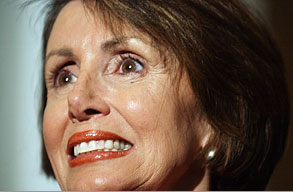
Was it “Meet the Press” or the Sci-Fi Channel? Watching Rep. Nancy Pelosi, D-Calif., make her first Sunday morning TV appearance since being elected House minority leader, I had to check the cable box twice to make sure.

The woman answering Tim Russert’s questions might have looked like Pelosi but she sounded like a character from “Invasion of the Body Snatchers.” What had happened to the congresswoman from California? Gone was the bold, combative, impassioned, progressive politician we’ve come to know over her 15 years in the House. In her place was a soulless pod person — an empty shell mouthing the kind of pallid, inoffensive, focus group-tested and cringe-inducing platitudes that have driven two-thirds of the American electorate away from politics — and a little more than half of the remaining one-third away from the Democratic Party.

I couldn’t help but wonder: Had head pod Terry McAuliffe given her a whiff of some life-sucking spores?

How else to explain, for example, Pelosi’s mealy-mouthed response to the all-important question of war with Iraq. The only member of the Democratic leadership to vote against the president’s resolution on the use of force, she had been unequivocal in her opposition to the war. “I have not seen,” she said in September following a White House meeting with President Bush, “intelligence to justify the action that the president is suggesting.”

But there she was, just 72 hours after her historic ascendance to her new post, vowing to back the president — even if he decides to unilaterally attack Iraq without U.N. approval. “If our young people are called to duty,” she said, “certainly we’ll support the action of the president.”

I had to turn up the volume on my TV set to make sure I was hearing her right. Sure enough, pod Pelosi was coming out foursquare in favor of backing our fighting men and women — having conveniently skipped right over the question of whether they should be put on the front lines in the first place.

And when Russert asked her to reconcile this with her previous opposition, she dismissed him with a curt, “That’s neither here nor there now. Let’s put that aside.” And so they did. Even when the specter of Pelosi’s former self appeared and suggested, “I do think that we can raise some questions before sending [our troops] into harm’s way,” she still refused to raise even a single one. Who then, if not one of the heads of the, nominally, opposition party is going to raise these questions? Paul Wolfowitz, perhaps?

She was similarly compliant when it came to the president’s handling of the war on terrorism. Unlike her counterpart in the Senate, Tom Daschle, who chided Bush for not having “made any real progress” in the war on terror, Pelosi gave the president two thumbs up, contending that when it comes to combating terror, Americans “are in better shape now than we were last year.”

Pelosi even tried to put a positive spin on the fact that Osama bin Laden is still on the loose — and, according to U.S. intelligence, very much alive — making the startling claim that the al-Qaida mastermind isn’t really “such an essential piece” of the war on terrorism. And John Muhammad was only tangentially involved with the sniper attacks, I suppose. So we have reason enough to bomb Iraq into the Stone Age, but Osama isn’t worth losing sleep over?

Turning her gaze on the smoldering ruins of Election Night 2002, Pelosi offered up some Churchillian language. “Never again,” she promised, “will you see a situation where the Democratic Party will go forth into an election with the Republicans characterizing who we are, but without a Democratic message to inoculate against that mischaracterization.” But when she tried her hand at delivering that message, the best she could manage were shopworn banalities about plans to “grow the economy” and “create jobs.” I’m afraid that inoculation is in need of a serious booster shot.

To hear pod Pelosi tell it, her leadership role is all about finding the political middle. “We must seek our common ground with the administration,” she told Russert. And I lost count of the number of times she used the word “consensus” during her appearance. In truth, the last thing the Democrats need right now is another champion of compromise — another Dick Gephardt. Why does she think he stepped down in the first place? Because he didn’t seek enough consensus?

“She has got her beliefs,” Pelosi’s communications director, Brendan Daly, helpfully explains. “But we are here to win, and she understands that to do that you need to be in the middle.” Well, congratulations. Because based on Pelosi’s inaugural appearances as minority leader-elect, yet another soulless middle-of-the-road leader is precisely what the Democrats — and the country — are about to get.

What is it about our system that the minute politicians are given a chance to lead, all they want to do is follow the pack? If the Democrats are really looking for a leader to help them return to power, the position, it seems, is still open.

Continue Reading Close

Arianna Huffington is a nationally syndicated columnist, the co-host of the National Public Radio program "Left, Right, and Center," and the author of 10 books. Her latest is "Fanatics and Fools: The Game Plan for Winning Back America."

Santorum: What does McCain know about torture?

The presidential hopeful claims torture survivor John McCain simply doesn't understand how torture works

  • more
    • All Share Services

Santorum: What does McCain know about torture?Possible 2012 presidential hopeful, former Republican U.S. Sen., Rick Santorum of Pennsylvania speaks during a We the People candidates forum, Saturday, April 30, 2011 in Manchester, NH (AP Photo/Jim Cole)(Credit: Jim Cole)

(UPDATED) John McCain has been on something of a crusade this week on the question of how we found Osama bin Laden, giving speeches and writing Op-Eds outlining his position that it was not torture of detainees that led the U.S. to its man.

Now comes presidential candidate and “enhanced interrogation” supporter Rick Santorum arguing on Hugh Hewitt’s radio show that McCain simply “doesn’t understand how enhanced interrogation works.” Yes, he’s talking about the same John McCain who, in his five and a half years as a prisoner of war in North Vietnam, was interrogated during a program of beatings and torture.

Here’s Santorum:

HH: Now your former colleague, John McCain, said look, there’s no record, there’s no evidence here that these methods actually led to the capture or the killing of bin Laden. Do you disagree with that? Or do you think he’s got an argument?

RS: I don’t, everything I’ve read shows that we would not have gotten this information as to who this man was if it had not been gotten information from people who were subject to enhanced interrogation. And so this idea that we didn’t ask that question while Khalid Sheikh Mohammed was being waterboarded, he doesn’t understand how enhanced interrogation works. I mean, you break somebody, and after they’re broken, they become cooperative. And that’s when we got this information. And one thing led to another, and led to another, and that’s how we ended up with bin Laden.

Santorum is wrong on the facts about Mohammed (more on this below). But what about his assertion about McCain?

Here’s a passage from McCain’s memoir in which he describes being subjected to beatings and telling his interrogators false information in response:

Once my condition had stabilized, my interrogators resumed their work. Demands for military information were accompanied by threats to terminate my medical treatment if I did not cooperate. Eventually, I gave them my ship’s name and squadron number, and confirmed that my target had been the power plant. Pressed for more useful information, I gave the names of the Green Bay Packers offensive line, and said they were members of my squadron. When asked to identify future targets, I simply recited the names of a number of North Vietnamese cities that had already been bombed.

I was occasionally beaten when I declined to give any more information. The beatings were of short duration, because I let out a hair-raising scream whenever they occurred.

In one four-day period, McCain says he was beaten “every two to three hours,” and his arm was broken and ribs cracked. So if nothing else, this is a man who can be said to know how enhanced interrogation works. (Santorum, as far as I can tell, has never been tortured, nor did he serve in the military.)

Khalid Sheik Mohammed, like McCain, also gave bad information after being tortured — a point that McCain himself made in a recent Op-Ed:

“In fact, the use of ‘enhanced interrogation techniques’ on Khalid Sheik Mohammed produced false and misleading information. He specifically told his interrogators that Abu Ahmed had moved to Peshawar, got married and ceased his role as an al-Qaeda facilitator — none of which was true,” McCain wrote. “I know from personal experience that the abuse of prisoners sometimes produces good intelligence but often produces bad intelligence because under torture a person will say anything he thinks his captors want to hear — true or false — if he believes it will relieve his suffering.”

(Hat tip: Elon Green)

UPDATE: Greg Sargent asks McCain’s spokeswoman for a response to Santorum, and she emails a single word: ”Who?”

Continue Reading Close
Justin Elliott

Justin Elliott is a reporter for ProPublica. You can follow him on Twitter @ElliottJustin

Don’t blame the government for mortgage lies

Fraudulent foreclosures, dodgy securities, run-amok greed: Free market failure, in action

  • more
    • All Share Services

Don't blame the government for mortgage lies

“There are so many fronts to the foreclosure crisis that it’s now becoming difficult to stay on top of all of them,” writes Naked Capitalism’s Yves Smith.

The attorney generals of all 50 states have opened a joint probe into “whether banks and loan servicers used false documents and signatures to justify hundreds of thousands of foreclosures,” reports Bloomberg. American Banker brings the news that banks are investigating themselves on the question of whether their mortgage servicers were lying about whether or not key loan documents had been lost. JP Morgan, reports the New York Times, has dropped out of the Mortgage Electronic Registration System (MERS) — a key component of the ever-widening scandal. The legal liabilities confronting the big banks are huge — Yves Smith is convinced that at least one major institution will collapse.

And on top of all this, Felix Salmon drops another blockbuster: He makes a compelling case that the banks that packaged mortgage bonds together and sold them to investors knew exactly how lousy the underlying loans were, but purposefully failed to disclose that information to their customers.

There’s probably never been a better time to be an experienced securities litigator.

The mortgage-bond scandal isn’t directly connected to the foreclosure mess, other than that both involve deceit and misrepresentation. But what strikes me as I try to grasp the magnitude of the disaster is the gaping absence of our favorite explanation from the right as to why this all happened. Strangely, no one is telling us how the foreclosure mess and the mortgage bond scandal are the government’s fault.

The notion that a governmental push for expanded low income housing was the primary factor responsible for the financial crisis has been endlessly debunked. But that doesn’t stop it from rearing its head at every opportunity. And yet, I’m not hearing any echoes of a similar argument to explain the complete unraveling of the mortgage loan industry, from top to bottom, that we are witnessing now. Because there’s really no way to sugar-coat it. Without any cops on the beat, with regulators at pains to take a hands-off approach to Wall Street, with an ideology firmly in place predicated on the belief that free market efficiencies would keep everyone’s noses clean, the mortgage loan industry — at every level — exploded in a frenzy of lies, misrepresentations, fraud, and greed.

Talk about your market failures!

Continue Reading Close
Andrew Leonard

Andrew Leonard is a staff writer at Salon. On Twitter, @koxinga21.

Lott falls, but Democrats don’t rise

Author Charles Bullock, an expert in the politics of the South, says the GOP will dust itself off and get along fine in Dixie.

  • more
    • All Share Services

After nearly two weeks of fierce controversy, Mississippi Republican Sen. Trent Lott has finally relinquished his position as Senate majority leader. In a sense, it seems like the end of an era: He’d made remarks before that seemed to suggest an unhealthy nostalgia for the days of segregation and he’d always gotten away with it. This time, he didn’t. And in the process, a glaring new light was thrown on his past and on the subtle race-baiting tactics used by others in the Republican Party.

But it’s wrong to think that Lott’s fall from power represents a dramatic shift in the political climate of the South, says Charles Bullock, professor of political science at the University of Georgia in Athens and co-editor of the 1998 book, “The New Politics of the Old South.” The Lott episode has been embarrassing for the Republicans, he told Salon in a telephone interview Friday, but there’s little reason to believe it will cost them much in the 2004 election. And, he added, there’s little reason to believe it signals the end of coded appeals to racism that are ingrained in the political culture of the South — and in much of the North, too.

The Lott affair came in the afterglow of the Republicans’ triumphant 2002 midterm elections, where the party seemed to firmly take control of the South, easily defeating Democrats in statewide races in places like Georgia, South Carolina and Florida. Some critics, though, charged Republicans ran a campaign that relied to a disturbing degree on subtle — and not so subtle — racism. For instance, in the Georgia race for governor, Republican Sonny Perdue stunned incumbent Roy Barnes on Election Day. As governor, Barnes had tried to push through the state Legislature an initiative to shrink the Confederate battle emblem on Georgia’s state flag. Perdue made an issue of it, and scored points in doing so.

“Most whites don’t necessarily see these appeals as being racially motivated or racially tinged,” Bullock says. “Sure, a Democrat is going to argue they are, but a whole lot of whites don’t see it that way.”

According to some election analysts, one key for Republican success in the South was the moderate turnout among African-Americans, who, in the absence of Bill Clinton, appeared less enthusiastic about voting on Election Day. At the same time, Republicans garnered more and more of the Southern white vote. The disaster was only partially mitigated by Louisiana Sen. Mary Landrieu’s election runoff win in December.

Bullock sees a simple dynamic at work: For Democrats, “the white vote’s just gone.”

But the controversy surrounding Lott’s comments has refocused and re-energized the long-running national debate on racial politics. In the interview, Bullock discussed whether it might give Democrats a chance to win back some crucial suburban swing voters down South.

In terms of Southern politics, what is the significance of Trent Lott’s resignation?

By removing himself from the leadership position it makes using his statement a less effective technique for Democrats trying to mobilize black turnout in 2004. After their relatively poor showing in 2002 in the South, they’re trying to figure out: What can we do to increase black levels of participation? They want to get races that look more like Louisiana a couple weeks ago, rather than the races in Georgia, South Carolina, and Florida from six weeks ago.

What about from the Republicans’ standpoint? There was lots of talk about the Georgia race and how an important issue was the Confederate flag and that there’s sort of been a code used in the past among Republican candidates. Will this incident make it harder for Republicans to flirt with those issues?

I think they can still flirt with them. Lott’s problem wasn’t so much flirtation as it was a mad love affair with the Dixiecrats of 1948.

So you think it’s a question of context and subtlety?

Yeah. I don’t think there are many Americans anymore who want to openly embrace something that’s seen as being racist. Fifty years ago that was no problem. The time has moved and the people have moved well beyond that.

Do you think President Bush will be able to improve upon the 8 percent African-American vote he received in 2000?

As an incumbent, I suspect he probably will. Will it be a large enough share that observers will say, “Wow, that’s impressive!”? No, I don’t think it’ll be there.

There’s been talk that Republicans are trying to reach out to African-Americans, but it seems that for Bush, politically, the Lott controversy had a different subtext. Bush received the smallest amount of African-American votes since Goldwater, and his strategists probably don’t see black voters as crucial. Was the White House handling of this controversy driven more by the need to avoid alienating moderate white voters in the South?

I think that’s right. For almost 40 years now, no Republican for president has done particularly well in terms of attracting black votes, and most Republicans running for governor or senator don’t get much of the black vote. So if it’s 10 percent, or 12 percent, or 14 percent, there isn’t a whole lot of variation there. And my guess is in 2004, unless for some reason Bush’s popularity is so overwhelming that Democrats effectively cede the contest to him — which I cannot imagine — I don’t think they’ll make great headway there. But you’re right, what can really hurt Republican candidates is if moderate whites were to perceive that the Republican message is a racist message.

So the only way for Democrats to unlock that stranglehold is to peel off a large chunk of those swing voters. And I’m guessing they’d be suburban voters who might feel uncomfortable with Lott in a leadership position.

Right, suburbanites, and disproportionately female.

And Republicans did very well with those suburban females in the midterms, correct?

Right. We didn’t have exit polls this year, but from looking at the results you’d have to assume that what the Republicans were able to do throughout much of the South was to eliminate much of the gender gap.

Bill Clinton called it hypocritical for Republicans to criticize Lott because they do this stuff all the time — trying to suppress the black vote and using code words like “crime,” or symbols such as the Confederate flag, to galvanize white voters with subtle appeals to racial fear or racial pride. After Lott’s very public humiliation, will Republicans still be able to use code messages like the flag or crime as a way to reach out to white voters in the South?

I think so, because most whites don’t necessarily see these appeals as being racially motivated or racially tinged. Sure, a Democrat is going to argue they are, but a whole lot of whites don’t see it that way.

So an issue like the Confederate flag, they see that as an issue of history and tradition?

Right. I had an interesting conversation with somebody very close to [former Georgia] Gov. Roy Barnes and he was saying you have in essence kind of two levels of white response to the flag but they all end up at the same point. You have traditional white, long-time Southern residents who talks about honoring the confederacy and the sacrifices in the 1860s, etc., etc. Then you have folks who moved into the South and for them it’s sort of a lifestyle. I think he referred to it as the “Disney World experience.” That you move to the South and people talk different and eat different kinds of things and they have this quaint flag and people sort of buy into that. After they’ve been here six months they’ve bought into that.

So really it’s only the African-American population that sees the flag issue as a race-based one?

It’s probably not that narrow. But polls I saw — and these were taken at the time of the 2000 presidential election — they showed white Democrats favoring the old flag by about 3 to 2. Republicans favored it even more heavily. But the white population, whether you’re Democrat or Republican, you weren’t terribly enthusiastic about changing the flag.

Why do you think the Lott controversy struck a chord the way that it did? He had made similar comments in the past. And John Ashcroft has made statements praising Confederate leaders. Do you think the rules have changed? Or was this an aberration?

I think part of the difference may be that you can talk about the bravery of Confederate soldiers. OK, fine — that’s 140 years ago. I’m sure some people would say, ‘Well, that means you wished the Confederate soldiers had won.’ But that’s so far in the past it doesn’t really resonate. But look at Lott’s statement that it was too bad Strom Thurmond didn’t win in 1948. Well, Strom’s still around, still alive. You’re more within the realm of what contemporary Americans have experienced and think of. Rather than trying to turn the clock back 140 years.

When was the last time you’d find an American leader of any sense who was saying “Too bad slavery’s gone”? Back in the 1880s, you could find people in public life who were saying that. Maybe even up until the turn of the century. Even noted racists of the 1950s and 1960s weren’t saying, “Gee, we need to get back to slavery.”

Why do you think his apologies didn’t stick?

I think part of it was that it turned out he’d said it more than one time. Conceivably if this were the only time, he could explain it as getting caught up in the moment, and it was a slip of the tongue. But then you had the 1980 comment and what was captured on tape in 2000, and then you start to think, maybe this is something he says every time he gets within 100 yards of Strom Thurmond, he launches into this kind of behavior.

In light of the midterm election results, which really seemed to be an exclamation point for Republicans in the South, do you think there was a sense of arrogance among Southern Republicans that “we’ve got this locked up and we can sort of say whatever we want now”?

I don’t think so. I think it’s more a Trent Lott problem, rather than a Republican problem.

You mentioned that now that Lott has taken himself out of a leadership position, his comments won’t be an issue in 2004. What lesson can Democrats take from this encounter in the context of Southern politics?

I’m not sure Democrats get much of a lesson out of this, or something they can take to the bank. I think they got a lesson from the vote in Louisiana in terms of what they need to do if they want to make headway. They need a strong black turnout and they need to hang onto about 40 percent of the white vote. And my hunch is they probably didn’t achieve either of those goals in a number of the contests they lost in 2002; the Southern white votes slipped and they also didn’t get strong black turnout.

Couldn’t this help among African-Americans who didn’t vote in 2002? Then the Lott controversy comes up and they decide, “I’m never going to skip an election again”?

Sure, I suspect it will be used in that way and I think it’ll have some impact. But it’s damaged a bit because he’s no longer the leader, so it’s a little bit harder to make the argument to vote for our local Democrat because Republicans are the party of Trent Lott and here’s what Trent Lott said. But Trent Lott’s no longer the Republican leader.

Continue Reading Close

Eric Boehlert, a former senior writer for Salon, is the author of "Lapdogs: How the Press Rolled Over for Bush."

Clinton: Democrats “were missing in action”

In a major political address this week, former President Bill Clinton bluntly dissected the Democrats' recent electoral losses. Moving to the left, he said, is not a solution -- but fighting back is.

  • more
    • All Share Services

Clinton: Democrats

Former President Clinton minced no words in a speech he delivered Tuesday at NYU dissecting his party’s serious losses in the midterm elections. “Democrats have to have ideas to win,” he said. “We were missing in action in national security and we had no positive plan for America’s domestic future.” To get the party back on its feet, he says, hard changes need to be made — but moving to the left is not one of them.

The following is the full text of his speech to the Democratic Leadership Council.

Thank you very much and good afternoon. Mayor O’Malley, congratulations on being the Esquire cover boy. I hope it’s just the beginning of greater things to come. Senator Bayh, Senator Carper, Representative Tauscher, Representative Meeks; John Sexton and the NYU family, which now includes two of my former administration members, Jack Lew and Cheryl Mills; and all the others here who were part of our team, Mack McLarty, my first chief of staff and special envoy to Latin America, Don Baer and Tom Freedman; Al From, Bruce Reed, Will Marshall and all the DLC family: I thank you for welcoming me back. I may have to take my glasses out this morning to read my handwritten notes. When you’re not the president anymore, one nice thing is you don’t have to say what anybody else wants you to say. So, I wrote this speech out this morning after coming back late from Mexico last night and I may or may not be able to read it without my glasses.

I am enormously proud to be a member of the DLC, to have been there at the beginning, to have done the work that we did between 1984 and 1992, work based on a vision of America at the turn of the century with opportunity for all, responsibility from all, and a community of all our people. We also wanted America to be the world’s leading force for peace and freedom, prosperity and security. We had a strategy rooted in new ideas and on the oldest of America’s missions: to constantly form a more perfect union. We implemented those ideas: AmeriCorps, the Empowerment Zones, community policing, charter schools, welfare reform, always going beyond false choices. We believed that we could have fiscal responsibility and social investment; that we could be good for labor and business; that we could grow the economy and clean the environment; that we could prevent and punish crime.

It turns out we were right. In 1995, Thomas Patterson, a highly regarded scholar of the presidency, said that although I had made more and more specific commitments when I ran for president in ’92 than any previous candidate, I had already kept a higher percentage of those commitments than the previous five presidents. Something, I might say, you would never have known by reading the press, but Patterson, after all, was a scholar interested in evidence, not ideology. I say that because I want to give the DLC a lot of the credit. Because we worked for years and years on these ideas together, and because a lot of the governors with whom I served, including then-governors Evan Bayh and Tom Carper, used the states as laboratories of democracy to test them. So we didn’t have to wake up the morning after the election and wonder what we were going to do. We knew what we wanted to do and we set about doing it.

We had remarkable support from the Democrats in Congress, but even after the Republicans won a majority, we were still able to enact most of our initiatives, thanks in no small measure to the wonderful work that was done by the members of my staff and cabinet and our allies in the Congress.

Democrats have to have ideas to win. Republicans will always have more powerful interest groups and the fervor of right wing emotions, as we saw with the Confederate flag issue in Georgia and South Carolina in this recent election. They have an increasingly right wing and bellicose conservative press, with the editorial page of the Wall Street Journal emboldened by the last election, to urge that what we should really be doing is raising taxes on lower income working people so they will come to hate the government just as much as the editors of the Wall Street Journal do. And we have an increasingly docile establishment press, to be fair, partly because of the enormous trauma of September 11th and its aftermath.

On the other hand, the cultural bases of the two parties are more or less even, about 45 percent of America each, and we win on the issues when we put them out in a balanced and fair way and people can hear what we have to say. We have to find a way that brings people together across party and income, racial and religious lines. In the recent election I was honored to do what little I could, mostly to keep our candidates from being even more badly outspent than they were going to be anyway. In the future, that will be done by others, especially as the presidential campaign takes over. I beg to differ with those who think we don’t have leaders of today and tomorrow who can do that. I think we have a lot of very, very good and able and articulate people in the House and the Senate and in other areas of public life. I think the most important thing is that we have to get the ideas out there. The work I do most of the time on most days is connected with my foundation and it’s also tied to the ideas that we developed in the DLC. I work on economic opportunity, community service and education at home and around the world, on fighting AIDS and building democracy.

But I still care a lot about my party and I care even more about my country. And I still believe ideas and results matter when people can hear evidence over ideology. The evidence shows that our approach worked. We had 22 and a half million new jobs, the most ever in any eight-year period. The longest economic expansion, the highest home ownership and the lowest minority unemployment ever recorded. The largest increase in college aid in 50 years, thanks to the Hope Scholarship, another New Democrat idea. The largest increase in health insurance for children in 35 years. The first three surpluses in 70 years. Eighty million people protected by the patients’ bill of rights by executive order. Thirty-five million people taking advantage of family leave, a bill that was vetoed during the previous Republican administration.

Almost 8 million people moved out of poverty in those eight years, 100 times as many as moved out of poverty in the Reagan recovery. We had more millionaires and more billionaires than they did and we moved more people out of poverty.

So, if evidence triumphs over ideology, there’s got to be an audience for our ideas. We had the lowest crime rate in 27 years. The lowest welfare rolls in 35 years. The largest land protection program in the lower 48 states in 100 years since Theodore Roosevelt; 43 million more Americans were breathing clean air when we left than when we started. We had nearly 300 trade agreements and they accounted for about 30 percent of our growth in those remarkable years. We ended ethnic cleansing in Bosnia and Kosovo, made peace in Northern Ireland, had seven years of peace in the Middle East until Mr. Arafat made the disastrous mistake of turning down the peace offer that we made in December of 2000. China and Russia were integrated more closely with the West with the World Trade Organization, partnerships with NATO and other cooperative endeavors. The Global Debt Relief Initiative was the most innovative international approach in decades, giving debt relief to 25, soon to be 32 nations, but only if they could prove they put all the money into health education or economic development. And we proved that diversity and excellence go hand in hand with appointments throughout the government and to our judgeships. We pursued a vision of America and the world based on American values and new ideas, and we had a strategy to make it all work.

“I’ve read all the people who say that the Democratic Party is dead. But I respectfully disagree.” I first said that on May 6th, 1991. I believed it then and I believe it today. Now, in the last two years, we’ve lost two elections. Well, we sort of lost in 2000 but we really did lose in 2002. I don’t want to dwell on the past because politics is best understood through the prism of the future. But I would like to offer a few thoughts.

First of all, I don’t think you can underestimate the impact of the psychological toll of September 11th on the American people. We long to be united and we long to be strong. Secondly, the Republicans won on message, money and turnout. The money couldn’t be helped. We did the best we could. And let’s not forget that in 1998, they outspent us by 100 million dollars and we gained seats in the House of Representatives when they thought they’d win 30. We lost no seats in the Senate, when they thought they’d win five. It was the first time since 1822 that the president’s party had won seats in the House in the 6th year of a presidency and in 1822, we were a one-party country. So, in fact, it had never happened before.

Let’s talk about the other things. The problem with our message was that to Democrats and Independents, we were missing in action in national security and we had no positive plan for America’s domestic future.

It’s not fair to say we were missing in action on national security. The Democrats supported the president against terror; they overwhelmingly supported the defense increases. Most of them supported the administration on Iraq. It was amazing that they were able to make such a big deal over the Homeland Security bill, a bill that was Senator Lieberman’s proposal, which the administration opposed for seven months before finally deciding that it was the only wedge issue they had because they didn’t have Iraq or terrorism anymore. But it’s our fault that we let it happen. Now because of the national security issue and because we had no positive plan on the economy and other domestic issues, we had no access to a large majority of voters who were otherwise predisposed to vote for Democrats for two reasons: one, they thought by 20 points that the administration had given insufficient attention to the economy and other domestic issues; and second, they thought by 23 points that other things being equal, it would be better to have more Democrats in Congress to restrain the extreme impulses of the Republicans on the environment and other special interest issues.

The turnout problem was related to the message problem, but not entirely. In Georgia, where Governor Barnes was 9 points ahead in the polls on the Saturday before the election, and where Senator Cleland was still ahead, they lost in part because for the first time in the history of that state, white men in 2002 voted in exactly the same numbers in which they voted in the 2000 presidential election. In North Carolina, Erskine Bowles was only 2 or 3 points behind on the Saturday before the election in the polls and gaining. He lost by 9 points in spite of the fact that he got more votes in 2002 than John Edwards did when he won in 1998. Why? Because the white turnout was 10 percent higher than the African-American turnout. In Georgia and South and North Carolina, we won all of our big elections in ’98 because the turnouts of African-Americans and white voters were identical.

Now, we have hope in this election because of what happened to South Dakota. Let me remind you about South Dakota. It was about the only place in America they couldn’t demonize Tom Daschle because the people of South Dakota knew him. And it was the only place in America where we successfully nationalized the election because there was no way to avoid it. In South Dakota, the president came five times, the Republican candidate John Thune is an articulate, attractive man, who looks right out of central casting. But we had money, message, and turnout too. They have a 50 to 37 registration advantage over us in South Dakota yet we won, which shows you that if we have a national message and we’re willing to compete, we can win even under adverse circumstances.

So, what do we draw from all this? Well without a national message that says where we agree, where we disagree, a message that defends our record and has positive proposals for the future, we can’t win a midterm election and we sure can’t win a presidential election. With one, we can.

Where are we now? Well the Republicans have what they want — the White House and the Congress — so presumably, they’ll finally have to stop playing the blame game and take some responsibility, and the American people can determine whether they agree with what they wish to do. Meanwhile, we have a heavy responsibility to cooperate in uniting this country on security issues and also to come up with better ideas across the board. We don’t have to be more liberal but we do have to be more relevant in a progressive way. We have to have a clear and strong national security stand. We have to compare the results of their efforts and ours. And we have to be tough and disciplined. We cannot wilt in the face of higher negative ratings for our leaders. They have a destruction machine, we don’t. Somebody has got to lead the Democrats in the House, in the Senate and in running for president, and the rest of us have got to stand up for them and stand with them when they’re subject to these attacks. They cannot be avoided. That’s what the other party and their allies are organized to do and they get rewarded for it if we wilt. So we abandon our leaders at our peril.

Now, most Americans don’t care about what politicians say about each other and don’t care about what happens to politicians unless it affects them, their children or their future. But they do have their ears and eyes open at election time. So we have to be firm and clear and strong and positive and prepared to defend our positions and those who are brave enough to stick their necks out to take them.

What should the positions be? First, on national security, the facts are that the majority of the Democrats have been clear and virtually unanimous in the fight against terror, and in supporting defense increases. The majority of us stood up and said, yes, we do have to have unlimited and unambiguous inspections in Iraq and the ability to use force, if necessary, if those inspections and the mandate of the UN are not honored. That’s what we wanted all along, exactly what has been done. We need to make that clear. We now have a homeland security department and that’s fine. It’ll probably do more good than harm.

But it’s not nearly enough. What should our security position be? First of all, we ought to listen to Senator Graham. Al-Qaida should be our top priority, Iraq is important but the terrorist network is more urgent in terms of its threat to our immediate security as we have seen recently in the attacks in Kenya and in Bali. There was a report in the press recently that the number two man in the al-Qaida organization, Dr. al-Zawahiri is hiding out in Bangladesh. If he is, we ought to find him and get him. He’s as smart at bin Laden, not quite as charismatic, but equally ruthless. He heads the Egyptian Terrorist Network that murdered Anwar Sadat over 20 years ago.

Secondly, we have to have real accountability if we’re going to have this reorganization. Who’s going to be held accountable to make sure all this intelligence is shared and what happens if it isn’t?

Somebody has to be accountable for law enforcement following up on the leads they do have. After all, one FBI agent in July and another in August called the central office of the FBI and said, hey, there are people here training, flying airplanes and they’re not taking them off, they’re not landing them. They just want to know how to fly them. There are a couple of thousand flight schools in America. It wouldn’t have been that hard to check them all. You can reorganize all you want and you can’t supplant that.

Someone also has to be accountable for making sure that we modernize information technology. Before we go round up all these people and profile them because they’re Muslims or Arabs or wear turbans, it’d be good to know that the government has the same information, checked it on a weekly basis, that’s already in the computers of every mass mailing company in the country on the rest of us. We’re all in somebody’s computer. They know where we live, they know where we pay our utility bills, they know how many credit cards we have. They know what our debt is. Mark is laughing because the biggest one of these companies is in Arkansas. My best childhood friend works for this company. He called me a couple of days after September 11th and said, we got four FBI agents here and we’ve already found five of these terrorists in our computers. Well you say, that’s fine but could they have known before September 11th? You tell me. One of the men, who flew an airplane into the World Trade Center, had 30 credit cards, a quarter of a million of dollars in debt and a consolidated payout schedule of $9,800 a month. Now, since this information is already available on all of us, you could scan that once a week. If somebody if has been in this country for two years or less and they already have 30 credit cards and a quarter a million dollars in debt, they’re either really rich or up to no good and it shouldn’t be that hard to figure out which.

Mohammed Atta, the ring leader, had 12 addresses, two places he lived and 10 safe houses, under the names Mohammed Atta, Mohammed J. Atta, J. Atta, and his middle initials spelled out. So if somebody has been here a couple years or less and they have 12 homes, they’re either really rich or up to no good. It shouldn’t be that hard to figure out which. That’s more important than all that reorganization. That’s what we ought to advocate. We ought to drive it home, that ought to be our homeland security position. It’s a legitimate issue.

We also ought to do more on weapons on mass destruction. I approve of what’s being done in Iraq now and the way it’s being done, but it’s not enough. We spent a lot of your tax money when I was president getting all the nuclear weapons out of the other nations of the former Soviet Union and getting them all into Russia and then reducing the number of nuclear weapons and destroying the many of them. We agreed with the Russians to destroy 50 tons of plutonium each and to do other things that would minimize the nuclear threat.

The Russians also have the biggest stock in the world of biological weapons and stocks of component parts. The Indians and the Pakistanis have nuclear weapons. There are lots of biological and chemical stocks around the world. For many years, during our administration, we paid the salaries of 20,000 of the 40,000 Russian scientists involved in nuclear, chemical or biological work, so they could be doing good positive things with us instead of being tempted, after some of them literally went six months without a paycheck to go to work for somebody that would do harm to us or to our friends and allies. We ought to do more of that. That’s a big security issue and the United States ought to be in forefront of making this whole effort that started before I became president with the bipartisan effort of Senator Lugar and Senator Nunn, one of the founders of the DLC.

Then, we ought to get to real homeland security, to matters more important than that department. The Democrats have a stronger position here than the Republicans, as Senator Landrieu has been pointing out in Louisiana in the last two weeks. You can reorganize all you want, but what are you doing to protect the tunnels, the bridges, the water systems, the utility systems, to provide for adequate first responders, police and fire and people, to respond if there’s an anthrax attack or a chemical release? The Democrats have pushed and pushed and pushed, against constant resistance from the Republicans, to provide adequate funding for these things. That’s a national security issue, a homeland security issue that matters a lot more than where bureaucratic boxes are. We didn’t say it in the last election and if we had, it would have made a difference in some of these races.

But it’s not important for political reasons, it’s important because people’s lives are at stake here. I believe it and I believe we’ll prevail if we stay together and advocate it.

We need to have a new energy policy. If we ever needed a reason to know we need more energy independence, more energy conservation, more alternative sources of energy, as a national security measure, here it is. We could also use some more oil from other places like the West Coast of Africa. It makes the pipeline deal I made for the Caspian Sea oil even more important. So, we need a comprehensive energy policy consistent with our national security.

Finally in the area of security, we need a positive agenda. We should never forget the reason most of you who, like me, are baby boomers, were able to grow up in the world we grew up in: the Marshall Plan and the rebuilding of Japan. When George Marshall and Truman, who had been through World War I and World War II and seen the world nearly destroyed, said you know, we ought to take a little bit of money and build a world with more partners and fewer enemies and try to win the Cold War and not to have World War III.

Look at the world we grew up in. I’m the oldest of the baby boomers. I was able to be the first person in my family to go to college. I was able to raise a child without having to worry about whether she was going to be blown up in a nuclear explosion. I was able to live the life of my dreams because George Marshall and Harry Truman understood that security was about more than scaring your enemies, that we needed to take a little money to build more friends and fewer enemies.

We need to do that today. We know how to do it. We know how to do foreign aid, we know how to do debt relief. We know how to get the 130 million kids in the world, who aren’t in school, to go. I’ll just give you one example. I recently went to Ghana with the great Peruvian economist Hernando de Soto. We set up an institute for working capital for the poor in Ghana to do there what he did in Peru, to move poor people’s assets into the legal system, so they could use them as collateral for credit and grow their economy internally. It was very exciting. I was walking to the airplane to leave when this women comes running up to me, waving a package. And she said, I work in a factory with 400 people, where we make shirts, and export them to the United States because you signed that bill opening America’s markets to Africa and the Caribbean. So there are 400 people that have jobs because of that. Here’s your shirt. And because I’m not subject to all these disclosure laws anymore, I took the shirt! I looked at it last night before I came.

You know what? Those 400 people don’t want to plant bombs in America. They don’t want their kids fighting in African tribal wars. They’re not mad at us. They like us. They don’t resent our wealth, our success or anything else because they think we want them to have it too.

We spent money in this debt relief initiative to help Honduras go from six to nine years of mandatory schooling. Every year of schooling in a developing country adds 10 to 15 percent to the annual income of a boy or a girl, for life. every year. They’re not mad at us in Honduras. In Uganda, they doubled primary school enrollment and lowered class size. They’re not mad at us. And they don’t want their kids to be in African tribal wars either. We spend 10 billion dollars total in this kind of assistance, by far the smallest percentage of any country in the world. They say we’re going up to 15 billion depending on how you count the money over the next couple of years. You know, it sounds like a 50 percent increase, big deal. I think Congress approved something on the order of 60 billion dollars in increases in homeland security and defense in one year. Well, positive assistance ought to be part of our security strategy, too, and the American people will buy it if you explain it to them in terms of the Marshall Plan.

If we don’t have a security strategy, as long as the American people are in their present frame of mind, they will not hear us on these other issues.

Now that brings me to the economy. Our policy was simple. We wanted economic growth for everybody. We had almost 8 million people moved out of poverty as compared to 70,000 in the Reagan recovery; 100 times as many. We also had more millionaires and billionaires than ever before. Every time I see one of my Republican friends, I always remind them that they did better under us too. We are an equal opportunity prosperity people, we Democrats.

A guy came up to me at a multiple sclerosis banquet the other night. The guy was twice as big as me and he said, I’m a Republican and I voted against you twice. Then he said, I’d sure like to have you back now. It was funny. My point is, what do people in upper-income brackets need? We want low inflation, low interest rates, a good stock market with good investment opportunities. Then we ought to have enough sense to do something with the money we have. Now this tax cut that was adopted by the administration and the Congress was done before we knew what our income was going to be, what our expenses were going to be and what our emergencies were going to be. It turned out or income was down, our expenses were up, and we had one heck of an emergency. So, now we need to spend more money on defense and to stimulate the economy The problem with this tax cut is that too little stimulus in the short run and it’s too little responsibility in the long run. It’s going to give us a long term permanent deficit without juicing the economy now.

I can only tell you what I think and I realize it’s easy for me to say because I don’t have to run for anything. But I think we ought to freeze at least the top rate, 400,000 and above, which affects one half of one percent of us and raise the ceiling on the estate tax but not get rid of it. If you did that, you could save 1.4 trillion dollars over the next two decades. If you freeze the top two rates, that’s 200,000 – 400,000 dollars, you could save two trillion dollars and make up over half the shortfall in Social Security. Now, let me remind you that if you froze it, people in upper income levels would already get a 10,000 dollar tax cut, which is more than ten times as much as the average person is going to get when the whole thing is phased in completely. No Democrat is talking about repealing the tax cut or raising anybody’s taxes.

I think it is amazing that we have a situation here, where we’re not stimulating a distressed economy, and we’re creating long term fiscal irresponsibility, which is bad for rich people because it means interest rates are going to be higher down the road. In this environment, where everybody wants to be asked to sacrifice, the poor are being asked to give up after school programs and training programs. Working people are being told we can’t extend unemployment insurance and oh, by the way, we’re going to deplete Social Security and Medicare trust funds, yet most of us in this room, who can afford to support the DCL, are being told our sacrifice is to expend the energy necessary to open the envelope containing our tax cut. Now that’s bad ethics, bad policy and horrible economics. Too many people are scared that we can’t explain that to average people, but we’re not taking anything away from anybody. Even I get to keep my ten grand.

Instead, this money should go, in my opinion, to stimulate tax cuts that will help the economy in the short run; to investment incentives that Senator Lieberman and a lot of other Democrats have called for them; to progressive rebates to people who will spend the money and juice the economy, to some incentives to help people who really feel insecure about their retirement in light of all that’s happened over last two years; to have access to 401-K like plans; to incentives to build the energy security we need for people to develop alternative energy sources, energy conservation, technologies and to encourage people to buy them.

That’s what I think we ought to do. We could be spending more money now to juice this economy and have longer term fiscal responsibility and every wealthy person in America, who would give up the rest of this tax cut, would make it back many times over the next decade in a stronger stock market and a more stable economy.

I also think we ought to regenerate our trade efforts. The president now has fast track authority. I think we ought to conclude this free trade agreement with Latin America. I think we should be much more active than we were in the Argentine crisis in trying to help avoid these kinds of crises. You know people made fun of me over and over again because I helped Mexico, Brazil, and other countries. All I know is it paid off big time. We made friends, we had stable trading partners. We had more economic growth. I was just down in Mexico. It reminded me of the day I agreed to loan Mexico 13 and a half billion dollars and put together a 50 billion dollar emergency package for them from international sources. There was a poll in the paper that said people were against it 81 to 15. Some people thought I had lost my mind, especially when the Republican Congressional leaders saw the poll and said, “We can’t support you anymore.”

But Mexico paid the loan back three years early with over 500 million dollars in interest. And the position of America there and what we avoided in terms of more narco-trafficking, more illegal immigration, more tensions on our borders, is light years different now. We need to be much more active in understanding the relationship of international economic problems, especially in our own backyard in Latin America, in trying to make good things happen there. A lot of our growth in the early years came from the fact that our trade with Latin America was exploding. For most of the years I was president, that’s where most of our trade expansion came. So, I think we need to reinvigorate these efforts.

We should give more serious thought to what kinds of research we should be targeting with all the government research dollars. For example, we spent probably over a billion dollars of your tax money in my presidency investing in nano-technology, super micro-technology. There’s no doubt in my mind that the sequencing of the human genome, coupled with this diagnostic capacities of nano-technology, will bring us to the point where, in the next few years, we’ll be able to diagnose most tumors that are presently undiagnosable. We’ll be able to save thousands, hundreds of thousands, maybe even millions of lives over a decade in a way that would be enormously beneficial to the American economy.

We need to identify these new technology investment opportunities that the private sector cannot afford to adequately invest in now, as we tried to do every year I was president and invest in them big time because we always get more than our money back.

Let me just mention a couple of other things. I think we need real corporate accountability. We have this bill that the Congress passed that the Democrats initiated on corporate accountability that all the Republicans opposed until the public opinion had moved so far, they turned on a dime and voted for it.

I admire that really. They had a lot of political discipline to pull themselves out of that hole they were in. But now they’re holding back the money necessary to implement the bill. So, the Democrats ought to be demanding the release of the implementing funds. At the same time, we, especially the DLC, ought to be talking about not killing the goose that laid the golden egg. A lot of good things happened in the ’90s. A lot of these companies did a good job, including with their stock options. But there’s more than one way to do it. What if a company gives stock options that you have to exercise over a long period of time to build employee loyalty and the strength of the company? That’s very different than somebody just taking the money and running because they knew something about the company that the other shareholders and the employees don’t, leaving everybody else high and dry. So, we’ve got to be pro business and pro accountability. We’ve got to be pro growth for business and for the people, who work and invest in these companies.

So, we need to say what we’re after is the abuses but we want to hold up the entrepreneurial giants that made this economy go in the 1990s. And we can do it in a balanced way that 90 percent of the American people will approve of and will generate a lot of support for the Democratic Party. Most people out there in business are good honest people and they’re more horrified than most of the rest of us are by some of the things that were done. I know people in Silicon Valley, who started companies, who ate their losses knowingly because they couldn’t bear to think that they’d walk off with the money that they could have gotten because they knew their companies were getting in trouble and they would never have gotten in any hot water with the SEC. They ate their losses because they believed in what they were doing. They thought their companies would come back and they would not abandon their employees and their other stockholders. So, we need to hold these people up, even as we’re demanding more accountability.

One other thing. I think there needs to be a serious analysis of the impact of this economic downturn on the way welfare reform works. And we need to ask ourselves, do we need to provide more incentives than we are presently providing to help poor people, who fall into the cracks? Is there something we should do to give them some bridging support? The DLC supported welfare reform. We believed in it. It has worked superbly but we all said the real test of welfare reform would be the first economic downturn.

So, we need an honest analysis. What’s happened to poor people in this downturn? Who lost their welfare benefits in this downturn? Is there something else we should be doing? And if there is, we ought to do it. Nobody will object to it as long as it’s fair and it’s still focused on work and the objective of giving the dignity of work to poor families.

Beyond the security and the economic issues, I think we need to get back to invigorating our work and family agenda. The thing that made the Democratic Party’s program effective, with a lot of middle class and people in the new economy of the 1990s was that we said, we’re the party that’s pro-family and pro-work. We know most parents are working. That’s why we’re for family leave. That’s why we were for the children’s health insurance program. I think we ought to look at ways we can expand family leave, ways that we can help support flex times for all these mothers and fathers who work in office parks. I think we ought to look at whether there are things we can do to make certain basic health insurance packages more affordable with all these people who are losing their health insurance. And there are lots of other issues there.

This is an opportunity and a responsibility I think the DLC ought to shoulder. I still have more people come up to me and talk to me about the family leave law than anything else I did as president. If you really talk to people about what they’re worried about, most of them are worried that their kids will have to support them in retirement and won’t be able to support their grandkids. That’s a whole subject we could talk about for an hour. This is something that the DLC and the Democratic party ought to be in the forefront of. You cannot have a successful society if people don’t think they can work and raise their children and do a good job of both. And there are a whole range of issues we need to be working on there.

The next point I’d like to make is that I think we have to face honestly some long-term reform issues. Maybe there ought to be a special commission the Democrats put together with people beyond our elected officials. When I left office, there was enough money to keep Social Security going till 2053, enough money to keep Medicare going till 2027, through half the life of the baby boomers. I don’t know what the latest numbers are going to show but they won’t be good. If we don’t modify the tax cut to have more tax cuts now but we reinstate fiscal responsibility over the long run, we’re going to be in real trouble there. So, what’s our option? If you don’t like privatizing Social Security and I don’t like it very much, but you want to do something to try to increase the rate of return, what are your options? Well one thing you could do is to give people one or two percent of the payroll tax, with the same options that Federal employees have with their retirement accounts; where you have three mutual funds that almost always perform as well or better than the market and a fourth option to buy government bonds, so you get the guaranteed Social Security return and a hundred percent safety just like you have with Social Security.

You can’t just attack the other guy’s ideas unless you have something to say. The same thing is true with health care. You know, the victors always get to write history, so they performed reverse plastic surgery on my health care proposal. The real thing that was wrong with health care is I should have resisted the people in my party, who said we had to present a plan and I should have given some general principles and let Congress write one because the Republicans had the filibuster and we were never going to pass any health care plan. Senator Dole said, no go ahead and send a plan and then we’ll write one together. Then somebody told him that was no way to get elected president, so we never got anything done. But it I would remind you when I proposed my plan, most of the experts said, it’s not too complicated and it’s a moderate plan. Then the health insurance companies didn’t like it, so by the time they got through advertising against it, it was really an ugly thing.

The fundamental thing I tried to deal with is this: we spent over 14 percent of our GDP on healthcare. You can’t provide the quality health care we provide with all the technology if you don’t spend about 11 percent. Even the Canadians spend ten and they’ve got backups. So, we have to spend that much. The problem is we spent over 3 percent of that 14 percent of our GDP on administrative costs. It’s a huge amount of money. Administrative costs of Medicare by comparison are 1 percent. Two percent of our gross domestic product is a huge amount of money. If we could figure out how to reconcile the various interests in America and free up some of that money, we could provide health insurance to uninsured people at a cost we could support without gagging.

That’s a discussion for another day, but we Democrats and especially the DLC ought to be on the side of thinking about ways to stop all these people from losing their health insurance because in times like this, employers on the margin find it more and more impossible to pay health insurance premiums. We got all the savings we could out of managed care, then natural inflation sort of took over again. So you got a lot of people left out in the cold again. We have a responsibility here. The last point I’d like to make, one I was glad to see made in Al and Bruce’s memo, is that we have to do some more things to support a spirit of community in America. Let me just mention a couple. One is the president says that he wants more people to work in communities to strengthen homeland security. Senator Bayh has got a proposal on that. We ought to take the president up on it and do it. That’s our deal.

The Democrats ought to have a proposal that gets Americans of all ages involved in serving in our communities. We also could expand the Peace Corps again. We could do a lot of things consistent with our security interests that would give more people a chance to serve. I think we should challenge everybody to give something. I don’t want to attack people who have a lot of money. I think we ought to hold up all the people who are in the maximum income group, who would tell us it’s a bad idea to continue this tax cut for us. And who would tell us it would be a terrible thing for philanthropy in America if we got rid of the estate tax completely?

You know it’s interesting. Bill Gates, who has given away more money and got more than anybody I know, is against repealing the estate tax. Warren Buffet is against repealing the estate tax. We ought to do this in a positive way and say, look, we need more philanthropy, more people investing in health clinics in America, investing in helping our schools modernize their equipment, investing in these kinds of things.

Another thing I would say is sort of heresy. I would like to see the DLC initiate a dialogue with conservatives all across America who aren’t interested in the politics of personal destruction. Most conservatives are conservative in theory but operationally progressive if they know and understand what the issue is and they don’t feel like it’s a threat to their values. And I think we ought to have conversations, not screaming matches on radio and television talk shows, conversations about why the Brady Bill is not a threat to the right of people to go hunting, about why being pro choice is not the same thing as thinking there ought to be more abortions in America, about why being for basic civil rights for gay people is in the best American tradition and doesn’t have anything to do with somebody’s religious or personal convictions. We ought to talk and, and we ought to listen. Look, the agents of change lose when there’s no dialogue. When people are screaming at each other and they’re mad and they’re scared, we lose. When people are talking and listening and thinking, we win. And I think we ought to reach out and have a genuine organized, disciplined dialogue.

The last point I want to make is we’ve got to be strong. When we look weak in a time where people feel insecure, we lose. When people feel uncertain, they’d rather have somebody who’s strong and wrong than somebody, who’s weak and right. When I went in to Bosnia or Kosovo, and some Republican leader criticized me, if I had run ads in his state against him, the Republicans would have shut down the operations of the Senate until we stopped. What was done to Tom Daschle was unconscionable, but our refusal to stand up and defend him in a disciplined way was worse. We should not demonize them. That’s not who we are. Are we comfortable with that? But we should defend ourselves. You just remember that when people are insecure, they’d rather have somebody who’s strong and wrong than somebody who’s weak and right.

Finally, a word about the basic things. We win with vision, values and ideas. What should our vision of the 21st century be? A global community of people committed to people and prosperity, freedom and security. What’s the basic value? Our differences are interesting but in an interdependent world, our common humanity matters more. Everybody counts, everybody deserves a chance, everybody has got a responsible role to play; we all do better when we work together. What’s the strategy? Just what I said: a security strategy; a positive strategy to make a world with more friends and fewer enemies; institutional cooperation through the U.N., the World Trade Organization, and I believe, cooperation against climate change, for a comprehensive nuclear test ban, for a biological weapons convention. I’m even satisfied that the criminal court presents no threat to our soldiers.

So, I’m for all that and I don’t think you can just ask people to cooperate when it suits you. There were times when the World Trade Organization issued decisions I thought were nuts. But I thought we were better off in than out. If people only cooperated when it suited them, there would be no marriages. There were would be no sports teams. There would be no successful business partnerships. There would be no nothing. We live in an interdependent world. In the ’90s, we got the benefits of it. On September the 11th, it hit us right upside the head. In both cases, the same forces were at work: open borders, easy travel, access to information and technology, what’s the difference? The downside happens in an interdependent world when people don’t have shared values, shared benefits, and shared responsibilities. That’s the world we’ve got to make.

To do it, we have to keep making America better. That’s our job. I think you ought to be optimistic. And I think you ought to be strong. Of course it is hard. Machiavelli said there is nothing so difficult in human affairs as to change the established order of things. The people who have fought throughout history for peace and progress have had a hard time. It cost Lincoln his life. FDR, destroyed his health. Gandhi, President Kennedy, Robert Kennedy, Martin Luther King, all killed. Sadat and Rabin died in the Middle East, killed by their own people, who were against the kind of progress and peace they sought to achieve. Mandela spent 27 years in jail because he thought the majority ought to have something to say about how the people of South Africa lived and ordered their affairs. Look, this is hard.

Martin Luther King said the arc of history is long, but it bends toward justice. The people, who want to be the benders toward justice have the harder burden. You chose to be Democrats. Nobody made you. You made this decision. And most of us are still here because we like being here. So we lost a couple of elections. Big deal. Compared to the sacrifices others have made to be agents of constructive change, so what? So I say, take a deep breath. Decide what you believe. Rear back and go on.

Thank you very much.

Continue Reading Close

Adapted from a recent speech to a Third Way conference in London, this article originally appeared in "Blueprint," the magazine of the Democratic Leadership Council.

Democrats: Wrong in Iraq

The opposition party not only failed to articulate a good case against war -- it ducked the hard question of what to do about a dangerous dictator.

  • more
    • All Share Services

Democrats: Wrong in Iraq

The Democrats lost so big this week, an emerging consensus has it, not because their message was rejected but because they didn’t have much of a message at all. The president’s persistence in making the case for war against Iraq gave Republicans something to vote for, the argument goes; Democrats weren’t quite sure what their leaders thought. Perhaps if they’d played the part of the loyal opposition and made a forceful case against the president’s policy, the election might have gone better for them.

The problem with this argument is that it ignores the much more straightforward possibility that the Democrats were simply wrong on Iraq — both in the policy they supported and the way they arrived at it. After all, if voters were really dead-set on sending a message of opposition to the war, was it really so hard to know which party to vote for?

The Democrats’ first problem on Iraq was not so much their policy itself as the way they approached the debate. From the get-go, Democrats approached Iraq less as a matter of foreign policy than one of domestic politics — they sought to get through the issue with as little political damage as possible and get back to domestic policy questions, where their political bread was really buttered. That meant dealing with the Iraq question tactically, rather than substantively — as a matter of politics rather than foreign policy. Because of that, over time their message became not whatever particular angle they were pursuing on this or that given day, but their own fundamental unseriousness about national security policy. That impression in itself proved deeply damaging.

On substance, moreover, it’s really not clear that congressional Democrats ever seriously confronted the Iraq question. The truth is that Iraq is a very grave danger to the security of the United States — not in the wing-nut sense of Saddam Hussein setting off nuclear warheads in American cities or dousing us with anthrax the first chance he gets, but a very serious danger nonetheless. Like it or not, the United States is the guarantor of the peace, security and free flow of oil out of the Persian Gulf, the jugular vein of the world economy. For 30 years Saddam has demonstrated a desire to dominate the region. And he’s launched a series of reckless and destructive wars — most notably against Iran and Kuwait — to secure those ends.

So long as Saddam remains on the other side of the nuclear threshold, we can keep him in check with occasional bursts of cruise missiles or whack him back into line with our massive conventional forces if he ever really gets out of line. But once he acquires nuclear weapons he becomes almost infinitely more difficult to control. Rather than our nukes deterring him, Saddam is likely to think — and not without good reason — that his nukes will provide deterrence against us and an umbrella under which he can go back to his old ways.

If Saddam starts muscling Kuwait or Jordan or Saudi Arabia, we’ll be very hard-pressed to deal with the situation. It’s easy enough to say that we’ll nuke him if he nukes the Kuwaitis. But if he calls our bluff, are we going to nuke Baghdad? Do we really want to face that choice? Deterrence really only works — or works well — if you’re dealing with an essentially conservative, rationally acting regime. But, as Kenneth Pollack notes in his recent book, “The Threatening Storm,” that hasn’t really been our experience with Saddam.

In any case, the question of whether we can let Saddam get nukes has already been hashed out. The first Bush administration and then the Clinton administration both pursued a policy that assumed the security of the United States was not compatible with Saddam’s acquiring a serious weapons-of-mass-destruction capacity — particularly nuclear weapons. As long as weapons inspectors roamed the country with some relative freedom and sanctions kept the Iraqi economy on its knees, the matter was more or less in check. But inspectors got kicked out, economic sanctions frayed to the point of nonexistence, and the geopolitical costs of our keeping those sanctions in place grew rapidly. For the last several years, Saddam may have been “in the box,” but we’ve been in there with him. And he’s been having a better time of it than we have.

The simple fact is that American foreign policy has for more than a decade been based on our unwillingness to allow Saddam to acquire the bomb. The policies we’d been using to hold him in check have broken down. And we’re thus faced with a simple decision: accept what we’d been unwilling to accept — a nuclear-armed Saddam; find some way to get Saddam back in check; or settle our beef with him once and for all, as the White House proposes. For all the administration’s swaggering indifference to international institutions and simplistic readings of the dynamics of Middle Eastern politics, this is a basic fact that the administration confronted squarely and the Democrats did not.

The Democrats had excuses aplenty — many of them valid. The Democrats wanted the president to make the case for the necessity of war. Fair enough. But it was never clear why the president had to “make his case” before the Democrats could figure out what their own Iraq policy should be. Other Democrats argued that, as important as Iraq might be, our first priority is al-Qaida, and going after Iraq now might hobble our more pressing struggle against terrorism. Again, good argument. But it would be a lot more convincing if these same Democrats had been pushing to resolve the Iraq question before Sept. 11. And of course most of them weren’t. That fact makes this argument sound like what, for most of them, it was: an excuse.

It’s certainly not that the president’s policies weren’t without their fooleries and missteps. The president started down this course by confronting not only Iraq but needlessly doing the same with most of our allies and international institutions we ourselves had created. Administration policymakers painfully misjudged the relationship between Iraq and the bloodletting on the West Bank. They needlessly mixed up the case on Iraq with a much broader and more iffy doctrine of “preemption.” And Dick Cheney and other administration hawks thought a good talking-to would be all that was needed to get the moderate Arab states on board. Over the course of the last year the administration has stumbled from one permutation of its policy to the next, finally settling on a plan to work through the U.N., a policy it had earlier rejected.

If the Democrats had their own coherent policy on Iraq they might have been able to make political hay out of the administration’s record of missteps and course corrections. But since the Democrats really had no policy to speak of, the fact that the president was at least confronting the problem squarely made him the winner in the debate.

Continue Reading Close

Joshua Micah Marshall, a Salon contributing writer, writes Talking Points Memo.

Page 1 of 2 in 2002 Elections