
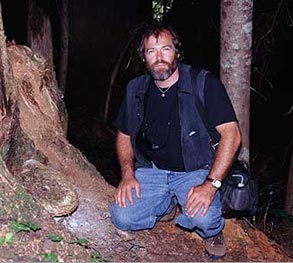

Once you’ve heard “renaissance mycologist” Paul Stamets talk about mushrooms, you’ll never look at the world — not to mention your backyard — in the same way again. The author of two seminal textbooks, “The Mushroom Cultivator” and “Growing Gourmet and Medicinal Mushrooms,” Stamets runs Fungi Perfecti, a family-owned gourmet and medicinal mushroom business in Shelton, Wash. His convictions about the expanding role that mushrooms will play in the development of earth-friendly technologies and medicines have led him to collect and clone more than 250 strains of wild mushrooms — which he stores in several on- and off-site gene libraries.
Until recently, claims Stamets, mushrooms were largely ignored by the mainstream medical and environmental establishment. Or, as he puts it, “they suffered from biological racism.” But Stamets is about to thrust these higher fungi into the 21st century. In collaboration with several public and private agencies, he is pioneering the use of “mycoremediation” and “mycofiltration” technologies. These involve the cultivation of mushrooms to clean up toxic waste sites, improve ecological and human health, and in a particularly timely bit of experimentation, break down chemical warfare agents possessed by Saddam Hussein.
“Fungi are the grand recyclers of the planet and the vanguard species in habitat restoration,” says Stamets, who predicts that bioremediation using fungi will soon be a billion-dollar industry. “If we just stay at the crest of the mycelial wave, it will take us into heretofore unknown territories that will be just magnificent in their implications.”
A former logger turned scanning-electron microscopist, Stamets is not your typical scientist — a role he obviously relishes. “Some people think I’m a mycological heretic, some people think I’m a mycological revolutionary, and some just think I’m crazy,” he says cheerfully. His discussions of mushroom form and function are sprinkled with wide-ranging — and provocative — mycological metaphors, among them his belief that “fungal intelligence” provides a framework for understanding everything from string theory in modern physics to the structure of the Internet.
In a recent interview, Stamets also spoke mysteriously of a yet-to-be-unveiled project he calls the “life box,” his plan for “regreening the planet” using fungi. “It’s totally fun, totally revolutionary. It’s going to put smiles on the faces of grandmothers and young children,” he says. “And it’s going to be the biggest story of the decade.”
Statements like those make it tempting to dismiss Stamets as either chock-full of hubris or somewhat deluded. But while many academic mycologists tend to question both his style and his methods, Stamets’ status as an innovative entrepreneur is hard to dispute. “Paul has a solid grounding in cultivation and has expanded from that base to show there are other ways of using and cultivating mushrooms than just for food,” says Gary Lincoff, author of “The Audubon Society Field Guide to North American Mushrooms.” “These are relatively new ideas … but Paul’s got a large spread where he can have experiments going on under his control. And he’s getting big-name people to back him.”
An advisor and consultant to the Program for Integrative Medicine at the University of Arizona Medical School and a 1998 recipient of the Collective Heritage Institute’s Bioneers Award, Stamets has made converts out of more than one researcher in the mainstream medical and environmental communities.
“He’s the most creative thinker I know,” says Dr. Donald Abrams, the assistant director of the AIDS program at San Francisco General Hospital and a professor of clinical medicine at the University of California at San Francisco. Abrams says he became interested in the medicinal properties of mushrooms after hearing one of Stamets’ lectures. Stamets is now a co-investigator on a grant proposal Abrams is authoring on the anti-HIV properties of oyster mushrooms.
Jack Word, former manager of the marine science lab at Battelle Laboratories in Sequim, Wash., calls Stamets “a visionary.” Stamets takes bigger, faster leaps than institutional science, acknowledges Word, who, along with Stamets and several other Battelle researchers, is an applicant on a pending mycoremediation patent. “But most of what Paul sees has eventually been accepted by outside groups. He definitely points us in the right direction.”
Although mycoremediation sounds “Brave New World”-ish, the concept behind it is decidedly low tech: think home composting, not genetic engineering. Most gardeners know that a host of microorganisms convert organic material such as rotting vegetables, decaying leaves and coffee grounds into the nutrient-rich soil required for plant growth. Fungi play a key role in this process. In fact, one of their primary roles in the ecosystem is decomposition. (Hence the killer-fungus scenario of many a science fiction novel, not to mention the moldy bread and bath tiles that are the bane of modern existence.)
The same principle is at work in mycoremediation. “We just have a more targeted approach,” says Stamets. “And choosing the species [of fungi] that are most effective is absolutely critical to the success of the project.”
Fungal decomposition is the job of the mycelium, a vast network of underground cells that permeate the soil. (The mushroom itself is the fruit of the mycelium.) Now recognized as the largest biological entities on the planet, with some individual mycelial mats covering more than 20,000 acres, these fungal masses secrete extra cellular enzymes and acids that break down lignin and cellulose, the two main building blocks of plant fiber, which are formed of long chains of carbon and hydrogen.
As it turns out, such chains are similar enough to the base structure of all petroleum products, pesticides, and herbicides so as to make it possible for fungi to break them down as well. A couple of years ago Stamets partnered with Battelle, a major player in the bioremediation industry, on an experiment conducted on a site owned by the Washington State Department of Transportation in Bellingham. Diesel oil had contaminated the site, which the mycoremediation team inoculated with strains of oyster mycelia that Stamets had collected from old-growth forests in the Pacific Northwest. Two other bioremediation teams, one using bacteria, the other using engineered bacteria, were also given sections of the contaminated soil to test.
Lo and behold. After four weeks, oyster mushrooms up to 12 inches in diameter had formed on the mycoremediated soil. After eight weeks, 95 percent of the hydrocarbons had broken down, and the soil was deemed nontoxic and suitable for use in WSDOT highway landscaping.
By contrast, neither of the bioremediated sites showed significant changes. “It’s only hearsay,” says Bill Hyde, Stamets’ patent attorney, “but the bacterial remediation folks were crying because the [mycoremediation] worked so fast.”
And that, says Stamets, was just the beginning of the end of the story. As the mushrooms rotted away, “fungus gnats” moved in to eat the spores. The gnats attracted other insects, which attracted birds, which brought in seeds.
Call it mycotopia.
“The fruit bodies become environmental plateaus for the attraction and succession of other biological communities,” Stamets says. “Ours was the only site that became an oasis of life, leading to ecological restoration. That story is probably repeated all over the planet.”
At Fungi Perfecti, a rural compound not far from Aberdeen, Wash., signs warn visitors not to enter without an appointment, and security cameras equipped with motion sensors guard several free-standing laboratories and a mushroom “grow” room. “My concerns are personal safety and commercial espionage,” says Stamets, explaining that competitors and mycological hangers-on (not always a stable lot, apparently) have a tendency to show up unannounced.
Then there’s the small problem of marketing a product associated in some people’s minds with illegal substances. In the late 1970s, Stamets did pioneering research at Evergreen State College on psilocybin hallucinogenic mushrooms; he later published a definitive identification guide: “Psilocybin Mushrooms of the World.”
“I drew the line a long time ago,” says Stamets. “But I’ll never be an apologist for that work. Everything I did was covered by a DEA license.”
Today, Stamets spends much of his time cloning wild mushrooms. One of his innovations has been identifying strains of mushrooms with the ability to decompose certain toxins and adapting them to new environments. With the benefit of computer clean-room technology, Stamets introduces samples of toxins to mycelia growing on agar culture, then screens the samples to see if the mycelia are actually metabolizing the toxin. You can actually train the mycelia to grow on different media, he says.
As reported in Jane’s Defence Weekly, one of Stamets’ strains was found to “completely and efficiently degrade” chemical surrogates of VX and sarin, the potent nerve gases Saddam Hussein loaded into his warheads.
“We have a fungal genome that is diverse and present in the old-growth forests,” says Stamets. “Hussein does not. If you look on the fungal genome as being soldier candidates protecting the U.S. as our host defense, not only for the ecosystem but for our population … we should be saving our old-growth forests as a matter of national defense.”
Stamets recently collaborated with WSDOT on another mycoremediation project designed to prevent erosion on decommissioned logging roads, which channel silt and pollutants toward stream beds where salmon are reproducing. In a process Stamets terms “mycofiltration,” bark and wood chips were placed onto road surfaces and inoculated with fungi. The mycelial networks not only helped to build and retain soil but also filtered out pollutants and sediments and thus mitigated negative impacts on the watershed.
Stamets envisions myriad uses of mycofiltration, one of which involves bridging the gap between ecological and human health. It’s been more than 70 years since Alexander Fleming discovered that the mold fungus penicillium was effective against bacteria. And yet, complains Stamets, nobody has paid much attention to the antiviral and antibiotic properties of mushrooms — partly because Americans, unlike Asian cultures, think mushrooms are meant to be eaten, not prescribed. But with the emergence of multiple antibiotic resistance in hospitals, says Stamets, “a new game is afoot. The cognoscenti of the pharmaceuticals are now actively, and some secretly, looking at mushrooms for novel medicines.”
Based on a recent study documenting the ability of a mushroom, Polyporus umbellatus, to completely inhibit the parasite that causes malaria, Stamets has come up with a mycofiltration approach to combating the disease. “We know that these fungi use other microorganisms as food sources,” he says. “We know they’re producing extracellular antibiotics that are effective against a pantheon of disease microorganisms. We can establish sheet composting using fungi that are specific against the malarial parasites. We can then go far in working with developing countries, in articulating mycelial mats specific to the disease vectors in which these things are being bred.”
Stamets is currently shopping this idea around to the Bill and Melinda Gates Foundation, a front-runner in the effort to provide vaccinations in developing nations.
Mycotechnology is part of a larger trend toward the use of living systems to solve environmental problems and restore ecosystems. One of the best-known examples is John Todd’s “Living Machine,” which uses estuary ecosystems powered by sunlight to purify wastewater. “The idea that a total community is more efficient against contaminants than a single Pac Man bug is gaining acceptance,” says Jack Word, now with MEC Analytical Systems, an environmental consulting firm. The key challenge facing mycotechnologies, he says, is securing funding to demonstrate their large-scale commercial feasibility.
Stamets is the Johnny Appleseed of mushrooms; he’s spreading the gospel about the power of fungi to benefit the world. Issuing a call to mycological arms, Stamets urges gardeners to inoculate their backyards with mycorrhizae, fungi that enter into beneficial relationships with plant roots, and to grow shiitake and other gourmet mushrooms, among the very best decomposers and builders of soil.
But Stamets’ vision doesn’t stop there. In the conference room at Fungi Perfecti, with a 2,000-year-old carved mushroom stone from Guatemala hovering, shamanlike, over him, he explains his far-reaching theory of mycelial structure.
“Life exists throughout the cosmos and is a consequence of matter in the universe,” he says. “Given that premise, when you look at the consequence of matter, and the simple premise of cellular reproduction, which forms a string, which forms a web, which then cross-hatches, what do you have? You have a neurological landscape that looks like mycelium. It’s no accident that brain neurons and astrocytes are similarly arranged. It’s no accident that the computer Internet is similarly arranged.”
“I believe the earth’s natural Internet is the mycelial network,” he says. “That is the way of nature. If there is any destruction of the neurological landscape, the mycelial network does not die; it’s able to adapt, recover and change. That’s the whole basis of the computer Internet. The whole design patterns something that has been reproduced through nature and has been evolutionarily successful over millions of years.”
The day after being interviewed in late October, Stamets called to point out a New York Times article on self-replicating universes, an article, he suggested, that reinforced his ideas about matter creating life and the generative power of mycelium. In describing the way universes might multiply, the reporter used the following felicitous metaphor: “For some cosmologists, that means universes sprouting from one another in an endless geometric progression, like mushrooms upon mushrooms upon mushrooms.”
Where is Stamets going with all this? “I have a strategy for creating ecological footprints on other planets,” he says. “By using a consortium of fungi and seeds and other microorganisms, you could actually seed other planets with little plops. You could actually start keystone species and go to creating vegetation on planets.”
“I think that’s totally doable.”
