
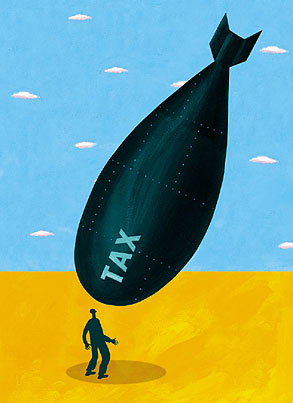

On Nov. 20, the editorial page of the Wall Street Journal began worrying that most Americans don’t pay enough in taxes. That was a shock — since the editorial page, a leading forum for conservative thought in America, has always led the charge to cut taxes. But in an editorial titled “The Non-Taxpaying Class,” editors agonized over the fact that the federal government gets most of its money from wealthy people. The top 5 percent of Americans — people who earn about $120,000 or more a year — “coughed up more than half” of tax revenue, the paper said, while poor people pay almost nothing. A worker who commands the kingly salary of $12,000 a year pays just 4 percent of his income in taxes. That tax burden, the editors conceded, “ain’t peanuts” — but it’s too small for that worker to feel any “rage” toward his wasteful government.
“Who are these lucky duckies?” the editors asked.
The editorial was widely ridiculed as an example of ideological stubbornness gone disastrously, hilariously overboard. “One of the things that has fascinated me about The Wall Street Journal editorial page is its occasional capacity to rise above the routine moral callousness of hack conservative punditry and attain a level of exquisite depravity normally reserved for villains in James Bond movies,” wrote Jonathan Chait in The New Republic.
Chait and countless others pointed out that the Journal’s argument was both factually wrong — it considered only the federal income tax, not all the taxes that poor and middle-class people pay, in particular hefty payroll taxes like Social Security — and culturally out of touch. Had the editors ever met a person of little means? Did they realize that being poor, while perhaps an attractive tax shelter, tended to come with such hard-to-bear downsides as not knowing where your next meal will come from?
You might think the chilly reception to the Journal’s tax-the-poor idea would have pushed conservatives away from the idea. But you’d be wrong. Last Monday, the Washington Post reported that the Treasury Department and the White House Council of Economic Advisers are looking for ways to show that the rich are overtaxed and the poor are undertaxed. Some liberal economists see these developments as the opening shots in a long-term effort by conservatives to get closer to what has long been a dream of theirs — the elimination of the current, slightly progressive federal tax system, and the institution of a flat tax.
A flat tax is one whose rate is the same across all income levels — people making $20,000 a year will pay the same percentage of their salaries or purchases (10 or 20 or 30 percent, say) as those making $200,000 or $2 million. It was a hot idea in the mid- to late 1990s, but none of the flat-tax proposals amounted to anything — they cost too much, or seemed too unfair, or both. But Republicans are trying once again to flatten taxes — only this time, they’re doing it a bit more quietly and much more slowly, laying a political and cultural groundwork instead of simply calling for the immediate scrapping of the tax code, as many did in the 1990s.
According to Grover Norquist, an influential conservative lobbyist and the president of Americans for Tax Reform, Republicans will soon attempt to pass some of the tax initiatives that his group considers key to the eventual establishment of a flat tax. The administration is likely to ask the new Congress for lower taxes on corporate dividends and business expenses, both of which, Norquist said, would have “pro-growth” effects.
Like many of the tax measures conservatives embrace, however, these new cuts will favor the wealthiest Americans. Indeed, that’s the political rub of flattening taxes: If you want to replace a progressive tax system — one in which wealthier people pay higher tax rates — with a flat tax and still maintain comparable government revenue, you can’t avoid cutting taxes for the rich and raising taxes on the middle class and the poor. Tax-policy conservatives say this is only fair: “No American worker should be punished by being taxed at a higher rate because they work hard, take a second job or work overtime or on Saturdays,” ATR says in a recent newsletter. “All income should be treated equally.” But is the majority of the public willing to give a tax break to the rich — with an increase, or no break, for themselves — just to be fair?
That doesn’t seem likely. And perhaps that explains the Wall Street Journal editorial and other conservative efforts to convince poor and middle-class Americans that they have good reason to pay more in taxes: They must do so to save our democracy. Republicans have long argued that the progressive tax system constrains overall economic performance; now they’re arguing that it also lets people feel OK about demanding government benefits, which to them is an unmitigated horror.
The idea that the poor aren’t taxed enough would seem politically indefensible, but some conservatives are coming up with a number of tortured explanations to support it — including the creative suggestion that the Social Security tax, the most burdensome tax on the poor, is not really a tax at all. (It’s a retirement program!)
Liberal economists, by contrast, say that the poor aren’t undertaxed at all; the rich pay such a high share of taxes, they maintain, because they are so much richer than (perhaps ever) before. But some economists worry that the administration could gain devotees for its tax-the-poor ideas, which would be a major boon to conservatives’ long-term flat-tax goals. “They’re trying out lots of different things,” says William Gale, an economist at the Brookings Institution. “But I think it would be a mistake to say they can’t possibly believe this. It’s a very well orchestrated campaign.”
During the past couple of decades, the wealthiest Americans have been paying an increasingly larger share of the federal income tax money collected by the government each year. The richest 1 percent — those earning about $290,000 and up — contribute 37 percent of the government’s total income-tax take. The wealthier half of Americans pay 96 percent of the income tax burden, while the poorest 50 percent contribute only about 4 percent. This arrangement may seem quite nice for the majority of the population, but many fiscal conservatives worry that it will lead the United States to big-government perdition.
“How can any free nation survive when a majority of its citizens, now dependent on government services, no longer have the incentive to restrain the growth of government?” Rep. Jim DeMint, R-S.C., asked at a lecture he gave to the Heritage Foundation in 2001. “Today, the majority of Americans can vote themselves more generous government benefits at little or no cost to themselves. As a result, most have little fiscal incentive to restrain the continued growth of Big Government and the entitlements it dangles before them.”
But is the rich’s share of the tax burden really significantly different from what it was in other periods? Not really. William Beach, a right-of-center economist at Heritage, points out that before the U.S. collected income taxes, most federal money came from property owners and others — like railroad operators — who used government services. “In that sense I guess you could say that government was paid for and supported by people who had the means to do so,” Beach says. Even after the income tax was instituted, in 1916, “it was focused on people who were wealthy and had high incomes. It was conceived as a tax that would fundamentally be paid by wealthy people.”
But everything changed in the 1930s and ’40s. “We moved to a totally different tax then. First the payroll tax, supporting Social Security — that was paid by middle- and lower-income people. Then in World War II, there were demands for revenue that were unprecedented in history. The middle class began to bear a large portion of the tax increase. And we had a change in philosophy that says there is a connection between what the government does and what the middle-class is willing to pay.”
This view held until the 1970s, when what Beach calls “the politics of tax” came into vogue; politicians realized that they could ratchet up the taxes on the rich and provide benefits to the middle class, a strategy that “disconnected an increasingly larger share of people from the tax system,” Beach says. Nobody wielded this tax-the-rich weapon more masterfully than Bill Clinton, who — to the delight of the vast number of Americans, and the frothing-at-the-mouth fury of many tax conservatives — in 1993 raised taxes on the rich, gave generous tax credits to the poor and, at the same time, ushered in a historic economic expansion.
Beach is not convinced that we are yet at a crisis point in the distribution of taxes. “I don’t know if it’s untenable,” he says. “And certainly there are countries that have not paid as much attention to this as we have. But I am concerned about the future. There should be a connection in our system between citizen benefits and what you pay. If you are disconnected, you may not realize that the benefits you’re demanding cannot be afforded.”
Beach’s position makes some sense; it’s logical to assume that if the rich keep paying more and more of the taxes, there’ll come a time when the poor and middle class might think nothing of voting themselves more and more federal money. But are we at or anywhere near that point yet? Liberal economists say we’re not.
When they talk about the tax burden on the wealthy, conservatives conveniently skip some facts. First, despite their tax burden, studies show that the rich aren’t doing so badly at all — indeed, they may be doing better than ever. And conservatives also like to discuss just the federal income tax while ignoring all the other federal taxes — especially the payroll tax — paid by the poor and middle class. When you factor in those taxes, it’s difficult to argue that the poor are very lucky duckies.
After the Washington Post reported that the administration was drawing up new models to prove that the rich pay too much of the tax burden, Joel Friedman and Isaac Shapiro, fellows at the Center on Budget and Policy Priorities, a think tank focusing on fiscal issues facing the poor and middle class, wrote up a quick report to explain why the rich pay as much as they do. The answer is rather obvious, but it’s one fiscal conservatives hardly ever mention: The rich are getting richer — and fast, too.
Friedman pointed to a landmark tax study published by the Congressional Budget Office in 2001. The study shows that between 1979 and 1997, the rich paid an increasing share of all taxes because their income “grew substantially faster than the income of other households.” The study says that the income of all Americans grew by about 30 percent during those years, “but that growth was highly unequal among quintiles.” (A quintile is one-fifth of the population.) “The average income of households in the highest quintile” — the top 20 percent — “was more than 50 percent higher in 1997 than in 1979, while that of the bottom fifth of households was nearly 4 percent lower,” the study says. (The rich, in fact, became even wealthier than the rest of us after Clinton raised their taxes.)
“They’re saying the burden on the top is too high,” says Friedman of the conservative position. “But they’re missing the fundamental reasons for that. The wealthy are taking a larger share of the income. Their incomes are higher.”
To make it seem as if the rich pay too much in taxes, conservatives often focus on the income tax, the most progressive of federal taxes. But “because of the regressivity of other federal taxes such as payroll and excise taxes … the overall federal tax system is only modestly progressive,” according to Citizens for Tax Justice, a public interest tax research group concerned with tax issues for the poor and middle class.
The payroll tax has long been a thorn in the side of people who say that the poor don’t pay enough in taxes, and one way they’ve responded to the argument that the poor are burdened by the tax is by ignoring it. But now they may trying a new, logic-straining approach — or at least Lawrence Lindsey, who in December was forced out of his job as chairman of the Bush administration’s National Economic Council, is doing so.
“I think the one question that has been left … is the question, ‘What is a tax?'” Lindsey asked Dec. 10, at a speech sponsored by the American Enterprise Institute. He went on to suggest that because you eventually get back what you invest in Social Security, “it is purely a private good” — and that the payroll tax is, therefore, not a tax at all but rather an investment.
None of the tax experts — from either the left or the right — contacted for this article agrees with Lindsey’s view that Social Security is not a tax. Bill Ahern, a spokesman for the Tax Foundation, a group that generally favors cutting taxes, says “the assertion that it’s not a tax is something we disagree with.” He noted that payments to Social Security are mandatory — one of the defining characteristics of a tax. Bob McIntyre, a liberal economist at Citizens for Tax Justice, said a similar thing: “Don’t count anything as a tax if you want. People still have to pay it.”
And William Gale, of Brookings, notes that when Lindsey was arguing, a year and a half ago, that we needed a tax cut because taxes were at a record high, he was counting Social Security as a tax then: “If payroll taxes are not a tax, then taxes as a share of GDP are at a post-World War II low, and therefore we should try to boost taxes to bring them up to historical levels. So the administration is being hypocritical if it counts payroll taxes when it wants to say taxes are high and then doesn’t when it wants to say taxes are low.”
After Lindsey gave his speech at the American Enterprise Institute, Sheldon Pollack, a professor of business law at the University of Delaware, took the podium. “I started off my talk by joking that I’ve been studying taxes for 20 years and I thought I knew what a tax was up until an hour ago,” he says. Pollack, author of a forthcoming book called “Refinancing America: The Republican Antitax Agenda,” is an expert on the Republican Party’s attempts to cut and flatten taxes, and he says, to Lindsey’s credit, that Lindsey’s comments on the status of Social Security were “very theoretical.”
Still, Pollack says that any real flat-tax plan will transfer the tax burden away from the rich and to the middle class and poor, and Lindsey’s speech was perhaps an attempt to make the case that it wouldn’t be so bad if the rich paid a little less. “There’s definitely a little bit of an ulterior motive there.”
But Pollack doesn’t expect Lindsey’s — or anyone else’s — arguments for a radical flattening of the tax system to convince enough of the public that lowering the tax burden for the rich, and raising it for everyone else, is the way to go.
He notes that some House Republicans could pass a few radical tax bills, as they have in the past. For example, in 1998, by a 219-209 vote, the House passed the Tax Code Termination Act, a bill that would have completely scrapped the federal income tax code by 2001. The bill did not specify any means of recovering the trillions that would have been lost in government revenue; it was, by any measure of civic duty, very reckless — yet after the House passed it, several members of the Senate expressed support for it. (President Clinton called it “irresponsible” and vowed to veto it.)
But it’s noteworthy that conservative groups aren’t calling for such a measure now, when they have a better chance to make it happen. Why? Pollack suggests that Republicans know that it’s pretty hard to run a government without any money, and the Bush administration, he says, “is not moving to cut back the size of government. A lot of things are funded by the income tax, including the military.”
In the end, the best way to look at the tax-the-poor rhetoric coming from some conservatives may be as pure political theater. How did conservatives manage to work toward the temporary repeal of the estate tax, a tax that most people had probably never even heard of a decade ago? They spent several years talking it down. They said it was hurting impoverished small farmers. They christened it the “death tax.” (Their discipline on this one thing is remarkable, and one that Democrats ought to try to match: How much could you change the world if everyone decided to call SUVs “death machines”?) And in time, even though it led to effectively higher taxes on the middle class, people in the middle class supported the estate-tax repeal.
So the flat-tax idea may seem easily dismissed now, but there’s real political craft to what conservatives are doing. They’re taking baby steps toward stripping most of the progressivity from the tax code, slowly passing initiatives that groups like Americans for Tax Reform say are key prerequisites for an eventual flat tax. But the campaign is not just political — it’s psychological too. Conservatives are slowly nudging the public to begin accepting a crazy thought: “Hey, aren’t I a lucky ducky? Shouldn’t I be paying more in taxes?” Editor’s Note: This article has been corrected since it first appeared.
