

When a well-known filmmaker who is nearly 70, and who possesses a distinctive style and singular sensibility, changes his way of making movies, it’s surely a sign of his faith in both the medium itself and his own creative powers, a sign that he possesses the confidence to make a sea change at the age when most directors are winding down their careers. Or, as in the case of Roman Polanski’s extraordinary new film “The Pianist,” it can herald the artistic essentialism that comes with age.
In “The Pianist,” Polanski is saying what he has long wanted to say, confronting the roots of his own preoccupations and obsessions, and he allows nothing to get in the way. It’s his most emotionally direct film, at times even a brutally blunt film. “The Pianist,” which was adapted by the playwright Ronald Harwood (“The Dresser”) from the memoirs of Wladyslaw Szpilman, a Polish-Jewish classical pianist who spent World War II on the run in Warsaw, offers a direct parallel to Polanski’s own experience as a Jewish boy hiding in the Krakow ghetto and then on the run through the Polish countryside (an experience his friend Jerzy Kosinski drew on in his novel “The Painted Bird”).
When we see Nazis ordering Jews to run through the streets as they gun them down, we can’t help but think of how laughing German soldiers used the young Polanski for target practice while the terrified boy dodged their bullets. Polanski is going to the source of the themes of victimization and violence that have run through his movies. Only this time, there is none of the sardonic ghoulishness that has characterized his work.
Like the dead-rotting face of Mrs. Bates subliminally imprinted on her son Norman at the end of “Psycho,” a death’s-head grin seemed to emerge on the very celluloid of pictures like “Rosemary’s Baby” and “Chinatown.” The black humor of those films (like Faye Dunaway’s character in “Chinatown” having a “flaw” in her eye, the same eye later shot out of her head) was without compassion. The grim hopelessness of Polanski’s humor was the coping strategy of someone whose life had twice been marked by pure evil. You could understand where it came from and still be repulsed by it.
There is no such distancing in “The Pianist.” Here Polanski is almost frighteningly open to the portrayal of inexplicable evil. At times I felt myself pulling away from the screen, as if Polanski were milking my response. When Nazis pick ghetto Jews out of a milling crowd and force them to dance, Polanski shows us a cripple on crutches falling to the ground. Polanski rubs our face in the obviousness of the cruelty, and it’s grating; that man seems doubly humiliated. And yet were Polanski to shrink from the worst it would seem inappropriately prim. He might almost be answering here for the grotesqueries his own films have relished.
Experience alone cannot trump art. But it can lend art an unimpeachable authority. And if anyone has a right to depict the horrors of the Warsaw ghetto, it’s Polanski. “The Pianist” took the Palme d’Or at this year’s Cannes Film Festival but almost immediately, the critical word coming out of Cannes was that it was Polanski’s most conventional movie, something like an old-fashioned well-made studio film of the ’40s. Is it the directness of the film that generated that response? Whatever the reason, classifying “The Pianist” as conventional doesn’t take into account how the film proceeds from the unblinking depiction of Nazi atrocities into territory which is artistically very risky, and how Polanski complicates the righteous anger the film stirs up in us. I think Polanski is attempting to put us in the shoes of Wladyslaw Szpilman (Adrien Brody) by making the events of the movie so direct and overwhelming that they cannot be easily sorted out. He makes us feel but does not always tell us how or even what to feel.
Early on we see Wladyslaw’s father (Frank Finlay) viciously slapped by a Nazi for failing to bow to him on the street, as Warsaw residents pass by the injured old man, paying him no notice. Is it an acceptance of the Nazis’ anti-Semitism or simple self-preservation, the Poles’ knowledge of what would happen to them if they attempted to intervene? Shortly after that, we see ghetto Jews attempting to carry on their everyday business while the corpses of those who have died of starvation litter the streets. It’s impossible to resolve your feelings about those scenes — are we watching callousness or some sort of subtly heroic defiance, a determination that life, even this stunted life, should continue? Polanski complicates things even further by showing us that determination to survive taken to its most logical and horrible conclusion: the Jewish policemen who, to ensure their own survival, worked for the Nazis keeping order in the ghetto.
On the surface, the first half of “The Pianist” follows a familiar course. Wladyslaw’s middle-class family, his parents, two sisters and brother, are moved from their spacious apartment to a cramped one in the newly barricaded Warsaw ghetto, and then to workers’ barracks, and then to the trains that will take them to the camps. It’s a gripping, assured piece of filmmaking, though perhaps the fact that we have all seen and read stories like this, in films about the Holocaust and in memoirs of the time, keeps us from grasping just how distinctive it is.
The film has the simultaneous feel of being observed as it happens and of springing from a complete vision. We all know about the horrors the European Jews faced. But no movie has ever presented them in quite this way. Again and again in “The Pianist,” the Szpilman family glimpses those horrors from a removed vantage point; for example, from their darkened apartment as Nazis raid a Jewish building across the street. And later, Wladyslaw watches the Warsaw ghetto uprising from the high windows of apartments where he is hiding. I think Polanski uses this motif, watching murder and death from a window, to convey the derangement of everyday life under the Nazis. “The Pianist” is very much about how notions like the familiarity and safe haven of home became an alien concept in wartime.
Polanski is also robbing those of us watching the film of our notion of a safe haven. As he did in 1995’s “Death and the Maiden,” his best film previous to “The Pianist,” Polanski is addressing the inadequacy of culture in the face of the unthinkable. That film, with its Latin American doctor turned rapist and torturer, a man who liked to listen to Schubert while he worked, was an attempt to get at how, while pretending to deal with the most horrible events of recent history, culture can actually smooth them over, make them seem safe, contain them and reduce them within the confines of “art.” Polanski knows that no book or painting or movie can make mass murder explicable. The passionate messiness and rage of “Death and the Maiden” was a way of saying that art can never be equal to the kind of experience the tortured heroine underwent or, by extension, the experience Polanski suffered as a child or that young Wladyslaw Szpilman suffered in the Warsaw ghetto.
You sense that theme being picked up in the rawness that marks the first half of “The Pianist,” in Polanski’s refusal to deflect the impact of the senseless shootings and beatings by aestheticizing them. And yet, because he is an artist, Polanski can’t help making art of Szpilman’s experience, can’t help trying to be true to both his own artistry and his experience — though it’s not the kind of art any of us might have expected in a film about the Holocaust.
Nothing in the first half of “The Pianist” prepares you for the audacity of what comes after Wladyslaw, having been spared the death camps, lives as a worker in the ghetto before escaping and, with the help of various members of the underground resistance, hiding in a series of unoccupied apartments. Until this time, Wladyslaw has seemed an almost remote character, really only alive when he’s behind the keyboard. There’s a heartbreaking moment when Wladyslaw, in one of his hideouts, holds his hands inches above a keyboard and goes through the motions of playing. Striking the keys themselves would be to risk discovery. Stripped of the possibility of playing, Wladyslaw is, in a sense, stripped of his identity. Brody’s performance is astonishing in the way it actually keeps us distanced from Wladyslaw when he is most secure, most “whole” — we come to feel closest to him when he’s reduced to the impulse to survive.
I can’t imagine what Brody put himself through physically for this film. His hair and beard give him the look of a derelict, and his weight loss makes him seem one of the walking corpses of that time. It’s a largely wordless, almost completely interior performance, a compendium of eloquent silences and a bottomless humanity. We watch Brody as Wladyslaw scrounges crumbs and shelter, as he carries around a can of pickles in hopes of finding a can opener, as all concept of time vanishes except the few minutes to come.
In the last hour of the film, Polanski and Brody come close to making a great silent comedy about the Holocaust. That’s not to say that what we see is funny, but Brody’s huge, somber eyes and rail-thin frame call to mind Buster Keaton making his way stoically through one disaster after another. Polanski seems to be channeling the sadness at the heart of film comedy, especially Keaton’s films. When Wladyslaw vaults a wall to escape some German soldiers and begins running away, the camera pulls up to take in the vast, overpowering landscape of the destroyed Warsaw.
After a few breathless strides, Wladyslaw stops dead in his tracks, stunned into stillness by what he sees, stung by the black joke of their being nowhere to escape to, of what survival means when it looks as if there is no life anywhere. In that moment, he’s a bit like Keaton wandering through a hurricane in “Steamboat Bill, Jr.,” alone in the universe, just skirting calamity by luck or invention. When a German officer comes upon Wladyslaw in hiding and asks him what he is doing, and Wladyslaw, proffering his precious pickles, answers, “I was just trying to open this can,” we seem to have traveled from Keaton to Samuel Beckett. It’s the summation of the black humor that runs through the film, a definition of a sorrowful, existential state that can conceive of no future beyond the next task. Brody’s reading of that line can make you laugh as tears are running down your face. (In moments like this, Polanski’s film can be seen as a rebuke to the cretinous sentimentality of Roberto Benigni’s “Life Is Beautiful.”)
Until Thomas Kretschmann enters the film as that officer (his part is small, but his performance is vivid and crucial to the movie), every actor who plays a Nazi is atrocious. They seem to be digging into the worst clichés of Nazis as leering, piggy sadists. I think the badness, the clichéd portrayal of evil, is intentional on Polanski’s part. It sets us up for the curve that Kretschmann’s appearance throws us and, after the rage that has built in us as we have watched the Nazi brutalization of the Jews, prevents us from going home with our hatred. What Polanski is doing here could, in lesser hands, have easily turned the film into a soggy brotherhood speech. For Polanski, it is simply an acknowledgment of the moral complications of wartime.
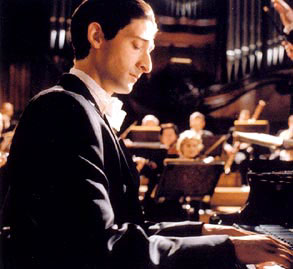
If anyone has the authority to speak about the scars that violence can leave on life, it’s Roman Polanski. Maybe his desire here to get something of his own experience down on film has made him ask what is really important to him. He seems to have concluded that survival must have a meaning beyond hatred and nihilism and hopelessness. And in the closing scene of Wladyslaw playing with an orchestra after the war (the piece he performs is Chopin’s Grand Polonaise for piano and orchestra, the same piece we see him silently practicing while in hiding), Polanski reverses the end of “Death and the Maiden,” with its insistence that the niceties of culture are irrelevant in the face of the unthinkable.
Instead, the director seems to be saying that, for survivors, art may be a way back to our finer selves, the selves that have no place when life is reduced to the imperative to survive. In the liner notes to the CD of his Carnegie Hall debut, the Russian pianist Mikhail Pletnev writes, “I want to make music sound so strong, make it visibly significant and appealing to the most essential basic feelings of every human individual.” In “The Pianist,” that’s what Roman Polanski has done.
