
Race

Another shade of black

John McWhorter talks about the pitfalls of reparations and affirmative action, why Eminem will never be hip-hop's Elvis, and why the N-word doesn't bother him much.

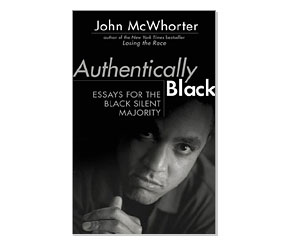
In the preface to his new collection of essays, “Authentically Black,” John McWhorter clears up a few things about his previous book, “Losing the Race.” First off, it is not a book about education, McWhorter, a professor of linguistics, insists, but an exploration of how certain aspects of race get played out in America and particularly, because he works in education, how they get played out in schools. “If I happened to be a criminologist, I would have written a similar book drawing from sentencing issues and racial profiling,” he writes. “If I were a businessman I would have concentrated on the corporate world, small business development and affirmative action in hiring and contracting.”

All of this is to say that McWhorter, also a senior fellow at the conservative Manhattan Institute, is much more concerned about murkier, more seemingly trivial but larger and, he maintains, more quietly destructive problems, ranging from blacks’ melodramatic reactions to the word “nigger” to the combative countercultural gestures of hip-hop artists. The combined effect of the past 35 years of post-civil-rights healing, McWhorter says, has led to a cult of victimhood and an invasion of black outsider iconography in all areas of black life. In “Authentically Black,” whether he’s writing about the reparations movement or blacks on TV, the same theme keeps popping up: Most black people act like victims in front of white people because they believe that keeping whites “on the hook” is the right thing for thinking African-Americans to do. Behind closed doors, however, black Americans feel very differently.

Beyond mere annoyances, how does this double-sided racial ideology deal with real issues — like legislation? “Authentically Black” argues convincingly that black Americans have a conflicted self-image; where that conflict comes from is harder to pinpoint. McWhorter spoke to Salon about affirmative action, the Republican response to Trent Lott’s embarrassing remarks, the political potential of hip-hop, and whether Eminem is really the next Elvis.

Do you think that Trent Lott represents a large portion of Americans in the sense that they are still stuck in the segregated past? Or do you think he’s an aberration?

Well, I think that whole thing was misinterpreted.

You do? How so?

I felt that he needed to step down as majority leader and I wrote an Op-Ed about that for the Wall Street Journal. But what Trent Lott said did not mean that he thinks the United States should go back to the days of segregation. He would have to be brain-dead to sit there and say that in 2002.

What he said did indicate, however, that he thinks that the civil rights revolution is just not a big deal. If you can make a joke about how Strom Thurmond should have been president, it means that you just don’t think that the race thing was a big deal. That’s bad enough that you should not be the majority leader of the Republicans when they’re in control of both houses and the White House.

But as far as Lott being racist? Maybe he is, maybe he isn’t. On a spiritual level, I really don’t care. The fact that some man with a toupee from Mississippi doesn’t like black people doesn’t hurt me. A lot of African-Americans ought to think about that when they talk about how something like that hurts them. Why would I care if Trent Lott — this person who I don’t know, don’t care about, don’t like — likes black people or not? But a person who thinks that the civil rights revolution was just kind of a footnote — which is clearly what he thinks — should not be in a position of power. What he meant was that he likes Strom Thurmond’s other planks, and as far as the fact that he was a racist, well, that didn’t matter a whole lot.

You’re making a distinction between racism and not putting a priority on desegregation? Is there significant difference?

For me, there’s a difference between how highly you rate black people and whether or not you’re a racist. Now, what various senators and representatives say behind closed doors — who knows? As far as I’m concerned, as long as it doesn’t affect legislation, who cares? — although priorities can matter as well.

Racism is not dead. Definitely, there are these biases. I don’t vote Republican either, but the idea that Republicans’ practices over the last 20 years have been racist — to be honest, it’s good for an Op-Ed, but it’s not accurate.

For example, Bob Jones University disagrees with interracial dating. Interracial dating is not the biggest thing on their agenda. Say you go and you talk to them because you’re a fellow conservative. Interracial dating doesn’t matter much to you because you’re white and your children are white. You are not so appalled by their racism that you won’t go and speak to them. That doesn’t mean that you’re a racist. It means that [race] is not very high on your agenda. I’m not pardoning this, but to say that the Republicans hate black people — it’s just Op-Ed material. What it really means is that Republicans don’t think the issue is all that important.

So why did the Republicans, and Bush, ask Lott to step down? It seemed to be a fairly strong consensus. Is it all cynical — was morality not involved here at all? Was it just fear?

Of course. They don’t want to be seen as racist because that detracts votes from them, especially those of female, middle-class votes apparently. It’s not that Republicans are so in love with black people that they were bleeding about what Lott said. But they think of black people as a potential source for untapped votes, and Lott was standing in the way of that. As far as I’m concerned, and this is a big theme of mine, I’m not interested in white people loving me. It’s an unrealistic expectation. Black people don’t love anybody but themselves.

Derrick Bell has this thought experiment where, if I’m not mistaken, all the black people are taken out of America by aliens and nobody knows where they are. The issue of the story is, How much would white people really care? Who would want to investigate? That’s seen as evidence that racism exists in America. As soon as I heard that story, I thought, OK, so we’re in America and instead of black people, all Filipinos are taken out of the United States. How many black people would care? None. Frankly, it wouldn’t really change my day. I don’t know any Filipino people. You have a love of your own. We can’t say that white people should be exempt from that because of the nature of the past.

No, but the past is always hanging over us. It seemed from the way the media reacted to the Lott scandal, digging through his past and showing photos from his fraternity, that this was a history lesson. There was this sense that Americans aren’t all that educated about who their leaders are.

We live in a transitional era. Just a few decades ago, we lived in a segregated society. It would be strange if there were not closet racists in our governing bodies. There are people in our governing bodies who are white and 50 or 60. Why in the world would some of them not be closet racists? It’s 2003. It really hasn’t been that long. So, it was nice that we were made aware of it. My issue is whether those things affect legislation, and to the extent that they can  Trent Lott as a leader, he has to go.

But the fact is that despite the racist history, the conventional wisdom is changing, and even if it just means you can’t say certain things in public, that is progress. The fact is that even in terms of private feelings, the feelings of most of the people representing our government today are different than they would have been 40 years ago. We’re not all the way there, but we’re close.

Don’t you think that the residual sentiments could be affecting legislation in ways that we’re not totally aware of? Or vaguely aware of? I just can’t believe that residual sentiments don’t play a huge factor in how these people decide to run the country.

I don’t think so. The only way that residual racist feelings could affect legislation, in my opinion, is through a lack of priorities, from not doing things. Perhaps you could argue that that’s already the case. Although it’s also true that I’m sure very few people today in any position know exactly what should be done for black people. It’s not easy. It’s not a matter of we just need more money, or we need more childcare.

You cannot be a Democrat politician and not do things along the civil rights line. So I’m not that scared. And more to the point, even if I was, what would you do? A lot of people like to strike this melodramatic note that the government isn’t doing anything for black people. They typically think that what we need is a Marshall Plan where billions of dollars are dumped into Detroit and North Philadelphia and the South Bronx. But that wouldn’t help. It’s not about money today. There’s a much deeper and more complicated problem. The typical people — Derrick Bell, Al Sharpton, bell hooks — all those people, they don’t know what needs to be done. I can’t say that I have the magical answer either. The Congressional Black Caucus doesn’t even know what needs to be done. What have they proposed? Reparations, that’s about it, and what would they do with the money?

Politicians have brought up unemployment insurance, affirmative action, as ways to heal after the Lott scandal. Some good might have come out of this, don’t you think?

There’s some of that, but the problem is that a lot of what’s considered to help black people doesn’t. For example, affirmative action. If what comes out of this is that the White House decides to nudge the Supreme Court into agreeing with the University of Michigan, they’re supporting a policy where black people of any circumstances are allowed into top universities with lower grades and test scores than other people. That’s what affirmative action is. We say “affirmative action” and we get kind of rosy inside, but it’s a euphemism for lowering standards for people with pigment.

But you do believe in affirmative action in the workplace.

I believe in it wherever there is true discrimination. Affirmative action where there is a handicap. For example, I still agree with it in terms of class, whatever color you are. When I talk about business, I mean things like, you’re trying to be a law partner. You’re a black woman. You, as a black woman in 2003, don’t hang out with your white male partners. You don’t click with them. You don’t, because you’re black. You have a different thing — you go to church on Sunday, you don’t have the same jokes, you don’t eat the same food. When it’s time to pick somebody as partner, a lot of it is social. It’s who you drank with last night. It’s not going to be that black woman down the hall. There can be affirmative action there because it’s not her fault.

Or if you grew up in a trailer park, how good are your SATs going to be? How good are your grades going to be? Affirmative action there is fine. Whether you are Eminem in “8 Mile” or somebody in “Boyz in the Hood” — it’s race neutral. But if you are Theo on “The Cosby Show,” you don’t deserve affirmative action. If Theo doesn’t make good grades, it’s because he’s not a very good student, not because he’s black. Affirmative action as we understand it needs to go — racial preferences is what it is. That was acute 30 years ago, when so many black people were poor that it made a certain sense. But today it’s obsolete. It’s immoral.

For example, at Berkeley every third student is Asian. They’re everywhere. There’s clearly something that Asian students are doing above and beyond what anyone else is doing. They’re obsessed with doing well and they show you what is required to hit the highest notes. Doing that requires incentive. Unfortunately, it also applies to black people, with all of our history and all of our struggle. Asian students have learned what it takes to do well — you can’t sleep, you can’t date. They practically overdo it. There’s no reason for that in the black community, because if you do pretty darn well, you’ll get into a school above and beyond what Suzie Wong could possibly get into. People wonder why middle-class black students still have these low grades and scores. There’s no reason to wonder. Part of it is that there’s an element in black culture that is a legacy of racism, and another part of it is that there’s no reason for that to go away, because everywhere a black person turns, they’re given a pass. That has to stop.

I struggle with these comparisons between groups. Isn’t it much more complicated? The history of blacks and the history of American immigrant groups — it’s so different. And each group is so different.

No, and I don’t mean to cut you off, but I hear that question so much. Latinos are immigrants too. They have the same problems as black people, right down the generations, right into the middle class. What that shows is that it’s not about whether you’re an immigrant. It’s cultural. There are people who for various geopolitical reasons identify doing well in school as inauthentic. In black culture, if you do that you’re acting white. In Latino culture, you’re acting like the gringos. It’s not unfair to compare. Yes, there is such thing as immigrant pluck, but it doesn’t even apply to all of the immigrants. With Latinos as well as black people, there’s a sense that to be white is to be uptight and to sell out. Not to mention that black people didn’t suffer from this until about 35 years ago. There was no such thing as the “acting white” syndrome in 1910. It’s a new thing.

You refer to the “civil rights miracle” in your book, and then you talk a lot about the last 35 years as this great disappointment. Where do you think it went wrong?

It’s a problem. If there were no civil rights miracle, I would not exist. But on the other hand — God, the whole country really went to shit in [the 1960s.] What happened — it wasn’t a black thing, it was a general thing — was that the white left realized that there’s such a thing as structural poverty and that the American system is not as gee-whiz wonderful as intelligent people often assumed. Then, of course, there’s Vietnam, which is a hideous mistake in the face of everybody day after day. Watergate comes soon after. As a result, it became common among thinking white people to suppose that reacting against the system was an authentic, vivid, lively thing to do.

That percolates down into the black power movement. So there’s the Civil Rights Act and black people are freed. At that time, you have this new idea that reacting against the system and crying victim is an intelligent thing to do. You’re enlightened if you do that. Black people were vulnerable. We have a self-image problem even today.

There’s also the drama of it. Every third person in the world is a drama queen. And crying victim, especially when you’re not really a victim in any real way, feels good. It feels good to cry victim if you’re not one. So as a result, black people bit this hook, line and sinker, and we’re stuck in it.

So you don’t believe that blacks have been victims.

Oh, yeah, we have.

Isn’t there just a period that people — any and all people — have to come to terms with the fact that they have been victims in order to move on?

No. You say that, and I know exactly what you mean because we’re people of our time. It wasn’t like that before, though. The idea that we need to air it and need to talk about it and exaggerate it and theatricalize our victimhood — that’s new. That’s something that wouldn’t have made sense to even a smart American in 1950. We’ve made a mistake with it and we’ve ended up distracting a lot of young people. Yes, there’s victimhood and I know my racism. I suffer it now and then. But the issue is, how important are those things at the end of the day? Frankly, if it doesn’t keep you from getting a job, if it doesn’t hurt your daughter, if it doesn’t hurt you — who cares? If you’re a strong people, if black is beautiful, if black people have survived, and somebody calls you “nigger,” move on.

You write about the one instance where you were called a nigger. Can you talk about that?

The one time anyone’s ever called me nigger — I can’t believe that anyone would look at a story like this and think that it hurt them — involved a guy who lived in an apartment near mine. A low-rent apartment complex just after I was a graduate student. He was fighting with his girlfriend at around two or three in the morning. Loud. I came out of my apartment and asked him to quiet down. He was a drunk and we got into an argument and it ended with him turning around and saying, “Just a fucking nigger anyway.” And I shut the door.

I know that I’m supposed to have shut the door and felt tears rolling hotly down my cheeks and thrown myself onto the couch and cried and called a friend. No. To be graphic, he was what we would call formally a working-class gentleman. Informally, he was a cracker. He was white trash. He had baggy, dirty blue jeans hanging off of his flat old butt. He wasn’t somebody who I looked up to in any way. And we have an argument. I’m pretty good at arguing and what he ends up with is to call up that word. Frankly, I don’t think he was a racist, because before that when he was sober we always had gotten along very well. I don’t think he was burning crosses on anyone’s lawn. That was his way of having something to say because I’m more articulate than him. And higher in life.

So what is a racist then?

A racist is someone who hates black people because they are black and/or acts against the welfare of black people. That person today is increasingly rare. More to the point, as often as not that person can’t have any effect on your life. So what’s the big deal? I know that sounds naive, but if you have a basic ego, how much can that matter? We’re taught to fall to pieces whenever there’s a “racist.” Why?

Well, that brings me to the next question: Do you really think that most black people do fall to pieces? Who and what are you talking about?

No, and that’s one of the major themes of “Authentically Black.” There is a split identity in black culture today, and I see this daily. There’s what you’re expected to do in public, and there’s what you’re expected to do in private. The black undergraduate who hears a professor use the word “niggardly” or hears something an administrator says that could be construed as “racist” and runs out of the classroom crying, I firmly believe, is not genuinely hurt. They have a sense that as good, thinking African-Americans it’s their job to blow the whistle on racism in public. It’s the same kind of theater that your counterculturally oriented white undergraduates pull.

So somebody says “nigger” or somebody draws a picture in some dorm, and a certain 25 black students jump out onto the central plaza and the local media comes and you’ve always got one or two of them who will cry. They’re not cynical; it’s not that they’re doing it on purpose, but they have a sense that to be intelligent, engaged black people you’re supposed to pull this kind of routine. Deep down, most black people know that some of these things will not destroy you, that you can succeed in a world even if it’s not perfect. That is the biggest problem today — the sense that to be authentically black is to cloak the black race in victimhood in public, no matter how well the race is doing. The idea is to keep whites on the hook. In private, this is not the way that black people talk.

The sadder truth is that for many white people, black people are a minority with a sad history, and they’d rather be rid of us completely. The very sad truth is that white people are much more important to black mythology than the other way around. That’s not fair, but like many things that aren’t fair, it’s also true.

Might that be changing considering how much black culture has influenced white culture? What I find hard to believe is that whites aren’t conscious in some ways of how they emulate black people.

Interesting question. Many black people are afraid that we’re being co-opted. What they don’t understand is how black white people are getting. And it’s something that’s easy to miss; fish don’t know that they’re wet. But it’s at the point where hybridism is becoming very much the norm. Most people don’t think about the fact that the way Britney Spears sings and moves is black.

It’s not only in entertainment. You see it in the way people talk. A lot of “ebonics” is now ordinary speech. I don’t know how many white girls I’ve seen calling each other “dude.” “Dude” starts with black people and it percolates into white vernacular among men. Now white women are saying, “Dude, let’s go get our nails done.” It’s a black thing. If you look at a silent film, at white people moving in 1903, they don’t walk like white people now, they don’t nod like white people. All of us are blacker. So what we’re really moving towards is a Mariah Carey, Tiger Woods sort of thing. Nowadays, black people do matter more to white people, but in a good way, because black people are in white people and they don’t even know it, which is the way it should be.

Which is the way it should be?

Yeah, because we’re moving towards getting past race. Al Sharpton wouldn’t like that, but we’re going to get past it. Getting past it does not mean these communities of wary blacks and wary whites eyeing each other and writing Op-Eds about each other.

Do they feel that way about hip-hop? It’s mostly black controlled.

Hip-hop is interesting. It’s almost as if people are waiting for it to be co-opted. But the thing is that there is no hip-hop Elvis and there’s not going to be one. There is Eminem, but nobody would claim that he is taking the lion’s share. There is nobody who thinks of Eminem as the quintessence of hip-hop.

But people have compared him to Elvis. Well, he compares himself to Elvis, anyway.

In that way that he is a white hip-hopper. But he is not taking over the field. He is not making more money than any other number of hip-hoppers. He is just one of the many. And he’s doing fine. But he’s not taking over in the way that Elvis did. Elvis made it and all of a sudden he’s making more money than Chubby Checker and Sam Cooke and all the others combined. Eminem’s not doing that, he’s not going to, nor will any white hip-hopper do it. Things have changed. The white kids in the suburbs are not listening only to Eminem. There’s no sense that they like Eminem better than the black ones.

I wanted to talk about leaders a little bit more. You direct a lot of your criticism at black leaders — Jesse Jackson and Al Sharpton. I’m wondering what you think of the young leaders, and while we’re talking about hip-hop, what’s being called the hip-hop political movement.

It makes me feel old. I’m 37. This whole hip-hop culture idea is an outgrowth of a general “bobos in paradise” idea — to be countercultural and to hate the establishment. I don’t love the establishment either, but this hip-hop thing is professional alienation, a recreational indignation. The idea that black identity can be centered on that, especially among the young, strikes me as a pose rather than an action. It feels good to be an underdog and that’s what that’s about. You put your cap on backwards, you think somebody set up Sept. 11 on purpose 

But I see Russell Simmons, who seems to be leading this movement, as very much a part of the establishment.

That’s the thing. Simmons will fund all of this music that’s preaching black alienation and he’s one of the richest people in the world. More to the point, the idea that the main face of black people for the country should be alienation and poverty is inaccurate. It’s the way that a segment of the population lives and we need to do something about that. But the idea that that’s the blackest thing that people need to pay the most attention to  again, it’s a pose. It feels good to play the underdog.

But when I first heard about this movement and that Simmons was spearheading it, my thought was that it was pragmatic. You want to get a lot of young people of all colors involved and to tap into such a large audience. He has so much money and power, and it’s a way to get people interested in politics.

And the question is: What politics? To get people to vote? For what? Is the idea to get people to vote for reparations? To get people to vote for expanding welfare benefits again? It’s so unclear to so many people today what black people need. It seems like a hip, get-out-the-vote movement. My god, vote for what? Do you feel that affirmative action needs to be restored? I disagree. It seems to me that that’s the sort of thing that Russell Simmons and his voters would push for.

Well, they are talking about things like racial profiling and incarceration.

That’s true.

It’s possible that they — and hip-hop — could bring college-age people together in a way that nothing else can. I’m not wild about Russell Simmons being the head of this, either. But I have been heartened by some aspects of it, if only because there is no young political movement out there.

Not today, no. And racial profiling is important. Some of this for me is just visceral. You have a guy, and I don’t care what color he is, his pants are baggy, he’s standing in front of a camera, and he’s throwing his hands and palms out in that hip-hop gesture. The rhythm is going and he’s bouncing his arms around and hurling his palms at the camera. Anyone who’s doing that — their main message is “Fuck the establishment, I am oppressed, and isn’t that wonderful?” Any vote movement based on that sentiment strikes me as one that’s going to keep running into walls. It’s not instructive, it’s melodramatic. The point is that whole iconography is not based on engagement with our society.

Suzy Hansen, a former editor at Salon, is an editor at the New York Observer.

Whitewashing, a history

From "Tiffany's" to "Khan," we look at Hollywood's illustrious tradition of casting white actors in non-white roles SLIDE SHOW

View the slide show

The extraordinary box office success of "The Hunger Games" has launched a heated discussion of Hollywood's peculiar habit of casting white actors in nonwhite roles. Why does this happen? We decided to turn to a very important studio chief for answers -- channeled here by comedian (and "Daily Show" correspondent) Aasif Mandvi.

All I have to say is that whitewashing has been going on since as long as Hollywood has existed — it’s a tradition — and rather than non-white people complaining about it, they should embrace it. It will make going to the movies so much easier and more fun. But there are just a few things you need to understand.

First, stop watching movies as ethnic people and start watching them as white people. There’s nothing that white people like more than seeing other white people in movies and on television. When you go to the movies with your ethnic “judgment” eyes, you miss my point. Watch as a white person, and suddenly your outrage turns to understanding and laughter.

Take a minute to walk to your limousine in my Gucci shoes, and you’ll realize that I’m just trying to make people smile. Mickey Rooney with buckteeth and a crazy accent in “Breakfast at Tiffany’s”? It’s so much funnier than finding a real Chinese actor just talking like himself. Then you’d have to get a screenwriter to actually write genuinely funny lines for that character. You get so much more comedy bang with buckteeth and a funny accent. I mean, it made me laugh. Many people, including myself, were also convinced that Charlton Heston truly was a Mexican/Native American/Egyptian/Ape who talked to God. And I think I convinced a lot of Asians that Genghis Khan really did look like John Wayne back in the ’60s. “Short Circuit” was one of my biggest hit movies and I was completely convinced that Fisher Stevens was Indian. Who knew he was a Jewish guy from New York? That accent was spot on!

My point is, I’m not the bad guy. I’m just the rich guy. When you look at it through my studio executive lens, you understand how important it is that both white people and non-white people believe that Indians, Asians, Mexicans and Arabs are truly just white people in brown makeup. I don’t like thinking that way. I just don’t have the luxury not to. I’m a businessman. White people spend more money on shit than anyone else. (Except on fast food, which is mostly blacks and Mexicans … at least that’s what I have heard. I’m a vegan.) So hey, non-Caucasians, stop buying tacos and start buying Cadillacs.

White people are also cheaper to light than dark-skinned people, and just so you know, you the moviegoer end up paying for that extra cost. Sometimes it’s just too unbelievable to cast an ethnic actor. I turned away a lovely Indian actress once who auditioned for the role of a hobbit. I mean there are no Indian hobbits. Audiences would never believe that.

Now, look: I am trying to do the right thing. America has changed and Hollywood should attempt to portray a truer depiction of the ethnic diversity that makes up this country. The fact that many television shows now hire a certain percentage of non-white actors is a step in the right direction, right? I am even prepared to make a deal with you ethnic people out there. Every time you let me cast a non-Caucasian character with a Caucasian actor, I will give you two or three non-white actors in smaller supporting roles. Why not lead roles? Because I’m trying to make a living here. I have spent a lot of time and money throughout history convincing everyone that white is normal. I have even convinced non-white people that white is better, prettier, smarter, stronger, and that only white people can truly be the heroes. Everyone has bought into it, and now you want me to just abandon all my hard work? OK, I will make an exception for some of you non-whites: If you are a hot Latina, you can be the lead. Why? Because white guys want to fuck Jennifer Lopez.

Here are a few more key elements to remember when watching a movie the way white people have been programmed to react. Laugh at the funny accents, because they are funny. Ignore the source material; I’m making movies, I don’t give a shit about staying true to your comic books. And … hold on! Why the fuck is Idris Elba playing a Norse God!?

To view a slide show of Hollywood’s egregious moments in white-washing, click on the link below — and share your own most memorable moments in the comments. (Slide show by Max Rivlin-Nadler)

View the slide show

Continue Reading Close

Aasif Mandvi is an actor and writer who appears as a correspondent on "The Daily Show with Jon Stewart." He also co wrote and stars in the film "Today's Special" and will be appearing this summer in the films "Premium Rush" and "Ruby Sparks."

Black politics, reinvented

Across the country, polished African-American outsiders are upsetting the political machine. An expert explains how

Cory Booker (Credit: AP/Julio Cortez)

Cory Booker’s failed 2002 campaign for mayor of Newark heralded a new type of black politician. Booker was an outsider with Ivy-league credentials who was trying to unseat a veteran urban politician who had made a name for himself during the civil rights movement. Like other “new black politicians,” Booker’s appeal granted him entry to the political world and helped him circumvent long-standing black democratic machines. But what does this process, which has been repeated everywhere from Washington to Alabama, tell us about our country’s changing attitude towards race — and politics?

In her new book, “The New Black Politician,” Andra Gillespie follows the career of Cory Booker, from his start as a lawyer and community organizer through his successful run for mayor and his reelection, in order to illustrate what separates the new generation of black politicians from other black leaders before them. These new black politicians seek to create the same multicultural coalition that propelled Barack Obama to the presidency, but many lose their black support and fade from the political scene.

Salon spoke with Gillespie about racial electability, Cory Booker’s senate prospects, and what black politicians have in common with Will Smith and Tyler Perry.

How have new black politicians used what you call “elite displacement” to win elected office?

It’s a theory that’s transferable to other minorities as well, be they racial or religious — basically, groups that have experienced stereotyping in the past and have been marginalized because of these stereotypes. Elite displacement is what happens when an older generation of politicians who have largely come to power despite the stereotypes levied at them have a new generation of leaders, who are more assimilated into mainstream culture and who don’t necessarily wear the same type of ethnic or racial veneer as their predecessors, now running against them — particularly in cities where the majority is from that same racial group. What I’m interested in is how these young politicians break through. They normally have not been socialized within the institutions in that community. They’re outsiders to that community, and they’re trying to figure out a way to break into politics when all the traditional paths to power have been shut off.

What elite displacement describes is the practice by which these young African-American politicians try to circumvent the black political establishment to reach office for the first time. What they take advantage of is their access to mainstream institutions and culture, and they use that as their calling card. They may not get the support of the older black congressman, the city council, or the local political bosses, but they have access to mainstream media and their friends who have money, and they use that to amass a resource that can overwhelm the existing structure of the black political community.

Part of the reason they get so much interest and their story is so compelling is because people think of these older black politicians in terms of stereotypes. They are viewed as corrupt, ineffective, criminal and incompetent — not quite up for technocratic leadership. And this younger group of politicians, because they bring the right qualifications and pedigree to the table, fit the bill. They fit the archetype of what white audiences want to see black leaders look like, which would be very well-spoken, not talking about race all the time, and having credentials from the right schools, and that gives them a certain cache which makes their story very compelling. It helps them get on television and helps them attract volunteers to come from outside the communities to help them out. In my book, I explore the consequences of this strategy. It’s very hard for young black politicians to develop a deep connection to their constituency. Does their strategy help them build a broader base of support? Does it help them win over some of their critics, who will still hold on to some positions of power? And what does this portend for long-term governance?

One of the things in African-American communities that should be noted is that there are tons of problems. African-American representation of those communities have not ameliorated those problems. In the 40 years of black government in Newark and similar cities, you still see high rates of unemployment, high dropout rates and very paltry health indicators. The idea that putting blacks in power will act as a panacea, will help blacks improve their physical and emotional health standing, is not really true. The subsequent question becomes: Are these new black leaders the magic bullet to gain on the progress of political equality that was achieved in the 1960s?

How are civil rights leaders — the politicians who emerged from the civil rights movements — limited in their ability to govern and seek higher office?

Part of this has to do with the moment that they were elected to office. They were elected because of demographic changes in the communities in which they lived. As early as the 1930s, there was a mass exodus of whites from the cities to the suburbs because of deindustrialization, but it was hastened by the riots in 1967. The white and black middle class left, leaving a city that was predominantly African-American. So the demographics of the city gave the opportunity for a black politician to win elected office. But there were other things that happened. Just because blacks were able to win positions in the city doesn’t necessarily mean that blacks in the ’70s, ’80s, and ’90s were going to be able to win statewide office. There’s no state in the United States that is majority African-American. It creates a very hostile environment for blacks to be able to run for higher office. On top of it, there is evidence to suggest that even when blacks have held positions of power or leadership, they haven’t always been taken seriously. Earlier generations couldn’t do what President Obama has done. You can look at members of Congress who couldn’t even get their hair cut in the capitol, couldn’t eat at the dining hall where all members of congress were allowed to eat. There was still a caste system that wouldn’t even let them dream of being president.

What is a “black political entrepreneur”? Which politicians embody this term?

A black political entrepreneur is a type of young black politician who is most likely to use elite displacement. They are the type of politician who is de-racialized and who doesn’t have demonstrable ties to the black political establishment. They would be the type of person who would not be a child of the civil rights movement and wouldn’t be the mentee of a civil rights politician. We’re not talking about Jesse Jackson Jr. or anyone who inherited their political role. A black political entrepreneur is different from other types of black politicians because they have very progressive political ambitions. They are clearly itching to run for higher office. You can look at them and say, “That’s a senator, or a governor, or maybe even another president.” Black political entrepreneurs are the ones who take the most risks when running for office. They usually try to challenge older black politicians for power when most others would argue that it’s ill-advised. If you contrast Cory Booker with former Tennessee congressman Harold Ford Jr. , for instance, Harold Ford Jr. inherited a congressional seat. Black political entrepreneurs challenge strong incumbents for power instead of waiting their turn.

You compare black political entrepreneurs to Will Smith and civil rights politicians to Tyler Perry.

I’m not talking about ambition. I’m talking about crossover appeal, the degree to which people are de-racialized, and where their power comes from. Will Smith built his acting career as someone who started off in hip-hop but never had a hard edge. He was, arguably, on the cornier end of the hip-hop spectrum. When he moved into Hollywood and became an A-list star, everyone knew he was African-American, but he wasn’t cast as a black actor. He was a comedic actor, an action hero. He was somebody who wasn’t threatening and whom everybody loved. And because of that, he was able to build this amazingly successful Hollywood career.

Tyler Perry, on the other hand, is somebody who, if you look at his net worth, has done better than Will Smith, but who has been unabashedly black in terms of self-presentation and the types of projects that he’s chosen. Today, people pay attention to him in Hollywood because he was the highest-grossing actor in Hollywood last year. But he’s made that money almost solely in the African-American community. He’s been able to be successful in this niche market, and people take him seriously because he’s made a lot of money, but he’s still on the margins. The fact that he’s based in Atlanta and that he’s regularly panned by movie critics proves he’s not fully mainstream. He needs to be contended and dealt with because you cannot deny his success. There are black people who have problems with how he presents his characters. People think Madea is a stereotype and that his television show is also a stereotype. Will Smith and Tyler Perry are very powerful in their own right, but they get their currency from very different sectors of the American public, and that helps to contribute to their persona.

You provide some examples in the book of where, while vigorously campaigning against the incumbent, new black politicians end up reinforcing some negative stereotypes. 

If you look at how the story usually gets framed in the media when the black political entrepreneur runs against the black incumbent, it’s usually cast in stark terms. Good versus Evil. It also gets cast as the anachronistic civil rights warrior going against a fresh person who doesn’t wear race on their sleeve. Given some of the stereotypes that exist of blacks in terms of their intelligence and corruption — and sometimes admittedly, the connection of some of these incumbents to corruption and incompetency — it ends up reinforcing stereotypes of the average black leader. The stereotype is that they should not be trusted, that they can’t lead. New black politicians continually reinforce the stereotype because they keep talking about the incumbents in those terms.

The consequence of this is twofold. In these minority communities — places where the black political entrepreneur is usually not needed — you will see the black constituencies rally around the incumbent because they believe the attacker is racially motivated or that the fight has a classist tinge to it. They are very resistant to having their leaders attacked.

Usually the younger black politician has something very valuable to offer their community. But eventually this notion that “this person is so much better than other black leaders” ends up being constraining for the black political entrepreneur. He or she gets held to incredibly high expectations. It becomes about how fast they can commit to change. And it reinforces the idea of the black political entrepreneur as a “magical black person,” as a black superhero. And the black superhero is the foil to the black villain — instead of transcending stereotypes, we end up reinforcing them. I think the notion of the black political entrepreneur as a black superhero who is going to save inner-city communities from blight and destruction ends up reifying this notion that normal black people are too stupid to run their communities and hold office. This ends up hurting everybody. If the black political entrepreneur can’t turn a community around very quickly, then it ends up looking bad for him, and it ends up reinforcing the idea that black people cannot govern themselves.

Do you see a backlash against black political entrepreneurs happening? I think of Adrian Fenty losing his reelection race for Mayor of D.C. 

Absolutely. What’s really interesting about de-racialization theory, which underlies a lot of my work, is the strategy of black politicians reaching out beyond the black community to try to create a multiracial electoral coalition. People have always been concerned about the multiracial coalition falling apart because you can’t help but avoid race. We saw that happen with David Dinkins in New York City. Dealing with the Crown Heights riots and the Big Apple boycott, we see what would be a traditionally democratic voting bloc fall apart over race. One of the underlying assumptions of de-racialization is that black voters support black politicians. That’s a little harder to untangle when you have black-on-black elections where blacks are running against one another. And the assumption is that the two black candidates split the black vote, and the de-racialized new politician makes it up with the non-black vote.

What we’ve seen with Booker’s first mayoral race and Adrian Fenty’s loss is that you can lose enough of the black vote to lose an election. It’s a question of what the sweet spot is. Black political entrepreneurs should be comfortable not winning over some blacks. It’s just a question of how many black votes you lose. In Adrian Fenty’s case, he lost too much of the African-American vote. It then becomes a question of why. It wasn’t because of his technocratic leadership, because by all accounts he was a great leader. He left D.C. in better shape in 2010 than when he received it in 2006. He underestimated the extent to which style would be important and the extent to which people had a problem with Michelle Rhee. Style becomes really important. People don’t think that it should be important, but it is.

Black political entrepreneurs have national political ambitions. You can afford to lose some of the black vote, but if you alienate too much of it, you can lose a statewide election, which is what happened with Arthur Davis’s senate campaign in Tennessee in 2006. Black political entrepreneurs, at the end of the day, are still very very dependent on black votes. You can’t alienate the black voters, even when you disagree with them, and you can’t come off as disrespecting them or condescending to them. Especially if they would have been sympathetic and voted for you, if only you hadn’t disrespected them.

It strikes me that these politicians are setting themselves up for disappointment by promising so much change and progress during their campaigns. 

I don’t know if you’re setting yourself up for failure, but I would warn black political entrepreneurs to tone down on the messianic rhetoric and to try to separate themselves from it, because it puts undue pressure on them. One of the things that I wanted to do in the conclusion of the book is to address the aspiring Cory Booker’s out there. I want them to understand that there are consequences, both positive and negative, for every type of political decision one makes. I’m not here to tell anybody, “No.” If you’re running against somebody who you truly think is incompetent, then you should point that out. But you should definitely be more circumspect in how you criticize them, and you should do it in the most respectful way. Booker learned that between his two campaigns. They toned down the stupid rhetoric a lot between the elections because they realized how much it harmed them.

Another thing I would tell budding Cory Bookers is to really assess the resources they have at their disposal. There are people who want to be black political entrepreneurs but who don’t really have access to the Stanford and Yale and Oxford alumni directories the way Booker does. They might not have friends in high places. They might not have the same fundraising capacity. It might not make sense to use the elite displacement election strategy if you don’t have the resources. Booker could overcome a lot of the negative externalities that come with elite displacement because he had this very, very deep base in mainstream culture. If other people don’t have that, because they didn’t go to Yale or Harvard, then you might want to cultivate a different sort of persona.

Where does Cory Booker go from here?

This is my observation: At one point, it looked like people were toying around with the idea of running him for governor. But, based on the decision last year to create the Federal PAC, I surmise that now they’re looking more at Frank Lautenberg’s senate seat. I think that’s a great idea. I think Booker would be a great senator. He could have the potential, with some longevity, to have a huge impact on the Senate. He could be Ted Kennedy-esque. As long as New Jersey residents are comfortable with both of their senators not being white (and hopefully no one brings that up or reminds them of it), then that’s actually really cool. If Cory were sitting with me right now and asked me, “Andra, what should I do?” I would tell him to go run for the Senate, without hesitation.


Continue Reading Close

Max Rivlin-Nadler is an editorial fellow at Salon.

Why protesters curse cops

New stats about the NYPD's racist tactics show why some Occupiers chant "F*** the police."

(Credit: Reuters/Andrew Kelly)

Attitudes toward the police are the source of innumerable disagreements and divisions between those who’ve participated in Occupy-related actions in the past half year. From Oakland, Calif., to New York “Fuck the Police” marches regularly snake through the streets, while in early encampments chants of “We are the 99%, and so are you!” would ring out invitingly to surrounding police officers. (Unsurprisingly, anti-police sentiment increasingly outweighed support for police as more and more Occupy participants felt the jab of billy clubs and the sting of tear gas.)

It’s beyond the purview of these paragraphs to explain the many reasons someone might take to the streets and shout “fuck the police!” However, as a new report from the New York Civil Liberties Union confirms, the consistently racist practices of the NYPD should make fierce anti-police sentiments understandable, even for those who find such an attitude unpalatable.

Using the NYPD’s own statistics, the NYCLU report highlights what they describe as a “two-tiered” policing system, in which black and Latino New Yorkers receive very different treatment from whites. Perhaps the most shocking finding of all: There were more stops of African-American young men in 2011 than there are African-American men living in the city — and nine out of 10 of those stopped had committed no crime.

In nearly half of New York’s 76 police precincts, black and Latino New Yorkers accounted for more than 90 percent of those stopped; in almost all precincts black and Latinos accounted for more than half of stops. Furthermore, frisks, which are only supposed to take place if police suspect someone is carrying a weapon, occurred far more often if the person stopped was black or Latino, even though white people were found more often to be carrying weapons. The report also notes that despite the 600 percent increase in stop-and-frisks under Mayor Bloomberg, the number of guns recovered has not increased proportionately.

“This cannot stand. Real people’s lives are in the balance. Whole generations of boys and girls are growing up afraid of the very people that are supposed to be keeping them safe,” Donna Lieberman, executive director of the NYCLU, told press on Wednesday.

Is it a surprise, then, that in a march of 5,000 predominantly non-white New Yorkers organized to call for justice for the murdered Trayvon Martin, with Occupy support, that chants moved smoothly from “We are Trayvon Martin!” to “Fuck the Police!”? The greater surprise should perhaps be why more people don’t feel angry at the NYPD. Of course, many will continue to disagree with anti-police marches. However, when statistics on policing show what the NYCLU’s Lieberman called “a tale of two cities,” disagreements should only arise over tactics to redress this system; it seems there’s an overwhelming case for fury at the police.

In a statement, NYPD spokesman Paul Browne defended police practices, saying that “stops save lives” and that New York has this year seen a record low for murders. He said that it is “the safest big city in America,” which prompts the question: safe for whom? When vast swaths of New York’s population live in constant fear of being harassed by a well-armed, uniformed gang — and that this fear is largely contingent on a person’s skin color — this strikes me as the sort of safety I have no interest in maintaining.

Continue Reading Close

Natasha Lennard covers the Occupy movement for Salon. A British-born, Brooklyn-based journalist, she has been covering Occupy Wall Street since before the first sleeping bag was unrolled in Zuccotti Park. One of the first journalists arrested at an Occupy action, she has managed to enrage Andrew Breitbart, Rush Limbaugh and Glenn Beck. You can follow her on Twitter (@natashalennard), and email her any Occupy updates/videos/ideas to natasha.lennard@gmail.com

Ashton Kutcher’s brownface fail

The actor's racist ad is pulled -- but what's left isn't much better

Ashton Kutcher

Somewhere, Charlie Sheen is laughing and saying, “At least I never did that.” This week, we learned what’s even less funny than Ashton Kutcher: Ashton Kutcher in brownface.

In an ill-advised Popchips ad spoofing online dating that launched Wednesday, the “Two and a Half Men” star appeared as a variety of love-hungry “World Wide Lovers” vying for your affection. In a spectacular display of racial tone-deafness, one of them included “Raj.” Raj, all darkened skin and heavy accent, is “a Bollywood producer looking for the most delicious thing on the planet.” He’s looking for something “Kardashian hot … I would give that dog a bone.” He brags that he once won a milking contest, and he does a little dance that will haunt your nightmares.

Shockaroonie, some people found this offensive. The ad went the wrong kind of viral, with a social media explosion of negative feedback. It’s not that comedy with a racial element is always wrong wrong wrong. The Jewish Hank Azaria is currently in his third decade of playing the Indian Apu Nahasapeemapetilon on “The Simpsons,” and nobody seems to be outraged about this. Kutcher’s incredibly unnuanced performance isn’t that, though. On his blog, writer Anil Dash explains it perfectly –  “a fake-Indian outfit and voice” constitute “the entire punchline” of the clip. And, as he eloquently put it, “I can’t imagine I have to explain this to anyone in 2012, but if you find yourself putting brown makeup on a white person in 2012 so they can do a bad ‘funny’ accent in order to sell potato chips, you are on the wrong course. Make some different decisions.”

And so that’s what Popchips is trying to do. On Wednesday, in a “message from Keith” on the company’s website, its founder, CEO and foe of proper capitalization Keith Belling wrote, “we received a lot feedback about the dating campaign parody we launched today and appreciate everyone who took the time to share their point of view. our team worked hard to create a light-hearted parody featuring a variety of characters that was meant to provide a few laughs. we did not intend to offend anyone. i take full responsibility and apologize to anyone we offended.” That’s a constructive, self-aware response to a potential public relations disaster. (Kutcher, who in recent months has been tainted by his hasty Twitter support for Penn State coach Joe Paterno and a divorce that featured rumors of unprotected extramarital sex, has so far had no comment on the problematic ad campaign.)

It’s a positive thing that Popchips understood its mistake and made an immediate effort to rectify it by pulling the ad. That step forward is mitigated somewhat, though, by the a large number of “get over yourself” responses on Anil Dash’s blog. We’ve still got much work we need to do in this country around issues of stereotypes and sensitivity, folks.

You don’t have to look any further than the entire Popchips campaign to see what I mean. Its remaining “World Wide Lovers” include the stoner Brit “Nigel,” who’s “seeking higher planes of consciousness” (GET IT????), the effeminate German “Darl” — a swishy riff on openly gay designer Karl Lagerfeld — and the dumb redneck “Swordfish.” In the end, there’s also regular old, newly single Kutcher, who describes the other guys in the club as a “freak show.” Hey, geniuses at Popchips – you’re still perpetuating gross generalizations. Also: They’re not funny. It’s a great big snack-loving country. Being cool about brown people – and gay people, and people others would call “white trash” – shouldn’t be such a crunch.


Continue Reading Close
Mary Elizabeth Williams

Mary Elizabeth Williams is a staff writer for Salon and the author of "Gimme Shelter: My Three Years Searching for the American Dream." Follow her on Twitter: @embeedub.

Your brain on white people

Neuroscience shows the media's overwhelming whiteness really is changing our minds. But we can change them back VIDEO

It simply isn’t true that there are no folks of color in the new HBO series “Girls,” in which young, attractive white women try to find their way in the post-9/11 Big Apple. For example, in the last minute of the very first episode, a homeless black guy talks to our quirky, spunky heroine, Hannah.  “Why don’t you smile?” he says to her. “Does your heart hurt? Oh, girl, when I look at you, I just want to say Hellloooo, New York!”

Hello, New York, indeed. This isn’t the first time TV pushed millions of immigrants and people of color to the margins of one of the most diverse cities in the world. Hello, Woody Allen! Hello, “Seinfeld”! Hello, “Friends” and “Sex and the City”! If “Girls” can’t make it there, it can’t make it anywhere. Of course, the rest of TV has been overwhelmingly white, too. Ever since “Father Knows Best” and “Wagon Train,” the medium has long presented a whitewashed version of the way we live.

That might be why some “Girls” writers take exception to their show being singled out for criticism. Here’s what writer Leslie Arfin tweeted in response to criticisms: “What really bothered me most about Precious was that there was no representation of ME.” (“Precious,” the 2009 film about a mentally and sexually abused teenager, featured a predominantly black cast.)

Why shouldn’t Arfin and creator Lena Durham be able to re-create their own private girl-world on screen? What responsibility do show runners have to represent diversity? Does it even matter? How do our brains respond when people of color are invisible or stereotyped on TV?

This is where science can help. I co-edited a book called “Are We Born Racist?,” which features new insights from psychology and neuroscience about what happens in our nervous systems when we encounter people of different races. And we found that decades of studies say yes, the racial vision of “Girls” does matter. For example, a series of four 2009 studies found that people who watched shows that featured negative nonverbal behavior toward blacks became more prejudiced themselves, as measured by tests of implicit bias — this was especially true when viewers didn’t recognize the behavior as negative. It seems that TV can indeed subconsciously induce racism.

So how can show runners correct for that? The research is overwhelmingly clear: job one is to confront the fact that racial difference exists. The new science of racism reveals that our brains do indeed seem to react negatively to people of different races — exposure of just milliseconds to a black face can cause white folks’ amygdalae to light up with fear.

Colorblindness doesn’t work because we never stop spotting differences in our environment.  Our brains are designed to do that; that’s how we survived on the savannah 50,000 years ago, and it’s how we survive in the globalized urban jungles of the 21st century. It takes an effort of will to cover your eyes and stick your fingers in your ears and shout, “Nah nah nah I’m not listening,” when confronted with racial difference. And doing that is what psychologists call “non-survival behavior,” something that belongs in the same category as smoking cigarettes and riding a motorcycle without a helmet.

The antidote to subconscious bias is not political correctness — shoehorning in a quirky, spunky black BFF for the girls will just annoy black viewers, instead of making the world a better place. Rather, the best cure for what ails shows like “Girls” is a dose of thoughtfulness, self-awareness and courageous originality.

The good news is that our brains get used to difference; in most situations, exposure to people of different races reduces prejudice. That’s a good reason for TV and movies to at least make an effort to show our cities in all their diversity. But that’s not all. As researchers have developed new and creative ways to induce racial nightmares in brain scanners, they’ve found that the prefrontal cortex — that’s the newest, most human part of the brain, the one responsible for long-term planning and intentional thought — is able to tell the oldest, least human part of the brain, the amygdala, to calm down. In other words, people can outthink and unlearn subconscious prejudice.

Some folks seem to think, as my colleague, UC Berkeley psychologist Rodolfo Mendoza-Denton writes, that “unconscious biases reveal ‘the real you’ — how you really feel about X or Y group despite your best, superficial efforts to hide it.” Some interpret this idea to mean that saying whatever ugly thing enters our heads is simply being honest. We don’t want to suppress our true savage nature, do we? We don’t want to sweep it under the rug, do we?

No, we don’t. And we should also be honest about how racially homogenous our social networks tend to be — if the quirky, spunky frenemies in “Girls” are all white, that’s just realistic, I agree. But shows like “Girls” improve when they implicitly and explicitly recognize that there are people in the world who aren’t like the protagonists, and that sometimes we all say stupid things.  So instead of being defensive, as Arfin was in her tweet, what if we just took knee-jerk bias for granted — and then also took it for granted that people can grow and correct for prejudice? What if we just, you know… had faith in each other?

“The assumption that prejudice and egalitarianism is an all-or-none proposition (i.e., one is either prejudiced, or one is egalitarian) makes the possibility that one may think or do something stereotypical very threatening, precisely because it would reveal one’s true nature,” Mendoza-Denton argues. But when we consciously condemn racism, that act of the prefrontal cortex is just as authentic and meaningful as the unconscious impulses we find in the amygdala. In fact, I’d argue that intentionally rejecting racism reveals the very essence of our humanity.

The trick is, quite simply, to acknowledge race and racism, and to talk about it. Many white parents avoid the subject like the plague — in one notorious instance, parents pulled out children en masse from a study when they learned it would entail talking about race. But this strategy doesn’t produce colorblind citizens. It creates shows like “Girls,” “Seinfeld” and “Sex in the City.” It perpetuates a society that historically has pretended to be entirely Anglo-Saxon.

In fact, many, many studies find that children whose parents talk with them about race ultimately become less prejudiced. Talking is how we become conscious of subconscious biases — bias against anyone or anything, not just people of different races. All this science stuff sounds high-minded and earnest, doesn’t it? Is it even possible to apply these insights to a TV show without wrecking its entertainment value? Is it possible to depict racially insular and casually prejudiced white people in a way that doesn’t promote insularity and prejudice, as “Girls” does?

“Mad Men” does it (for gender as well as race). The non-quirky, non-spunky main characters are all white, but race haunts the show, in ways that are mostly lost on the chain-smoking ad executives it depicts. The difference between “Mad Men” and “Girls” is simply that “Mad Men” sees its characters with a combination of compassionate objectivity and ruthless historical perspective. That’s the result of artistic integrity, not political correctness.

Take this video, for example. It’s easy to chuckle at the character, Pete Campbell. But as you watch this clip, think about the nuances involved in this interaction — the ways Pete and Hollis struggle to communicate across profound differences in social power.

And by the way, HBO has done it before. “The Sopranos” was a show about Italian-American mobsters who must, as with any modern line of employment, work with people different from themselves. In this scene, we see the crew discussing some workplace diversity issues, wiseguy-style.

It’s raw, racist and honest. But it’s more than that. The writing is also smart, self-aware and grounded in the real world. This kind of writing does not see moral seriousness and entertainment as a trade-off, an either-or. It’s a both-and.

“Girls” is actually a pretty good show; it made me laugh, it made me sigh. But the bloggers are right to ask for it to be smarter and better. It’s something we should always be asking of ourselves.

Continue Reading Close

Jeremy Adam Smith is Web Editor at the UC Berkeley Greater Good Science Center and the author or coeditor of four books, most recently "Are We Born Racist?" and "Rad Dad: Dispatches from the Frontiers of Fatherhood."

Page 1 of 78 in Race

www.salon.com/topic/race/