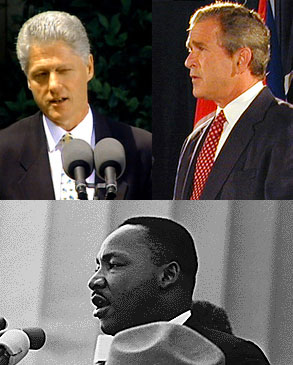

George W. Bush

“Horrible” speaker, great speech

An expert on great speakers says President Bush is among the worst ever, but on Tuesday night, he tapped into his inner Clinton.

  • more
    • All Share Services

Topics: , , , , ,

Veteran speech consultant and communications expert Richard Greene doesn’t mince words when it comes to criticizing President Bush as a public speaker. “He is the least articulate president that I’ve ever seen or I’ve ever listened to,” Greene told Salon, just before Bush’s State of the Union address on Tuesday. “He is a horrible communicator.”

But sitting in front of the television watching Bush address Congress Tuesday night, Greene was pleasantly surprised by what he saw. He says the speech was the president’s best ever, and Greene should know. The author of “Words that Shook the World,” a 2002 book that assembled and analyzed 20 speeches he identified as the best of the last 100 years, he’s been an advisor to high-powered clients in the corporate and political worlds, from Princess Diana to presidential candidates. And he’s studied Bush’s oratory: Before the 2000 election, he informally advised campaign strategist Karl Rove on the many and profound weaknesses in Bush’s performance on the stump. He’s even met Bush a couple of times.

Perhaps, in such speeches, most of us hear what we want to hear, and believe what we’re predisposed to believe. The New York Times called Bush’s speech “his strongest effort yet to convince reluctant allies and anxious Americans that war with Iraq may be unavoidable.” A poll by CNN, USA Today and Gallup showed an overwhelming 84 percent positive response to the speech. Yet Bush critic Maureen Dowd thought it fell short. “At a moment when Americans were hungry for reassurance that the monomaniacal focus on Iraq makes sense when the economy is sputtering, Mr. Bush offered a rousing closing argument for war, but no convincing bill of particulars,” Dowd wrote in her Times column Wednesday.

Greene admits that Bush didn’t deliver the ultimate case for war with Iraq — but he says that’s not what the speech was meant to do. “Here’s the great truth about selling a case, whether it’s front of a jury or in front of the world like Bush was Tuesday night: If you like the messenger, if you feel a connection to the messenger, you will be receptive to the message. And his job last night was to make people like him and be more receptive to the message that was to come.” Bush pulled it off, Greene says.

It is surely a controversial conclusion, and Greene himself is surprised by it. In interviews before the speech and after — our abridged conversation follows below — he was a stern critic of the president, both as a speaker and as a policy-maker. But when assessing a leader’s ability to persuade, he has ample grounds for comparison. In assembling his book, he reviewed hundreds of speeches by dozens of speakers. The Rev. Martin Luther King, the slain civil rights leader, was the best of them all, Greene says. The late Barbara Jordan, the first black woman elected to Congress from a formerly Confederate state, followed King. Winston Churchill, John F. Kennedy, Ronald Reagan and Albert Einstein were also at the top of his list.

Bush, in his State of the Union address, did not reach that standard — but Greene insists he came close.

Historically, how important is the State of the Union speech?

I think every State of the Union speech is important for different reasons and in different degrees. I think in peacetime, with no major issues going on, it’s a critical opportunity, mainly for the president, to create a connection to the American people. It’s the only time in a year that we have a one-on-one, face-to-face conversation, and if it’s done well, it feels like a conversation. If it’s done poorly, it feels like a speech. That is an unbelievably important opportunity, even in the most calm of times. In times where there is great doubt about the individual — his competency, his capability, his direction as a leader, like there was when Clinton gave his State of the Union speech around the time of Monica Lewinsky — these are very important times to reestablish and reconnect, as Clinton did so well in that State of the Union following his impeachment. And certainly, in times like this, when the country and the world are poised to move in a very dramatic direction, we are all looking at not just the word, but we are looking very much at the level of confidence and certainty surrounding those words from our leader during the State of the Union. It cannot be overstated, the amount that those nonverbals — of confidence and certainty and resoluteness, or lack thereof — will affect the poll numbers immediately following a speech like this.

So then: Go back to the moment after the curtain fell on Bush’s speech Tuesday night and tell me what your first reaction was.

I was quite impressed. For George Bush, I think it was an A performance. Relative to other presidents, like Kennedy, Reagan and Clinton, I would give it a B+. I think that there are a number of different George Bushes giving that speech. There’s the George Bush who’s clearly reading the teleprompter and not being a natural orator and having that show. I think that there is a George Bush who is still uncomfortable as a speaker and as an orator and in the beginning especially, I found that he was quite nervous — nervous and scared. But as the speech progressed, and it was written in such a skillful way to build his connection as a compassionate and emotional and sober and presidential president, I felt that he ultimately reached a crescendo of connection with message and audience that was by far the best oratorical moment of his presidency.

How could you tell in the early part of the speech that he was nervous and scared?

His facial gestures were forced and stiff, and he does what he often does when he’s uncomfortable, which is that he over-enunciates and over-extends his lips. And he forces his head forward and gestures not with his whole body, in a natural, relaxed way, but in an awkward, forced way, with his head bobbing forward and his eyes and lips making somewhat forced and dramatic movements. It’s more subtle than it used to be, and I’m sure he’s received quite a bit of coaching on this, to smooth out the rough edges, but it’s still on close examination obvious that he’s not yet in his comfort zone when he started the speech.

You seem to be saying that a key element of Bush’s success was the emotion conveyed in his presentation. But Maureen Dowd, in the New York Times Wednesday morning, had this take: We were all waiting for a compelling argument on Iraq. This was the time, this was the place — and he came up short. He said nothing new. He didn’t deliver any new evidence. Is there a risk that if we give too much emphasis to the delivery, we’ll give too little to the message, or the lack of message?

Well, here’s the great truth about selling a case, whether it’s front of a jury or in front of the world like Bush was Tuesday night. If you like the messenger, if you feel a connection to the messenger, you will be receptive to the message. And his job last night was to make people like him and be more receptive to the message that was to come. I don’t think that they even wanted to use the speech last night as the forum to put out new evidence.

People who listened to the speech, both in our country and overseas, very much have Iraq on their minds. Do you think that many of them, after hearing the speech, would be moved from the antiwar column, or the undecided column, into a place more favorable to Bush?

Let me back up and say that I agree with Maureen Dowd. Personally, I do not think that Bush or the administration have made the case yet. I think they have come incredibly short on establishing a rationale on the question of “why now?” I mean, this guy has basically had all of this stuff and has been doing all these bad things for 11 years or more. So why now? Why should we stir up the hornets’ nest? The ultimate question that I have not heard answered is: By attacking, don’t we in fact encourage a madman to do something that he may or may not have been willing to do? I see a great argument against going in — that if he has these weapons, they are probably defensive weapons, and only going to be used if he is fact going to be attacked? It’s a logical flaw. And there was nothing in his speech that answered that.

But again, I return to my basic point: What he did Tuesday night was create a warmer, friendlier George Bush image for the rest of the world. He made a lot of progress in changing the reputation for those people who were watching around the world, of him being this loose-cannon, wild Texas cowboy. That was a huge step forward for him. Now, the administration is still going to have to sell the case. And I think they were very smart to put the ball now in Colin Powell’s court, because he in my opinion is much more respected and has much more credibility in the foreign arena than George Bush. Better for him to come up with the hard evidence.

You’ve hit a number of points that can determine the success of a speech. Language, the emotion that a speaker brings to the speech, the importance of the historical moment at which the speech is made. Tell me, generally: What makes a speech great? What separates it from the routine and the run of the mill?

The first thing is a lasered message. One of the mistakes that so many people make when they make a speech is that they try to bring in the kitchen sink and throw two, four, seven, 10, 15 points out there. By the end of the speech, you have no idea what the theme was.

So when John Kennedy says, “Ich bin ein Berliner,” and then he says it again at the end. And in the middle of the speech, he goes, “The Russians say, blah blah blah. Let them come to Berlin!” And he hits that theme four times in a row. And FDR’s “The only thing we have to fear is fear itself.” And Lou Gehrig’s “I am the luckiest man on the face of the earth.” And John Kennedy, “Ask not what your country can do for you, but what you can do for your country.” Churchill, “All I have to offer is my blood, toil, tears and sweat.” Martin Luther King, “I have a dream.” The speeches that survive are those that have an identifiable theme often — often — marked by what we would refer to now as a sound bite.

The second important thing is that in the giving of the speech, one has to communicate with not just the words, but also the other 93 percent of human communication, which is voice tone and body language. There was a study, a somewhat controversial study done in 1968, that indicated that words communicate only 7 percent of the overall impact of a speech or any communication. And determine only 7 percent of do you like someone or not like someone? Trust someone or not trust someone? Feel comfortable following or voting for that person, or not comfortable? And 38 percent of that result is communicated by the tone of your voice. Fifty-five percent is communicated by body language — how you stand, what you do with you facial muscles. What you do with your arms. Things that George Bush does not do very well at this point, though he is getting better. That 7 percent, versus 93 percent non verbal, explains why, with the same team of speech writers at the White House for eight years from 1993 to 2001, Bill Clinton and Al Gore would give speeches with the same administration message, the same quality of speech writing, and a completely different result. Al Gore would bore people to tears, and Bill Clinton for the most part would inspire people with very much the same words.

The third thing is a little more complex. Human beings actually speak four different neurological languages every time they open up their mouths. We have the visual language, which is very dynamic and high-energy, I call it the Robin Williams language. It is critical for having an audience be filled with energy and pay attention. The second language would be called auditory. How do put what we see and what we feel into words that people can then understand — a story line, a sense of beginning, middle and end, a sense of literature or drama. This is an area where George W. Bush has had very, very little competence. That part of his brain, for whatever reason, has not been well-developed. Some people assume it’s because he’s not very smart. But that is not necessarily the case. It could be, but it’s not necessarily the case. The reason we assume that is because most people in business and politics are much more glib and articulate than George W. Bush. In my opinion, he is the least articulate president that I’ve ever seen or I’ve ever listened to. And following right after one of the most glib and most articulate presidents — in my opinion the most articulate that we’ve ever had, which would be Bill Clinton.

Then we go to the third language, and that’s called auditory digital, which is the ability to translate what you see and what you feel and to use facts, details and a depth of analysis that will in fact provide a foundation for soaring rhetoric. You can’t have a speech that works if it’s just fluff and inspiration. There’s got to be some gravitas and some depth and some details that will ground it and support the emotions that are trying to be triggered. But the most important language is what we call kinesthetic, and it is a combination of the earthier, more sensual senses that we have — touching, tasting and smelling. These operate at much lower frequencies. I call it the Barry White language. It’s the “Ooooohhhhh baaaabyyy,” taking 15 seconds just to say those two words. Where Robin Williams, in hyper-speed, might say it in a half-second or a quarter-second. This is where and this is why Bill Clinton was elected twice and survived his own foibles to the extent that he did. Because of his ability to — and it became a buzzword in describing what Al Gore did not do — his ability to connect. We may not — if we’re focused on seeing something or hearing something, we may not be consciously aware of it, but our body will receive it massively.

This is the language that in a movie causes somebody to cry. And this bit of information is worth unlimited amounts of money to anyone in sales. This is the language where many people make their decisions one way or another — whether to vote for someone, whether to buy something or to go into business with someone, or even to go out with somebody. How does this idea feel? How does this speech make me feel? How does this person make me feel? You look at the details of what they’re saying, and there may not be a lot there. But if the person is making the audience have a certain feeling, that’s many times going to rule the day.

Let’s talk in more detail about George W. Bush. You did include one of his speeches in your book — the speech he made in the aftermath of Sept. 11. Where does he fit in the pantheon of great speakers of modern times?

We were very close to finishing the book when Sept. 11 happened, and in fact it was going to be the 20 greatest speeches of the 20th century. And then Sept. 11 happened, and George Bush, prior to that moment, would have probably been on an actual list that I would’ve made out, the last person on that list that I would even think about including in a book about the 20 greatest speeches. He is a horrible communicator. And really operates from maybe one and a half or maximum two of these languages. He has no capacity on his own to communicate in the auditory language that I referred to. His language to translate what he sees and what he feels into complete sentences and complete flowing paragraphs is almost nonexistent — and surprisingly so for someone who’s president of the United States, or even someone who’s a governor. His capacity, his intellectual curiosity and his capacity to refer to and to integrate details and facts and a depth of analysis in his ad libbed communication, is again, almost nonexistent. And again, that does not mean he’s not intelligent. That means to some extent he’s been lazy in the development of those parts of his communication repertoire. He could be the smartest guy on the planet, but it doesn’t many times sound like that because of his lack of competence in those two areas.

Where George Bush is in fact a very talented communicator and orator is in the area of the kinesthetic, the area of emotion. George Bush’s training as an orator in a very real sense, and I’m not making this as a joke, came from his experience as a yell leader at Yale [athletic events]. If we remember back to right after Sept. 11 when he was in New York, it was almost eerie. Here’s a guy who was a yell leader at an Ivy League college who is now president of the United States, standing up in front of a group of people with a megaphone, and rallying them as if it were at some sort of a football game, to be strong and to stay strong and to keep being hopeful — all the things he would do at a football game, but instead of it being at his university, it was the country and the world. This is an emotional guy. This is a back-slapping, “c’mon, let’s all pull together” guy. This is a round-em-up cowboy kind of guy. So when he combined those two things — let’s round up the bad guys — you know, it was very Texan. His ability to see the world similar to the way Ronald Reagan did, in black and white, with very little gray, in good and evil, with very little in between, allows him with that simple world view, to be a yell leader without complication.

One of the problems with people who are auditory-digital and see a lot of grays in their world view, like Jimmy Carter, who was a Ph.D. in nuclear physics, is that you lose track of the fact that human beings need that simple lasered message. Ronald Reagan was also terrific in simplifying complex things. The entire Cold War — the entire Cold War — could be summarized by Ronald Reagan in 1987 standing up in front of the Berlin Wall, saying: “Mr. Gorbachev, tear … down … this … wall!”

That simplicity and directness and laser-ness of message is one of the things that makes a great leader and a great speech. And in his post-Sept. 11 speech, Bush and his very excellent speechwriter, Mike Gerson, were able to translate all of these qualities that George Bush had — this simplicity, this simple worldview, this round-em-up-cowboy sort of quality that Bush was obviously comfortable with, and this yell-leader quality that Bush was clearly very comfortable with, and put them in an extremely well-worded, beautifully crafted speech which I, as much as I didn’t want to, felt was worthy of being included in this book.

You talk about the need to develop a laser-like message and the phrase that comes to mind when I’m thinking of George Bush is “axis of evil.” Do you think that was a success, and that that speech was a success?

We now know that [phrase] was his — that he changed that from the “axis of hatred.” It was originally going to be “axis of hatred,” but the information that I’ve read lately was that he changed that. And that one change — “axis of hatred” to “axis of evil” — was indicative again of his worldview, this very black-and-white world view that he has, that people in more mature and sophisticated parts of the world, like in Europe, have a hard time with. This one change has caused him to be criticized and America to be criticized heavily. “Axis of hatred” would’ve been fine. “Axis of evil” had the effect, in my opinion, of polarizing the world in a very unfortunate way.

Is it possible for somebody with Bush’s nature and experience, his skills and deficits, to get better?

[Chuckles] People ask me that all the time. “If the president called you to help him, would you?” And the truth is, I would — how do I put this? Before he became president, I had a couple of opportunities to spend some time with Karl Rove, and I did in fact share some performance tips with Karl Rove, some of which he seems to have implemented.

Such as? Can you be specific?

[Twelve-second pause] You know, out of respect to that relationship and the fact that he is now the president, I don’t feel comfortable going into detail with that. But I can talk generally. I think, let’s put it this way: When someone, and this is not specifically the advice I gave — one of the reasons Bill Clinton was respected as a communicator and an orator was his posture. Bill Clinton has one of the best speaking postures of anyone who’s ever spoken at a high level. He stands very tall, the shoulders are up, very straight and tall. And he gestures, while keeping his body still, he gestures with his hands appropriately, in a conversational, relaxed way, very much connected to his emotions and his feelings. In analyzing Al Gore during the 2000 campaign for television and newspapers, I actually ran across a time when Gore was saying, “We absolutely must move forward,” and he was pointing 90 degrees off to the side. [Laughs] “And we must now come together!” — but his hands were going apart. I showed this on TV and everyone cracked up. That’s the reason he lost the election.

He was not connected, on a feeling level, with what he said. I would’ve suggested to Al Gore that he talk about the environment, because he clearly has a deep passion for the environment. And yet, because we’re now in an era of polls and poll-driven sound bites, he was clearly told that was not an issue people cared about and he shouldn’t go there. But then we have [Arizona Sen.] John McCain, who was trumpeting an issue that every poll says that no one understands or cares about, at that time, which was campaign finance reform, but because it was authentic passion, his authentic passion about campaign finance reform, even Democrats here in California fell in love with John McCain. If Al Gore had been more connected to his authentic feelings, he would’ve more than made up for that 537 votes in Florida.

Back to Bush. One of the things the president does that is tremendously undermining to his authority as a speaker, is — he’s doing it less now, but he does this thing I call “the duck head.” He makes his points by forcing his head forward exactly like a duck does. I remember in the debates, he says: “It’s fuzzy math!” And he was so emphatic that he forgot to use his hands to gesture and only used his head. And so you’d see this head bobbing back and forth. Any time someone uses their body language like that, they lose credibility and they lose authority. So could I help George Bush? Yes, I think he’s getting better. I think he’s beginning to own more, as every president does, a sense of gravitas in his speaking, which he did not have when he was governor of Texas. I think his ability to communicate emotionally and powerfully seems to have grown because there are emotional issues to deal with. His ability as a speaker when he is talking about economic policy or talking about certain aspects of domestic policy which do not involve emotion, and good and bad, and right and wrong, has been unchanged. He is a horribly ineffective communicator when dealing with more detailed topics, either foreign or domestic. And what people see as his growth as an orator is in large part due to the fact that he now is getting softballs. He now is able to speak on these big right-and-wrong, good-and-evil, let’s-go-get-the-bad-guys topics which are right in his wheelhouse.

Most of all, what I would suggest to him, is — and this is something that would be up to him to develop or not — he will have reached a real ceiling in his ability to grow, especially in the extemporaneous and ad libbed communications, unless and until he develops more of an intellectual curiosity, that capacity I understand John Kennedy had, and that capacity Bill Clinton had, to be fascinated by a particular issue and to dig deeply into the substance of that issue. That intellectual curiosity that Albert Einstein said was the most important thing for any scientist and any human being seems not to be in great supply with George Bush. Without that, you can never have the passion and the details of that passion that drive great communication that are not written by other people.

You’ve suggested that the State of the Union is an opportunity for a president to have a conversation with the American people, and with people overseas as well. Obviously, this speech comes at a crucial juncture in modern history. Did Bush make the most of the opportunity?

You know, he really did. The big strategic decision, as to voice tone and body language, was: Do we come off strong, powerful, we’re-going-to-go-in-and-eradicate-evil-in-the-world, with a Texas machismo and bravado, or do we do it more in a Bill Clinton-esque, I-feel-your-pain, softer, more kinesthetic way — that touchy-feely human language? Do we come in visual with lots of energy and dynamic, with strength and vigor, like a Winston Churchill would have? Or do we do it in a more warm and fuzzy way? Given Bush’s past communications on the subject, I would’ve guessed that he would’ve been more Churchillian and less Bill Clinton.

What was stunning to me about what he did Tuesday night was, when he was talking about the things Iraq had done, the torturing children in front of their parents and raping and pillaging and all of the terrible things that he was talking about, and then going on to make the case for going in to Iraq, he wasn’t strident. He wasn’t Churchillian. He was very, very touchy-feely, sober, somber and restrained. And I think that was exactly the right tone that he needed to hit, and was really quite surprised that he had it in him. In fact, there was a point, toward the end of his argument on Iraq, where his eyes got teary. And that, if it’s genuine, teary eyes always work. Bill Clinton, when he was genuine with his teary eyes, was enormously compelling. When it looked like it was forced and acting, obviously, he gave critics an opportunity to respond to that. This was the first time I’d ever seen Bush be so heartfelt and so soft and touchy-feely and I think it came at a perfect time for him.

You’ve said that one key to a successful speech is to have a lasered message — that is, simple terms, a sound bite. Was there a line in Bush’s State of the Union speech that we’ll remember?

There were two or three times where he said stuff and I thought, “Oh my God! His speech writer is having a good moment.” The one I remember is where he was listing all the horrible evils — torturing children in front of their parents and stuff like that. What did he say — “If this is not evil, then evil has no meaning.” That was good. That was really good. We talked earlier about how he changed “axis of hatred” to “axis of evil.” And he kind of had to define that, and to put a human context on it. And that was a brilliant way to do that. Because any parent could imagine — having your child tortured in front of you, what could be worse? And evoking those emotions and then saying, “That’s what I meant, that’s who this guy is.”

But again I think the message of the speech, the thing he did accomplish, there was a warmer, Bill Clinton-esque quality that came out at the end of the speech that was as connecting as I’ve ever seen George Bush be. And I think it helped his case. But I still think he’s not made the case.

Until he can come up with a really compelling, logical rationale for not only going in, but for all of the different possibilities that might happen, there are many people who are going to feel this is another situation like Vietnam. Until he does that, I think that no matter how emotional he is, he’s not going to carry the day with a lot of people in the United States and around the world.

Continue Reading Close

Edward W. Lempinen is a senior news editor at Salon.

Guess who’s coming to dinner?

George and Laura Bush dine with the Obamas

  • more
    • All Share Services

Topics: , ,

Judy Gold

Emmy Award-winning actress and comedian Judy Gold is best known as the star of her two critically acclaimed off-Broadway shows, "The Judy Show - My Life As A Sitcom," and "25 Questions For A Jewish Mother." Judy has had her own comedy specials on HBO, Comedy Central and Logo. She appears regularly on Tru TV's World"s Dumbest. Check out www.JudyGold.com and follow her on Twitter at @JewdyGold.

Using Bush’s playbook

"Karl Rove politics" aren't quite dead: Obama's strategy in 2012 will mirror W's in 2004

  • more
    • All Share Services

Topics: , , , , , ,

Using Bush's playbookGeorge W. Bush and Barack Obama (Credit: Reuters/Larry Downing)

Barack Obama’s presidency was born from nothing so much as his repudiation of George W. Bush’s administration — its policies and politics, its style and tone. One of Obama’s most effective 2008 stump speech refrains was his promise to end the era of “Scooter Libby justice, ‘Brownie’ incompetence and Karl Rove politics.”

But the political dynamics for winning a second presidential term often differ markedly from winning the first. So don’t be surprised by many eerie parallels between Obama’s 2012 reelection bid and Bush’s 2004 campaign. The president may not rely upon “Karl Rove politics” in the strictest sense, and nobody would confuse David Axelrod with Rove. But Obama’s reelection route and rhetoric may bear more than a few Rovian hallmarks.

Now that Mitt Romney has won the Republican nomination, two key features prevail over the 2012 campaign — and both were also plainly evident in 2004. First, the incumbent president’s reelection fortunes are far from certain; and, second, the incumbent faces a decent but nevertheless weak challenger who is further hampered by internal problems within his party’s coalition.

Because incumbents can’t run for reelection promising “change,” and because “hope” during a lingering recession was also off the menu, the Obama campaign’s 2012 theme of  “forward” — a word that often follows “plow,” mind you — was the best available alternative. That said, and substituting the economy for terrorism, Obama is implicitly if not explicitly advancing the same theme Bush did in 2004: America suffered a tough blow, but the situation could have been worse and, more to the point, under my stewardship the nation is steadily regaining its footing.

This counterfactual campaign theme — vote for me not because of what happened, but what might have but didn’t — is a common thread for Bush and Obama. It’s not an uplifting message, but it sufficed in 2004 and Obama is counting on it working again in 2012.

Politics 101 further dictates that when an incumbent’s reelection is in doubt, he must go negative against the challenger. Obama political operatives in the White House and at the Democratic National Committee long ago made it abundantly clear they were willing to do just that. Team Obama may not go negative against Romney to the degree the Bush camp did against John Kerry in 2004. (By mid-summer 2004, 75 percent of Bush’s TV ads were negative attacks on Kerry.) But don’t be surprised if attacks on Romney’s record and even character are plentiful, harsh and relentless. In 2008, America saw candidate Obama’s toothy grin; four years later, expect to see President Obama’s fangs.

Expect the Obama camp to emphasize two major critiques of Romney: that he is a flip-flopper willing to say anything or reverse any position to win; and that he is an economic royalist whose personal and public life suggest a person incapable of understanding the lives and struggles of average Americans. Again — note the unusual parallels with 2004.

Although Romney is a Republican former governor and Kerry was at the time his state’s Democratic junior U.S. senator, the two Massachusetts pols make for similar targets. Each man is an extraordinarily rich preppie and Ivy Leaguer. Each represents the liberal wing of his respective party. Each has shown a propensity for ruining an otherwise valid point with sloppy, backfiring language. And each has a reputation for lacking political spine.

The flip-flop frame is candidate character assassination of the first order. Like the lone negative number in a string of multiplied positives, the critique that nobody can trust any statement or claim made by a politician has the potential to negate every accomplishment or promise. If it sticks, it can be fatal, as Kerry learned in 2004.

Obama and the Democratic National Committee know their electoral history and, sure enough, last November — a year before the election and two full months before a single Iowan had caucused — the DNC released a four-minute “Mitt vs. Mitt” ad and its accompanying website with the damning tag line, “the story of two men trapped in one body.” The site is a brilliant homage to the Bush campaign’s 2004 windsurfer attack ad and the devastating, 11-minute ad the Republican National Committee produced chronicling Kerry’s “evolution” on Iraq.

And then there is what might be called “the Willard factor”: Romney as Richy Rich, the Monopoly Guy with the Bain Capital background and the Swiss bank account. His bio would be political gold to Romney’s opponent any election cycle, but it’s gold-plated platinum in the first full presidential campaign following the biggest economic crisis since the Great Depression, the rise of the Occupy Wall Street movement, and the long overdue national debate over income inequality.

Again, the wealth-personified line of attack mirrors the out-of-touch, Martha’s Vineyard yoke the Bush team put around Kerry’s neck in 2004. Right on cue, in the first public event of his reelection campaign, last week Obama attacked Romney by name and invoked the economic disconnect card with relish. “He sincerely believes that if CEOs and wealthy investors like him make money the rest of us will automatically prosper as well,” said Obama of Romney, adding that “corporations aren’t people – -people are people.” (For the record, Kerry is actually wealthier than Romney, who would become one of the richest men ever to occupy the White House, should he win.)

Obama will also try to shift the national debate toward areas of strength, as Bush did. Historically, this meant the same strategy, but with inverse implications for each party: The so-called mommy party Democrats would encourage voters to focus on more favorable kitchen-table economy issues — healthcare, jobs, education — and away from less favorable “daddy party” Republican issues surrounding foreign wars abroad and culture wars. Because Obama is net-positive in foreign policy approval and net-negative on the economy, rather than mirroring by inversion, Obama will try to duplicate Bush’s shift-in-emphasis in 2004. GOP complaints that Obama is politicizing the killing of Osama bin Laden reveal Republican fears that Obama is going to play the terrorism card in 2012 just like Bush did eight years ago.

The 2004 parallels extend beyond message. Obama will be amply resourced and enjoy a field technology by virtue of his campaign’s state-of-the-art Web, donor, volunteer and social media innovations. Remember the Bush reelection campaign’s vaunted “72-hour” voter turnout model? That seems like an Edsel compared to the Ferrari the Obama team will be sporting this summer and fall. Among the perquisites modern presidential incumbents enjoy is the option to test-drive the best mobilization machines before anyone else.

Finally, what most connects Obama 2012 to Bush 2004 is the stability of the electoral map itself. Only three states — two net to Bush — flipped from one party to the other between 2000 and 2004; only nine states flipped between 2004 and 2008. Split the difference and a good, back-of-the-napkin over-under for number of states likely to flip between 2008 and 2012 is six. And thus, like the lead sailboat during a windless race, Obama doesn’t need or want conditions to change much from 2008: He merely has to replicate the map that swept him into office, with the burden of figuring out how to shake up the Electoral College falling to Romney, just as it did for Kerry against Bush. Even Karl Rove’s mapping of the 2012 election concedes this reality.

The 2008 election was memorable; to borrow the title of one best-selling chronicle, it was a “game changer.” But 2012 will not be. In many respects, it will be a game repeater, with Obama playing Bush to Romney’s Kerry of 2004. The president may be asking Americans to look “forward” in 2012, but the best preview of his reelection campaign can be found by looking backward eight years.

Continue Reading Close

The Bushies are back

Missed the neocons? Don't worry: Mitt Romney's getting the band together again

  • more
    • All Share Services

Topics: ,

The Bushies are back (Credit: Reuters/Win McNamee)

There was good reason for Republicans to cry foul over the Obama campaign’s advertisement highlighting the president’s killing of Osama bin Laden; the GOP has lost its decades-long edge on national security. According to a Washington Post poll, “By a margin of more than 2 to 1, Americans say the president’s handling of terrorism is a major reason to support rather than oppose his bid for reelection.”

Republicans lost their popularity on security issues for one reason: George W. Bush’s foreign policy was a disaster. And yet, the party’s nominee, Mitt Romney, has assembled a foreign-policy team composed almost exclusively of individuals with the same war-always mentality and ideology that served Bush — and the United States — so poorly. In some cases, the exact same men responsible for Bush’s catastrophic national security policies are advising Romney. The former Massachusetts governor could have included some of the pragmatists and realists from the George H.W. Bush administration. Instead, a Romney presidency seems like it would be Bush 43 all over again.

Richard Grenell, who served as United Nations spokesman under Bush, may be gone from the Romney campaign after an uproar over his sexuality, but there are plenty more former Bushies. First off, there are Romney’s “special advisors.” There’s Michael Chertoff, W.’s Homeland Security director. Chertoff oversaw DHS’s failures during Hurricane Katrina, and amassed unprecedented powers of secrecy. Next up is Eliot Cohen, counselor to the State Department for Bush’s last two years and on the Defense Policy Advisory Board for the president’s entire term. Cohen was an adamant supporter of the Iraq War and advised Bush directly on the issue. Or take Cofer Black, the man who infamously said to Bush in September 2011 about al-Qaida that “When we’re through with them they will have flies walking across their eyeballs.” Black went on to become chairman of Blackwater, where he resigned after the company illegally bribed Iraqi officials.

Then there are the 13 “working groups” composed of equally worrisome individuals. The Middle East and North Africa Working Group is co-chaired by Bush’s Assistant Secretary of Defense Mary Beth Long, and Meghan O’Sullivan, Bush’s special assistant and deputy national security advisor for Iraq and Afghanistan. The remaining co-chair is Walid Phares, who never worked for Bush but advised Lebanese warlords in the 1980s. Romney has reportedly promised Phares a top job in his administration, despite his virulently anti-Islamic views.

All told, Romney lists 37 holdovers from the George W. Bush administration — the very same administration he and all other Republican candidates barely referenced during their many debates because it was so discredited and toxic, even to the Republican base.

It didn’t have to be this way. There are, in fact, people in Republican circles who are sensible on international affairs. The Cato Institute, in particular, has experts that could dramatically change the direction of American foreign policy. Men like Justin Logan and Christopher Preble were prescient on Iraq and a host of other issues. Similarly, the Center for the National Interest (formerly the Nixon Center) has a host of solid scholars, including ones like Dimitri Simes and Geoffrey Kemp, who have valuable government experience in the Nixon and Reagan administrations, respectively, and a history of perceptive analysis. Richard Haass, president of the Council on Foreign Relations, would have been another good pick.

So why aren’t guys like this being tapped? Why is the GOP sticking with a discredited foreign-policy approach rather that looking to its own past for wiser counsel? “Most of the realists and pragmatists have simply been driven out of the Republican Party,” says Stephen Walt, who writes a blog at Foreign Policy and teaches at Harvard. “The neoconservatives have been driving the agenda since Bush was elected and they remain well-entrenched.”

Another factor is that the Republican Party’s base remains strongly militaristic and reluctant to recognize limits on American power. Jon Huntsman’s failed presidential campaign illustrated that problem. The good news is that nobody seems to be calling for nation-building and occupying foreign countries in the mold of Iraq and Afghanistan. But that’s the only lesson that seems to have been learned from the last decade of foreign-policy debacles.

Finally, it may just be that the United States has too much power to change course. While the Unites States has undoubtedly made disastrous decisions in the last decades, it is so powerful that it is largely insulated from the consequences of them. If Romney’s foreign-policy advisor list is anything to go by, a Romney administration would have to teach the U.S. all over again about the problems with trying to police the world. Prepare for Bush redux.

Continue Reading Close

Jordan Michael Smith writes about U.S. foreign policy for Salon. He has written for the New York Times, Boston Globe and Washington Post.

Bush aide blasts torture

Philip Zelikow tried to warn Bush on interrogations. Now he's penned an authoritative article on how he was ignored

  • more
    • All Share Services

Topics: ,

Bush aide blasts torture (Credit: Reuters/Jim Young)

The Bush administration hasn’t heard the last from Philip Zelikow. After the rediscovery last week of his long lost 2006 anti-torture memo, Zelikow, a former State Department official, has written arguably the most damning article yet about U.S. government’s interrogation policies from 2001 to 2009. The article, called “Codes of Conduct for a Twilight War,” will be released in a forthcoming issue of the Houston Law Journal, and was obtained exclusively by Salon. Says Zelikow in an email: “I’m not aware of other accounts that combine historical, policy and legal approaches to” the subject of the Bush administration’s interrogation methods.

Based on published histories and his firsthand observations, and adapted from a lecture delivered in November, the article calls the administration’s rationale for its use of torture — which he nonetheless insists only on calling “extreme interrogation” and “coercive methods” — “radical,” “an amazing contention,” “untenable and extreme,” “unsustainable,” “an unprecedented program of coolly calculated dehumanizing abuse and physical torment,” and, finally, simply a “mistake.” He concludes: “This was a collective failure of American public leadership, in which a number of officials and members of Congress (and staffers) of both parties played a part, endorsing a CIA program of physical coercion without any precedent in U.S. history.”  In fact, “The only defense against criminal prosecution would be that officials acted in good faith reliance on the advice of their government lawyers.”

Part of what makes Zelikow’s analysis so damning and definitive is its judiciousness. The article is deeply empathetic of the uniquely fearful situation under which the Bush administration was initially operating. Zelikow calls the Sept. 11 attacks a “collective trauma” and a “shoc[k] to mass beliefs.” He notes that Bush and others spent time in burn units, morgues and with survivors of the attacks. One traumatic experienced often overlooked — overlooked because it appeared in Stephen Hayes’ stenographic biography of Dick Cheney — was that the vice-president’s daughter was (falsely, it turns out) told that her house with her children in it had tested positive for anthrax. Similarly, Cheney and National Security Advisor Condoleezza Rice were told that they and others had been exposed to an extremely lethal toxin in a particular area of the White House — and might soon die as a result. “The alarms did not stop and they too were not abstract … The pressure on Bush and his senior advisers was so direct because so much of the response had to be invented and improvised,” the article reads.

An additional factor in the power of the article is Zelikow’s credibility and history. Before entering government, he was a civil rights lawyer in Texas battling the Ku Klux Klan and then a highly esteemed Harvard historian specializing in U.S. foreign policy — he co-authored one book with Rice. He then served on the National Security Council under President George H.W. Bush and directed the 9/11 Commission before becoming counselor to Rice at the State Department from 2005 to 2007. He currently volunteers part-time on the President’s Intelligence Advisory Board under President Obama.

Such bipartisan, establishment credentials render the breakdown and conclusion of this article all the more damning. He believes that what should have been a political and moral question — should the United States torture captives? — became strictly a legal matter left up to government lawyers, few of whom had any experience with these issues, and who had to take the necessity of extreme measures as a given. “These lawyers then became secular priests, granting absolution to the supplicant policymakers,” Zelikow writes.

The problems began when the Office of the Vice President and the CIA took central roles in policymaking. Cheney felt himself above the rest of the National Security Council, bypassing Rice and other traditional channels of national security policymaking. Ad-hoc decision-making and improvisation became “a habit of thought,” which seemed initially to pay off in the security of the nation, as well as in Bush’s political standing and self-confidence.

With Cheney and CIA head George Tenet “the key entrepreneurs in setting codes of conduct for the War on Terror,” it was essentially left to their obsequious lawyers to decide, in secret, on the interrogation methods America should employ. Bush even told the Senate’s Intelligence Committee chairman that “the vice president should be your point of contact … [He] has the portfolio for intelligence activities.” Decisions were made to jettison international treaties. By December 2001, the CIA was already interested in reverse-engineering methods “heretofore used only to treat Americans to resist enemy torture.” When a senior al-Qaida member was captured in March 2002, the prototype for the administration’s torture policies was already developed. “So, for the first time in American history, leaders of the U.S. government carefully devised ways and means to torment enemy captives.”

Zelikow notes that “None of the policy or moral issues connected with these choices appear to have been analyzed in any noticeable way.” Perhaps worst of all, no serious consideration was given to weighing the costs of benefits of the torture program, with reference to relevant historical precedents and/or examinations of the respective French, British and Israeli experiences in dealing with captured terrorists. “Bush and Rice should have insisted on this,” Zelikow writes.

The 52-page article observes the successes of Obama’s counterterrorism policies after repudiating the use of torture. On the basis of the empirical evidence then, “[t]here is no evident correlations between intelligence success and the available of extreme interrogation methods,” no matter what Bush and Cheney claim. Finally, “The program’s costs — which include the high-level effort expended in order to establish, maintain, and defense the program — appear on the evidence so far to have well outweighed any unique value the program might have had as a method of counterterrorism intelligence collection.” This is apart from the damage to America’s international standing and corrosion of its traditional values.

Zelikow concludes his analysis by arguing that, although the Obama administration has the right to wage war and use extralegal methods to defeat al-Qaida, its claim of that authority to defeat “associated forces” is unwarranted. “The U.S. government should publish and explain any overarching policy and legal documents that guide and confine the conduct of deadly operation against its foreign enemies … the executive branch of the U.S. government has a duty to articulate the scope of its warfare to the Congress and the public.” The Bush administration’s unprecedented elevation of torture to national policy may be history, but the job to get U.S. foreign policy in line with its constitutional and moral obligations is far from over.

Continue Reading Close

Jordan Michael Smith writes about U.S. foreign policy for Salon. He has written for the New York Times, Boston Globe and Washington Post.

Thomas Kinkade, the George W. Bush of art

The rise and fall of Thomas Kinkade, the Painter of Light™ in a decade of bad faith

  • more
    • All Share Services

Topics: , ,

Thomas Kinkade, the George W. Bush of art

News of Thomas Kinkade’s death arrived on the same day I received in the mail a vintage teacup on which I had spent a ridiculous amount of money. It has a cottage painted on it. Kinkade, whose work has long exerted a morbid fascination for me (to the concern of all my friends), specialized in cottages. So some part of me understands the appeal, I guess, but, damn: Those paintings make my corneas hurt. And yet, I could barely stop looking at them.

Kinkade was only 54, and his family told the media that he died of “natural causes.” This comes after years of reports of drunken public misbehavior: cursing at people who tried to save him from falling off bar stools, heckling Siegfried & Roy, grabbing a woman’s breasts at a publicity event and, most memorably, urinating on a Winnie the Pooh statue at the Disneyland Hotel while proclaiming, “This one’s for you, Walt!” There were DUI arrests. Also, his manufacturing company declared bankruptcy two years ago, and former franchisees of the once-ubiquitous Thomas Kinkade Signature Galleries won settlements against him for fraud.

That’s quite a fall for a man who frequently spoke of his Christian faith and family values when asked to comment on the mammoth success of his brand in the early 2000s. “When I got saved, God became my art agent,” Kinkade explained in a 2004 video. He went from a childhood in Placerville, Calif. (invariably characterized as “hard-scrabble”) to an apprenticeship selling his work in supermarket parking lots to his apotheosis as the nation’s “most profitable” artist, the Painter of Light™, and multimillionaire. He was profiled in the New Yorker by Susan Orlean.

I first learned about the dark side of the Painter of Light™ — sorry, couldn’t resist that one — when I reviewed “his” novel, “Cape Light,” in 2002. The novel, first in a series, was produced much as his paintings are: by a semi-industrial process in which low-level apprentices embellish a prefab base provided by Kinkade. He wasn’t the only artist to work in this way; he wasn’t even the only novelist. To the best of my knowledge, his novels — heartwarming, fuzzily pious tales of small-town life — have been coming out ever since, one more facet of a lifestyle brand that, at its most ambitious, included an entire Thomas Kinkade-themed housing development.

My review was just a goof intended to amuse Salon’s readers, but after it appeared, I began to receive emails from people who had sunk their life savings in Thomas Kinkade Signature Galleries (essentially, mall and shopping-district outlets for his prints) and been fleeced. I didn’t really understand how the financial architecture of Kinkade’s gallery empire worked, and I sure didn’t share their taste in wall art, but these people struck me as decent and sincere. They’d believed in Thomas Kinkade — not just in the man or the company, but in the ethos supposedly represented by his work, one in which (to quote Kinkade’s introduction to “Cape Light”) “people have the time to savor life’s simple pleasures” and lead “deep, satisfying lives.”

My conversations with these victims made me uneasy. Was there some relationship between the franchisees’ naivete, perhaps even their willful self-delusion, and their terrible taste? Was it hopelessly snobby to wonder that? What about Kinkade himself? He seemed to be at best a hypocrite and at worst a crook. Was there a meaningful connection between his bad conscience and his bad art? German thinkers of the 1930s would have said so, and they had plenty of opportunity to observe bad fascist art up close. Hermann Broch maintained that someone who chooses to make kitsch is “ethically depraved, a criminal willing radical evil.” The novelist Milan Kundera believes kitsch to be the natural expression of totalitarianism. That’s a lot of moral weight to place on a bunch of garish cottage paintings, but Kinkade was always the first to present his work as a form of ideology.

I felt compassion for the ripped-off gallery operators, and at the same time I was aware that quite a few of them had probably also fallen for the similarly sanctimonious, bogus folksiness of George W. Bush, thereby subjecting our nation to one of the worst presidents in its history. Kinkade and Bush struck me as of a piece, probably because they had both borrowed from Ronald Reagan in promising that we could get back to a better way of life that never existed in the first place. In nearly every encounter with the press, Kinkade delivered a diatribe against the art-world “establishment” that had shut him out. They were “elites” touting unfathomable, downer junk to hardworking people who needed uplift instead. Art snobs were the aesthetic counterparts of the so-called liberal elites, a group that surely included me.

At the same time, I must admit that I, too, like a cottage. Granted, I like the stylized, art-deco kind painted on bone china, rather than the insanely detailed and phosphorescently lit specimens in Kinkade’s pictures. And I’m in little danger of equating my new teacup with a Brancusi just because it’s cheerier. Nevertheless, I suspect that my idea of what’s pleasing about a cottage isn’t too different from that of Kinkade’s fans: an aura of harmless coziness, of modest domestic beauty and comfort not too cut off from the past. It’s as if we’re speaking the same word, but in different languages.

I suspect this is why Kinkade’s paintings have exerted their weird, hypnotic effect on me. They are so preposterous (especially the stream-side ones; he really needed to sit down with an architect and go over the basics of drainage), so awful. And yet I can still detect — beneath that cacophony of hollyhocks and cobblestones and snapdragons — the whisper of something intelligible. I’m pretty sure I know why the hordes of Kinkade collectors love his work, even if I don’t like it myself. Kinkade’s paintings are irredeemably false, like all kitsch, but through them you can just barely glimpse the honest desires they seek to exploit, sinking under the dreck.

Kundera defined kitsch as “the absolute denial of shit,” meaning it offers an airbrushed, sterilized, sentimentalized view of the world. From that, it doesn’t necessarily follow that art wallows in shit, but art doesn’t exist for the primary purpose of denying it, either. Kitsch is, first and foremost, a lie; its very existence is founded on bad faith.

Kinkade, like Bush, peddled a falsely simplified image of the world — one without mildew or flooded basements, for one thing — which, no surprise, turned out to be plastered over a whole lot of stinky stuff. The true believers, the ones who bought into these men the most during the 2000s, ended up paying some of the highest prices, from the Kinkade acolytes who invested in his gallery Ponzi scheme to the working-class red-staters who sent off their kids to die in a pointless war. Bad taste, harmless as it may seem, can end up costing you a lot.

Further reading

Los Angeles Times obituary for Thomas Kinkade

Susan Orlean’s 2001 profile of Thomas Kinkade for the New Yorker

A 2006 Los Angeles Times story documenting Kinkade’s business problems

Salon’s Janelle Brown visits Hiddenbrooke, a Kinkade-theme housing development in Northern California

Laura Miller reviews “Cape Light,” a novel by Thomas Kinkade and Katherine Spencer

Continue Reading Close
Laura Miller

Laura Miller is a senior writer for Salon. She is the author of "The Magician's Book: A Skeptic's Adventures in Narnia" and has a Web site, magiciansbook.com.

Page 1 of 436 in George W. Bush