
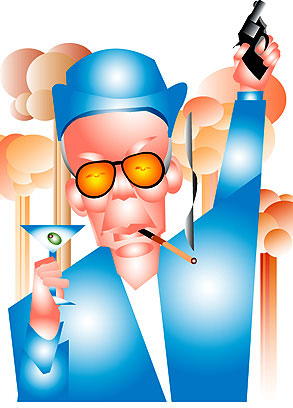
He calls himself “an elderly dope fiend living out in the wilderness,” but Hunter S. Thompson will also be found this week on the New York Times bestseller list with a new memoir, “Kingdom of Fear: Loathsome Secrets of a Star-Crossed Child in the Final Days of the American Century.”
Listening to his ragged voice, there is some sense that Thompson, now 65, has reined in his outlaw ways, gotten a little softer, perhaps a little more gracious now that he’s reached retirement age. “I’ve found you can deal with the system a lot easier if you use their rules,” he says. “I talk to a lot of lawyers.”
But do not be deceived. In “Kingdom of Fear” and in a telephone interview with Salon from his compound in Aspen, Colo., Thompson did what he’s always done: speak the truth about American society as he sees it, without worrying much about decorum. “Who does vote for these dishonest shitheads?” he writes, referring to the people currently occupying the White House. “They are the racists and hate mongers among us — they are the Ku Klux Klan. I piss down the throats of these Nazis.”
That’s his enduring attitude in this new age of darkness: a lot more loathing than fear.
The godfather of gonzo believes America has suffered a “nationwide nervous breakdown” since 9/11, and as a result is compromising civil liberties for what he calls “the illusion of security.” The compromise, he says, is “a disaster of unthinkable proportions” and “part of the downward spiral of dumbness” he believes is plaguing the country.
While the country’s spinning out of control, Thompson says his own lifestyle has been a model of consistency. He still does whatever the hell he wants. In fact, his new book was supposed to be a “definitive memoir of his life,” a long look back by the man who rode with the Hell’s Angels, who experienced the riots at the 1968 Democratic Convention, and who has smoked more cigarettes, driven more fast cars, fired more weapons and done more drugs than most living people, let alone most living authors. But the book is much more than memoir.
Thompson has long been an outspoken and vigorous champion of civil liberties, at least since a well-publicized 1990 case in which he was charged with sexual and physical assault and possession of illegal drugs — charges that were ultimately dropped due to an illegal search and seizure.
Of course, the writer has distrusted power all his life, and it may come as no surprise that he now believes the administration is “manufacturing” the Iraqi threat for its own political gain and the economic gain of the “oligarchy” (read: the military-industrial complex).
Perhaps Thompson’s most disturbing charge is aimed at the American people — only half of whom exercise their right to vote. “The oligarchy doesn’t need an educated public. And maybe the nation does prefer tyranny,” he says. “I think that’s what worries me.”
In the end, however, Thompson is not and has never been that easy to pigeonhole. He’s friends with Pat Buchanan and has a lifetime membership in the National Rifle Association. In his own mind, if not in others’, he is “one of the most patriotic people I’ve ever encountered in America.”
Your new book, “Kingdom of Fear,” is being called a definitive memoir — although almost all of your books seem to be autobiographical in one way or another. What’s the difference between the written accounts — of drug use, run-ins with the law, sex, fast cars, guns and explosives — and real-life events?
I don’t really see any difference. Telling the truth is the easiest way; it saves a lot of time. I’ve found that the truth is weirder than any fiction I’ve seen. There was a girl that worked for me a long time ago, who graduated third in her class from Georgetown Law School, and was from some kind of uptown family in Chicago, and instead of going to work for some big-time firm, she came to Aspen and ends up working for me out here in the wilderness. A year or so later her mother or father were coming out to visit. I’ve had some understandable issues with parents — really all my life. And I’d be worried about my daughter, too, if she’d run off with some widely known infamous monster. And so I asked her — just so I could get braced for this situation, meeting the parents and having them come to the house: “Given what you know about me and what you hear about me, which is worse?” She finally came out and said there was no question in her mind that the reality was heavier and crazier and more dangerous. Having to deal with the reality is no doubt a little more traumatic.
Indeed, your author blurb says you live in “a fortified compound near Aspen, Colorado.” In what sense is it fortified and why does it need to be?
Actually, I live in an extremely pastoral setting in an old log house. It’s a farm really. I moved here 30 years ago. I think the only fortification might be my reputation. If people believe they’re going to be shot, they might stay away.
Yes, I understand you’re a gun enthusiast, to put it euphemistically. But do you support more restrictive gun laws? Do you support a ban on assault weapons?
I have one or two of those, but I got them before they were illegal. In that case, if I were sure that any tragedies and mass murders would be prevented, I’d give up my assault rifle. But I don’t really believe that. Do I have any illegal weapons? No. I have a .454 magnum revolver, which is huge, and it’s absolutely legal. One day I was wild-eyed out here with Johnny Depp, and we both ordered these guns from Freedom, Wyo., and got them the next day through FedEx. Mainly, I have rifles, pistols, shotguns; I have a lot of those. But everything I have is top quality; I don’t have any junk weapons. I wouldn’t have any military weapon around here, except as an artifact of some kind. Given Ashcroft and the clear blueprint of this administration to make everything illegal and everything suspicious — how about suspicion of being a terrorist sympathizer? Goddamn, talk about filling up your concentration camps. But, yeah, my police record is clean. This is not a fortified compound.
So, just to clarify, how do your views stack up with the NRA’s?
I think I’m still a life member of the NRA. I formed a gun club out here, an official sporting club, and I got charter from the NRA. That made it legal to have guns here, to bring guns here, to have ammunition sent here, that sort of thing. I’ve found you can deal with the system a lot easier if you use their rules — by understanding their rules, by using their rules against them. I talk to a lot of lawyers. You know, I consider Pat Buchanan a friend. I don’t agree with him on many things. Personally, I enjoy him. I just like him. And I learn from Pat. One of the things I’m most proud of is that I never had anybody busted, arrested, jailed for my writing about them. I never had any — what’s that? — collateral damage.
But speaking of rules, you’ve been arrested dozens of times in your life. Specific incidents aside, what’s common to these run-ins? Where do you stand vis-`-vis the law?
Goddammit. Yeah, I have. First, there’s a huge difference between being arrested and being guilty. Second, see, the law changes and I don’t. How I stand vis-`-vis the law at any given moment depends on the law. The law can change from state to state, from nation to nation, from city to city. I guess I have to go by a higher law. How’s that? Yeah, I consider myself a road man for the lords of karma.
In 1990, you were put on trial for what you call “sex, drugs, dynamite and violence.” Charges were eventually dropped. Since then, you’ve been outspoken on Fourth Amendment issues: search and seizure, the right to privacy. I assume you’ve taken a side in the civil liberties debate that’s come up in the aftermath of 9/11?
It’s a disaster of unthinkable proportions — part of the downward spiral of dumbness. Civil liberties are black and white issues. I don’t think people think far enough to see the ramifications. The PATRIOT Act was a dagger in the heart, really, of even the concept of a democratic government that is free, equal and just. There are a lot more concentration camps right now than Guantanamo Bay. But they’re not marked. Now, every jail, every bush-league cop can run a concentration camp. It amounts to a military and police takeover, I think.
Well, as some have pointed out, Lincoln suspended habeas corpus during the Civil War. Is some suspension of civil liberties ever appropriate or justified in a time of war?
If there’s a visible, obvious threat like Hitler, but in my mind the administration is using these bogeymen for their own purposes. This military law is nothing like the Constitution. They’re exploiting the formula here: The people are afraid of something and you offer a solution, however drastic, and they go along with it. For a while, yeah. My suspicions are more justified every day with this manufacturing of dangerous killer villains. The rest of the world does not perceive, I don’t think, that some tin-horn dictator in the Middle East is more of a danger to the world than the U.S. is. This country depends on war as a primary industry. The White House has pumped up the danger factor because it’s to their advantage. It’s to John Ashcroft’s advantage. There have always been pros and cons about the righteousness of life in America but this just seems planned, it seems consistent, and it seems traditional.
What do they get out of it?
They get control of the U.S. economy, their friends get rich. These are not philosopher-kings we’re talking about. These are politicians. It’s a very sleazy way of using the system. One of the problems today is that what’s going on today is not as complex as it seems. The Pentagon just asked for another $14 billion more in the budget, and it’s already $28 billion. [Defense spending in the 2003 budget rose $19.4 billion, to $364.6 billion]. That’s one sector of the economy that’s not down the tubes. So, some people are getting rich off of this. It’s the oligarchy. I believe the Republicans have never thought that democracy was anything but a tribal myth. The GOP is the party of capital. It’s pretty basic. And it may have something to do with the deterioration of educational system in this country. I don’t think Bush has the slightest intention or concern about educating the public.
Many people would say you’re un-American and unpatriotic.
I think I’m one of the most patriotic people that I’ve ever encountered in America. I consider myself a bedrock patriot. I participate very actively in local politics, because my voice might be worthwhile. I participate in a meaningful way — not by donations, I work at it.
Well, what do you prescribe? What do you advocate?
All the blood is drained out of democracy — it dies — when only half the population votes. I would use the vote. It would seem to me that people who have been made afraid, if you don’t like what’s happening, if you don’t want to go to war, if you don’t want to be broke, well for God’s sake don’t go out and vote for the very bastards who are putting you there. That’s a pillar of any democratic future in this country. The party of capital is not interested in having every black person in Louisiana having access to the Ivy League. They don’t need an educated public.
So what took place during this past election?
I believe the Republicans have seen what they’ve believed all along, which is that this democracy stuff is bull, and that people don’t want to be burdened by political affairs. That people would rather just be taken care of. The oligarchy doesn’t need an educated public. And maybe the nation does prefer tyranny. I think that’s what worries me. It goes back to Fourth Amendment issues. How much do you value your freedom? Would you trade your freedom for some illusion of security? Freedom is something that dies unless it’s used.
This is coming from someone who’s described himself as “an elderly dope fiend who lives out in the wilderness” and also as a “drunken screwball.”
A dangerous drunken screwball.
Right. Sorry. So why would anybody listen to you?
I don’t have to apologize for any political judgments I’ve made. The stuff I wrote in the ’60s and ’70s was astonishingly accurate. I may have been a little rough on Nixon, but he was rough. You had to do it with him. What you believe has to be worth something. I’ve never given it a lot of thought: I’ve never hired people to figure out what I should do about my image. I always work the same way, and talk the same way, and I’ve been right enough that I stand by my record.
But is there a sense in which your views are, by definition, going to be seen as fringe views — views that can just be discarded?
That is a problem and I guess “Fear and Loathing in Las Vegas” might have colored the way people perceive me. But I haven’t worried that people see me as “dope fiend,” I’d rather get rid of the “elderly” rather than the “dope fiend.”
What’s the best example of something you were right about?
Christ, the Hell’s Angels certainly. Police agencies regarded that book as a major primary resource on motorcycle gangs. I started covering presidential politics after I realized how easy it was to manipulate the political machinery in this county — or almost officially doing it — by running for sheriff. I saw that there might be some serious fun in politics. I covered Goldwater’s convention in 1964. And I went from Nixon to Kennedy to Nixon. I wanted to have some say in events, just for my own safety.
You have famously attached yourself to the word “fear” since you wrote “Fear and Loathing in Las Vegas.” Now you’ve written “Kingdom of Fear.” Will you explain?
This country has been having a nationwide nervous breakdown since 9/11. A nation of people suddenly broke, the market economy goes to shit, and they’re threatened on every side by an unknown, sinister enemy. But I don’t think fear is a very effective way of dealing with things — of responding to reality. Fear is just another word for ignorance.
You write in “Kingdom of Fear” about the passing of the American century —
That’s official, by the way. The American century was the 20th, so sayeth Henry Luce. And when it ends, Christ, you can’t avoid thinking: “Ye Gods!”
To whom or what is the 21st century going to belong?
That’s something I have not divined yet. Goddammit, I couldn’t have told you in 1960 what 1980 was going to be like.
You’ve also referred to your beat as the “Death of the American Dream.” That was the ostensible “subject” of “Fear and Loathing in Las Vegas.” Has it just sort of been on its deathbed since 1968?
I think that’s right.
A lot of people would argue with you about that anyway, and believe that the American Dream is alive and well.
They need to take a better look around.
But in a way, haven’t you lived the American Dream?
Goddammit! [pause] I haven’t thought about it that way. I suppose you could say that in a certain way I have.
You said back in 1991 that you were “as astounded as anybody” that you were still alive. Still drinking, smoking and doing drugs?
I guess I’d have to say I haven’t changed. Why should I, really? I’m the most stable neighbor on the road here. I’m an honest person. I don’t regret being honest. I did give up petty crime when I turned 18, after I got a look at jail — I went in there for shoplifting — because I just saw that this stuff doesn’t work. There’s a line: “I do not advocate the use of dangerous drugs, wild amounts of alcohol and violence and weirdness — but they’ve always worked for me.” I think I said that at a speech at Stanford. I’ve always been a little worried about advocating my way of life, or gauging my success by having other people take up my way of life, like Tim Leary did. I always quarreled with Leary about that. I could have started a religion a long time ago. It would not have a majority of people in it, but there would be a lot of them. But I don’t know how wise I am. I don’t know what kind of a role model I am. And not everybody is made for this life.
In fact, you’ve experienced more than your share of dangerous situations. You’ve been beaten by the Hell’s Angels. You were in the middle of the 1968 Democratic Convention riots. You’ve been shot at. What’s going on with that?
By any widely accepted standard, I have had more than nine lives. I counted them up once and there were 13 times that I almost and maybe should have died — from emergencies with fires to violence, drowning, bombs. I guess I am an action junkie, yeah. There may be some genetic imperative that caused me to get into certain situations. It’s curiosity, I guess. As long as I’m learning something I figure I’m OK — it’s a decent day.
Is there anything you regret?
That goes to the question of would you do it again. If you can’t say you’d do it again, it means that time was wasted — useless. The regrets I have are so minor. You know, would I leave my Keith Richards hat, with the silver skull on it, on the stool at the coffee shop at LaGuardia? I wouldn’t do that again. But overall, no, I don’t have any regrets.
