
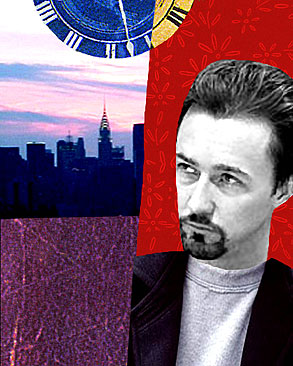

“But who can take a dream for truth?”
— Robert Browning
Spike Lee can. Lee’s latest film, “25th Hour,” which got lost in the glut of prestige Christmas releases, climaxes with a dream that has so much emotional conviction, so much faith in the possibility of still being able to live a good life in America, that you’d have to be a complete cynic to think he’s putting one over on us. The movie is both a lament for the chances at a good life that we — individually and as a nation — have let slide and a profession of thanks for the chances that still exist. And yet that thanks is couched in a profound awareness of fragility. That fragility is apparent in the shot that closes the credit sequence — a view of the Manhattan skyline with the ghostly twin beams of light that emanated from ground zero six months after the attack. Never before has the city looked so stark, so impermanent against the nighttime sky, as if it were some magnificent set that had been erected for the camera and would be collapsed and put into storage when the director had the shot.
Sept. 11, 2001, is referred to directly only a few times in “25th Hour,” and yet the entire movie is overshadowed by it. Nothing I’ve seen or read — nothing — understands what it felt like to live in New York City after Sept. 11 the way “25th Hour” does. By the time the movie gets to its closing line — “This life came so close to not happening” — those of us who lived in the city that fall are likely experiencing what we felt in our bones during those days, amazed that anyone got it on-screen with such uncanny accuracy. And maybe even more amazed that Lee was the one to do it.
I gave up even my professional interest in seeing Spike Lee movies some years back. I was sick of his racism (particularly toward Jews and Italians), sick of his misogyny (particularly toward white women), sick of getting clubbed over the noggin with his various harangues. As each movie was released and — inevitably — failed at the box office, you could count on Lee to blame that failure on the racism of Hollywood. Instead of the respectful, sometimes worshipful tone of the reviews he got, I longed for someone to confront Lee with the fact that black audiences weren’t going to see his movies either. He had, as a friend of mine recently observed, become something like the black Woody Allen.
So I winced early on in “25th Hour” when Edward Norton, as the movie’s hero, Monty Brogan, a drug dealer having his final day of freedom before beginning a seven-year prison sentence, goes into a monologue in which, one by one, he tells every ethnicity and class in New York to go fuck themselves. As Lee shoots it, it’s an awfully showy sequence. Monty has stepped into a restaurant men’s room to splash some water on his face, and sees “Fuck you!” written on the mirror. And he — or rather his reflection in the mirror begins to riff, starting with “No, fuck you!” Lee cuts to fish-eye views of some of the stereotypes we’ve seen before in his movies — hawk-nosed Jews, beady-eyed Korean deli owners, loudmouthed Bensonhurst goombahs. This time around, they’re joined by other stereotypes, all shot with equal ugliness — Upper East Side matrons stretched tight from rounds of plastic surgery, surly Sikh cabbies, Brighton Beach Russian mobsters, Chelsea gays, Master of the Universe Wall Street traders. At the beginning of the scene, I was certain Lee was up to his old tricks. Then I began shaking with laughter.
On the surface the scene is the oldest stand-up routine, Don Rickles working his way through every poor shlub who’s paid money to be insulted by him. Except there’s no grandstanding in Edward Norton’s performance. But then, is there ever any grandstanding in an Edward Norton performance? Norton is one of the subtlest actors around, a guy who, as Pauline Kael once said of Gene Hackman, gets so fully immersed in his characters that he’s always in danger of being underrated by having people say he’s good. Even playing a drug dealer, Norton doesn’t go in for the streetwise hood clichés.
Monty is a softie — a businessman, not a muscleman. That’s what has him terrified about his upcoming prison stretch. He’s sure of himself when using the VIP entrance at glitzy clubs, or lounging in his spartan-chic bachelor apartment (his framed “Cool Hand Luke” poster tells you exactly where’s he’s gotten his notions of tough-guy cool). But he knows he’ll be catnip for the tough cons he’ll face behind bars. The goatee Monty wears is very touching. It gives Norton the boyishness of an adolescent trying to act hipper than he is.
Norton’s likability, the fact that he’s one of the few actors around whose eyes genuinely twinkle without turning him into a cutie-pie, is what gives the stream of invective its out-of-nowhere punch. Monty doesn’t really mean what he’s saying. Or, to be more accurate, he means it as much as any other New Yorker. And that’s the kick of the scene. Monty’s speech is a manic version of the free-floating hostility all of us in New York give in to when somebody in front of us on the sidewalk isn’t moving fast enough, when some store owner treats us curtly, when some cabbie gets stuck in traffic, when somebody beats us to the only seat on a crowded subway train. The patience you have to have to live in such a crowded, noisy, abrasive city manifests itself in daily — sometimes hourly — bursts of impatience. And the worse the day we’re having, the nastier our spiel gets.
Lee finds the common ground in this collective hostility by offering up Osama bin Laden as the last target of Monty’s rant. We may all hate each other, Monty might be saying, but we all hate that cave-dwelling donkeyfucker. It’s a good, nasty New York joke. But it feels like nothing, a cheap gag, compared to the real payoff to this sequence which, coming at the end of the movie, is its most emotionally overwhelming moment.
Ever since Sept. 11, we’ve heard news anchors and Op-Ed writers, cab drivers and people in the street all say, “Things will never be the same.” Those words have sprung so glibly to so many lips that they prevent us from asking just how things will never be the same. Lee doesn’t pretend to answer that question in terms of foreign policy or increased security measures. He’s trying instead to get at how something so dire seeps into every bit of our existence, how the very texture of our lives soaks it up.
For me, Sept. 11 wells up in “25th Hour” in the sudden lost look that takes over each character’s face; in the way the subject is broached so tentatively (“Any of those guys coming back in here?” Monty asks his dad, talking about the firemen who frequent the older man’s Irish bar); in the loneliness that permeates even the movie’s most intimate and loving encounters; in the invocation of the beauty and burden of what it meant to walk down a street and feel that you were connected to every person you passed, even if those were the people that, like Monty, you had been cursing a week before.
In William Gibson’s new novel, “Pattern Recognition,” a character whose father disappeared on Sept. 11 notes that, of all the hundreds of posters for the missing that were everywhere in the city, not one was posted on top of another one. It would have been unthinkable for that to happen. For a few weeks, the city seemed to expand its streets and avenues to make room for the dead as well as the living. The memory of the dead wasn’t in the air; the dead were the air. There was nothing repugnant about that, certainly not in the way people talk about the stench of human remains at disaster sites. It seemed fitting that New Yorkers should be literally breathing the dead. We the living had become walking crypts.
There were fewer people than usual on the streets of New York in the fall of 2001, yet it took longer to get anywhere. Mostly because those “MISSING” posters (the word itself a choice of almost unbearable optimism) kept calling to you. The people on those posters, even more than the daily pictures of the dead that continued for months in the New York Times, were presences as real as the particles we all carried within us. You had to look at those posters, to acknowledge the fact of each person, if only for a second, before going on your way. There was no leaving them behind. The posters were speaking to us in a new language, not out of a false delicacy or tact but in an attempt to talk of awful things to people who had already been rubbed raw. When a poster for a missing young woman described her tattoo, you understood that the detail was there to aid in the identification of her remains.
That sense of needing to imprint everything on your mind before moving on, the idea of memory as a bulwark against loss, is the reason why the individual scenes feel elongated in “25th Hour.” Lee’s use of long takes with an unmoving camera, his willingness to let scenes unfold and give actors the time and space to feel their way through, gives the movie a persistent tentativeness. “25th Hour” follows Monty as he says his goodbyes to his dad (Brian Cox), his best friends (Barry Pepper and Philip Seymour Hoffman), his girlfriend Naturelle (the wonderful Rosario Dawson), even Doyle, the abused dog he rescues at the start of the movie.
These goodbyes are taking place in a city where goodbye has become a way of life, where everything and everyone so familiar to us could be gone in a flash. Where, as the movie’s final line says, “This life came so close to not happening.” The encounters are more resigned than pained, full of awkward, gaping spaces. The characters here are watching every word they say, weighing them, painfully aware of their inadequacy. What do you say to someone in Monty’s position — what can he say to the people he’s let down — that wouldn’t sound ridiculously false?
That’s the connection being made between Monty’s story (adapted by David Benioff from his novel) and Sept. 11. The movie is about human interaction thrown into relief by both the memory of disaster and the unknown disasters to come. Lee is asking how we continue to connect to the people we love in the face of fear, asking how we dare to believe in the future, even the chance of a future.
Those fears pull like a weight in the center of your chest in the scenes between Norton and Dawson. Even when Monty refuses Naturelle’s request to join her in the bathtub, you still feel the enormous tenderness between them. Yet that tenderness remains largely unspoken, because to admit it would be to open themselves up to the pain that their coming separation will mean. In “25th Hour” we are in a world where people are connected by their shared proximity to an event and yet always tempted to retreat into isolation. Isolation may be the price they pay for being able to get out of bed in the morning, to walk the dog or buy a paper. The need to connect is side by side here with the vulnerability that connecting leaves them open to.
“25th Hour” is, on the surface, a tale of how men deal with their emotions by denying them, tamping them down. The heart of the movie is what roils beneath the surface, the story of people struggling to find words to give weight and shape to an event that seems unimaginable and a future that offers no comfort, and no certainties, neither good nor bad. In one scene Pepper, whose character is a hotshot Wall Street trader, and Hoffman meet up in Pepper’s swank high-rise apartment. They treat each other with the forced bonhomie of formerly close friends who grew apart long ago, trying to pretend their connection is as strong as ever.
As they talk the two of them make their way to the apartment’s picture window, and suddenly we’re looking with them down on the emptiness of ground zero. The images that cinematographer Rodrigo Prieto gives us are simple, even banal images, ones we saw on the news over and over again. A man stands raking the dirt. A dump truck rolls up the highway, like thousands before and after it, on the way to the landfill where the debris of the twin towers was collected. Maybe because the surrounding darkness throws the workers, the truck and the site itself into relief, it feels as if we are seeing those images for the first time. They are profoundly ambiguous images. Why is that man raking dirt? The task feels both futile and necessary. Prieto’s images are the simplest means of conveying how these people, and by extension the people who died there, are dwarfed by the immensity of the event. But they also convey sheer human persistence in the face of that immensity.
All the oblique, implied meanings of “25th Hour” come together in the final sequence (and as a warning to those of you who haven’t seen it, there’s no way to discuss this without giving away the ending of the movie). Monty’s father has come to his son’s apartment to drive him to prison. Along the way he offers to help his son escape, to drive west and just keep going. Suddenly, we’ve left the Henry Hudson Parkway and are driving on two-lane Midwest highways and then through desert towns. Cox’s voice takes over on the soundtrack, the soothing voice of a father telling his grown son that things can still be all right, talking to his son like an adult but with the fierce protective instinct parents feel for their newborn.
He tells Monty that he can choose one of those desert towns, get a new identity and a job. As he talks, we see father and son stopping off for a beer in some nameless bar. Then Monty is alone, having his photo surreptitiously taken by an old desert rat who makes his living forging I.D.s. The guy must have a hundred piercings in his face. He’s only on-screen for a minute but you look at him, wondering, “What’s this guy’s story?” You realize that, like Monty, he’s come there to escape something and to start a new life. Maybe he’s making money by extending to his customers the same freedom he found. We see Monty at work behind the bar of a small-town tavern, a welcoming face to his regulars and a good guy to his co-workers. We see something like gratitude in Norton’s face. This may not be the life he imagined for himself, but it’s a life he got to choose, and better than the one that awaited him in prison.
Monty’s dad promises his son that after a few years he’ll find a way to send Naturelle to him. Lee goes on to envision the couple’s future, their life progressing surrounded by happy children and then grandchildren. The images follow one another so seamlessly that we feel as if the natural flow of a life were taking place on the screen. They seem less to have been imagined than to have been found — as if this life were waiting for any of us to find.
We know, of course, even as we want more than anything to believe it, that it’s a dream. Sooner or later, we’ll be back with Monty, in his dad’s car, on the way to prison. But the preternatural familiarity of the imagery won’t go away. Even if we’ve never been there, we’ve seen these places before, towns where everyone knows each other at the local bar, where the Greyhound still stops in the center of town. We’ve seen them in WPA photographs, or maybe in our family albums. It’s our collective dream of the American past, what Don Henley, in his song “The End of the Innocence,” called “that same small town in each of us.” But who knew that same small town existed in Spike Lee?
If there were any small town inside Spike Lee, it was never anything bigger than a block in Brooklyn. At times, he has seemed not only the most divisive American filmmaker, but also the most cloistered. He may have been working in a different neighborhood than Woody Allen, but like Allen he has always seemed like a New Yorker content never to leave his own neighborhood. Were Lee ever to have depicted a small town in one of his movies before, it would probably have been as a place where someone like him was not welcome.
After all, no outsiders were welcome in the communities he put on-screen. You didn’t need to be an Italian-American or a Korean immigrant operating a business in an African-American neighborhood (as in “Do the Right Thing”) or a shylock running a jazz club (as in “Mo’ Better Blues”) to be made to feel like an intruder, a usurper. You could simply be a white guy who had moved into the neighborhood wearing a Larry Bird T-shirt (John Savage in “Do the Right Thing”), or the white she-devil that dares to destroy the sanctity of the black family (Annabella Sciorra in “Jungle Fever”). If you were Spike Lee, you could get away with what would have been labeled racist, misogynist and anti-Semitic in any other filmmaker’s work. You could get away with it because you were an authentic voice of rage or oppression or whatever signifier you care to put in that sentence.
If there’s one way to gauge Lee’s achievement in “25th Hour,” to measure the sheer generosity of the film, it’s simply this: He knows that all bets are off and that falling back on the old ways of thinking about the world will no longer suffice. Lee has had the bravery to make a movie in which he realizes that his most cherished preconceptions are no longer adequate, and in which he disdains the divisiveness of his previous work. To give just the smallest example: the affection that exists between Monty’s Irish dad and his Puerto Rican girlfriend and the dad’s refusal to listen when people around Monty try to tell him that Naturelle was the one who turned Monty in. In “25th Hour” Lee is, for the first time, thinking outside his block.
Lee is affirming that the vision of America that ends the film, an America that may exist only in our shared iconic memory, is part of him, too. He films battered main streets with peeling clapboard on each building, signs painted on the sides of buildings decades ago that are still visible after years of being exposed to the elements. Informing this all are people who, like the beaten-up buildings in these old towns, refuse to fade away. It’s a mixture of races Lee shows us, maybe more of a mixture than we would find in these rural towns. That, too, is the point: The life he is showing us has room for everyone. It’s a promise that’s still open, with the potential for grace or camaraderie or simple kindness, with the possibility of a future.
The promise this vision of America offers — no less than the chance at a life we can still be proud of — not just to Monty but to Lee and to us, is too real. It is too keenly felt to be a fake, although it is no longer a certainty.
By the time “25th Hour” reaches its climax, it’s clear that Lee is trying to grab as much of his city and as much of his country in his embrace as he can. He also expands his embrace to include people he has never previously considered, and he holds on for as long as film runs through his camera, or through the projector on the screen in front of us. It’s the rough, loving embrace you give someone you have no idea if you’ll ever see again.
Will this generosity continue to flourish in Spike Lee? It’s impossible to say. But whether it does or not won’t diminish the fact that Lee has worked with an honesty of feeling equal to his subject that many more celebrated thinkers have refused.
Writing an open letter to President John F. Kennedy in early 1963, a few months after the end of the Cuban missile crisis, Norman Mailer raised the question of a Look magazine report about the underground bomb shelters in Virginia and Maryland where the president and his Cabinet could retreat in case of attack. What about Kennedy’s family, Mailer wondered?
Mailer went on to propose a solution that would assure us the president himself had something to lose if he were to push the button. “Why not send us a hostage?” Mailer asked. “Why not let us have Jacqueline Kennedy?” A president faced with the possibility of loss, Mailer reasoned, would tell us he was “ready to suffer as we suffer, and that the weakness we feel before war is not merely our own pathetic inability to stare into the mountain passes of Heaven, the stench of Hell … but is the impotence of men who would be brave, and yet must look at the children they have become powerless to protect.” In “25th Hour” Spike Lee has given us himself as a hostage.
