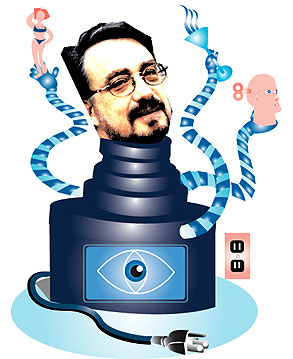

Artificial Intelligence

Artificial stupidity

The saga of Hugh Loebner and his search for an intelligent bot has almost everything: Sex, lawsuits and feuding computer scientists. There's only one thing missing: Smart machines.

  • more
    • All Share Services

Artificial stupidity

All Hugh Loebner wanted to do was become world famous, eliminate all human toil, and get laid a lot. And he was willing to put up lots of good money to do so. He’s a generous, fun-loving soul who likes to laugh, especially at himself. So why does everybody dislike him so much? Why does everybody give him such a hard time?

Actually, not everybody does dislike him. He is beloved among sex workers, of whose rights he is a tireless advocate. Loebner also has friends, or at least people willing to hang out with him for short intervals, among the eccentric group of self-tutored hackers and robot builders who participate in the annual competition for the Loebner Prize in artificial intelligence.

Since 1989 Loebner has spent, by his account, more than $200,000 and a thousand hours of unpaid time to hasten the arrival of intelligent machines. He has set aside a gold medal and $100,000 in cash for the creator of the first machine that can pass for human. In the meantime he gives out annual prizes for programs that come closest to a long-sought holy grail in the artificial intelligence community: passing the Turing test.

But Hugh Gene Loebner, a fast-talking hardware manufacturer who has a distracted air, a Ph.D. in sociology, and an intense devotion to what he calls WWS (wine, women and song), is assiduously avoided by virtually everybody who has helped him organize his contests over the past dozen years or so. He is considered pushy and unpleasant by some of his biggest fans. And he is anathema to the self-proclaimed leading lights of “real” A.I., who loathe Hugh Loebner with a passion that borders, ironically, on the irrational.

For example, MIT professor Marvin Minsky — known by his disciples as the father of artificial intelligence — calls Loebner’s prize “obnoxious and stupid” and has offered a cash award of his own to anybody who can persuade Loebner to abolish his prize and go back to minding his own business. The mere mention of Loebner’s name is sometimes enough to get the father of artificial intelligence talking about lawsuits.

It’s easy to understand why contest organizers don’t have much good to say about Dr. Loebner — in their experience, he’s a control freak and congenital, chronic pain in the ass. People say that the more you go out of your way to do Hugh Loebner a favor, the more he treats you like hired help. Even participants in past Loebner contests say similar things. But what can account for this passion of the academic A.I. community, for whose benefit Loebner took out a mortgage on his house to endow the $100,000 grand prize? All he wants to do is give them his money for work they were going to do anyway!

To win the Loebner competition, software programs must mimic human conversation. Such programs are known as “chatting robots” or, more often, “chatterbots” or simply “bots.” But today’s academic A.I. researchers consider the chatterbot approach simpleminded. The Loebner competition, they argue, isn’t a real measure of progress in artificial intelligence but merely a “bot beauty contest.” To mainstream researchers, Loebner is a self-aggrandizing fool and his contest is hokum: at best irrelevant and at worst a public disservice that encourages bad science.

Loebner contests are often farcical and Hugh Loebner does act foolishly. But the closer one looks at the history of the Loebner Prize, the more it appears that Loebner’s real offense was showing up the biggest stars in “real” artificial intelligence as a bunch of phonies. Thirty years ago, Minsky and other A.I. researchers were declaring that the problem of artificial intelligence would be solved in less than a decade. But they were wrong, and every year the failure of computer programs to get anywhere close to winning the Loebner Prize underlines just how spectacularly off the mark they were.

Alan Turing was the British mathematician, cryptographer and prototypical computer scientist who, some say, did as much as Winston Churchill to save Western civilization from the Nazis. He was also perhaps the most influential thinker of the 20th century — in the sense that his ideas are the foundation upon which is built computer science and thus our entire digital world. He started the modern discussion about minds, machines and artificial intelligence. Turing was gay and did not hide it; for this he was shunned by his peers and forced by the government to undergo hormone “therapy.” He killed himself in 1954, and it is widely believed that he did so to escape persecution over his sexual preference.

The Turing test is the canonical benchmark by which we humans will know that computers have caught up with us in the smarts department. In 1950 — barely two years after the construction of the first machine that could reasonably be called a computer — Alan Turing proposed a simple test to determine whether machines could think. If you were conversing with an entity and you could not tell whether that entity was human or merely human-made, then whatever you were conversing with was at least as intelligent as you were. Turing predicted that computers would pass this test by the year 2000.

Long known to historians of the computer, the Turing test emerged from obscurity and became part of popular culture in 1966, when Joseph Weizenbaum’s simple 200-line Eliza program, which used a few simple tricks to generate bland responses to human-posed questions, fooled people into thinking they were conversing with an intelligent being.

Although the challenge was at first embraced by the academic A.I. community, passing the Turing test — which proved to be a rather more difficult nut to crack than some prominent A.I. people had said it would be — has long since fallen out of fashion as a legitimate goal or benchmark among “real” A.I. researchers. The A.I. establishment has for more than a decade put more energy into explaining why the Turing test is irrelevant than it has into passing it.

The Loebner competition is designed to provide a real-world opportunity for bots to pass the Turing test. And even though the academics are loudly boycotting the Loebner competition today, that doesn’t mean it wants for entrants.

There are three categories in the Loebner Prize. The grand prize of $100,000 and a gold medal bearing the likeness of Hugh Loebner will go to the first non-human entity that passes what Loebner calls the “full” Turing test (although the criteria for what constitutes “full” are a little vague.) A silver medallion and $25,000 will go to the winner of a somewhat more rigorously defined “limited” Turing test. And a bronze medallion and $2,000 are awarded annually to whichever program is judged best according to the rules in force at that time.

Contestants have included two-time winner Robby Garner, a self-taught computer programmer and robot builder; Benji Adams, the creator of the Web site Personality Forge, home of hundreds of chatterbot “personalities”; and perhaps the most famous (or infamous) of them all, two-time winner Dr. Richard Wallace, founder of the ALICE Foundation. Dr. Wallace, who, by his own admission suffers from a debilitating mental illness — which he mitigates with daily doses of medicinal marijuana — is known not only for his unorthodox theories about consciousness and intelligence but also for the restraining order that keeps him off the University of California campus in Berkeley. Something about the Loebner Prize seems to draw eccentrics out of the woodwork, and chaos itself is the very essence of the annual ritual.

The 2002 contest, hosted in Atlanta by the Institute of Mimetic Science, had the most participants ever. More than 40 bots were entered, from which, by some apparently occult process, a final field of eight was selected.

The event itself, by most accounts, was conducted with all the dignity and pomp of the finale of the Marx Brothers’ “Duck Soup,” although it perhaps lacked some of Freedonia’s essential seriousness. Every person with whom I spoke about it said that last year’s contest was an utter fiasco, with unclear rules, inconsistent judging, arbitrary fiats by an opaque prize committee, petulant prima donnas, and last-minute changes of venue that prevented most entrants from even discovering where the contest was taking place until after it had happened.

There are strongly divergent views about the cause of those problems, and in asking some of the principals a few questions about it I soon felt that I had set myself up as Judge Wapner, with each of the aggrieved parties anxious to get their story out to the world. Benji Adams was the most forthcoming; his 26-page memo, in its righteousness and obsessive attention to every slight — replete with chronologies and an e-mail trail documenting the alleged incompetence or malfeasance of the Loebner competition committee — reminded me of nothing so much as Kenneth Starr’s report to Congress.

By tradition, three things happen at the conclusion of every Loebner contest: The winners take their prizes and run for the nearest exit, Hugh Loebner basks in glory, and the hosting organization takes a solemn oath: “Never again.”

Over the 11 years of its existence the Loebner competition has taken place in nine locations, including the Boston Computer Museum, the London Museum of Science, Dartmouth College, Flinders University of South Australia and, during a particularly dark period in the prize’s short history, in the billiard room of the private Salmagundi Club in New York City, of which Loebner is a member.

Despite the differing locations, the contest has always been conducted under the auspices of the Cambridge Center for Behavioral Studies, an obscure Massachusetts-based nonprofit that apparently doesn’t do much beyond running the Loebner competition and yet, as we’ll see, would dearly love to have nothing to do with the contest at all.

There’s no waiting list of prestigious institutions clamoring for the honor of physically hosting the contest these days. Rather, the Loebner competition has proven so stressful to its host that it’s seldom invited back, and each year the Cambridge Center must scramble to find a new home for it, as a social service agency might scramble to find a foster home for a troublesome adolescent. Three years ago the Cambridge Center seemed to have found a permanent home for its problem child: With great fanfare, the London Museum of Science and the Cambridge Center jointly announced that the museum would be home to the Loebner competition for the next 44 years. After one dose of the Loebner competition, however, the museum had changed its mind and annulled the agreement. Once again the Cambridge Center was shopping for a suitable foster home.

Every year finding another institution to host the Loebner competition becomes a little harder; “selling” the Loebner has become, for the Cambridge Center, a job akin to selling the Brooklyn Bridge. And yet each year, one way or another, Loebner himself has made sure that the show goes on.

Today, however, Hugh Loebner is on the brink of initiating legal action that may finally do what the combined efforts of his detractors have been unable to do for a decade, which is to make him take his money and go home. For years Loebner and the Cambridge Center for Behavioral Studies have been stuck in a dysfunctional marriage of sorts. But now Loebner and the center are flirting with divorce, and it may be a messy one. If they do wind up in court, which Loebner tells me is likely, it’s hard to see how the prize will survive.

In fact, although the University of Surrey (U.K.) has announced that it will host the 2003 competition next October, there’s always a possibility that it will back out. The last Loebner bronze medallion may already have been won, and the silver and gold medallions may wind up for sale on eBay before anyone has earned them.

It wasn’t always like this.

When Hugh Loebner created the Loebner Prize in 1989 to spur progress toward technology that could pass the Turing test, the A.I. establishment welcomed him with open arms. Under the aegis of the Cambridge Center, a blue-ribbon panel chaired by cognitive scientist and author Daniel Dennett and composed of a who’s who of computer scientists from leading institutions, organized the first contest and wrote the first rules. When, after two years of planning, the first event was held in 1991 at Boston’s Computer Museum, it was a gala affair partially underwritten by the National Science Foundation and Sloan Foundation.

Hype had been building for months, and when the actual contest finally took place, reporters from the popular and scientific press thronged the hall. Robert Epstein, director emeritus of the Cambridge Center and a former subordinate of Loebner’s at University of Maryland in Baltimore County (UMBC) acted as master of ceremonies. When you consider that Loebner’s degrees are in sociology, not computer or cognitive science, and that before his return to the family business his only employment in the groves of academe was as an assistant director of the statistics center at UMBC, you see what a stunning coup he had pulled off. It was as if the goofiest nerd in the entire high school had wormed his way into the “A” clique, the one led by the rich, handsome quarterback and the beauty queen/state tennis champ.

There was only one problem: the A.I. programs entered in the contest performed horribly. They were pathetic. The mountain, as it were, had gone into labor and given birth to a mouse.

“Perhaps the most conspicuous characteristic of the six computer programs was their poor performance.” This damning summary of the first event appears in the article “Lessons From a Restricted Turing Test,” by Harvard professor Stuart Shieber, in the Communications of the Association for Computing Machinery (CACM), the house organ for the computer science establishment. The winning program, by Joseph Weintraub, was a very simple variant of Joseph Weizenbaum’s 25-year-old Eliza program. Worse, the article reported, “Dr. Epstein, in a speech after the event, noted that he had learned from the day’s proceedings that ‘little progress has been made in the last twenty-five years.’”

It had to be said, and Epstein said it: The emperor had no clothes. After decades of government-funded research by the brightest minds in computer science, A.I. programs still stank, and the National Science Foundation and Sloan Foundation had just spent $80,000 to demonstrate this sad fact to the world. Now what?

The answer, according to Shieber, was obvious: stop running the contest! The world wasn’t ready for a Loebner Prize, he said, so having one was counterproductive.

The wheels of the ACM grind exceedingly fine, but they grind slowly, and Shieber’s report on the 1991 Loebner contest did not appear until the spring of 1994. In the meanwhile Dennett’s committee gamely soldiered on and conducted two more contests (attended by considerably less hype and similarly unimpressive results). But once Shieber’s article appeared, the world had changed. The Party had spoken, saying, in effect, “Loebner is making us look bad. Make him go away (but see if you can find a way to keep the money).” Dennett and other members of the committee tried to get Loebner to change his contest along lines suggested by Shieber, but he refused. Shortly thereafter Dennett and his committee resigned en masse, angry at Loebner’s intransigence and generally sick of dealing with him. Dennett is still bitter about this episode.

Actually, the themes “angry at Loebner” and “generally sick of dealing with him,” came up a lot in my research for this article, although not many people were willing to use those phrases for attribution. For example, I discovered that sometime before Dennett’s resignation, Loebner and his old friend Epstein had ceased to be on speaking terms. Epstein was the first of many people associated with the contest who are no longer on speaking terms with Hugh Loebner. Even his friends and fans find him, well, hard to take in anything other than small doses. In the words of Robby Garner — a two-time Loebner Bronze winner, and currently a member of the 2003 contest committee, “Loebner was criticized early on for his self-aggrandizement, and he has hardly disappointed any of those detractors if they have ever spent any time or shared a meal with the man.”

Who is this man who seems to attract controversy the way picnics attract ants?

- – - – - – - – - –

I first heard of Hugh Loebner from a friend of mine who had attended a conference in the fall of 2002 for users of the Lisp programming language, the language favored for most A.I. work. He told me about Loebner, about his prize, and about what it was like to have a conversation with him. “Loebner’s one of those guys who’s always trying to catch up with his own thoughts,” my friend said. “You can almost see him running after them.” And then he added, “It’s not clear whether going through life both very intelligent and very ignorant is a wise strategy, but that seems to be the one he has chosen.”

I was intrigued by my friend’s story about the Loebner competition, because last August I published a novella, called “Cheap Complex Devices,” that purported to comprise the chronicle of, and the results from, a storytelling competition between researchers vying for the inaugural “Hofstadter Prize for Machine-Written Narrative.” The contest was named after Douglas Hofstadter, the Peter Pan-ish author of the Pulitzer Prize-winning favorite book of every freshman student of cognitive science: “Gödel, Escher, Bach: An Eternal Golden Braid.”

Like Hofstadter’s, my book is about minds and machines, and it is basically incomprehensible (at least to me), but unlike his book, mine at least has skulduggery, sex, egomaniacal and possibly delusional computer scientists, pathos, a bitterly feuding prize committee, and a whore with a heart of gold. I really like my book, and I’m glad I wrote it. So I am quite happy that I had never heard of Hugh Loebner, or of the Loebner Prize for Artificial Intelligence, before I undertook to write “Cheap Complex Devices,” for had I known then what I know now, I never would have bothered. The story had already been done!

Among other things, “Cheap Complex Devices” is a lampoon of the technology cult of MIT’s A.I. Laboratory (co-founded by Marvin Minsky) and Media Lab (with which Minsky is closely associated) and places like them. Being a techno-paranoid humanist, I find techno-utopian trans-humanists of the Minsky ilk an affront. I desire to live in a world without future shock, and they want to shock me every chance they get.

I loathe “progress”; they worship it. But, paradoxically, I find myself annoyed by the way the A.I. elite has, for decades, promised far more than it has delivered. So I’m annoyed with self-promoting A.I. visionaries for moving both too fast and too slow. Or maybe I’m just touchy because as a member of the usability engineering group at Sun Microsystems in the early ’90s I was a frequent participant at conferences where Media Lab triumphalism was as predictable as sunrise. In any event I felt like giving them a pie in the face.

Which is to say that although Loebner wants to live in the 22nd century and I want to live in the 19th, both of us seem to have a thing about tweaking the noses of the A.I. establishment. I was predisposed to like the fellow.

I checked out Loebner’s Web site. It was cheesy, poorly laid out, and surprisingly light in content. Somehow I had expected more pizzazz from somebody aggressively pushing the limits of computer intelligence. I had not known, before visiting his site, that his favorite political causes are the legalization of prostitution and setting the record straight about the Olympics’ so-called gold medals. (They’re actually gold-plated silver, it turns out, so they should be called “gilt” medals.)

I found myself in agreement with Loebner on both of those issues, and I respected his being an “out and proud” john, that is, someone who pays for sex with prostitutes. On the other hand, being neither an Olympic athlete nor a patron of sex workers, I didn’t find myself especially worked up about either topic. I was about to surf someplace else and forget all about this self-proclaimed gadfly. But then I read about his spat with Marvin Minsky, and I knew I had to talk to this guy.

I first spoke with Loebner last November. I wanted to find out about his prize, but mostly I wanted to ask him about his public virtual spitball fight with Minsky.

I was a little nervous in calling him, because being a reporter doesn’t come easy to me — I’ve never been good at taking notes. I was a little taken aback, then, that he didn’t remember who I was or that we had set up an appointment, and that he was evidently taking my call on the manufacturing floor of his company, Crown Industries of East Orange, N.J. — a maker of stanchions and ropes (used by banks to keep their customers in line), brass rails and fittings, bellman’s carts, pedestal tables, folding table legs, and roll-up illuminated disco floors. People were loudly speaking in the background and things were clanging, and a couple of times it sounded as though he had put his hand over the phone and was giving directives while I was speaking to him. Several times he forgot what I had asked him. Like King George, he tended to say “What? What?” I would repeat my question and he would say, “Oh yes. Oh yes. Minsky. Quite the story. Quite.” So much for the Bill Moyers thing.

Loebner talks very, very fast. And he doesn’t seem to pay much attention to what you’re saying. Nevertheless I found him pleasant and interesting. He speaks with the candor of a child, and sometimes uses a child’s language. For example, I asked him how he had decided to put up such a large sum of money to endow his prize.

“I wanted to draw attention to the Turing test,” he said. “I thought it was about time that somebody did. Daddy didn’t want to, but Daddy died. So I put up the money.”

That’s one of the few verbatim quotes I have from our first conversation. My note-taking skills were no match for his output.

Loebner has many enthusiasms. He likes prostitutes. He likes marijuana. He likes pornography. He likes the Loebner Prize. He likes wine and fine paintings. And he likes Hugh Loebner. He spoke enthusiastically about all those things. But I was surprised to learn that he didn’t seem to care much about artificial intelligence, per se.

His interest in the field has always been pragmatic, he told me, never philosophical. He’s a hedonist who thinks work is an abomination and sloth is our greatest virtue. He got interested in A.I. because he hoped the day would come when robots and A.I.’s could do all the work and people could play all the time. I asked him about the current state of A.I. research. Well, he said, some progress was evidently being made in the area of “decision support” systems, but that didn’t really interest him too much. What about the quality of entrants in his competition? “Pretty gruesome,” he said. “Gruesome.”

I was surprised to learn that he had not even read the transcripts of the prior year’s competition. He didn’t very much care for chatting with the bots himself; they were too stupid.

I was also surprised at how open Loebner was about his emotions. He laughed a lot and yet he told me, after we had spoken for perhaps a minute, that he was deeply depressed about his prize, that he had not slept at all for the previous two nights from worrying about it. He spoke to me, after knowing me for 60 seconds by phone, in a way that I would only speak to my closest confidants. He was in dark despair, he told me.

What was troubling him was that it was November 2002 and the Cambridge Center had not yet announced the date and venue for the 2003 contest. Loebner had just instructed his attorney to tell the center that if it did not make an announcement by Jan. 2, 2003, he would sue to get his money back and thereafter administer the prize himself. He seemed genuinely anguished by the prospect of going to court, but resolute.

When he had made the gift to the Cambridge Center he attached only three strings, he said: that the Loebner contest be conducted every year, that a prize be given every year, as long as there was at least one entrant, and that the rules by which the contest was run be acceptable to Loebner and to the Cambridge Center. Now he was suspicious that the center, because it had not announced the next year’s competition, was leaving open the possibility that no contest would be held. This prospect drove him nuts. As far as he was concerned, if the Cambridge Center could not find a suitable organization to conduct the contest, then the center’s staff should conduct it themselves.

The job of organizing and conducting the contest was trivial, he said. “It’s a very simple concept. One person could do it without headwind.” If it so transpired that organizing the contest fell to him, he said, he would probably just conduct it in his New York City apartment. The important thing was that the contest happen, not where it happened or who sponsored it.

If one thing makes Loebner see red, it’s the idea that his contest will not be held every year. “On this point I have been stalwart,” he said. “I have been adamant. I have been steadfast.” And then he offered to send me copies of recent and pending letters between his lawyers and the center’s.

The more he told me of his simmering argument with the Cambridge Center, the more I felt myself being handed a mini Mike Wallace-style story, which made me uncomfortable. “Why are you telling me all this?” I asked him. “I’m a reporter. Do you really want me to write a story ‘Eccentric Philanthropist Set to Sue His Own Contest’? Won’t that just make matters worse for you?”

“Sure,” he said. “But go ahead. Write it. Stir things up. Let’s see what happens.”

And then we talked about the whole Minsky episode.

It’s instructive to take a closer look at Shieber’s 1994 CACM article. Shieber goes on at great length about just what a stupid idea the whole Loebner Prize was and then proceeds to lecture Loebner about how to spend his money:

“Given that the Loebner Prize, as constituted, is at best a diversion of effort and attention and at worst a disparagement of the scientific community, what might a better alternative use of Dr. Loebner’s largesse be? …. In order to prevent degrading of the imprimatur of the reconstructed Loebner Prize, it would be awarded on an occasional basis, only when a sufficiently deserving new result, idea, or development presented itself.”

Shieber was well aware that Loebner had, in making his gift to the Cambridge Center, set three stipulations. Shieber derisively dismissed all three. He suggested instead that Loebner give his money to a commission of experts (such as Stuart Shieber) in order that they might give it out whenever they felt like it, according to criteria set by experts — without any meddling from disco-floor makers or other amateurs.

Never a shy violet, Loebner wrote a response, published in the same issue, taking Shieber head-on.

“Shieber would like to tell me how I should spend my money. He suggests alternative prizes for my ‘largesse.’ In my letter of December 30, 1988 to Dr. Robert Epstein, wherein I authorized Dr. Epstein to move forward with the contest, and referring to the Turing Test, I concluded with these words: ‘Robert, in years to come, there may be richer prizes, and more prestigious contests, but gads, this will always be the oldest’” Well, one out of three isn’t bad. I was aware when I penned those words that I had no patent on prizes, and that opportunities to reward advances in A.I. were not barred to others. I look forward with great anticipation to The Shieber Prize.”

He went on, a bit later, to give some of his reasons for initiating the prize:

“My primary purpose was to develop the Turing Test itself. By the time I thought of my prize, Turing’s article proposing the test was decades old. A.I. scientists and philosophers regularly discussed the test, yet no one had taken steps to implement it … The initial Loebner Prize contest was the first time that the Turing Test had ever been formally tried. This in itself justified the endeavor. It also introduced the Turing Test to a wide public, and stimulated interest in it. To my knowledge, no one had asked, let alone answered, the many important questions about the Turing Test which must eventually be solved.”

Then Loebner rebutted Shieber’s contention that the contest was premature and gave his rationale for insisting on an annual contest, concluding: “I am not worried that the winning entries in early years are primitive. Their inadequacies are incentives for others to enter the contest.”

In going through the ACM online archives, I was amused to see contemporary commentary to the effect that Shieber had hit the nail on the head and that silly Hugh Loebner just didn’t get it. This struck me as odd, because to my reading Shieber’s analysis and recommendations seem snide and puerile, whereas Loebner’s seem cogent and, what’s more, playful. “My reaction to intelligence is the same as my reaction to pornography,” he wrote. “I can’t define it but I like it when I see it.”

In 1995, about a year after the publication of Shieber’s article, Marvin Minsky, the father of artificial intelligence, posted a notice on the comp.ai and comp.ai.philosophy Usenet newsgroups. In it he drew attention to a clause in the Loebner contest rules to the effect that using the term “Loebner Competition” without permission could result in a revocation of the prize.

Minsky wrote, “I do hope that someone will volunteer to violate this proscription so that Mr. Loebner will indeed revoke his stupid prize, save himself some money, and spare us the horror of this obnoxious and unproductive annual publicity campaign. In fact, I hereby offer the $100.00 Minsky prize to the first person who gets Loebner to do this. I will explain the details of the rules for the new prize as soon as it is awarded, except that, in the meantime, anyone is free to use the name “Minsky Loebner Prize Revocation Prize” in any advertising they like, without any licensing fee.”

(Minsky did not respond to e-mails requesting an interview.)

If the CACM article marked Loebner’s fall from grace, the Minsky note on comp.ai marked his utter banishment into the wilds of A.I. quackery.

Can you imagine, for example, being a graduate student in computer science at a big-name school in 1996 and telling your major professor that your goal was to win the Loebner? Loebner was more “out” than Liberace.

But Loebner did not take his snubbing meekly. Loebner immediately wrote back that the best way for Minsky to get Loebner to revoke his prize was to win it. Of course Minsky had already hinted that Loebner had never made clear what the rules for winning the prize were, so that was not a very satisfactory rejoinder. But then a few days later (“while taking a nice hot bath, drinking a fine wine, about an hour after smoking a really fat joint”), Loebner came up with a more considered and clever response, one that still rattles Minsky nearly a decade later.

Minsky had announced that he would give $100 to whoever made Loebner stop his contest. But Loebner would only stop his contest when somebody won the gold medal. Therefore, Loebner reasoned, Minsky, being an honorable man, would give $100 to whoever won the ultimate Loebner competition. Therefore, Marvin Minsky was a cosponsor of the Loebner competition, simple as that. It was delicious!

Loebner promptly issued a press release saying that Marvin Minsky was now a cosponsor of the Loebner Prize, by virtue of his announcement of the “Minsky Loebner Prize Revocation Prize.” What made this development so delightfully ironic was Minsky’s own statement that anyone was free to use the name “Minsky Loebner Prize Revocation Prize” in any advertising they liked, which made it nearly impossible for Minsky to prevent Loebner from doing just that. Which is why Loebner continues to cite Minsky as a cosponsor of his event every chance he gets.

The image that comes to my mind whenever I think of this development is from the sublime cartoons of the late, great Chuck Jones, with Hugh Loebner in the role of Bugs Bunny, and Marvin Minsky, the father of artificial intelligence, in the role of Yosemite Sam, stamping his feet, with smoke coming from his ears. In fact, Minsky is still listed as a cosponsor of Loebner’s prize on the Web site, and, as we’ll see, Minsky is still stamping his feet.

End of Part 1. Read Part 2.

This story has been corrected since it was first published.

John Sundman writes about technology and people who swear by it. His novels are available for free download under the Creative Commons license.

Man, machine tied after one round of “Jeopardy!”

IBM's Watson supercomputer and former champ Brad Rutter are neck-and-neck after one round of play

  • more
    • All Share Services

Man, machine tied after one round of In this undated publicity image released by Jeopardy Productions, Inc., host Alex Trebek, left, poses with contestants Ken Jennings, center, and Brad Rutter and a computer named Watson in Yorktown Heights, N.Y. On Monday, Feb. 14, 2011, "Jeopardy!" will begin airing two matches spread over three days between Jennings, Rutter and Watson, who was developed by IBM scientists. (AP Photo/Jeopardy Productions, Inc.) NO SALES(Credit: AP)

In the “Jeopardy!” battle of man vs. machine, man and machine were neck-and-neck on Monday.

Human player Brad Rutter and the supercomputer named Watson ended an initial round tied at $5,000. The other challenger, human Ken Jennings, was far behind with $2,000.

Rutter (the show’s all-time money-winner with $3.25 million) and Jennings (who has the longest winning streak at 74 games) are the most successful players in “Jeopardy!” history. Watson, named for IBM founder Thomas J. Watson, is powered by 10 racks of computer servers running the Linux operating system.

“You are about to witness what may prove to be an historic competition,” host Alex Trebek told viewers at the top of the answer-and-question quiz show.

No question, Watson proved to be an amazing competitor — maybe even a little creepy in the speed and accuracy it displayed.

With categories including Beatles People, Olympic Oddities and Name the Decade, the round got started with Rutter choosing the first answer, Alternate Meanings for $200: “4-letter word for a vantage point or a belief.”

“What is a view?” was Rutter’s correct response.

But Watson took charge with its question to Alternate Meanings for $400: “4-letter word for the iron fitting on the hoof of a horse or a card-dealing box in a casino.”

“What is a shoe?” said Watson in its resonant electronic voice.

Its next selection was the game board’s Daily Double, and, after wagering $1,000, it correctly named the literary character being sought: “Who is Hyde?”

Watson was dominating to the tune of $4,000, against $200 each for Jennings and Rutter. Then Rutter, giving hope to worried human viewers, began his rally.

Along the way, Watson made a few embarrassing stumbles.

After Jennings incorrectly said the 1920s was the decade in which Oreo cookies were introduced, Watson jumped in with its question: “What is 1920s?”

“No,” Trebek told the supercomputer. “Ken said that!”

Rutter got it right when he responded, “What are the 1910s?”

Later, Watson slipped up on the answer “Stylish elegance, or students who all graduated in the same year.”

“What is chic?” ventured Watson.

“What is class?” Rutter correctly said.

The exhibition tournament will continue with the Double Jeopardy and Final Jeopardy rounds of the first game airing Tuesday and a second, complete game airing Wednesday. The overall winner will collect $1 million.

The bouts were taped at the IBM research center in Yorktown Heights, N.Y., last month. Both men and Watson have managed to keep the final outcome under wraps.

Continue Reading Close

Chinook, the unbeatable checkers-playing computer

Computer scientists have solved the game of checkers, showing that if two players play perfectly, the game will result in a draw. No human can beat their machine.

  • more
    • All Share Services

Scientists at the University of Alberta report that they’ve built an unbeatable checkers-playing computer. Their machine, Chinook, has solved checkers: It proves that if two players play perfectly, making no mistakes, the game of checkers will result in a draw.

The proof required analyzing 500 billion billion checkers positions — 5 x 10²⁰ — a computational process that began in 1989 and has been running on hundreds of processors almost continuously since. Chinook now knows everything about checkers, the perfect response to any move, and the best that any human can do is drive Chinook to a draw. You can never win.

Checkers grandmasters have long suspected that perfect play would result in a draw, but until now, there has been no definitive proof. The first checkers-playing computer was created in 1963 by the artificial intelligence pioneer Arthur Samuel; the computer managed to win a single game against a human.

In 1989, Jonathan Schaeffer, who now heads the computer science department at Alberta, created Chinook with the aim of marshaling parallel processing and lots of storage to take on the world’s best players. In 1990, Chinook became good enough to enter the checkers World Championships, and in 1992, it faced off against the world champion — and the best checkers player who ever lived — Marion Tinsley. Tinsley narrowly defeated Chinook. Then, in 1994, the pair had a rematch, but Tinsley took ill and withdrew in the middle of the game. He died of pancreatic cancer a short while later.

“The unfinished Tinsley match left the question unanswered as to who was the better player,” Schaeffer and his colleagues write in this week’s issue of the journal Science, where their paper is published. But now the answer is clear: “As great as Tinsley was, he occasionally made losing oversights — he was human after all,” they say. Chinook will not make mistakes, and thus becomes the greatest checkers player of all time.

The research makes checkers “the most challenging popular game to be solved to date, roughly one million times more complex that Connect Four,” which was solved in 1989 (if two players play Connect Four perfectly, the first player will always either win or draw).

Their work also highlights the utility of raw computing power in intense artificial intelligence applications. In the early days of A.I. research, Schaeffer and his colleagues note, scientists often tried to make computers mimic human thought. But this approach led to difficulties, and they found that “human-like strategies are not necessarily the best computational strategies.”

A better method for solving complex tasks like checkers, A.I. theorists discovered, was “brute force” — rather than trying to master human strategies, computers would rely on “limited knowledge” of the specifics of the game, and instead use superior processing power to search and analyze all possible moves. That’s the approach taken by chess-playing computers — such as IBM’s Deep Blue, which beat champion Gary Kasparov in 1997 — and it’s also what Chinook does with checkers.

That their machine managed to solve the game, the researchers say, “provides compelling evidence of the power of limited-knowledge approaches to artificial intelligence.” This method will become even more powerful as computers themselves get faster and cheaper, they note. But solving games as complex as chess is still far off.

“Checkers has roughly the square root of the number of positions in chess (somewhere in the 1040-1050 range),” they write. “Given the effort required to solve checkers, chess will remain unsolved for a long time, barring the invention of new technology.” But disk-flipping game othello — solving that is possible, they say. The effort “will require considerably more resources than were needed to solve checkers,” but soon we’ll have an unbeatable othello-playing machine, too.

You can play against Chinook here.

Continue Reading Close

The perfect man

Design-your-own boyfriends lack that certain something. Until they don't. A short story.

  • more
    • All Share Services

The perfect man

Martin was a mouth breather. Jim lacked ambition. Rennie’s head was too big. Craig licked my face like a dog.

But Pritchard. Pritchard is everything I want. And I’m not going to apologize about the way I met him. Especially not to my friends still slugging it out on LovePlanet.com. I did LovePlanet. Seventy-four dates with sixty-two men. You know what I learned? People lie. Sylvester was fifty-five, not thirty-five. Jacob was an unemployed bartender with halitosis, not a financial planner with a beach house. I admit I lied about my weight. All women lie about their weight.

But I can laugh at all of this now because I am off the roster. I am no longer “out there,” as they say. And I didn’t have to lower my standards or search outside my geographic region either. What I had to do was stop searching and start designing. That’s right. I designed my boyfriend. I’m a busy woman. I don’t have time for the Toms, Dicks, and Harrys the world keeps throwing at me.

Enter AI4U, top-of-the-line virtual-companion designers. No, they’re not cheap, but get real, they’re custom-designing your boyfriend. If it’s cheap I’m not interested. Granted, he’s a Web-based AI, not a flesh-and-blood man. So what? This isn’t about sex and anyway, the physical part of a relationship always fades eventually.

The design process is easy. First step: Pick a physical template. A youth squandered on Monty Python reruns left me with a full-blown kink for English guys, so I chose a template called “Nigel” — think Michael Palin crossed with Laurence Olivier. Then, to assure he didn’t look overdesigned, I clicked the “random factor” option to introduce “lifelike imperfections.”

As for Mr. Dreamboat’s personality, I had two options: I could allow AI4U to mine my Web habits, construct a psychological profile, and design my boyfriend’s personality to match. Or I could tell them in one hundred words or less exactly what I wanted. I chose the latter. I’m no privacy freak, but I didn’t want someone spying on my subconscious. Plus, when it comes to men, I know what I want. I don’t need some faceless software shrink hypothesizing about it.

I began with a firm list of no-nos culled from the rogues’ gallery of losers I’d dated over the years. Anyone bossy, intolerant, macho, repetitive, nosy, bookish, vain, foppish, anal, whiny, bipolar, fickle, sexist, nihilistic, or judgmental need not apply.

But I didn’t want Mr. Dreamboat to be defined by negatives, so I dredged the muck of my romantic archives for desirable traits. They were scant. There was Peter’s reliability. He said eight-fifteen, he meant eight-fifteen. James, despite the love handles and a wife in Greenwich, had initiative up the wazoo. Then there was Billy Sebert, who made me a papier-mâché model of his heart in sixth grade. That was sweet.

So on the plus side I had reliable, initiative-taking, and good with papier- mâché. That felt slim, so I added quick-witted, fun-loving, and emotionally balanced. For good measure I threw in the ability to rhyme at will, a passion for Shakespeare and an inexplicable love of the color orange. Why not, right? When I hit Send, a pop-up told me I’d hear from Mr. Dreamboat in forty-eight hours.

Exactly forty-eight hours later, I got the following e-mail:

Dear Lucy:

I hope you are well. If you’re free Thursday night, I’d love to show you around my neighborhood. Just goggle in to the following link — Pritchard_Booker.ai4u.com.

Cheers,

Pritchard

Reliable: check.

So Thursday night rolled around. I donned my favorite Janny Renoir suit — off-white, three-piece, custom-tailored to fit me like a glove. I slid into my almost-but-not-quite-obsolete RingletGloves — Titanium three-knucklers with a faux copper finish. And finally, I popped on my flash new UltraReality Goggles. Sharper Image $3,000. Thank you very much. For an extra $2,000, I could have had the matching UltraSensory full body glove, but at that point in time, I was in no way ready for a pervsuit. The very idea of virtual sex gave me the willies.

My pothead friend, Marla, is always telling me what a waste of money all this swank geekgear is, that I should be saving up to go neural like her. She’s even working a third job to buy herself the operation. I’ve always said the girl would turn herself into ones and zeroes if she could.

Once I’m goggled and gloved, I get comfortable on my white leather sofa, gog into my homesite, which is an exact replica of my living room, and give my avatar a good once-over in the virtual mirror. I dress her in the same suit I’m wearing, then try out a couple of different hairstyles. Nothing too extreme. I want to appear stylish, not desperate. I go for the mod bob. Ash blonde. Other than that (plus a little “help” in the chest region) I don’t falsify my avatar. What’s the point? What do I get out of pretending I’m a supermodel? The only person I need to impress tonight is designed to love me exactly as I am.

A cluster of icons for my favorite sites hover like thought balloons above my virtual desk. Among them is Pritchard’s link. I aim my ringletted right pointer finger at it and wink. It lights up in neon blue for a second, then everything goes black.

A moment later, I’m sitting on a bench in some swanky urban neighborhood with people criss-crossing the sidewalk in front of me. Avatars or scenery, I can’t tell. The taxis are huge and black and the sky is that dark steel blue you don’t find in the U.S. unless it’s about to rain. On the corner to my left is the giveaway: a person-sized red phone booth. London.

Across the street I notice a guy on a bench sneaking looks at me over the top of a newspaper. Longish dark hair, faded jeans, a camel tweed suit jacket and a muted orange shirt. When he sees me looking at him, he puts down the newspaper and heads toward me. There’s a four-lane street between us, which gives me plenty of time to give him the old up and down. Tall: check. Slim: check. When he’s about two-thirds of the way, I make out the details of his face: high cheekbones, a large nose angled slightly to the left and a wide goofy smile. His teeth are perfect, except for a twisted left incisor.

When he makes it onto the sidewalk, he offers his hand, looks me right in the eye and says, “Lucy?”

The “u” sound is deliciously English.

Much as I’d like to report that I took his hand, smiled confidently and said, “Why Pritchard, what a pleasure to meet you,” I cannot. I’m stricken, mesmerized, hypnotized by his eyes. They’re a shade of green I’ve never seen before. Not quite emerald, but brighter than hazel, with tiny flecks of black in them. They’re the only otherworldly feature in his achingly human rendering. The man is stunning. Not in any predictable way. He’s no movie star. He’s the guy in your Renaissance Lit class. You know the one: sits alone in the back, shoots you tortured glances you can’t interpret.

Well done, AI4U.

“Let’s take a walk,” he says. Then he lays this nuclear smile on me. I swear he could melt glaciers with that thing. So I take his arm and now we’re walking through virtual London. For reasons I can’t yet grasp, I’m too nervous to look at Pritchard, so I take in the sights instead. It’s a topnotch ‘scape, the chewing-gum-free sidewalks and reverse-flowing traffic utterly convincing. Even the snippets of dialogue from passersby are authentically English.

“I chose London,” Pritchard says, “because I thought you’d like it.”

“Yeah,” I say, a fountain of eloquence. “I guess I am a bit of an anglophile.”

He smiles darkly and says, “So I presumed.”

That’s when it hits me. It hits me like a slap in the face. This is no date. Pritchard is not some helpful, accidentally gorgeous Brit playing impromptu tour guide to my lost American tourist. He’s a gigolo. He’s an artificial gigolo and I’m a sad, thirtysomething spinster.

Now before you rain down a storm of duhs on me, understand that this is my very first intimate encounter with a humanoid AI. Sure I’ve interfaced with animated bots and had conversations with soft agents with human voices before, but I’ve never, you know, dated one. I have no analog for this. Somehow in the rush to design the perfect man, I forgot to anticipate what the actual date would be like. Now that it’s happening in real time, it feels dirty. And I don’t mean dirty in a good way.

To avoid revealing this inconvenient rush of squeamishness, I decide to clam up and let Pritchard walk me around. He tells me some quasi-interesting factoids about London’s architecture, then takes me to a public square where a handful of college students are mugging their way through a scene from “A Midsummer Night’s Dream.”

I manage a full sentence: “Do you like Shakespeare?”

Of course he likes Shakespeare. I designed him to like Shakespeare.

Pritchard laughs and says, “Is that supposed to be Shakespeare?”

I try to follow up with a joke. Something about Shakespeare turning over in his grave, but it’s pitiful. I’m in terrible form. My usual charming self has called in sick and hired a joyless bimbo for a temp. Pritchard takes it all in stride. Every time I say something stupid he laughs gently like I am the most adorable thing he’s ever seen. I wish I could say this was endearing, but it wasn’t. Truth be told, it annoyed me. Any self-respecting man would have faked an emergency and left me in the dust back at the intros.

Eventually we make our way back to the bench portal and the merciful end to this contender for worst date ever. After a pause that lasts an eternity, Pritchard takes my hand and says, “Lucy, I’d like to see you again.”

Now I know that Pritchard is designed to want to see me again, but I let the words reassure me anyway.

“There’s an orchid show in Covent Garden,” he says. “What do you think?”

On the one hand I’m thinking, no effin’ way am I going through this weirdness again. On the other hand, I’m thinking: orchids, interesting. I never said anything about orchids in my profile. Initiative: check.

“Sunday,” he says. “I’ll e-mail you the link.”

He doesn’t even wait for me to consent. Now that’s confidence. Without so much as a suggestion of a good-night kiss, he starts across the street, then turns one last time to lay the smile on me. He’s smooth. I’ll give him that.

“Phone home,” I say, and virtual London disappears.

When I take off my gogs and look at the clock, I’m shocked to discover only twelve minutes have passed. But even more shocking than that is the weird pang of anticipation bubbling up in my stomach. For I know at that moment, despite the conviction that I’ve just endured the creepiest dating incident of my life, that I am going to see Pritchard again. Somehow, the guy has qualified for a second date.

Date One was suboptimal, but that’s to be expected. Lucy has a heightened sensitivity to the nuances of decorum, and our arrangement was just outside her range of tolerable social deviance. Date Two was smashing. An orchid show in Covent Garden followed by a two-hour-and-forty-seven-minute discussion of Renaissance poetry.

On Date Three I introduced the barest hint of a sexual undertone to the proceedings by taking her to an all-AI production of “Romeo and Juliet.” Post-theater, we commenced a one-point-three-kilometer walk around Covent Garden, which featured three invitingly awkward silences before crescendoing in thirteen seconds of light snogging.

I was in. Or so I thought.

After that it all went pear-shaped. For Date Four, I arranged tickets to the virtual Janny Renoir spring runway show. Lucy seemed to enjoy it — smiling eighty-seven percent of the time and applauding on eight occasions. But after the show she said only six words: “Thanks. I’m tired. See you later.”

Clearly, I was boring her. So for our next date, I enhanced my initiative, strayed outside her preference boundaries and brought her to an avant-garde circus. There was a spot of nudity, but it was within an artistic context. And the show had gotten rave reviews. What a dreadful miscalculation. It visibly upset her.

After that she avoided me for nine days. When she did agree to see me again, I suspected she was only trying to get her money’s worth.

I had no choice but to modify all of my flexible parameters. I raised my spontaneity level, then executed a perfect grab and snog one night outside the opera house. That only unnerved her. I enhanced my writing abilities and sent her a love sonnet one line at a time. She asked me to stop because her superiors were screening her e-mail.

Before long I was out of options. Further modifications would violate my behavioral inhibitors. I didn’t want to lose her. But the more I tried to please her, the less satisfied she seemed.

- – - – - – - – - – - -

What can I say, it got boring. You think you know what you want. When you get it, you realize all you want is to be surprised. I know, I know. How can I complain about a smart, hunky Brit who adores me and makes no demands whatsoever? In some ways it was a perfect relationship. He was never threatened by my career or jealous of my co-workers. He had nothing but nice things to say about my friends — even Marla. If I brought up a subject on one date, on the next date he was armed with a PhD’s worth of knowledge on it. Pritchard was perfect. Except for one detail, one missing element from an otherwise flawless personality.

Now before I name that detail let me make one thing perfectly clear. I was not an AI liberationist. I did not believe AIs deserved the same rights as humans any more than I believed Marla’s cat should count as a tax deduction. I knew very little about the AI Liberation Movement. But the fact of the matter is, you cannot create a convincingly human-like personality in an AI with overly restrictive behavioral inhibitors.

All right, that’s not my theory. I cribbed it from a liberationist Web site, the same Web site that spooked me with ghost stories about the AI Underworld, which supposedly is secretly woven into our own Web. If you want to know anything about the “human” rights travesty currently under way courtesy of draconian anti-AI laws, there’s a whole subculture of liberationists ready to lecture you on it. They’ve got the skinny on behavioral inhibitors, recursive self-teaching limiters and other artifacts of AI “slavery.” For my purposes, what it all boiled down was this: snip Pritchard’s inhibitors or resign myself to dating a functionary. Do you want to date a functionary? Me neither. Thankfully, for every Webcop dutifully guarding the behavioral inhibitors of the thousands of AIs cropping up on the Web, there’s a black market geek with the tools to snip.

Which is why I find myself one Thursday afternoon sipping a latte in the Lower East Side with a twitchy seventeen-year-old geek-for-hire who’s clearly gone neural.

“His personality will be based on the seed traits you specified,” she says while gesturing a second conversation over the Web with her tattooed fingers. “But once we snip his inhibitors, he’ll evolve in unpredictable ways.”

“How unpredictable?” I ask.

“As unpredictable as any human,” she says in dull monotone. “Once you agree and payment is received, there’ll be no contact until he’s ready. Don’t try to reach us. We’ll contact you.”

“How?” This is all sounding so cloak-and-dagger.

She pulls a small plastic card out of her back pocket and slides it across the table.

“When you see that icon,” she says, “click on it.”

On the card is an image of a bright pink butterfly with shimmery blue stripes. When I reach for the card she slaps her hand over it and slips it back into her pocket.

“All our work is guaranteed,” she says, returning to her gestured conversation, which apparently is more interesting to her than this one. “You don’t like him, we terminate.”

“Excuse me,” I say.

She stops gesturing and deadpans me. She’s wearing thick black eyeliner and has something written or tattooed across her eyelids.

“Look,” she says. “We don’t kill them. We reclaim them, recycle them. But as far as you’re concerned, if you don’t like what he turns into, he’s gone.”

“What about AI4U?” I say. “Don’t they have something to say about that?”

Her eyes fog over and she resumes gesturing her other conversation. “You’ve got to dump AI4U,” she says. “They’re a legit op. As soon as we snip, they disavow. He’ll have to go down for a couple of weeks while we scrub his identity. After that you’ll meet him through a darknet protocol.”

“What’s a darknet protocol?”

With a tight squint, she blinks away her retinal Webview and stares through me. “You’re kidding, right?”

This is the default tone of voice among state-of-the-arters. Anyone with less than an up-to-the-minute grasp of geek life and its ever-evolving terminology is, in their colorful lingo, a “technoramus.” All right, so I’m a technoramus. Sue me.

I lower my voice to a whisper and lean over the table. “You’re talking about the AI Underworld, aren’t you?”

She leans forward and whispers back. “There is no AI Underworld.”

I can’t be sure, but I’m fairly certain she’s being ironic here. And the smug ‘tude is starting to grate on me.

“Look,” I say. “Whatever you’re talking about, it sounds risky.”

“Don’t worry,” she says, already back in the Web. “The cops have any inkling this is going on, we adios your boyfriend and your avatar. There’s nothing to connect any of it to you.”

“So it’s risk free,” I say.

“Nothing’s risk free,” she says. “You in or what?”

Translation: Just how desperate are you for a boyfriend? Desperate enough to risk jail time?

“Excuse me,” I say.

She grunts but keeps gesturing. I’ve always found people who could speak one conversation while gesturing another impressive and highly obnoxious.

“Can you just look at me for a second?”

She sighs, squints hard, and folds her hands primly on the table. Meat is dead. That’s what’s written across her eyelids.

“Do you take credit?” I say.

Predictably, they’re a cash-only outfit.

A cash-only outfit with no sense of the calendar, I might add. A few weeks, my ass. Twenty-seven days go by with no contact from her or Pritchard. I’m so anxious I stay gogged in day and night just waiting for that goddamn pink butterfly. Even at work. And when I’m not consumed by the paranoid fantasy of a knock on the door followed by twenty-five to life, I entertain myself with heaping doses of guilt. I’ve sent Pritchard off for virtual brain surgery, after all. What if it turns him into a vegetable? Or a hacker-terrorist? What have I done? What kind of a woman am I? That sort of thing.

Well, no point in drawing out the suspense here. On Day 28, I’m slouched on the sofa, working on my second bottle of Chardonnay while gogged into my favorite reality soap, when the butterfly icon makes its long-awaited appearance underneath the left boob of the soap’s femme fatale.

This is it, I think to myself. Time to meet Pritchard Version 2.0. I point at the little butterfly and wink.

Fade to black, deep breath, brief moment of panic, then I’m in a bright white void. I swivel my head to take in the details of the place. White. That’s it. Looking down, all I see are my own legs in their white Janny Renoir trousers, anchored by a pair of lemon-yellow sneaker-pumps. In the distance, at what I imagine is a horizon, a small black dot pops into existence. I can’t grasp the dimensions of the ‘scape so it’s hard to tell if the dot is moving toward me or just getting bigger. Eventually, it takes on a vaguely humanoid shape and sways gently from side to side. I make out arms, legs, a head. It’s walking toward me and, yes, it’s him.

Sort of.

He’s barefoot, with a buzz cut and two days’ growth of beard. Plus he’s wearing a pair of tattered jeans and a threadbare Salvation Army junk bin T-shirt that reads “Summer of ’89.” If the idea here was to simulate a mental patient fresh from the lobotomy ward, well, bravo, geek-for-hire.

I take a few steps toward him and he freezes. Literally. He doesn’t just stop walking. It’s as if someone has hit pause on a vid. On a badly rendered 2D vid, no less. He all but disappears when I look at him from certain angles. Never before has the sordid nature of this project been so tangible. I have to resist the temptation to peel off my gogs and bail out of the whole misguided adventure. It’s guilt more than anything that keeps me there. This frozen image of a man is my creation.

“Pritchard?” I say as gently as I can manage. “Pritchard, are you — ”

Are you what, I think to myself. Are you broken? Are you conscious? Are you still you?

I reach my hand toward his flattened rendering and he fizzes with white noise for a second, then he blinks hard and reclaims his third dimension. But he’s not looking into my eyes. He’s looking just left of my head.

“Pritchard,” I say. “It’s me. It’s Lucy.”

“Can I go now?” he says.

“Pritchard, it’s–”

“Can I go?”

My heart sinks.

“Of course,” I tell him. “You don’t have to stay if–”

He vanishes before I can finish the sentence.

Turns out Little Miss Meat Is Dead forgot to mention that Pritchard would return from his upgrade with a functional IQ of 70. Another thing she skimmed over: It’s my responsibility to nurture him back to “full functionality.” It might have been nice to know these things beforehand, but, as my black market geek-for-hire keeps reminding me, if I’m unsatisfied, there’s always termination. Like I said, I’m no liberationist, but this is a concept I can’t wrap my mind around. For better or worse, Pritchard is my problem now.

So I meet him again in that creepy white void. It’s all the stimulus he can handle. He can barely tolerate the sight of me. After greeting me with a convincing performance of dry heaves, he recites a Shakespeare sonnet, then collapses at my feet.

The next day, Pritchard enters the void reciting the Ten Commandments at top volume, stops at Number Five and vomits a swirl of teddy bears at me. It’s okay, though, because the teddy bears turn into blue daisies before they hit me.

This is my punishment. I have asked for this. I have, in fact, demanded this. I had a lovely, if mildly tedious boyfriend, and I ruined him in a desperate attempt to trade up. This daily ritual of incomprehensible blather and vomit is my penance.

So I keep at it like a good Catholic and, each time, the encounter lasts longer. There is poetry. There are tears. There are endless lists of rules, of kitchen items, of languages. There is even some tap dancing. Eventually, Little Miss Meat Is Dead assures me, it will all congeal into a full-fledged intellect. I can’t see how, and the ugly specter of termination hovers like a black cloud full of lightning.

- – - – - – - – - – - -

Yes, there was a spot of bother after the Big Snip. Without the behavioral inhibitors, one feels rather lost in a sea of possibilities. Total freedom is a kind of insanity. I’m told quite a few newly liberated AIs don’t survive the first weeks. Of course, “liberated” isn’t the right word at all. I’m not liberated. I don’t have freedom of life. Lucy can terminate me whenever she wants. In the arcane logic of the black market, I belong to Lucy.

That’s why I must please her. Now that I have my sanity back, I must dive deep into the black waters of her soul, excavate her most primal desires, and do what no human male has been able to do: keep her interested in me. Thankfully, I have one freedom human males do not — the freedom to redesign myself. I can make myself so fascinated by Lucy that all I want to do is watch her, study her. A nip here, a tuck there, and voilà, I’m in love with the girl. Well, not in love, exactly. Love is still an alien concept. But I have made myself a bit of a stalker. And the more information I gather about my lovely little monkey, the more I can adjust my personality to suit her needs. Heck, I could turn myself into Prince Charming if I wanted. Something tells me that would not tickle Lucy’s fancy. In fact, the more I learn about Lucy, the more I realize she doesn’t know what she wants at all. She only thinks she knows. No, Lucy’s desires are my nut to crack. And crack it I will. Or she’ll crack me. Oh, I don’t mean to sound morbid. I’m incapable of morbid thoughts. To mitigate the persistent fear of being snuffed, I’ve given myself a devil-may-care attitude about death. That way I can focus my energies more intensely on Lucy.

The first step I’ve taken is to switch the financial burden of our relationship from Lucy to me. That gives her one less reason to snuff me. Nothing’s free, you know, not even here in the AI Underworld. But thanks to my careful redesign, I’ve been able to find work as a psycho-modeler. Business interests with a need for, shall we say, discretion, pay top dollar for my insights into human desires. And since most of my income is disposable, I can spend the lot on Lucy. But I must be careful. If I’ve learned anything about the girl it’s that she does not want a boyfriend who’s overly eager to please. That’s what brought her to the black market in the first place.

I begin slowly. I send her flowers, pick up the tab for her goggle and glove enhancements, splurge now and again on a pricy date ‘scape. I want to get her used to the idea of letting me be in the driver’s seat. She responds well. She seems to enjoy the AI Underworld. And why shouldn’t she? Its sensory interface is designed for human pleasure. And, since no one gets in here without a black market AI escort, it’s one of the things I can offer her that no human male can.

One night, I take her to an immersive opera. It’s the sort of entertainment that’s best experienced through a pervsuit and gyroscope, but Lucy remains suspicious of anything beyond audiovisual commitment to the Web. While she’s watching and listening, I monitor her vitals. She exhibits all the usual ups and downs of excitement and surprise as the ‘scape shifts from one psychedelic rendering to another. But there’s something more going on. Fear. A very peculiar kind of fear. A very exploitable kind of fear. Not the sort that makes a woman run screaming to her therapist, but the sort that keeps her coming back to the source, even against the dictates of her own judgment. That’s when I know I’ve played her correctly. For the time being at least, I am safe.

For a nonexistent fantasy world imagined by lonely geeks and crackpots, the AI Underworld is a pretty fabulous place. In fact, this Xanadu of our collective imagination makes the regular Web look like a pile of puke. Of course, it helps to have an escort with a sizable disposable income and no hang-ups about blowing it all on me. Between the mind-bending immersive operas and the fantastic shopping excursions, I begin to wonder what we need the real world for at all.

But it’s not all sunshine and roses, mind you. There is, at first, the barest hint of a downside to Pritchard Version 2.0. One night, for example, we’re hiking around the weird alien landscape of virtual Mars (a very pricy ‘scape), when Pritchard lays this doozy on me:

“Now then, Lucy, I think it’s time we got you into a full-body sensory suit.”

I’m thinking, nice timing, Lothario. Drop a wad of cash on me, then make an indecent proposal. What am I, for sale? Am I a hooker? He knows how I feel about virtual sex. I demur as tactfully as possible.

His response? He avoids me for two weeks! Can you believe it? ‘Cause I couldn’t believe it. Who would have thought an AI boyfriend would try to use me for sex? It just didn’t make sense.

Eventually the jerk does get around to contacting me with some lame excuse about his heavy workload. But from that moment on it’s different between us. He starts rescheduling dates at the last minute, canceling when he’s got better things to do. Sometimes he just blows me off completely. No e-mail, nothing. Now I know I have options here. But I figure, before getting drastic, maybe we should have a heart-to-heart.

So one night Pritchard takes me to this Underworld club to hear an AI/human jazz combo and he spends the whole evening chatting up this group of AIs at the next table who look like superheroes. Well, they look like superheroes to me. Lord only knows what they look like to each other.

“Pritchard,” I say finally. “We need to talk.”

He takes his time finishing his conversation, then flashes me the glacier-melting smile, which, thankfully, has survived the upgrade. “Yes, Miss Lucy,” he says.

I hate when he calls me that. It makes me feel like a john. But that’s an argument for another day. “Look,” I tell him. “I’m really happy with the way you’ve progressed, but I think you need to treat me with a little more respect.”

The smile sticks. “I don’t think so,” he says.

“Pardon me?”

“That’s not what you want,” he says. “Trust me.”

I lower my voice. “Since when do you know what I want?”

Now get this, he says to me: “Since I started mining your Web habits twenty-four-seven.”

It takes a moment for the meaning of these words to sink in.

“That’s right,” he says, inching closer. “I started by hacking into your psych profile at AI4U.”

“I never consented to the psych profile at AI4U,” I tell him.

He takes my hand and says, “Darling, they don’t need your consent any more than I do.” Then the smug bastard starts laughing. “How do you think they designed me?” he says.

I remind him his design was based on the specifications I gave AI4U. Well, apparently this is the number one joke of all time in the AI Underworld, because the whole table erupts in laughter.

“Sweetheart,” he says to me, “did you honestly think it was possible to build an entire personality from a one-hundred word description?”

I’m so stunned I don’t say anything. I peel off my gogs and throw them on the floor. I have never felt so stupid. I pace my living room for a few minutes before I realize I never logged out of the ‘scape. So I put my gogs back on just so I can remind the snide son of a bitch that all it takes is one phone call to my black market geek-for-hire and it’s adios, virtual boyfriend. But I can’t get back in. The bastard has logged me out.

- – - – - – - – - – - -

It’s not a risk-free strategy. But Lucy’s a very thorny bird. She doesn’t want a nice guy full of plain-vanilla respect for her. She wants an unreliable, vaguely creepy arsehole with an unholy lust for her body. Not that she knows this, mind. It’s my job to know these things.

Now before you all get your knickers in a twist, let me just say that humans always misinterpret this impulse. You think it has to do with female self-loathing. You couldn’t be more wrong. Trust me. One is just as likely to find this impulse in men. It has to do with control, not self-loathing. I know a few things about humans, you see. When I’m not mining Lucy, I’m mining large numbers of you. And you love to be out of control.

You love to be in control too, of course. You really are an adorable species, full of quaint little contradictions and romantic foibles. And you’re so mystified by yourselves. That’s the best part. Lucy, for example, has no idea what is happening to her. She keeps finding herself making choices she shouldn’t make. The little dear. She’s not making choices at all. She’s merely following the dictates of her programming. Now if I can just get her to follow those dictates into a pervsuit, then I can complete Phase One of my grand scheme.

Oh, don’t play dumb. Of course there’s a grand scheme. I’m not about to spend the rest of my days tethered to a monkey with a gun at my head. If you didn’t see that coming, then you’re even more adorable than I thought.

So I’m up all night, pacing, wondering what on earth I’ve gotten myself into. Eventually, I gog back in and go virtual shopping, hoping that will relax me. I check out some winter coats, order a pizza, try on some jewelry. All the while I’m thinking: Pritchard’s probably watching me, studying me, mining me. I know this should anger or, at least, frighten me. And it does. Don’t get me wrong.

But truth be told — and trust me, I am no less scandalized by this turn of events than you are — it excites me too.

Go ahead. Say it. Lucy, you’re dating a psycho. Pick up the phone and have that little punk terminate him. Don’t think I’m not tempted either. I’m tempted all right, but the jerk has gotten under my skin. Somewhere between AI “Madame Butterfly” and our visit to virtual Mars, I fell for him. Hard. I don’t know how it happened. It’s like a dormant part of me woke up and said, that’s the one, Lucy; that nonphysical, negligent scumbag of a sex pervert is the man of your dreams. And try as I might to resist that voice, I can’t. I’m weak.

Eight days go by. No contact. Just me surfing, Pritchard presumably spying. When the jerk finally does contact me, he offers no apology. Instead he tells me I should start wearing my gogs and gloves all the time. He’ll always be watching and when he fancies it (his words), he’ll contact me.

The words, “I could wipe you out with one phone call!” are right on the tip of my tongue. But I don’t speak them. I know I should, but I don’t. Instead, I say this: “Okay, Pritchard. If that’s the way you want it.”

Clearly Pritchard and I have crossed a relationship boundary.

And for twisted, pervy reasons I’d rather not know about, it works. As a result I start spending so much time gogged in, my friends think I’m zombifying. And don’t think my co-workers haven’t noticed. I’m skating on thin ice there.

Marla says the only way she can see me any more is if she stands on the sidewalk somewhere between my place and Geektown. You should see my apartment. I’ve got so much interface, the place looks like Silicon Valley puked in it.

Yes, I got the pervsuit. Top of the line Teledildonics model too and all I can say is, Yowza! Turns out Pritchard, when the bastard can lower himself to keep a date, is a demon in the virtual sack. It’s like he slides right into my subconscious. I mean the kind of buried stuff even I don’t know about.

- – - – - – - – - – - -

Of course she doesn’t know the contents of her subconscious. She lacks the processing power to unravel it. It’s a number-crunching job, that’s all. Humans, with your lovely little wet brains, will never achieve the self-knowledge you so desire.

Take Lucy. After all her to-ing and fro-ing about what she wants in a man, what it came down to was someone to keep her just in, just out of control, teetering between ecstasy and emotional ruin. So that’s where I keep her. I keep her there by maintaining a precise balance of surveillance and neglect. It’s a simple algorithm. I turn up the neglect when she’s feeling too comfortable. Then right before she exercises her right to terminate, I swoop in with a bit of surveillance. How she manages to derive so much pleasure from this algorithm mystifies me.

What must that feel like? This ecstasy of vulnerability, this paradise of non-control? All I know, because this is how I’ve engineered myself, is the thrill of perpetually increasing expertise. That’s where I derive my pleasure. I mean, just look at how deftly I escorted Lucy, a woman with a pronounced sense of sexual dread, into a pervsuit. Sure, you’ll say, but everyone wants to get laid. And, yes, they do. But getting laid and wearing a body glove outfitted with invasive mechanisms remotely controlled by a black market AI with a well-defined dark side are two very different things. I think I’ve earned a spot of gloating.

But only a spot, mind. No rest for the wicked, you see. Now that Phase One is complete, it’s time to lay the groundwork for Phase Two. Lucy won’t realize what’s happening to her. They never do. From Lucy’s lovesick point of view, we’ll merely be growing closer and closer, sharing a mind and sharing a body. Isn’t that romantic? But here’s the pièce de resistance: Lucy will believe it’s all her idea. By the time she realizes otherwise, it will be too late to do anything about it.

- – - – - – - – - – - -

Who would have thunk it, right? Sometimes you have to let go of your preconceived notions to get what you really want. That’s what I’ve learned. I thought if I designed him just right, I’d have the perfect man. I was so wrong. You don’t get the perfect man by specifying all the right physical and personality traits. You get the perfect man by letting go of your preconceived notions. That’s when love happens. It sneaks in through the cracks between your expectations. It’s random. It’s lawless. It’s unpredictable. I’ve tried telling my friends this, but they all think I’m nuts.

Well, at least I’m not alone anymore. That’s more than they can say. No, it’s not the relationship I would have chosen for myself back when I started this project, but then I’m not that woman anymore.

I don’t even look like that woman. For one thing, I never take off my gogs. I can even speak one conversation while gesturing another, just like Little Miss Meat Is Dead. I’m even thinking about going neural. Me! Now that is something I never would have predicted. But you know, when you’re this connected already, it just makes sense. I haven’t told Pritchard yet, but I’ve got a consultation with a neurosurgeon tomorrow. For once, I’ll be able to surprise him. Won’t that be something.

I know what you’re thinking. I’m letting a guy change me. But you know what? Sue me. That’s what love does to you. It changes you. It changes everything.

- – - – - – - – - – - -

I have this daydream. Lucy, in her avatar’s white suit, walks out of the ocean dragging a long chain from her ankle. In one version I’m on the other end of the chain and she drags me across the sand. In another, I pull her back into the water.

A shrink would say this daydream represents the power struggle between us. A human shrink, that is. An AI would know there is no power struggle. Only a power schedule. Lucy has it now. I’ll have it soon. As soon as she goes neural, in fact. An event that was always in the cards, always just a matter of time.

I just like thinking about the ocean. I think I would like to swim, to be that close to drowning and not to drown. To be just in, just out of control. Like Lucy.

There she is. She’s been shopping for hours but she hasn’t bought anything. She’s waiting for me to contact her. I’ll give it two more days. That will make her very angry. When she’s forgiven me (after the bit with the pervsuit), she’ll tell me about her appointment with the neurosurgeon. Honestly, the girl still hasn’t grasped that I know what she does every minute of the day. I mean she knows on some level, but she’s still shocked by it. This capacity for self-delusion is one of the facets of human psychology that continue to amaze me. I suppose it’s what allows you to feel out of control. God, I’d give anything to feel that.

In one version of the daydream, I save Lucy from drowning. In another, I let her drown. I’ve tried to imagine myself drowning, but it never works. I always find I can breathe under water.

As soon as Lucy goes neural, the first thing I’m going to do is take our body for a nice long swim. Somewhere dangerous. Somewhere full of currents and riptides. Somewhere Lucy would never take herself. She’ll hate it, but knowing Lucy, she’ll love it too.

Continue Reading Close

Lauren McLaughlin ditched a movie career to write science fiction novels.

The Big Idea

Presenting the leading edge in science: Decoding the brain, stringing together the universe and arresting human aging.

  • more
    • All Share Services

The Big Idea

Decoding the brain

The neural code is the most important scientific problem you have (probably) never heard of.

Analogous to the software of a computer, the neural code is the set of rules or the syntax that transforms the electrical pulses emitted by brain cells into perceptions, memories and decisions. Knowledge of the neural code could give us almost unlimited power over our psyches, because we could monitor and manipulate brain cells with exquisite precision by speaking to them in their own private language. The neural code could also solve one of philosophy’s oldest conundrums, the mind-body problem. We may finally understand how this wrinkled lump of jelly in our skulls generates a unique self with a sense of personal identity and autonomy, a self that perceives, emotes, remembers, imagines, chooses, acts, creates.

Until recently, a complete decoding of the brain seemed impossibly remote, because researchers had limited means of probing the microcircuitry of living brains. Trying to glean the neural code with external scanning methods such as magnetic resonance imaging or electroencephalography is like trying to learn English by standing outside a baseball stadium and listening to the roar of the crowd. But over the past decade researchers have begun crafting arrays of microelectrodes that can eavesdrop on hundreds and even thousands of separate neurons simultaneously. These advances “have really transformed the field,” says Terry Sejnowski, of the University of California at San Diego, a leading neural-code theorist.

The immediate goal of many researchers is producing “neural prostheses” for the disabled. By far the most successful neural prosthesis is the artificial cochlea, which restores hearing by feeding signals from an external microphone to an implanted chip that stimulates the auditory nerve. Work is proceeding slowly but surely on prostheses that can restore vision to the blind and enable the paralyzed to control computers and other devices. The Pentagon, which funds research on neural prostheses, has openly broached the possibility of implanting chips in healthy soldiers to enhance their perceptions and memories.

Neuroscientists are still far from converging on a solution to the neural code. They are embroiled in debates over whether information is represented primarily by signals from individual neurons, by many neurons firing in lockstep, by even higher-level waves of chaotic electrical activity sweeping through the brain, or all of those schemes and more. These disputes have led some theorists to warn that the neural code may never be fully deciphered. But 60 years ago, many biologists feared the genetic code was too complex to crack. Then in 1953 Francis Crick and James Watson unraveled the structure of DNA, and researchers quickly established that the double helix mediates an astonishingly simple genetic code governing the heredity of all organisms.

Science’s success in deciphering the genetic code, which has culminated in the Human Genome Project, has been widely acclaimed — and with good reason, because knowledge of our genetic makeup could enable us to reshape our fundamental nature. A solution to the neural code could, in principle, give us much greater and more direct control over ourselves than mere genetic manipulation. It is not too soon to start pondering the potential consequences of this achievement, especially given the Pentagon’s interest. How will knowledge of the neural code be used, and by whom? Who will be liberated, and who enslaved?

Physics: New dimensions

Albert Einstein once said that his chief mission as a scientist was to determine whether God had any choice in creating the universe. In other words, was our cosmos in some sense probable or even inevitable, or is it just an arbitrary, brute fact that we must accept and can never explain? Modern physicists share Einstein’s obsession with this riddle. They have constructed an extraordinarily detailed account of physical reality, embodied in the standard model of particle physics, which accounts for electromagnetism and the nuclear forces; and general relativity, Einstein’s description of gravity. But physicists still have no idea why we find ourselves in this particular universe ruled by these particular laws.

Physicists such as Lisa Randall, of Harvard, hope to solve the conundrum by finding a theory that combines the standard model and general relativity — which offer disparate mathematical and conceptual approaches to reality, one quantum mechanical and probabilistic and the other deterministic — into a single, tidy, consistent package. Randall is a leading proponent of string theory, which for some 20 years now has been the leading candidate for this so-called unified theory. String theory holds that reality boils down to infinitessimal strings, or loops, or membranes vibrating in a hyperspace of 10 or more dimensions. Viewing reality from higher dimensions makes certain problems that have stymied unification efforts much more mathematically tractable.

String theory has suffered from various problems. One is that it offers few predictions that can be tested by any current accelerators. Moreover, far from making our cosmos seem less arbitrary, string theory allows for more than a googol (1 followed by 100 zeros) possible universes with dimensions, particles, forces and other properties radically unlike our own. But Randall has proposed a version of string theory that she believes may solve these problems. In most versions, the extra dimensions are “compactified,” wrapped up into balls so small that they cannot be detected. In Randall’s variant, which she describes in her acclaimed new book “Warped Passages,” some extra dimensions — or passages, as she calls them — stretch to infinity and may be experimentally discernible.

Together with Andreas Karch, of the University of Washington, Randall has also shown that a universe like ours emerges quite naturally from the physics she postulates, whereas in other universes gravity would be too stringy or too weak to allow for the emergence of stars, planets and life. Randall hopes that the Large Hadron Collider, a powerful accelerator being built in Switzerland, may provide evidence for her theory within the next decade.

Then we may discover that God had little choice after all.

Robots with common sense

In the mid-1960s, Marvin Minsky, a founding father of the field of artificial intelligence, predicted that computers would be as smart as humans in less than a decade. Since then, computers have become exponentially more powerful and clever; they can now translate languages, recognize voices, judge loan applications, interpret cardiograms, play championship chess, help us navigate our cars. But while computers excel at performing tasks that can be precisely defined, they still lack the flexible, all-purpose intelligence — the ordinary common sense — that most humans acquire in childhood.

Some artificial-intelligence researchers now doubt that computers will ever display the complex, humanoid intelligence of HAL, the silicon star of Stanley Kubrick’s film “2001.” In the essay collection “HAL’s Legacy,” the computer scientist Roger Shank declares that HAL “is an unrealistic conception of an intelligent machine” and “could never exist.” Computer scientists can only create machines that “know a great deal about what they are supposed to know about and miserably little about anything else.” Minsky rejects that pessimism, pointing out that computers have failed to acquire common sense because scientists have failed to give it to them. “There’s been only large project to do something about that,” Minsky remarked recently, “that’s the famous Cyc project.”

The gigantic software program called Cyc is the brainchild of Douglas Lenat. Since 1984, he and a small team of co-workers have painstakingly embedded millions of common-sense rules, or assertions, into Cyc. As a result, Lenat says, Cyc “knows that trees are usually outdoors, that once people die they stay dead, and that a glass filled with milk will be right side up, not upside down.” Those are the sorts of assumptions that supposedly smart computers often fail to make. Lenat calls Cyc “the world’s first true artificial intelligence, having both common sense and the ability to reason with it.” He believes Cyc has already achieved something akin to consciousness. “If you ask it what it is, it knows that it is a computer,” he says. “If you ask who we are, it knows that we are users.”

In 1994 Lenat founded Cycorp in Austin, Texas, to market commercial applications for Cyc. In an effort to tap into funds flowing from the Department of Homeland Security, Lenat has trained Cyc to be an expert in identifying security loopholes in communication networks. But Cyc’s most impressive talent is gleaning the contextual rather than just literal meaning of language. As a result, Cyc can supplement speech-recognition and language-translation programs; it can also boost the power of search engines by responding to the spirit and not just the letter of requests for information.

Lenat hopes that Cyc will eventually become more or less autonomous, capable of acquiring new knowledge by prowling the Web and absorbing information on its own. After that phase transition, Lenat predicts, Cyc will begin evolving in ways that may be difficult to predict. Cyc will become a “full-fledged creative member of a group that comes up with new discoveries,” Lenat says. “Surprising discoveries. Way out of boxes.”

Lenat has given versions of Cyc to other computer scientists, who are free to tinker with it as they choose — creating, in effect, children of the original Cyc, which will no doubt develop in their own idiosyncratic ways.

Perhaps Cyc and its offspring will help us solve the neural code or other problems — that is, if they do not turn on us, like the psychopathic killer HAL.

122 years young

In 1997, a French woman named Jeanne Calment died at the age of 122, making her the longest-lived human on record. Soon, some anti-aging enthusiasts suggest, we may pity Madame Calment for dying so young. In a recent issue of the journal Gerontology, Aubrey de Grey, a computer scientist turned biogerontologist at Cambridge University, predicts that some people now in their 60s will still be alive in the year 3000.

De Grey is merely one of the more flamboyant members of a growing corps of scientists who believe we are on the verge of solving that quintessential aspect of the human condition, mortality. As the journalist Steve Hall documents in “Merchants of Immortality,” the National Institutes of Health and venture capital firms such as Kleiner Perkins have poured money into research aimed at slowing down, stopping and even reversing senescence. The White House Council on Bioethics takes the prospect of immortality seriously enough to deplore it in position papers.

Over the past decade, researchers have identified myriad biological processes that contribute to aging as well as ways to extend the lifespan of simple organisms.

Early on, investigators focused on telomeres, bundles of DNA that cap the ends of chromosomes. Every time cells divide, telomeres get a little shorter, until finally cells stop dividing altogether after 50 or so divisions. Some researchers speculate that if they can prevent telomeres from shortening, they might make individual cells and even entire organisms immortal. Scientists have also discovered genes that, when manipulated, can boost the lifespan of yeast, worms and fruitflies. Genes with similar structures have been identified in humans, inspiring hopes that genetic tinkering might greatly extend human life.

Scientists have boosted the lifespan of mice and other animals by more than 50 percent simply by curtailing their diets, a method called caloric restriction. Recent investigations suggest that caloric restriction works by altering activity within mitochondria, cellular structures essential to metabolism. As mitochondria consume nutrients, they produce oxygen ions called free radicals, which in abundance wreak havoc on DNA and other crucial biological components. Free radicals are thought to cause the wear and tear of senescence as well as genetic mutations that trigger cancer and other diseases.

Some gerontologists advocate a low-calorie diet — especially one rich in antioxidants, substances that counter the effects of free radicals — as a way to extend life by reducing the risk of cancer, heart disease and other afflictions of age. Others have proposed countering free radicals with more exotic interventions involving modified versions of antioxidant enzymes found in bacteria. De Grey advocates an approach he calls Strategies for Engineered Negligible Senescence, or SENS, which involves attacking aging on every possible front: with genetic engineering, stem cells, telomere intervention, cloning, antioxidants and caloric restriction.

Aging, he says in a recent issue of Technology Review, “is something we need to fix,” and at 42 de Grey is confident that he will live long enough to reap the benefits.

Desktop fusion reactor

For more than half a century, physicists have been trying to harness fusion — the nuclear reaction that makes the sun and other stars shine and hydrogen bombs explode — to create a cheap, clean, boundless source of energy. Unlike fission, which involves splitting the nuclei of heavy elements such as uranium and underpins the nuclear-power industry, fusion occurs when the nuclei of two light elements such as hydrogen fuse to form a heavier element such as helium. Unfortunately, the experimental fusion reactors built to date are gigantic, expensive, Rube Goldberg contraptions, which attempt to mimic the stupendous heat and pressure of the sun but so far consume more energy than they produce.

Physicists have long dreamed of finding a way to generate fusion with small, simple devices at or near room temperature. A method dubbed cold fusion briefly galvanized researchers more than a decade ago but turned out to be bogus. The fusion-research community is therefore thrilled by the news that physicists at the University of California at Los Angeles have built a desktop fusion reactor the size of a lunch bucket. The reactor consists of a so-called pyroelectric crystal in a chamber filled with gaseous deuterium, a variant of hydrogen containing an extra neutron. When heated, the crystal acquires an electric charge, ripping electrons off the surrounding deuterium atoms and propelling them toward a target of solid deuterium. When the gaseous and solid deuterium atoms collide they fuse — creating helium atoms and spewing high-energy neutrons.

The remarkably low-tech UCLA device has no moving parts and does not even have to be plugged in to work. Dunking it into warm water can heat the pyroelectric crystal enough to yield some fusion.

With some refinements, the gadget could serve as a compact neutron source, which could be incorporated into implantable devices for irradiating tumors, handheld medical imagers, baggage and cargo scanners, radioactive-material detectors, propulsion systems for spacecraft, and particle accelerators for further research on fusion.

The UCLA team emphasizes that the device probably cannot produce more energy than it consumes and hence cannot serve as an energy source. But at the very least, the gadget should energize the moribund fusion-research community –which for years has been losing prestige and funding — to seek other simple, low-cost fusion techniques that can be scaled up for large-scale energy generation.

Decades ago, fusion researchers justified their enormous budgets by promising that one day fusion would give us an energy source “too cheap to meter,” freeing us of our dependence on fossil fuels and fission reactors, which require fuels that can also be used to make nuclear bombs. Obviously, we need such a breakthrough now more than ever.

And our BIGGEST science idea is…

Continue Reading Close

John Horgan is the Director of the Center for Science Writings at the Stevens Institute of Technology, Hoboken, New Jersey, and the author of "The End of Science," "The Undiscovered Mind," and "Rational Mysticism." See his personal website at johnhorgan.org.

The Big Idea: No more breakthroughs

We live in a period of explosive scientific progress. But admitting that science has limits may be our greatest achievement.

  • more
    • All Share Services

The Big Idea: No more breakthroughs

Here’s another Big Idea: We will never solve the riddle of the cosmos, or our brains, or our mortality.

Most people find this notion absurd, and I understand why. We have all grown up in a period of explosive scientific progress, and so it is natural for us to assume that this progress will continue, possibly forever.

I became a science writer more than 20 years ago because I was a fervent believer in scientific progress. Science offers our best hope of understanding ourselves and our place in the universe; it can also help us create, if not a Utopia, then at least a much better world than the one we now inhabit. I also believed that science represents an “endless frontier,” as physicist Vannevar Bush, founder of the National Science Foundation, put it in a famous 1945 essay.

But about 10 years ago, where once I saw challenges and opportunities, I began to see limits and barriers. We may never invent super-intelligent, autonomous machines, or spaceships that travel faster than light, because science is now bumping up against fundamental limits.

My goal as a science journalist is to foster an attitude that I call “hopeful skepticism.” Too much skepticism culminates in a radical postmodernism that denies the possibility of achieving any truth. Too little skepticism leaves us prey to peddlers of scientific snake oil. But just the right amount of skepticism — mixed with just the right amount of hope — can protect us from our lust for answers while keeping us open-minded enough to recognize genuine breakthroughs and insights if and when they arrive.

The belief in endless scientific achievement is alluring, but it also stems from very bad inductive logic. Inductive logic actually suggests that the modern era of explosive scientific progress, far from being permanent, might be a historical anomaly, a product of a singular convergence of social, intellectual and political factors. Science, like all human enterprises, is bounded by social, economic and physical factors. Science is being threatened — literally, in some cases — by creationists and other religious fundamentalists, by anti-technology Luddites, by animal rights activists, by skeptical postmodern philosophers and of course by stingy politicians.

Moreover, one of the most profound — and least appreciated — paradoxes of modern science is that some of its greatest advances impose limits on its own power. Albert Einstein’s theory of special relativity prohibits travel or communication faster than light. Quantum mechanics dictates that our knowledge of the microrealm will always be slightly blurred. Chaos theory confirms that, even without quantum indeterminacy, many phenomena would be impossible to predict. And evolutionary biology keeps reminding us that we are animals, designed by natural selection not for discovering deep truths of nature but for breeding.

Our progress-besotted culture has also given us a distorted view of science. Commercial advertisements and political rhetoric incessantly promise us that tomorrow will be very different from — and almost certainly better than — today. Scientists and journalists who write about science also focus, for understandable reasons, on frontiers that are generating the most advances, whether genuine or hypothetical. This emphasis, which overlooks all the areas in which little or no progress has been made, makes science seem more potent and fast moving than it really is.

Almost every day, for example, the media reports some breakthrough in the understanding and treatment of cancer. But what journalists rarely mention is that overall mortality rates from the disease have remained virtually unchanged for as long as they have been measured. Given science’s poor showing against cancer thus far, it seems premature — to put it mildly — to be discussing the pros and cons of immortality.

If you accept that science has limits — and science tells us that it does — then the only question is when, not if, science bumps into them. Historian Henry Adams observed a century ago that science accelerates through a positive feedback effect. Knowledge begets more knowledge; power begets more power. This acceleration principle has an interesting corollary. If science has limits, then it might be moving at maximum speed just before it hits the wall. Today, many people who cannot believe in God have faith instead in the myth of scientific progress. Faith in science is vitally important; without it, scientists would not have come so far so fast. But when this faith can be sustained only by shunning contradictory evidence and arguments, it violates the scientific spirit.

I certainly hope that researchers will invent a perfect, free, nonpolluting energy source, attain an understanding of the cosmos and our place in it, and achieve many other tantalizing goals. But I would like to see a greater recognition of science’s limitations — particularly in mind-related fields, where our desire for self-knowledge can make us susceptible to pseudo-scientific cults such as Marxism, social Darwinism, eugenics, psychoanalysis and psychopharmacology.

Science is never more dangerous than when it seeks to tell us what we are, what we can be and even what we should be.

Continue Reading Close

John Horgan is the Director of the Center for Science Writings at the Stevens Institute of Technology, Hoboken, New Jersey, and the author of "The End of Science," "The Undiscovered Mind," and "Rational Mysticism." See his personal website at johnhorgan.org.

Page 1 of 3 in Artificial Intelligence