
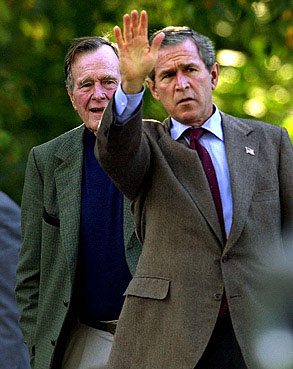

In his second presidential debate with Vice President Al Gore, on Oct. 11, 2000, Gov. George W. Bush faulted the Clinton-Gore team for not working hard enough multilaterally to keep the heat on Saddam Hussein.
“The coalition that was in place isn’t as strong as it used to be,” Bush said, calling the previous eight years a foreign policy failure. “It’s going to be important to rebuild that coalition to keep the pressure on him.” The fact that he was the son of the man who had built that coalition, the 41st president, George H.W. Bush, gave the Texas governor’s argument added political credibility.
His statement was representative of Bush’s approach to Iraq. Asked about his policy toward the rogue nation in a Dec. 2, 1999, Republican presidential debate in Manchester, N.H., Bush said simply: “I’d make darn sure that [Saddam Hussein] lived up to the agreements that he signed back in the early ’90s,” Bush said. “And if I found — in any way, shape or form — that he was developing weapons of mass destruction, I’d take ’em out.”
Moderator Brit Hume of Fox News sought a clarification of the Texan’s twangy pronunciation. “Take him out?” Hume asked.
No, Bush explained; “take them out,” as in, take out the “weapons of mass destruction,” he said.
But that was three-plus years ago, and now President Bush has a completely different take on things. His father’s views on Iraq, which once seemed to guide his own approach, have been drowned out by a chorus from a rival school of foreign policy. No longer does Bush say that the U.S. can’t be “arrogant,” that we “will not be able unilaterally to keep the peace,” that the country needs to “be humble partners in coalitions,” as he did to the Washington Post in December 1999. A month later, on ABC’s “This Week,” he talked about the need “to get the inspectors back into Iraq” and pushed the need for the U.S. to lead internationally, multilaterally. “One of the tests of a leader is to convince your allies what’s right and what’s wrong,” Bush said. “And that’s what a leader does. A leader builds up alliances.”
That was then. Now the test of a leader seems to be his courage to go it alone. And no longer is mere disarmament — “take them out” — his demand. He now insists upon regime change: to “take him out.”
What a difference one pronoun can make. The debate over whether we need to get “them” or “him” separates warring factions of Republican foreign policy makers, and it represents George W. Bush’s break from the faction of his father. The elder Bush believed in multilateralism and international cooperation and containment. He spent generations fending off the more unilateral, preemptive beliefs of those who now run his son’s foreign policy. An ambassador to the United Nations, he believed strongly in that body’s importance.
The son, on the other hand, has sent mixed signals, and the result has been disastrous. Monday brought some of the worst news on the U.S. diplomatic front in years. The U.S. and United Kingdom postponed their plan to call for a vote on a second Iraq resolution at the United Nations Security Council because France and Russia threatened vetoes, and six Security Council members remained against the measure. Needing nine votes, the U.S. and U.K. have only two others: Spain and, ahem, Bulgaria. While the Bush administration is still pursuing votes, it is doing so poorly and has been for quite some time — at least since last September, when Bush, largely because of his father’s lobbying, agreed to go to the U.N. while making it clear that he didn’t think he needed to.
Even as Bush did his father’s bidding at the U.N., he did it with his own signature style. It is difficult to picture the former president Bush asking, as his son did in New York on Sept. 12, 2002, “Will the United Nations serve the purpose of its founding, or will it be irrelevant?” It is nearly impossible to imagine the elder Bush saying aloud, as his son did last Thursday, that “when it comes to our security, if we need to act, we will act, and we really don’t need United Nations approval to do so.”
But if Bush today sounds very little like his father, the ghost of his father’s presidency lingers — and his father remains very much alive. On Feb. 26, the elder Bush was the speaker at Tufts University’s esteemed Issam M. Fares Lecture, where he discussed the Iraq situation during his presidency. In doing so, he illustrated that the priorities that mattered to him are, shall we say, a tad less important to his son, including maintaining an international coalition behind a move against a sovereign country.
The speech, combined with the thoughts of conservative foreign policy experts — as well as interviews with the elder Bush’s biographer and historian — underline stark differences in the two men’s worldviews, which can’t be accounted for by the simple explanation that shifting events, most notably Sept. 11, have led to a change in policy. Neither the elder Bush nor the White House will comment on conversations between father and son, nor will the Bush administration acknowledge reversals in policy or discuss the influence of individual advisors.
Whether they’re over the importance of international coalition building, the wisdom of sending American soldiers to control the inevitable postwar chaos, relations with Israel, or even the peace efforts of the Democrat whose presidency interrupted the Bush family reign, the disagreements between father and son are stark and paint a clear picture of two competing schools of conservative thought, ones that have been scrambling for the upper hand for generations. In any other family, the differences might result in Thanksgiving table arguments. In la famille Bush, however, they’re a matter of life and death.
Critics of the pending war slam the president as on a personal crusade — a “fixation,” as Sen. Ted Kennedy, D-Mass., said last week, stopping short of comparing the president to the avenging Spanish fencer Inigo Montoya from the film “The Princess Bride.” (President Bush didn’t help matters by once describing Saddam as “the guy who tried to kill my dad.”) And of course the loyal son has defended his father’s decision to allow Saddam to remain in power, arguing on Feb. 27 that “the mission in early 1990s was to liberate Kuwait, and the United States achieved that mission.” But this isn’t about avenging a father. What’s increasingly clear is that for the current president, a loving though unruly scion whose high-profile acts of disobedience have been well documented — from the fraternity pranks and youthful scuffles with the law to a successful battle with the bottle at age 40 — an Iraq invasion represents the ultimate act of rebellion. It is an intellectual, philosophical and political rejection of his father’s way of looking at the world. And it’s of more than psychological interest to the rest of us.
The differences between father and son were on rare display at Tufts two weeks ago. The speech offered a unique window into the former president’s own Iraq policy, as well as the ways it diverged — and still diverges — from the current president’s. Bush the elder was asked to address “the difference between your policy of coalition building and respect for the United Nations, and that of the current administration,” which some found “striking.” Significantly, the former president essentially refused to answer whether or not he was “troubled by the willingness of the U.S. to act unilaterally without broad-based international support.” No one expected Bush to denounce his son, but his support sounded a little weaker than some Bush watchers expected.
George H.W. Bush insisted that he and his son agree that “it would be much better to act with as much international support as possible.” But remarkably, he seemed less than solidly supportive of the U.S.’s goals in attacking Iraq, as well as his son’s assertion that Saddam has weapons of mass destruction. He spoke far more forcefully when defending his own decisions 12 years ago than in explaining his son’s moves today.
“The difference between ’91 and today is that the objective was clearer, in a way, back when I was president,” the elder Bush said, because Iraqi soldiers had invaded Kuwait, committed atrocities against the Kuwaiti people, and seemed poised to attack Saudi Arabia. “Today it’s less clear.” While it’s indisputable that Saddam Hussein has violated myriad U.N. resolutions, Bush said, “the question is, how much does he have in a way of weapons of mass destruction? That could be debated.”
The former president acknowledged the peril of living in a post-9/11 world. “Now, I’m not saying that this is a big conspiracy between Osama bin Laden and Saddam Hussein, but the United States must do what it can to protect itself and its friends against the use of weapons of mass destruction.”
It’s worth looking at the way even those restrained comments stand in marked contrast to his son’s view of Iraq. The current president has affirmed repeatedly that Hussein has myriad weapons of mass destruction, and insists it’s not even an item for debate. During an Oct. 7, 2002, speech at the Cincinnati Museum Center, George W. Bush said unequivocally that Iraq “possesses and produces chemical and biological weapons. It is seeking nuclear weapons.” During his Thursday night press conference, President Bush said that Hussein continues to manufacture missiles, “hide biological and chemical agents,” and otherwise “harbor weapons of mass murder and terror.”
Moreover, though the elder Bush somewhat flippantly said he wasn’t “saying that this is a big conspiracy between Osama bin Laden and Saddam Hussein,” a big conspiracy is pretty much what his son has been charging. Last Thursday, he charged Saddam with having “trained and financed al-Qaida and other terrorist organizations.” In October he said that “Iraq and al-Qaida have had high-level contacts that go back a decade” and that “Iraq has trained al-Qaida members in bomb making and poisons and deadly gases.” At the U.N. he mentioned Abu Musab “Al Zarqawi, who was in charge of the poison network who was wounded in Afghanistan, received aid in Baghdad, ordered the killing of a U.S. citizen, USAID employee.”
At Tufts, the elder Bush also passed up the opportunity to take the politically easy way out and say that with hindsight, he wishes he’d taken Saddam out when he had the chance. Even his former Secretary of State Lawrence Eagleburger has said, post-9/11, that “while I thoroughly understand and totally supported President Bush’s decision not to pursue Saddam personally, I am now prepared to admit that it was probably a mistake.” But the former president is not prepared to make any such admission. “The mission was not to invade Iraq,” he said at Tufts. “It wasn’t to kill Saddam Hussein. It wasn’t to free the Kurds in the north, or the Shiites in the south. The mission was to end the aggression.” Once it was over, the U.S. withdrew from Kuwait, and thus “we kept our word to the United Nations, and to our coalition partners.”
And finally, the elder Bush continued to emphasize the way he valued the coalition he had assembled to confront Iraq. If he’d told Norman Schwarzkopf to bring him Saddam’s head, “the coalition would have instantly shattered,” the former president recalled. “And the political capital that we had gained as a result of our principled restraint to jumpstart the peace process would have been lost.” Coalition support for further international maneuvers would have been lost, he said, and “we would have lost all support from our coalition, with the possible exception of England.” No one in the audience was rude enough to mention that his son has appeared to choose exactly that path, essentially standing alone with the U.K.
To gung-ho anti-Saddam neo-cons, of course, the elder Bush’s Tufts speech was a reminder of everything that was wrong with his presidency. For those delighted with this President Bush’s “moral clarity” and his post-9/11 preemptive doctrine, the spirit of the previous Bush lingers like the cheap perfume of a disappointing date. It’s the stench of failure.
By not going into Baghdad to depose Saddam Hussein after the quick rout of the Iraqi army in February 1991, they think, the former president essentially left the world just as dangerous. Thus, his son is doing what needs to be done because his father was a fey anachronism with skewed priorities, a president who put too much stock in discredited ideals. The current deputy secretary of defense, Paul Wolfowitz, served under the elder Bush as undersecretary of defense for policy and is known for disapproving of the decision to allow Saddam to remain in power, what fellow neo-con Frank Gaffney Jr. — President Reagan’s assistant secretary of defense for international security policy –has called “a terrible mistake.”
“It was a mistake of historic proportions,” seconds Dr. Richard Pipes, a former national security advisor to Reagan. “The older Bush was always very hesitant about doing anything; he was indecisive and constantly vacillating. This one seems much more decisive,” Pipes says, adding that he is glad it’s the junior Bush in charge in this post-Sept. 11 world.
Danielle Pletka, a scholar at the conservative American Enterprise Institute and a GOP staffer on the Senate Foreign Relations Committee during the 1990s, wants to avoid bashing the elder Bush, arguing that some of the difference between the two presidents is directly attributable to Sept. 11. “Bush’s father lived in a different world than this president. The kinds of solutions that may have seemed attractive in 1990 or 1991 are no longer feasible, and Bush 43 understands that.”
Such as what? “Worshipping at the foot of the god multilateralism,” Pletka says, with a sneer in her voice. Like Pipes, she has clear disdain for what she says she saw during the Clinton administration, which placed “multilateralism as the goal above achievement of some foreign policy goal important to the United States.” She sums up what could become Bush 43’s foreign policy motto: “If it’s important enough to do with others, it’s important enough to do alone.”
By contrast, admirers of Bush 41 think his son’s approach endangers America. “The current administration has so much that it could learn from the administration of the first President Bush,” says Cazenovia College history professor John Robert Greene, who has written “The Presidency of George Bush,” the first scholarly text about the previous Bush administration. “It has mishandled the coalition building. It has mishandled it just as the first Bush administration was masterful at it.”
“George Herbert Walker Bush would have finessed the diplomacy with the United Nations much better,” agrees Herbert S. Parmet, a former professor at the City University of New York and the author of “George Bush: The Life of a Lone Star Yankee,” the first complete biography of the 41st president. “There is no question how much more sophisticated he was in his approach to foreign policy than is his son.”
The elder Bush came by his convictions through his diverse experiences as a congressman, a liaison to China, a United Nations ambassador and director of the Central Intelligence Agency. At the CIA he first became fully and formally acquainted with those who prefer the stark, go-it-alone-if-necessary view of things his son has adopted — and he rejected it. In early 1976, acting on a recommendation by President Ford’s Foreign Intelligence Advisory Board — which was worried that U.S. intelligence was too soft on the Soviet threat — Bush set up a group of 10 experts, called “Team B,” to be granted access to classified documents in order to offer a fresh view.
Headed by Pipes, Team B’s advisory panel included Wolfowitz, then a wunderkind with the Arms Control and Disarmament Agency, now one of the architects of the Iraq campaign. Team B’s conclusion was a bombshell: U.S. intelligence estimates, they wrote, “substantially misperceived the motivations behind Soviet strategic programs, and thereby tended consistently to underestimate their intensity, scope and implicit threat.” This more suspicious view of the USSR came to be a hallmark of what was soon called neo-conservatism, as did a strong tilt toward Israel. And with the rise of Wolfowitz and others who share his worldview — such as White House advisor Richard Perle, the assistant secretary of defense for international security policy in the Reagan administration — Team B members soon began growing in influence.
Back then, critics of Team B blasted the approach as exaggerating the Russian menace, “to prove that the Russians are 20 feet tall and their interest is all wrong,” as Herbert “Pete” Scoville, the former CIA deputy director for science and technology, told the Washington Post in 1977 — much the way President Bush’s critics today say he exaggerates the threat that Saddam and Iraq pose to the United States. But Pipes praises Team B’s approach to the Cold War. “It takes a more realistic view of what the intentions of the other side are,” he says. The elder Bush, as CIA director and afterwards, “was not happy with Team B, of course,” Pipes adds.
The Team B doctrine was crafted in more careful detail in 1992 in a controversial draft of the Defense Department’s “Defense Planning Guidance,” by Wolfowitz and his deputy, Lewis “Scooter” Libby, currently the chief of staff to Vice President Dick Cheney, who was then Wolfowitz and Libby’s boss as defense secretary. The draft, leaked to the media, noted “the sense that the world order is ultimately backed by the U.S.” and stated, “The United States should be postured to act independently when collective action cannot be orchestrated.” Rejecting the old theory of containment, the draft said that “we should expect future coalitions to be ad hoc assemblies, often not lasting beyond the crisis being confronted.” If other nations didn’t step up, “the United States should be postured to act independently.”
The report was to be officially issued by Cheney in early March 1992. But Team A prevented that; a couple days after this report was leaked the White House of Bush 41 began a campaign to disavow it. The then-president’s national security advisor, Brent Scowcroft, Secretary of State James A. Baker III, and Deputy Secretary of State Lawrence Eagleburger all let it be known that they disagreed with it. The New York Times quoted an administration official “familiar with the reaction of senior officials at the White House and State Department,” who called it a “dumb report” that “in no way or shape represents U.S. policy.” It was substantially rewritten before it was issued in May 1992. Almost 11 years later, it can be fairly argued that Team B is now running the show.
The younger Bush sent some signals during his campaign that he would be more like Reagan than his father. His first foreign policy address, after all, was delivered at the Reagan Library in Simi Valley, Calif., in November 1999.
Clearly the candidate’s initial influences were largely his father and Condoleezza Rice, a former deputy to Scowcroft, the elder Bush’s national security advisor; Rice assumed that very role for George W. Bush. But during the campaign, Bush’s foreign policy advisory team began expanding. Soon to join the circle were Cheney, Wolfowitz, Perle; Reagan administration Secretary of State George Shultz; Reagan administration assistant secretary of defense for international security affairs Richard Armitage, currently the deputy secretary of state; Bush 41’s National Security Council advisor, Robert Blackwill, the current ambassador to India; Bush 41’s assistant secretary of defense Steven Hadley, currently Rice’s deputy; Bush 41’s undersecretary of state for economic and agricultural affairs, Robert Zoellick, the current U.S. trade representative; and Dov Zakheim, who served as an undersecretary of defense for both Bushes.
One of the few Team A members to be given a position of prominence in the new administration, Gen. Colin Powell, chairman of the Joint Chiefs of Staff for the elder Bush, became the son’s secretary of state. Powell, who was heralded by the current President Bush at his swearing-in ceremony on Jan. 26, 2001, for being “a leader who understands that America must work closely with our friends in times of calm, if we want to be able to call upon them in times of crisis,” had butted heads with Team B throughout his career. Powell noted in his 1995 autobiography, “My American Journey,” that during the Gulf War Cheney once ordered him to explore the possibility of using nuclear weapons against Iraq.
“We’re not going to let that genie loose,” Powell told Cheney, who nonetheless pressed him to study the issue.
In George W. Bush’s first year in office, there was an occasional tug-of-war between the Team A and Team B factions in the administration. And on occasion, when Bush was tilting too strongly toward the tough Team B approach, his father would occasionally pop his head in to give him a tug toward the Team A view.
This moderating influence was evident in March 2001. President Bush voiced an initial Team B aggressiveness toward North Korea, saying (correctly, as it turned out) that the administration was “not certain as to whether or not they’re keeping all terms of all agreements.” The comment, however, contradicted Team A-ish comments made by Secretary Powell, who had said the administration would continue talks with North Korea’s Communist dictator Kim Jong Il, pledging to “pick up where President Clinton and his administration left off.”
That June, the elder Bush sent his son a memo by Donald Gregg, former ambassador to South Korea, which argued for reengagement. The president forwarded the memo to Rice, who briefed her boss on its contents. Having argued against meetings with North Korea, Rice subsequently changed her mind. In June 2001, President Bush announced that he would resume talks with North Korea.
Teams A and B clashed once again in the immediate wake of the Sept. 11, 2001, terrorist attacks. On Sept. 13, Wolfowitz gave a press conference in which he said that “it’s not just simply a matter of capturing people and holding them accountable, but removing the sanctuaries, removing the support systems, ending states who sponsor terrorism.” The idea of “ending states” did not sit well with Team A types. Powell soon said that the administration would be “ending terrorism. And if there are states and regimes, nations that support terrorism, we hope to persuade them that it is in their interest to stop doing that. But I think ending terrorism is where I would like to leave it, and let Mr. Wolfowitz speak for himself.” For the first few months of the new post-9/11 world, the Bush administration worked closely with several other nations in the war on terrorism and in Operation Enduring Freedom in Afghanistan. But however much the administration was working in concert with other governments, Team B was in charge.
As Afghanistan was liberated from the Taliban, the administration set its sights on Iraq. Many wondered where the issue Iraq had come from — why now, why Iraq? The answer was simple: Iraq had long been a foreign policy priority for Team B. In 1998, Wolfowitz, Perle and several others wrote to President Clinton urging him to take Saddam out, urging him “to turn your Administration’s attention to implementing a strategy for removing Saddam’s regime from power.” This, too, had been a tug-of-war between Teams A and B. In a March 2001 press briefing with French Foreign Minister Hubert Vedrine, Powell had actually spoken in favor of easing some of the sanctions against Iraq, making sure “that the U.N. sanctions are targeted at the Iraqi regime’s attempts to develop weapons of mass destruction, while sparing the people of Iraq from any suffering.”
Sept. 11, of course, had pushed President Bush more and more into the Team B camp. But former President Bush tugged his son back toward the Team A side again in August 2002. After all, once he learned that Iraq had invaded Kuwait on Aug. 1, 1990, the elder Bush decided immediately to work through the U.N. on a response; Scowcroft and U.N. Ambassador Thomas Pickering worked through night with the U.N. Security Council on a resolution. “Decisive U.N. action would be important in rallying international opposition to the invasion and reversing it,” George H.W. Bush writes in “A World Transformed,” the book he coauthored with Scowcroft. Conversely, the current administration seemed dead-set on attacking Iraq without first going to the United Nations, with Cheney, Wolfowitz, and Defense Secretary Rumsfeld being the most vocal proponents of that path. Yet leaders from around the globe began issuing warnings that the Bush administration must first seek U.N. approval. German Chancellor Gerard Schroeder and French President Jacques Chirac made a joint statement asserting that Bush needed to seek the approval of the U.N. Security Council first. “Kuwait does not support threats to hit Iraq or to launch an attack against it,” Sheikh Jaber al-Hamad al-Sabah, Kuwait’s defense minister, told Kuwait’s al-Rai al-Aam daily. “Our acceptance for this matter is conditional on an international blanket decision within the global organization.”
The former president Bush kept his counsel. But in early August, father and son spent four days together in Kennebunkport, Maine, where they had intense discussions about what to do next.
That month, three former aides to the elder Bush unleashed a public relations barrage in favor of seeking U.N. approval. On Aug. 15, Eagleburger told ABC News that unless Saddam “has his hand on a trigger that is for a weapon of mass destruction, and our intelligence is clear, I don’t know why we have to do it now, when all our allies are opposed to it.” In an Aug. 25 Op-Ed in the New York Times, former Secretary of State James Baker III wrote that the U.S. needed to seek U.N. approval before any military action. “Seeking new [U.N.] authorization now is necessary, politically and practically, and will help build international support.”
The biggest splash came on Aug. 16, when Scowcroft penned an Wall Street Journal Op-Ed. He didn’t just argue that the U.S. should be “pressing the United Nations Security Council to insist on an effective no-notice inspection regime for Iraq” — Scowcroft slammed the whole idea.
“There is little evidence to indicate that the United States itself is an object of [Saddam’s] aggression,” he wrote. “An attack on Iraq at this time would seriously jeopardize, if not destroy, the global counterterrorist campaign we have undertaken.” Moreover, he wrote, “it undoubtedly would be very expensive — with serious consequences for the U.S. and global economy — and could as well be bloody Finally, if we are to achieve our strategic objectives in Iraq, a military campaign very likely would have to be followed by a large-scale, long-term military occupation.”
While the elder Bush insisted that his advisors were acting on their own, biographer Parmet has his doubts. “Having met Gen. Scowcroft, I understood the closeness and loyalty he has to the father,” Parmet told Salon. “And as more time has gone by I’m convinced that Scowcroft was not consciously contradicting or being disloyal to former President Bush. I believe it was a reflection of the first president Bush’s thinking; whether he got a sign-off or not, we may never know.”
Meanwhile, within the current Bush administration, Team B made its voice heard. On Aug. 26, speaking to the Veterans of Foreign Wars in Nashville, Tenn., Cheney slammed the logic of the former presidential aides. “What we must not do in the face of a mortal threat is to give in to wishful thinking or willful blindness,” Cheney said. “We will not simply look away, hope for the best, and leave the matter for some future administration to resolve.”
But in September, President Bush decided to go to the U.N. after all. “It was interaction between the president and his father” that changed the policy, a family associate told the Los Angeles Times. By Sept. 5, Bush was announcing that he was going to telephone Presidents Vladimir V. Putin of Russia, Jiang Zemin of China, and Jacques Chirac of France to lobby them to support a U.N. resolution against Iraq.
Team B-ers were dismayed, seeing this path as an exercise in futility that would only buy Saddam more time. But in fact it may well have been Team A’s last hurrah. Bush went to the U.N. on Sept. 12 and seemed to nod toward multilateralism. But on Sept. 17, 2002, the administration issued a 33-page National Security Strategy, which bore more than a slight resemblance to Wolfowitz’s original draft of the Defense Planning Guidance document from 11 years before. Heralding “proactive counterproliferation efforts,” it seems to be in favor of the ad hoc crisis-by-crisis alliance system from the 1992 draft.
“It has taken almost a decade for us to comprehend the true nature of this new threat. Given the goals of rogue states and terrorists, the United States can no longer solely rely on a reactive posture as we have in the past,” the NSS tellingly states. One can argue that on the day it was issued, President Bush officially cast off his father’s foreign policy views.
The debacle at the U.N. of recent weeks would seem to confirm Team B’s views about the need for the U.S. to stand alone. But admirers of George H.W. Bush don’t think failure at the United Nations was a foregone conclusion. The former president “finessed the diplomacy with the United Nations much better than his son,” Parmet says. “He put much greater stock in the importance of alliances” and thus was able to accomplish much more.
“This second Bush administration is less skilled at building coalitions and it’s going to haunt them,” Greene agrees. The father’s dealings with the “United Nations were handled skillfully, not abruptly.” But in the current crisis, “the U.N. was told by this president that it was a dead letter if it didn’t play ball. You don’t treat the U.N. like that if you expect to get something out of it.”
Even some Team B supporters agree Bush could have handled the U.N. more skillfully. Pipes, the Reagan national security advisor who favors the son over the father, says that the current President Bush is “a clumsy diplomat. I agree with the need to remove Saddam Hussein, but I don’t think he’s laid the groundwork.”
At the very least, Pipes says, last fall Bush and his team “should have explored the attitudes of various members of the Security Council about what they intended to do, and if they found that there was such tremendous opposition, they should not have gone before the Security Council.” Now the administration will be launching a military action against the wishes of the Security Council, which is far worse than having simply refrained from asking for approval at all — as President Clinton did before launching NATO air strikes in the Balkans.
Still, Pipes says the fault lies with the elder Bush for not having taken Saddam out 12 years ago. “Now his son is stuck with the job of finishing it,” he says.
But the previous president’s reluctance is worth exploring, too. “The last thing [the elder Bush] wanted was to see the United States get into Iraq or that part of the world, and then stay there in force,” says Eagleburger. The U.S. would have had to commit to staying in the region for some time, to “find a replacement for Saddam Hussein, help them set up a new government, and that could have kept us there for some period of time.”
His son, however, is committing to precisely that sort of long-term presence. On Feb. 11, Douglas J. Feith, undersecretary of defense for policy, told the Senate Foreign Relations Committee that the U.S. was “going to eliminate Iraq’s weapons of mass destruction and likewise the terrorist infrastructure, safeguard Iraq’s territorial integrity, and begin the process of economic and political reconstruction.” U.S. Army Gen. Tommy Franks, commander of U.S. Central Command, would be the first administrator of postwar Iraq, Feith said. Asked how long the U.S. would be there, Feith said, “We can’t now even venture a sensible guess.” At the end of February, Army chief of staff Gen. Eric Shinseki told the Senate that the occupying U.S. force would total “several hundred thousand soldiers,” which Wolfowitz called “wildly off the mark.”
Why the difference between father and son? One reason might be that the elder Bush comes from the “greatest generation,” one familiar with fighting in the streets of Berlin during World War II. “They were terrified that they were going to get bogged down,” Greene says. “And the people around him had Vietnam syndrome, and they didn’t want to get into a quagmire.”
Other issues relevant to the Team A/Team B divide came up in the elder Bush’s Tufts speech. The former president is seen as the U.S. president most critical of Israel in modern history, while his son has perhaps been more supportive than any other president — particularly since Sept. 11. “I remember refusing to give Israel loan guarantees for settlements if they continued to build settlements in the occupied territories,” the elder Bush recalled at Tufts. “I said, ‘We’re not going to do it.’ And I paid a hell of a price for it.” He also spoke graciously about Clinton’s efforts to negotiate peace between the Israelis and Palestinians, while his son has faulted those efforts for being the cause of “a significant intifada.”
The elder Bush alluded in the Tufts speech to one other crucial difference between his approach to diplomacy and his son’s. It was indirect, and not meant to slap Bush 43, but the contrast between their approaches to diplomacy couldn’t be missed. The former president talked about the way he worked to heal relations with King Hussein I of Jordan who, along with the Yemenis and Palestinians, supported Saddam Hussein during his last face-off with the U.S. After the war, however, both the president and King Hussein were determined to “get the relationship between Jordan and the United States back on track.” Which they did, and the elder Bush cited it as an example of how the U.S. can move on from its current strains with so many other nations throughout the globe. “You’ve got to reach out to the other person,” he said. “You’ve got to convince them that long-term friendship should trump short-term adversity.”
The son’s administration hasn’t demonstrated evidence of its forgiveness skills yet. After German Chancellor Schroeder was reelected last September 2002 on a platform of opposing the U.S. war against Iraq, Bush refused to call and congratulate him. At a meeting of NATO defense ministers soon afterward, Rumsfeld — who said Schroeder’s campaign “had the effect of poisoning a relationship” — refused to meet with Germany’s Peter Struck. “I made it clear to the world, that either you’re with us or you’re with the enemy, and that doctrine still stands,” Bush said then. But his father restored relations with Hussein, who was literally with the enemy. Whether his son is capable of such a step in the name of the greater good remains to be seen.
As President Bush continues charting his Team B path, bringing the Cheney/Wolfowitz/Libby 1992 draft plan to fruition, there will likely be many more times where the son diverges far from where his dad would take the nation. In the March 10 issue of Time, the former president Bush recalls that “the night before [the Gulf War] I could not move my neck or arms. The tension had taken hold, the responsibility for those lives, even though I had been in combat myself.” His son, who has never been in combat and even has a somewhat disconcerting (if seldom discussed) missing year in his service with the Air National Guard, recently told reporters that he’s been sleeping well at night, sustained by people’s prayers, which he called “the kindest act a fellow citizen can do for anybody, much less the president.” The two have extremely different personalities and temperaments; and now they represent divergent schools of Republican foreign policy.
The president and Powell, his loyal Team A secretary of state, are still working with the U.N., of course, trying to get Security Council approval for action against Iraq. Bush spent Monday morning on the phone with President Jiang Zemin of China, Japanese Prime Minister Koizumi, and President Mbeki of South Africa. Powell phoned up three Security Council swing votes — Angolan President Jose Eduardo dos Santos, Pakistani President Gen. Pervez Musharraf and Mexican Foreign Minister Luis Ernesto Derbez — and lunched with a fourth, the foreign minister of Guinea, François Ousseynou Fall. But the international community is hardly Bush’s highest priority. Also on Monday White House spokesman Ari Fleischer seemed to be preparing the nation for the possibility that the U.S. will have to go it alone, arguing that “as the world witnessed in Rwanda, and as the world witnessed in Kosovo,” the United Nations Security Council “is, from a moral point of view, leaving the people of these regions on the sidelines. And from the president’s point of view, that’s a regrettable development if it happens.”
Yet moments like those cry out for international leadership, which the elder Bush was able to provide. On Iraq, his son, so far, has not.
But the former president insists he won’t meddle in his son’s job. “Now I stay out of the president’s way and try not to complicate his life,” he said at Tufts. “I have an appreciation for the big job he has to do. And so I don’t go around giving advice to the 43rd president of the United States.”
For better or for worse.
